Introduction
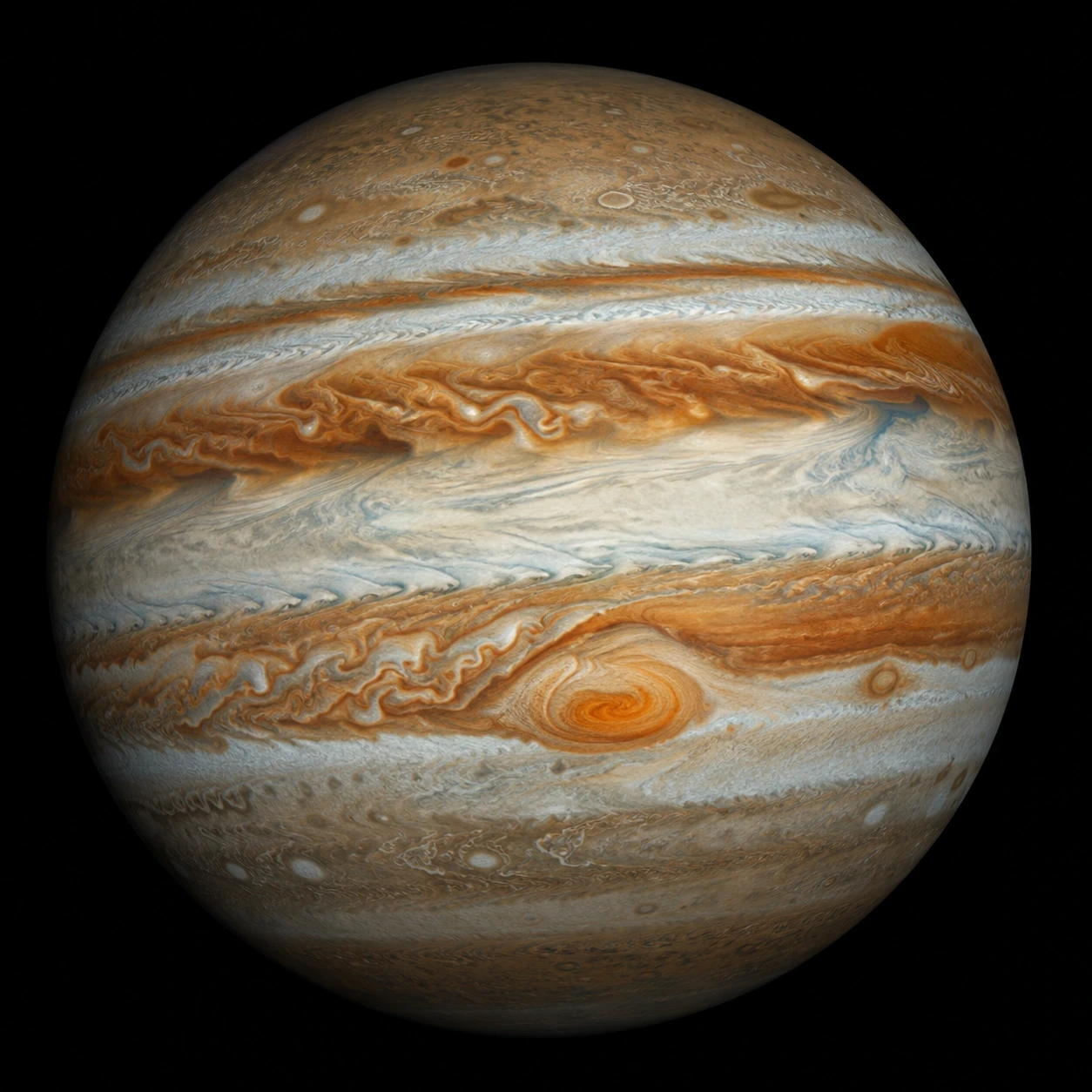
Far beyond the rocky worlds of the inner Solar System lies a planet so enormous that it defies imagination. Jupiter is not simply the largest planet orbiting the Sun—it is a world so massive that all the other planets in the Solar System could fit inside it many times over. Its immense gravity shapes the paths of asteroids, influences neighboring planets, and has played a crucial role in the Solar System's history for more than 4.5 billion years.
Unlike Earth, Jupiter has no solid surface to stand on. There are no mountains, oceans, or continents hidden beneath its swirling clouds. Instead, the planet is an immense sphere of hydrogen and helium wrapped in colorful cloud bands that race around the globe at incredible speeds. Towering storms larger than Earth have raged across its atmosphere for centuries, while lightning flashes illuminate clouds that plunge hundreds of kilometers into its depths.
To ancient civilizations, Jupiter appeared as one of the brightest wandering stars in the night sky. Today, powerful telescopes and robotic spacecraft have revealed a world far more extraordinary than anyone once imagined—a giant whose influence extends far beyond its own orbit.
Studying Jupiter is not just about understanding one planet. It is about uncovering the story of how giant planets form, how planetary systems evolve, and how one colossal world helped shape the neighborhood that Earth calls home.
Chapter 1:
How Jupiter Became the Largest Planet in the Solar System
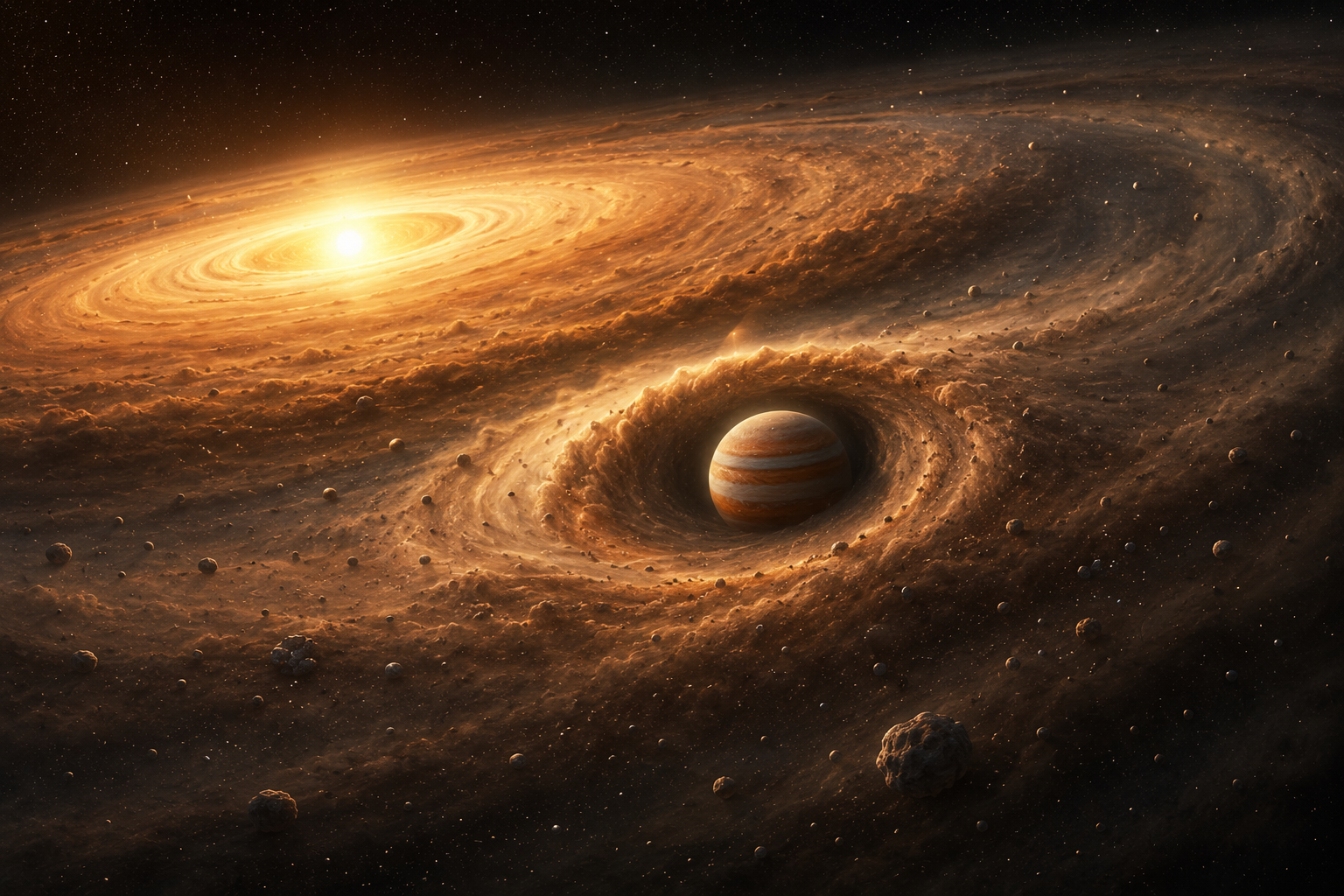
Around 4.6 billion years ago, the Solar System was a vast rotating cloud of gas and dust surrounding the newly formed Sun. Within this enormous disk, countless particles collided and merged, gradually building the planets we know today.
While Mercury, Venus, Earth, and Mars formed primarily from rock and metal, the outer regions of the Solar System offered something very different. Temperatures were much lower, allowing water, methane, and ammonia to freeze into solid ice. These icy materials gave growing planets access to far more building blocks than were available closer to the Sun.
One of these young worlds grew faster than all the others.
As Jupiter's core became larger, its gravity strengthened dramatically. It began pulling in staggering amounts of hydrogen and helium—the two lightest and most abundant elements in the Solar System. Within a relatively short period of astronomical time, Jupiter transformed from a growing planetary core into an enormous gas giant.
By the time the remaining gas surrounding the young Sun was blown away by solar winds, Jupiter had already captured enough material to become the dominant planet of the Solar System.
A Planet Built on an Unimaginable Scale
Trying to understand Jupiter's size using numbers alone is difficult.
Its diameter measures approximately 143,000 kilometers (88,850 miles)—more than 11 times wider than Earth. If Jupiter were hollow, over 1,300 Earths could fit inside it by volume.
Even more astonishing is its mass. Jupiter contains more than twice the mass of every other planet in the Solar System combined. No other planet comes close to matching its gravitational influence.
Despite this immense size, Jupiter rotates extraordinarily quickly. A complete day lasts just under 10 hours, making it the fastest-spinning planet in the Solar System. This rapid rotation stretches the planet outward at its equator, giving Jupiter a noticeably flattened appearance instead of a perfect sphere.
Its enormous gravity, rapid spin, and deep atmosphere combine to create one of the most dynamic environments ever observed.
A World Made Mostly of Hydrogen
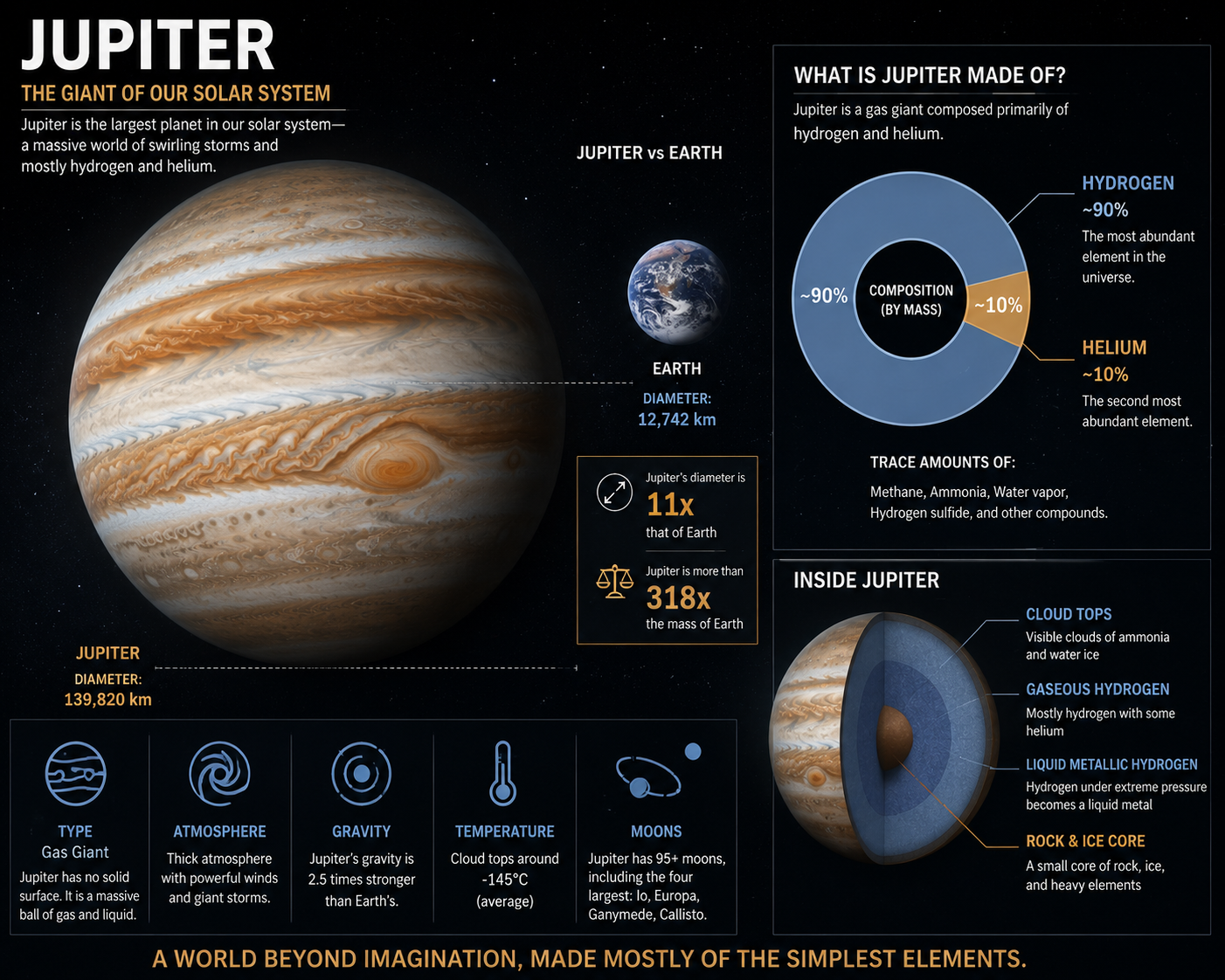
The Birth of Jupiter
Transition to Chapter 2
From a distance, Jupiter appears calm, its colorful cloud bands wrapping neatly around the planet.
But beneath those clouds lies an alien world unlike anything found on Earth—a place where pressure rises to unimaginable levels, temperatures soar, and matter itself behaves in ways impossible on our home planet.
In the next chapter, we will descend through Jupiter's atmosphere to explore what truly lies inside the king of the planets.
Chapter 2: Descending Into Jupiter's Endless Atmosphere
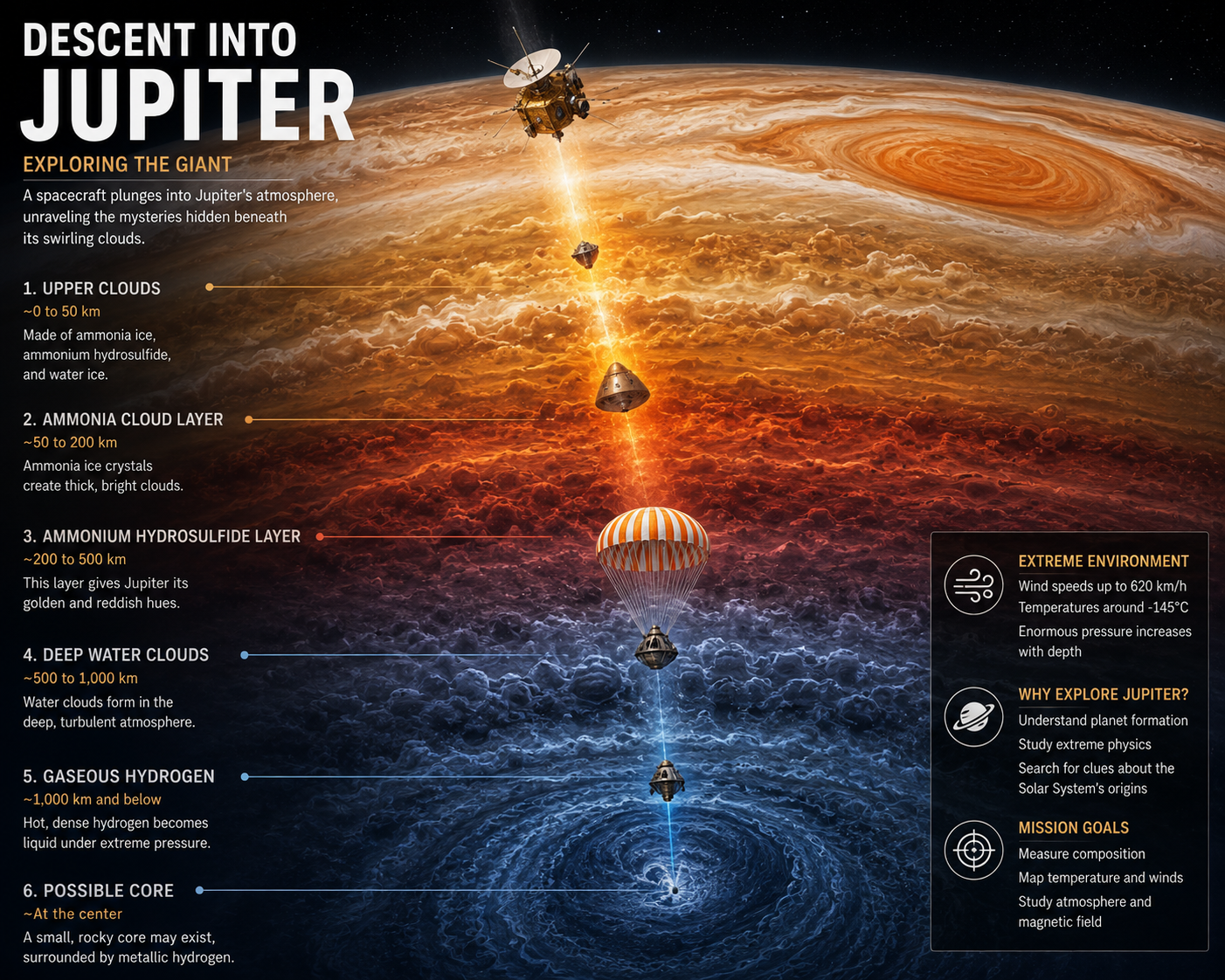
if a spacecraft could slowly descend toward Jupiter, the journey would be unlike landing on any other planet in the Solar System.
There would be no rocky ground waiting below. Instead, the spacecraft would enter an endless ocean of clouds stretching thousands of kilometers into the planet's interior. As it descended, the sky would darken, temperatures would rise, and atmospheric pressure would increase with astonishing speed.
Eventually, the conditions would become so extreme that no spacecraft built by humanity today could survive.
Jupiter is often described as a gas giant, but that description barely captures its complexity. Beneath its beautiful cloud tops lies an alien world where familiar gases transform into exotic forms of matter under crushing pressure.
A Sky Painted with Clouds
The stunning bands that wrap around Jupiter are among the most recognizable features in the Solar System.
These alternating light and dark stripes are created by powerful jet streams flowing in opposite directions. Some winds exceed 600 kilometers per hour (370 mph), carrying clouds around the planet in an endless race. Unlike Earth's atmosphere, which has relatively calm regions between weather systems, Jupiter's entire atmosphere is in constant motion.
The colorful appearance of the clouds comes from trace chemicals mixed with hydrogen and helium. Scientists believe compounds containing ammonia, sulfur, phosphorus, and water react with sunlight, producing shades of white, orange, brown, and reddish hues.
The highest visible clouds are composed mainly of frozen ammonia crystals. Beneath them lie layers of ammonium hydrosulfide and deeper water clouds, each existing under different temperatures and pressures. These stacked cloud decks create a complex atmosphere that extends far deeper than the eye can see.
From orbit, Jupiter appears calm and beautifully striped. Inside, however, its atmosphere is one of the most turbulent environments known.
The Hidden World Beneath the Clouds
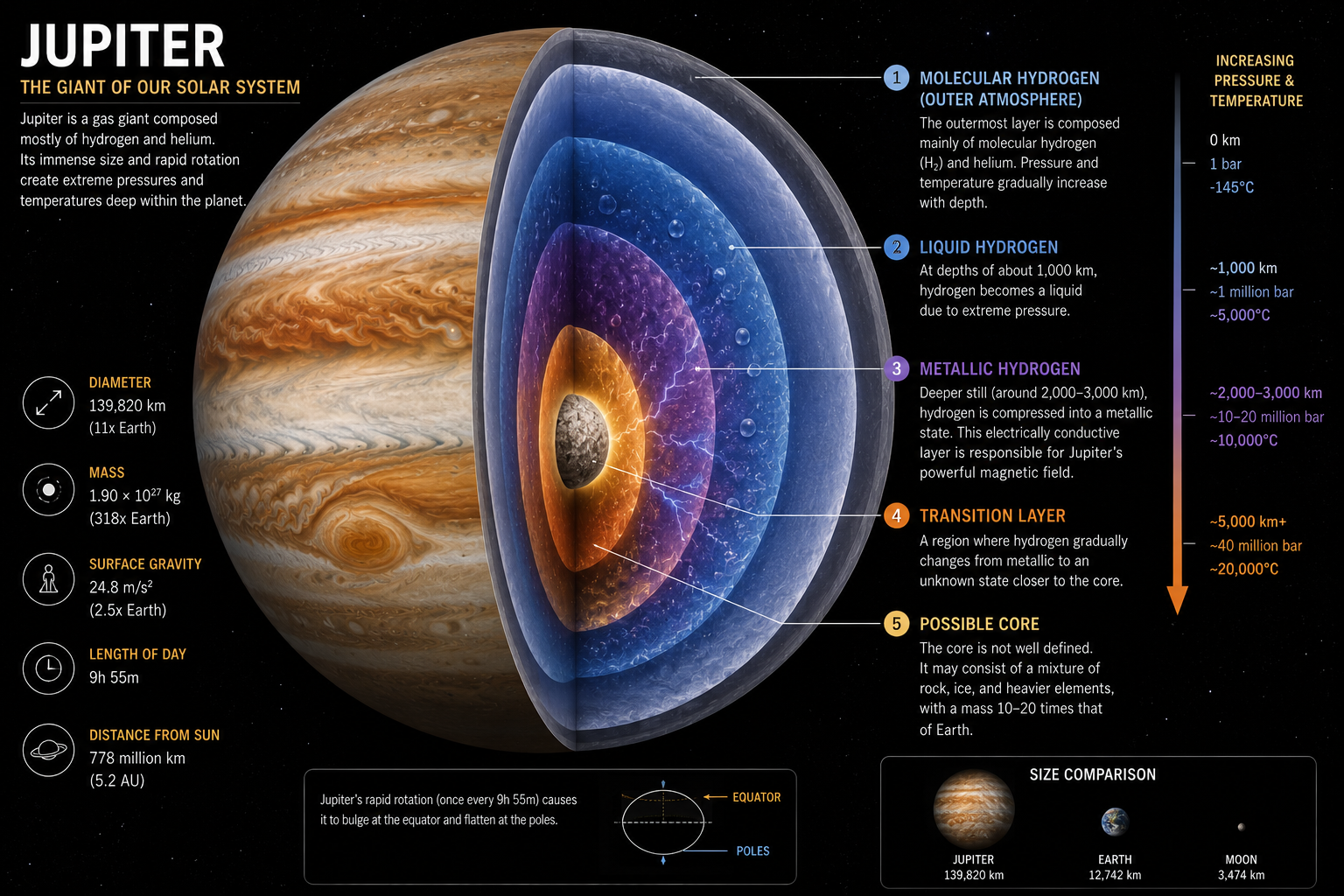
As a spacecraft continued descending, it would eventually pass below the visible clouds into regions no camera has ever directly observed.
Pressure would increase thousands, then millions, of times beyond what humans experience at sea level. Hydrogen gas would become compressed into a dense liquid, forming an enormous ocean unlike anything on Earth.
Deeper still, scientists believe the pressure becomes so immense that hydrogen changes into metallic hydrogen—a remarkable state in which the element behaves like an electrically conducting liquid metal rather than a gas.
This exotic layer is thought to occupy a significant portion of Jupiter's interior. The movement of metallic hydrogen generates electrical currents that produce Jupiter's immense magnetic field, a protective bubble so vast it extends millions of kilometers into space.
Although invisible from the outside, this hidden region is one of the defining features that makes Jupiter unique among the planets.
Inside Jupiter
Does Jupiter Have a Core?
For decades, scientists debated one of Jupiter's greatest mysteries: Does the giant planet have a solid center?
Early models suggested that Jupiter formed around a compact rocky and icy core that later attracted enormous quantities of hydrogen and helium. However, data collected by NASA's Juno mission has revealed a far more complicated picture.
Rather than containing a small, sharply defined core, Jupiter may possess a large, diluted central region where heavier elements are mixed with hydrogen under extreme pressure. Some researchers describe it as a "fuzzy core" rather than a solid one.
This discovery has changed how scientists think about the formation of giant planets—not only in our Solar System but throughout the galaxy.
Every new orbit of Juno continues to refine our understanding, reminding us that even the largest planet in the Solar System still holds many secrets.
A Magnetic Giant
Jupiter's immense interior does more than shape the planet itself—it creates one of the most powerful magnetic environments in the Solar System.
Its magnetic field is approximately 20,000 times stronger than Earth's and traps enormous numbers of charged particles arriving from the Sun. These particles form intense radiation belts capable of damaging spacecraft electronics within a short time.
Despite these hazardous conditions, the magnetic field also creates spectacular auroras around Jupiter's poles. Unlike Earth's auroras, which appear mainly during periods of increased solar activity, Jupiter's auroras shine almost continuously because of the planet's immense magnetic energy and the constant supply of charged particles from its volcanic moon, Io.
These glowing polar lights are among the brightest anywhere in the Solar System and reveal the incredible power hidden deep within Jupiter's interior.
Chapter 2 Summary
Jupiter is far more than a giant ball of gas. Beneath its colorful cloud tops lies an extraordinary world where hydrogen becomes liquid, then metallic, under pressures almost impossible to imagine. Its mysterious interior generates a magnetic field of immense strength, while its atmosphere hides layers that no spacecraft has yet fully explored.
Yet even these hidden depths are overshadowed by what happens above them.
In the next chapter, we will witness Jupiter's most dramatic feature—a world of colossal storms, planet-wide winds, lightning more powerful than anything on Earth, and the legendary Great Red Spot, a storm that has raged for centuries without stopping.
Chapter 3: The Planet of Endless Storms.
A World Where the Weather Never Sleeps
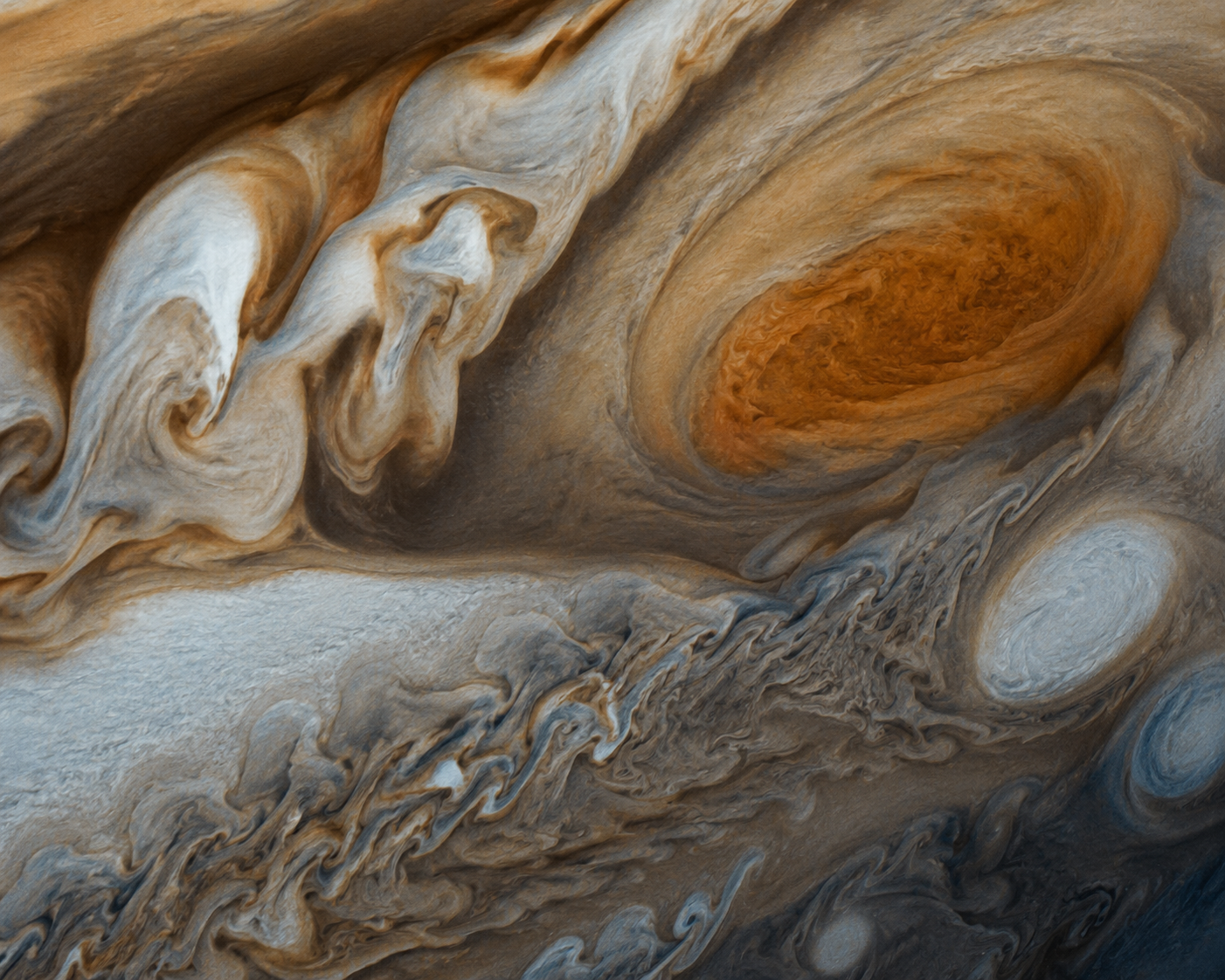
On Earth, storms eventually fade.
A hurricane may last for days or even weeks before weakening over land or cooler waters. Thunderstorms disappear within hours, and even the most powerful cyclones eventually come to an end.
Jupiter follows a completely different set of rules.
There are no continents to interrupt powerful winds, no mountain ranges to redirect weather systems, and no solid surface to drain a storm's energy. Instead, the planet's atmosphere is an endless ocean of gas where colossal storms can survive for years, decades, or even centuries.
Every hour, clouds race around the planet at incredible speeds, lightning flashes illuminate the darkness beneath the cloud tops, and gigantic cyclones collide in a never-ending display of atmospheric violence.
Jupiter is not simply a planet with weather—it is a planet made of weather.
The Great Red Spot: A Storm Bigger Than Earth
Among all the wonders of Jupiter, none is more famous than the Great Red Spot.
First observed by astronomers more than 350 years ago, this enormous storm has continued spinning ever since. Although it has gradually become smaller over time, it remains one of the largest storms ever discovered in the Solar System.
Today, the Great Red Spot measures roughly 16,000 kilometers (10,000 miles) across—still wide enough for Earth to fit comfortably inside it.
Unlike hurricanes on Earth, which draw energy from warm oceans, the Great Red Spot is powered by Jupiter's complex atmospheric circulation. Winds around the storm can exceed 430 kilometers per hour (270 miles per hour), creating a gigantic anticyclone that towers high above the surrounding clouds.
Scientists are still trying to understand why this storm has survived for so long. Some believe it continuously absorbs smaller storms, while others suggest Jupiter's unique atmospheric conditions allow it to persist for centuries.
Even after decades of spacecraft observations, the Great Red Spot remains one of the greatest mysteries in planetary science.
Lightning Beyond Imagination
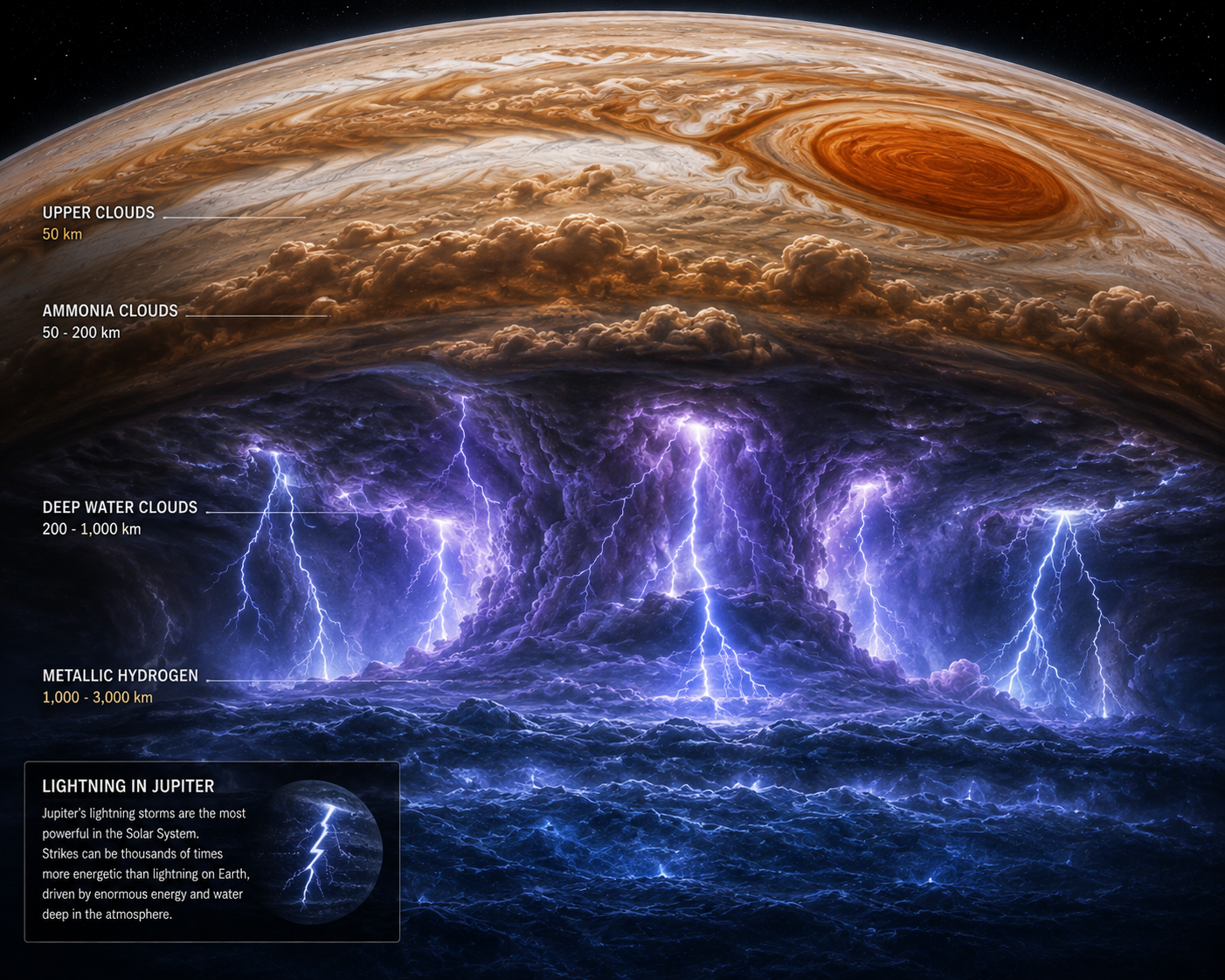
Beneath Jupiter's colorful clouds, another spectacular phenomenon unfolds.
Powerful thunderstorms produce lightning flashes far more energetic than those typically seen on Earth. These storms form deep within water-rich cloud layers where rising warm gases collide with colder material above, creating enormous electrical charges.
NASA's Juno spacecraft has recorded lightning across much of the planet, including near Jupiter's poles—a surprising discovery, since Earth's lightning is concentrated mainly in tropical regions.
Some lightning bolts on Jupiter release several times more energy than a typical terrestrial strike, briefly illuminating towering clouds hidden far below the visible atmosphere.
Combined with hurricane-sized cyclones and violent turbulence, these storms make Jupiter's atmosphere one of the most active weather systems ever observed.
Jupiter's Extreme Weather
Winds That Circle an Entire Planet
Jupiter's atmosphere is divided into dozens of powerful jet streams that race around the planet in alternating directions.
These winds can reach speeds of more than 600 kilometers per hour (370 miles per hour), creating the planet's distinctive light and dark cloud bands. Where opposing air currents meet, enormous storms form, merge, and sometimes disappear, only for new ones to emerge elsewhere.
Unlike Earth's atmosphere, where weather is influenced by continents and oceans, Jupiter's winds flow almost uninterrupted around the entire planet.
The result is a world in constant motion.
Even the smallest cloud formations observed by spacecraft can grow into swirling vortices larger than entire countries. Near the poles, scientists have discovered massive cyclones arranged in stable geometric patterns, with several giant storms circling a central cyclone like petals around a flower.
These extraordinary formations have remained remarkably stable for years, challenging scientists' understanding of how planetary atmospheres behave.
A Sky That Never Rests
If someone could somehow float safely above Jupiter's cloud tops, the view would be unlike anything imaginable on Earth.
Towering cloud towers would rise for dozens of kilometers into the atmosphere. Vast storms would stretch beyond the horizon, while powerful jet streams carved colorful bands around the planet. In the distance, lightning would flash inside clouds so deep that their full extent could never be seen.
There would be no calm mornings or clear blue skies.
Every moment would be dominated by movement.
The atmosphere would roar with winds hundreds of kilometers per hour, while pressure and temperature increased rapidly with every kilometer downward. Beneath those clouds, the storms would continue endlessly, powered by the immense energy stored inside the Solar System's largest planet.
Jupiter reminds us that weather is not merely a feature of some planets—it can become the planet itself
Chapter 3 Summary
Jupiter's atmosphere is the most powerful weather system in the Solar System. From the centuries-old Great Red Spot to lightning storms, supersonic winds, and enormous polar cyclones, every layer of the planet is alive with motion.
Yet Jupiter's story extends far beyond the giant planet itself.
Orbiting this colossal world is an extraordinary family of moons—some hiding global oceans beneath icy crusts, others covered in volcanoes more active than any on Earth. Together they form a miniature planetary system unlike any other.
In the next chapter, we will leave Jupiter's turbulent atmosphere behind and explore its remarkable moons, faint rings, and the spacecraft that continue to reveal the secrets of the Solar System's giant.
Chapter 4: A Mini Solar System
The Planet That Has a World of Its Own
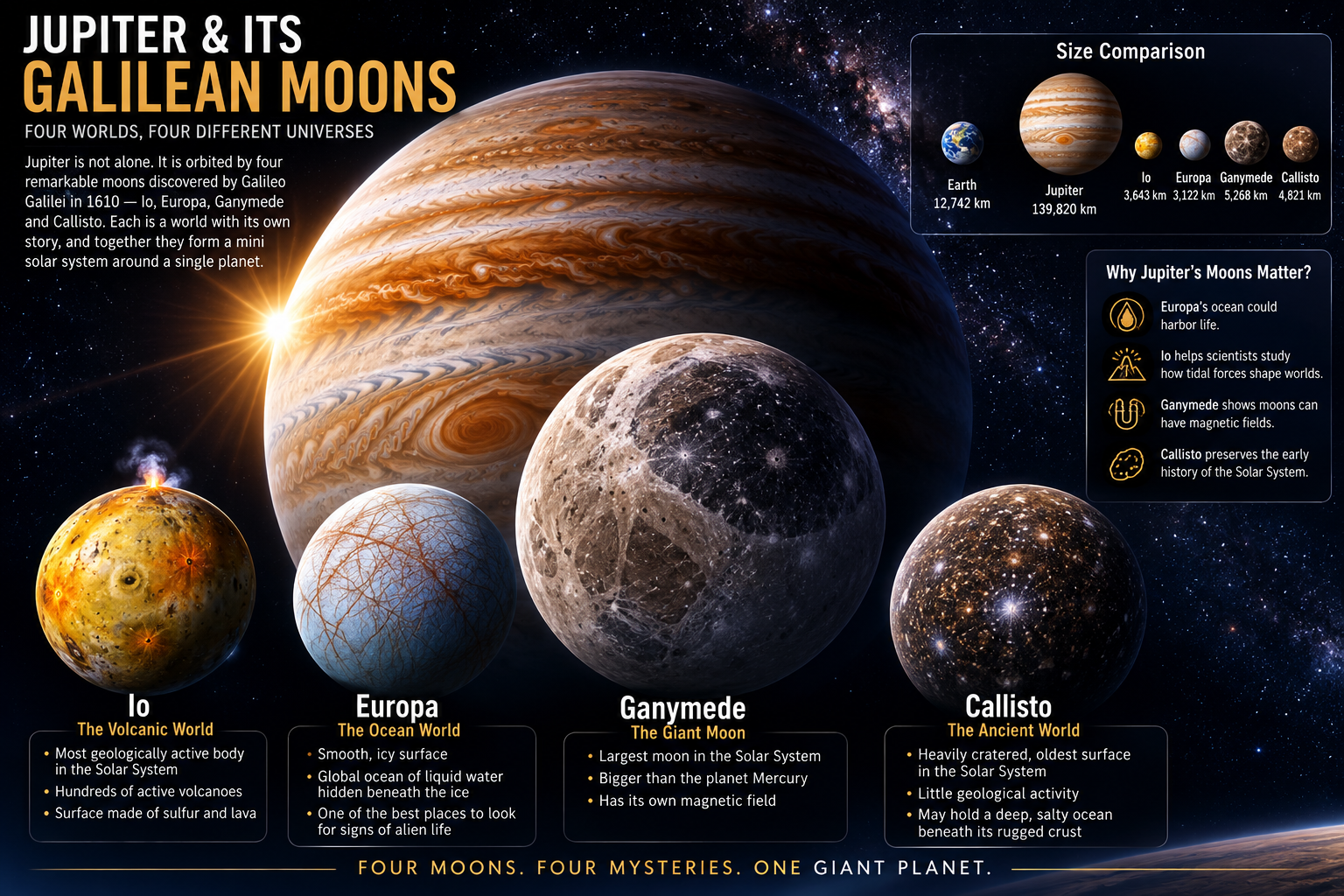
Jupiter is often called the king of the planets, but it could just as easily be called the ruler of a miniature solar system.
Orbiting this giant world are more than 90 confirmed moons, along with a faint ring system and an enormous magnetic environment that stretches millions of kilometers into space. Some of these moons are larger than planets, while others are small, irregular chunks of rock captured by Jupiter's immense gravity.
Each moon tells a different story.
One is covered in hundreds of active volcanoes. Another hides a vast ocean beneath a frozen shell of ice. A third preserves billions of years of impact history, while another possesses a magnetic field of its own.
Together, they make the Jupiter system one of the most fascinating destinations ever explored by humanity.
The Four Giants Discovered by Galileo
On a cold January night in 1610, Italian astronomer Galileo Galilei pointed his telescope toward Jupiter and noticed four tiny points of light beside the planet. Over several nights, he realized these objects were moving around Jupiter rather than Earth.
It was a revolutionary discovery.
For the first time, humanity had direct evidence that not everything in the universe orbited our planet. The observation helped transform our understanding of the Solar System and became one of the strongest arguments in support of the Sun-centered model.
Today, these four worlds are known as the Galilean moons.
- Io is the most volcanically active body in the Solar System, with hundreds of volcanoes constantly reshaping its surface.
- Europa hides a vast global ocean beneath its icy crust, making it one of the most promising places to search for extraterrestrial life.
- Ganymede is the largest moon in the Solar System—even larger than the planet Mercury—and the only moon known to possess its own magnetic field.
- Callisto is an ancient, heavily cratered world that preserves a record of billions of years of impacts.
Each moon is so unique that scientists often describe them as planetary worlds rather than ordinary satellites.
More Than Just Moons
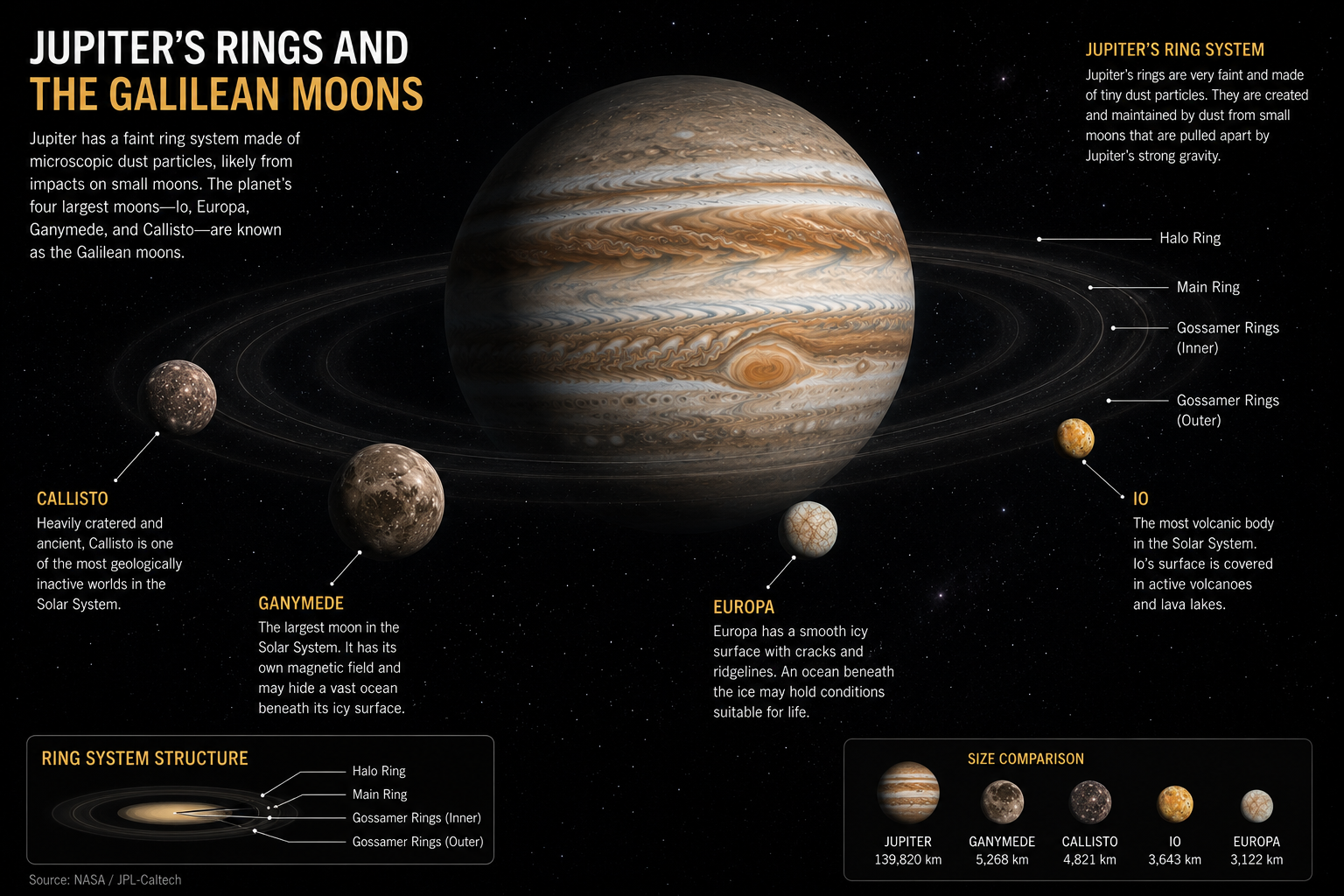
Beyond the famous Galilean moons lies an entire family of smaller satellites.
Some are tiny, irregular objects only a few kilometers across, likely captured asteroids pulled into orbit by Jupiter's immense gravity. Others travel in unusual paths, including retrograde orbits, meaning they circle the planet in the opposite direction of Jupiter's rotation.
Jupiter also possesses a faint system of rings.
Unlike Saturn's bright and spectacular rings, Jupiter's are thin, dark, and composed mainly of microscopic dust particles produced when small meteoroids strike its inner moons. They are so faint that they remained undiscovered until spacecraft flew past the planet.
Although easily overshadowed by Saturn's magnificent rings, Jupiter's ring system reminds us that rings are not unique to a single planet.
The Jupiter System
An Invisible Kingdom of Magnetism
Jupiter's influence extends far beyond its visible atmosphere.
The planet possesses the largest and most powerful magnetosphere of any planet in the Solar System. If it could be seen from Earth, it would appear several times larger than the full Moon in our sky.
This invisible magnetic bubble traps enormous numbers of charged particles from the Sun and from Io's volcanic eruptions, creating intense radiation belts around the planet.
The radiation environment is so extreme that spacecraft must be specially designed to survive it. Engineers working on NASA's Juno mission equipped the spacecraft with a titanium radiation vault to shield its most sensitive electronics during repeated close passes over Jupiter.
Despite these hazardous conditions, the magnetosphere also produces breathtaking auroras around Jupiter's poles. Unlike Earth's auroras, which brighten mainly during periods of strong solar activity, Jupiter's auroras glow almost continuously, powered by both the solar wind and material ejected from Io's volcanoes.
These brilliant displays are among the brightest anywhere in the Solar System.
Humanity's Journey to Jupiter
For centuries, Jupiter could only be observed through telescopes.
Everything changed in the space age.
Beginning with Pioneer 10 in 1973, robotic explorers have transformed our understanding of the giant planet. The Voyager spacecraft revealed its active moons in stunning detail, while the Galileo mission spent nearly eight years studying Jupiter and its satellites from orbit.
In 2016, NASA's Juno spacecraft entered Jupiter's orbit, providing the closest and most detailed views ever captured of its atmosphere, magnetic field, and deep interior. Its discoveries continue to reshape scientific understanding of how giant planets form and evolve.
The exploration is far from over.
NASA's Europa Clipper mission and the European Space Agency's JUICE mission are expected to investigate Jupiter's icy moons in unprecedented detail, searching for environments that may be capable of supporting life beneath their frozen surfaces.
Every mission reveals that Jupiter is not simply one planet—it is an entire planetary system waiting to be explored.
Chapter 4 Summary
Jupiter's immense gravity has gathered an extraordinary collection of moons, faint rings, and one of the largest magnetic environments in the Solar System. From Europa's hidden ocean to Io's relentless volcanoes, each world offers new clues about planetary evolution and the potential for life beyond Earth.
Yet Jupiter's greatest influence reaches even farther.
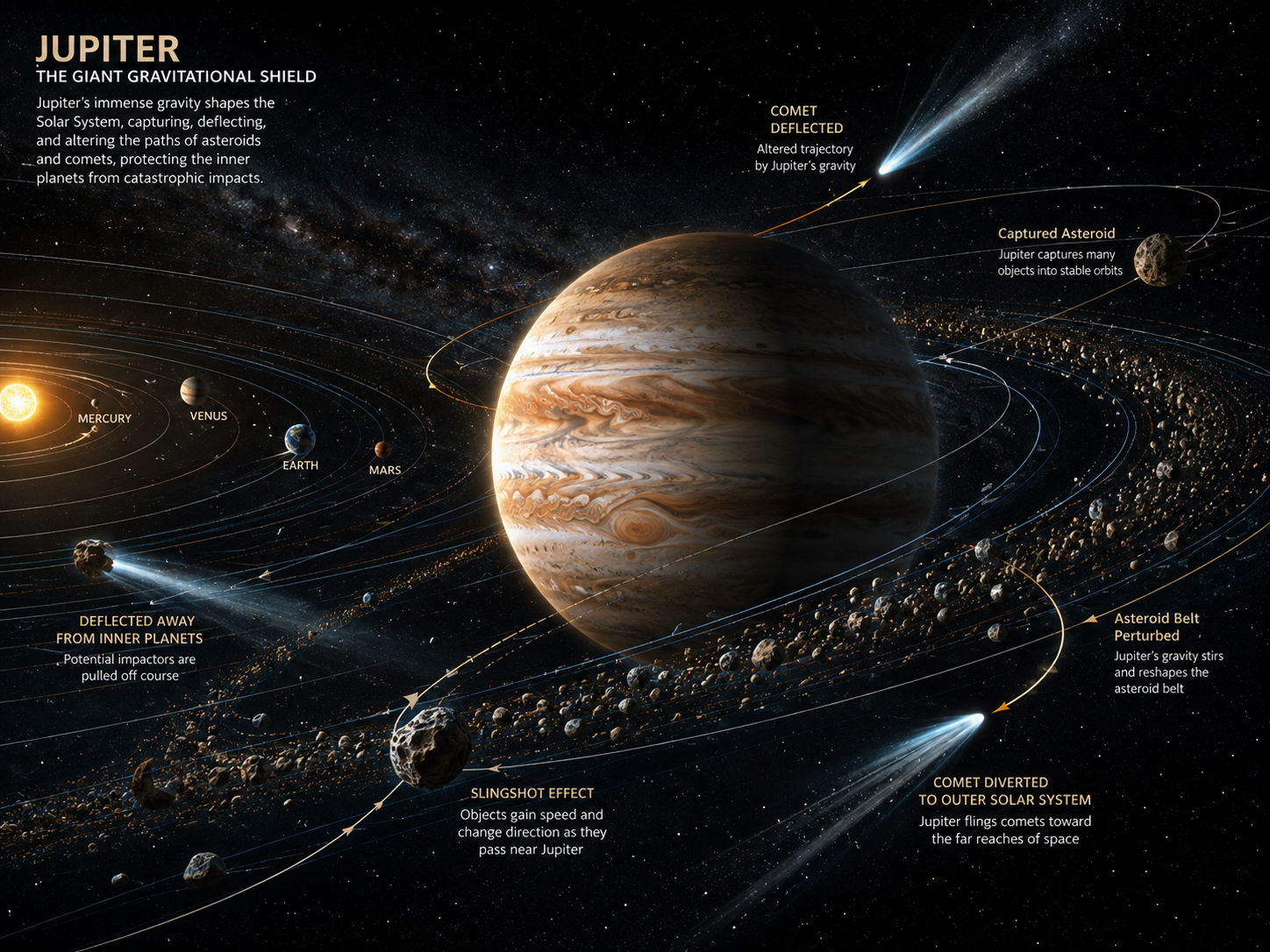
Its enormous gravity has shaped the history of the Solar System itself, protecting and sometimes threatening the inner planets through its interactions with comets and asteroids.
In the final chapter, we will discover why many scientists call Jupiter the Guardian of the Solar System and explore what humanity's future relationship with this giant world may become.
Chapter 5: Guardian of the Solar System
The Giant That Helped Shape Our Cosmic Neighborhood
A Living Laboratory for Planetary Science
Jupiter has become one of the most important natural laboratories in astronomy.
By studying its atmosphere, interior, magnetic field, and moons, scientists gain valuable insights into how giant planets form—not only in our own Solar System but around distant stars as well.
Thousands of gas giant exoplanets have already been discovered orbiting other stars. Many are even larger than Jupiter and exist in environments unlike anything found near our Sun. Understanding Jupiter helps astronomers interpret these distant worlds and improve theories about the formation of planetary systems across the galaxy.
The giant planet has also challenged long-held scientific ideas.
Data from the Juno spacecraft revealed that Jupiter's interior is far more complex than expected, while the icy moon Europa continues to inspire new research into the possibility of life beneath frozen oceans.
Each discovery reminds us that even after centuries of observation, Jupiter still holds countless mysteries waiting to be solved.
Could Humans Ever Visit Jupiter?
The dream of exploring Jupiter has inspired generations of scientists and science-fiction writers.
However, visiting Jupiter presents challenges unlike those of any rocky planet.
Because Jupiter has no solid surface, there is nowhere for a spacecraft—or a human—to land. As any probe descends deeper into the atmosphere, temperatures and pressures increase rapidly until they become overwhelming.
In 1995, NASA released the Galileo atmospheric probe, which entered Jupiter's atmosphere and transmitted data for about an hour before being destroyed by crushing pressure and intense heat. It remains the only spacecraft to directly sample the planet's atmosphere.
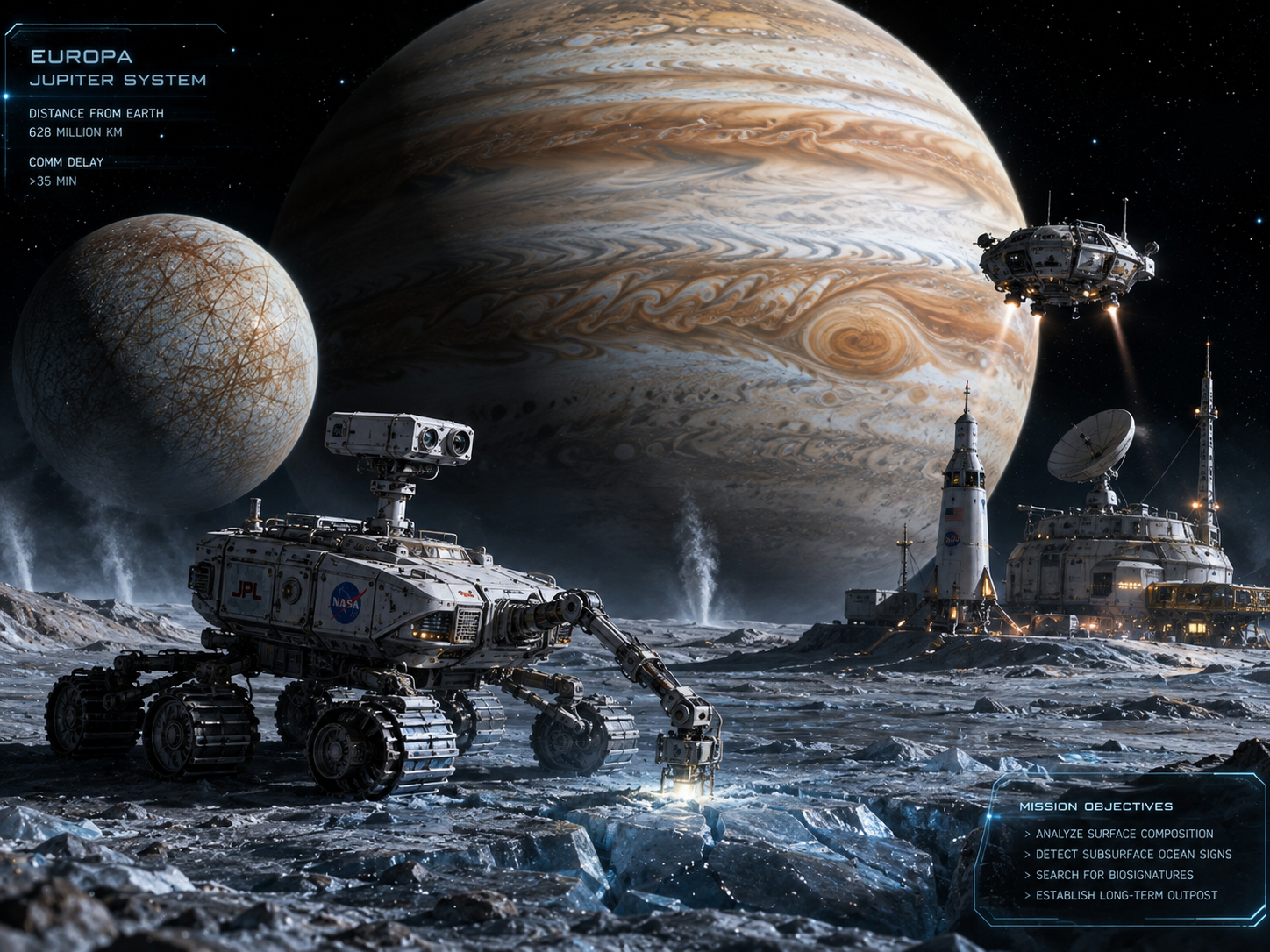
Although humans are unlikely to explore Jupiter's atmosphere directly, its moons offer far more realistic destinations. Worlds such as Europa, Ganymede, and Callisto may one day become key locations for robotic exploration and, perhaps in the distant future, human missions.
Jupiter itself may never be a place we can stand upon, but the system surrounding it could become one of humanity's greatest frontiers.
Jupiter vs. Earth
A Giant That Continues to Inspire
Long before telescopes existed, Jupiter shone brightly in the night sky, inspiring myths and legends across civilizations. Today, it inspires something equally powerful—scientific curiosity.
Every mission to Jupiter has revealed discoveries no one expected. Hidden oceans beneath icy moons, storms larger than Earth, immense auroras, and an interior unlike any other planet have transformed Jupiter from a distant point of light into one of the most fascinating worlds in the Solar System.
Future missions will continue this journey.
NASA's Europa Clipper will investigate Europa's hidden ocean, while the European Space Agency's JUICE mission will explore Jupiter's largest icy moons in unprecedented detail. These missions may answer some of astronomy's biggest questions, including whether environments suitable for life exist beyond Earth.
The story of Jupiter is far from finished.
Each new observation brings humanity one step closer to understanding not only the giant planet itself, but also the origins of planetary systems throughout the universe.
Conclusion: The King of the Solar System
Jupiter is a world of breathtaking extremes.
Born from the same cloud of gas and dust that created the rest of the Solar System, it grew into a planet unlike any other—a giant composed mostly of hydrogen and helium, wrapped in colorful cloud bands, home to storms that have lasted for centuries and a magnetic field powerful enough to dominate millions of kilometers of space.
Its family of moons forms a miniature planetary system, where volcanic worlds, frozen oceans, and ancient cratered landscapes orbit a common center. Meanwhile, its immense gravity continues to shape the Solar System, influencing the paths of asteroids and comets while offering scientists invaluable clues about the formation of planets around distant stars.
Although no human will ever stand on Jupiter itself, its mysteries continue to drive exploration. Every spacecraft that ventures into its domain reveals another chapter in a story that began more than 4.5 billion years ago.
When we look toward Jupiter, we are not simply observing the Solar System's largest planet.
We are witnessing one of the greatest natural wonders our cosmic neighborhood has ever created.
Frequently Asked Questions (FAQs)
1. Why is Jupiter called the largest planet in the Solar System?
Jupiter is the largest planet because it has a diameter of about 143,000 kilometers (88,850 miles) and contains more than twice the mass of all the other planets combined. More than 1,300 Earths could fit inside Jupiter by volume.
2. Can humans live on Jupiter?
No. Jupiter has no solid surface to stand on. Its atmosphere becomes hotter and denser with depth, eventually reaching pressures and temperatures that would destroy any spacecraft or human.
3. What is the Great Red Spot?
The Great Red Spot is a giant storm on Jupiter that has been observed for over 350 years. It is an enormous anticyclone with winds reaching about 430 km/h (270 mph) and is still larger than Earth.
4. What is Jupiter made of?
Jupiter is composed mostly of hydrogen and helium, the same elements that make up the Sun. Beneath its clouds, hydrogen is compressed into liquid and metallic forms due to immense pressure.
5. How many moons does Jupiter have?
Jupiter has more than 90 confirmed moons. The four largest—Io, Europa, Ganymede, and Callisto—are known as the Galilean moons and are among the most fascinating worlds in the Solar System.
6. Does Jupiter have rings?
Yes. Jupiter has a faint ring system made primarily of tiny dust particles created when meteoroids strike its small inner moons. Although much less visible than Saturn's rings, they are an important part of the Jupiter system.
7. Why is Jupiter important to the Solar System?
Jupiter's enormous gravity influences the movement of asteroids and comets, helping shape the Solar System's structure. It also provides scientists with valuable insights into how giant planets form and evolve.
8. Which spacecraft have explored Jupiter?
Several missions have visited Jupiter, including Pioneer 10, Pioneer 11, Voyager 1, Voyager 2, Galileo, and NASA's Juno spacecraft. Future missions such as Europa Clipper and ESA's JUICE will continue exploring Jupiter and its moons.
9. Does Jupiter have the strongest magnetic field of any planet?
Yes. Jupiter has the strongest planetary magnetic field in the Solar System. It creates a vast magnetosphere that extends millions of kilometers into space and produces spectacular auroras near its poles.
10. Could there be life on Jupiter's moons?
While Jupiter itself is considered uninhabitable, scientists believe that moons such as Europa may have liquid oceans beneath their icy surfaces. These hidden oceans are among the most promising places to search for extraterrestrial microbial life in our Solar System.