Introduction: The Last Great Frontier
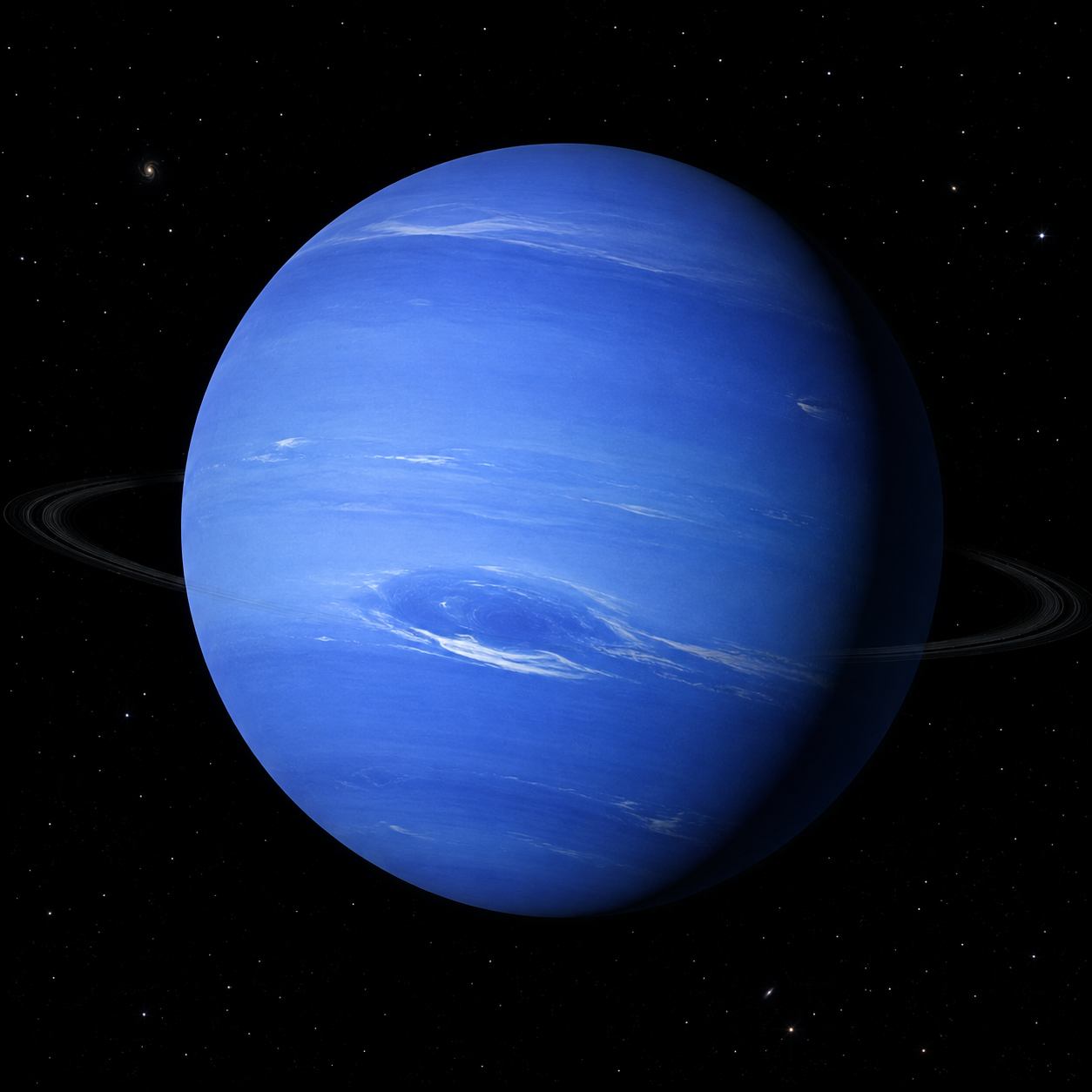
At the outer edge of the Solar System, nearly 4.5 billion kilometers (2.8 billion miles) from the Sun, a deep blue world silently circles through the darkness.
This is Neptune—the eighth and farthest known planet from the Sun.
From Earth, it appears as nothing more than a tiny bluish point of light, invisible to the naked eye and hidden beyond the reach of ancient astronomers. Yet beneath its tranquil appearance lies one of the most violent planets ever discovered. Here, gigantic storms race across an icy atmosphere, clouds of frozen methane drift through the sky, and the fastest winds in the Solar System roar at more than 2,000 kilometers per hour (1,200 miles per hour).
It is a world where sunlight is so faint that noon resembles Earth's twilight.
Neptune belongs to a rare class of planets known as ice giants. Like Uranus, it is composed not only of hydrogen and helium but also vast amounts of water, ammonia, and methane compressed into exotic forms deep within its interior. Despite being farther from the Sun than Uranus, Neptune radiates surprising amounts of internal heat, fueling the powerful weather systems that continue to puzzle scientists.
Orbiting this distant giant is a fascinating collection of moons led by Triton, a frozen world that travels backward around Neptune and ejects icy geysers into space. Together with faint rings and a mysterious magnetic field, Neptune forms one of the least explored yet most intriguing planetary systems in our cosmic neighborhood.
Remarkably, humanity has visited Neptune only once.
In 1989, NASA's Voyager 2 spacecraft became the first—and so far only—mission to fly past this distant giant. During its brief encounter, it transformed Neptune from a distant blue dot into a dynamic world of storms, powerful winds, and astonishing discoveries.
More than three decades later, Neptune still guards countless secrets.
Studying this remote planet helps scientists understand not only the outer Solar System but also the countless ice giants that orbit distant stars throughout our galaxy. Every mystery hidden within Neptune brings us one step closer to understanding how planets form, evolve, and survive in the coldest reaches of space.
Chapter 1: The Birth of the Blue Giant
A Planet Born in the Frozen Frontier
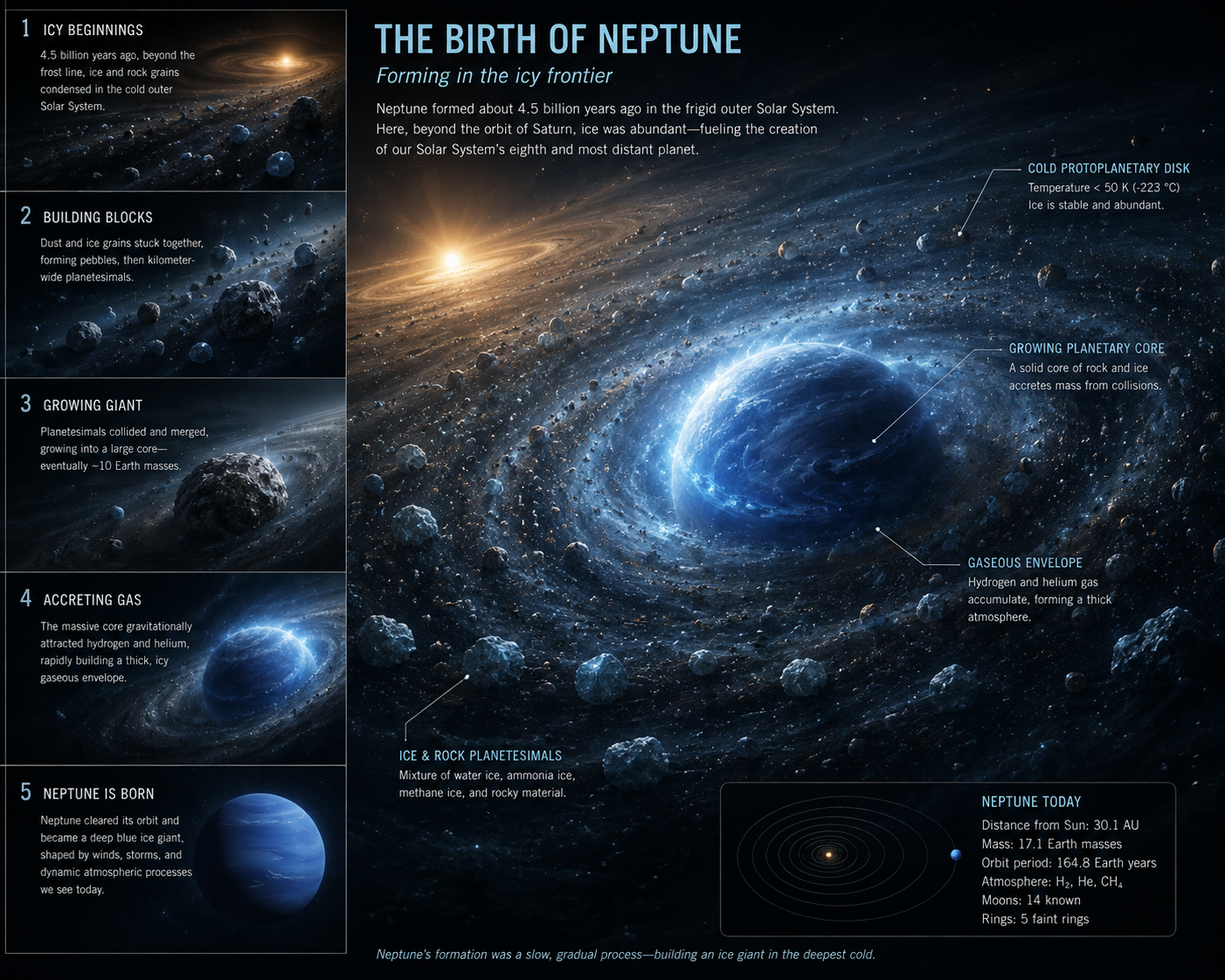
More than 4.5 billion years ago, while the young Sun was still surrounded by a swirling disk of gas, dust, and ice, the outer Solar System was a harsh and frigid place.
Far beyond the region where rocky planets formed, temperatures were low enough for water, ammonia, and methane to freeze into solid particles. These icy materials collided over millions of years, gradually building larger and larger bodies through gravity.
One growing planetary core eventually became massive enough to attract surrounding gases.
That world would become Neptune.
Unlike Jupiter and Saturn, Neptune formed where hydrogen and helium were less abundant. Instead of becoming a gas giant, it accumulated enormous quantities of frozen volatile materials, earning its classification as an ice giant.
Today, Neptune contains about 17 times the mass of Earth while measuring nearly 49,500 kilometers (30,800 miles) in diameter, making it the fourth-largest planet in the Solar System.
A Planet That May Have Wandered
Modern computer simulations suggest Neptune may not have formed exactly where it orbits today.
According to the Nice Model, Neptune likely formed closer to the Sun before slowly migrating outward through gravitational interactions with the other giant planets and countless icy objects.
As Neptune moved farther into the Solar System's outer frontier, its gravity scattered enormous numbers of smaller bodies, helping shape regions such as the Kuiper Belt—a vast population of icy objects beyond Neptune's orbit that includes dwarf planets like Pluto.
This ancient migration dramatically reshaped the architecture of the Solar System and influenced the orbits of countless objects that still exist today.
Without Neptune's slow outward journey, the Solar System might look very different from the one we know today.
The Deepest Blue Planet
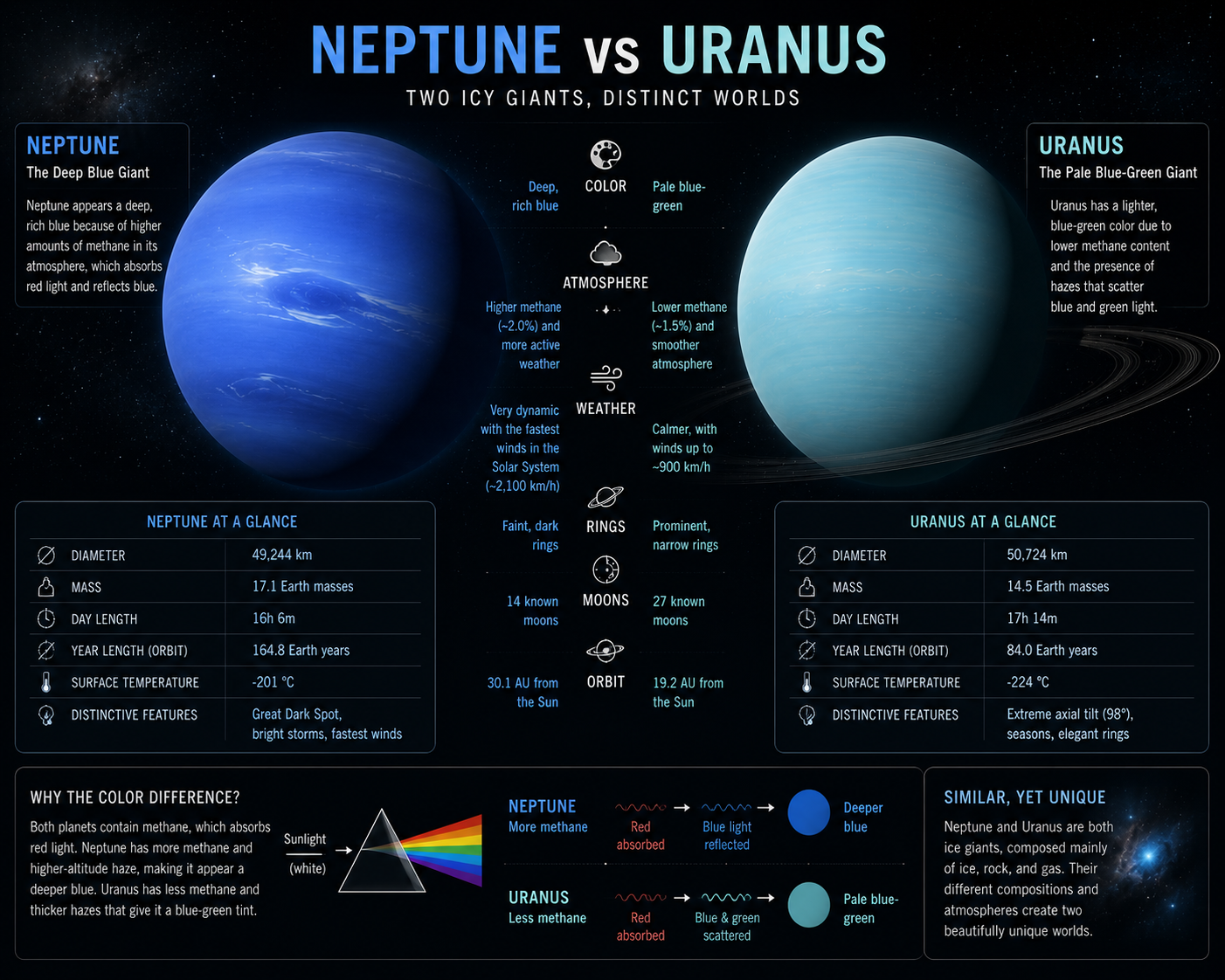
Among all the planets, Neptune possesses the richest shade of blue.
For many years, scientists believed methane alone was responsible for this striking color because it absorbs red wavelengths of sunlight while reflecting blue light back into space.
Recent research, however, suggests the explanation is more complex.
Additional atmospheric particles and hazes appear to influence how sunlight is scattered, giving Neptune a deeper, more vivid blue than neighboring Uranus.
Even from billions of kilometers away, this beautiful color makes Neptune instantly recognizable.
It is one of the most visually distinctive worlds in the Solar System.
The Birth of Neptune
Transition to Chapter 2
From a distance, Neptune appears calm and serene.
Yet beneath its brilliant blue clouds lies a world of crushing pressure, mysterious interiors, and the fastest planetary winds ever measured.
In the next chapter, we will descend beneath Neptune's atmosphere to explore the hidden structure of the Solar System's most distant giant.
Chapter 2: Inside the Storm Giant
Beneath Neptune's Brilliant Blue Clouds
From billions of kilometers away, Neptune looks calm.
Its deep sapphire-blue atmosphere appears smooth, peaceful, and almost motionless against the darkness of space. Compared with Jupiter's colorful cloud bands or Saturn's brilliant rings, Neptune seems quiet—a lonely giant drifting through the frozen edge of the Solar System.
But this impression could not be more misleading.
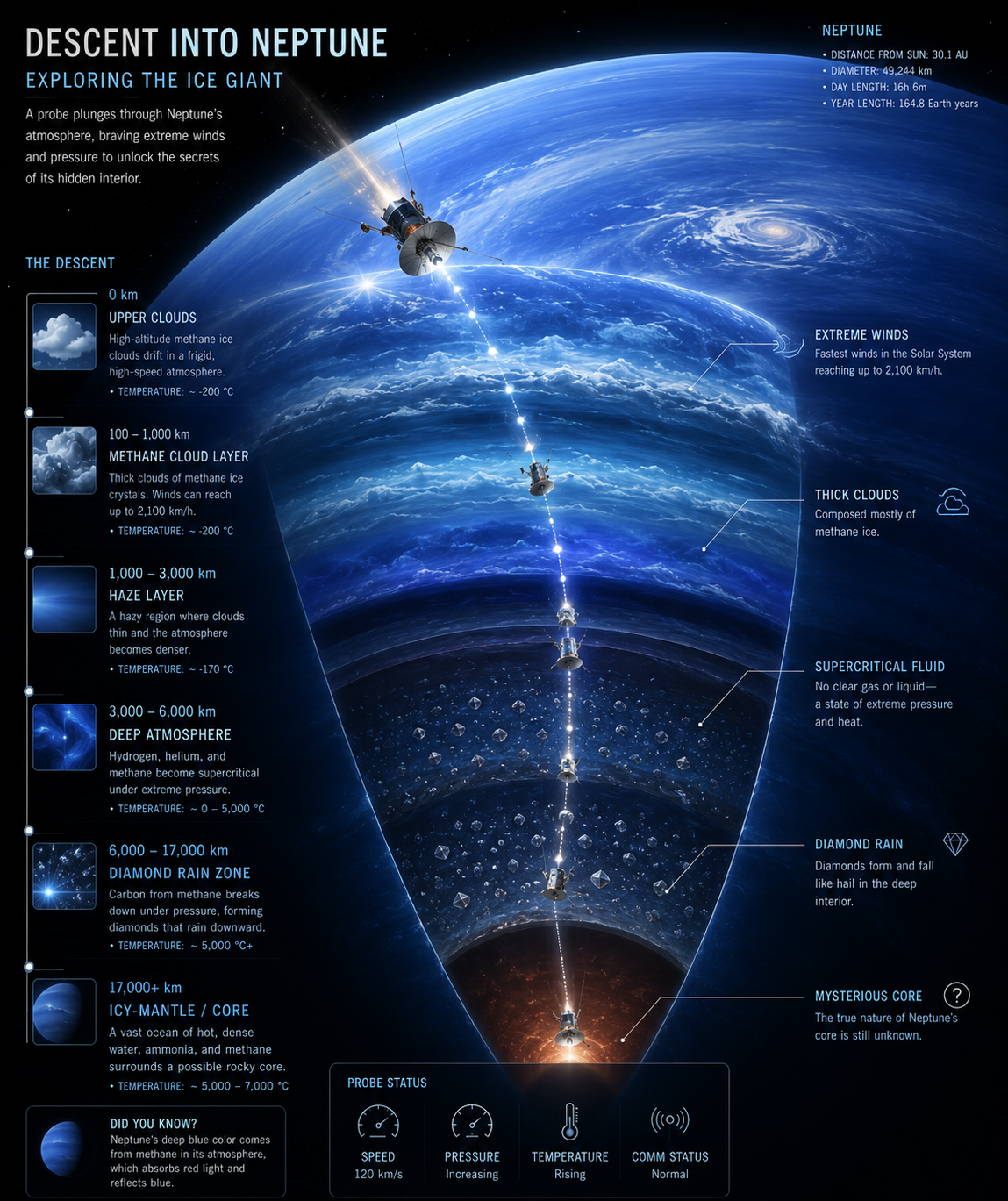
Beneath Neptune's cloud tops lies one of the most violent environments in the Solar System. Powerful storms rage across the atmosphere, immense pressures transform ordinary materials into exotic states, and temperatures rise dramatically toward the planet's hidden center.
Like Uranus, Neptune has no solid surface.
Instead, its atmosphere gradually merges into deeper layers of increasingly dense gas and fluid, making it impossible to identify where the sky ends and the planet truly begins.
An Ice Giant Unlike Any Other
Neptune belongs to a rare category known as an ice giant.
Despite the name, its interior is not filled with frozen ice in the everyday sense. Instead, scientists use the term to describe planets rich in compounds such as water, ammonia, and methane—materials that existed as ices during the Solar System's formation.
Deep inside Neptune, these substances are compressed by enormous pressure into hot, dense fluids unlike anything found naturally on Earth.
Surrounding this exotic interior is an atmosphere composed mainly of hydrogen and helium, with a small amount of methane. It is this methane that absorbs red sunlight while reflecting blue wavelengths, giving Neptune its famous deep-blue appearance.
Beneath the atmosphere lies an immense mantle of superheated water, ammonia, and methane extending thousands of kilometers toward the planet's center.
At the core, scientists believe a dense mixture of rock and metal remains buried beneath layers of compressed fluid.
A Furnace Hidden in the Darkness
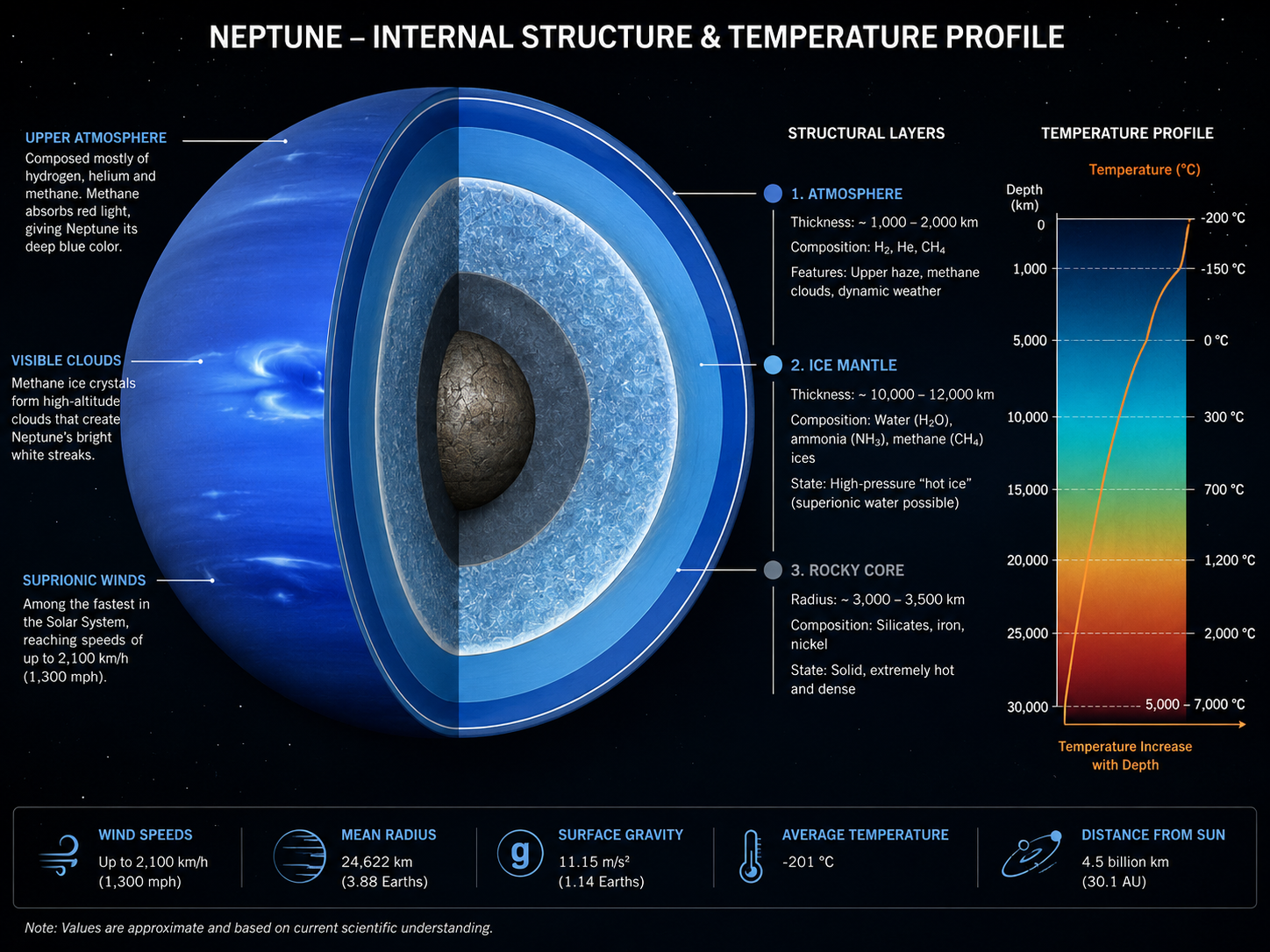
One of Neptune's greatest mysteries is its internal heat.
Although Neptune is the farthest planet from the Sun, it radiates more than twice as much energy as it receives from sunlight.
Scientists are still trying to understand why.
Unlike Uranus, which releases very little internal heat, Neptune possesses an active interior that continuously transfers energy outward. This hidden heat powers the planet's extraordinary weather, driving cloud formation and fueling gigantic storms despite the extremely weak sunlight reaching the outer Solar System.
Temperatures near Neptune's cloud tops average around −214°C (−353°F).
Yet deep inside the planet, conditions become unimaginably different. Temperatures near the core may exceed 5,000°C (9,000°F), while pressures rise to millions of times those found on Earth's surface.
This contrast between a frozen atmosphere and a scorching interior makes Neptune one of the most fascinating planets ever discovered.
Inside Neptune
The Mystery of Diamond Rain
Deep within Neptune's mantle, scientists believe one of the Solar System's most extraordinary natural phenomena may occur.
Under immense pressure, methane molecules could break apart, releasing carbon atoms that become compressed into tiny diamonds.
These microscopic crystals may slowly sink through the planet's interior like glittering raindrops before eventually melting in the hotter regions below.
This remarkable process is known as diamond rain.
Laboratory experiments have successfully recreated conditions similar to those inside Neptune, providing evidence that diamond formation is physically possible under such extreme pressures.
Although scientists have never directly observed diamond rain inside Neptune, it remains one of the leading explanations for the planet's unusual internal chemistry.
If confirmed, Neptune would be home to one of the most spectacular geological processes known in planetary science.
A Magnetic Field That Defies Expectations
Like neighboring Uranus, Neptune possesses a magnetic field unlike Earth's.
Instead of being closely aligned with the planet's rotation axis, Neptune's magnetic field is tilted by about 47 degrees and significantly offset from the planet's center.
As the planet rotates, this unusual magnetic field twists and shifts through space, creating a highly irregular magnetosphere.
Scientists believe the field is generated not within the rocky core, but within electrically conducting layers of water and ammonia deep inside the icy mantle.
Exactly how this process works remains uncertain.
Even after Voyager 2's historic flyby, Neptune's magnetic field continues to challenge scientists' understanding of how planetary dynamos operate.
Chapter 2 Summary
Beneath Neptune's peaceful blue appearance lies a dynamic and mysterious world. A superheated icy mantle, an intensely hot interior, possible diamond rain, and a strangely tilted magnetic field make Neptune one of the most unusual planets in the Solar System.
Yet its greatest surprises lie above the clouds.
Neptune is home to the fastest winds ever recorded on any planet, with storms powerful enough to circle the globe and weather systems that continue to evolve despite receiving so little sunlight.
In the next chapter, we will explore Neptune's extraordinary atmosphere, uncover the secrets behind its supersonic winds, and discover why this distant ice giant is one of the most meteorologically extreme worlds in the Solar System.
Chapter 3: The Planet of Supersonic Storms
Where the Fastest Winds in the Solar System Never Rest
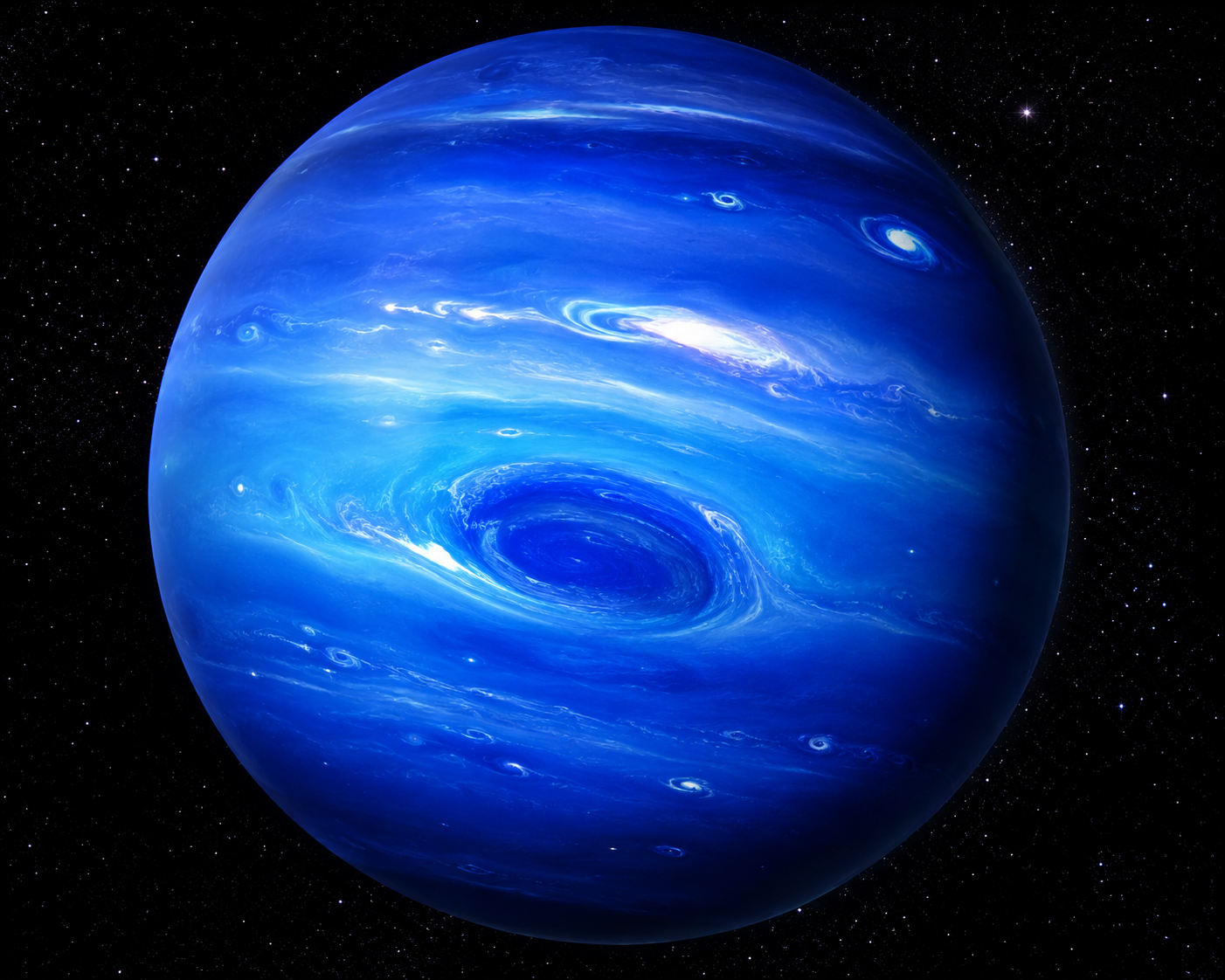
Neptune is the most distant planet from the Sun.
It receives only about one nine-hundredth of the sunlight that reaches Earth. At such an incredible distance, scientists once expected its atmosphere to be cold, quiet, and largely inactive.
Instead, they found exactly the opposite.
Neptune is home to the fastest planetary winds ever measured, with speeds reaching more than 2,100 kilometers per hour (1,300 miles per hour)—faster than the speed of sound in Earth's atmosphere.
These supersonic winds race through the planet's icy skies, carrying enormous storms across a world where sunlight is little more than a faint glow.
Even after decades of research, scientists still cannot fully explain how such powerful weather exists so far from the Sun.
The Great Dark Spot
When Voyager 2 arrived at Neptune in 1989, it discovered a gigantic storm unlike anything previously seen on the planet.
Known as the Great Dark Spot, this enormous vortex measured roughly the size of Earth and resembled Jupiter's famous Great Red Spot. Powerful winds swirled around the storm while bright white methane clouds formed along its edges, creating one of the most dramatic weather systems ever photographed.
Scientists expected the storm to survive for centuries.
Instead, it disappeared.
A few years later, observations by the Hubble Space Telescope revealed that the Great Dark Spot had completely vanished, while new dark storms had appeared elsewhere on the planet.
Unlike Jupiter's long-lived storms, Neptune's giant vortices seem to form, drift across the atmosphere, and eventually fade away before entirely new ones emerge.
This constantly changing weather makes Neptune one of the most dynamic planets in the Solar System.
Clouds of Frozen Methane
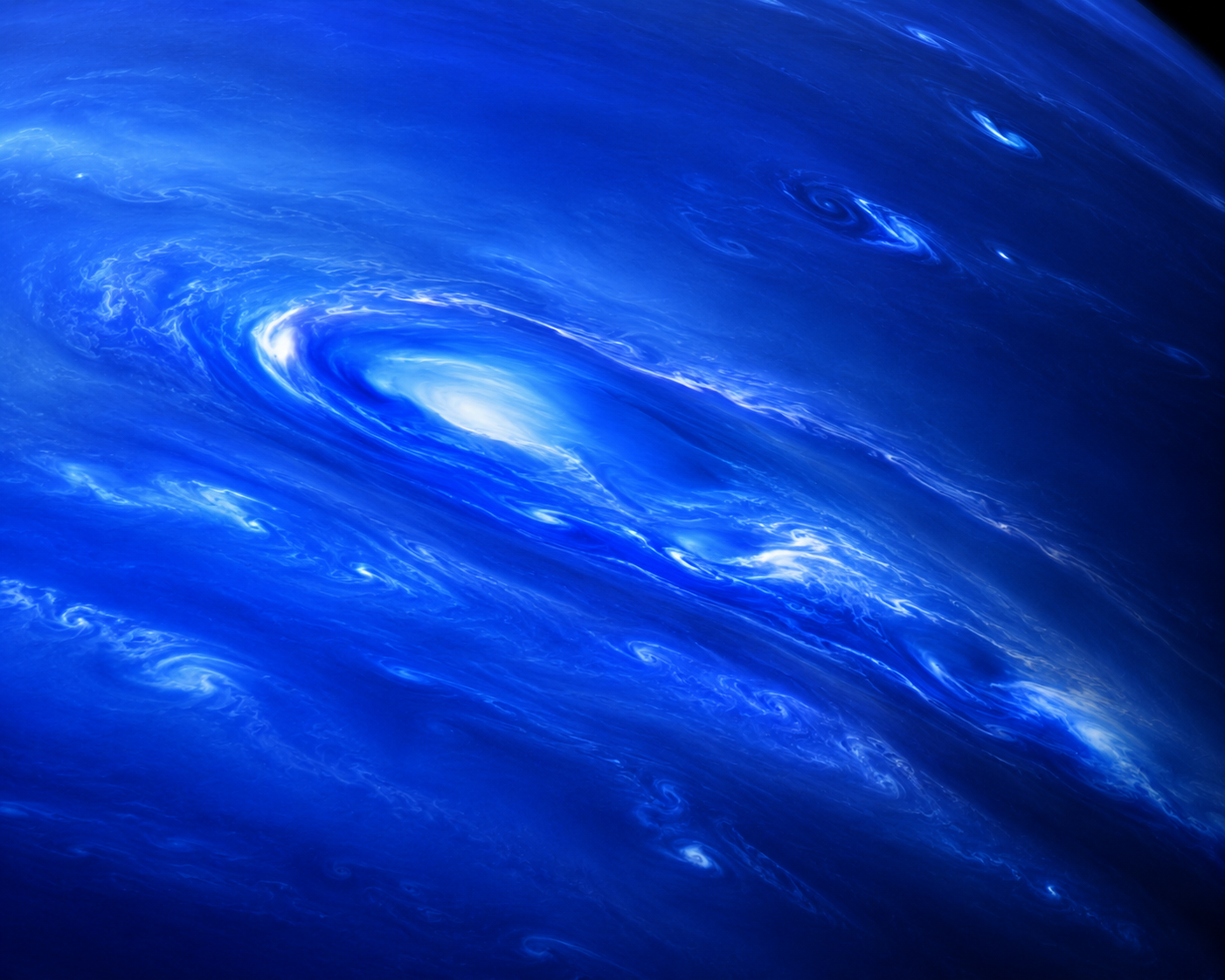
Despite its freezing temperatures, Neptune's sky is surprisingly active.
High above the atmosphere, sunlight illuminates brilliant white clouds made primarily of methane ice crystals. These clouds are carried around the planet by powerful jet streams, sometimes changing shape within just a few hours.
Beneath them lie deeper layers of haze and gas that remain hidden from direct view.
Modern telescopes have shown that Neptune's atmosphere is constantly evolving. Bright cloud systems appear unexpectedly, drift across the planet, and gradually disappear as new storms emerge elsewhere.
Although Neptune receives very little energy from the Sun, its own internal heat continues to drive this remarkable atmospheric activity.
The result is a planet whose weather never truly stands still.
Neptune's Extreme Weather
Why Are Neptune's Winds So Fast?
The origin of Neptune's extraordinary winds remains one of planetary science's greatest mysteries.
Scientists believe the answer lies beneath the clouds.
Unlike Uranus, Neptune releases large amounts of heat from its interior. This rising energy likely powers convection within the atmosphere, causing warm material to rise while cooler gases sink.
Combined with the planet's rapid rotation of about 16 hours, these powerful convection currents generate enormous jet streams that circle the globe.
Exactly how these winds accelerate to supersonic speeds is still not fully understood.
Some computer models suggest interactions between internal heat, atmospheric chemistry, and the planet's rotation create ideal conditions for maintaining these remarkable winds over long periods.
Future spacecraft may finally reveal the complete story.
The Faint Rings of the Blue Giant
Although Saturn is famous for its brilliant rings, Neptune also possesses a subtle ring system.
Its rings are dark, dusty, and incredibly faint, making them difficult to observe from Earth.
Voyager 2 confirmed the existence of five principal rings, now known as Galle, Le Verrier, Lassell, Arago, and Adams. Unlike Saturn's broad icy rings, Neptune's are composed largely of dark dust particles mixed with ice.
One of the most unusual features is found within the Adams Ring, where brighter regions called ring arcs appear instead of a continuous uniform ring.
For many years, scientists struggled to explain why these arcs remained stable instead of spreading out evenly around the planet.
Today, researchers believe the gravity of Neptune's small moon Galatea helps maintain these unusual structures, preventing them from dispersing.
Even Neptune's faint rings demonstrate that this distant planet continues to surprise astronomers.
Chapter 3 Summary
Neptune is anything but a quiet world. It possesses the fastest winds ever recorded, giant storms that appear and disappear, brilliant methane clouds, and one of the Solar System's most mysterious ring systems.
Yet beyond those rings lies an even more extraordinary discovery.
Orbiting Neptune is Triton, a frozen moon unlike any other—a world that travels backward around its planet, erupts with icy geysers, and may conceal a hidden ocean beneath its frozen surface.
In the next chapter, we will leave Neptune's turbulent atmosphere behind and explore the remarkable moons that make this distant ice giant one of the Solar System's most fascinating planetary systems.
Chapter 4: Triton and the Frozen Kingdom
The Moon That Doesn't Belong
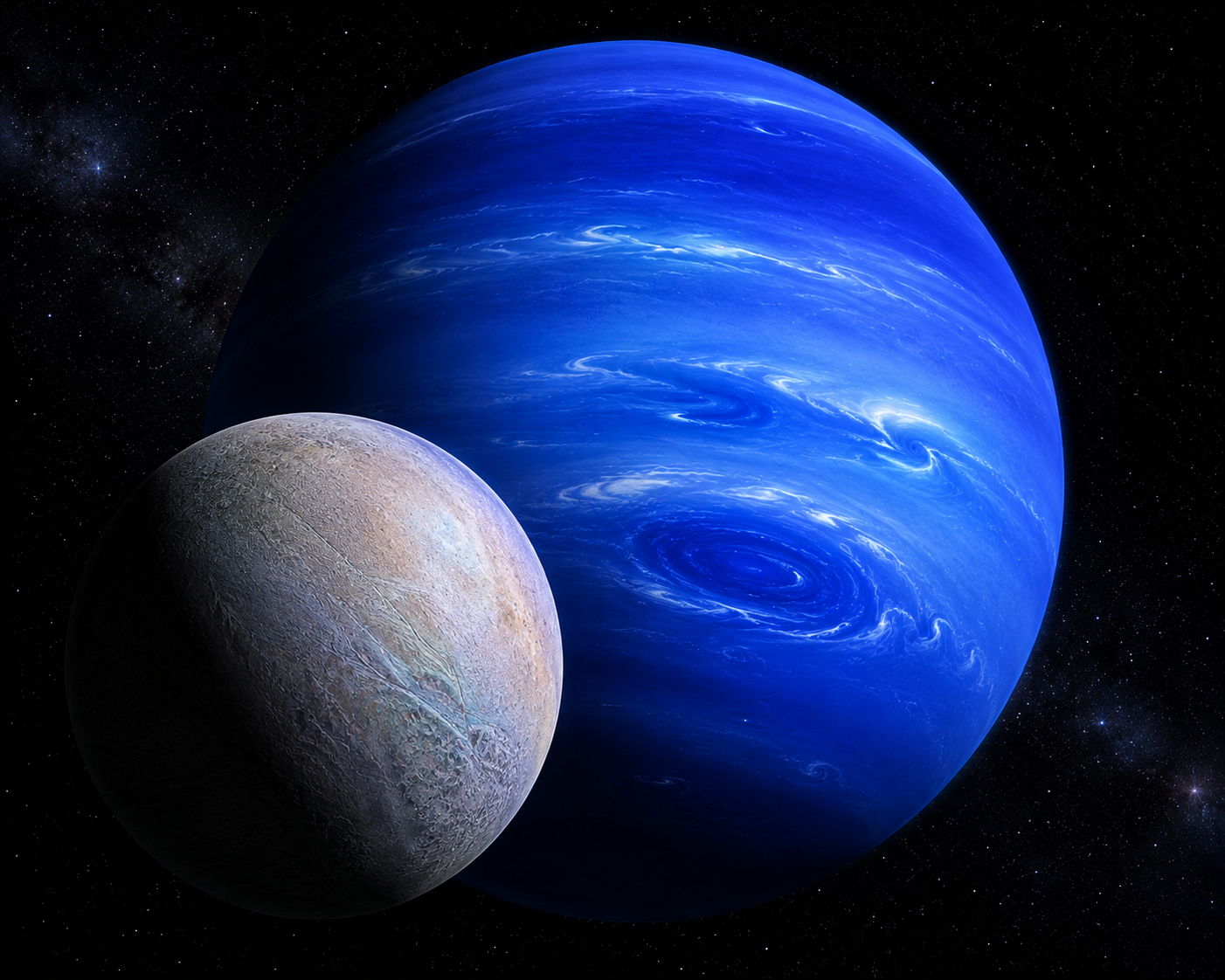
Beyond Neptune's turbulent blue atmosphere lies a world that has fascinated astronomers since its discovery.
Its name is Triton, and unlike almost every large moon in the Solar System, it travels around its planet backward.
This unusual motion, known as a retrograde orbit, immediately tells scientists that Triton probably did not form alongside Neptune. Instead, evidence suggests it was once an independent icy world in the distant Kuiper Belt before Neptune's immense gravity captured it billions of years ago.
That dramatic event forever changed the Neptune system.
Today, Triton is Neptune's largest moon, containing about 99% of the total mass of all the planet's moons combined. Its frozen surface, active geology, and mysterious interior make it one of the most extraordinary moons ever discovered.
A Frozen World That Is Surprisingly Alive
At first glance, Triton appears silent and lifeless.
Its surface is covered with frozen nitrogen, water ice, methane, and carbon dioxide, creating a landscape brighter than many other icy moons. Temperatures average around −235°C (−391°F), making Triton one of the coldest known worlds in the Solar System.
Yet beneath this frozen exterior lies surprising activity.
During Voyager 2's historic flyby in 1989, scientists witnessed something no one expected.
Dark plumes of nitrogen gas were erupting from Triton's surface, rising several kilometers into the thin atmosphere before drifting downwind across the icy plains.
These cryovolcanic eruptions—often called ice volcanoes—proved that Triton was still geologically active.
It became the first object beyond Saturn where active geysers had ever been observed.
Could Triton Hide an Ocean?
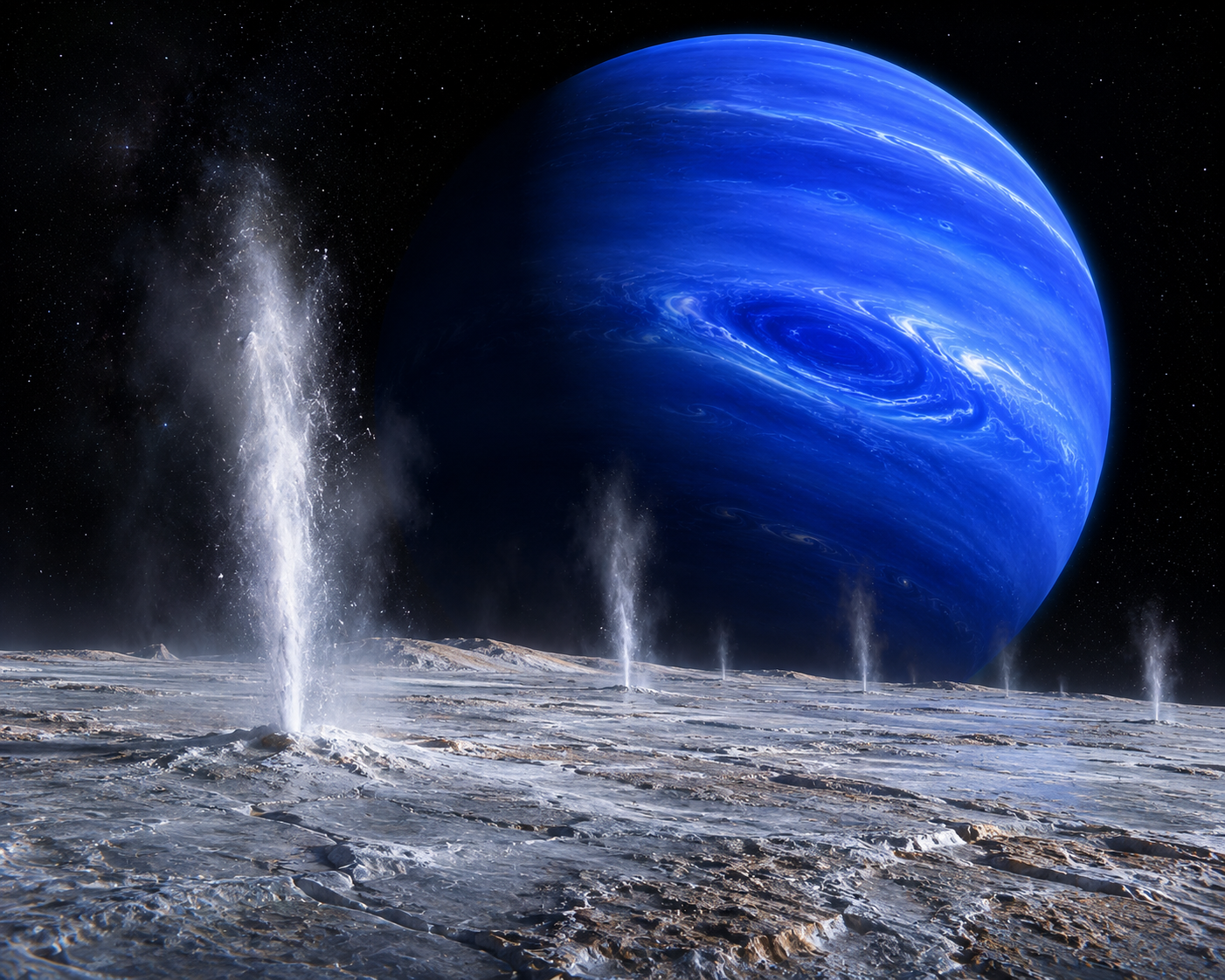
One of the biggest questions surrounding Triton lies beneath its frozen crust.
Many planetary scientists believe a subsurface ocean of liquid water may exist deep below the ice.
Although sunlight at Neptune is extremely weak, tidal forces generated during Triton's capture and radioactive heat from its rocky interior may provide enough energy to keep portions of this hidden ocean from freezing completely.
If such an ocean exists, Triton would join Europa and Enceladus as one of the Solar System's most intriguing candidates in the search for environments that could potentially support microbial life.
No evidence of life has been discovered.
But every new model strengthens the case that Triton may be far more than a frozen ball of ice.
The Neptune System
More Than Just One Moon
Although Triton dominates the Neptune system, it is not alone.
Neptune has 16 confirmed moons, each with its own unique orbit and history.
Proteus is the second-largest moon and has an irregular shape because its gravity is too weak to pull it into a perfect sphere. Despite its relatively large size, it remained undiscovered until Voyager 2 photographed it in 1989.
Nereid follows one of the most unusual orbits of any moon in the Solar System. Instead of traveling in a nearly circular path, it moves around Neptune in a highly elongated orbit, carrying it dramatically closer to and farther from the planet during each revolution.
Smaller moons such as Galatea, Despina, Larissa, and Hippocamp quietly help shape Neptune's faint rings through their gravitational influence.
Together, these distant worlds create a planetary system that remains largely unexplored.
Voyager 2: Humanity's Only Visit
Everything humanity knows about Neptune changed during one extraordinary journey.
After exploring Jupiter, Saturn, and Uranus, NASA's Voyager 2 spacecraft arrived at Neptune on August 25, 1989.
Traveling at nearly 90,000 kilometers per hour (56,000 miles per hour), the spacecraft had only a brief opportunity to investigate the distant planet before continuing toward interstellar space.
Even in that short time, Voyager transformed our understanding of Neptune.
It discovered the Great Dark Spot, measured the fastest winds in the Solar System, confirmed Neptune's faint rings, photographed Triton's icy geysers, and revealed an active world far more dynamic than scientists had imagined.
More than three decades later, no spacecraft has returned.
Everything beyond Voyager's discoveries remains one of the greatest unfinished chapters in planetary exploration.
Chapter 4 Summary
Neptune's moons reveal a frozen kingdom unlike any other. Triton's backward orbit, icy geysers, and possible underground ocean suggest it is one of the most fascinating moons in the Solar System, while Neptune's smaller satellites quietly shape the planet's faint rings.
Yet Neptune's story extends far beyond its moons.
As the Solar System's outermost giant planet, it offers scientists valuable clues about the formation of distant planetary systems throughout the galaxy.
In the final chapter, we will explore Neptune's lasting legacy, future exploration, and discover why this remote blue world remains one of the greatest frontiers in modern astronomy.
Chapter 5: The Last Giant
The Final Frontier of the Solar System
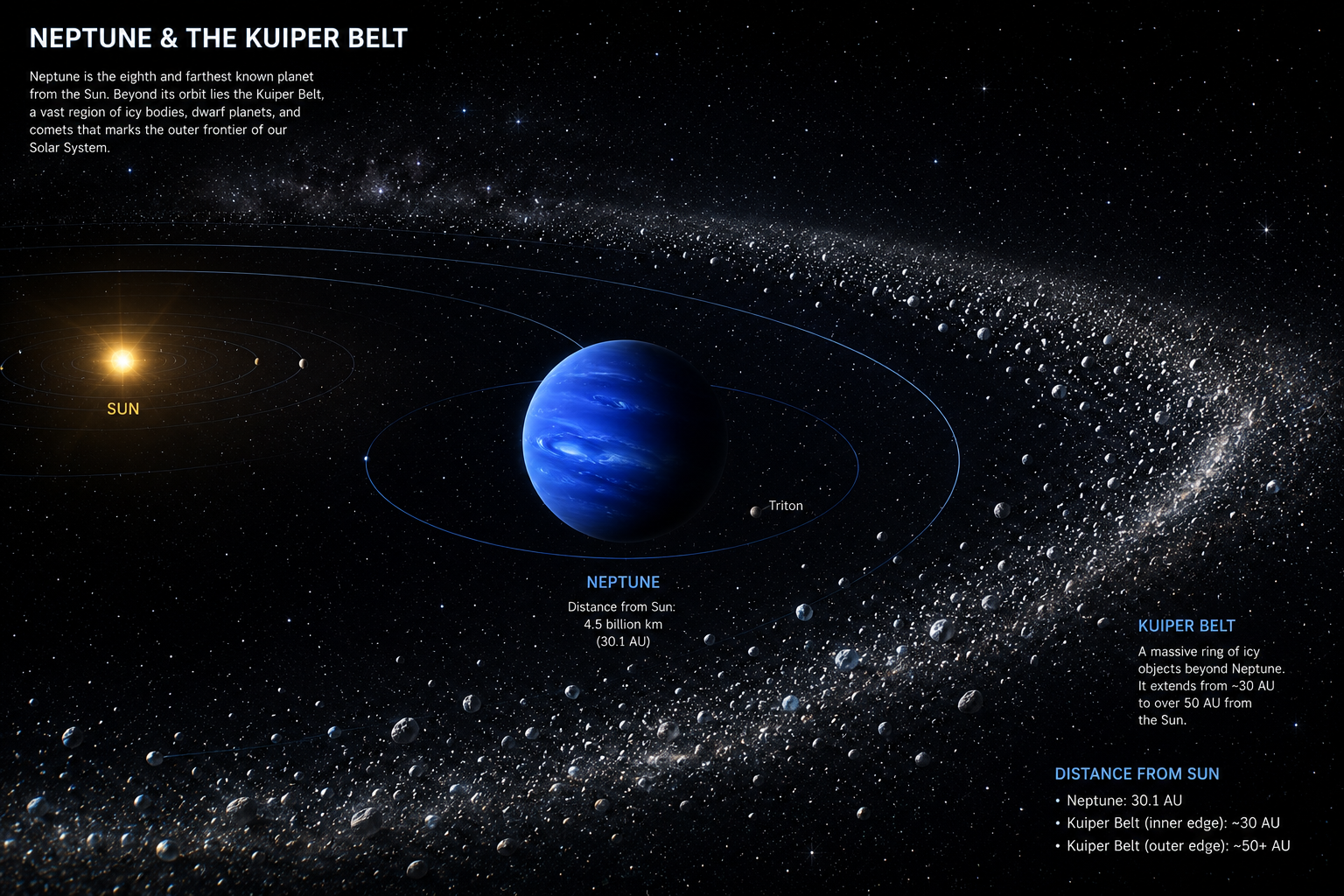
Neptune marks the end of the Sun's family of major planets.
Beyond its orbit lies a vast region filled with icy dwarf planets, comets, and countless frozen worlds that stretch toward interstellar space. Standing at the edge of this immense frontier, Neptune acts as the final giant guardian before the Solar System gradually fades into the darkness between the stars.
Its immense gravity shapes the outer Solar System in ways scientists are still uncovering. It influences the paths of distant icy objects, helps define the structure of the Kuiper Belt, and may even play a role in sending long-period comets toward the inner Solar System over millions of years.
Neptune is not simply the last planet.
It is the gateway to a much larger cosmic wilderness.
A Blueprint for Countless Distant Worlds
Although Neptune seems unique within our own Solar System, astronomers have discovered that planets of similar size are remarkably common around other stars.
Using powerful space telescopes, scientists have identified thousands of exoplanets, many of which fall into the same general size category as Neptune.
This makes Neptune one of the most important planets for understanding the galaxy.
By studying its atmosphere, weather, magnetic field, and internal structure, researchers gain valuable insights into worlds that are light-years away and impossible to explore directly.
Every discovery made about Neptune improves computer models used to explain how planetary systems form, evolve, and survive over billions of years.
In many ways, Neptune serves as a nearby laboratory for understanding countless distant planetary systems.
The Next Journey to Neptune
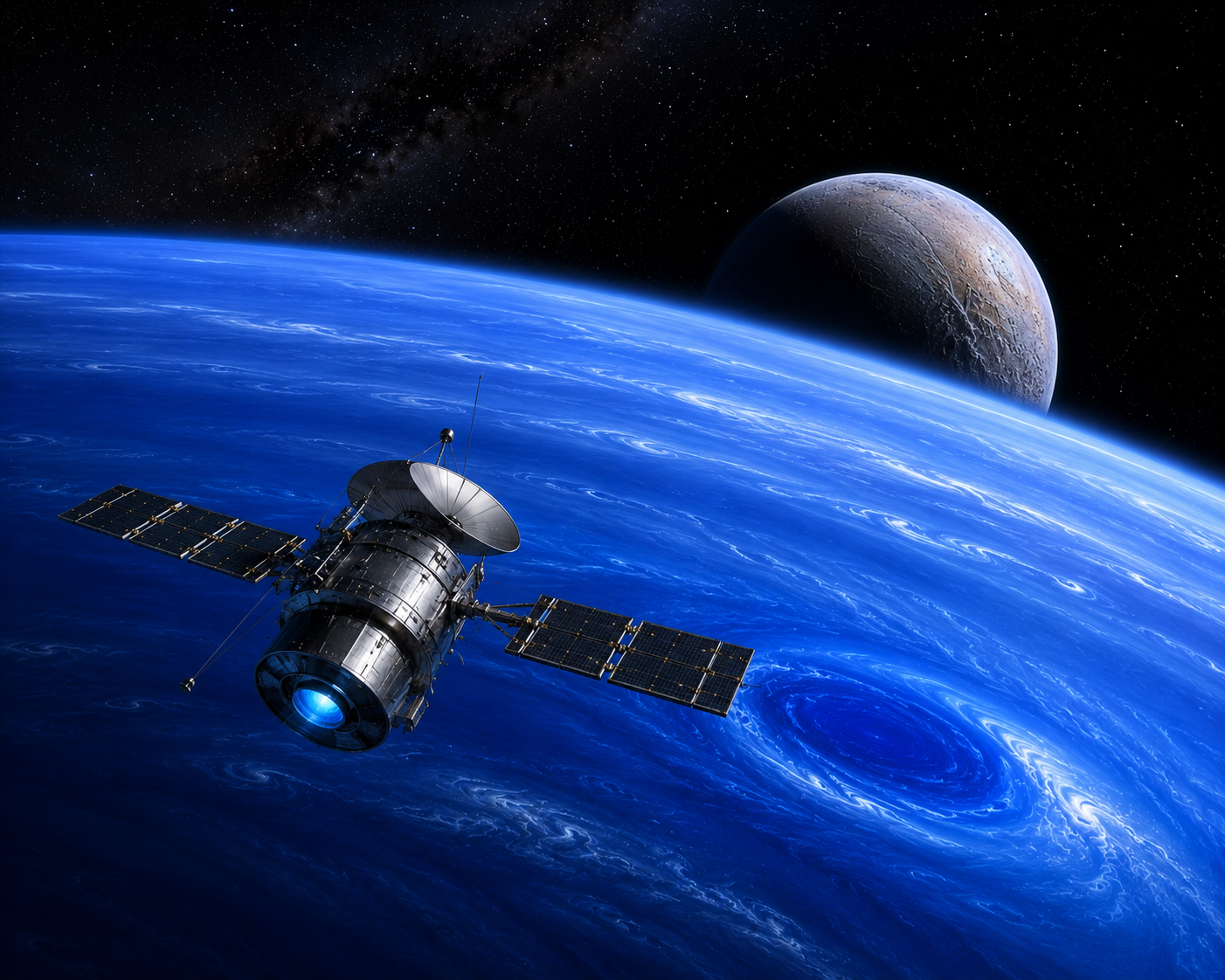
Since Voyager 2 flew past Neptune in 1989, no spacecraft has returned.
Yet interest in exploring the distant ice giant has never been greater.
Planetary scientists have proposed future missions that could place an orbiter around Neptune, deploy an atmospheric probe, and closely investigate Triton and the planet's faint rings over several years.
Unlike Voyager's brief encounter, an orbiter could observe changing storms, measure Neptune's powerful winds throughout different seasons, study its unusual magnetic field in detail, and search for evidence of hidden oceans beneath Triton's frozen crust.
Such a mission would transform Neptune from one of the least understood planets into one of the best-studied worlds in the outer Solar System.
For now, however, Neptune continues to wait.
Patiently circling the Sun once every 165 Earth years, it remains a destination for future generations of explorers.
Neptune Compared with Earth
A Planet That Defies Expectations
Few planets have surprised scientists as much as Neptune.
Researchers expected a frozen, inactive world because of its enormous distance from the Sun.
Instead, they discovered a planet with the fastest winds in the Solar System, giant storms that constantly change, a mysterious interior that radiates its own heat, faint rings held together by tiny moons, and an extraordinary companion—Triton—that may once have been a wandering dwarf planet.
Even after decades of research, fundamental questions remain unanswered.
Why does Neptune generate so much more internal heat than Uranus?
How exactly do its supersonic winds form?
Does diamond rain truly fall inside its mantle?
Could Triton's hidden ocean provide conditions suitable for life?
These mysteries ensure that Neptune will remain one of planetary science's highest priorities for decades to come.
Conclusion: The Blue Guardian
Neptune is a planet of distance, mystery, and extraordinary power.
Born in the frozen outskirts of the young Solar System, it evolved into an ice giant unlike any other. Beneath its brilliant blue atmosphere, powerful internal heat fuels supersonic winds and planet-sized storms, while deep inside, exotic materials exist under pressures beyond imagination.
Its faint rings quietly circle the planet, and its remarkable moon Triton hints at hidden oceans and a dramatic past shaped by gravitational capture.
Although humanity has visited Neptune only once, that brief encounter forever changed our understanding of the Solar System's outer frontier.
Yet the greatest discoveries may still lie ahead.
One day, new spacecraft will return to Neptune, descend through its atmosphere, orbit its mysterious moons, and answer questions that have remained unsolved since Voyager 2 disappeared into the darkness beyond.
Until then, Neptune continues its silent journey around the Sun—a brilliant blue giant standing watch at the edge of our planetary family.
It reminds us that the farther we travel into the universe, the more extraordinary it becomes.
Frequently Asked Questions About Neptune
1. What is Neptune?
Neptune is the eighth and farthest planet from the Sun in the Solar System. It is classified as an ice giant and is famous for its deep blue color, powerful storms, and the fastest winds of any known planet.
2. Why is Neptune blue?
Neptune appears blue because methane gas in its atmosphere absorbs red light from the Sun while reflecting blue wavelengths. Scientists also believe tiny atmospheric particles contribute to its richer blue color compared with Uranus.
3. How far is Neptune from the Sun?
On average, Neptune orbits about 4.5 billion kilometers (2.8 billion miles) from the Sun, or roughly 30 astronomical units (AU). At this distance, sunlight is nearly 900 times weaker than it is on Earth.
4. Is Neptune the coldest planet in the Solar System?
No. Although Neptune is the farthest planet from the Sun, Uranus has the coldest recorded planetary atmosphere. Neptune's cloud-top temperatures average around −214°C (−353°F), but its strong internal heat makes it warmer than Uranus in some regions.
5. Why does Neptune have the fastest winds in the Solar System?
Neptune has the fastest winds ever measured on a planet, reaching speeds of more than 2,100 km/h (1,300 mph). Scientists believe these winds are powered by the planet's internal heat combined with its rapid rotation, though the exact mechanism is still being studied.
6. Does Neptune have rings?
Yes. Neptune has five main rings that are dark, dusty, and much fainter than Saturn's. Some parts of the outer Adams Ring contain bright ring arcs, which are maintained by the gravity of nearby moons.
7. How many moons does Neptune have?
Neptune has 16 confirmed moons. The largest is Triton, an icy moon that orbits Neptune in the opposite direction of the planet's rotation, suggesting it was captured from the Kuiper Belt billions of years ago.
8. Has anyone ever visited Neptune?
Yes. NASA's Voyager 2 is the only spacecraft to have visited Neptune. It flew past the planet on August 25, 1989, discovering the Great Dark Spot, confirming Neptune's rings, and observing Triton's icy geysers.
9. Could there be life on Neptune or Triton?
Neptune itself is considered uninhabitable because of its extreme pressure, freezing atmosphere, and lack of a solid surface. However, scientists think Triton may have a hidden subsurface ocean beneath its icy crust, making it an interesting target in the search for environments that could potentially support microbial life.
10. What makes Neptune important to scientists?
Neptune helps scientists understand ice giants, one of the most common types of planets discovered around other stars. Studying Neptune improves our knowledge of planetary formation, atmospheric physics, extreme weather, magnetic fields, and distant exoplanets.