Introduction: The Planet That Wears Rings
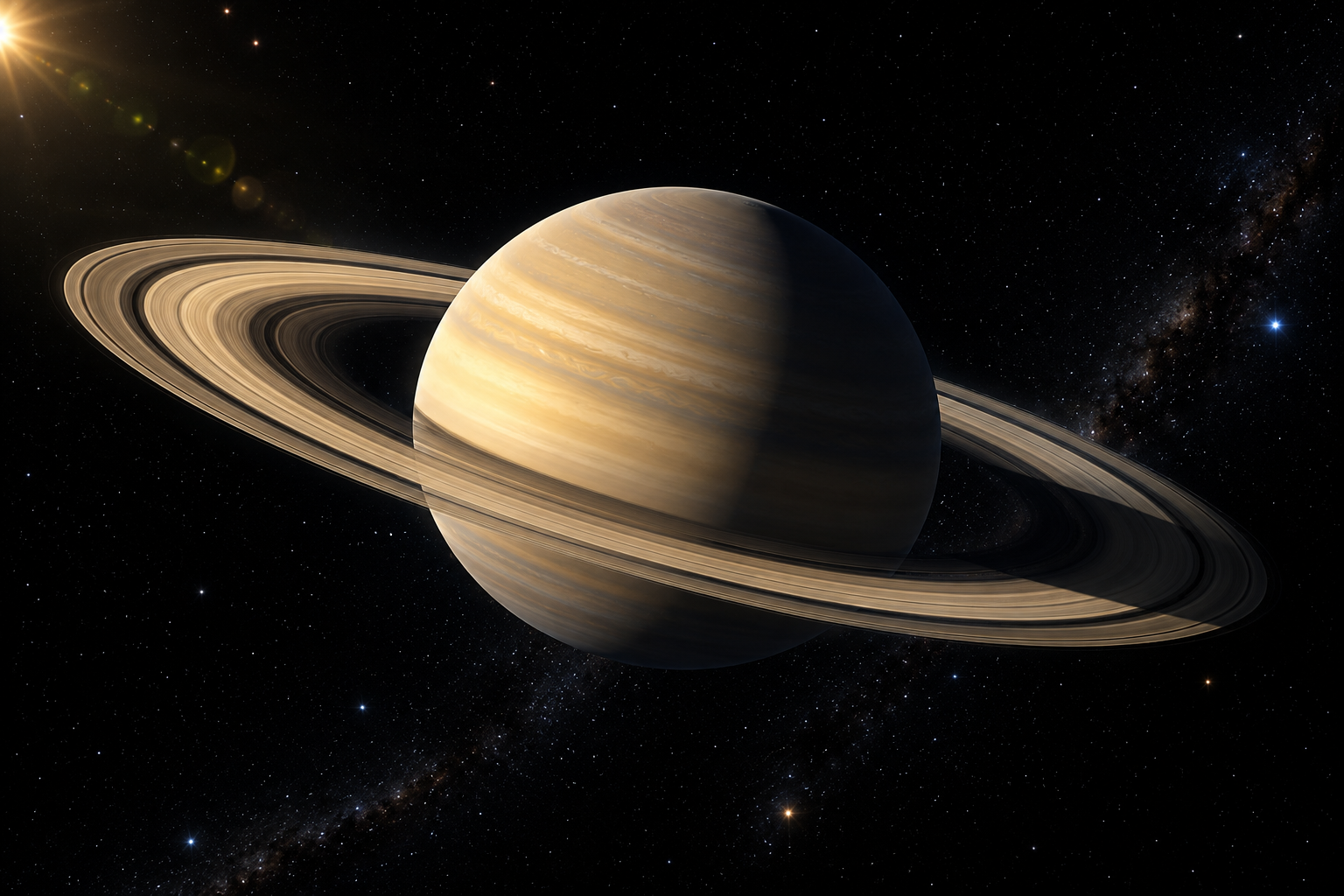
There are countless breathtaking sights in the Solar System, but few capture the imagination quite like Saturn. Wrapped in a magnificent system of icy rings that stretch hundreds of thousands of kilometers into space, Saturn has inspired astronomers, artists, and dreamers for centuries. Even through a small backyard telescope, its elegant silhouette is instantly recognizable, making it one of the most iconic worlds ever discovered.
Yet Saturn is far more than a beautiful planet.
Beneath its golden clouds lies a colossal gas giant made mostly of hydrogen and helium, with powerful storms, fierce winds, and an interior hidden beneath crushing pressure. Orbiting this giant are more than a hundred moons, including Titan, a world with rivers and lakes—not of water, but of liquid methane—and Enceladus, an icy moon that sprays enormous plumes of water into space from a hidden underground ocean.
Together, Saturn, its rings, and its remarkable moons form one of the most complex planetary systems in the Solar System.
For decades, robotic explorers have revealed that behind Saturn's graceful appearance lies a dynamic world where gravity sculpts rings, moons reshape one another, and natural forces create structures unlike anything found elsewhere. Every orbit around Saturn reveals another reminder that beauty and complexity often exist side by side.
Studying Saturn is not simply about understanding a ringed planet. It is about exploring one of nature's greatest masterpieces and discovering how giant planets and their moons continue to shape our understanding of the universe.
Chapter 1: Birth of the Ringed Giant
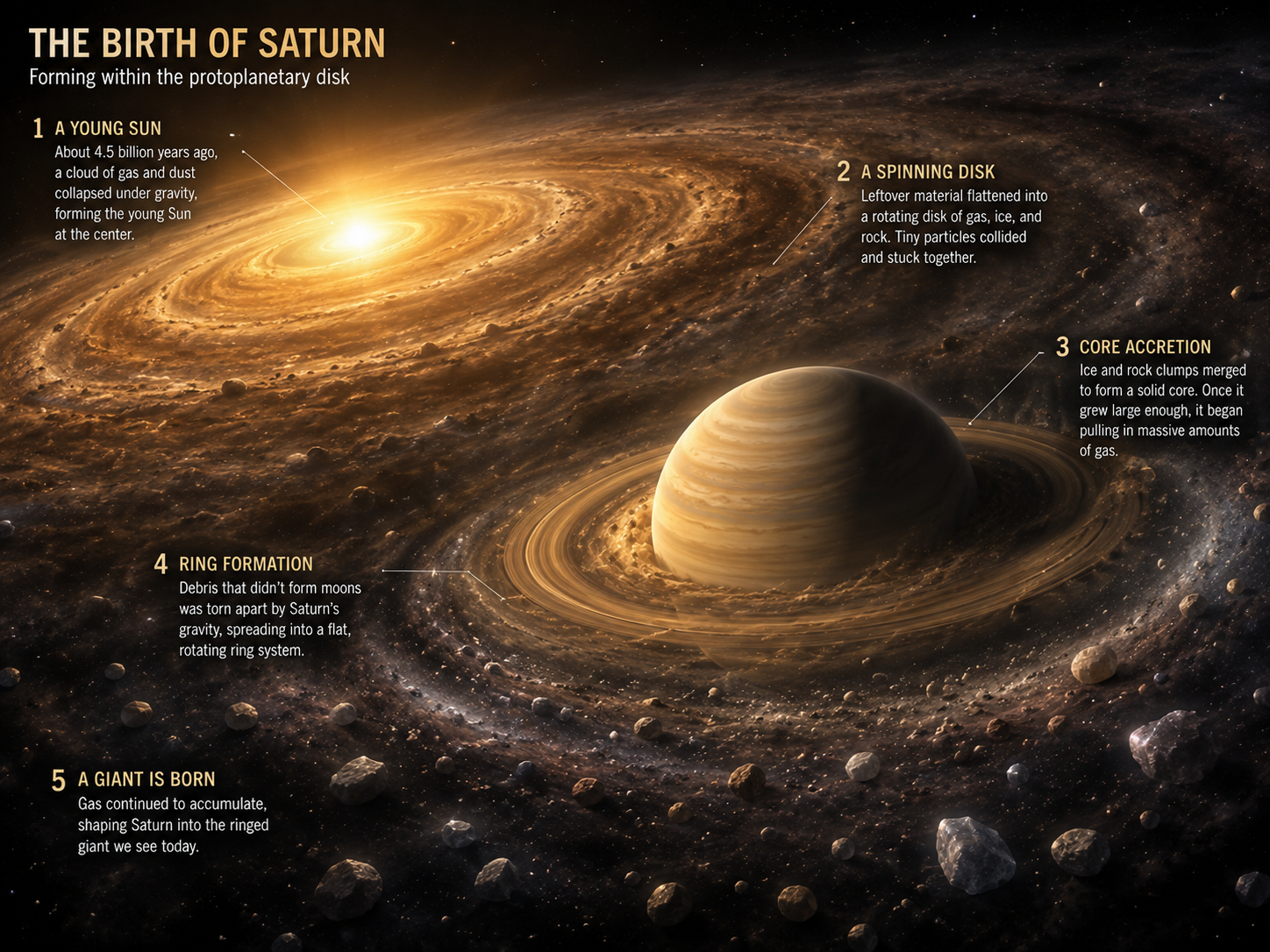
More than 4.5 billion years ago, while the young Sun was still surrounded by a vast disk of gas, dust, and ice, another giant planet was beginning to take shape far beyond the rocky worlds of the inner Solar System.
In these colder outer regions, frozen water, methane, and ammonia provided abundant material for growing planets. Tiny particles collided, merged, and gradually formed larger bodies called planetesimals. Over millions of years, one rapidly growing planetary core became massive enough to attract enormous quantities of hydrogen and helium from the surrounding solar nebula.
That world would become Saturn.
Although it followed a formation process similar to Jupiter's, Saturn captured less gas before the young Sun's intense solar wind swept away the remaining material. Even so, it grew into the second-largest planet in the Solar System, containing nearly 95 times the mass of Earth.
A Giant Unlike Any Other
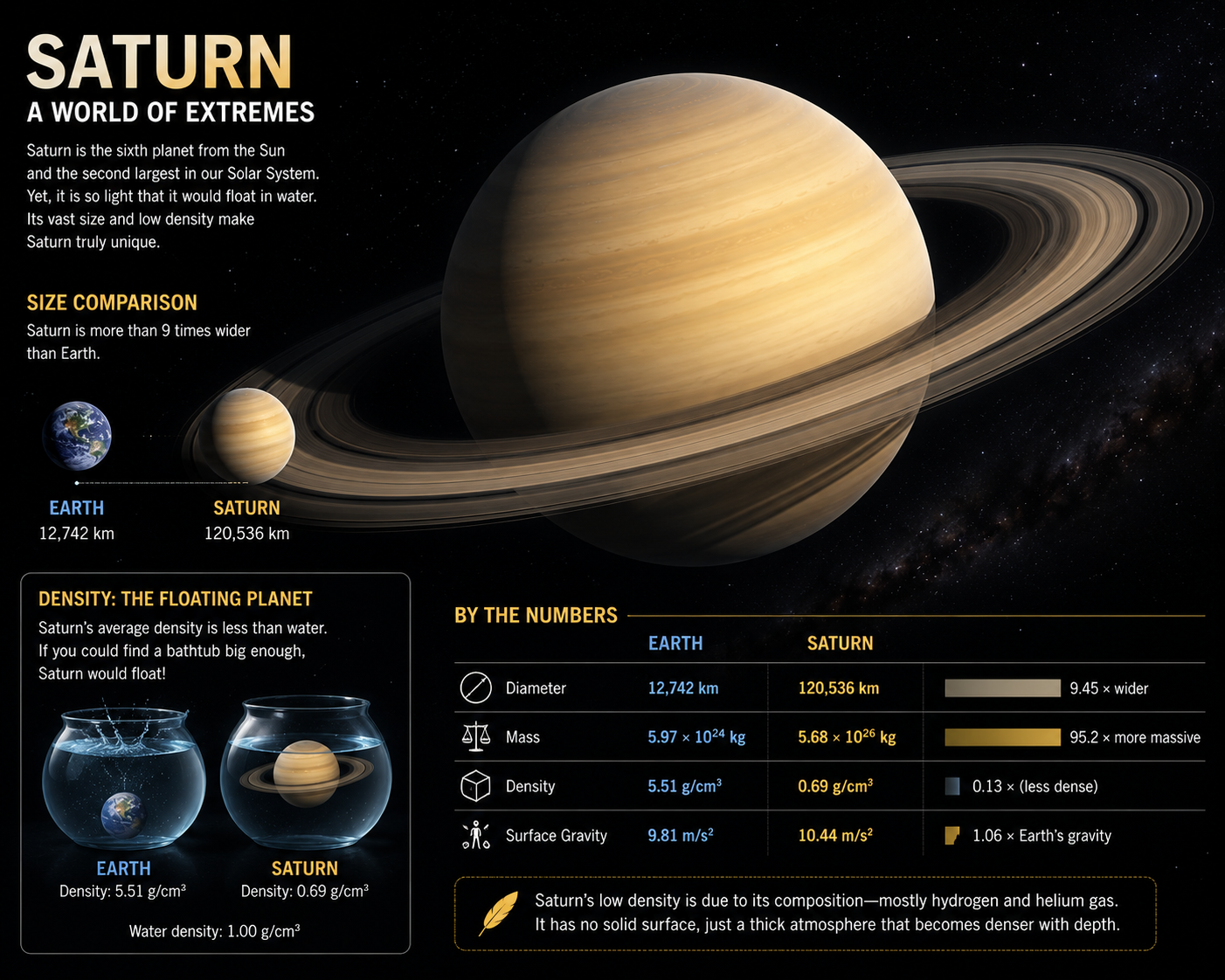
At first glance, Saturn may appear similar to Jupiter, but it possesses characteristics that make it truly unique.
With a diameter of approximately 120,500 kilometers (74,900 miles), Saturn is the second-largest planet in the Solar System. Despite its immense size, it is also the least dense planet. Its average density is lower than that of liquid water, meaning that if an impossibly large ocean existed, Saturn would theoretically float.
Like Jupiter, Saturn is composed primarily of hydrogen and helium. Beneath its cloud tops, pressure increases dramatically, transforming hydrogen into liquid and eventually into metallic hydrogen deep within the planet's interior.
Its rapid rotation—completing one day in about 10.7 hours—causes Saturn to bulge noticeably around its equator, giving the planet a slightly flattened shape.
Despite sharing similarities with Jupiter, Saturn has evolved into a world with its own identity, defined above all by the extraordinary rings that surround it.
The Birth of Saturn
Transition to Chapter 2
From millions of kilometers away, Saturn appears peaceful, almost delicate.
But beneath its golden clouds lies a turbulent atmosphere filled with powerful winds, mysterious storms, and an interior unlike anything found on Earth.
In the next chapter, we will descend beneath Saturn's cloud tops to uncover the hidden giant that lies within.
Chapter 2: Inside the Ringed Giant
Beneath Saturn's Golden Clouds
From a distance, Saturn appears calm and graceful. Its pale golden atmosphere and magnificent rings give it an almost peaceful appearance, as though it were quietly drifting through the darkness of space.
Appearances, however, can be deceiving.
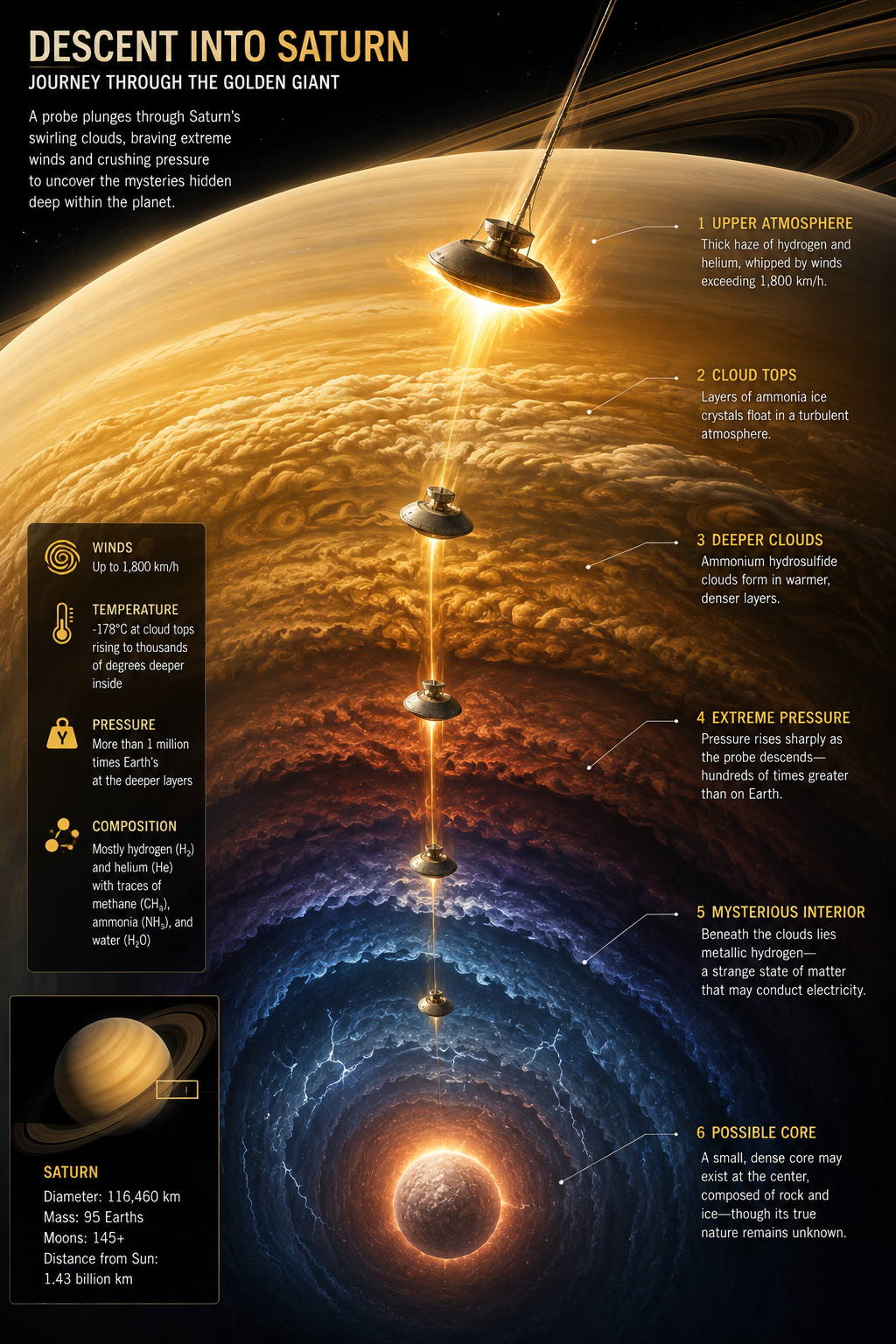
Beneath those beautiful cloud tops lies a world of crushing pressure, freezing upper skies, violent storms, and temperatures that rise dramatically with depth. Like Jupiter, Saturn has no solid surface waiting beneath its atmosphere. Instead, its clouds gradually merge into denser and hotter layers of gas, creating an environment unlike any rocky planet in the Solar System.
If a spacecraft attempted to descend into Saturn, it would never reach a traditional "ground." It would simply sink deeper into an atmosphere that becomes increasingly hostile until the immense pressure eventually destroys it.
A Planet Made Mostly of Hydrogen
Saturn is composed primarily of hydrogen and helium, the same two elements that dominate the Sun. These lightweight gases make up nearly all of the planet's enormous mass.
The upper atmosphere is filled with ammonia ice clouds that give Saturn its soft golden appearance. Beneath these clouds are deeper layers containing ammonium hydrosulfide, water ice, and water vapor, each existing under different temperatures and pressures.
As scientists look farther into Saturn's atmosphere, the environment becomes increasingly mysterious. Pressure rises so dramatically that hydrogen gas transforms into liquid hydrogen. Deeper still, it is believed to become metallic hydrogen, an exotic state of matter capable of conducting electricity.
This hidden layer plays a crucial role in generating Saturn's magnetic field, although it is considerably weaker than Jupiter's.
Unlike Earth, where the atmosphere is only a thin blanket surrounding a rocky surface, Saturn's atmosphere gradually blends into its interior, making it difficult to determine where the atmosphere ends and the planet truly begins.
A Hidden Core Deep Below
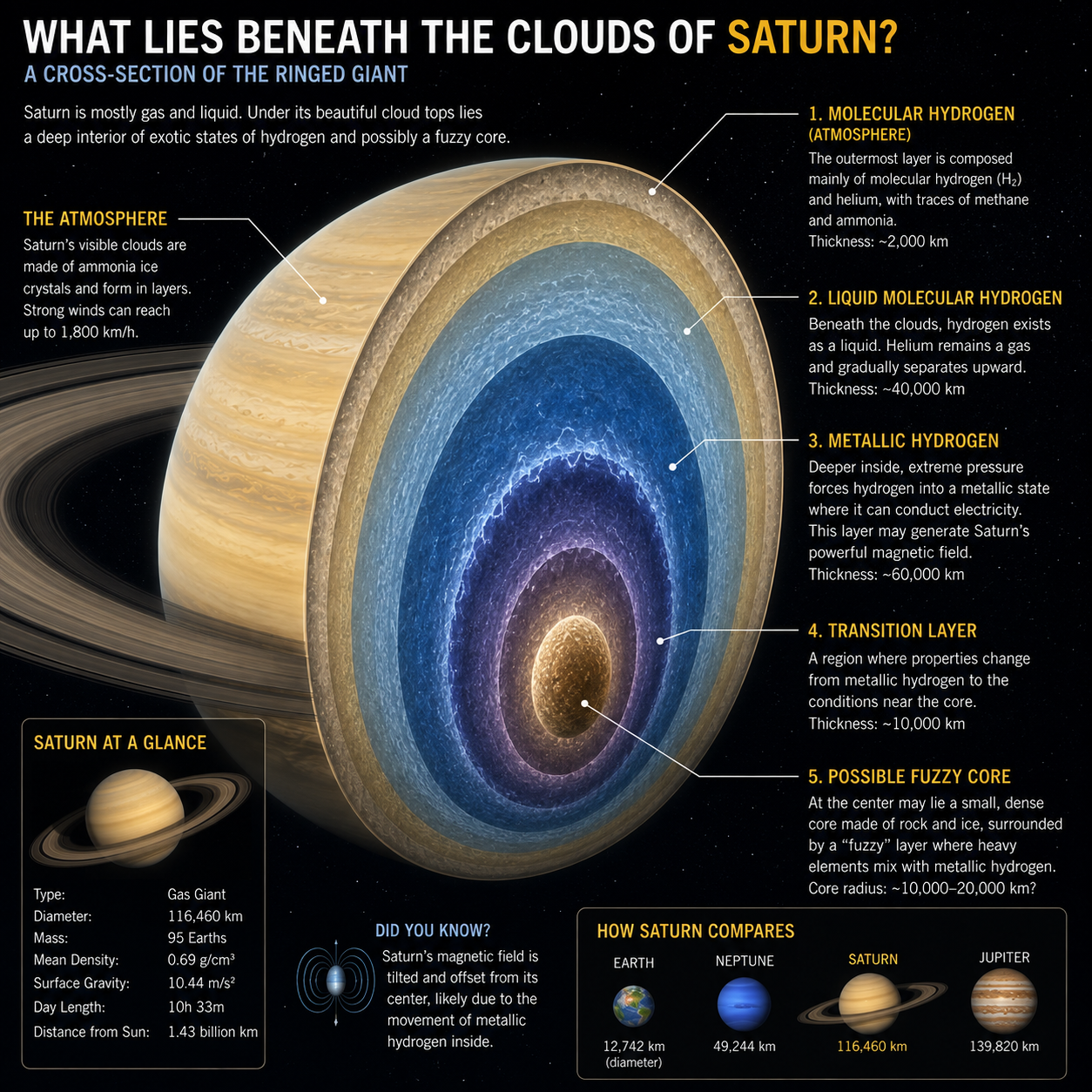
At the very center of Saturn, scientists believe a dense core made of rock, metal, and ice lies buried beneath thousands of kilometers of compressed hydrogen.
Although no spacecraft has ever reached this region, observations from NASA's Cassini mission suggest the core may not be completely solid. Instead, some evidence indicates it could be a diffuse or "fuzzy" core, where heavier elements gradually mix with surrounding fluids rather than forming a sharply defined boundary.
This discovery has changed scientists' understanding of how giant planets evolve over billions of years.
Temperatures near Saturn's center may exceed 11,000°C (20,000°F)—hotter than the surface of the Sun—while pressures become millions of times greater than those experienced on Earth.
These unimaginable conditions remain far beyond the reach of current technology, leaving Saturn's deepest interior one of the Solar System's greatest mysteries.
Inside Saturn
Winds Faster Than Sound
Saturn's atmosphere is one of the windiest places in the Solar System.
Near the equator, powerful jet streams can reach speeds of more than 1,800 kilometers per hour (1,120 miles per hour)—faster than the speed of sound in Earth's atmosphere. These tremendous winds race around the planet, creating broad cloud bands similar to Jupiter's but with softer colors and fewer visible details.
Scientists are still investigating why Saturn's winds remain so powerful. Heat rising from deep inside the planet combines with rapid rotation to drive enormous atmospheric currents that circle the globe without interruption.
Unlike Earth, Saturn has no continents or mountains to slow these winds. They can travel around the entire planet almost endlessly, carrying clouds across thousands of kilometers.
Occasionally, these jet streams produce enormous storms known as Great White Spots. Roughly once every Saturnian year—about 29.5 Earth years—a gigantic storm erupts, wrapping around much of the planet before gradually fading away.
These rare storms remind astronomers that Saturn's calm appearance hides an atmosphere capable of astonishing power.
The Mysterious Hexagon at the North Pole
One of Saturn's strangest features lies high above its north pole.
Discovered during the Voyager missions and later studied in remarkable detail by Cassini, this enormous hexagon-shaped storm has puzzled scientists for decades.
Stretching nearly 30,000 kilometers (18,600 miles) across—wide enough to fit more than two Earths side by side—the hexagon is unlike any weather system observed elsewhere in the Solar System.
Rather than changing shape like ordinary storms, it has maintained its six-sided structure for decades.
Researchers believe the hexagon forms because powerful jet streams moving at different speeds create stable atmospheric waves, though scientists continue studying exactly how this remarkable phenomenon remains so perfectly organized.
It stands as one of the most unusual and beautiful weather systems ever discovered on another planet.
Chapter 2 Summary
Beneath Saturn's elegant appearance lies a giant world dominated by hydrogen, crushing pressure, supersonic winds, and mysterious atmospheric phenomena. From its possible fuzzy core to the remarkable hexagon spinning above its north pole, Saturn continues to challenge scientists' understanding of how gas giants function.
Yet even these incredible discoveries are overshadowed by the feature that has made Saturn famous throughout human history.
In the next chapter, we will explore the breathtaking ring system that transformed Saturn into the most recognizable planet in the Solar System and discover why those delicate rings may not last forever.
Chapter 3: The Rings That Define a Planet
Nature's Greatest Masterpiece
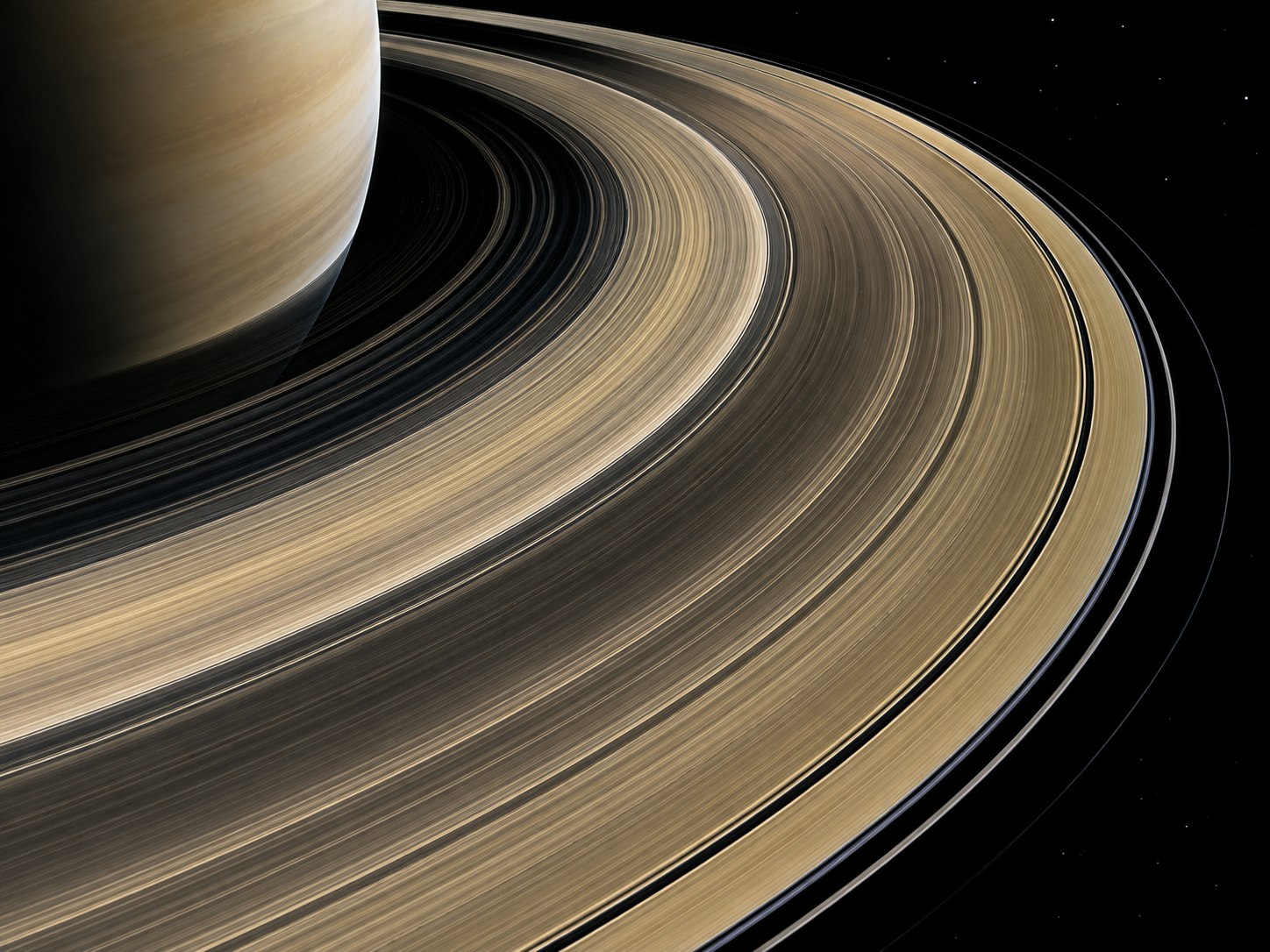
If someone were asked to draw a planet from memory, chances are they would sketch Saturn.
Its magnificent rings have become one of the most recognizable symbols in astronomy. For centuries, they have fascinated scientists and inspired artists, appearing almost too perfect to be real. Through a small telescope, Saturn immediately stands apart from every other planet, its delicate rings giving it an elegance unmatched anywhere else in the Solar System.
But these rings are not solid discs.
They are made of billions of individual particles, each following its own orbit around Saturn. Some are no larger than grains of sand, while others are as large as mountains. Together, they create a structure so vast that it stretches hundreds of thousands of kilometers across space, yet in many places it is only a few tens of meters thick.
From a distance, the rings appear timeless.
In reality, they are constantly changing.
Billions of Pieces Dancing Together
Saturn's rings are composed mainly of water ice, mixed with smaller amounts of rock and dust. Sunlight reflects brilliantly from these icy particles, making Saturn's rings far brighter than those of any other planet.
Scientists divide the rings into several major sections known as the A, B, C, D, E, F, and G rings. Although they appear connected from afar, each ring has its own unique structure, thickness, and particle distribution.
Tiny gaps separate many of these rings, while larger divisions, such as the famous Cassini Division, create the striking patterns visible through telescopes.
Every particle travels around Saturn according to the laws of gravity. Faster-moving particles orbit closer to the planet, while those farther away move more slowly. This constant motion creates an elegant celestial dance that has continued for millions of years.
Seen up close, Saturn's rings are not smooth at all. They are a dynamic system where countless icy fragments endlessly collide, separate, and reorganize under Saturn's immense gravitational pull.
How Did Saturn's Rings Form?
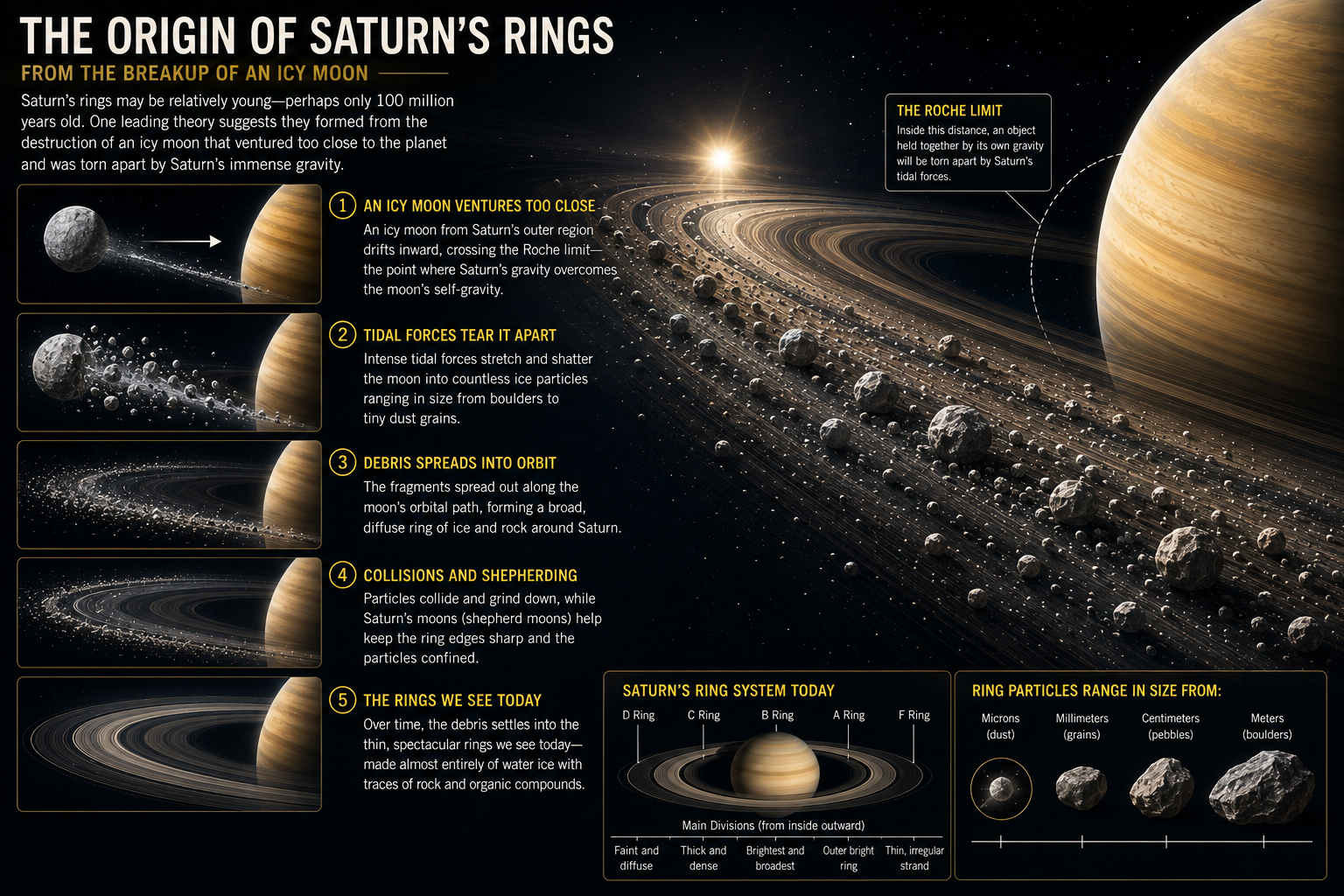
Despite centuries of study, one of Saturn's greatest mysteries remains unanswered.
Where did the rings come from?
Scientists have proposed several ideas.
One possibility is that the rings formed when a large icy moon ventured too close to Saturn. The planet's immense gravity tore the moon apart, scattering countless fragments into orbit.
Another theory suggests the rings are leftovers from Saturn's formation, composed of material that never became a moon.
Recent observations from NASA's Cassini mission indicate that the rings may be much younger than Saturn itself, perhaps only a few hundred million years old. If this is correct, the spectacular view we enjoy today may be relatively recent in the planet's long history.
Although researchers continue to debate their exact origin, one thing is certain: Saturn's rings remain one of the most extraordinary structures ever discovered in the Solar System.
Saturn's Ring System
The Moons That Shape the Rings
Saturn's rings do not exist in isolation.
Several small moons, known as shepherd moons, travel alongside the rings, using their gravity to keep ring particles in place. As they orbit Saturn, these tiny worlds sculpt sharp edges, create narrow gaps, and maintain the beautiful structure visible today.
One of the best-known examples is Pan, a small moon that orbits inside the Encke Gap. As it moves through the ring, its gravity clears a path and produces delicate waves in the surrounding ice particles.
Without these shepherd moons, Saturn's rings would gradually spread out and lose much of their intricate structure.
The rings and moons are locked in a remarkable gravitational partnership, each constantly influencing the other in subtle but important ways.
A Beauty That Will Not Last Forever
Although Saturn's rings appear permanent, they are surprisingly fragile.
Data collected by the Cassini spacecraft revealed that tiny ring particles are slowly falling into Saturn's atmosphere in a process known as "ring rain." Over immense periods of time, gravity pulls this icy material toward the planet, causing the rings to gradually lose mass.
Scientists estimate that, if this process continues, Saturn's rings could largely disappear within the next 100 to 300 million years.
Compared with the planet's age of more than 4.5 billion years, this is only a brief moment.
That means humanity exists during a remarkably fortunate period in cosmic history—one in which Saturn still wears the magnificent rings that have captivated observers for generations.
Perhaps millions of years in the future, future civilizations looking toward Saturn may see a very different world.
Chapter 3 Summary
Saturn's rings are far more than a beautiful decoration. They are a vast and ever-changing system of billions of icy particles, shaped by gravity, guided by tiny moons, and slowly evolving over time.
Yet Saturn's story does not end with its rings.
Orbiting beyond them are extraordinary moons—worlds with methane lakes, hidden oceans, and towering ice geysers. Some may even possess the ingredients needed for life.
In the next chapter, we will leave the rings behind and explore the remarkable family of moons that makes Saturn one of the most fascinating planetary systems in the Solar System.
Chapter 4: A Family of Extraordinary Moons
Worlds That Could Each Tell Their Own Story
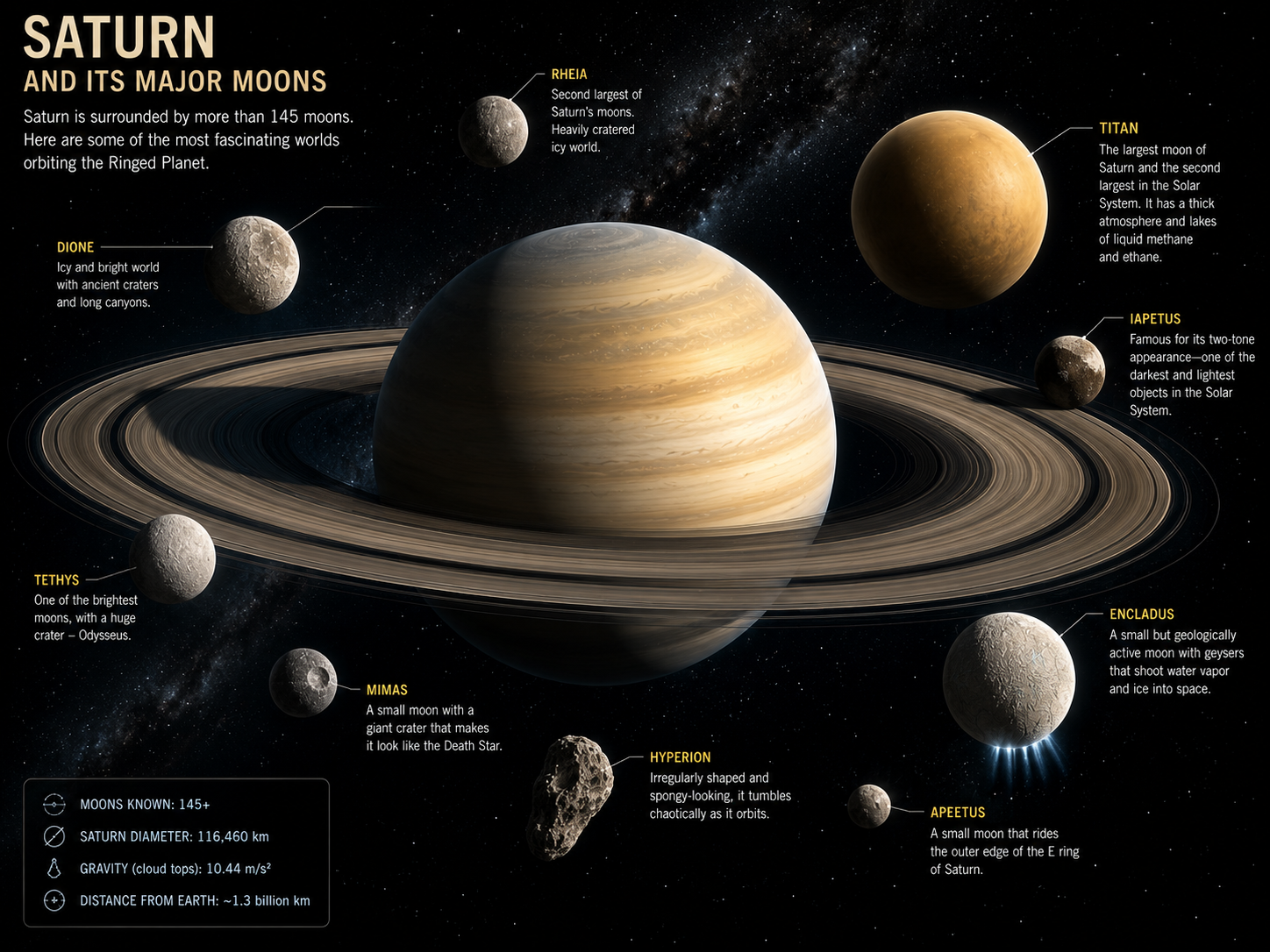
While Saturn's magnificent rings often steal the spotlight, they are only part of what makes this giant planet extraordinary.
Orbiting beyond the rings is an incredible family of more than 140 confirmed moons, each with its own unique landscape, history, and mysteries. Some are small, irregular chunks of rock only a few kilometers across, while others are massive worlds that could easily be mistaken for planets.
Among them are frozen moons hiding underground oceans, worlds covered in giant impact craters, and one moon with rivers, lakes, clouds, and rain—not made of water, but of liquid methane.
Together, these moons transform Saturn into something far greater than a single planet.
It is an entire planetary system waiting to be explored.
Titan: A World That Feels Surprisingly Familiar
The largest and most fascinating of Saturn's moons is Titan.
Larger than the planet Mercury, Titan is the only moon in the Solar System with a thick atmosphere. Dense orange clouds hide its surface from ordinary view, keeping its landscapes mysterious until spacecraft finally pierced the haze.
When NASA's Cassini spacecraft and the Huygens probe explored Titan, they revealed something astonishing.
Titan possesses rivers, lakes, seas, sand dunes, and even rainfall.
The difference is that these features are not made of water.
Because Titan is extremely cold—around −179°C (−290°F)—water behaves like solid rock, while liquid methane and ethane flow across the surface, forming lakes and carving river channels much like water does on Earth.
Scientists believe Titan may resemble what Earth looked like before life emerged billions of years ago. The moon's rich organic chemistry makes it one of the most promising places to study the building blocks of life elsewhere in the Solar System.
Enceladus: An Ocean Hidden Beneath Ice
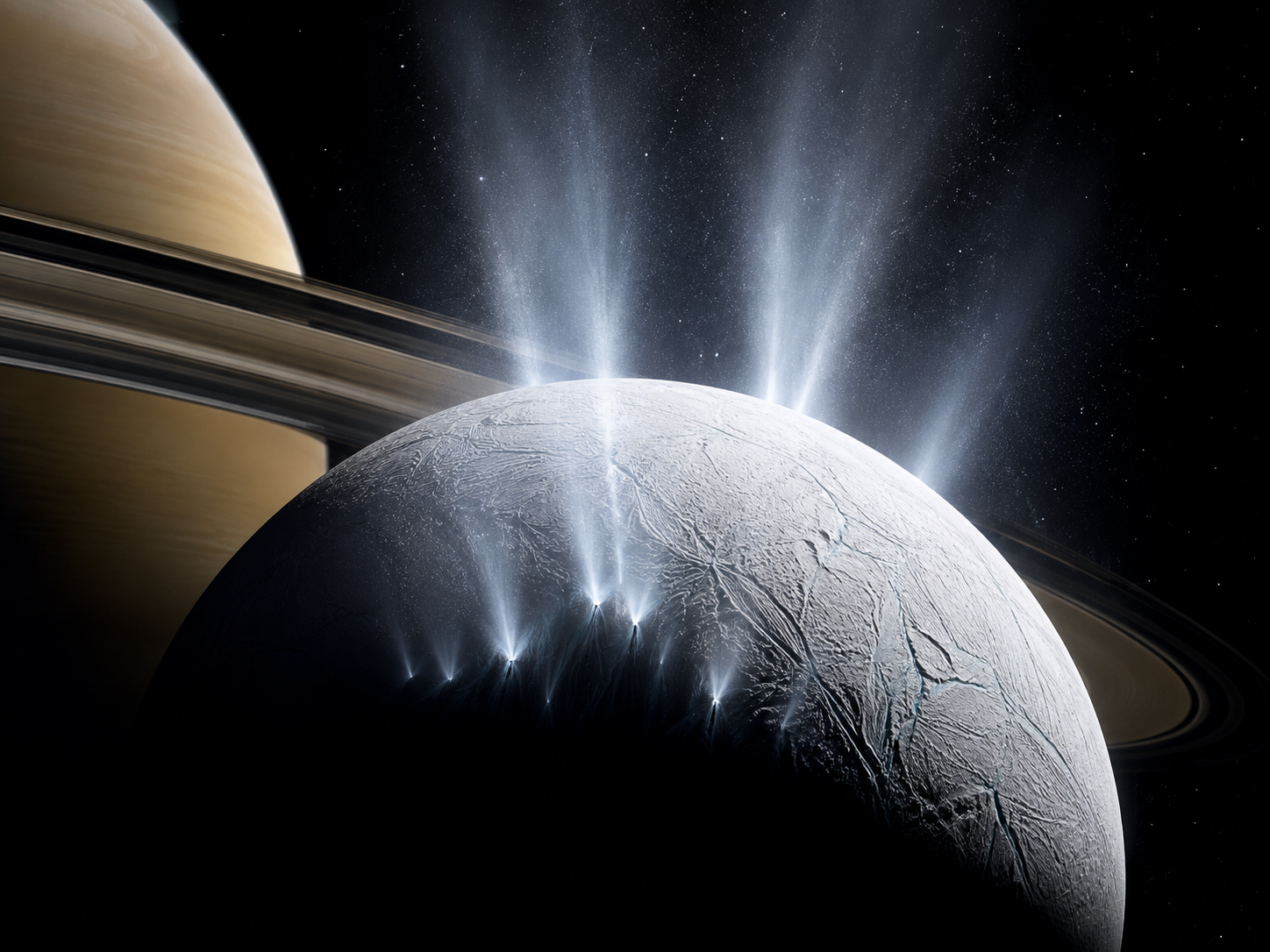
If Titan represents one of Saturn's greatest mysteries, Enceladus represents one of its greatest surprises.
This small icy moon, only about 500 kilometers (310 miles) in diameter, appears quiet from a distance. Beneath its frozen crust, however, lies a vast global ocean of liquid water.
In 2005, the Cassini spacecraft discovered enormous geysers erupting from long fractures near Enceladus' south pole. These towering plumes shoot water vapor, ice particles, and organic compounds hundreds of kilometers into space.
The discovery transformed Enceladus into one of the most exciting places in planetary science.
Scientists believe the underground ocean is warmed by tidal forces generated by Saturn's gravity. This process may create hydrothermal activity on the ocean floor, similar to deep-sea hydrothermal vents on Earth where life can exist without sunlight.
Although no evidence of life has been found, Enceladus has many of the essential ingredients considered necessary for microbial organisms.
Saturn's Major Moons
More Than One Hundred Worlds
Beyond Titan and Enceladus lies an extraordinary collection of diverse moons.
Rhea, Saturn's second-largest moon, is a heavily cratered icy world that may once have possessed a faint ring system of its own.
Iapetus is famous for its dramatic appearance. One hemisphere is almost as dark as coal, while the other is brilliantly bright, creating one of the most striking color contrasts anywhere in the Solar System.
Mimas, with its enormous impact crater, bears such a remarkable resemblance to the fictional Death Star that it has become one of Saturn's most recognizable moons.
Smaller moons continuously interact with Saturn's rings, acting as shepherd moons that help maintain their structure. Others travel in distant, irregular orbits, suggesting they were once asteroids or icy objects captured by Saturn's immense gravity.
Every new moon discovered adds another piece to Saturn's remarkably complex planetary system.
Cassini: The Mission That Changed Everything
For centuries, Saturn remained little more than a beautiful object viewed through telescopes.
That changed dramatically in 2004, when NASA, the European Space Agency (ESA), and the Italian Space Agency (ASI) successfully placed the Cassini spacecraft into orbit around Saturn.
For the next 13 years, Cassini transformed our understanding of the ringed planet.
It flew repeatedly through the ring system, mapped Titan's hidden surface using radar, discovered active geysers on Enceladus, studied Saturn's atmosphere in extraordinary detail, and revealed new moons and previously unseen ring structures.
In 2017, with its mission complete and fuel running low, Cassini made a deliberate final dive into Saturn's atmosphere. Scientists chose this dramatic ending to ensure the spacecraft would never accidentally contaminate moons such as Enceladus or Titan, where future discoveries about life may still await.
Cassini's final transmission marked the end of one of the greatest planetary exploration missions in history, but its discoveries continue to shape scientific research today.
Chapter 4 Summary
Saturn's moons are not merely companions orbiting a giant planet—they are fascinating worlds in their own right. Titan's methane seas, Enceladus' hidden ocean, and dozens of other icy satellites reveal that Saturn's system is one of the most diverse and scientifically important regions in the Solar System.
Yet Saturn's influence extends beyond its rings and moons.
Its gravity, immense size, and enduring beauty have shaped both scientific discovery and humanity's imagination for centuries.
In the final chapter, we will explore Saturn's lasting legacy, future exploration, and why this elegant giant continues to be regarded as one of the greatest wonders of our cosmic neighborhood.
Chapter 5: Saturn's Legacy
A Planet That Changed the Way We See the Universe
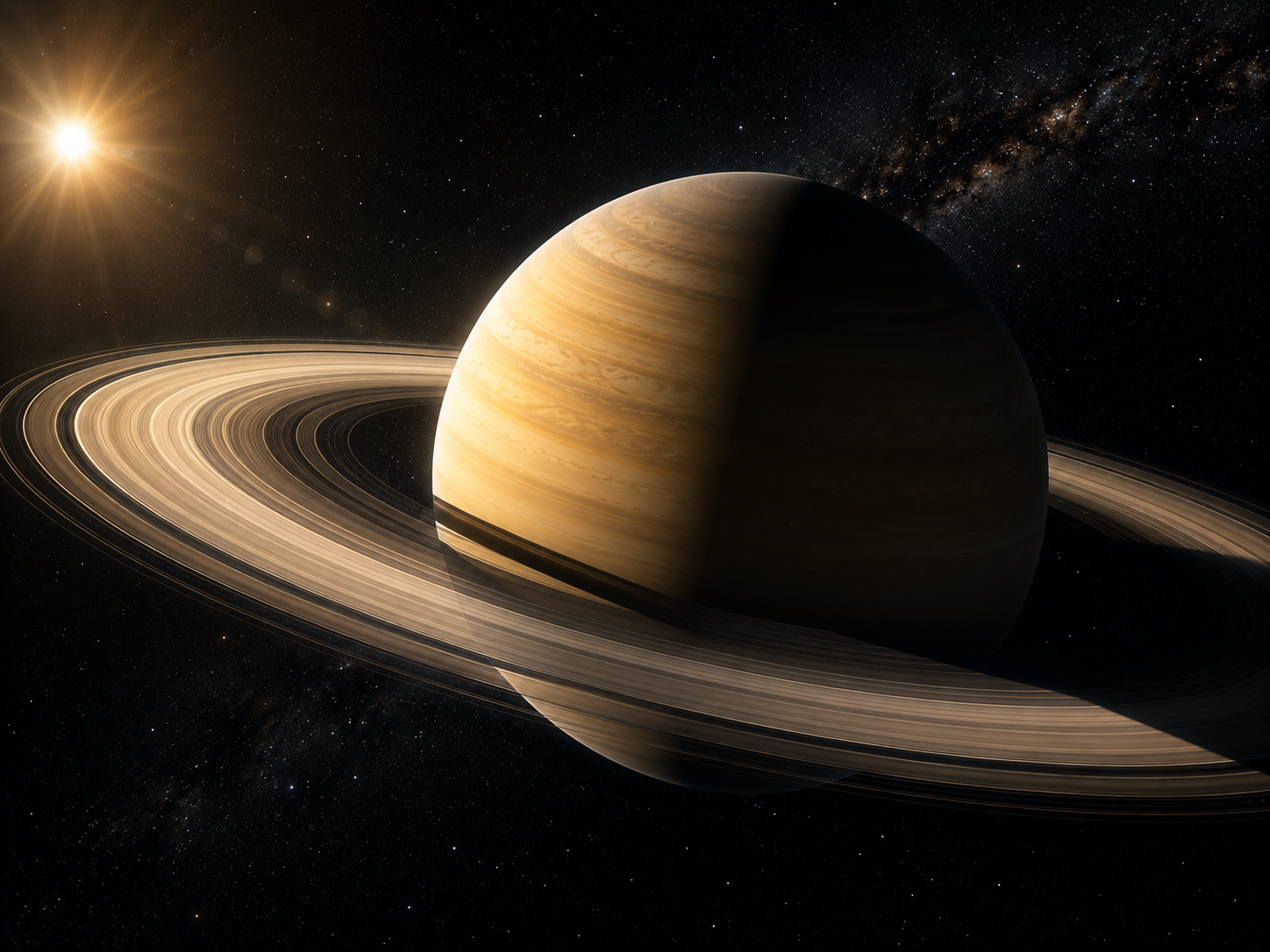
Among all the planets in the Solar System, Saturn occupies a special place in human imagination.
For thousands of years, it appeared as a slow-moving golden light wandering across the night sky. Ancient civilizations watched its steady motion long before they understood that it was another world orbiting the Sun. With the invention of the telescope, Saturn became one of astronomy's greatest mysteries, and when Galileo Galilei first observed it in 1610, he could not understand the strange shapes extending from its sides.
It was only decades later that astronomers realized Saturn was surrounded by an immense system of rings unlike anything ever seen before.
Since then, every generation has looked at Saturn with the same sense of wonder.
The ringed giant is more than just a beautiful planet—it is a reminder that the universe often exceeds the limits of our imagination.
A Window Into Planetary Evolution
Saturn has become one of the most valuable laboratories for understanding how planetary systems evolve.
Its atmosphere reveals how giant planets transport heat from deep within their interiors. Its rings allow scientists to observe gravity shaping billions of icy particles in real time. Its moons provide natural laboratories where geology, chemistry, oceans, and atmospheres evolve under conditions unlike those on Earth.
Many discoveries made at Saturn have changed planetary science forever.
The hidden ocean beneath Enceladus, the methane lakes of Titan, and the dynamic behavior of Saturn's rings have expanded our understanding of where potentially habitable environments may exist.
Astronomers also use Saturn to study distant exoplanets. Thousands of gas giants have been discovered around other stars, and many share similarities with Saturn. By understanding the ringed giant, scientists gain valuable clues about how giant planets throughout the galaxy form, migrate, and interact with their own systems of moons.
Saturn is no longer viewed as an isolated planet.
It has become a key to understanding countless planetary systems beyond our own.
Could Humans Ever Explore Saturn?
Unlike Mars or the Moon, Saturn itself is not a destination where humans could ever stand.
Its atmosphere has no solid surface, and conditions become increasingly extreme with depth. Crushing pressure, powerful winds, and rising temperatures would destroy any spacecraft long before reaching the planet's deepest layers.
Its moons, however, tell a different story.
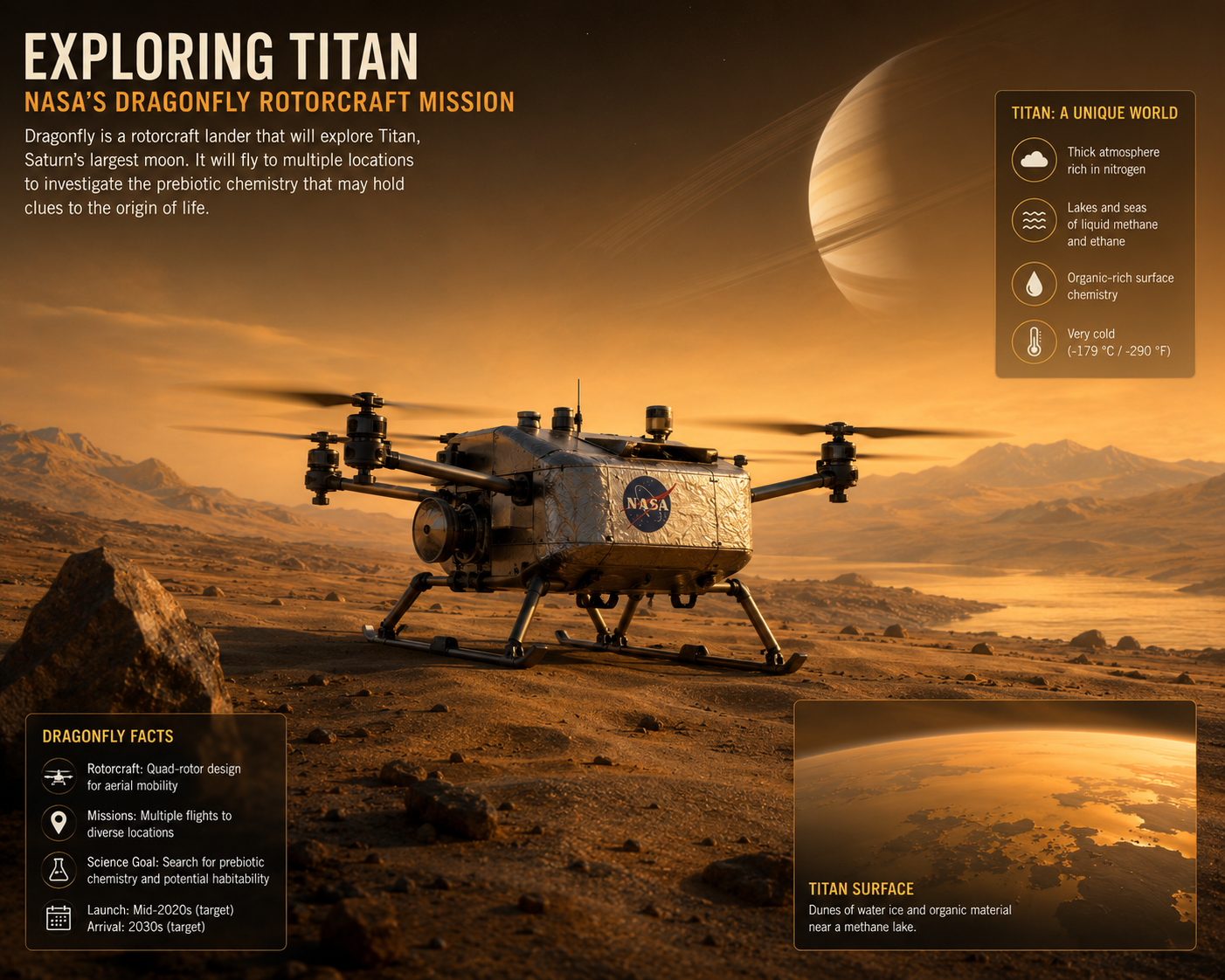
Titan is considered one of the most promising destinations for future exploration. With its thick atmosphere, low gravity, and stable surface, it is one of the few worlds where an aircraft could fly with remarkable efficiency.
NASA's Dragonfly mission, scheduled to explore Titan in the coming decade, will send a nuclear-powered rotorcraft to investigate its dunes, ancient riverbeds, and organic-rich landscapes. The mission aims to search for clues about the chemical processes that may resemble those that existed on the early Earth.
Meanwhile, Enceladus remains a prime target for future missions seeking evidence of life beneath its frozen crust.
Saturn itself may remain forever unreachable, but its remarkable moons could become some of humanity's most important destinations beyond Earth.
Saturn Compared with Earth
The Beauty of a Temporary Wonder
Perhaps the most remarkable fact about Saturn is that its defining feature may not last forever.
The magnificent rings that have inspired humanity for centuries are slowly disappearing.
As tiny particles spiral into Saturn's atmosphere through ring rain, the planet gradually loses the icy material that makes its rings so spectacular. Scientists estimate that within the next 100 to 300 million years, much of the ring system could vanish.
Considering Saturn is more than 4.5 billion years old, this means humanity exists during a brief window of cosmic history when the rings are still bright and clearly visible.
That realization makes Saturn even more extraordinary.
Every photograph taken by a spacecraft, every telescope pointed toward the planet, and every person who gazes at it through the night sky is witnessing a temporary masterpiece that future observers may never see in the same form.
Conclusion: The Jewel of the Solar System
Saturn is often described as the most beautiful planet in the Solar System, but beauty alone does not explain its importance.
Beneath its elegant rings lies a giant world of powerful winds, mysterious interiors, and hidden forces. Surrounding it is an extraordinary family of moons, where methane seas, icy geysers, and underground oceans challenge our understanding of where life might exist.
Its rings reveal gravity in motion, its atmosphere demonstrates the immense power of gas giants, and its moons continue to reshape planetary science with every new discovery.
For centuries, Saturn has inspired curiosity, exploration, and scientific discovery. From Galileo's first uncertain observations to the breathtaking images returned by the Cassini spacecraft, every generation has uncovered another chapter in the story of this remarkable world.
When we look toward Saturn, we are not simply admiring the Solar System's most elegant planet.
We are witnessing one of nature's greatest works of art—a masterpiece sculpted by gravity, time, and the endless forces of the cosmos.
Frequently Asked Questions (FAQs)
1. Why is Saturn called the Ringed Planet?
Saturn is known as the Ringed Planet because it has the largest and most spectacular ring system in the Solar System. These rings are made of billions of icy particles, rocks, and dust orbiting the planet.
2. What are Saturn's rings made of?
Saturn's rings consist mostly of water ice, mixed with smaller amounts of rock and dust. The particles range in size from tiny grains to large chunks several meters across, reflecting sunlight and giving the rings their bright appearance.
3. Can humans land on Saturn?
No. Saturn is a gas giant with no solid surface. A spacecraft descending into its atmosphere would encounter crushing pressure and extreme temperatures, eventually being destroyed before reaching the planet's deep interior.
4. How many moons does Saturn have?
Saturn has more than 140 confirmed moons, making it the planet with the largest known moon system in the Solar System. Its most famous moons include Titan, Enceladus, Rhea, Iapetus, and Mimas.
5. Why is Titan one of the most interesting moons?
Titan is unique because it has a thick atmosphere, along with rivers, lakes, seas, and rain made of liquid methane and ethane. Scientists believe Titan may resemble the early Earth before life developed.
6. Could there be life on Enceladus?
Possibly. Enceladus has a global ocean beneath its icy crust, and spacecraft have detected water vapor, organic molecules, and other ingredients considered important for life. While no life has been discovered, it is one of the most promising places to search for microbial life.
7. Why are Saturn's rings disappearing?
Saturn's rings are gradually losing material through a process called ring rain, where tiny ice particles are pulled into the planet's atmosphere by gravity. Scientists estimate the rings may largely disappear within the next 100 to 300 million years.
8. Which spacecraft have explored Saturn?
Several spacecraft have visited Saturn, including Pioneer 11, Voyager 1, Voyager 2, and the Cassini-Huygens mission. Cassini orbited Saturn from 2004 to 2017, while the Huygens probe successfully landed on Titan in 2005.
9. Why is Saturn less dense than water?
Although Saturn is enormous, it is composed mostly of lightweight gases such as hydrogen and helium. This gives it an average density lower than water, making it the least dense planet in the Solar System.
10. What is the hexagon on Saturn?
The Saturn Hexagon is a massive six-sided jet stream surrounding the planet's north pole. Measuring about 30,000 kilometers (18,600 miles) across, it has remained stable for decades and is one of the most unusual weather patterns ever discovered in the Solar System.