Introduction: The Planet That Broke the Rules
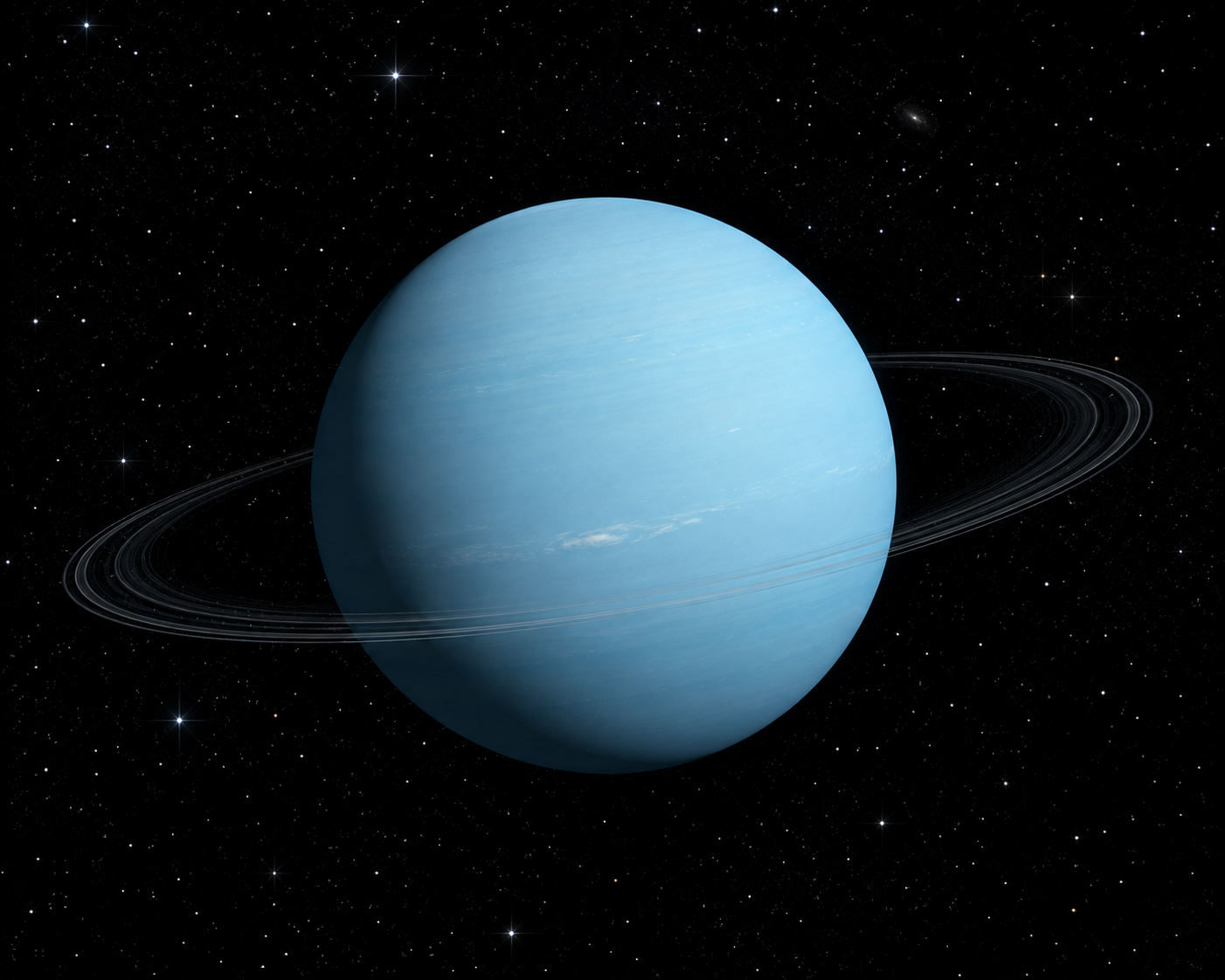
In the distant reaches of the Solar System, nearly three billion kilometers from the Sun, a pale blue-green planet drifts through the darkness with an elegance unlike any other world.
At first glance, Uranus appears almost featureless. Its soft cyan color and smooth atmosphere give the impression of a quiet, frozen planet where nothing ever changes. Compared with Jupiter's raging storms or Saturn's brilliant rings, Uranus seems almost forgotten.
But appearances can be deceptive.
Uranus is one of the strangest planets ever discovered. It rotates on its side, as if it had been knocked over during the Solar System's violent youth. Its seasons last more than 20 Earth years each, its magnetic field is strangely tilted and off-center, and its atmosphere contains some of the coldest temperatures measured on any planet.
Beneath its calm exterior lies an alien world made not only of hydrogen and helium but also vast quantities of water, ammonia, and methane compressed into exotic forms deep inside the planet. Scientists classify Uranus as an ice giant, separating it from the larger gas giants Jupiter and Saturn.
Despite being discovered over two centuries ago, Uranus remains one of the least explored planets in the Solar System. Only one spacecraft has ever flown past it, leaving many of its mysteries unsolved.
Studying Uranus offers more than an understanding of one distant world. It provides a window into an entire class of planets that appear to be common throughout our galaxy, helping astronomers understand how planetary systems form far beyond our own.
Chapter 1: The Planet That Fell Sideways
A Violent Beginning
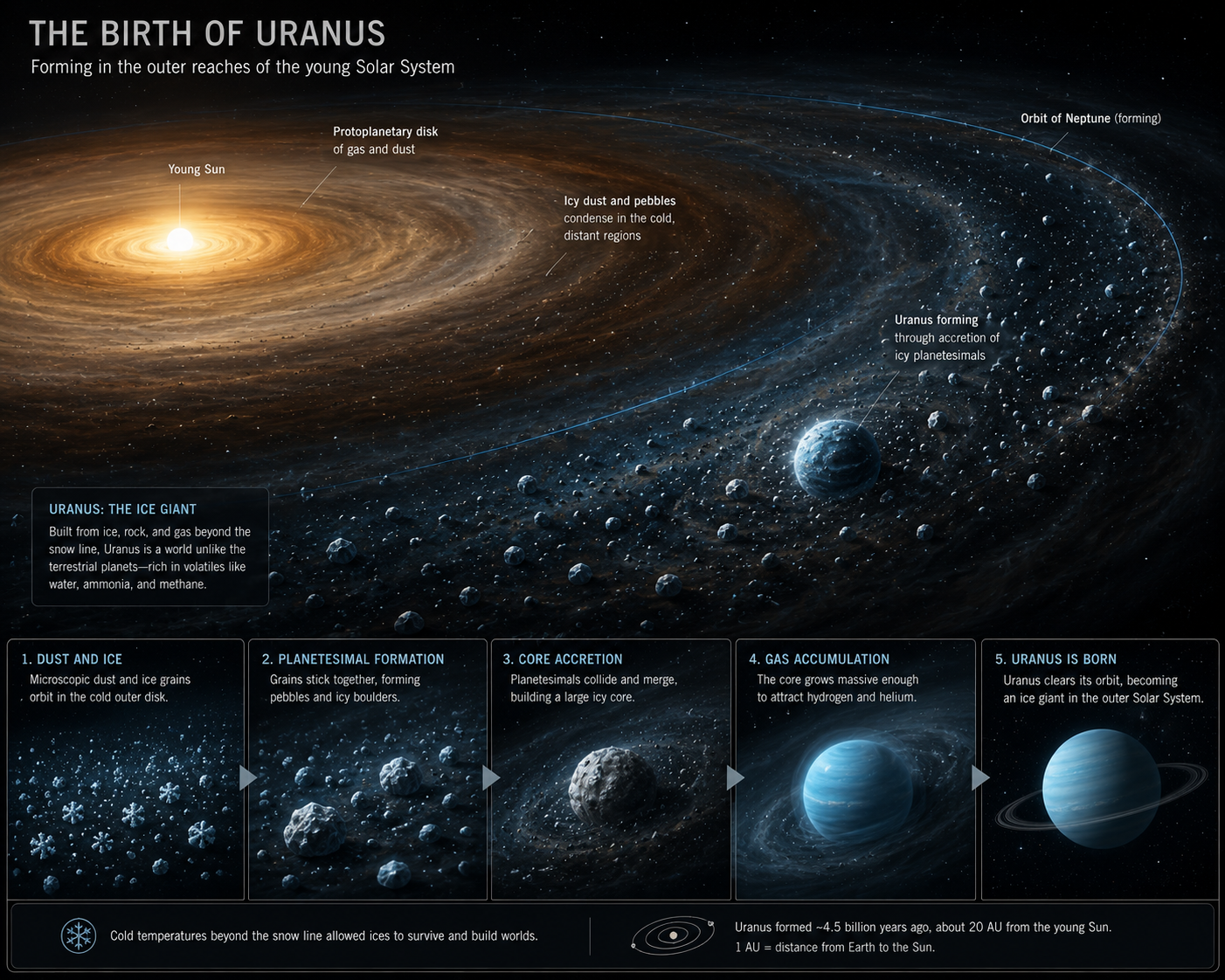
More than 4.5 billion years ago, while the giant planets were taking shape in the outer Solar System, Uranus began forming from a mixture of gas, rock, and enormous quantities of frozen water, ammonia, and methane.
Like Jupiter and Saturn, Uranus grew around a dense core that gradually attracted surrounding material. But because it formed farther from the young Sun, less hydrogen and helium were available before the solar nebula dispersed.
The result was something entirely different.
Rather than becoming another gas giant, Uranus evolved into an ice giant, a planet whose interior contains far greater proportions of water, ammonia, and methane than Jupiter or Saturn.
Scientists believe Uranus reached its current size relatively early in the Solar System's history. Then, sometime during its formation, an event occurred that changed the planet forever.
The Collision That Changed Everything
Among all the planets orbiting the Sun, Uranus stands apart for one remarkable reason.
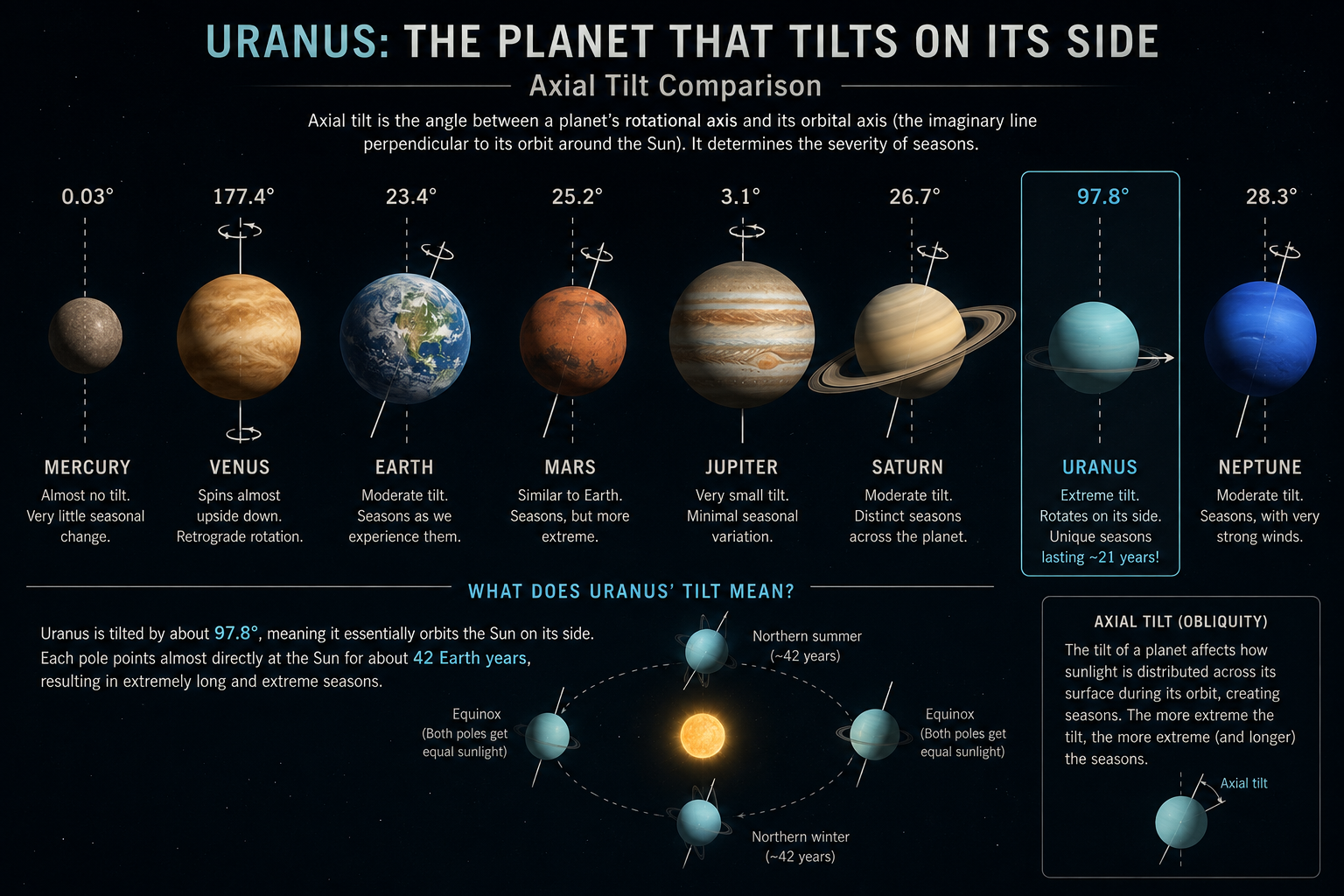
Its axis is tilted by approximately 98 degrees.
Instead of spinning upright like Earth or Jupiter, Uranus rotates almost completely on its side. Imagine rolling a ball across a table instead of spinning a top—that is how Uranus travels around the Sun.
The leading explanation is that a massive object, perhaps twice the size of Earth, collided with the young Uranus billions of years ago. The impact may have knocked the planet onto its side while leaving it intact.
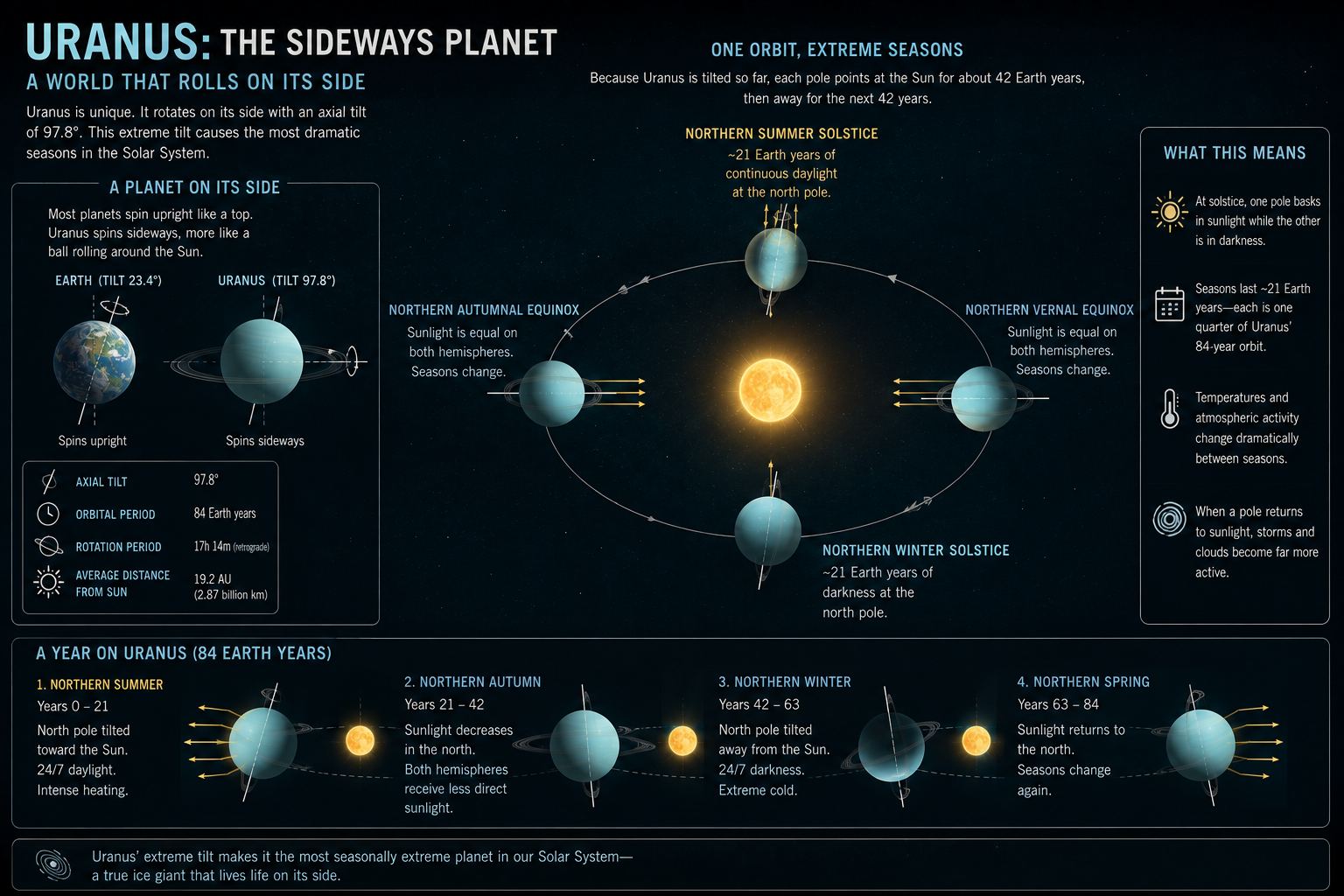
This unusual orientation creates the most extreme seasons in the Solar System. Each pole experiences about 42 years of continuous sunlight followed by 42 years of darkness as Uranus completes one orbit around the Sun every 84 Earth years.
No other planet experiences seasons quite like this.
Why Uranus Spins Sideways
Transition to Chapter 2
From a distance, Uranus appears calm, almost motionless.
Yet beneath its pale blue atmosphere lies a frozen giant where powerful winds race around the planet, exotic materials are compressed under immense pressure, and temperatures plunge lower than anywhere else in the Solar System.
In the next chapter, we will descend into Uranus' mysterious interior to discover what truly lies beneath its tranquil appearance.
Chapter 2: Inside the Frozen Giant
Beneath the Calm Blue Sky
From millions of kilometers away, Uranus appears almost peaceful.
Its pale blue-green atmosphere shows few visible storms, giving the impression of a quiet and unchanging world. Compared with the dramatic cloud bands of Jupiter or the golden beauty of Saturn, Uranus seems almost motionless.
But beneath this tranquil appearance lies one of the most mysterious interiors in the Solar System.
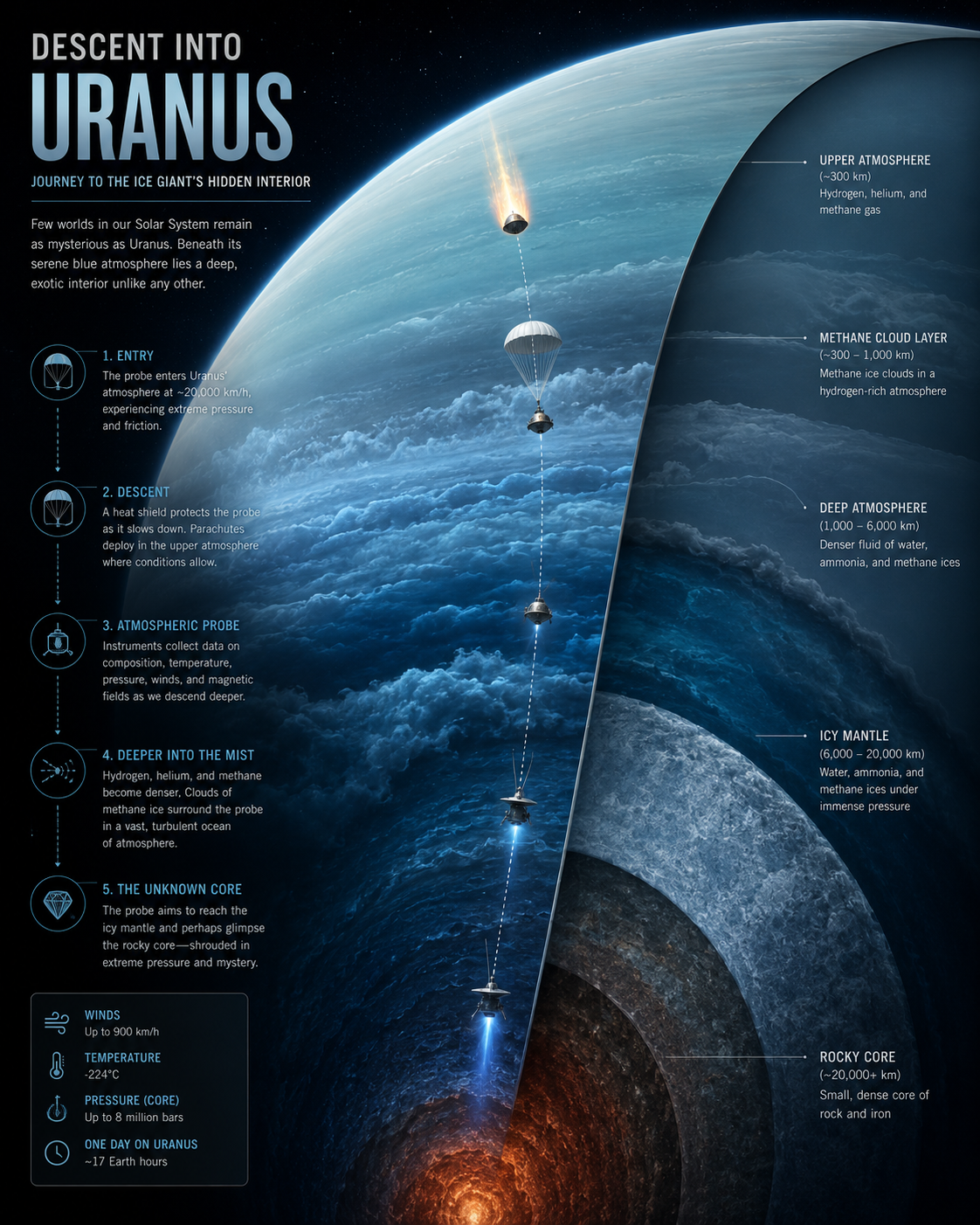
There is no solid surface waiting beneath the clouds. Instead, the atmosphere gradually transitions into deeper layers where pressure rises enormously, temperatures climb despite the planet's distance from the Sun, and familiar substances behave in extraordinary ways.
The farther one descends, the stranger Uranus becomes.
A Planet of Ice—But Not the Ice We Know
Although Uranus is called an ice giant, the name can be misleading.
Scientists do not mean that the planet is filled with frozen ice cubes. Instead, the term refers to materials such as water, ammonia, and methane that were frozen when the Solar System formed billions of years ago.
Deep inside Uranus, these substances no longer exist as ordinary ice.
Under pressures millions of times greater than those on Earth, they transform into scorching, dense fluids unlike anything found naturally on our planet. Scientists believe much of Uranus' interior consists of a vast mantle of superheated water, ammonia, and methane surrounding a relatively small rocky core.
Above this mantle lies a thick atmosphere composed mainly of hydrogen and helium, with a small amount of methane.
It is the methane that gives Uranus its beautiful blue-green color. The gas absorbs red wavelengths of sunlight while reflecting blue and green light back into space, giving the planet its distinctive appearance.
The Coldest Planet in the Solar System
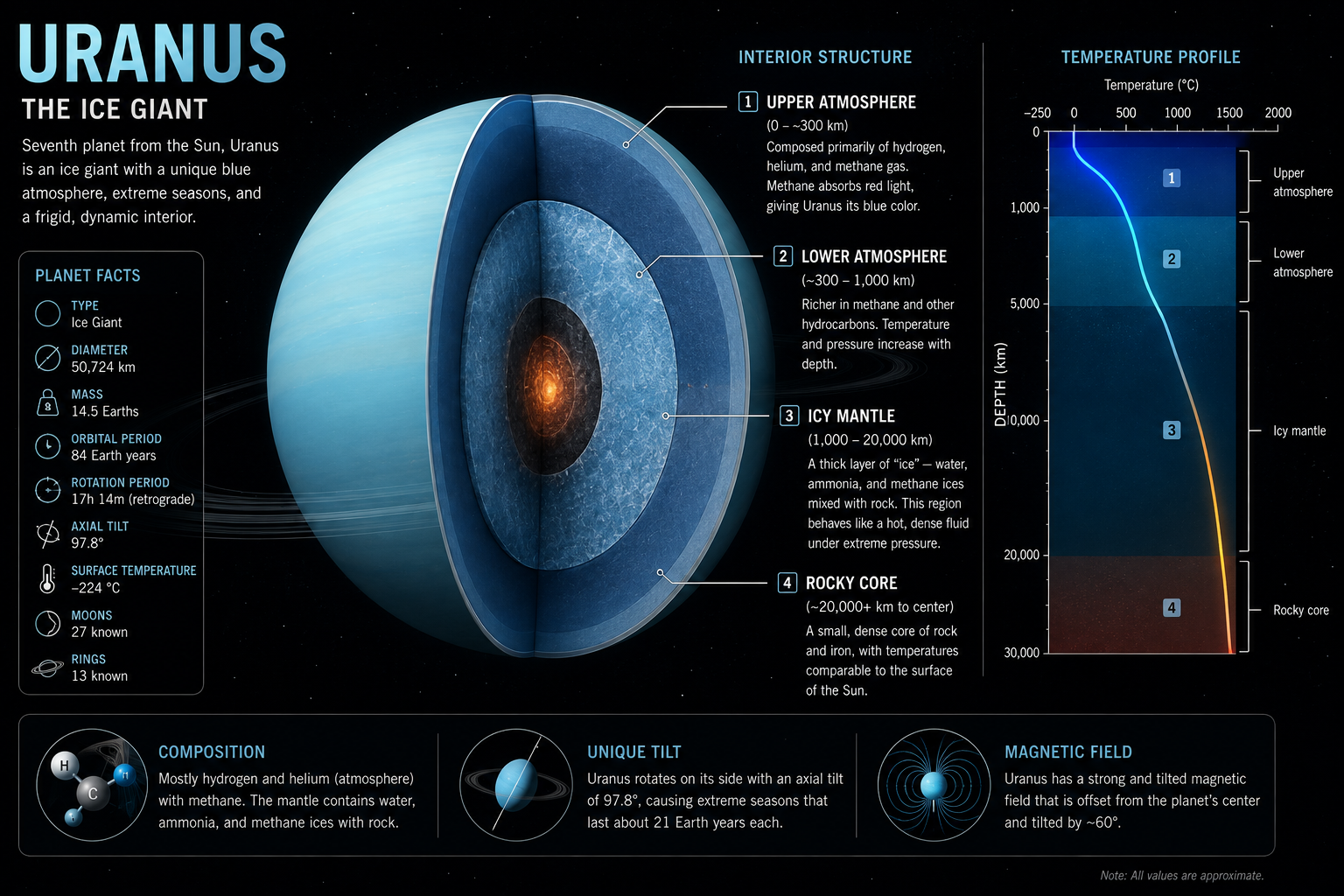
One of Uranus' greatest mysteries is its temperature.
Despite being closer to the Sun than Neptune, Uranus is actually the coldest planet in the Solar System.
Temperatures in its upper atmosphere can fall to around −224°C (−371°F), making it even colder than Neptune.
Scientists are still trying to understand why.
Most giant planets release significant heat left over from their formation. Jupiter, Saturn, and Neptune all radiate more energy than they receive from the Sun.
Uranus is different.
It emits remarkably little internal heat, causing its atmosphere to remain exceptionally cold. Some researchers believe the ancient collision that tipped Uranus onto its side may also have disrupted its internal heat flow, trapping much of its energy deep within the planet.
Although the exact explanation remains uncertain, Uranus continues to challenge scientists' understanding of how giant planets evolve.
Inside Uranus
An Ocean Unlike Anything on Earth
Far below Uranus' atmosphere, conditions become almost impossible to imagine.
As pressure increases, water and other compounds enter exotic states that cannot exist naturally on Earth. Laboratory experiments suggest that under these extreme conditions, carbon atoms from methane may separate and become compressed into tiny crystals.
In theory, these crystals could slowly sink through the planet's interior like glittering raindrops.
This remarkable idea is often called "diamond rain."
Although scientists have recreated similar conditions in laboratory experiments, whether large-scale diamond rain truly occurs inside Uranus remains an active area of research.
If it does, the planet may contain one of the most extraordinary natural phenomena in the Solar System.
A Magnetic Field That Refuses to Behave
Most planets with magnetic fields generate them deep within their cores.
Uranus breaks that rule.
Its magnetic field is tilted by about 59 degrees from its rotation axis and is significantly offset from the planet's center. As Uranus rotates, this unusual geometry causes the magnetic field to wobble dramatically through space.
Scientists think this strange field may be generated within electrically conducting layers of water and ammonia deep inside the icy mantle rather than near the core.
The result is one of the most unusual magnetic environments ever discovered.
Even after the brief flyby of Voyager 2 in 1986, researchers still cannot fully explain why Uranus' magnetic field behaves so differently from those of the other planets.
Chapter 2 Summary
Beneath Uranus' quiet appearance lies a remarkably complex world. Its methane-rich atmosphere gives the planet its blue-green color, while an immense icy mantle, mysterious internal structure, extreme cold, and oddly tilted magnetic field make Uranus unlike any other planet in the Solar System.
Yet the surprises do not end beneath the clouds.
Despite appearing calm from a distance, Uranus possesses powerful winds, hidden storms, faint rings, and seasons unlike anywhere else in the Solar System.
In the next chapter, we will explore the planet's dynamic atmosphere, its extraordinary weather, and the faint ring system that quietly circles this distant ice giant.
Chapter 3: The Quiet World That Isn't Quiet
A Planet That Hides Its Storms
For many years, astronomers believed Uranus was one of the most peaceful planets in the Solar System.
When Voyager 2 flew past the planet in 1986, its cameras captured a nearly featureless blue sphere. Unlike Jupiter's colorful cloud bands or Saturn's dramatic storms, Uranus appeared smooth and almost lifeless. It quickly earned the nickname "the boring planet."
But as telescope technology improved, that image began to change.
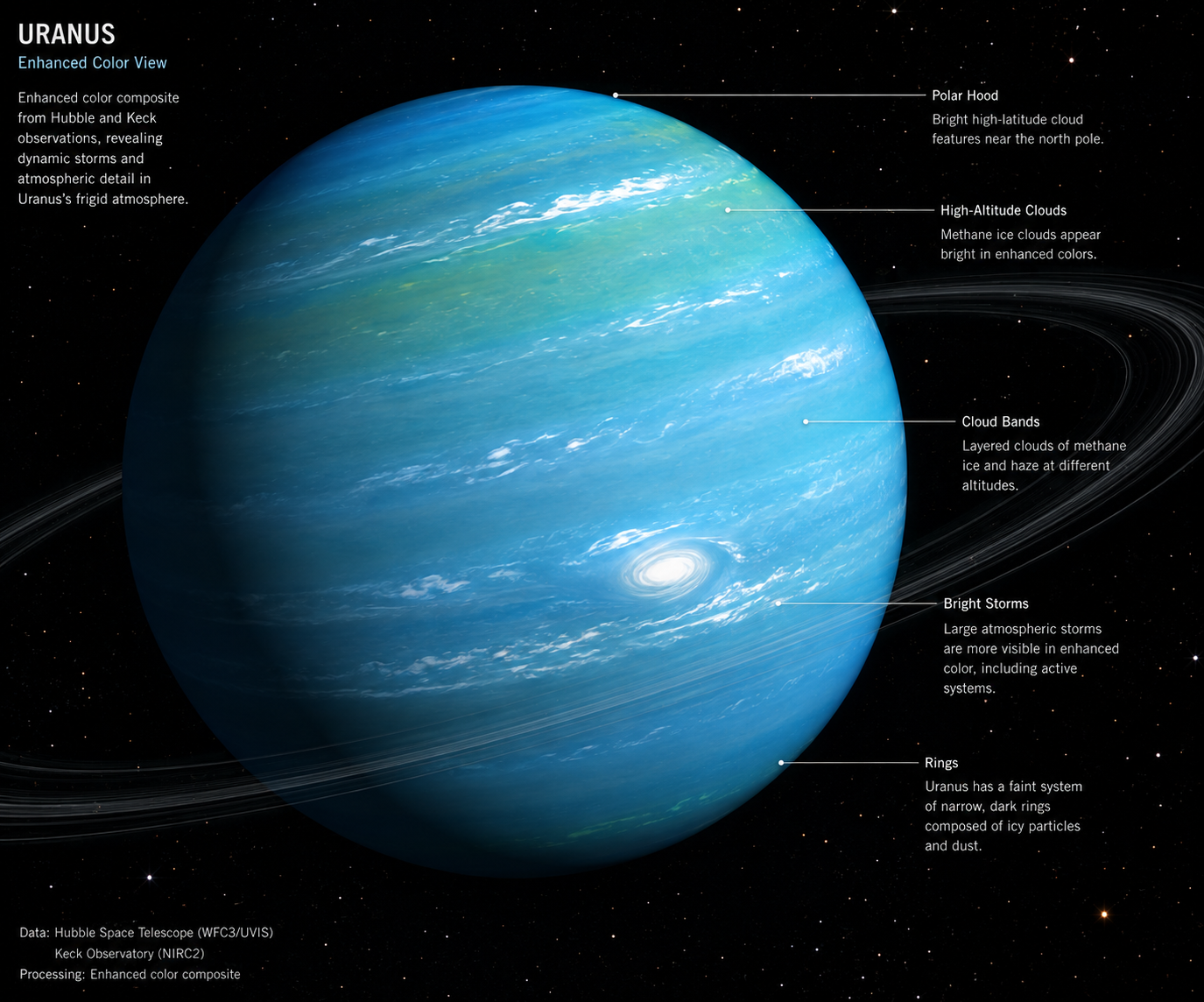
Powerful observatories, including the Hubble Space Telescope and large ground-based telescopes, started detecting bright storms, swirling clouds, and powerful winds racing through Uranus' atmosphere.
The quiet giant had been hiding its true nature all along.
Winds Faster Than a Hurricane
Although Uranus receives only a tiny fraction of the sunlight that reaches Earth, its atmosphere is surprisingly active.
Powerful jet streams race around the planet at speeds exceeding 900 kilometers per hour (560 miles per hour). These winds are several times stronger than the most intense hurricanes ever recorded on Earth.
Scientists are still investigating what drives such powerful winds.
Unlike Earth, where the Sun is the primary engine of weather, Uranus receives very little solar energy because of its enormous distance from the Sun. Instead, scientists believe complex interactions between the planet's rotation, atmospheric composition, and internal processes generate these powerful air currents.
High-altitude clouds made of methane ice drift through the atmosphere while deeper layers remain hidden beneath thick haze.
Even though Uranus appears calm from afar, its atmosphere is constantly moving.
Seasons That Last a Generation
No other planet experiences seasons quite like Uranus.
Because the planet rotates on its side, each pole points almost directly toward the Sun for decades before gradually turning away into darkness.
As Uranus slowly travels around the Sun, one hemisphere experiences about 42 years of continuous daylight, followed by 42 years of continuous night. A complete orbit takes 84 Earth years, meaning a single season lasts roughly 21 Earth years.
Imagine being born during summer and not seeing winter until adulthood.
These extraordinary seasonal changes affect the planet's atmosphere in ways scientists are still trying to understand. As sunlight shifts from one hemisphere to the other, cloud activity increases, storms appear, and atmospheric circulation gradually changes.
Each Uranian year offers researchers a rare opportunity to watch an entire planet slowly transform over decades.
The Seasons of Uranus
The Hidden Rings of Uranus
Saturn may be famous for its spectacular rings, but Uranus also possesses a ring system.
The difference is that Uranus' rings are dark, narrow, and extremely faint.
They remained undiscovered until 1977, when astronomers noticed a distant star repeatedly disappearing as Uranus passed in front of it. Instead of fading only once behind the planet, the star briefly dimmed several times before and after the main eclipse.
The explanation was remarkable.
A system of thin rings surrounded Uranus.
Today, astronomers have identified 13 known rings, composed mainly of dark rocky material mixed with small amounts of ice. Unlike Saturn's bright rings, Uranus' rings reflect very little sunlight, making them difficult to observe even with powerful telescopes.
Some of the rings are kept in place by small shepherd moons, whose gravity helps maintain their narrow shapes.
Although they rarely appear in photographs, these delicate rings reveal that Uranus is more dynamic than its calm appearance suggests.
A Planet That Still Guards Its Secrets
Despite decades of research, Uranus remains one of the least understood planets in the Solar System.
Only one spacecraft—Voyager 2—has ever visited, spending just a few hours studying the planet before continuing its journey into deep space.
Everything scientists have learned since then has come from telescopes orbiting Earth or observing from mountaintops around the world.
Many questions remain unanswered.
Why is Uranus so much colder than Neptune?
What truly lies inside its icy mantle?
How did its magnetic field become so strangely tilted?
What caused the giant impact that tipped the planet onto its side?
These mysteries make Uranus one of the highest priorities for future planetary exploration.
Every unanswered question reminds us that the quiet blue giant still has many stories left to tell.
Chapter 3 Summary
Behind Uranus' peaceful appearance lies a surprisingly active world. Powerful winds race through its atmosphere, storms appear with the changing seasons, faint rings circle the planet, and its extraordinary sideways rotation creates the most unusual climate in the Solar System.
Yet Uranus is not alone.
Orbiting this distant giant is a remarkable family of icy moons, each preserving clues about the violent history of the outer Solar System.
In the next chapter, we will explore Uranus' fascinating moons, discover landscapes unlike any found elsewhere, and revisit the historic Voyager 2 mission—the only spacecraft ever to visit this mysterious world.
Chapter 4: The Forgotten Kingdom of Moons
A Family of Frozen Worlds
Far beyond Saturn's brilliant rings, where sunlight is nearly 400 times weaker than on Earth, Uranus quietly carries a remarkable collection of icy moons through the darkness.
Although they rarely receive the same attention as Jupiter's Galilean moons or Saturn's Titan and Enceladus, the moons of Uranus are among the most fascinating worlds in the Solar System. Many preserve the scars of ancient collisions, while others show signs of enormous geological forces that once reshaped their frozen landscapes.
Today, Uranus has 28 confirmed moons, ranging from tiny irregular objects only a few kilometers across to massive icy worlds hundreds of kilometers wide.
Unlike many planetary systems, most of Uranus' largest moons are named after characters from the works of William Shakespeare and Alexander Pope, giving this distant family of worlds a literary identity unlike any other planet.
Together, they form one of the least explored planetary systems in the Solar System.
Miranda: The Moon That Shouldn't Exist
If one moon perfectly represents the mysteries of Uranus, it is Miranda.
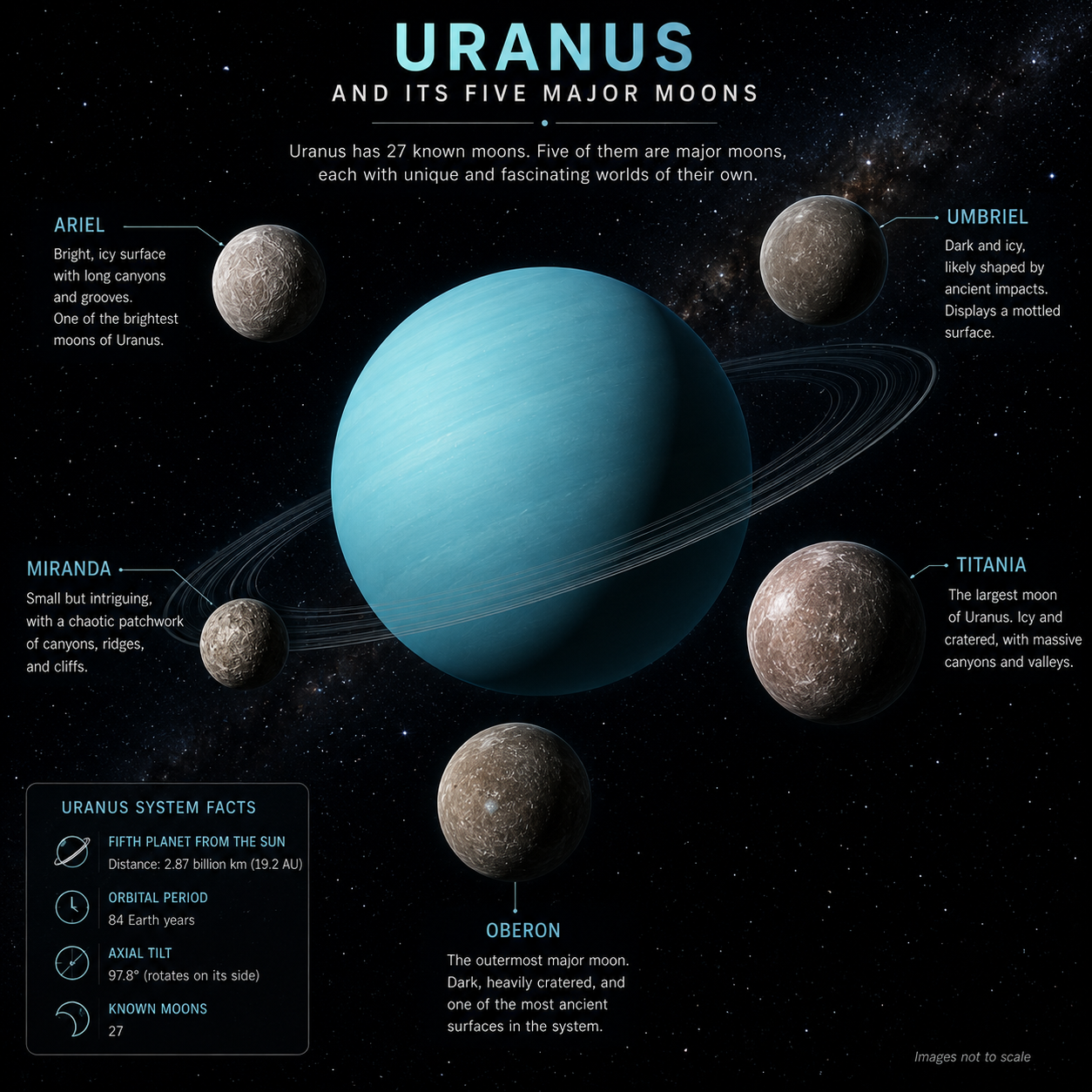
At only about 470 kilometers (290 miles) across, Miranda is relatively small, yet its surface is unlike anything else ever discovered.
Towering cliffs rise nearly 20 kilometers (12 miles) above the surrounding terrain. Vast canyons slice through ancient plains, while enormous ridges and strange patchwork landscapes make the moon appear as though it had been broken apart and reassembled.
One of its most spectacular features, Verona Rupes, is believed to be the tallest known cliff in the Solar System.
Scientists think Miranda may have experienced catastrophic impacts early in its history. Some theories suggest the moon was shattered by a massive collision before gravity slowly pulled the fragments back together.
Whether that dramatic event truly occurred remains uncertain, but Miranda continues to challenge our understanding of how small icy worlds evolve.
Titania and Oberon: The Giants of Uranus
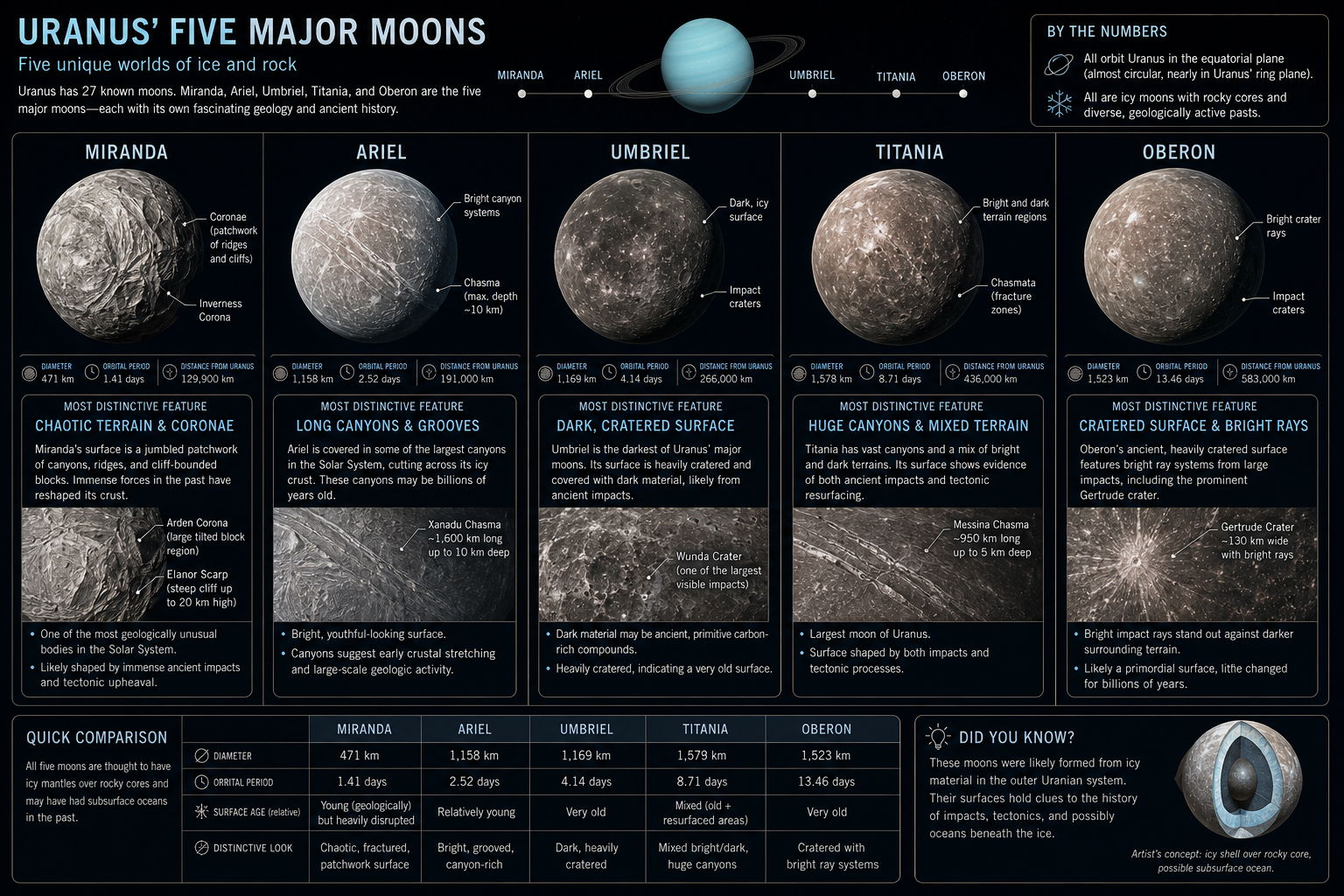
The two largest moons of Uranus are Titania and Oberon.
Both are ancient worlds composed of rock and ice, covered with countless impact craters that record billions of years of Solar System history.
Titania, the largest moon, displays enormous fault valleys stretching hundreds of kilometers across its surface. These giant fractures suggest that the moon expanded as its interior cooled, cracking its icy crust much like dry mud splitting under the Sun.
Oberon, the outermost of Uranus' major moons, is even more heavily cratered. Bright deposits found inside several impact craters hint that fresh ice may have been exposed when ancient collisions blasted through the darker surface.
Although neither moon has been explored in detail since Voyager 2's brief flyby, scientists believe they may still conceal surprises beneath their frozen crusts.
The Major Moons of Uranus
A Planet Visited Only Once
Despite its scientific importance, Uranus remains one of the least explored planets ever discovered.
The only spacecraft to visit was Voyager 2, which flew past the planet on January 24, 1986.
Traveling at more than 60,000 kilometers per hour, the spacecraft had only a few hours to observe Uranus before continuing toward Neptune.
Even during that brief encounter, Voyager transformed our understanding of the distant ice giant.
It discovered new moons, photographed the planet's faint rings, measured its unusual magnetic field, and captured the first close-up images of its largest satellites.
Yet compared with the years spent exploring Jupiter and Saturn, Uranus received only a fleeting visit.
Much of what we know today still comes from that single encounter nearly four decades ago.
The Next Great Frontier
Planetary scientists increasingly agree that Uranus deserves another mission.
Modern spacecraft equipped with advanced cameras, radar systems, spectrometers, and atmospheric probes could answer questions that Voyager 2 never had time to investigate.
Researchers hope to study Uranus' unusual interior, understand its oddly tilted magnetic field, investigate the chemistry of its atmosphere, and search for evidence of hidden oceans within some of its larger moons.
A dedicated orbiter could spend years exploring the Uranian system, revealing details that have remained hidden since humanity's only visit.
For now, however, Uranus continues its silent journey around the Sun, guarding many of its greatest secrets beneath pale blue clouds.
Chapter 4 Summary
Uranus' moons reveal a frozen kingdom shaped by ancient collisions, tectonic forces, and billions of years of cosmic history. From Miranda's towering cliffs to Titania's vast fault valleys, each moon offers clues about the evolution of the outer Solar System.
Yet humanity has explored this remarkable system only once.
In the final chapter, we will discover why Uranus is becoming one of the highest priorities for future space exploration, explore what its distant future may hold, and understand why this quiet ice giant is far more important than its understated appearance suggests.
Chapter 5: The Silent Giant's Legacy
The Planet That Still Waits to Be Understood
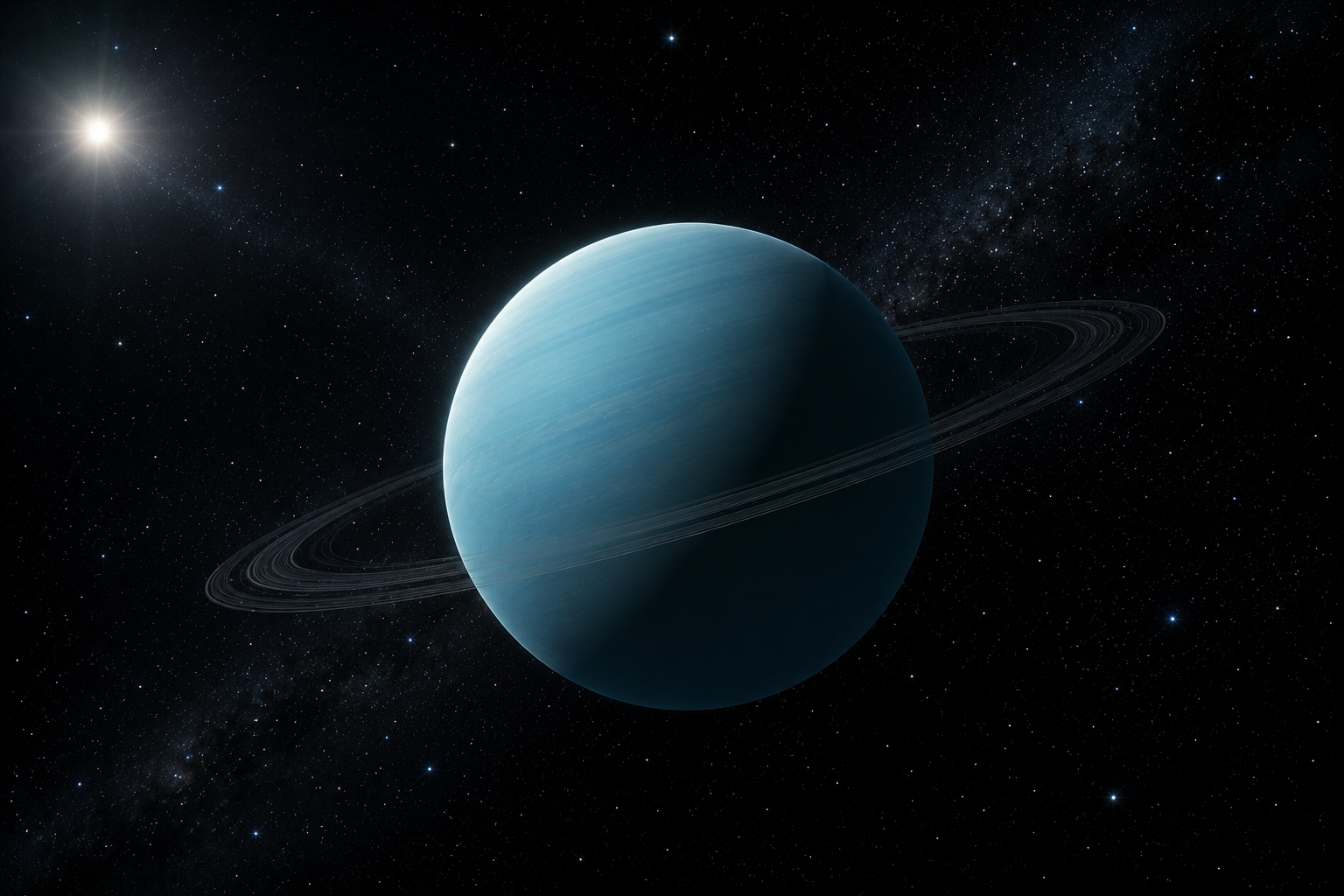
Among the eight planets of the Solar System, Uranus is perhaps the most overlooked.
Mercury races around the Sun under scorching heat. Venus hides beneath a toxic atmosphere. Earth teems with life, while Mars fuels dreams of future exploration. Jupiter dominates with its immense size, and Saturn dazzles with its magnificent rings.
Uranus, meanwhile, quietly orbits in the darkness.
For decades, it has remained the least explored giant planet, visited only once by a passing spacecraft. Yet beneath its calm appearance lies one of the greatest scientific opportunities in planetary science.
Every unanswered question about Uranus is an invitation to explore.
A Blueprint for Distant Worlds
Although Uranus seems unusual within our own Solar System, planets like it appear to be surprisingly common throughout the Milky Way.
Over the past two decades, astronomers have discovered thousands of exoplanets orbiting distant stars. Among the most frequently detected are planets similar in size to Uranus and Neptune.
This makes Uranus far more important than its quiet appearance suggests.
By understanding its atmosphere, magnetic field, internal structure, and evolution, scientists gain valuable insights into countless planets beyond our Solar System.
In many ways, Uranus serves as a nearby laboratory for studying worlds that are far too distant to visit.
Every discovery made here helps astronomers better understand planetary systems throughout the galaxy.
The Next Mission to Uranus
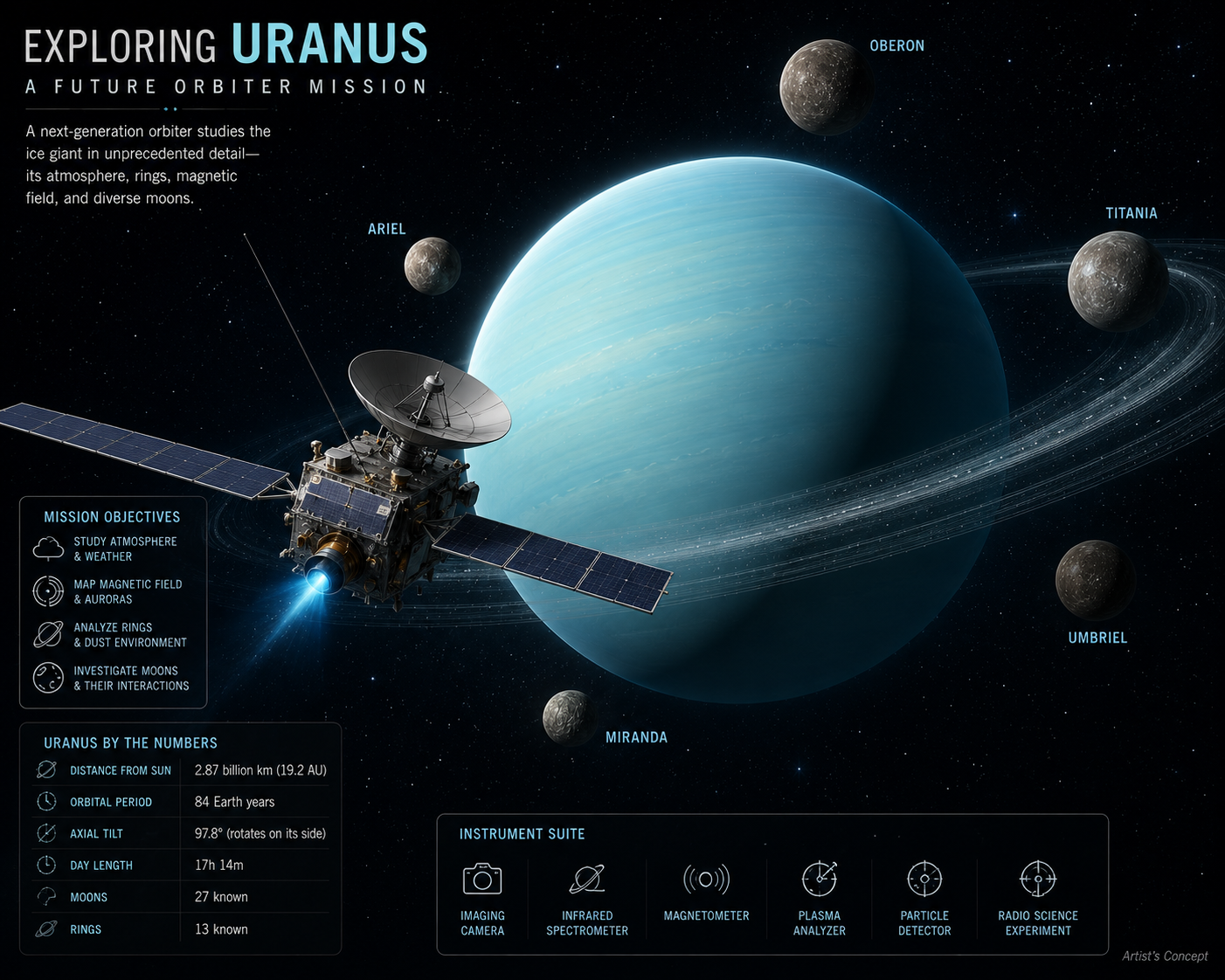
Since Voyager 2 sped past Uranus in 1986, no spacecraft has returned.
Yet that may soon change.
Planetary scientists have repeatedly identified a dedicated Uranus Orbiter and Probe as one of the highest priorities for future exploration. Such a mission could spend years studying the planet instead of only a few hours.
A modern spacecraft could map the atmosphere in extraordinary detail, measure the planet's gravity and magnetic field with far greater precision, investigate the chemistry of its clouds, and release an atmospheric probe to sample gases directly for the first time.
Its moons would also become major targets.
Scientists hope to determine whether some of these frozen worlds still hide subsurface oceans beneath their icy crusts and to investigate how the unusual Uranian system evolved after the ancient collision that tipped the planet onto its side.
A single long-term mission could answer questions that have remained unsolved for generations.
Uranus Compared with Earth
A Planet of Endless Questions
The greatest mystery surrounding Uranus is not one single phenomenon.
It is the sheer number of unanswered questions.
Why does Uranus release so little internal heat compared with Neptune?
Did a giant collision truly knock the planet onto its side?
How does its unusual magnetic field form?
Does diamond rain fall deep inside its interior?
Could some of its moons conceal hidden oceans?
Each answer has the potential to reshape our understanding of how planets form and evolve.
History has shown that the most important discoveries often come from the worlds we understand the least.
Uranus reminds us that even in our own cosmic neighborhood, exploration is far from complete.
The Beauty of the Quiet Unknown
Unlike Jupiter's dramatic storms or Saturn's dazzling rings, Uranus inspires wonder in a quieter way.
Its beauty lies in its subtlety.
Its pale blue color comes from methane drifting through a distant atmosphere. Its extreme seasons unfold so slowly that an entire human generation experiences only part of one Uranian year. Its faint rings quietly circle a planet that spins almost sideways, while frozen moons preserve landscapes billions of years old.
It is a world that asks us to slow down.
To look beyond first impressions.
To remember that some of the universe's greatest mysteries do not announce themselves with spectacular explosions or brilliant colors—they wait patiently for curious minds to uncover them.
Conclusion: The Forgotten Ice Giant
Uranus is often described as the most mysterious of the giant planets.
Born in the frozen outer Solar System, it evolved into an ice giant unlike any other. An ancient collision tipped it onto its side, creating the most extreme seasons of any planet. Beneath its pale blue atmosphere lies an exotic interior where water, ammonia, and methane exist under unimaginable pressure, while a strangely tilted magnetic field continues to puzzle scientists.
Around it orbit frozen moons, faint rings, and a planetary system that has barely been explored.
More than forty years have passed since Voyager 2 offered humanity its only close look at this distant world. Yet Uranus still holds countless secrets, waiting for the next generation of explorers to return.
Perhaps that is what makes Uranus so fascinating.
It reminds us that even after centuries of astronomy and decades of space exploration, our own Solar System still contains worlds that remain largely unknown.
Sometimes, the greatest discoveries are not found on the brightest planets—but on the quiet ones waiting in the darkness.
Frequently Asked Questions (FAQs)
1. Why does Uranus rotate on its side?
Uranus has an axial tilt of about 98 degrees, meaning it rotates almost completely on its side. Scientists believe a massive collision with a young protoplanet billions of years ago knocked Uranus into this unusual position.
2. Why is Uranus called an ice giant?
Uranus is classified as an ice giant because its interior contains large amounts of water, ammonia, and methane in dense, superheated forms. Unlike Jupiter and Saturn, it has a much smaller proportion of hydrogen and helium.
3. Why is Uranus blue-green?
The planet's blue-green color comes from methane gas in its atmosphere. Methane absorbs red light from the Sun while reflecting blue and green wavelengths back into space.
4. Is Uranus the coldest planet in the Solar System?
Yes. Uranus has the coldest atmosphere of any planet, with temperatures dropping to around −224°C (−371°F). Surprisingly, it is even colder than Neptune, despite being closer to the Sun.
5. Does Uranus have rings?
Yes. Uranus has 13 known rings, but they are much darker and fainter than Saturn's. They are made mostly of rocky material mixed with small amounts of ice, making them difficult to observe.
6. How many moons does Uranus have?
Uranus has 28 confirmed moons. The five largest are Miranda, Ariel, Umbriel, Titania, and Oberon, and most are named after characters from the works of William Shakespeare and Alexander Pope.
7. Has any spacecraft visited Uranus?
Yes. NASA's Voyager 2 is the only spacecraft to have explored Uranus. It flew past the planet on January 24, 1986, capturing the first close-up images of its atmosphere, rings, and moons.
8. Does diamond rain really fall on Uranus?
Scientists think it is possible. Under the planet's extreme pressure and temperature, carbon atoms from methane may compress into tiny diamonds that sink through the interior. Laboratory experiments support this idea, but it has not yet been directly observed inside Uranus.
9. Why are Uranus' seasons so extreme?
Because Uranus rotates on its side, each pole experiences about 42 years of continuous daylight followed by 42 years of darkness during its 84-year orbit around the Sun. This creates the most extreme seasonal cycle of any planet.
10. Why is Uranus important to scientists?
Uranus helps scientists understand ice giants, a type of planet that appears to be common throughout the galaxy. Studying Uranus also improves our knowledge of planetary formation, magnetic fields, atmospheric physics, and distant exoplanets.