Introduction — The Fish That Looks Like a Plant
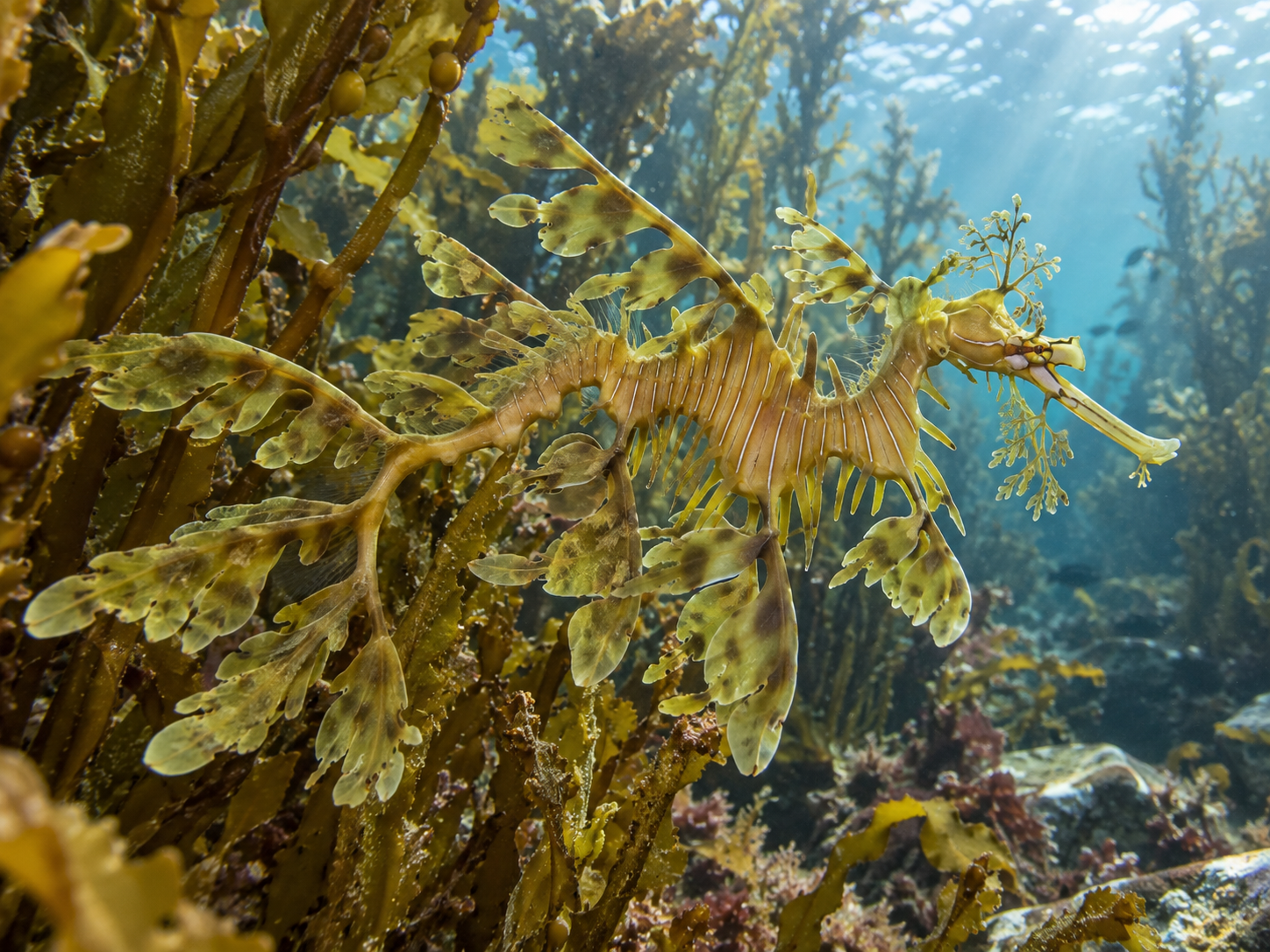
At first glance, a leafy seadragon looks less like a fish and more like a piece of drifting seaweed. Its body is covered with strange leaf-like structures, and as it slowly moves through the water, those structures sway with it. But there is a fascinating reason for this unusual appearance: the leafy seadragon is built to disappear in plain sight. So why did a fish evolve to look like a plant—and how does this disguise actually protect it?
Chapter 1 — What Is a Leafy Seadragon?
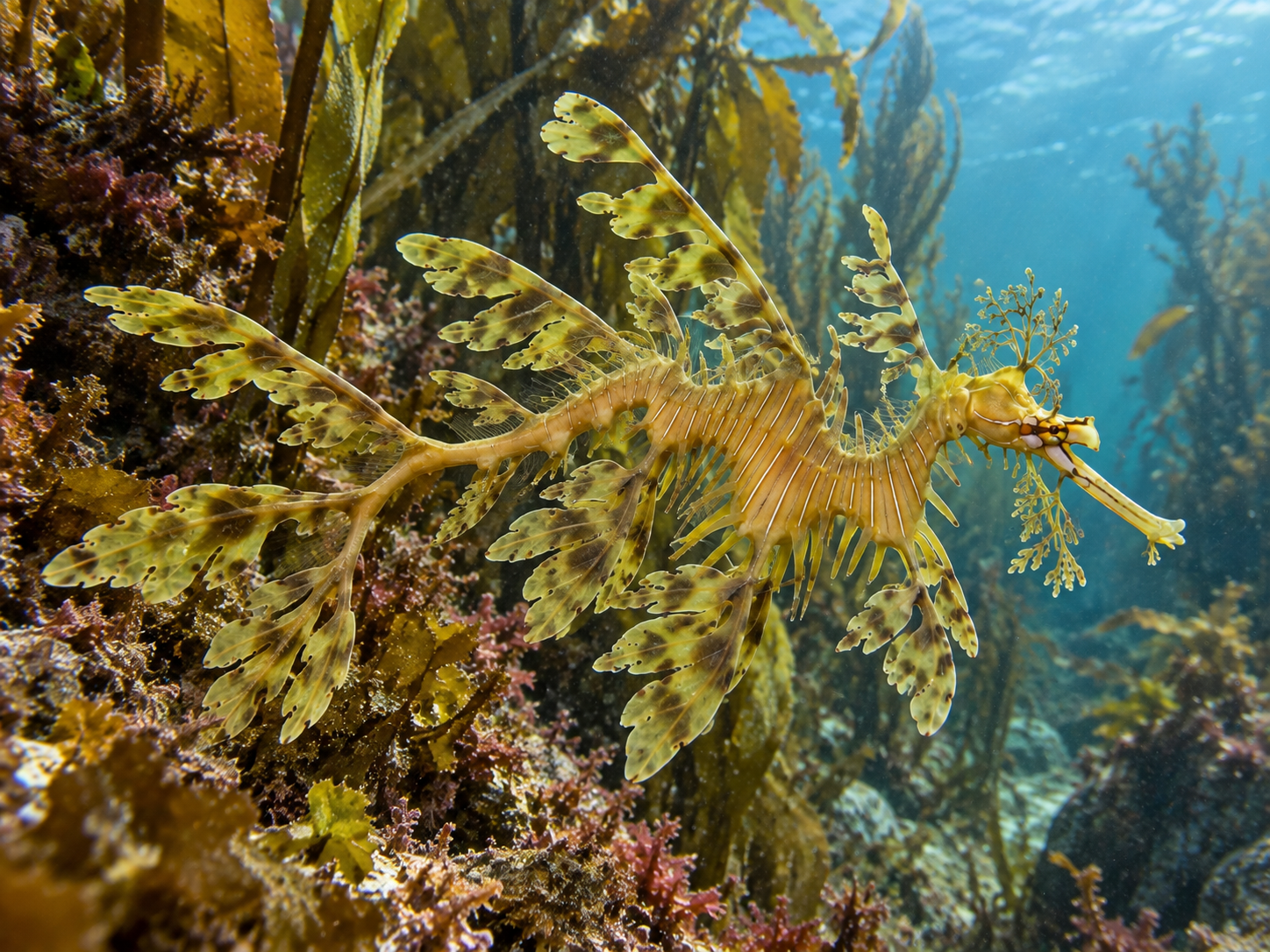
If you saw a leafy seadragon underwater without knowing what it was, you might not even realize you were looking at a fish.
The leafy seadragon (Phycodurus eques) is a marine fish from the same family as seahorses and pipefish. It has the long, tubular snout and unusual body shape that make its relatives so recognizable. But unlike an ordinary seahorse, its body seems to have grown pieces of seaweed.
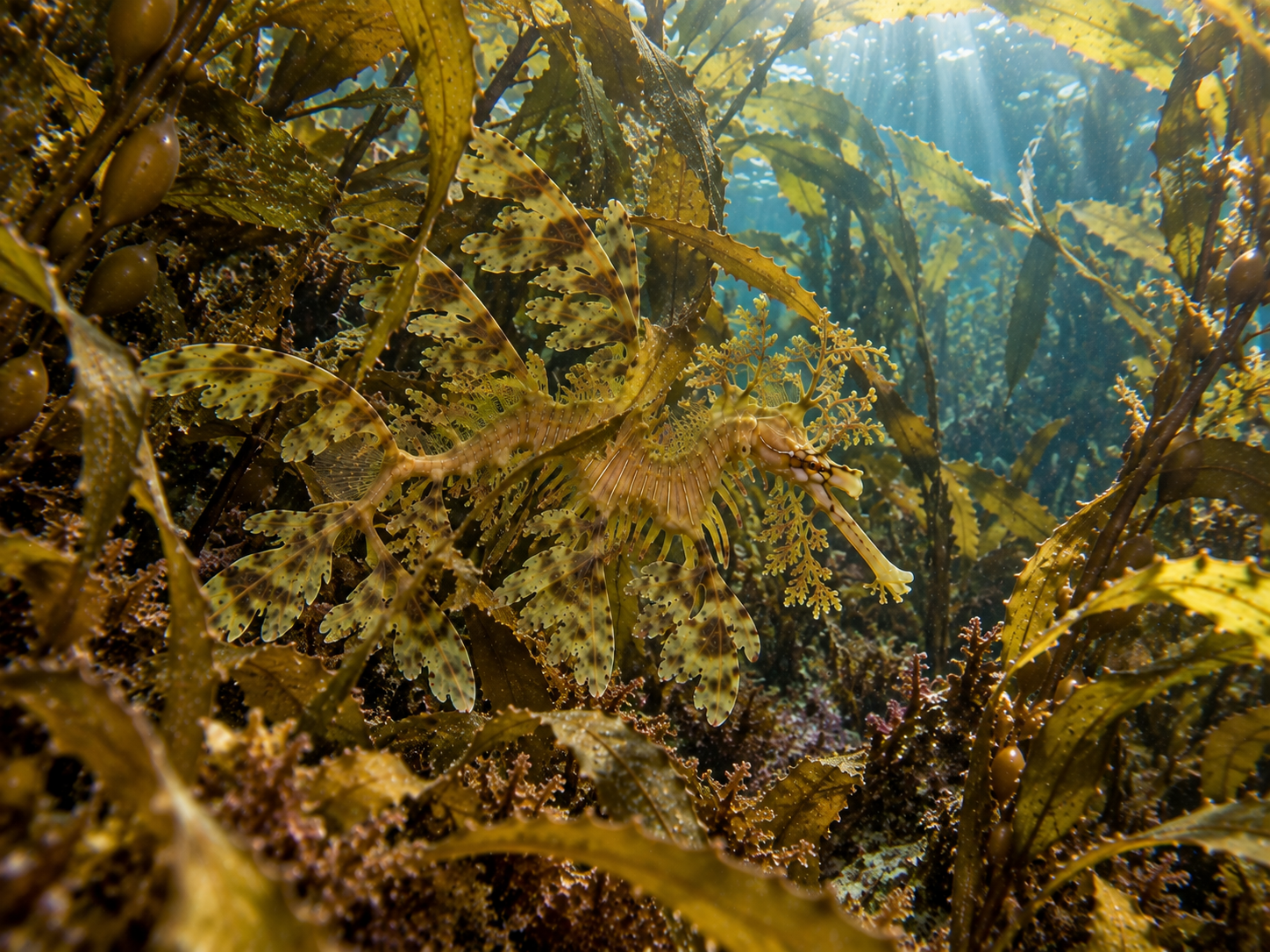
Those strange structures are called leaf-like appendages. They extend from the head, body and tail, giving the fish an almost plant-like appearance. Its colours can also blend with the vegetation around it, making the whole animal surprisingly difficult to pick out among kelp and seaweed. The Australian Museum
Leafy seadragons live in temperate coastal waters of southern Australia, particularly around kelp-covered rocky reefs. They are usually found from roughly 3 to 50 metres deep. The Australian Museum
They are not large animals. Adults can reach around 30–35 centimetres, but their unusual shape makes them appear much bigger and more complicated than they really are.
And that shape is the important part.
The leafy seadragon is not covered in those strange appendages simply because they look beautiful. They are part of a much more useful trick.
The fish is trying to look like the place where it lives.
Chapter 2 — Why Does It Look Like Seaweed?
This is where the leafy seadragon becomes really interesting.
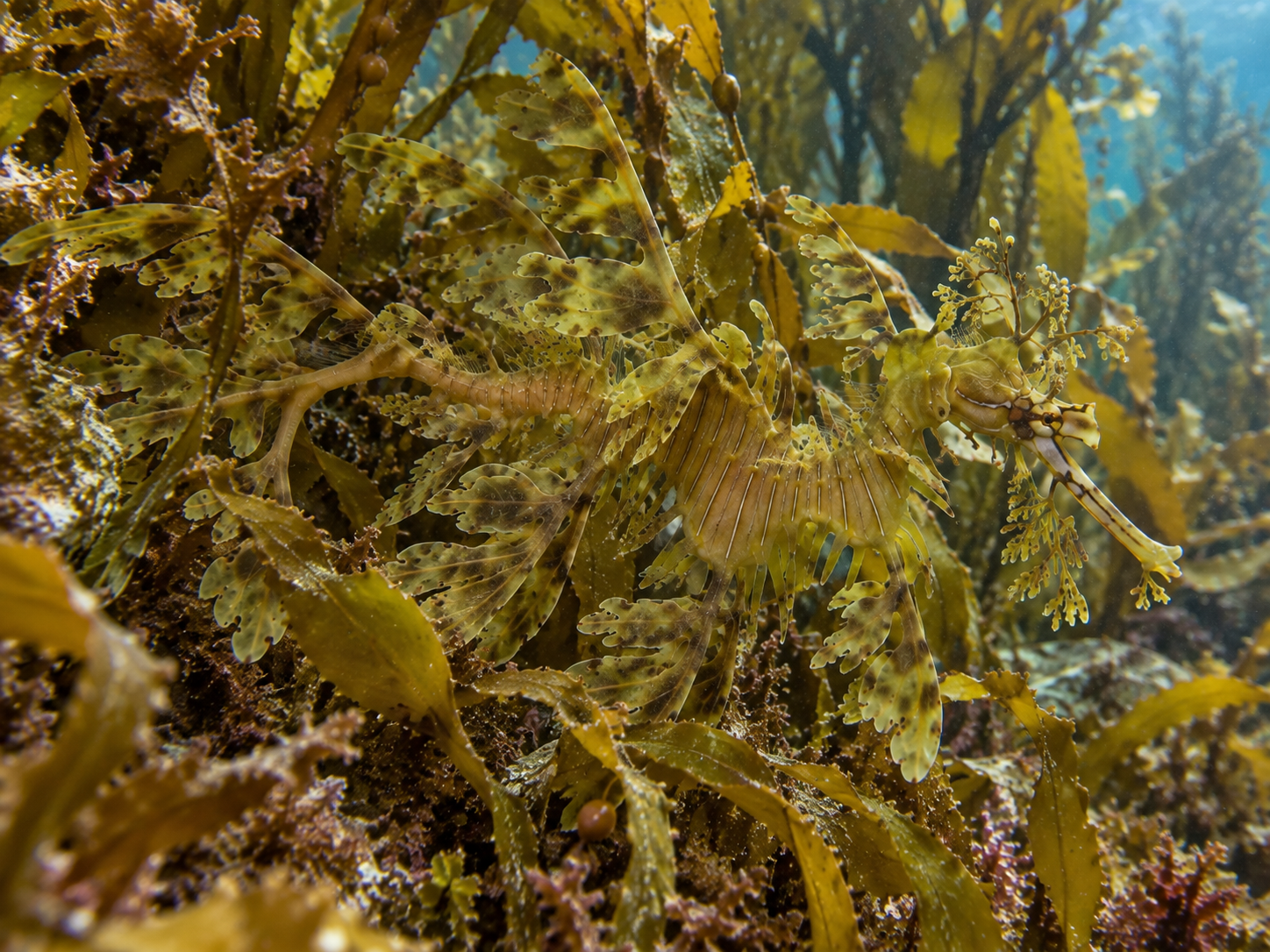
Its unusual appearance is the result of evolution shaping the fish around its environment. Leafy seadragons live among kelp and other seaweeds, so looking like a piece of that vegetation can make them much harder to notice. The Australian Museum describes their leafy appendages and coloration as excellent camouflage on kelp-covered rocky reefs. The Australian Museum
Think about what a predator sees underwater.
A normal fish has a clear outline: head, body, fins and tail. Even if its colour matches the background, that familiar shape can give it away.
The leafy seadragon has a different problem—and a clever solution.
Its body is broken up by all those irregular appendages. Instead of presenting one smooth fish-shaped outline, it looks more like a tangled piece of vegetation.
That makes it harder to recognize as an animal.
The appendages also give the fish a more convincing shape. They are not perfectly symmetrical or arranged like artificial decorations. They stick out in different directions, helping the animal resemble the complicated forms of underwater plants.
Its colour adds another layer to the disguise.
A leafy seadragon can have yellowish, brownish, greenish or reddish tones, depending on the individual and its surroundings. Combined with the leaf-like structures, this makes the fish look much less like something that should be swimming through the water.
But there is an important point here.
Camouflage does not mean invisibility.
A leafy seadragon can still be spotted if it is against the wrong background or moves in an obvious way. Its disguise works best when it is in the kind of habitat it has evolved to live in.
And that leads to the next part of the trick.
The leafy seadragon doesn't just look like seaweed.
It also moves like it.
Chapter 3 — How Does Its Camouflage Actually Work?
Saying that an animal has “camouflage” is easy.
But camouflage is not just about having the right colour.
Imagine a green fish sitting beside green seaweed. Its colour might match perfectly, but its smooth body would still look completely different from the thin, irregular shapes around it.
The leafy seadragon solves that problem by changing the shape predators see.
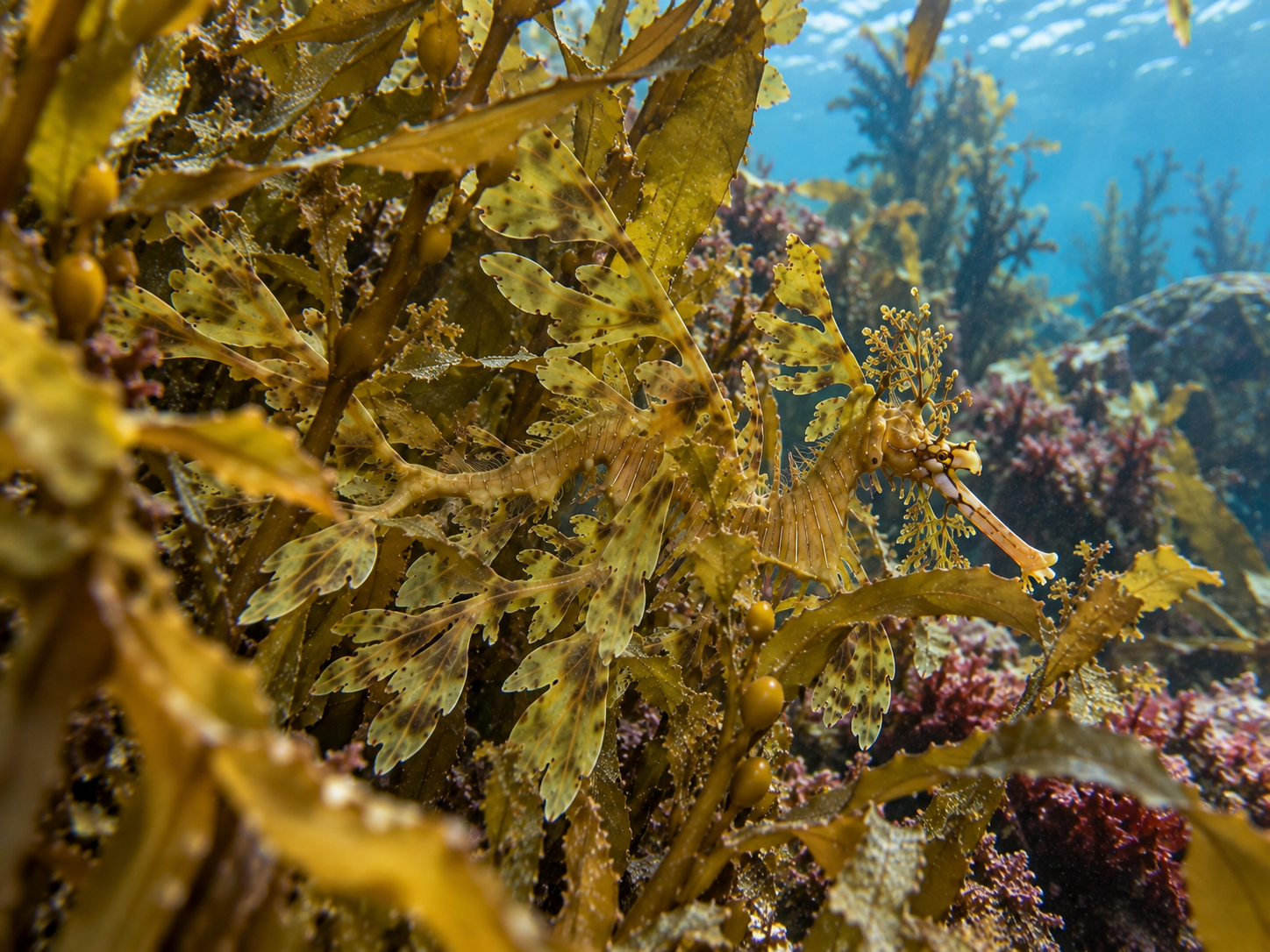
Its leaf-like appendages break up the normal outline of its body. Instead of seeing a clean fish-shaped silhouette, a predator may see something that looks more like pieces of drifting vegetation.
This is sometimes called shape disruption.
The colour helps too. Against kelp and seaweed, the fish's body can become surprisingly difficult to separate from the background.
But there is one more trick.
It sways.
Leafy seadragons are poor swimmers and move slowly. In their natural habitat, they can make gentle swaying movements that fit the movement of nearby vegetation. Older observations from the Australian Museum describe seadragons showing little movement and swaying with weed as currents and swell move through the water. Australian Museum
That matters because movement can reveal an animal even when its colour and shape are hidden.
A sudden dart would immediately look suspicious.
A slow, gentle movement among seaweed can look much more natural.
So the disguise works as a combination:
shape + colour + movement + the right habitat.
It is not one magical feature doing everything.
It is several small advantages working together.
And then comes one of the strangest things about the leafy seadragon.
Those beautiful “leaves” aren't its main swimming fins.
Chapter 4 — Are Its “Leaves” Really Used for Swimming?
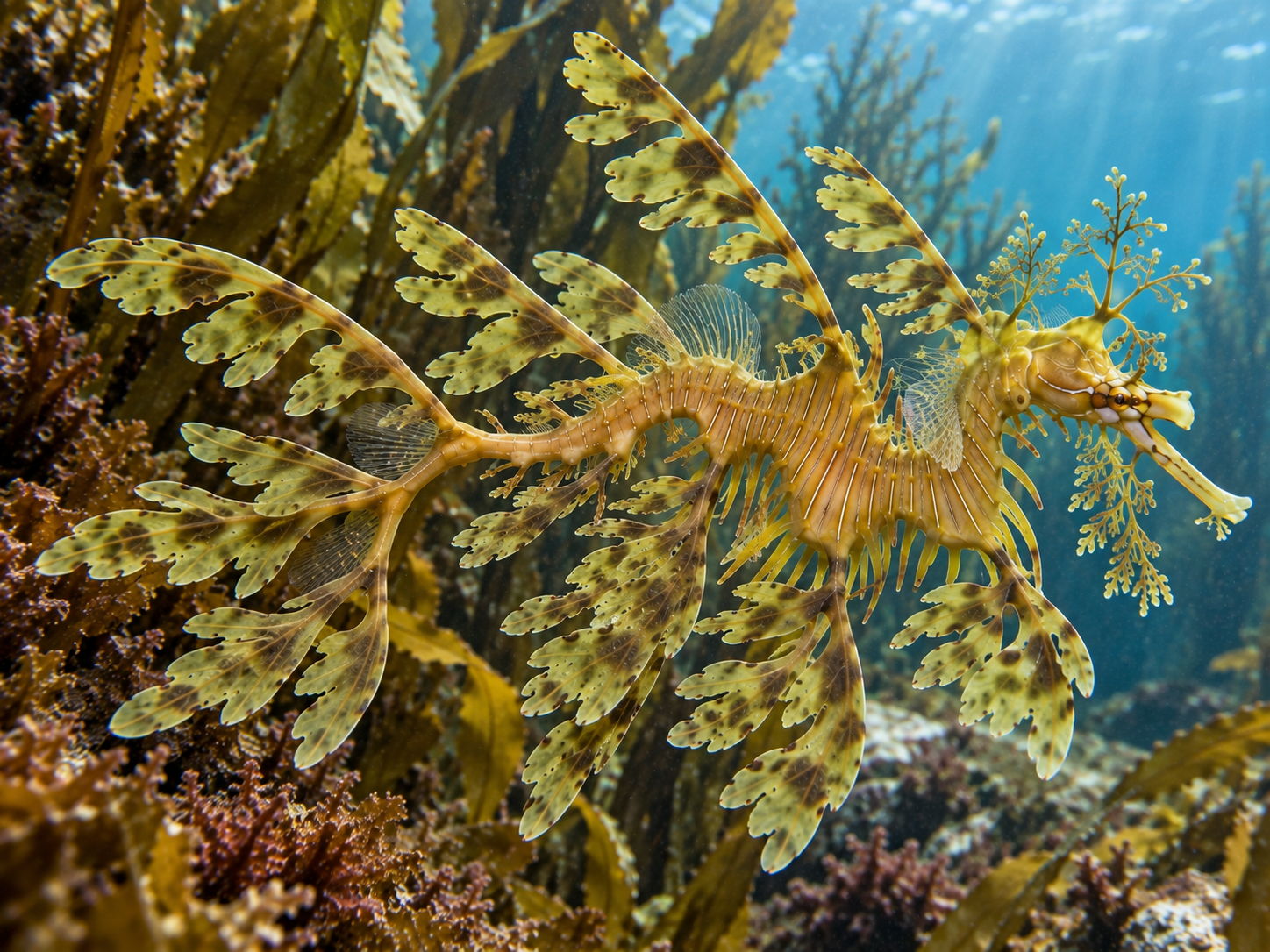
Here is where the leafy seadragon becomes even stranger.
Look at its body and you might assume those large leaf-like structures are fins.
They aren't the main fins responsible for swimming.
The fish actually has much smaller, harder-to-notice fins. A dorsal fin runs along its back, while a pectoral fin is located near the upper part of its body. These fins provide the movement, even though they are easy to miss when you first look at the animal. The Australian Museum
The large leafy structures are mainly part of its camouflage rather than powerful swimming equipment.
This creates an unusual combination.
The fish has a body covered in structures that make it look like seaweed, while the actual fins doing the swimming are relatively subtle.
And it doesn't swim very fast.
Leafy seadragons are considered poor swimmers. Their unusual body shape and reduced swimming ability mean they move slowly rather than darting quickly through the water. The Australian Museum
At first, that sounds like a disadvantage.
For many fish, it would be.
But for a leafy seadragon, speed is not necessarily the best answer.
Its survival strategy is closer to:
Don't run. Don't attract attention. Just blend in.
That makes its slow movement part of the same strategy as its strange appearance.
The fish isn't built like a fast predator chasing prey across open water.
It is built for a quieter life among vegetation.
And that also explains how it feeds.
Chapter 5 — How Does a Leafy Seadragon Eat?
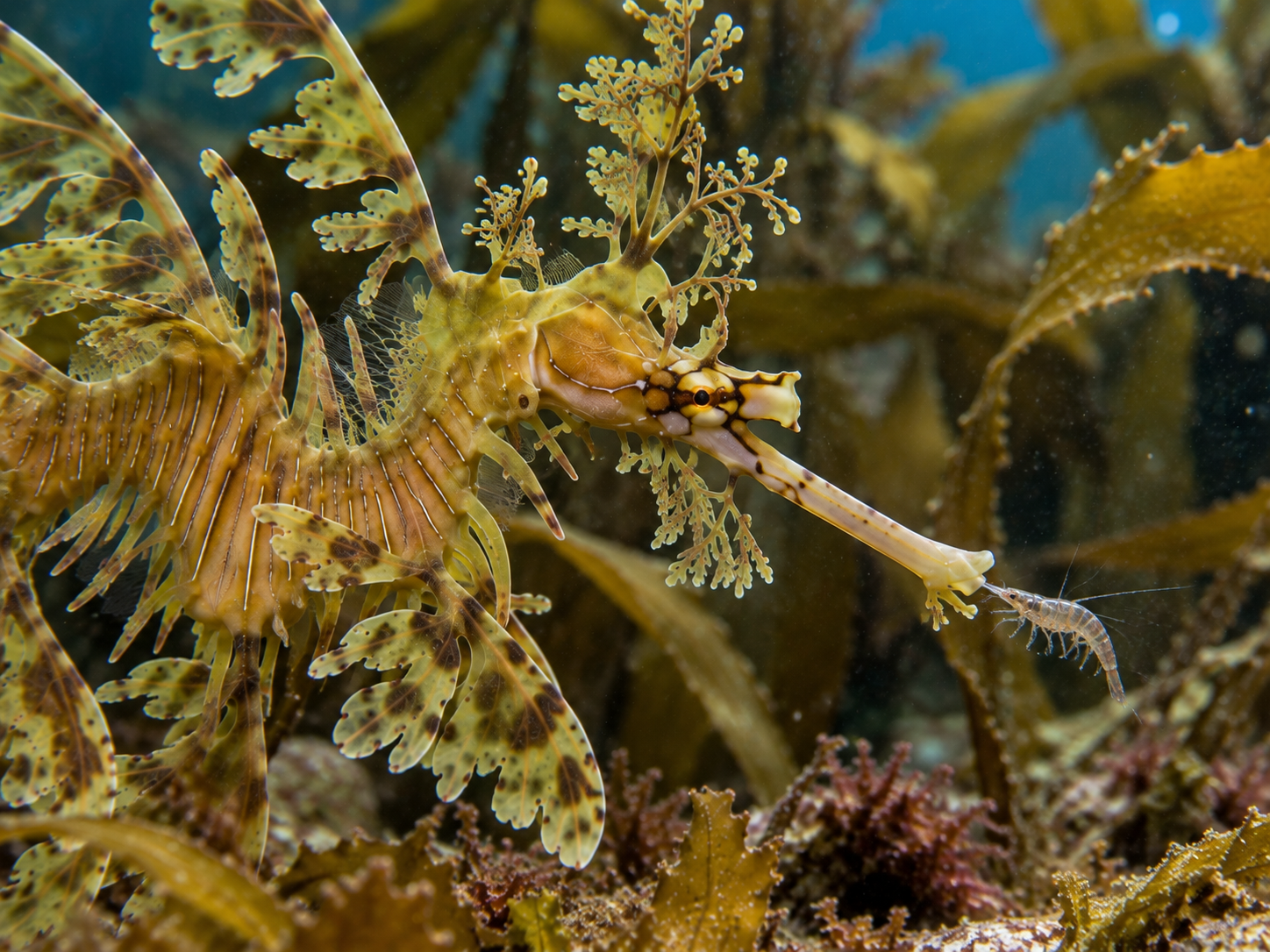
A slow fish might seem like it would struggle to catch food.
But the leafy seadragon has a feeding method that suits its lifestyle perfectly.
It does not need to chase prey through the water.
Instead, it uses its long, narrow snout to suck in tiny prey.
Leafy seadragons feed on small crustaceans, including mysid shrimp and other tiny animals. Their tubular snout is part of a suction-feeding system shared with their seahorse and pipefish relatives. The Australian Museum
The basic idea is surprisingly simple.
The seadragon gets close to its prey.
Then, rather than lunging after it like a fast fish, it creates a sudden flow of water toward its mouth.
The tiny animal is pulled inside.
This is especially useful for a creature that is not built for speed.
Its camouflage allows it to stay relatively inconspicuous, while its feeding system lets it capture small prey without needing a high-speed chase.
So the leafy seadragon's strange lifestyle starts to make sense.
It hides like seaweed, moves slowly like seaweed, and waits for tiny prey to come close enough to swallow.
But there is another part of its life that is even more surprising.
When it is time to reproduce, the father—not the mother—takes on the job of carrying the eggs.
Chapter 6 — How Does It Reproduce?
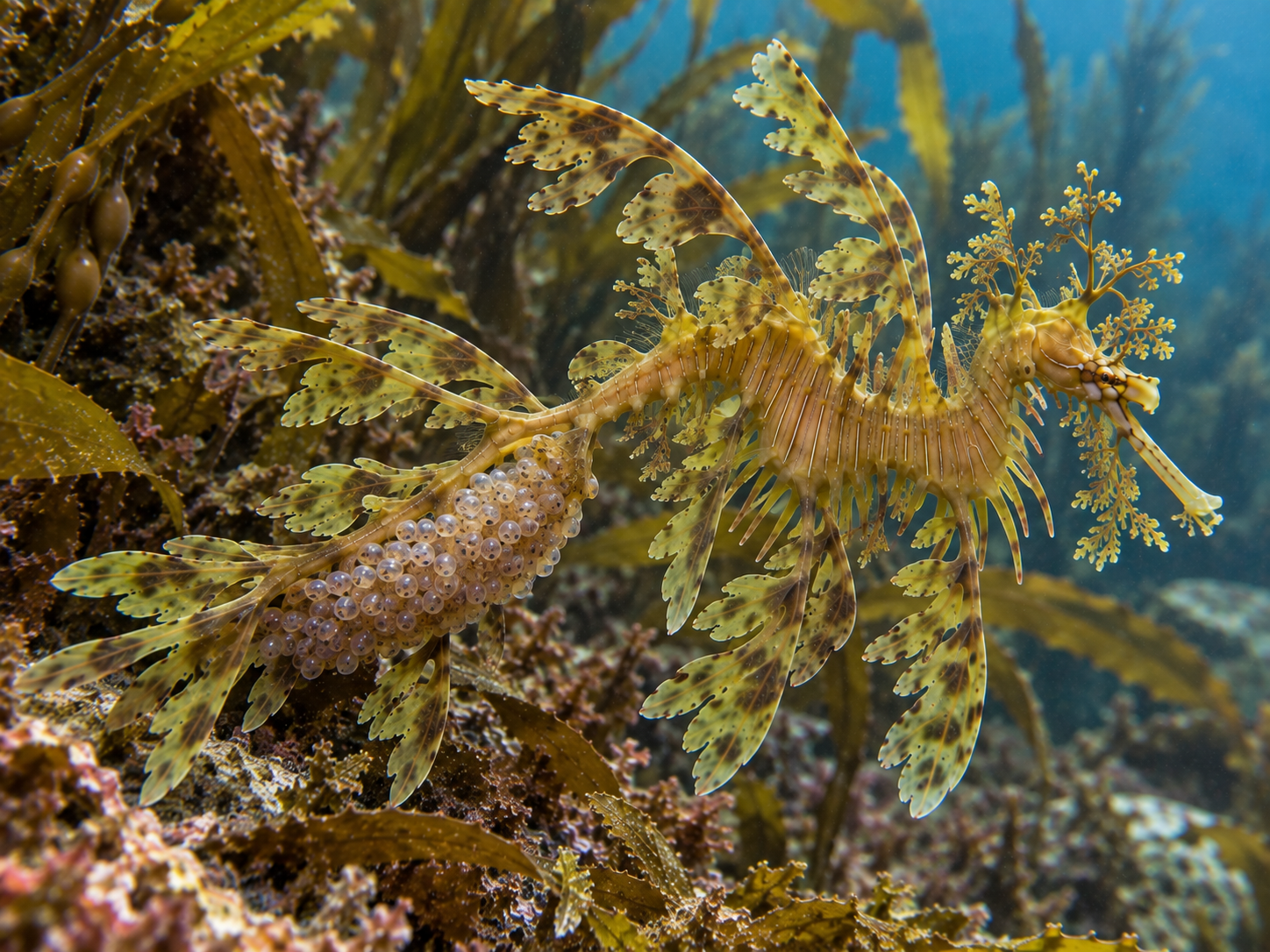
The leafy seadragon has another surprise waiting in its reproductive life.
The male carries the eggs.
During breeding, the female transfers her eggs to a specialized area on the underside of the male's tail. The eggs remain attached there while they develop. The Australian Museum
This is related to the unusual reproductive system found across the seahorse family.
But leafy seadragons are not exactly the same as seahorses.
A male seahorse has a specialized brood pouch. A male leafy seadragon instead carries the eggs attached to the underside of his tail.
As the embryos develop, the male carries them until they are ready to hatch.
That means the strange-looking tail is doing more than helping the animal resemble seaweed.
At certain times of the year, it also becomes the place where the next generation develops.
And when the young finally hatch, they begin life on their own.
The whole process is another reminder that the leafy seadragon isn't simply a strange-looking fish.
Almost every unusual part of its body has a role in its way of life.
Chapter 7 — Where Does the Leafy Seadragon Live?
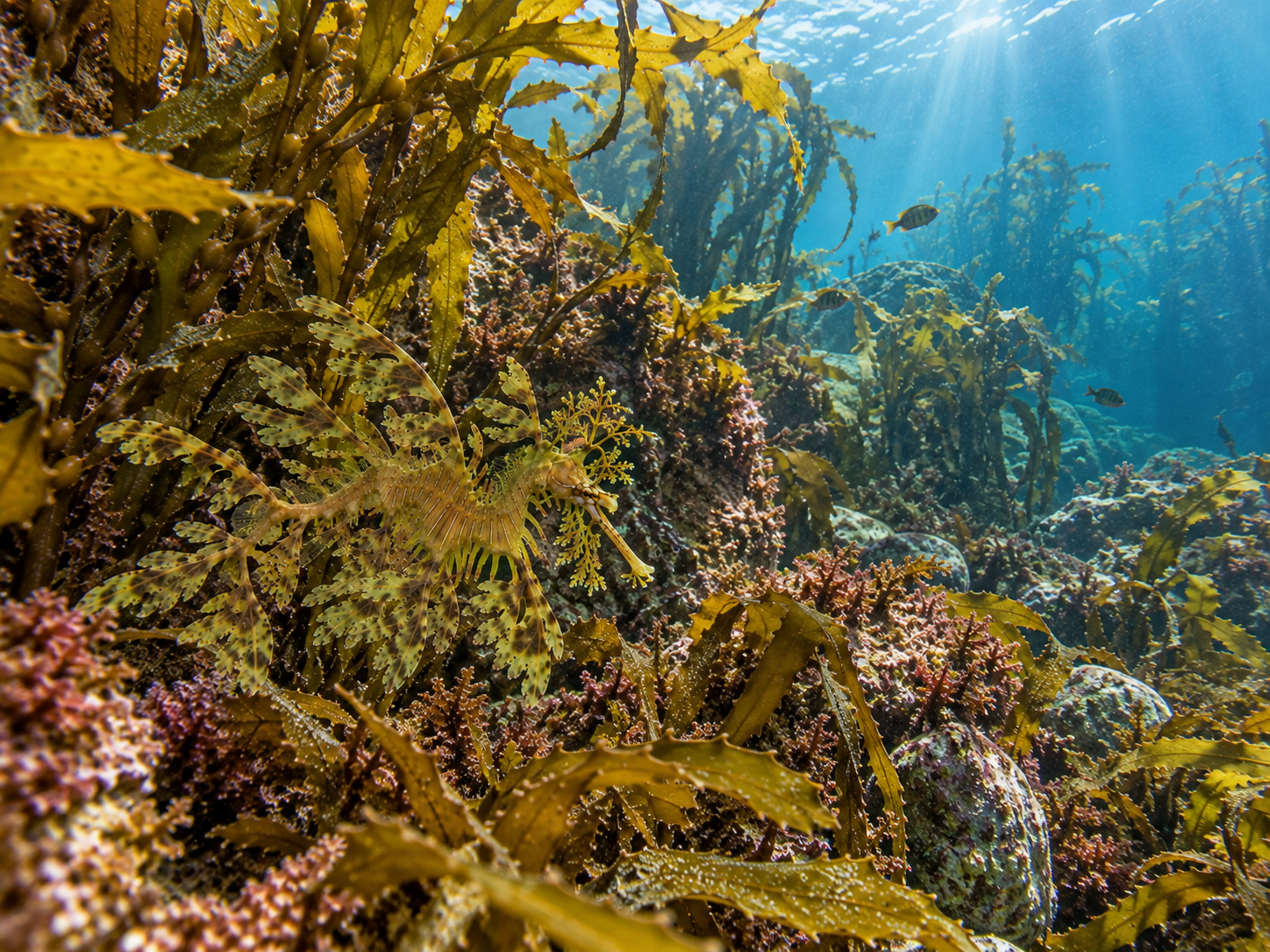
The leafy seadragon has a relatively restricted home.
It is found in temperate marine waters around southern Australia, including waters around South Australia and southwestern Western Australia. The Australian Museum
Its favourite surroundings are important.
Leafy seadragons are associated with kelp-covered rocky reefs, where their body shape and colours have something to blend into.
That means the habitat is not simply where they happen to live.
It is part of their survival strategy.
Imagine removing the kelp and replacing the seabed with bare rock.
The leafy seadragon would still have its leaf-like appendages.
But suddenly those appendages would not make nearly as much sense.
This is why protecting an animal sometimes means protecting the environment around it, not just the animal itself.
A species can be perfectly adapted to its habitat and still struggle if that habitat changes too much.
For a leafy seadragon, losing healthy coastal vegetation could mean losing both shelter and the background that makes its camouflage effective.
Chapter 8 — What Threatens Leafy Seadragons?
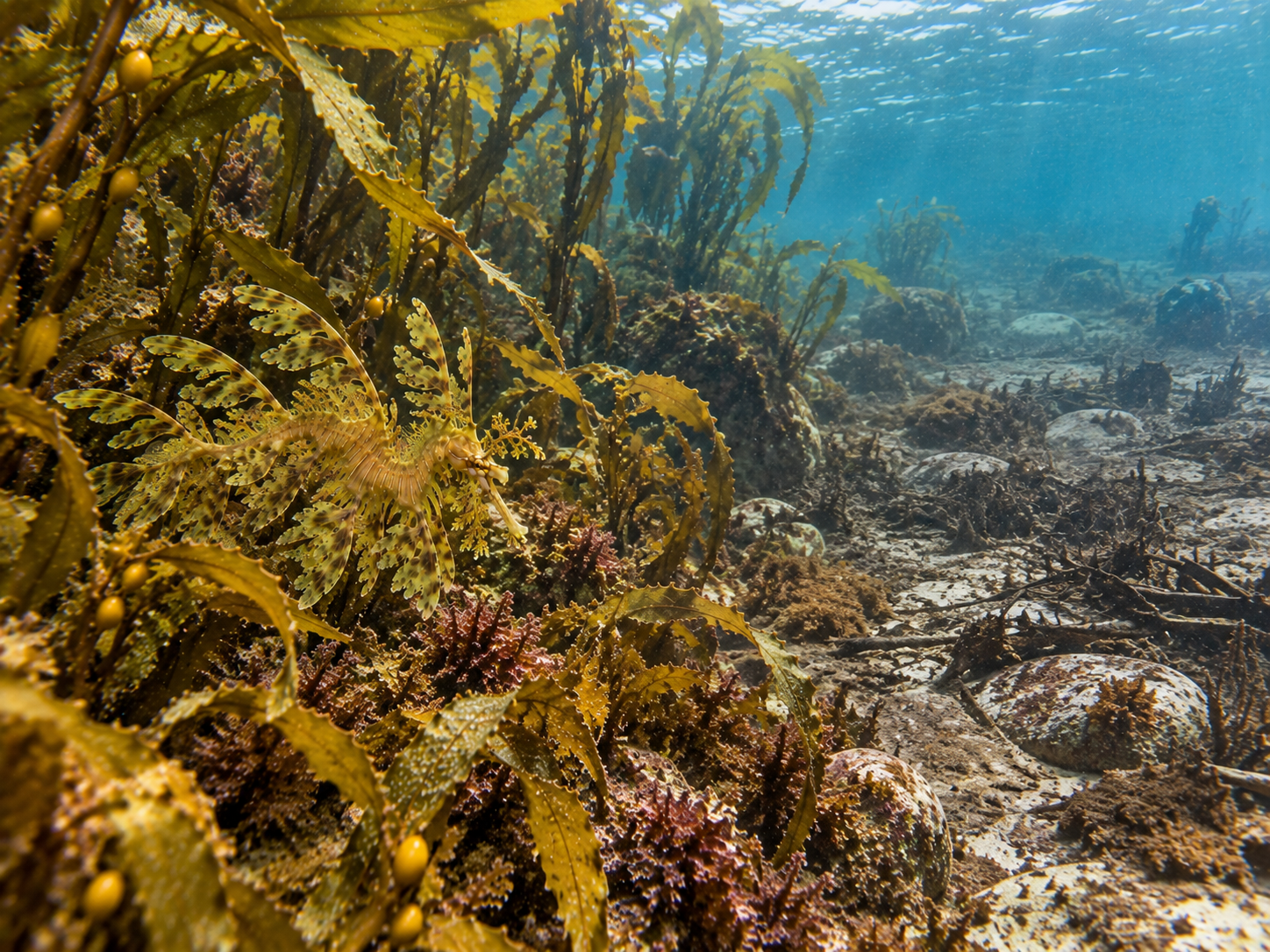
The leafy seadragon's greatest strength can also reveal its weakness.
It is highly dependent on its coastal habitat.
If kelp-covered reefs and other suitable coastal environments are damaged, the fish loses more than a place to hide. Changes to the habitat can affect feeding areas, shelter and the surroundings its camouflage depends on.
Pollution, coastal development, habitat degradation and other human pressures can therefore matter even when nobody is directly catching the fish.
This is an important distinction.
Protecting a leafy seadragon isn't simply about finding the animals and keeping them safe.
You also have to keep their underwater world healthy.
Seadragons are poor swimmers, which limits how easily they can move away from damaged areas. Their restricted distribution makes healthy habitat particularly important. The Australian Museum
Conservation therefore focuses on protecting marine habitats, reducing damaging human activities and maintaining the coastal ecosystems these fish depend on.
The lesson is bigger than the leafy seadragon.
Sometimes the best way to protect a species is not to build a special place for it.
It is to make sure the place it already calls home is still there.
Chapter 9 — What Makes the Leafy Seadragon So Unusual?
The leafy seadragon is strange in a way that starts making sense once you look closely.
It is a fish related to seahorses and pipefish, yet its body looks like seaweed. Its large leaf-like structures help create its disguise, while smaller fins do the actual swimming. It moves slowly, feeds by suction and spends its life among the vegetation that helps hide it. The Australian Museum
And then there is the male.
He carries the eggs beneath his tail until they hatch.
None of these features is completely separate from the others.
The strange body helps with camouflage.
The camouflage works best in kelp.
The slow movement fits the disguise.
The suction feeding suits a slow-moving fish.
And the male's unusual reproductive role is another part of a family already famous for unusual ways of carrying young.
That is what makes the leafy seadragon so fascinating.
It doesn't look like seaweed by accident. Its entire way of life has been shaped around living among it.
Conclusion — A Fish That Learned to Disappear
The leafy seadragon doesn't need to be the fastest fish on the reef.
It has found another way to survive.
By looking like the seaweed around it, moving slowly through the same water and feeding without chasing prey, it can remain difficult to notice. Its bizarre leaf-like body is therefore much more than an unusual appearance.
It is a survival strategy.
And perhaps that is the most interesting thing about the leafy seadragon: the closer you look at its strange body, the more each part starts to make sense.
Frequently Asked Questions
1. Is a leafy seadragon a fish?
Yes. The leafy seadragon is a marine fish belonging to the family Syngnathidae, the same family that includes seahorses and pipefish. The Australian Museum
2. Why does the leafy seadragon look like seaweed?
Its leaf-like appendages and coloration help it blend into kelp and other underwater vegetation, making its body harder to recognize as a fish. The Australian Museum
3. Are the leafy structures actually fins?
No. They are mainly camouflage structures. The leafy seadragon has smaller dorsal and pectoral fins that provide its swimming movements. The Australian Museum
4. Can leafy seadragons swim fast?
No. They are relatively poor swimmers and move slowly. Their survival depends much more on camouflage than on speed. The Australian Museum
5. What does a leafy seadragon eat?
It feeds on tiny marine prey, including small crustaceans. It uses its tubular snout to capture prey through suction feeding. The Australian Museum
6. Where are leafy seadragons found?
They are endemic to temperate marine waters of southern Australia, including areas from South Australia to southwestern Western Australia. The Australian Museum
7. Does the male leafy seadragon carry the eggs?
Yes. The eggs are attached to the underside of the male's tail, where they develop until hatching. The Australian Museum
8. Are leafy seadragons related to seahorses?
Yes. They belong to the same family, Syngnathidae. The Australian Museum
9. Are leafy seadragons completely invisible to predators?
No. Their camouflage is highly effective in suitable habitat, but it is not perfect. If the background changes or the fish moves noticeably, it can still be detected.
10. Why is protecting kelp habitat important for leafy seadragons?
Kelp-covered reefs provide the surroundings in which leafy seadragons feed, shelter and camouflage themselves. Protecting their habitat is therefore an important part of protecting the species.