Introduction
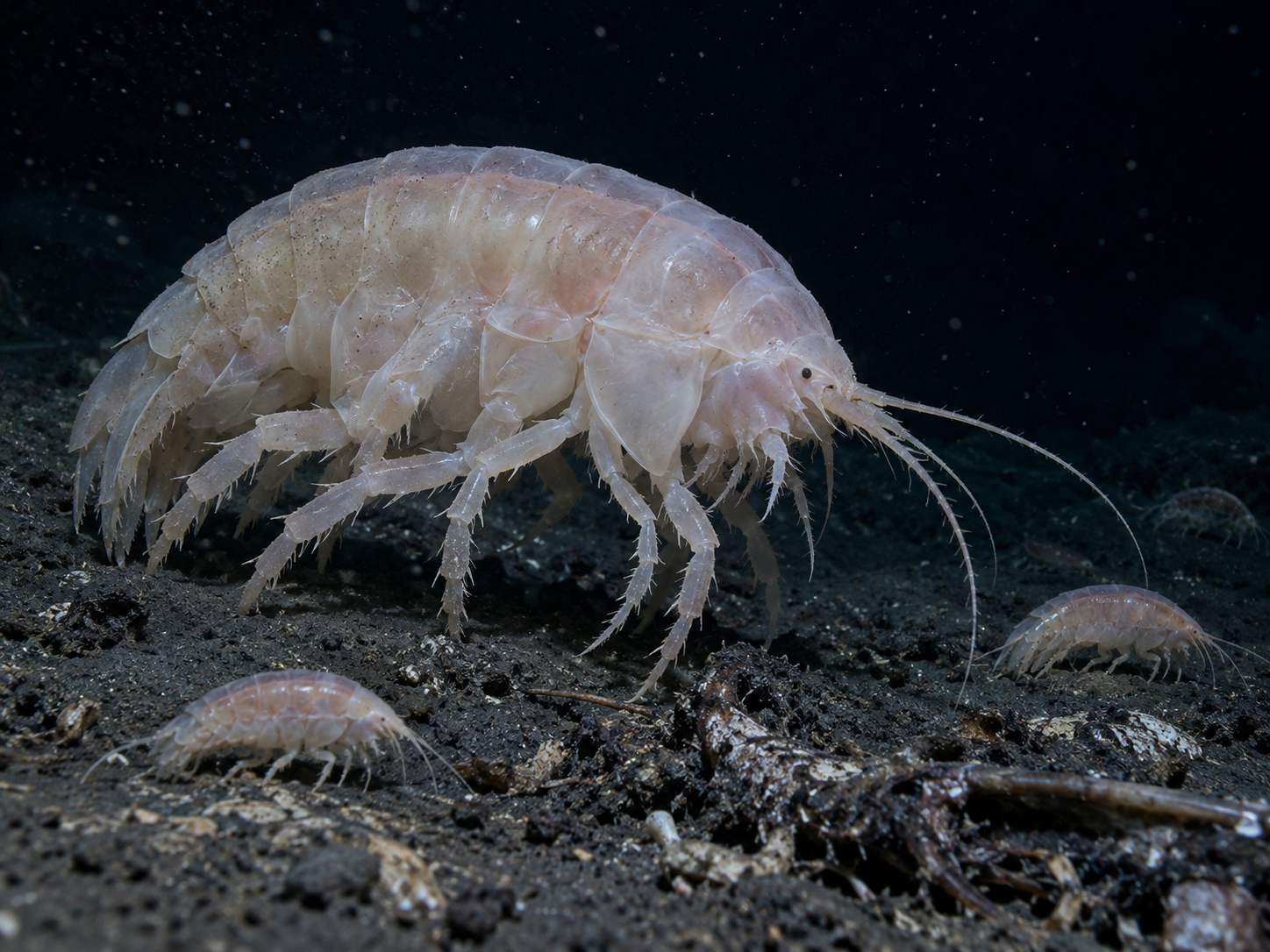
The deep ocean seems like a terrible place to become large.
There is almost no sunlight.
The water is near freezing.
Food can be hard to find.
And in the deepest parts, the pressure is enormous.
Yet some of the animals living there are surprisingly big.
There is the giant amphipod Alicella gigantea, which can reach around 34 centimetres long. Most amphipods are much smaller; one study comparing more than 2,000 species found that most were under 4 centimetres.
There are giant isopods too. Some deep-sea pycnogonids have legs that seem far too large for a spider-like animal. And some deep-sea sea cucumbers can grow to remarkable sizes. This pattern is often called abyssal gigantism or deep-sea gigantism.
But there is an important catch.
Not everything gets bigger in the deep sea.
In many deep-sea groups, body size actually becomes smaller with increasing depth. Scientists therefore do not have one simple answer for deep-sea gigantism. Different animals may become large for different reasons.
So why do some of them become giants?
The answer may begin with something very small.
A slower heartbeat.
Chapter 1 — The Giant That Should Not Look That Big
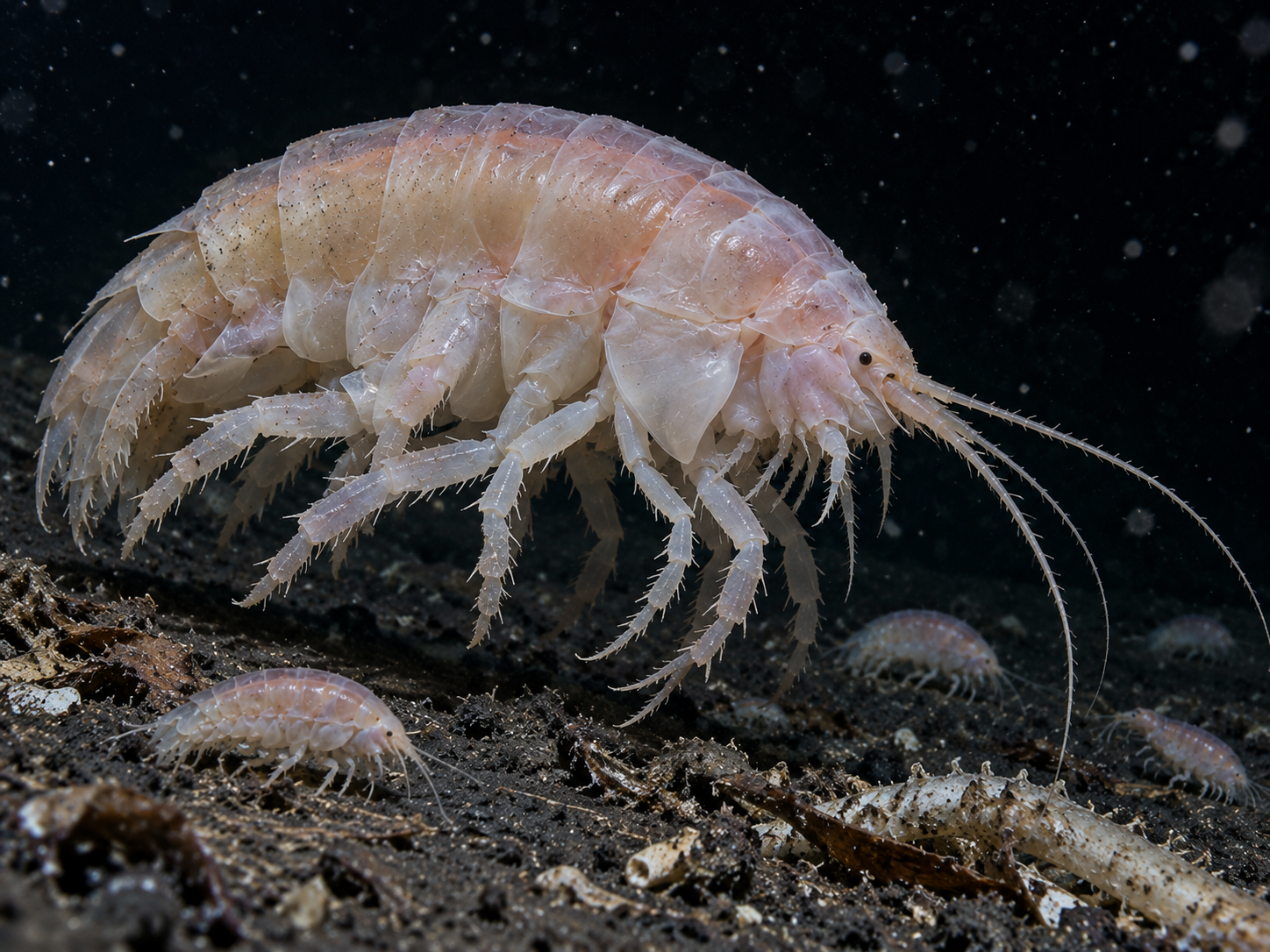
Start with Alicella gigantea.
At first glance, it looks like an oversized shrimp.
Except it can be more than 30 centimetres long.
That is enormous for an amphipod.
Amphipods are the small, sideways-swimming crustaceans you may have seen near beaches or in freshwater. Most species are tiny. Alicella gigantea is different. Adults can reach roughly 24–34 centimetres, and it is regarded as the largest known amphipod.
And it lives deep below the surface.
Not 20 metres down.
Not 100 metres.
It has been found in abyssal and hadal environments, including trenches thousands of metres deep.
This is where the mystery begins.
At those depths, there is very little food arriving from the surface compared with coastal waters. The temperature is extremely low. The environment is dark and under enormous pressure.
You might expect an animal living there to save energy by staying small.
And many deep-sea animals do.
But some went in the opposite direction.
Why?
One possibility is that being large can actually help when food is scarce.
Another is that cold changes the cost of being large.
And another involves oxygen.
None of these explanations works perfectly on its own.
That is what makes the giant amphipod so interesting.
It is not simply a big animal.
It is a clue.
How Big Is a Deep-Sea Giant?
Chapter 2 — Cold Changes the Rules
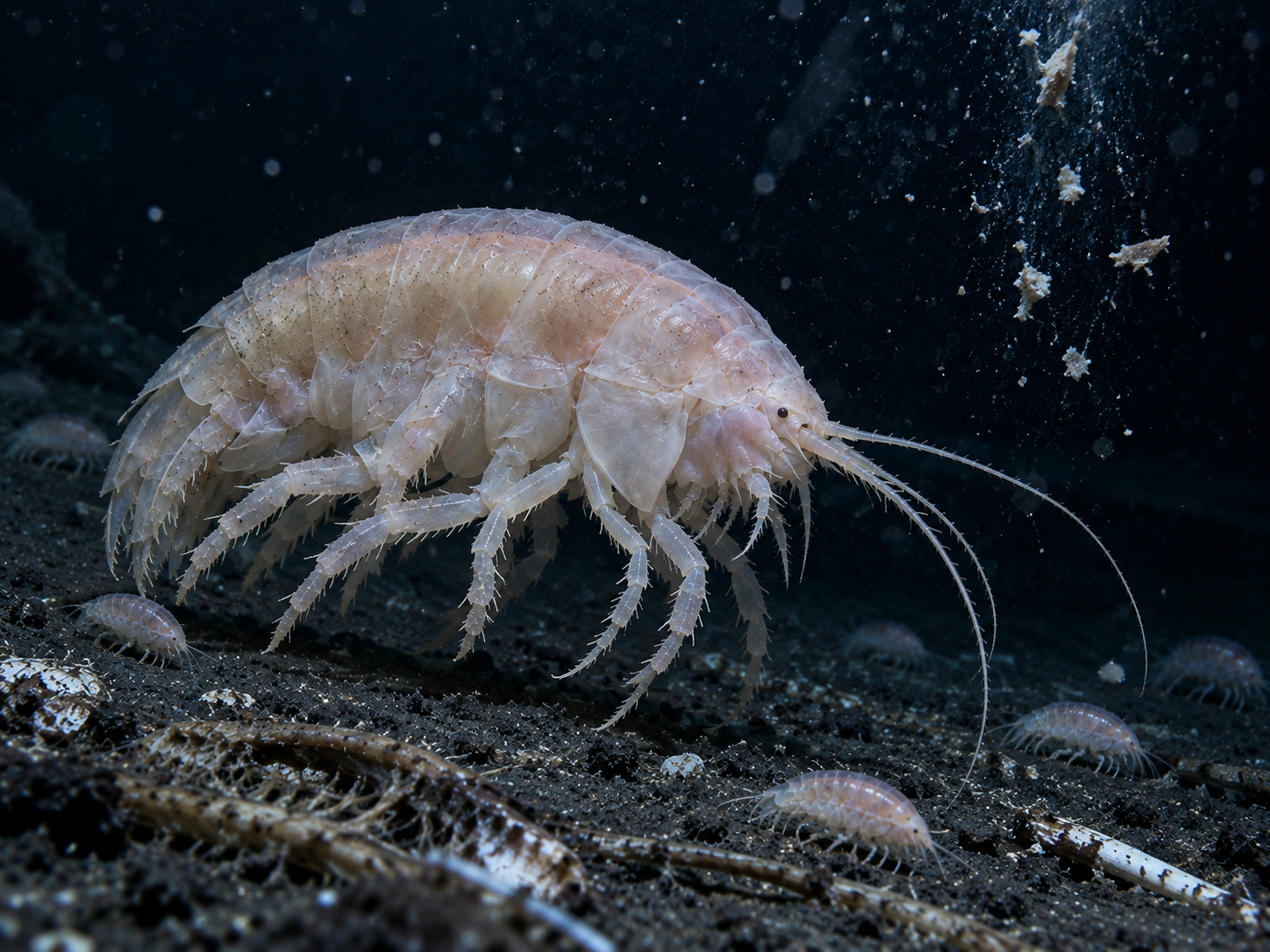
The first thing that happens to an animal in very cold water is simple.
Everything becomes slower.
Deep-sea animals live in cold water, often only a few degrees above freezing. Their metabolism can be very low compared with animals living in warmer environments.
That matters because a large body is expensive.
A large animal needs energy to build itself.
It needs energy to move.
It needs energy to maintain its tissues.
If food is scarce, becoming large sounds like a bad deal.
But cold can change that calculation.
A slower metabolism means the animal may use energy more slowly. In some deep and polar animals, long life and slow growth occur together with large body sizes. Researchers have therefore proposed that cold environments may make large size more physiologically possible.
That does not mean:
Cold water = giant animal.
There are too many exceptions for that.
It means cold can help create a different set of limits.
An animal that burns energy slowly may have more room to grow without paying the same daily energy cost as a warm-water animal.
That could help explain part of the puzzle.
But only part.
Because being large still means finding enough food.
And the deep sea is not generous with food.
What Does Cold Do to the Animal?
Chapter 3 — When Food Is Rare, Being Big Can Help
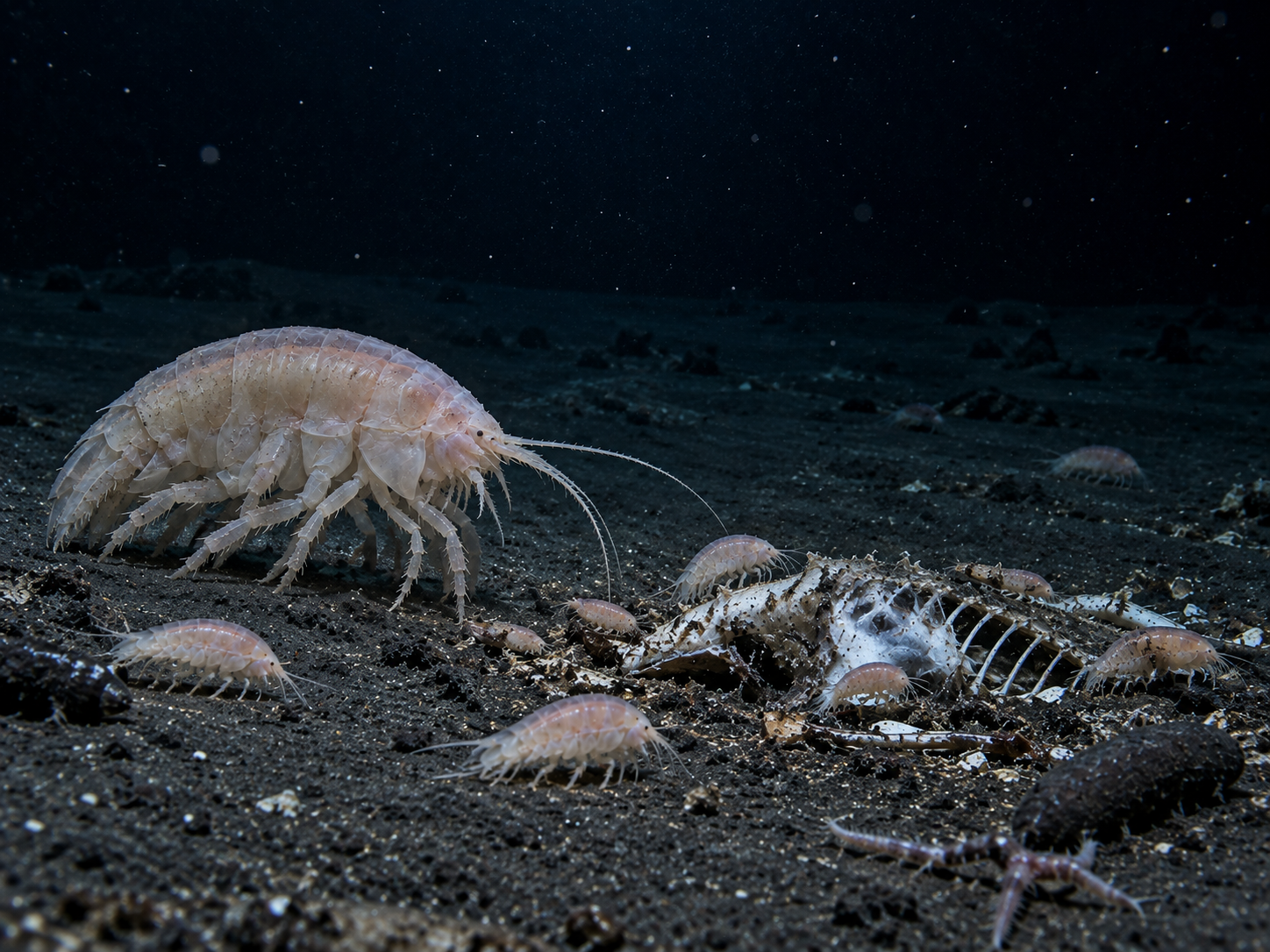
Now we reach the problem that seems to argue against gigantism.
Food.
The deep seafloor does not have forests, grasslands or coral reefs constantly producing food.
Much of the energy reaching the deep ocean begins at the surface.
Tiny organisms grow near the surface.
Some die.
Some are eaten.
Some of their remains slowly sink.
By the time that material reaches the deep seafloor, there is much less of it.
Food can therefore arrive in scattered and unpredictable patches. Deep-sea animals have developed many ways of dealing with this scarcity.
And for some scavengers, a larger body may be useful.
A larger animal can store more energy.
It can travel farther between food patches.
It may also be able to survive longer periods without feeding.
This is one reason gigantism is especially noticeable among some mobile scavengers such as amphipods and isopods. Researchers studying deep-sea ecosystems have linked larger body size in these animals with longer movement between food sources and greater food storage.
Imagine two animals finding the same piece of food.
One is tiny.
The other is much larger.
The larger animal may be able to travel farther before the next meal appears.
It is not necessarily eating more often.
It may simply be better prepared for long gaps between meals.
In a place where food is unpredictable, that can matter.
Why Size Can Help When Food Is Scarce
Chapter 4 — Oxygen Helps, But It Is Not the Whole Answer
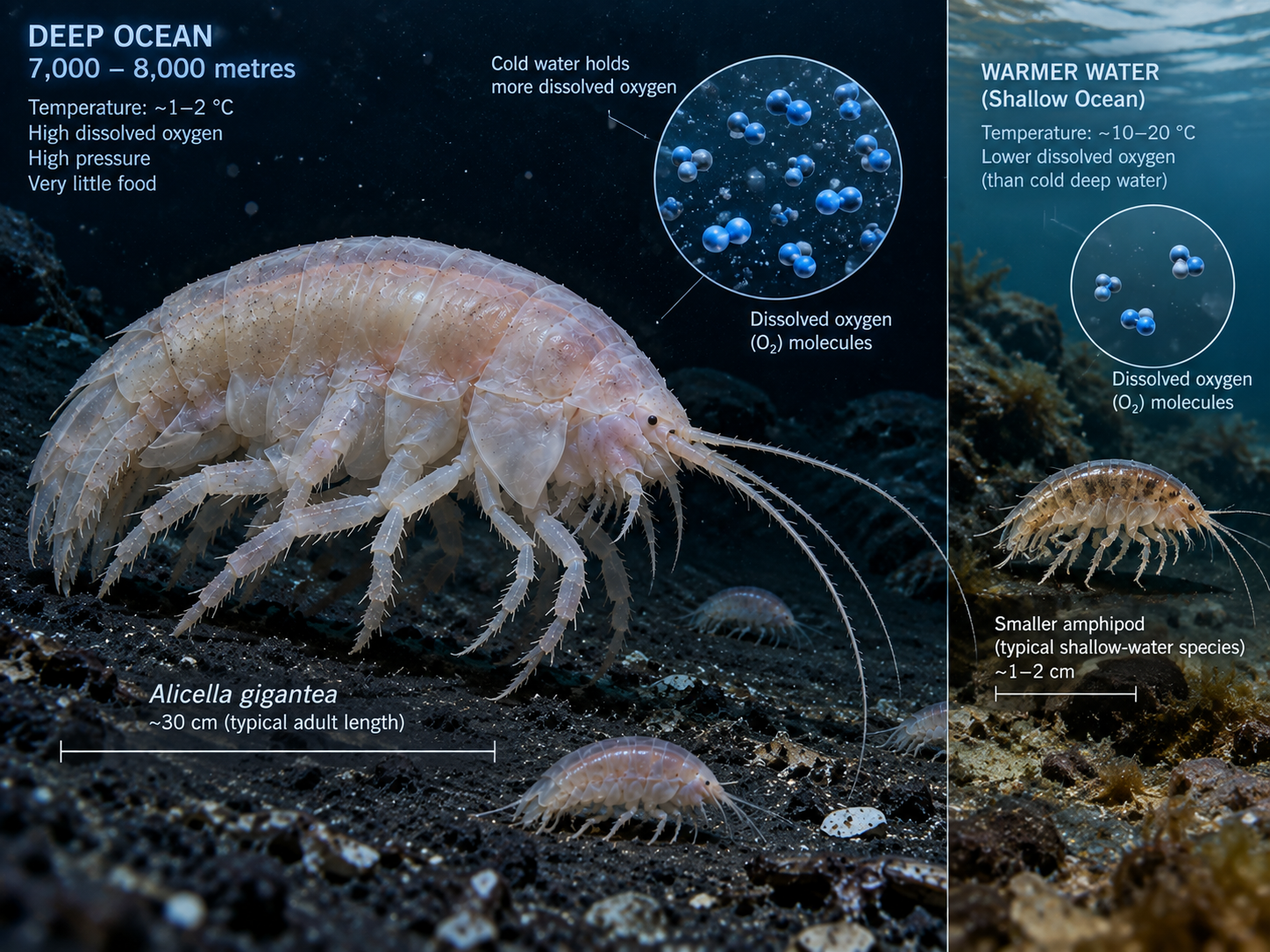
Here is another idea.
Oxygen.
Cold seawater can hold more dissolved oxygen than warmer seawater. At the same time, cold animals generally have lower metabolic demands.
That creates an interesting situation.
More oxygen available.
Less oxygen needed.
Researchers proposed that this could allow animals to reach larger sizes than they could in warmer environments. The idea became known as the oxygen hypothesis.
The idea is appealing.
But science has not accepted it as a complete answer.
Even among amphipods, the group most often used when discussing this hypothesis, many cold-water species remain small. Only a fraction become giants. The review literature suggests that high oxygen availability relative to demand may raise the possible size range rather than actively force animals to become large.
That distinction is important.
Oxygen may open the door.
It does not tell every animal to walk through it.
Something else has to make large size useful.
Food.
Competition.
Predators.
Evolution.
And the particular body design of each animal may all matter.
So when someone says:
“Deep-sea animals become huge because there is more oxygen,”
the answer should be:
Not quite.
Oxygen may be part of the explanation.
It is not the explanation.
The Oxygen Puzzle
Chapter 5 — A Bigger Body Can Change the Whole Strategy
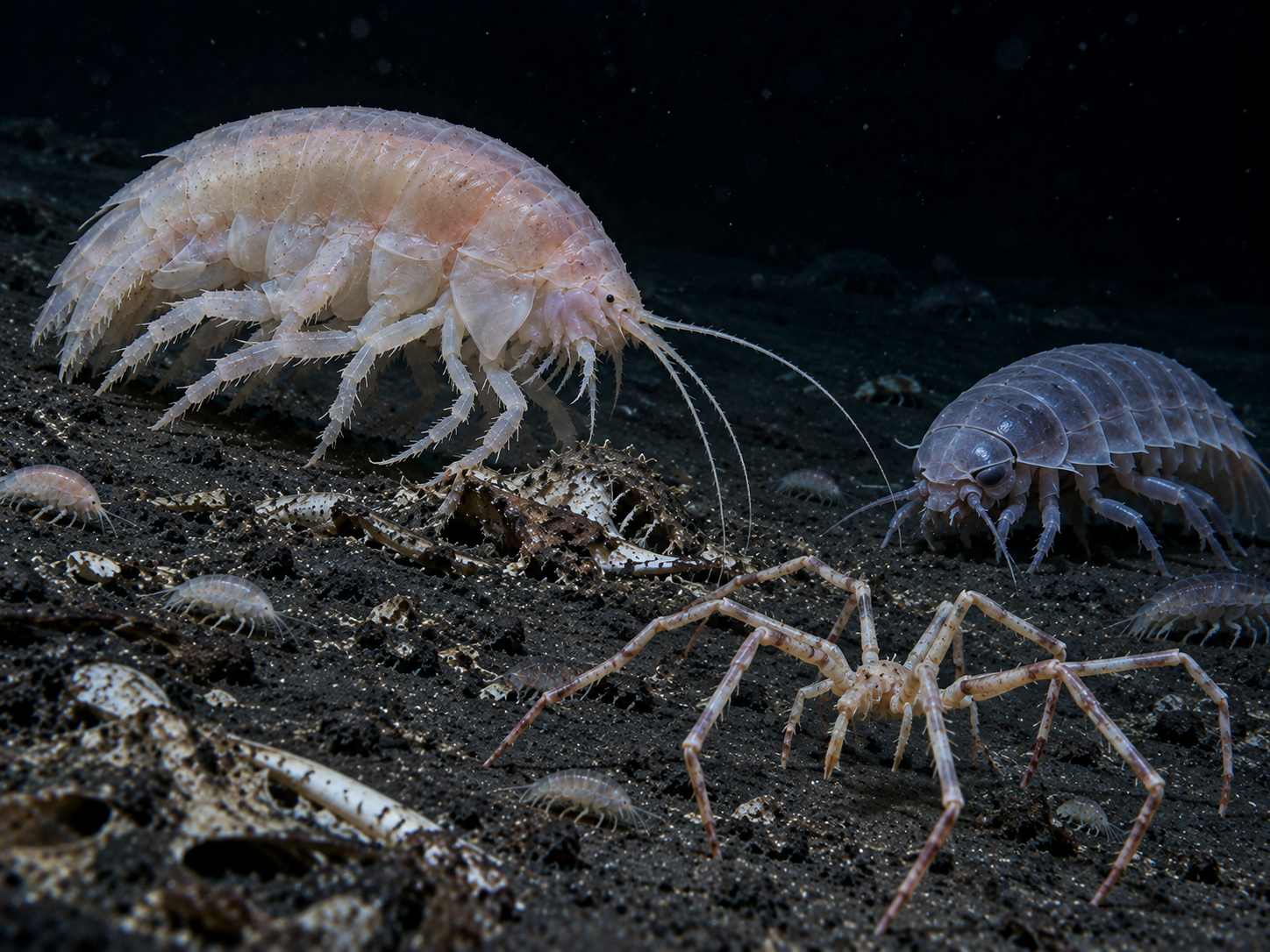
There is another advantage to being large.
Distance.
The deep sea is enormous.
Two food patches may be far apart.
A small animal may spend a large part of its energy simply moving between them.
A larger animal can sometimes travel more efficiently and carry larger energy reserves. In deep-sea scavengers, researchers have linked large size with extended movement between rare food sources.
Size can also change how an animal interacts with its environment.
A larger body can store more material.
It can offer more room for reproductive tissues.
And in some animals, being large may help with movement through the deep water or with surviving long periods when conditions are poor.
But again, there is no single rule.
A large body is useful only when its benefits outweigh its costs.
That is why the biggest deep-sea animals are not all built the same way.
A giant amphipod is a scavenging crustacean.
A giant isopod has a very different body.
A giant pycnogonid is stranger still.
The deep sea has produced giants more than once.
But it has not produced one universal “deep-sea giant design.”
What Can a Large Body Change?
Chapter 6 — So Why Isn't Everything Down There Huge?
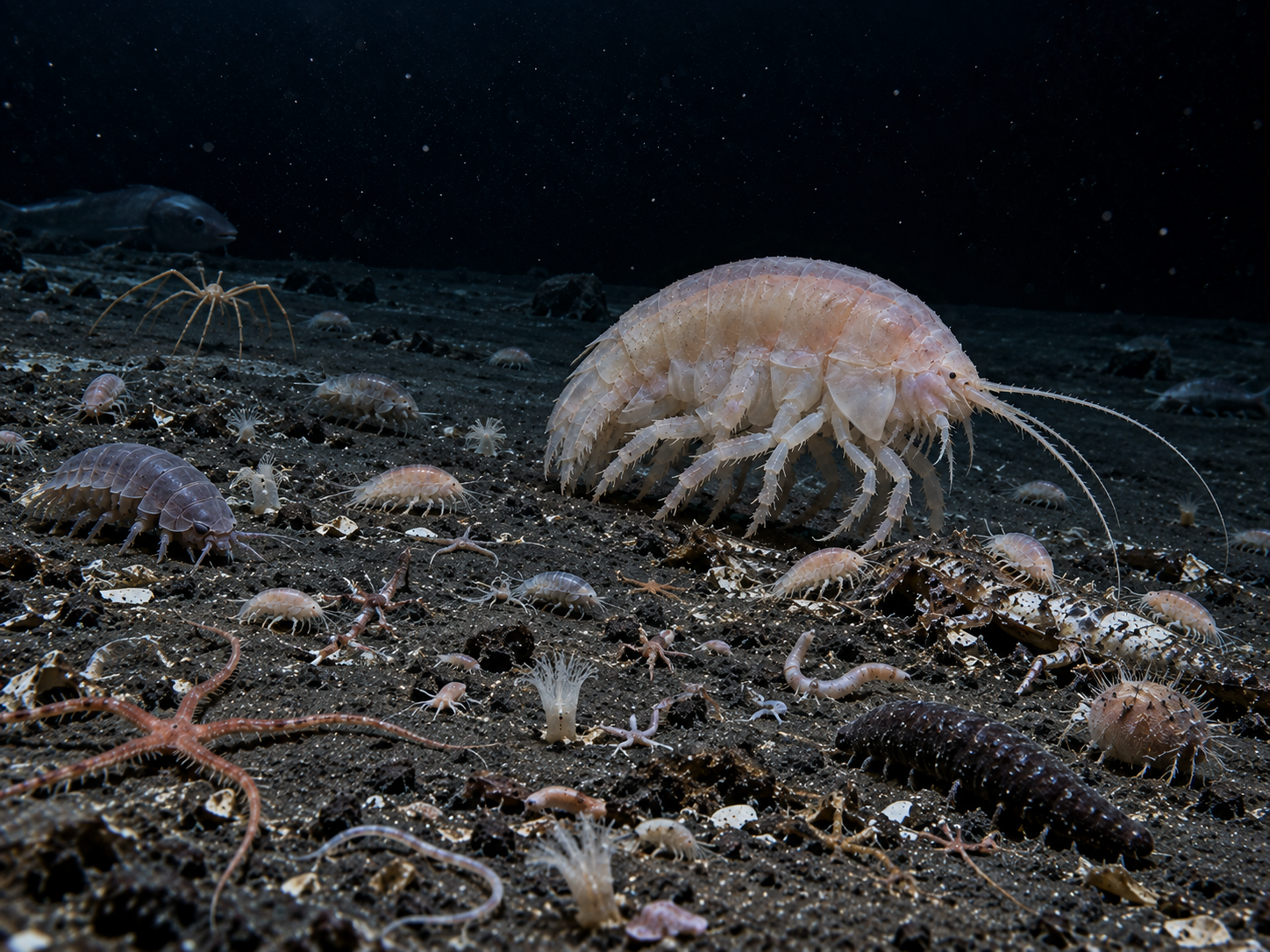
This is where the simple story breaks.
If cold helps.
If oxygen helps.
If large bodies can store more energy.
Why are there still tiny animals in the deep sea?
Because being small has advantages too.
Food is limited.
A smaller body needs less energy.
That can be very useful when meals are hard to find.
Research on deep-sea communities has repeatedly found that body size can decrease with depth in many groups. One explanation is that when food becomes scarce, smaller animals may survive on lower food demands.
So two animals can face the same deep-sea conditions and reach opposite solutions.
One becomes larger.
Another becomes smaller.
It depends on what kind of animal it is.
What does it eat?
How does it move?
Does it wait for food or search for it?
How often can it find a meal?
What predators compete with it?
What does its body need to survive?
These questions matter because gigantism is not a rule of the deep sea.
It is one possible evolutionary response.
That is why scientists are careful with the phrase “deep-sea gigantism.”
They are not saying the entire deep ocean is populated by monsters.
They are describing a pattern seen in particular groups.
And once you understand that, the deep ocean becomes even more interesting.
There are giants.
There are dwarfs.
And there are millions of animals somewhere in between.
The Deep Sea Has Giants and Small Animals
Chapter 7 — Scientists Still Don't Have One Answer
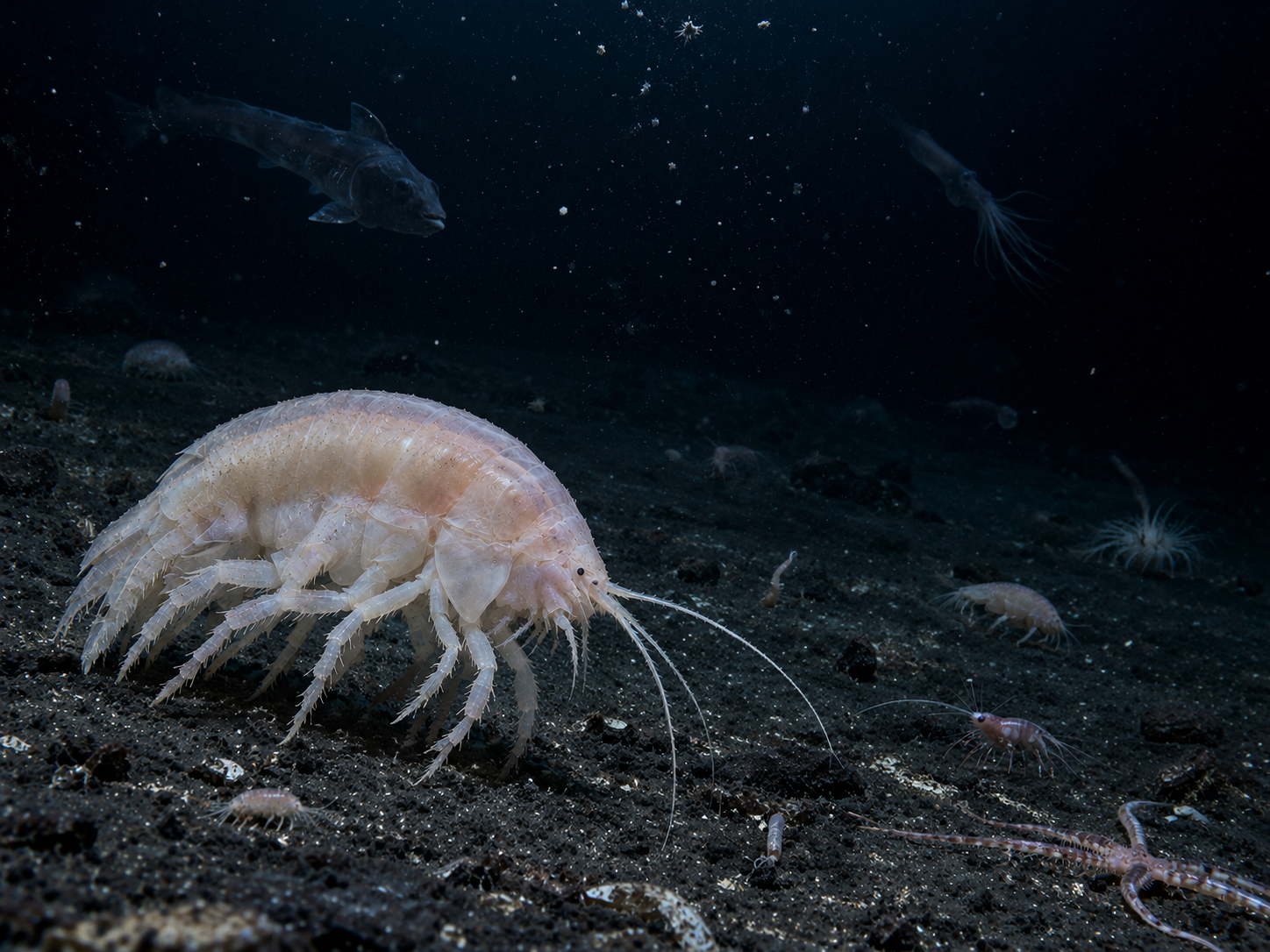
The most honest answer is also the most interesting.
We know that deep-sea gigantism exists.
We know which groups show it.
We know that some giant amphipods are adapted to extreme pressure, scarce food and cold conditions.
And we have several good ideas about why large size may help.
But we do not have one explanation that works for every giant.
A major review of deep-sea biology points out that some deep-sea groups show gigantism while others show miniaturization. Researchers have linked the pattern to food supply, mobility and energy storage, among other factors.
The same problem appears when scientists look specifically at oxygen.
The oxygen hypothesis has evidence behind it in some animals, especially amphipods, but it does not explain why only some lineages become giants. Researchers therefore increasingly treat body size as the result of several interacting pressures rather than one simple environmental switch.
And recent work on Alicella gigantea has opened another door.
Researchers comparing its genes with those of smaller hadal amphipods found signs of selection in pathways related to growth regulation, starvation response and lipid metabolism. These results suggest that the animal's unusual size is connected to a wider set of adaptations rather than one single trick.
That makes sense.
The deep sea is not one problem.
It is many problems at once.
Cold.
Pressure.
Food shortage.
Distance.
Competition.
Time.
Different animals solve those problems in different ways.
Some became small.
Some became giant.
And some found a solution somewhere in between.
Why Deep-Sea Gigantism Is Still a Puzzle
Why Do Deep-Sea Creatures Grow So Large?
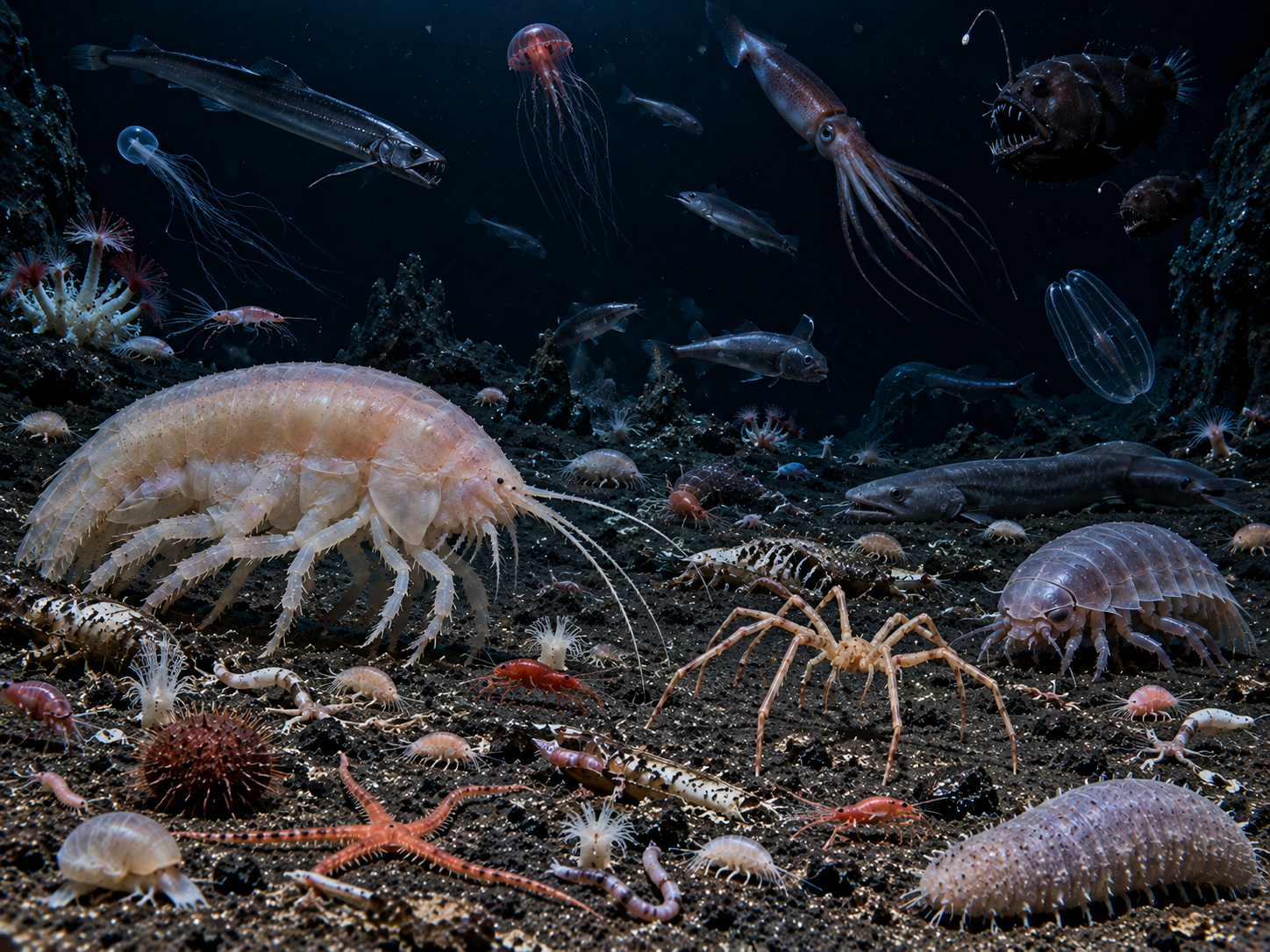
The surprising thing about deep-sea giants is that they live in a place where almost every condition seems to favour saving energy.
The water is cold.
Food can be scarce.
The world is dark.
Yet some animals become enormous.
The answer is probably not one thing.
Cold can slow metabolism.
High oxygen availability relative to metabolic demand may make larger bodies more possible.
Scarce food can favour animals able to store energy and travel farther between meals.
And evolution can push different groups toward very different solutions.
That is why the phrase “deep-sea gigantism” needs a little care.
The deep sea does not make everything big.
Some animals become giants.
Others become smaller.
And many do neither.
The giant amphipod Alicella gigantea may be the clearest example of how strange the deep-sea answer can become.
It can grow to roughly a third of a metre long in a world where most amphipods are tiny.
So perhaps the better question is not:
“Why are deep-sea animals so big?”
It is:
“Why does the deep sea sometimes reward being big?”
And scientists are still working that out.
Frequently Asked Questions
1. What is deep-sea gigantism?
Deep-sea gigantism is the unusually large body size seen in some deep-sea animals compared with their relatives in shallower environments. It has been documented in groups including certain amphipods, isopods and pycnogonids.
2. Why do some deep-sea animals become so large?
Scientists think several factors can contribute, including cold temperatures, low metabolic rates, food scarcity, oxygen availability, mobility and evolutionary history. No single explanation works for every deep-sea giant.
3. What is the largest deep-sea amphipod?
Alicella gigantea is regarded as the largest known amphipod. Reported adult lengths can reach roughly 24–34 centimetres.
4. Why might cold water favour larger animals?
Cold can reduce metabolic rates in ectothermic animals. This may lower energy demands and allow some animals to support larger bodies, although cold alone does not explain gigantism.
5. Does the deep sea have more oxygen?
Cold seawater can hold more dissolved oxygen than warmer water, and deep-sea animals often have low metabolic demands. This has led scientists to investigate whether the balance between oxygen supply and demand helps explain large body size in some groups.
6. Does more oxygen automatically make an animal larger?
No. The oxygen hypothesis may help explain why larger bodies are physiologically possible in some environments, but it does not explain why only certain species become giants. Many deep-sea animals remain small.
7. How can being large help when food is scarce?
A larger body can store more energy and may allow some mobile scavengers to travel farther between rare food patches. This is one proposed advantage of large size in certain deep-sea animals.
8. Are all deep-sea animals giant?
No. In many deep-sea groups, average body size actually decreases with depth. Deep-sea gigantism is therefore a pattern seen in some lineages rather than a rule for the entire deep ocean.
9. Why are giant amphipods useful to study?
They provide an unusually clear example of how an animal can evolve and survive at very large size in extreme deep-sea conditions. Research on Alicella gigantea has identified adaptations linked with starvation, metabolism and growth regulation.
10. Do scientists know exactly why deep-sea gigantism evolved?
Not yet. Several explanations have evidence behind them, but the relative importance of each one varies among animal groups. Scientists increasingly view gigantism as the result of several interacting environmental and evolutionary factors rather than one universal cause.