Introduction
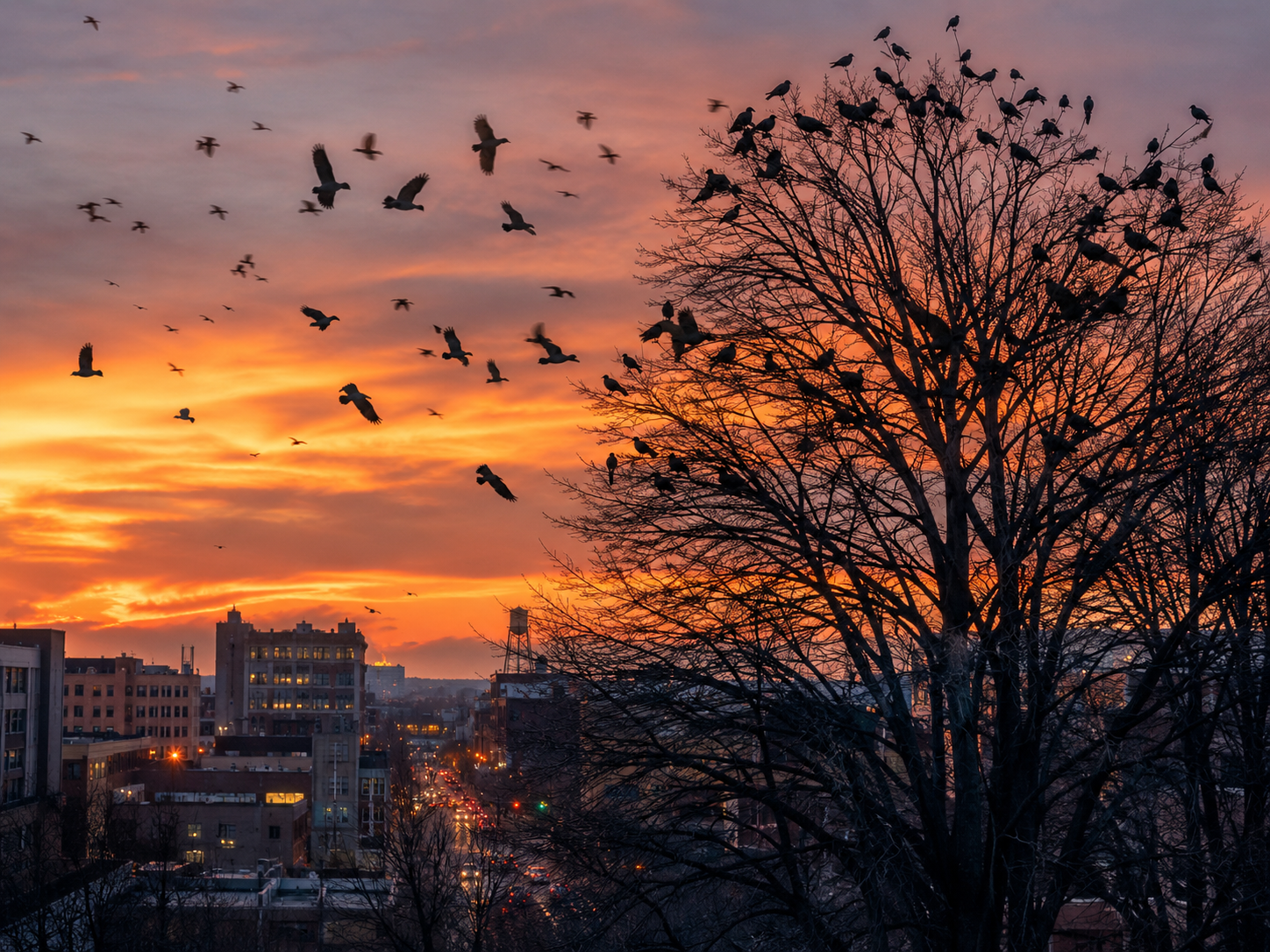
Just before sunset, something strange can happen above a city street.
One crow appears.
Then another.
Then several more arrive from different directions.
Within minutes, the sky may seem full of black wings. Crows settle into the same trees, calling to one another as daylight disappears. In some places, hundreds or even thousands can gather in a single area.
And then, almost as quickly as they arrived, the noise fades.
Why do they do this?
Crows could spread themselves across dozens of trees. They could sleep alone or in small family groups. Instead, they often come together in enormous communal roost: a location where many birds gather to spend the night. particularly during the fall and winter months. Research from Cornell Lab of Ornithology describes this behavior as communal roosting and notes several possible advantages, including protection from predators, favorable roosting conditions and opportunities for information exchange.
The gathering looks chaotic from the ground.
For the crows, however, it may be a very practical arrangement.
The remarkable part is that scientists still cannot reduce the behavior to one simple explanation. A crow roost can provide safety, warmth, a suitable place to spend the night and perhaps even access to useful information.
So when hundreds of crows suddenly converge on the same trees at dusk, they are not simply having a giant meeting.
They are settling into one of the most intriguing social behaviors in the crow world.
“Roost” means a place where birds rest or sleep, typically on a branch or perch
Chapter 1 — The Strange Evening Gathering
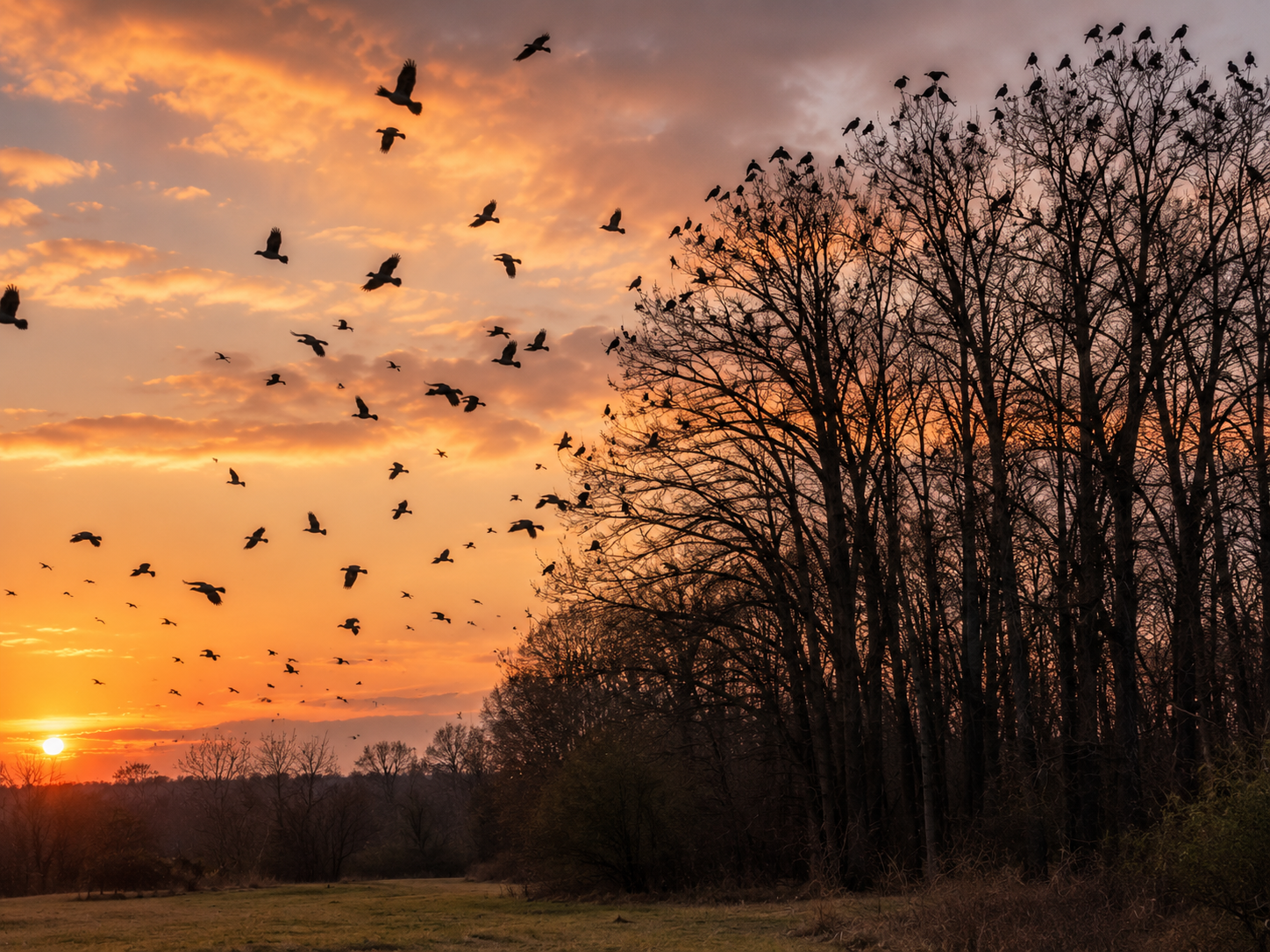
The first thing you notice is usually the noise.
A few crows begin calling somewhere in the distance. Then more arrive.
They fly over rooftops, roads and parks, often coming from different directions. Some land immediately. Others circle the trees before joining the group.
From the ground, it can look as though the birds have chosen one particular place for no obvious reason.
This is called a communal roost: a location where many birds gather to spend the night.
American Crows are well known for forming large winter roosts. The size can vary dramatically depending on location and season, from relatively small gatherings to enormous concentrations containing thousands of birds.
The behavior is particularly noticeable because crows do not simply appear at the roost at random.
The gathering develops gradually.
Birds arrive from different directions, settle into nearby trees and interact with one another before nightfall.
That raises an obvious question.
Why this place?
The answer begins with the timing.
How a Crow Roost Forms
Chapter 2 — Why Dusk Matters
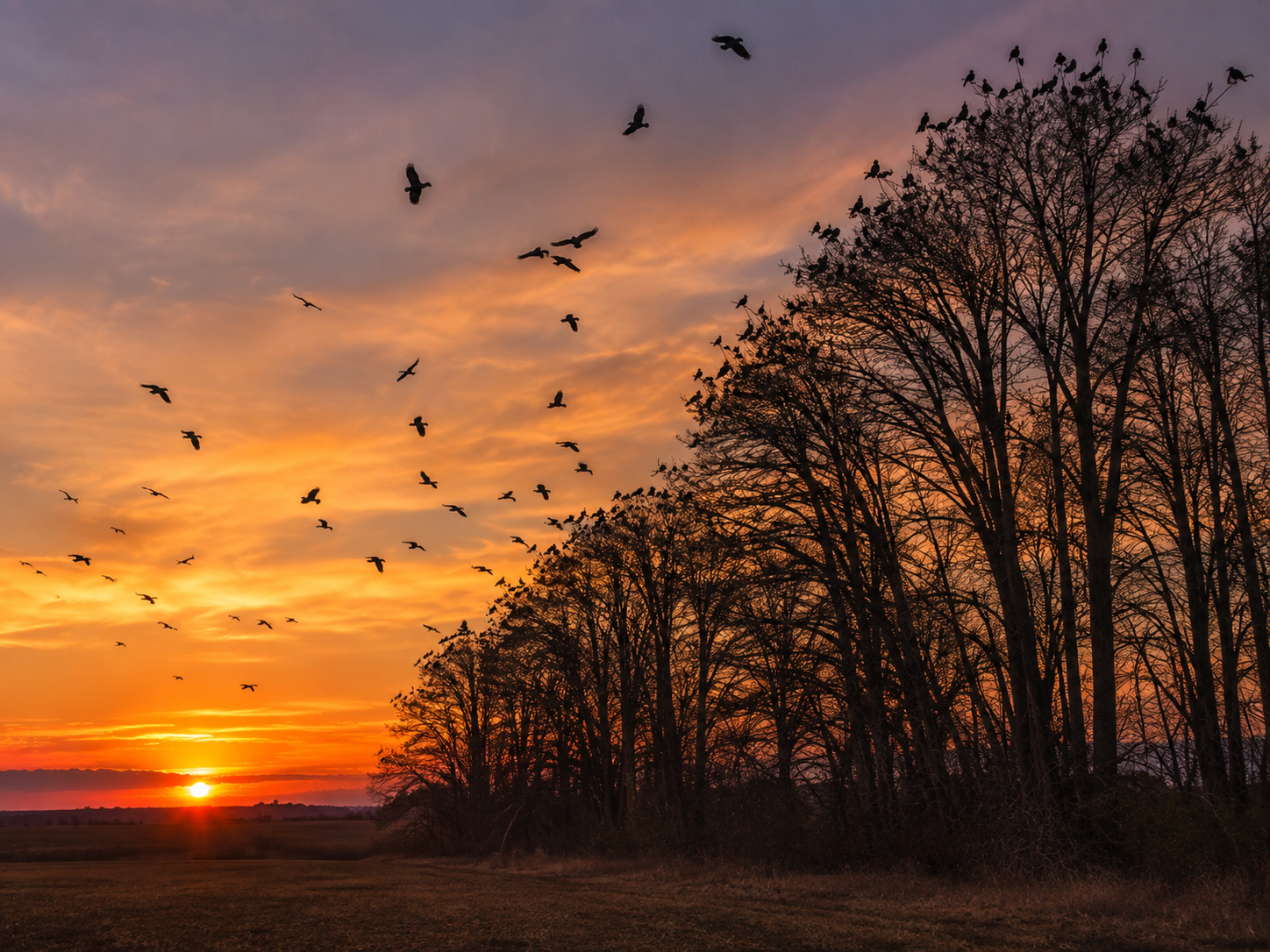
A crow roost does not usually appear in the middle of the afternoon.
There is a reason the gathering becomes obvious around sunset.
During the day, crows have other priorities.
They need to find food, move through their territory, interact with other birds and respond to whatever is happening around them.
As daylight fades, those daytime activities become less useful.
It is time to find somewhere to spend the night.
This is when the advantages of a communal roost become relevant.
The roost needs to be a place where many birds can settle safely. Trees may provide elevated perches that are difficult for some ground-based predators to reach. The location may also offer shelter from wind or other favorable conditions.
But the exact reasons can vary between roosts.
One location may offer good protection. Another may simply contain suitable tall trees in a favorable position. In urban areas, artificial light, warmer temperatures and the availability of large trees or structures may also influence where crows gather.
So dusk is less like an appointment and more like a transition.
The birds finish their daytime activities.
The night begins.
And hundreds of separate journeys can end at the same destination.
Why Crows Gather at Dusk
Chapter 3 — Safety in Numbers
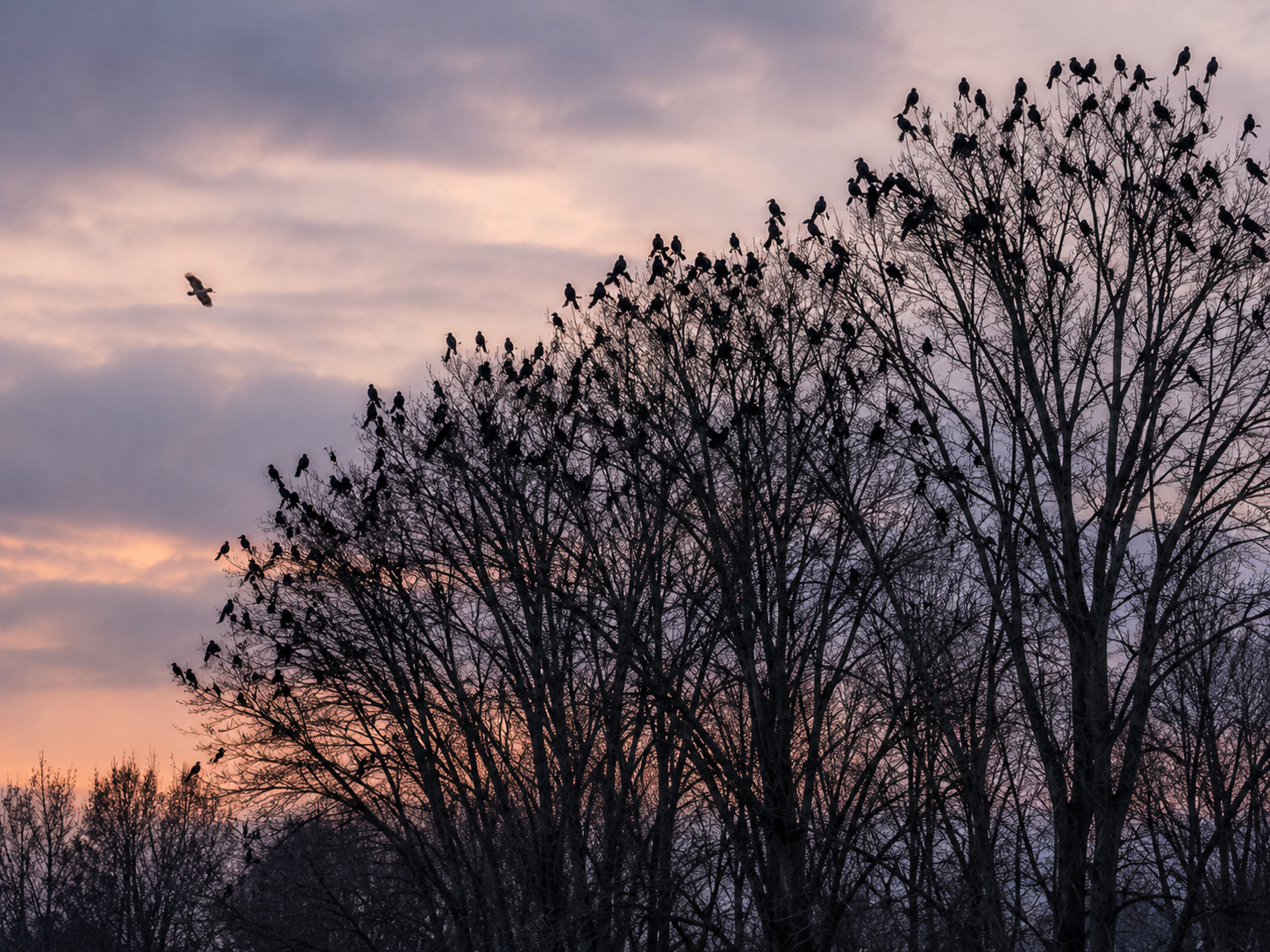
Imagine spending the night alone in a tree.
Then imagine spending it with hundreds of other birds.
For a crow, the second option may offer an important advantage: more eyes and ears watching for danger.
Predators do not disappear after sunset. A lone bird resting in darkness may have fewer opportunities to detect danger before it gets close.
In a large group, however, many individuals are potentially monitoring the surroundings.
This is one of the leading explanations for communal roosting.
If one crow detects something unusual, its behavior or calls may alert others. A large gathering can therefore make it harder for a predator to approach unnoticed.
But there is an important distinction here.
Scientists do not need to prove that every crow consciously thinks, “There are more of us, so I am safer,” for group living to provide a survival advantage.
Natural selection can favor behavior that improves survival even when individual animals are not consciously calculating the benefits.
There can also be disadvantages.
A huge gathering is noisy and conspicuous. Food competition can increase. Diseases or parasites could potentially spread more easily in dense groups.
So communal roosting is not simply a matter of more birds = safer.
It is a trade-off.
And for crows, the benefits may often be worth it.
The Safety-in-Numbers Effect
Could the Crow Roost Help Keep Them Warm?
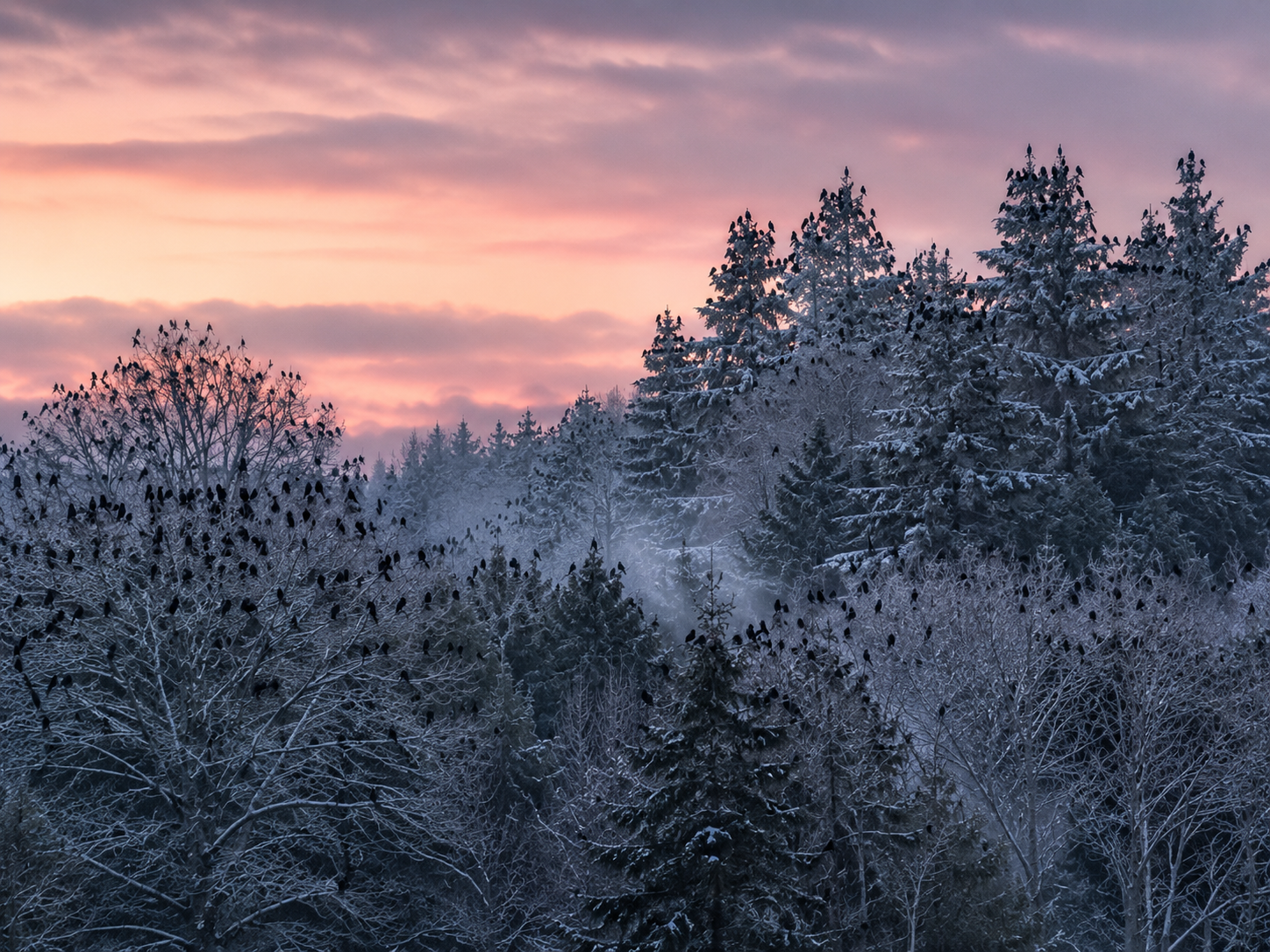
Winter changes the equation.
Cold nights can be difficult for any bird, especially when temperatures fall and wind increases heat loss.
Gathering together may help reduce some of that challenge.
A group of birds occupying suitable roosting sites can create a different local environment from a single exposed bird. Choosing sheltered locations may also reduce exposure to wind.
But this needs a little caution.
It would be misleading to say that crows gather in enormous groups mainly to keep warm.
Communal roosting occurs for multiple possible reasons, and the importance of each advantage can vary by location and season.
Still, winter is when the behavior often becomes especially conspicuous.
Cornell notes that American Crows form large communal roosts particularly during fall and winter.
That seasonal pattern suggests that conditions at that time of year matter.
Perhaps the same roost that provides protection also happens to provide favorable shelter.
Nature rarely offers animals only one benefit from a useful behavior.
A good roost can be valuable for several reasons at once.
Why Winter Roosts Matter
Chapter 5 — Are the Crows Sharing Information?
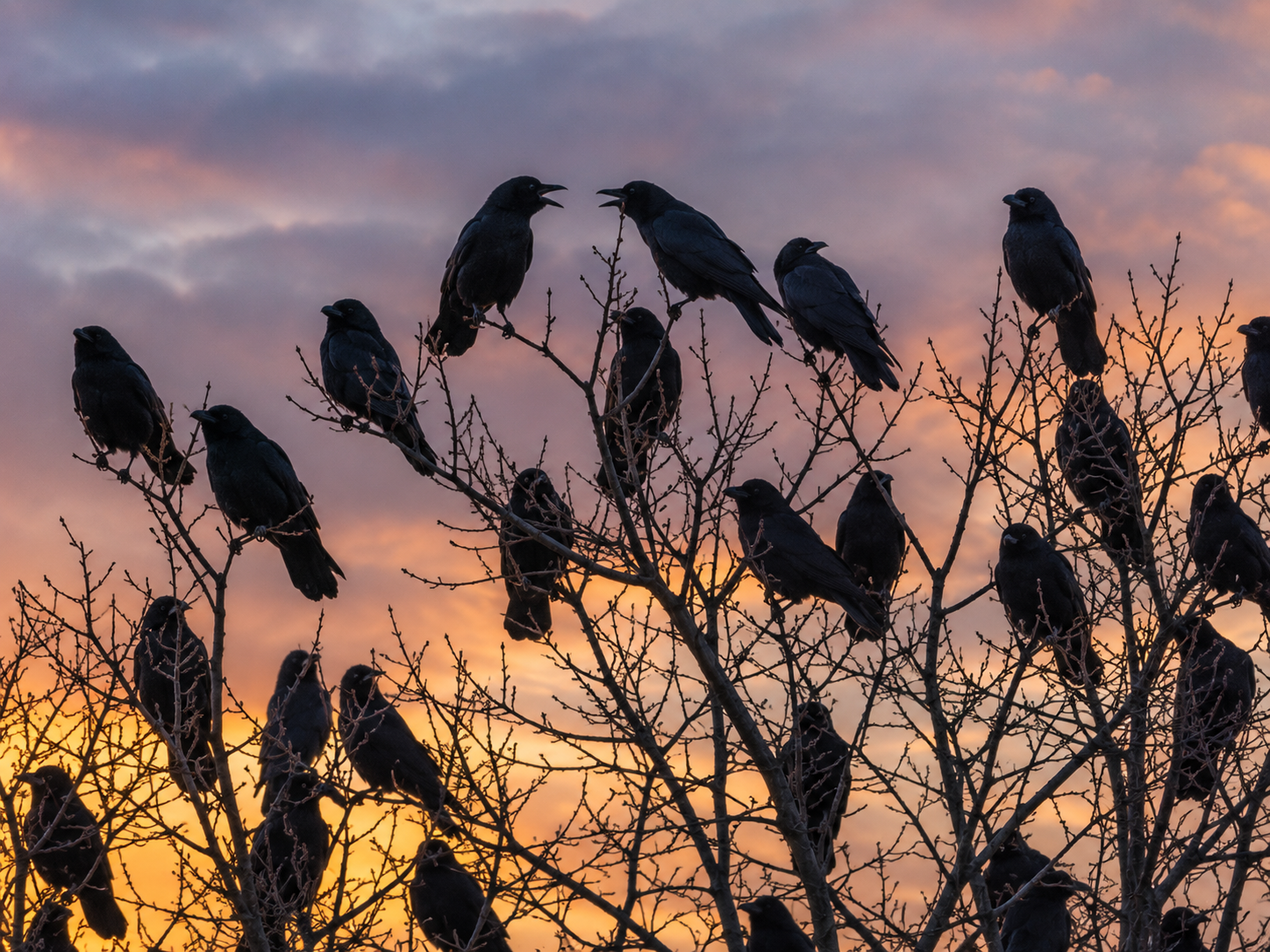
This may be the most fascinating possibility.
A crow leaves its daytime feeding area and arrives at a communal roost.
Nearby, dozens or hundreds of other crows are doing the same thing.
Could the gathering help birds learn from one another?
Researchers have proposed that communal roosts may provide opportunities for information exchange, including information related to food.
The idea makes sense when you consider how mobile crows are.
A crow that discovers a useful food source may have information that another crow does not. At a communal gathering, many individuals with different daily experiences come together.
The roost could therefore act as an information hub.
But this is where we need to be careful.
It does not mean scientists have proved that crows hold a nightly conversation about where breakfast will be tomorrow.
Animal communication is much more complicated than that.
Researchers continue to study how social information moves through crow populations and how communal roosts influence behavior.
What makes the idea so interesting is that the roost may provide something that cannot be measured simply by counting birds:
access to other birds that know things you do not.
The gathering could therefore be useful not only because there are many crows in one place, but because those crows have spent the day in different places.
Could a Roost Be an Information Hub?
Why Cities Can Become Giant Crow Bedrooms
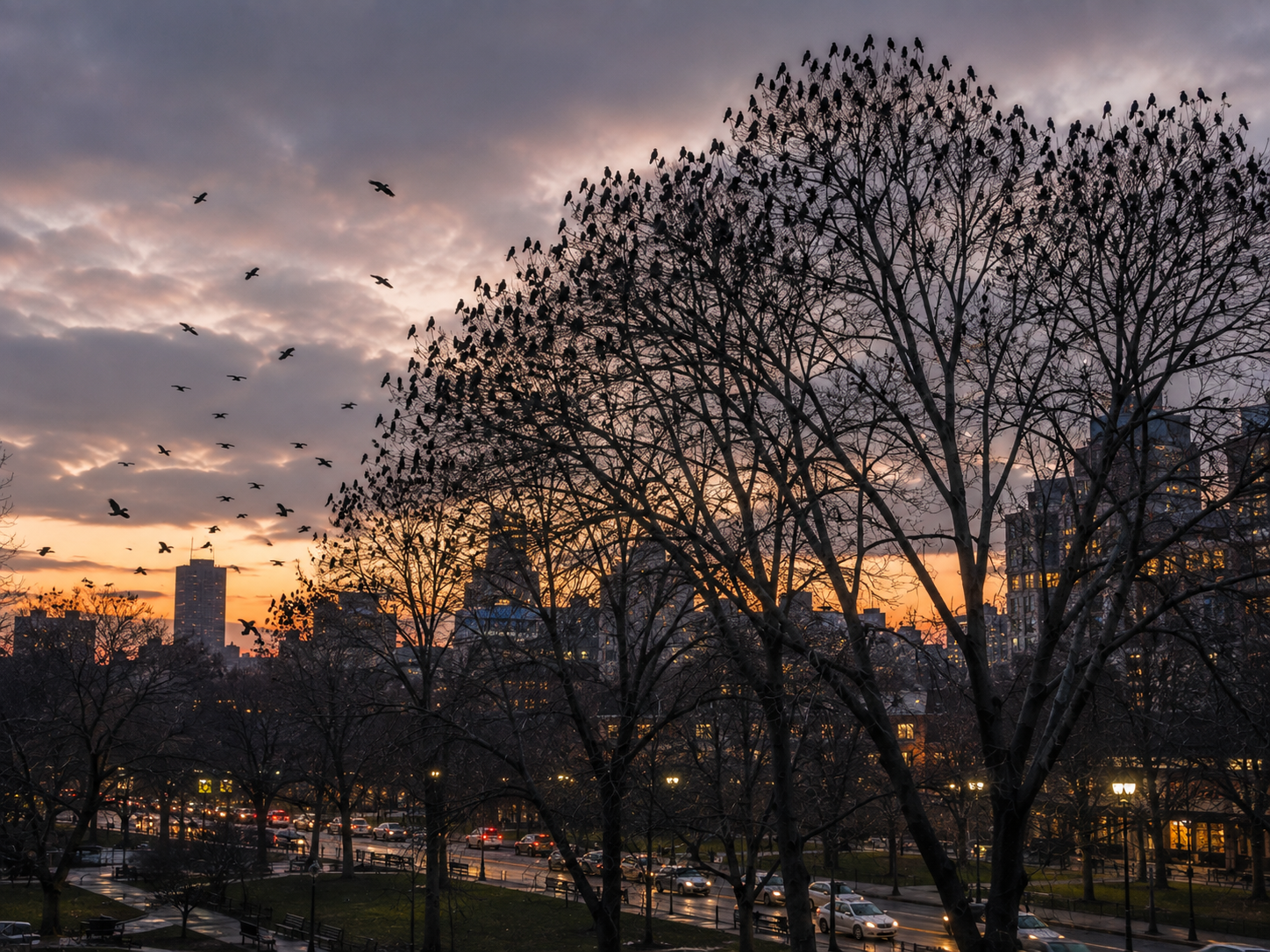
If you live in a city, a huge crow gathering may seem especially strange.
Why would so many wild birds choose a place filled with traffic, buildings and people?
The answer is that cities can contain surprisingly useful roosting habitat.
Tall trees, large structures and sheltered areas can provide elevated places for birds to spend the night. Urban environments can also have relatively favorable nighttime conditions compared with exposed rural areas.
And there is another important factor:
Food.
Crows are highly adaptable generalists. They can use a wide range of food sources, including resources associated with human environments.
That does not mean a crow roost forms simply because people leave food behind.
Instead, cities can offer several of the things a crow needs within a relatively small area: food, suitable trees or structures and places where large numbers of birds can gather.
This helps explain why people sometimes encounter enormous crow gatherings in cities and towns.
The birds are not necessarily being attracted to the city itself.
They may be attracted to what the city accidentally provides.
And once a suitable roost becomes established, the spectacle can be remarkably consistent.
Every evening, the same trees can fill again.
Why Cities Attract Crow Roosts
Chapter 7 — What Scientists Still Don't Completely Know
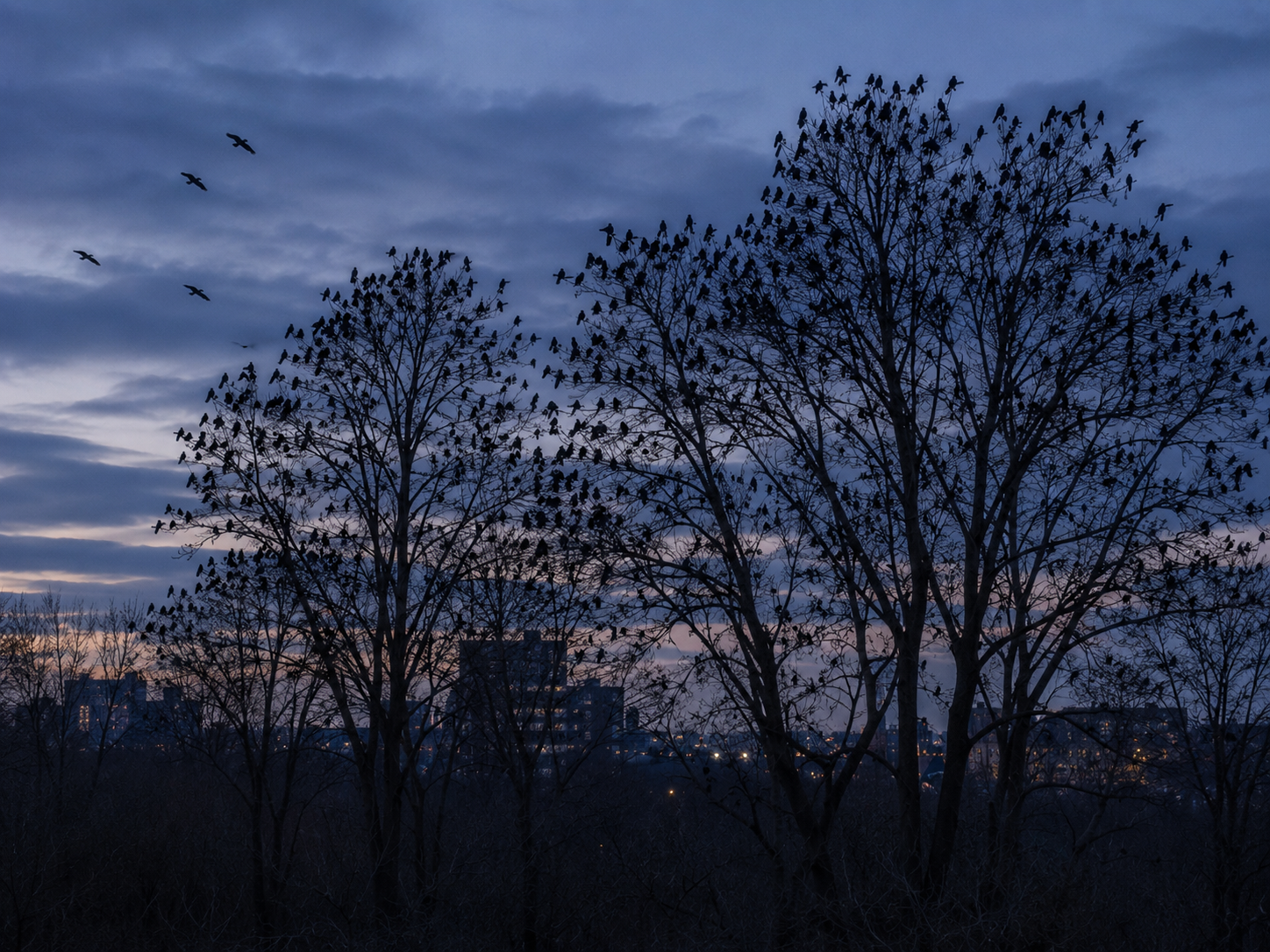
The more closely scientists study crow roosts, the less satisfying the simplest explanation becomes.
Safety matters.
Shelter may matter.
Temperature may matter.
Social contact may matter.
Information exchange may matter.
And the importance of each factor may change from one roost to another.
That is the key point.
There may not be one universal reason why every crow chooses to spend the night with hundreds of others.
The exact social dynamics inside a massive roost are also difficult to observe. Imagine trying to understand a conversation taking place among thousands of birds, most of which are moving, calling and interacting at the same time.
Researchers can observe where birds gather, when they arrive, how roosts change seasonally and how environmental conditions affect them.
But some questions are much harder.
What information moves through the group?
Which birds influence others?
How do individual crows choose between different roosts?
How much does safety matter compared with food or shelter?
These questions are part of what makes communal roosting so interesting.
The strange scene above your neighborhood is not simply an old behavior with every answer already written down.
It is an active area of behavioral research.
So the next time hundreds of crows fill the trees at sunset, it is worth looking up.
You are watching hundreds of individual birds make use of a shared nighttime world.
And scientists are still working out exactly why that world is so attractive.
What We Know and What Remains Uncertain
FAQ Frequently Asked Question
1. Why do crows gather at dusk?
Crows gather at dusk because daylight activity is ending and they are moving toward communal roosts where they will spend the night. Large roosts are particularly common in fall and winter.
2. Why do hundreds of crows gather in the same trees?
The same location may provide several advantages, including suitable perches, protection from predators, favorable shelter and opportunities for social interaction. The exact combination can vary between roosts.
3. Why do crows gather in large groups at night?
Nighttime is when crows need a safe place to rest. A communal roost can provide potential safety-in-numbers benefits as well as suitable shelter.
4. Do crows sleep together?
Yes. Crows can spend the night in communal roosts containing large numbers of birds, particularly during fall and winter.
5. Why do crows gather more in winter?
Large communal roosts are especially associated with fall and winter. Seasonal changes may make the benefits of shared roosting, including safety and favorable shelter, more important.
6. Do crows gather together for warmth?
Warmth and protection from environmental conditions may be among the advantages of suitable roosts, but warmth alone does not fully explain communal roosting.
7. Do crows communicate at their nighttime roosts?
Crows interact and vocalize at communal roosts, but scientists are still studying exactly what information is exchanged and how those interactions influence later behavior.
8. Why are there so many crows in cities at sunset?
Cities can contain tall trees, sheltered areas, food resources and connected flight routes that make suitable communal roosting possible. Urban crow populations are highly adaptable.
9. Do crows choose the same roost every night?
Crows can repeatedly use established communal roosts, although roost locations and numbers can change with season, environmental conditions and local circumstances.
10. Is there one reason why crows gather in huge groups?
Probably not. Safety, suitable roosting conditions, environmental factors and social information may all contribute. Scientists continue to investigate how these factors interact.