Why Do Chameleon Scales Change Colors?
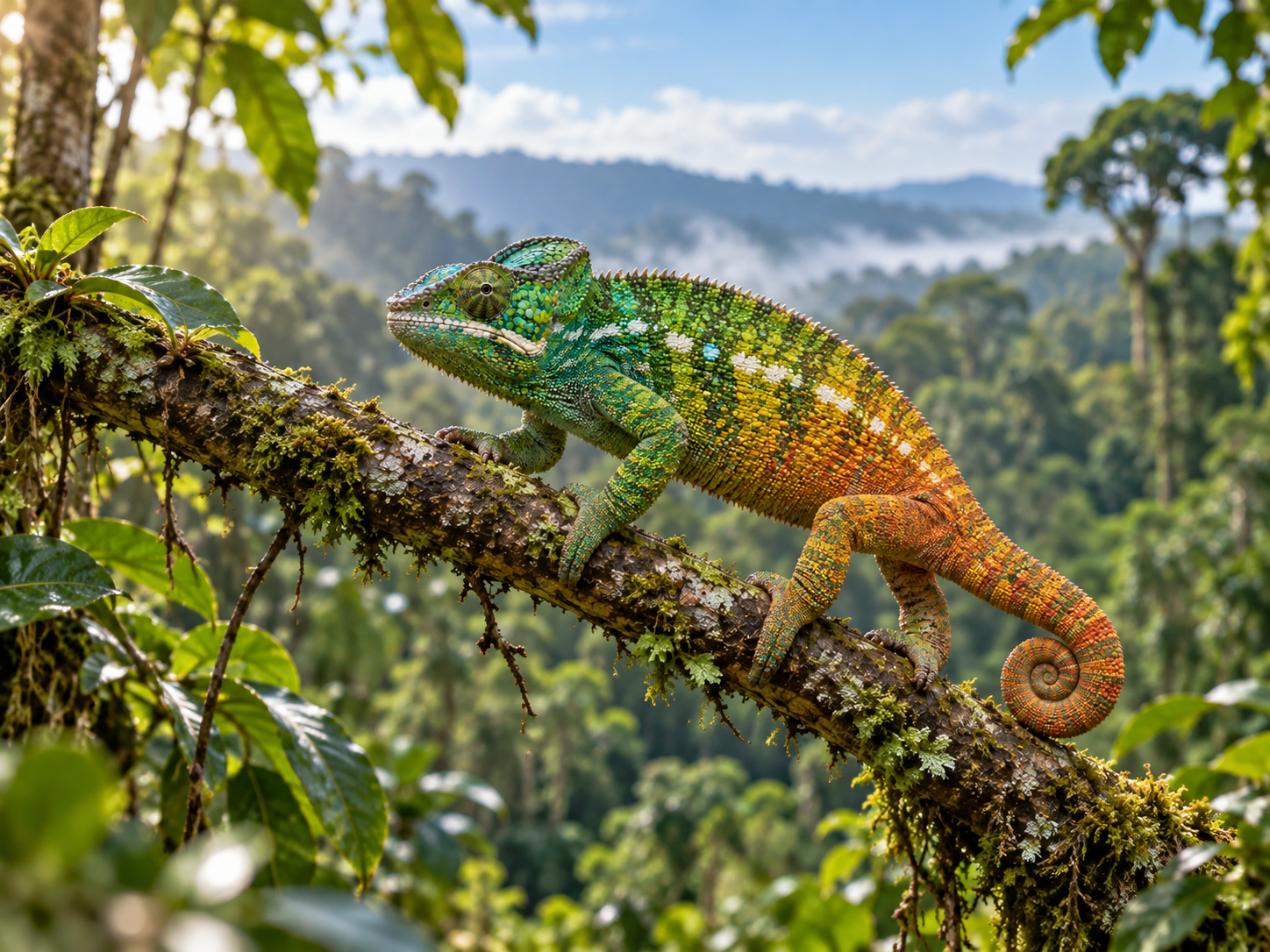
A chameleon sits on a branch.
Its skin is green.
Then another chameleon appears.
The first one suddenly becomes brighter. Green shifts toward yellow. Orange and red begin to appear.
It looks as though the animal is changing its skin like a digital screen.
That is not quite what is happening.
And there is another common idea that needs correcting.
A chameleon does not simply look at a green leaf and turn green to copy it.
Some chameleons can adjust their colour for camouflage, but colour change is also strongly connected with communication, especially when males meet or when a chameleon is excited. Colour can also help with temperature control.
The most remarkable part happens much deeper than the scales.
Inside the skin are special cells called iridophores. In some chameleons, these cells contain incredibly tiny crystals of guanine. By changing the spacing between the crystals, the animal changes which colours of light are reflected back to our eyes.
So the chameleon is not mixing a new paint colour.
It is changing the way its skin handles light.
And that is a much stranger trick.
Chapter 1 — The Scales Are Not Changing Colour by Themselves
Look closely at a chameleon.
The scales are what you notice first.
But the colour change is happening underneath them.
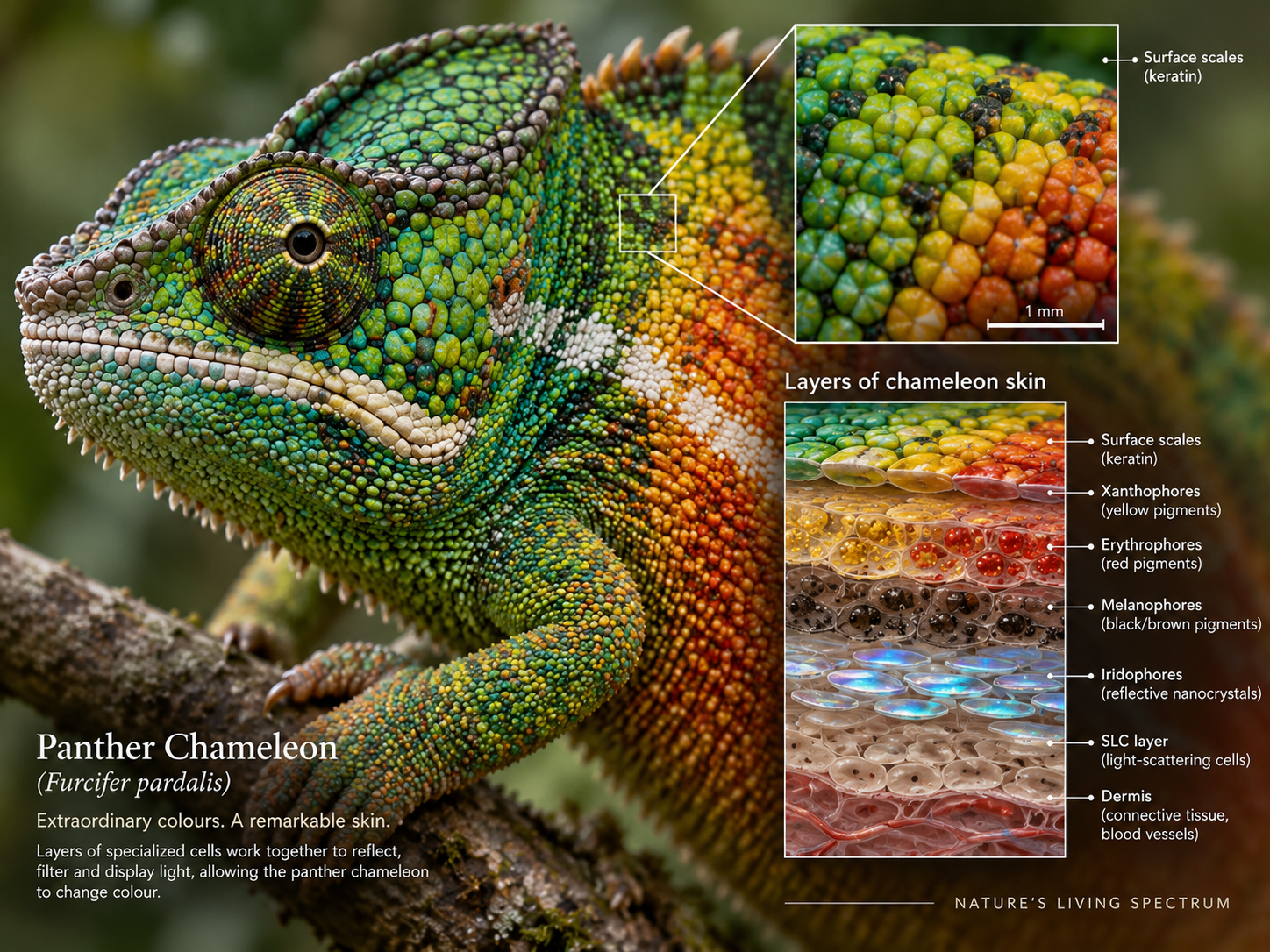
The skin contains several layers of specialised cells. Some hold pigments. Others reflect light. Together, they create the colour that reaches your eyes.
That is why saying “chameleon scales change colour” is convenient, but not quite accurate.
The scales cover the skin.
The real work happens inside the skin.
In panther chameleons, scientists have found two layers of iridophores. These are cells containing tiny guanine crystals that interact with light. The upper layer is involved in rapid colour changes, while a deeper layer reflects a broad range of light, especially near-infrared radiation.
There are pigment cells too.
So the final colour is not produced by one thing.
It is a combination.
The easiest way to think about it is this:
Pigments absorb some light.
Iridophores reflect some light.
Your eyes see what comes back.
That is why a chameleon can make such a dramatic change without replacing the pigments in its skin.
It is changing the light.
What Is Actually Changing?
Chapter 2 — The Secret Is Hidden in Tiny Crystals
Now we get to the part that sounds almost impossible.
Tiny crystals.
Inside the iridophore cells are crystals of guanine.
They are far too small to see with your eyes.
But they have a very important property.
They can reflect light.
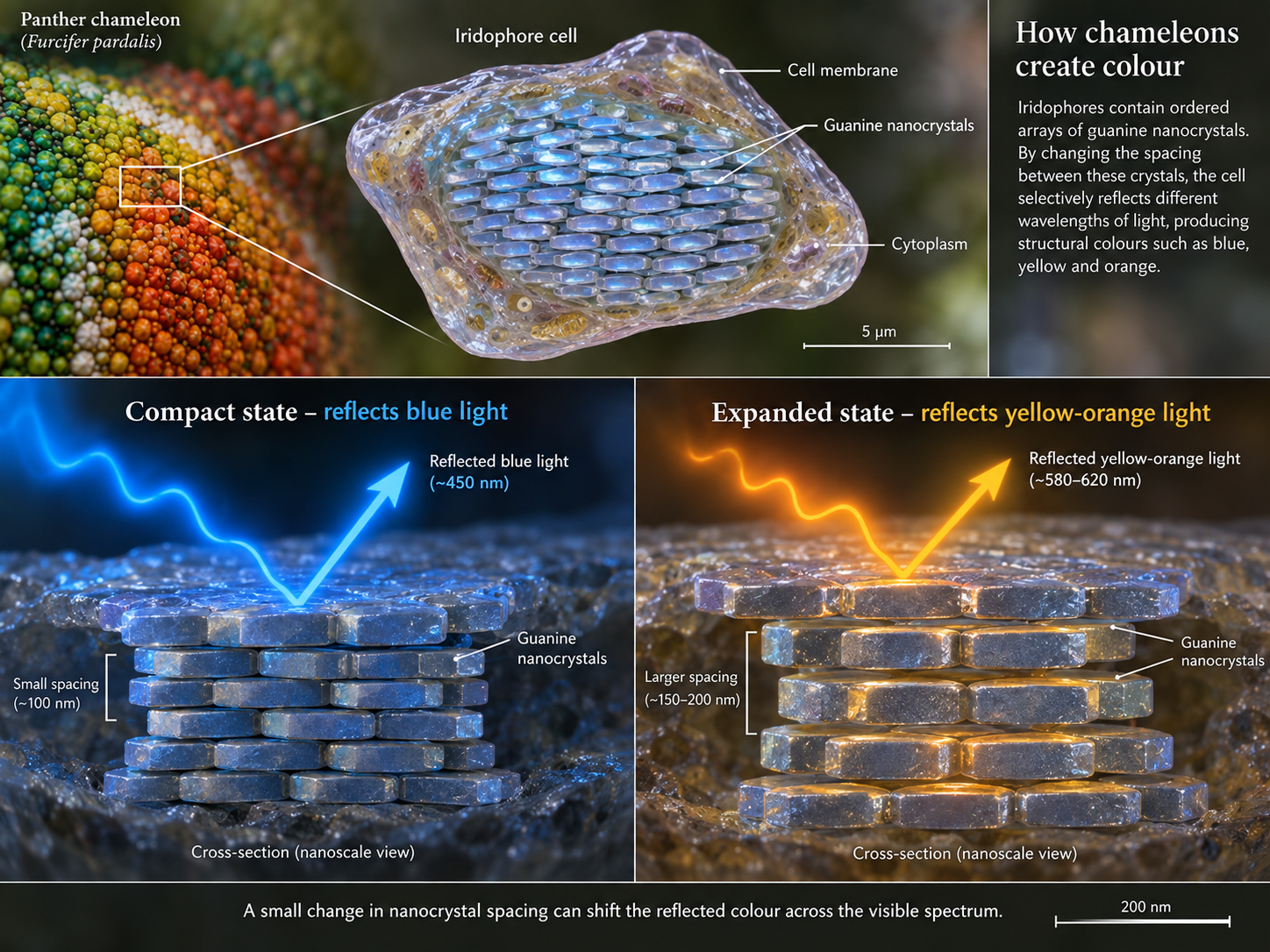
In panther chameleons, the crystals in the superficial iridophores are arranged in an organised structure. When the spacing between them changes, the wavelengths of light that are strongly reflected also change.
Think about a row of windows.
Change the spacing between the windows and the way light moves through the pattern changes.
The chameleon is doing something similar at a much smaller scale.
When the crystals are closer together, shorter wavelengths such as blue are strongly reflected.
When the spacing increases, longer wavelengths can become more strongly reflected, shifting the visible colour toward yellow or orange.
That sounds complicated.
The basic idea is not.
Change the crystal spacing.
Change the reflected light.
Change the colour you see.
The chameleon does not need a new pigment every time.
It simply changes the structure that reflects the light.
The Crystal Trick
Chapter 3 — A Tiny Change Can Make a Big Colour Change
Here is the strange part.
The crystals do not need to move very far.
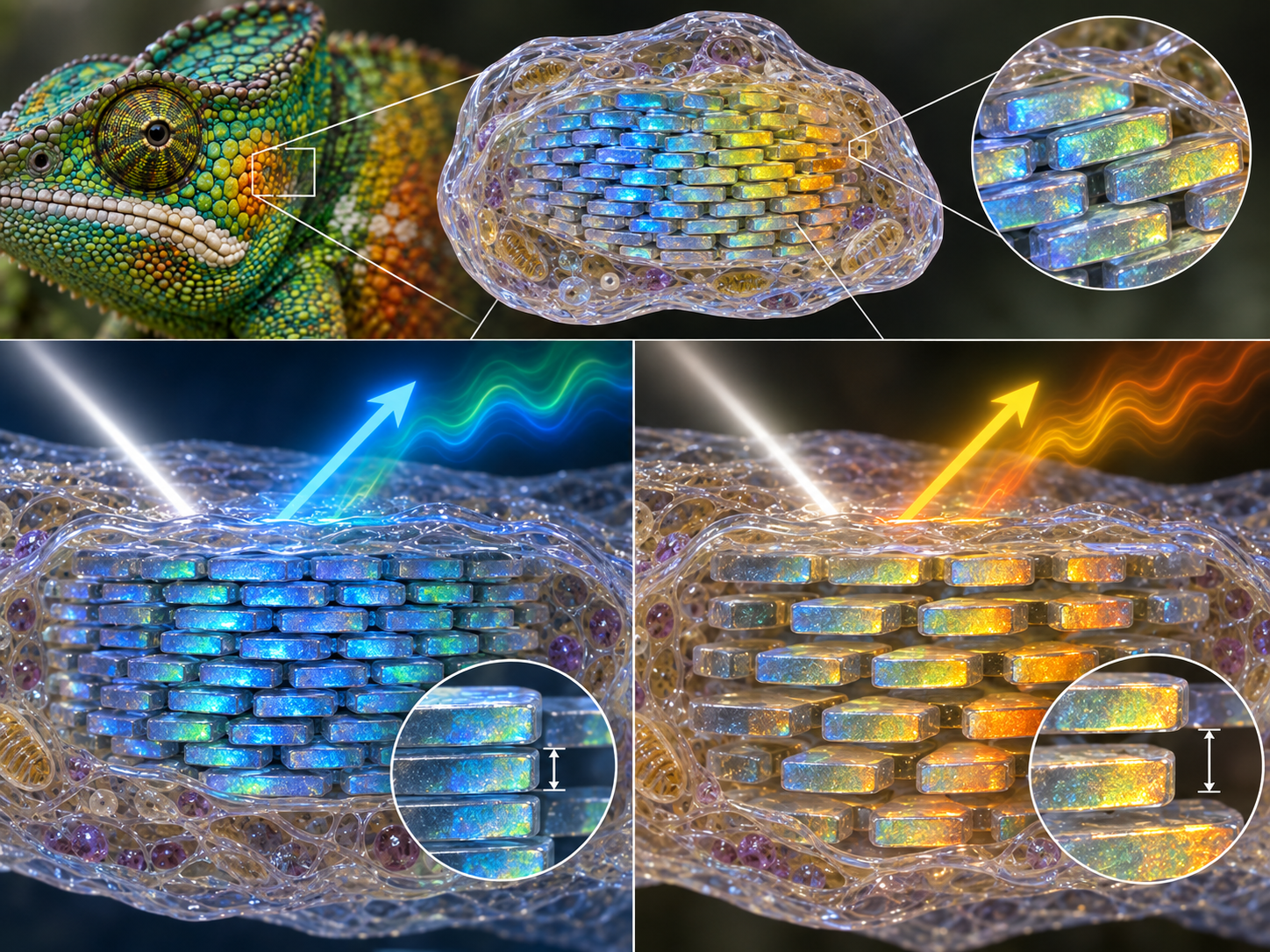
In the study of panther chameleons, the average spacing between guanine nanocrystals in the superficial iridophores was about 30% smaller in resting skin than in excited skin. That relatively small structural change was enough to shift the reflected colour dramatically.
Why?
Because the crystals are not acting like random bits of shiny material.
They are arranged in an organised pattern.
That pattern controls how light interacts with them.
Change the pattern slightly and the reflected wavelengths can change a lot.
This is why the word photonic crystal appears in research about chameleon skin.
It sounds advanced.
But the basic idea is simple.
A repeated structure can control light.
The chameleon can tune that structure.
And the colour changes with it.
Scientists tested this idea experimentally. When skin samples were placed under conditions that caused the crystal lattice to contract, the reflected colour shifted back toward blue, supporting the idea that the spacing itself was controlling the colour.
So the chameleon's colour change is not just something that happens to its skin.
The skin is actively changing its optical structure.
Small Structural Change, Big Colour Change
Chapter 4 — So Is It Really Camouflage?
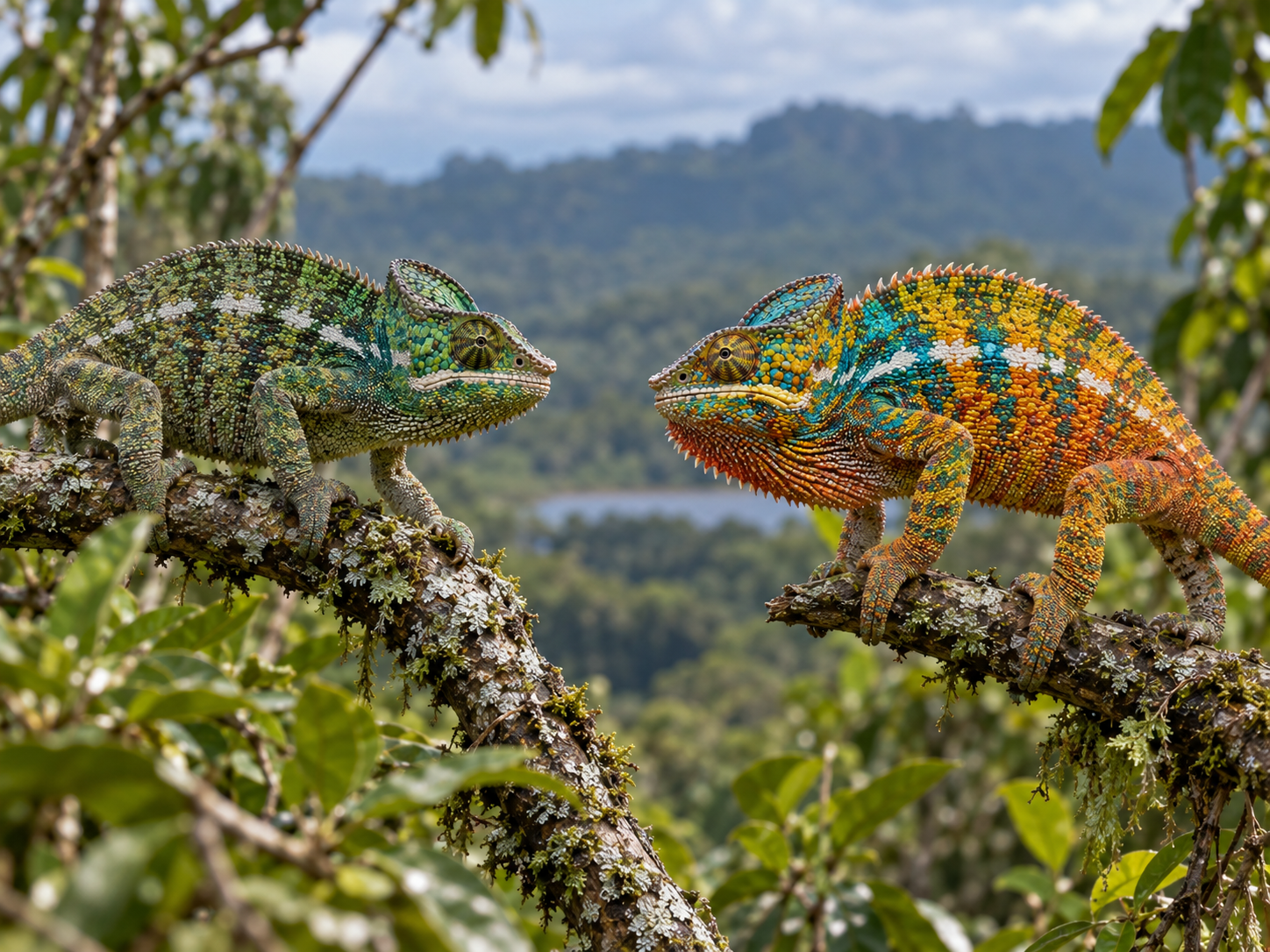
This is the part most people get wrong.
The chameleon changes colour.
So we assume it sees a leaf.
Then it becomes the exact colour of the leaf.
It sounds reasonable.
But real chameleons are more complicated.
Colour change can help with camouflage, but it is also strongly used for communication. Scientists have observed striking changes during social interactions, including fights between males and courtship.
Recent work on flap-necked chameleons has also shown that background matching does occur, but not in the cartoon-like way people often imagine. The animals could change brightness and match some background colours, but they did not simply reproduce the background's full pattern.
That makes sense when you think about how useful communication can be.
Imagine two male chameleons meeting.
One wants the other to leave.
Turning brighter and showing strong colours can make that message impossible to miss.
In panther chameleons, males can shift from relatively green or blue-green colours toward much brighter yellow, orange and related colours during excitement and male-male contests.
So sometimes the best colour is not the one that hides you.
It is the one that makes sure another chameleon sees you.
Camouflage Is Only Part of the Story
Chapter 5 — Sometimes the Brightest Colour Is the Most Useful
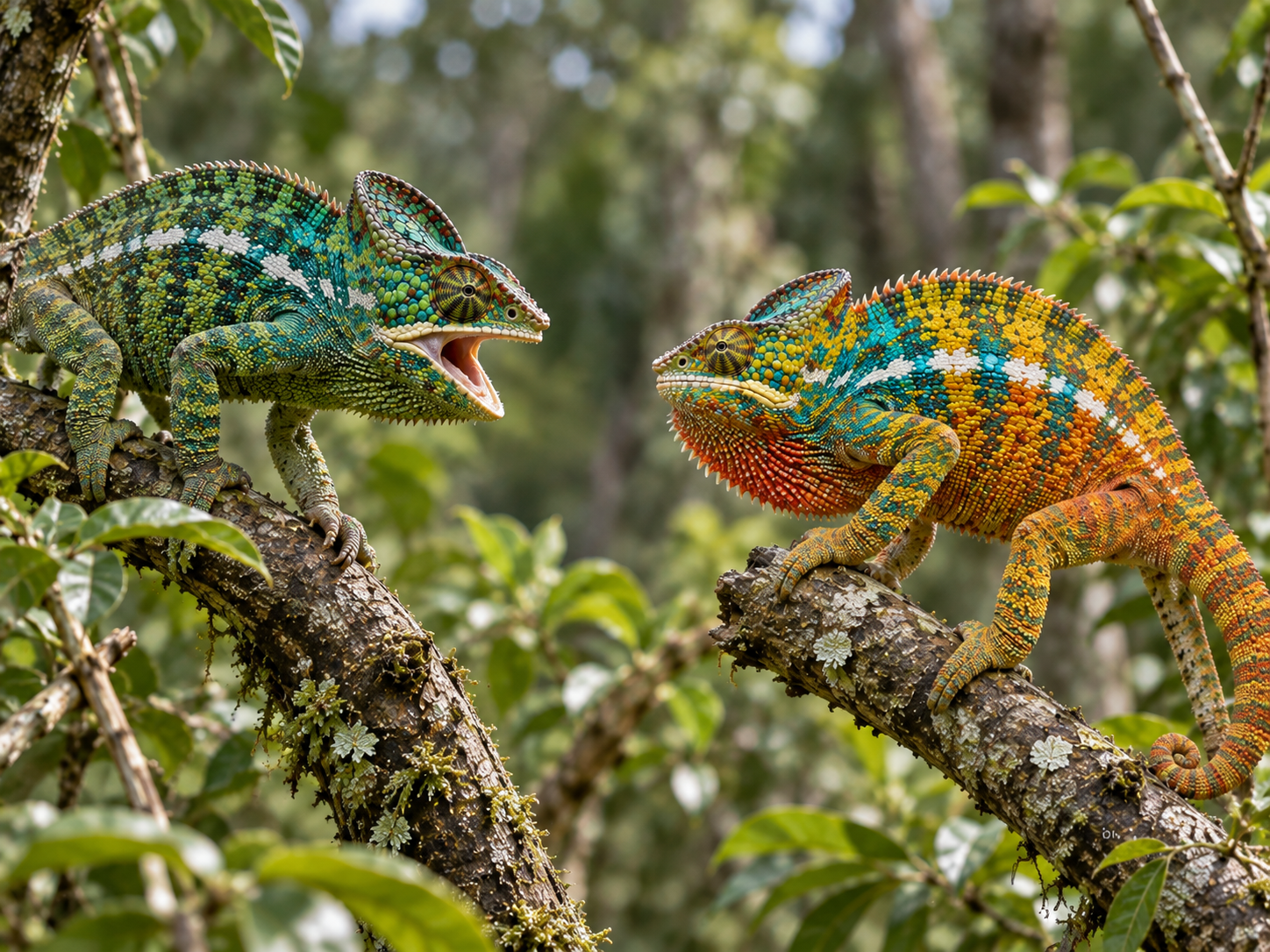
This is where chameleon colour change becomes almost the opposite of camouflage.
Imagine a male seeing another male.
Blending into the branch would be useful if he wanted to disappear.
But what if he wants to be noticed?
Then disappearing is the last thing he needs.
Some chameleons can produce very bright colours during social encounters. In panther chameleons, male contests can trigger rapid changes from green or blue-green toward yellow, orange and red patterns.
The colour is now doing a different job.
It is a signal.
I am here.
I am excited.
Stay away.
Or, in the right context:
I am interested.
Researchers studying chameleon colour change have found evidence that social signalling has played a major role in the evolution of dramatic colour-changing abilities in some chameleons.
This also explains why the most dramatic changes are not always the best examples of camouflage.
A bright orange chameleon on green leaves is not trying very hard to disappear.
It may be doing exactly the opposite.
It wants another chameleon to notice.
Chapter 6 — The Colour Can Also Help With Heat
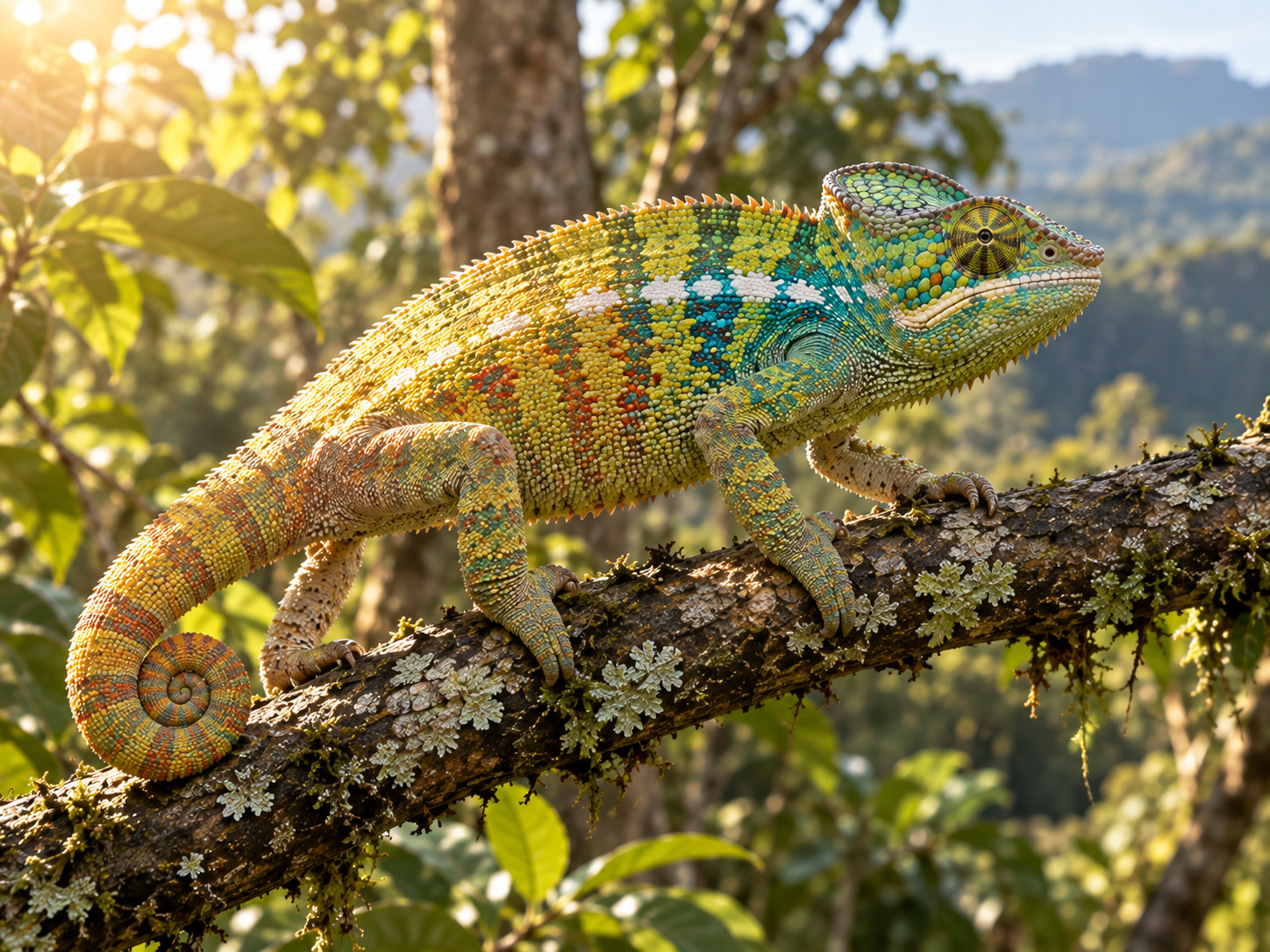
There is one more job hiding in the skin.
Heat.
Chameleons are ectotherms, so their body temperature depends heavily on the environment. Colour and brightness can affect how much solar radiation the animal absorbs or reflects.
This is where the deeper layer of iridophores becomes interesting.
In panther chameleons, the deeper iridophore layer contains larger guanine crystals and reflects a substantial amount of incoming radiation, especially near-infrared wavelengths. Researchers suggested that this layer may help reduce the thermal effects of strong sunlight.
So the skin is doing more than producing pretty colours.
It can also influence what happens to incoming sunlight.
A darker surface generally absorbs more visible light.
A lighter surface can reflect more.
The exact response depends on the species, the body region and the environmental conditions, so it would be too simple to say that every colour change is purely about cooling or warming.
But heat is part of the story.
The chameleon's skin is not just a billboard.
It is also part of the animal's relationship with sunlight.
Chameleon Skin and Sunlight
Chapter 7 — Not Every Chameleon Can Do the Same Trick
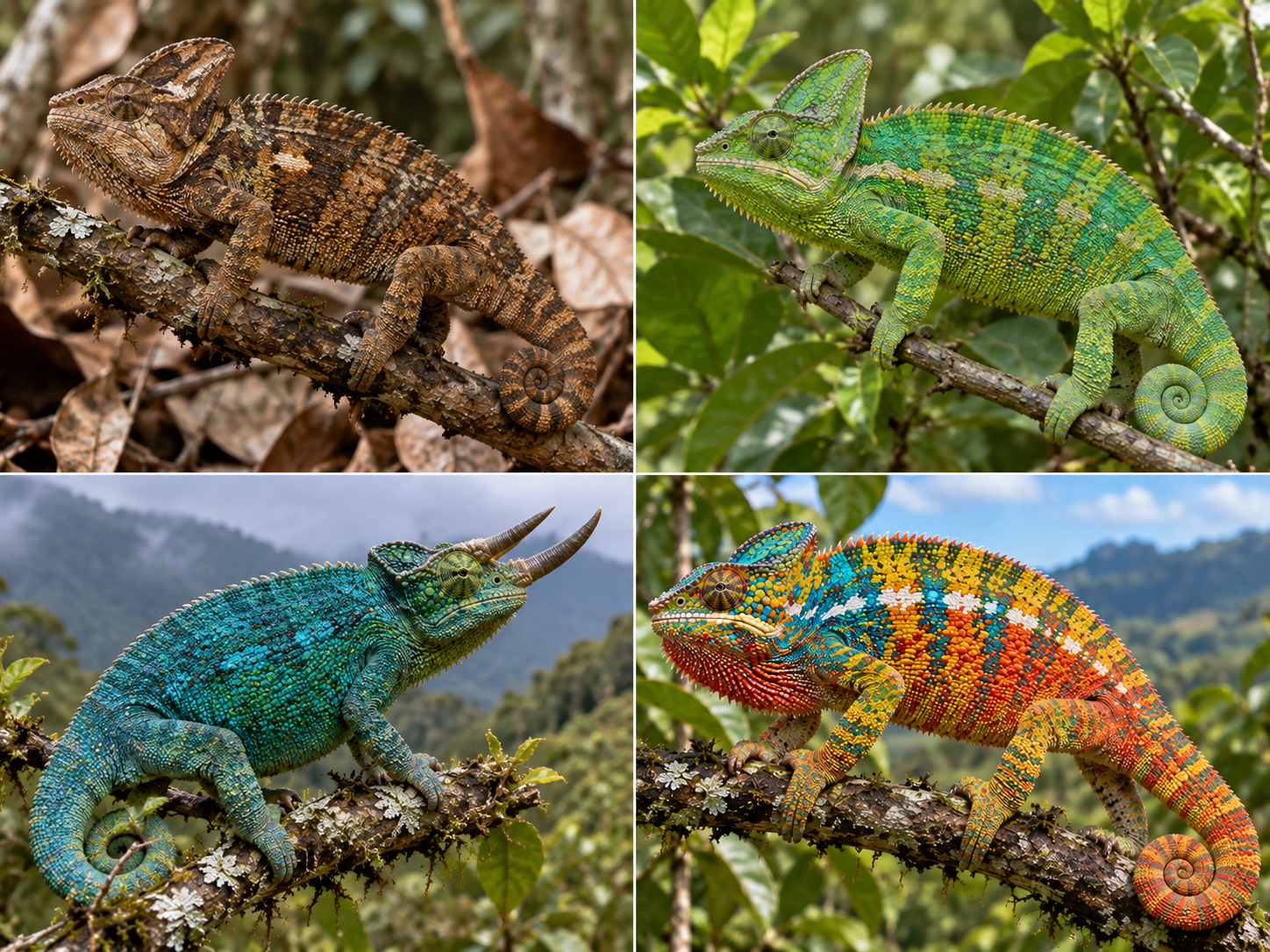
There is one final mistake worth avoiding.
When we say “chameleons change colour,” it sounds as though every chameleon can do the same thing.
They cannot.
There are more than 200 recognized chameleon species, and their ability to change colour varies widely. Some mainly change shades of brown or brightness. Others can shift through striking greens, blues, yellows and oranges.
Even within one species, males and females can have very different colour-changing abilities.
The famous structural-colour research was carried out on panther chameleons, especially adult males. Their superficial iridophore layer is much more developed than in females and juveniles, which helps explain their dramatic colour displays.
Recent research on flap-necked chameleons has also added an important piece: these animals can change their colour and brightness to improve camouflage against some backgrounds, but they do not simply reproduce every pattern around them.
So there is no single chameleon colour-changing machine.
Different species have different skin structures.
Different situations produce different responses.
And scientists are still working out exactly how the nervous and hormonal systems control the tiny changes inside the skin cells. The mechanism that actively changes the spacing of the guanine crystals is not yet fully understood at the molecular level.
That leaves us with a more interesting picture.
A chameleon does not carry a secret paint box under its scales.
It carries a living optical system.
And sometimes, all it has to do is change the spacing of crystals smaller than you can see.
Then the colour changes.
Not All Chameleons Change Colour the Same Way
So, How Does a Chameleon Change Colour?
The answer is hidden beneath the scales.
The skin contains pigment cells and specialised iridophores.
Inside some of those iridophores are tiny guanine crystals.
When the animal changes the spacing between the crystals, the way they reflect light changes.
Blue can become green.
Green can shift toward yellow.
Yellow can become orange.
The exact response depends on the species and the situation.
And that colour is not always a camouflage trick.
Sometimes the chameleon wants to disappear.
Sometimes it wants another chameleon to notice it.
Sometimes changes in brightness can also help with dealing with sunlight and body temperature.
So the old picture of the chameleon changing colour simply to match whatever is behind it is missing most of the story.
The remarkable thing is not that the animal has coloured skin.
It is that the skin can change how it reflects light.
The chameleon does not repaint itself.
It changes the light.
FAQs
1. Why do chameleons change colour?
Chameleons change colour for several reasons, including communication, camouflage and temperature control. The importance of each purpose depends on the species and situation.
2. Do chameleons change colour to match their surroundings?
Sometimes they can adjust their colour or brightness to help with camouflage, but they cannot simply copy any background or become an exact match.
3. How does a chameleon change its colour?
Its skin contains special cells called iridophores. In some species, tiny guanine crystals inside these cells change their spacing, altering the wavelengths of light reflected from the skin.
4. What are the tiny crystals in chameleon skin?
They are crystals made of guanine, a substance that can reflect light. Their organised arrangement helps produce the chameleon's changing colours.
5. Can a chameleon change from blue to yellow?
Some species can make large shifts between colours such as blue, green, yellow and orange. The exact range depends on the species.
6. Why do male chameleons become brighter?
Bright colours can be used as signals during social interactions. Male panther chameleons, for example, can show vivid colours during territorial contests and other encounters.
7. Do all chameleons change colour dramatically?
No. Colour-changing ability varies between species, and males, females and juveniles can also have different abilities.
8. Can chameleons change colour to control their body temperature?
Colour and brightness can influence how much sunlight the skin absorbs or reflects. Specialised deeper skin layers may also help deal with solar radiation.
9. How quickly can a chameleon change colour?
Some chameleons can produce noticeable colour changes very quickly, sometimes in less than a minute, although the speed varies with the species and situation.
10. Are chameleons actually changing their skin pigment?
Not necessarily. Dramatic colour changes can result from changes in the structure of reflective cells beneath the scales, which alter how light is reflected.