Why Can’t Cheetahs Roar Like Other Big Cats?
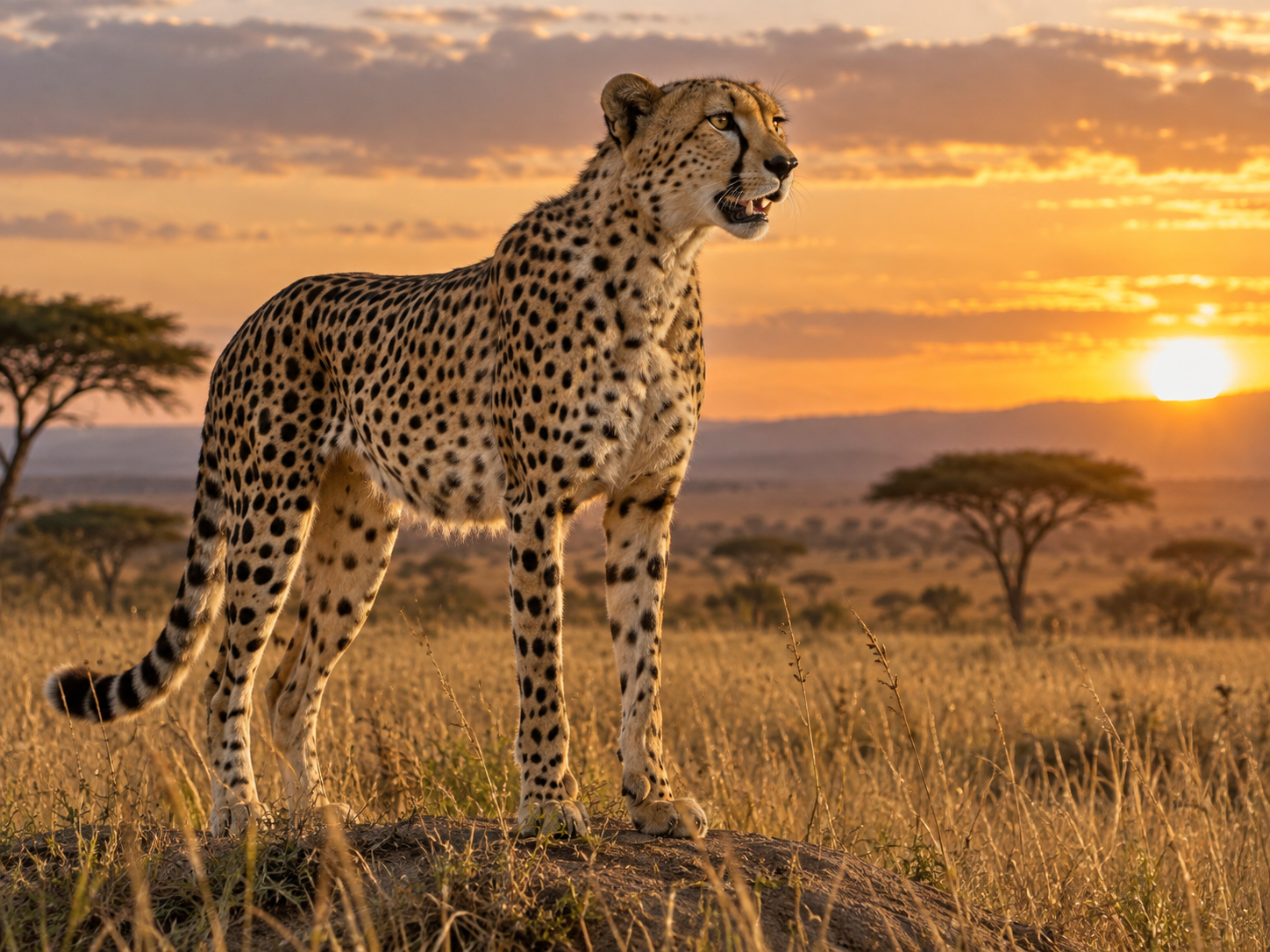
A cheetah can run faster than almost any other land mammal.
But it cannot do something that lions, tigers and jaguars are famous for.
It cannot roar.
Instead, a cheetah chirps.
It can purr, growl, hiss, bark and make a strange stuttering call. A loud chirp can even carry a surprisingly long distance.
At first, that seems odd.
The cheetah is a large predator. It has powerful muscles, sharp teeth and a body built for chasing prey across open ground. Why should its voice be so different?
The answer is hidden in its throat.
And, strangely enough, the same evolutionary story that made the cheetah so fast also helps explain why its body is built so differently from a lion's or tiger's.
A cheetah did not become a speed specialist by simply making everything bigger and stronger.
It became a very different kind of cat.
Chapter 1 — A Cheetah Is a Cat That Talks Differently
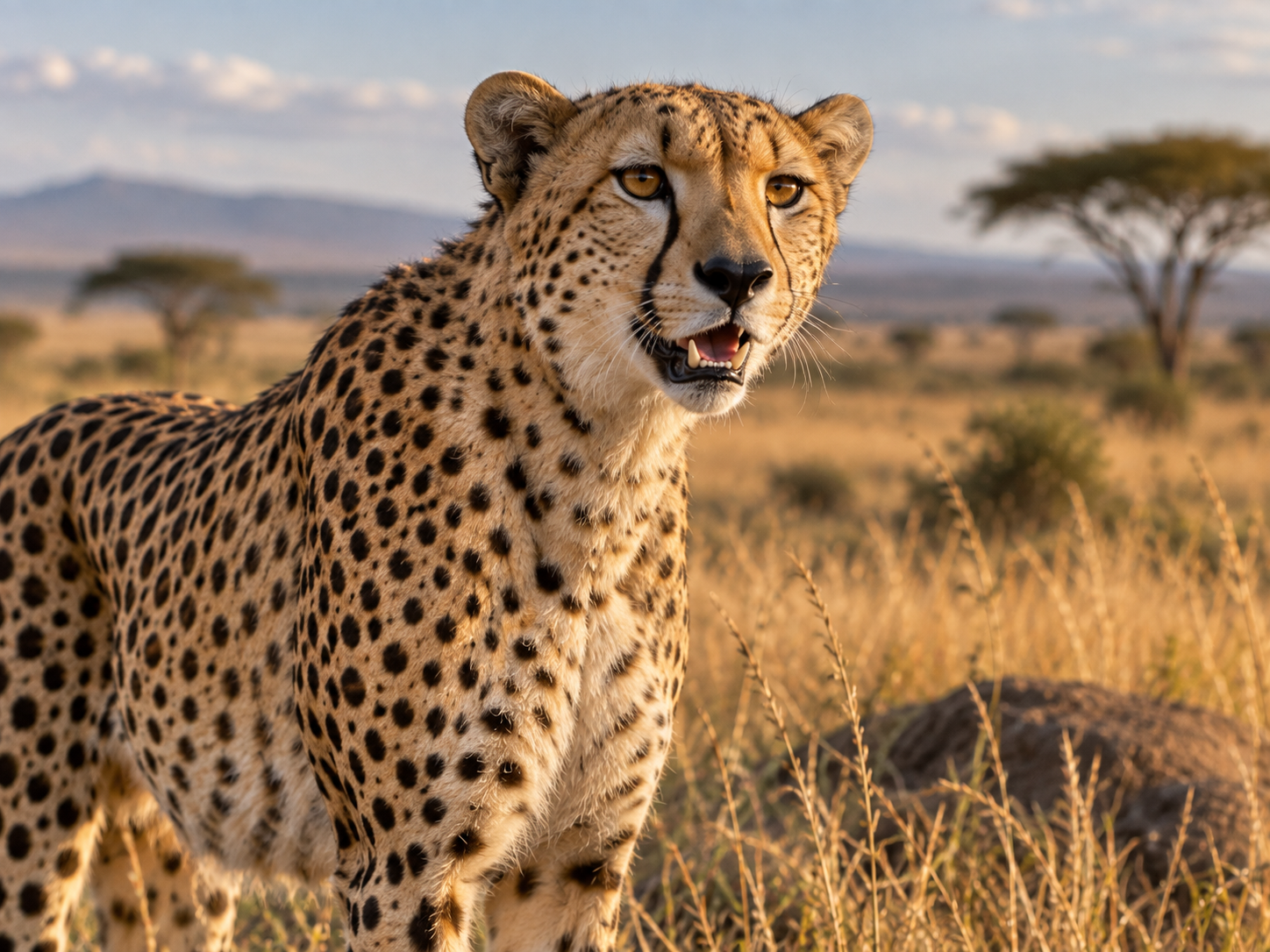
Listen to a lion and the sound is obvious.
A deep roar.
A tiger can produce something similar. Jaguars and leopards can roar as well.
A cheetah cannot.
But that does not mean it is silent.
Cheetahs have one of the more unusual vocal repertoires among cats. Their calls include chirps, purrs, growls, hisses, barks and stutters. The chirp is especially important in communication between mothers and cubs, between separated animals and during mating interactions.
This matters because the cheetah did not simply lose its voice.
It developed a different one.
For a long time, scientists explained the difference mainly through the hyoid apparatus, the group of small bones and connective structures that support the tongue and larynx. Lions, tigers and jaguars have a partly flexible part of this structure that is different from the more fully ossified arrangement found in cheetahs.
That became a neat rule:
Roaring cats have a certain hyoid structure.
Other cats have another.
But biology is rarely that neat.
Later research showed that the relationship between hyoid structure and roaring is more complicated than the old rule suggested. The structure of the larynx and vocal folds is also extremely important in producing the powerful, low-frequency sound of a roar.
So the cheetah's missing roar is not caused by one broken part.
Its whole vocal system is different.
And that difference becomes easier to understand once we look at what the rest of its body was built to do.
Why Cheetahs Do Not Roar
Chapter 2 — The Cheetah's Voice Is Better Suited to Its Social Life
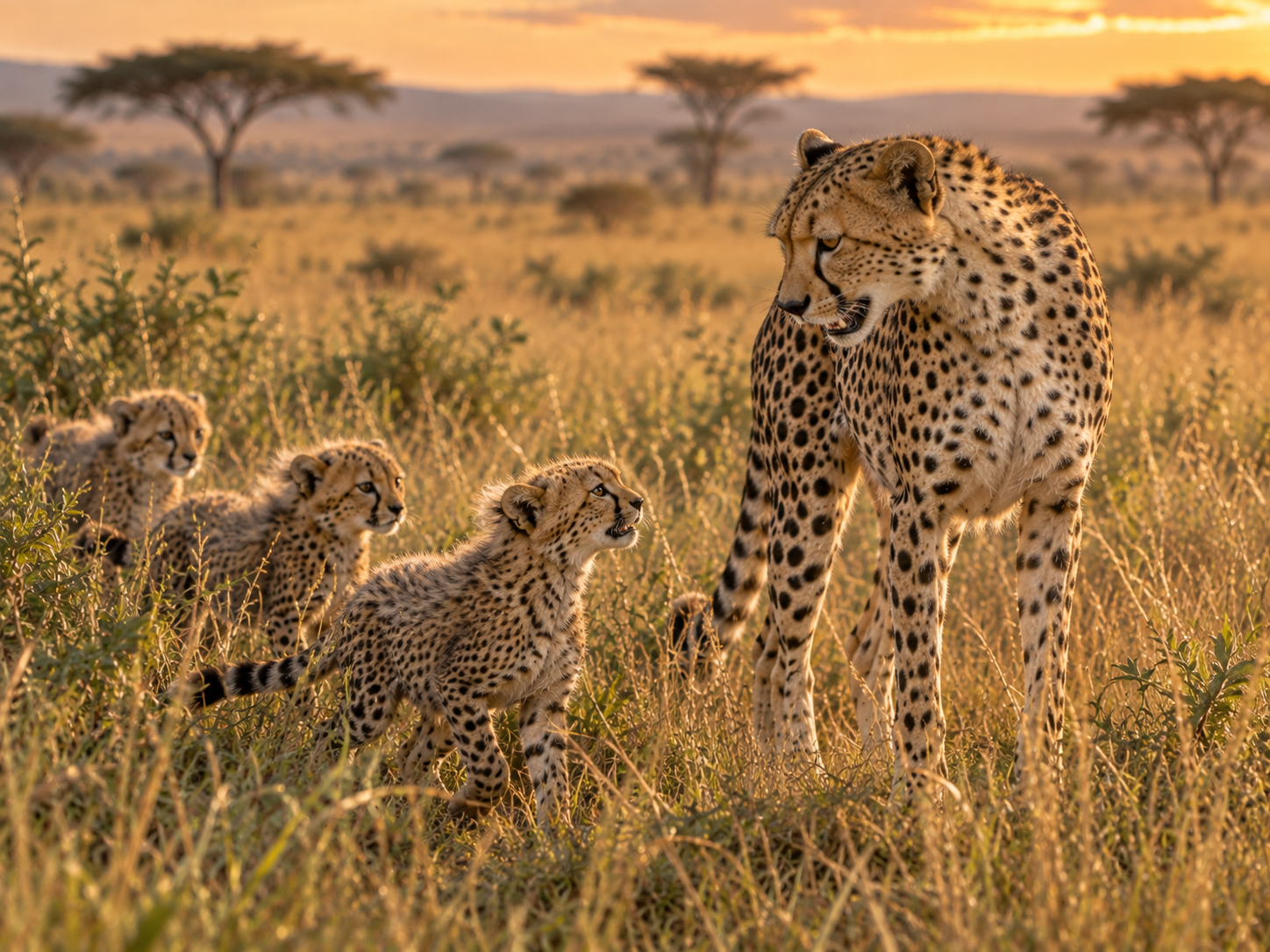
A roar is useful when a large cat needs to make a deep, powerful sound that travels through its territory.
Cheetahs rely on a different kind of communication.
Their chirps can help mothers and cubs find each other. Separated animals may chirp to locate one another. Females in estrus can chirp to attract males, and males may chirp when separated from members of their coalition.
There is even evidence that individual cheetahs may have slightly different chirps, potentially giving them a way to recognise one another by sound.
That gives the cheetah a very different acoustic world from the lion.
The lion's most famous sound announces a powerful animal across a large territory.
The cheetah often needs something more personal.
Where are you?
Stay with me.
Follow me.
A mother calling her cubs does not need to sound like a lion.
She needs the cubs to recognise the call.
And sometimes that call has to travel farther than you might expect.
A cheetah's chirp can be surprisingly loud, despite coming from an animal that sounds nothing like the giant roar people expect from a predator.
The result is a useful reminder:
Loud does not always mean deep.
Chapter 3 — The Strange Voice Begins With the Way the Throat Is Built
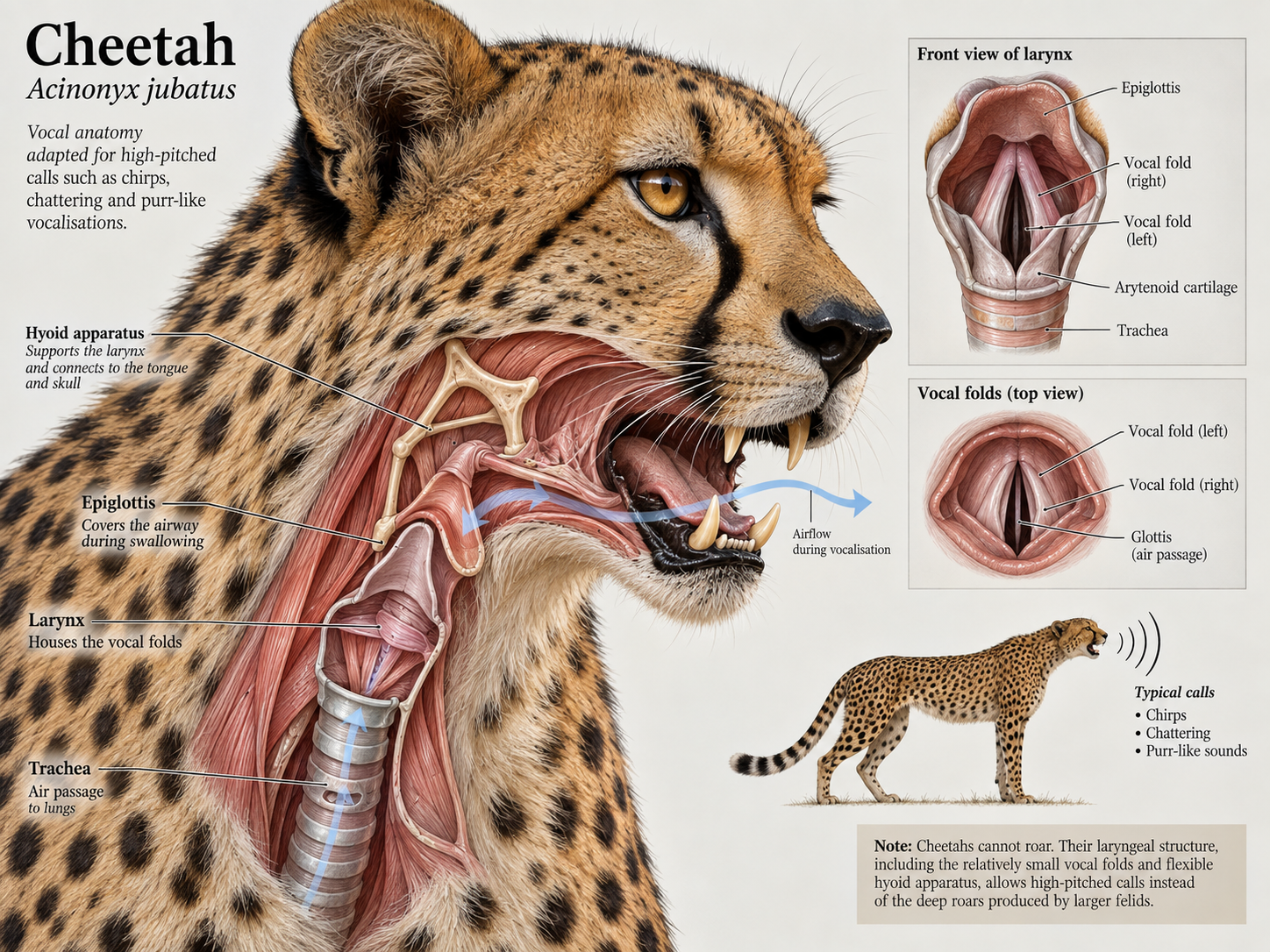
To understand the missing roar, we have to go deeper.
A roar is not just a loud meow.
It requires a vocal system capable of producing intense low-frequency sound.
Research comparing felid anatomy has shown important differences between roaring cats and non-roaring cats in the larynx, vocal folds and upper vocal tract. In roaring cats, long, flexible vocal folds and the shape and position of the laryngeal system help generate the deep, powerful acoustic output associated with a roar.
Cheetahs do not have that same roaring arrangement.
Instead, their vocal tract is suited to the kinds of calls they actually use.
This is important because it corrects one popular explanation.
You may hear that a cheetah cannot roar simply because its hyoid bones are different.
That is part of the story, not the whole story.
The hyoid supports the tongue and larynx, but the sound itself is produced through the interaction of airflow, vocal folds and the shape of the vocal tract.
In other words, the cheetah's throat is not a defective version of a lion's throat.
It is a different design.
And once you see the cheetah as a specialist rather than a smaller copy of a lion, another feature becomes much easier to understand.
Its entire body has been redesigned around one extraordinary job.
Running.
From Airflow to Sound
Chapter 4 — The Same Body That Lost the Roar Became an Extraordinary Runner
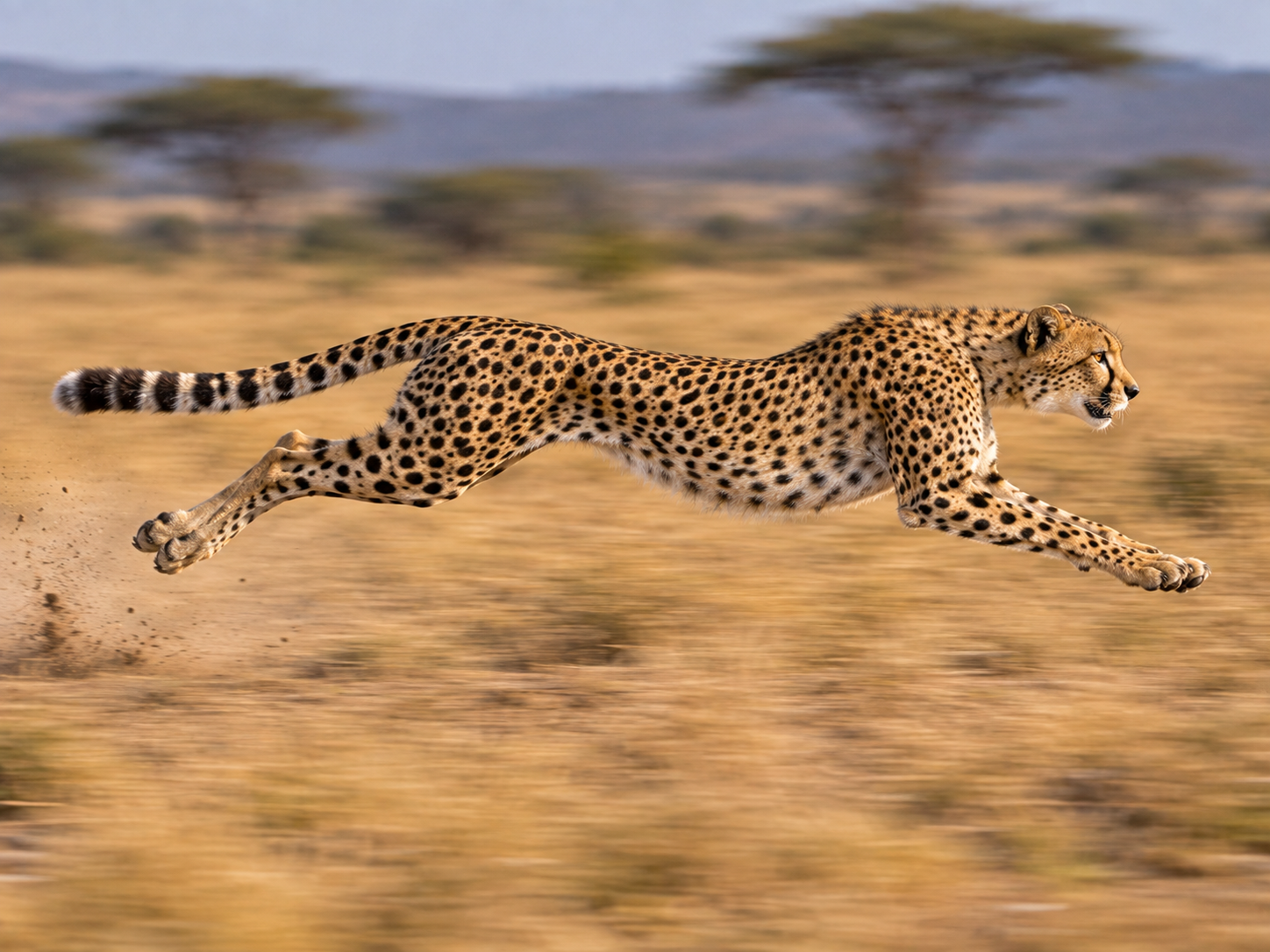
Now look at a cheetah from the side.
The body seems almost stretched.
Long legs.
Small head.
Deep chest.
Flexible spine.
Long tail.
Nothing about it looks built like a heavily muscled lion.
That is because a cheetah is not designed to overpower prey.
It is designed to catch it quickly.
Cheetahs are the fastest living land mammals, reaching roughly 26–29 metres per second in measured high-speed studies—about 94–104 km/h.
But the impressive part is not only the final number.
It is how the body reaches it.
During high-speed galloping, the cheetah uses two different airborne phases, and its spine flexes and extends dramatically. This movement helps lengthen the stride and lets the animal use force from the hindlimbs efficiently.
The spine is not just holding the body together.
It is part of the stride.
As the back flexes, the body gathers.
Then it extends.
The legs reach farther.
Another stride begins.
And another.
At full speed, the whole animal seems to stretch and fold like a spring.
That is very different from the kind of body you would expect from an animal built around brute strength.
The cheetah traded some of that heavy, powerful build for speed.
The Spine Becomes Part of the Sprint
Chapter 5 — Even the Feet Are Built for the Chase
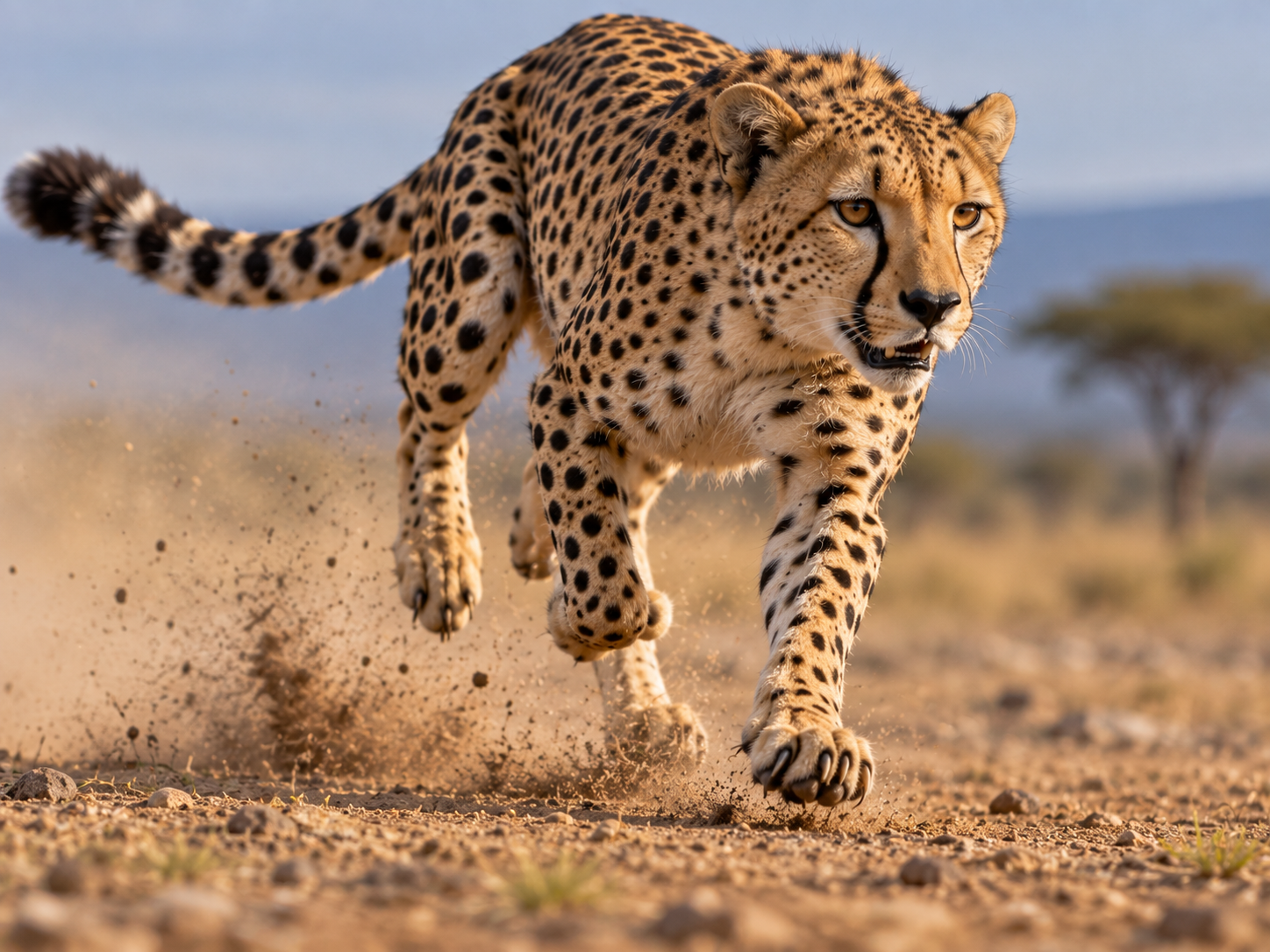
The legs are only part of the trick.
Look at the paws.
Most cats have strongly retractable claws.
A cheetah is different.
Its claws are only partly retractable, and the claw tips remain more exposed. This gives the paws better contact with the ground during running, much like built-in traction equipment.
That is useful because at high speed, losing grip for even a moment can ruin the chase.
The cheetah also has a long tail that helps stabilise the body when it accelerates, brakes and changes direction.
And it needs more than speed.
A prey animal rarely runs in a perfectly straight line.
That is why manoeuvrability matters so much.
Research on predator-prey chases has shown that speed alone does not decide a pursuit. Cheetahs can accelerate and decelerate extremely well, while prey such as impalas remain difficult to catch because they can manoeuvre sharply at lower speeds.
So the cheetah's advantage is not simply:
“I am faster than you.”
It is closer to:
“I can change speed and direction while moving very fast.”
That is a much harder problem for a body to solve.
And the head has to keep up too.
Built to Grip the Ground
Chapter 6 — At That Speed, Seeing Clearly Becomes a Problem
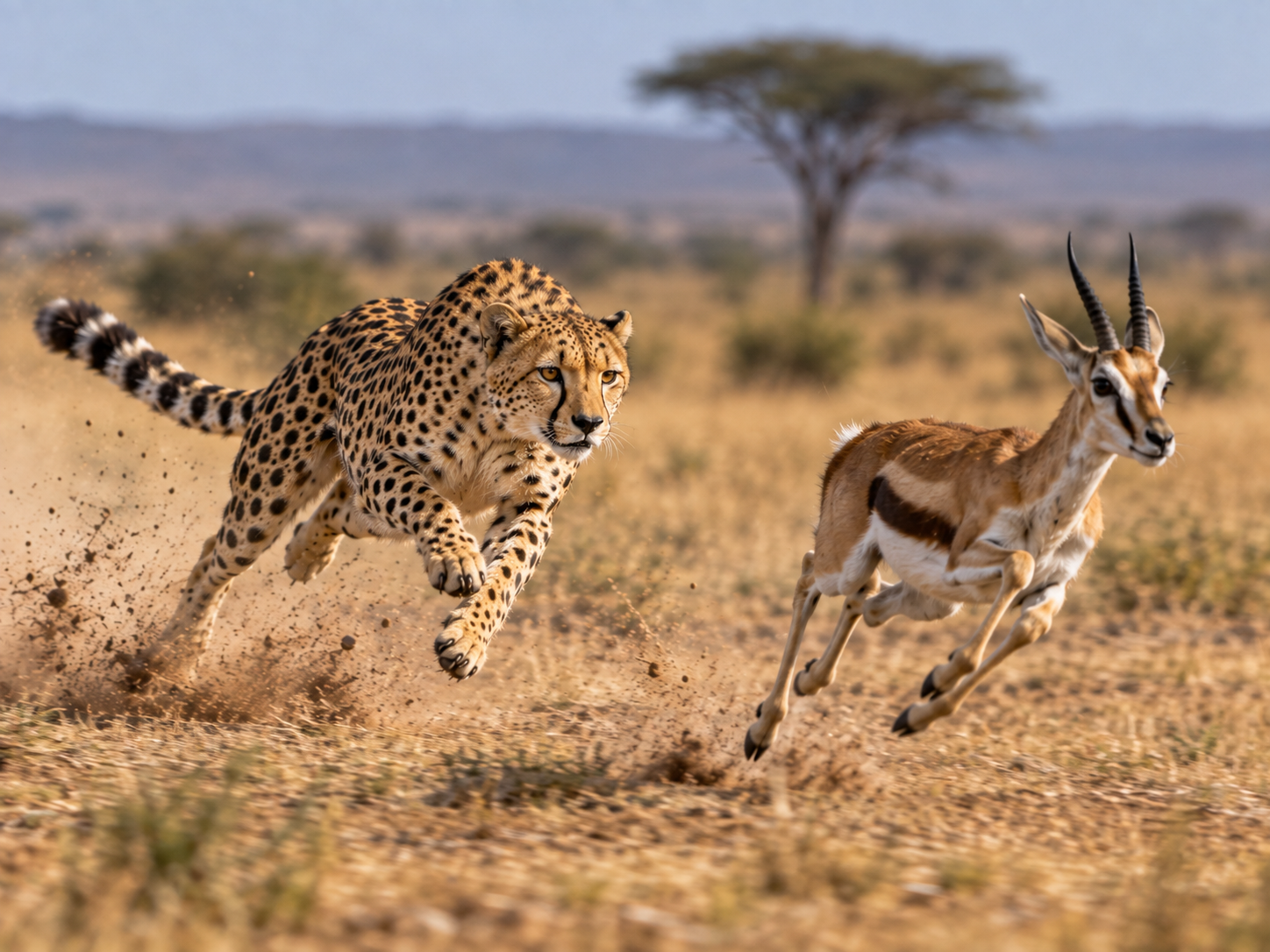
Running at nearly 100 km/h creates another problem.
The world moves extremely quickly.
A cheetah cannot simply sprint after prey while its head bounces around.
It has to keep its eyes and head remarkably stable.
This is where the inner ear becomes important.
The inner ear contains the vestibular system, which helps animals sense head movement and maintain balance.
Research has found that modern cheetahs have an unusually specialised vestibular system compared with other cats. Its shape is associated with greater sensitivity to head movements, helping the animal maintain postural and visual stability during high-speed pursuit.
Think about what happens during a chase.
The legs are striking the ground.
The spine is flexing.
The body is accelerating.
The prey is changing direction.
Yet the cheetah still needs to keep its eyes on that moving target.
Its head cannot simply be thrown around with every stride.
The inner ear helps solve that problem.
It is a quiet adaptation.
You cannot see it in a photograph.
But without it, the famous sprint would be much harder to control.
The cheetah's speed is therefore not the work of its legs alone.
It involves the spine.
The paws.
The tail.
The eyes.
And even an organ hidden deep inside the skull.
Keeping the Head Stable at Full Speed
Chapter 7 — The Cheetah Chose a Different Way to Be a Big Cat
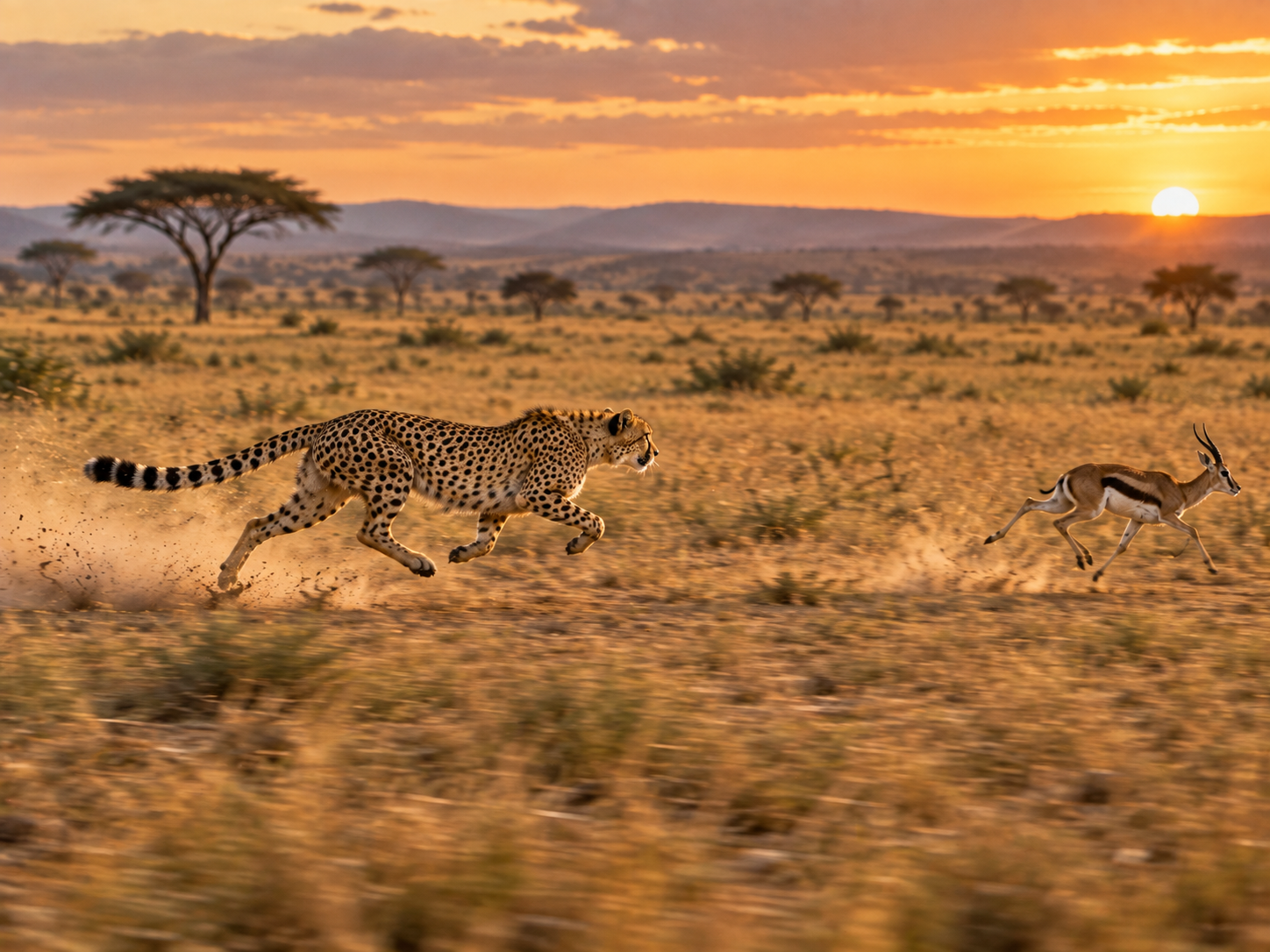
Put all of this together and the missing roar starts to make more sense.
A cheetah is not a failed lion.
It is a different evolutionary experiment.
Its throat produces a different range of sounds.
Its claws remain partly exposed.
Its limbs are long and slender.
Its spine bends deeply during the gallop.
Its inner ear is unusually specialised for high-speed movement.
Its body is built around catching prey quickly rather than overpowering it.
Scientists have found that cheetahs can reach around 26–29 metres per second in short high-speed runs, while their specialised running anatomy helps them achieve extraordinary acceleration, stride length and manoeuvrability.
And this is the important connection.
The cheetah's unusual body does not have separate tricks added one by one.
They work together.
The claws help grip.
The hindlimbs push.
The spine lengthens the stride.
The tail helps control the body.
The inner ear helps stabilise the head.
The eyes stay on the prey.
Meanwhile, the throat produces chirps instead of the deep roar of a lion.
None of these features makes the cheetah less of a cat.
They show how specialised it has become.
Perhaps that is why the cheetah's voice feels so surprising.
We expect a giant predator to announce itself with a roar.
Instead, one of the fastest animals on Earth can race across the grassland at close to 100 km/h and then call to another cheetah with something that sounds almost like a bird.
The contrast is the point.
The cheetah does not need to sound like a lion.
It has built its life around something else.
Speed.
One Body, Many Speed Adaptations
Why Can't Cheetahs Roar Like Other Big Cats?
The answer begins in the throat.
Cheetahs have a different arrangement of the hyoid and vocal anatomy from the classic roaring cats, and the structure of the larynx and vocal folds plays an important role in determining the sounds they can produce.
So instead of roaring, they communicate with chirps, purrs, growls, hisses, barks and other calls.
But the more interesting story is what happened to the rest of the animal.
The cheetah became a specialist.
Its spine flexes and extends during the fastest part of the gallop. Its claws remain partly exposed for traction. Its long tail helps with control. Its inner ear helps stabilise the head while the whole body is moving at extraordinary speed.
At speeds approaching 100 km/h, every part of the chase becomes a mechanical problem.
The cheetah's solution was not more brute force.
It was better control of movement.
And perhaps that is the best way to understand its missing roar.
The cheetah is not a lion that forgot how to roar.
It is a cat that evolved for a very different life.
FAQ
1. Can cheetahs roar at all?
No. Cheetahs do not produce the true roar associated with lions, tigers, jaguars and leopards.
2. What sound does a cheetah make instead of a roar?
Cheetahs make chirps, purrs, growls, hisses, barks, stutters and other calls. The chirp is especially common.
3. Why do cheetahs chirp?
Chirping can help with communication between mothers and cubs, separated animals, and potential mates.
4. Is the hyoid bone the only reason cheetahs cannot roar?
No. Hyoid structure is important, but research shows that the larynx, vocal folds and upper vocal tract also play major roles in roaring.
5. How fast can a cheetah run?
High-speed studies have recorded cheetahs reaching roughly 26–29 m/s, or about 94–104 km/h, over short distances.
6. Why can cheetahs run so fast?
Their flexible spine, long limbs, powerful hindlimbs, traction-oriented paws and highly specialised gallop all contribute to their speed.
7. Why are cheetah claws only partly retractable?
Their more exposed claws help provide traction while running, which is useful during rapid acceleration and pursuit.
8. Does a cheetah really bend its spine while running?
Yes. During high-speed galloping, the spine flexes and extends, helping increase stride length.
9. How does a cheetah keep its head stable while running?
Its highly specialised vestibular system helps detect head movements and supports postural and visual stability during high-speed pursuit.
10. Is the cheetah the fastest land animal?
Yes. The cheetah is the fastest living land mammal, with measured short-distance speeds approaching 29 m/s.