Introduction
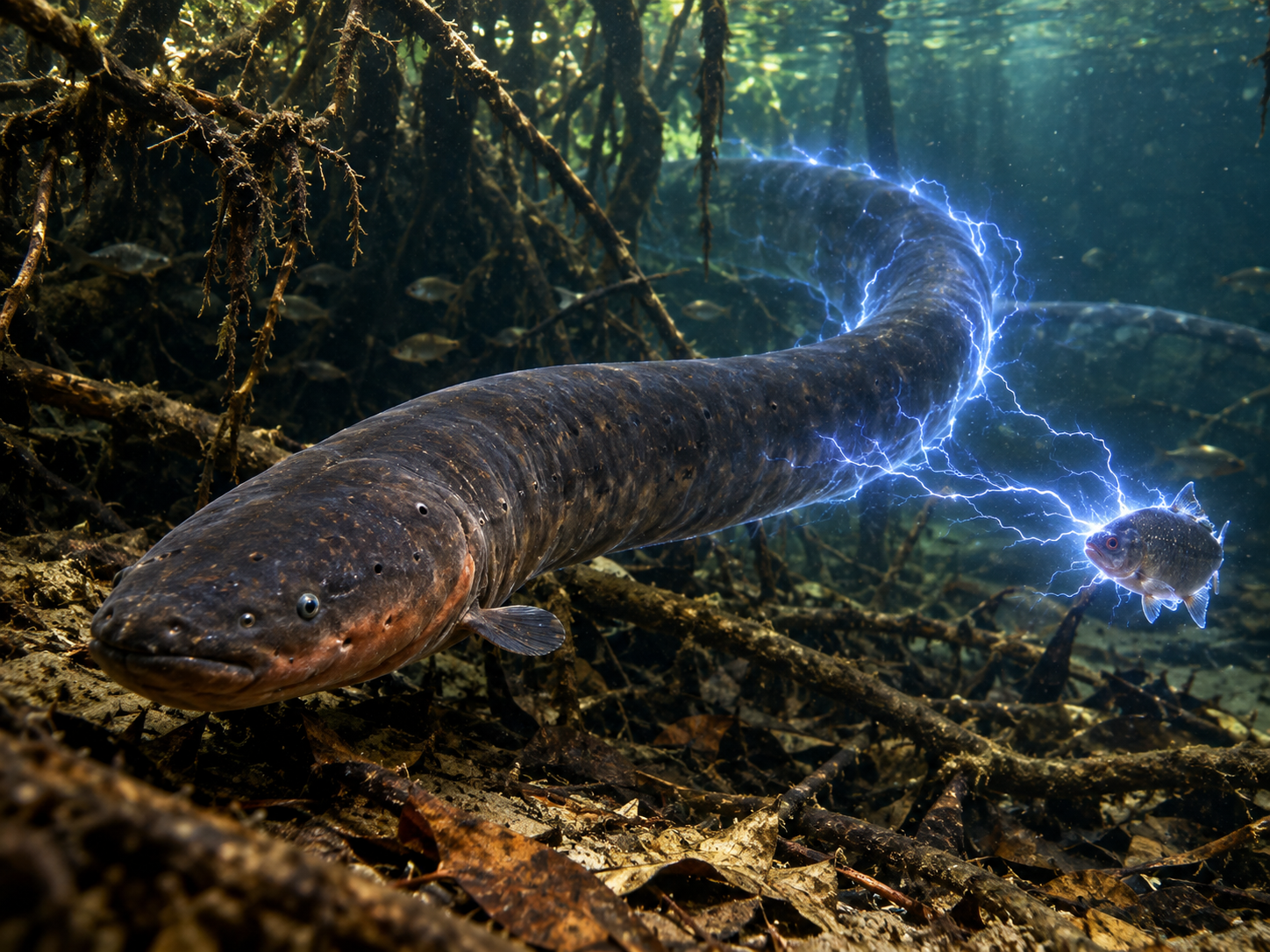
Imagine being able to produce enough electricity to deliver a shock of up to 860 volts.
Now imagine that the electricity is being produced inside your own body.
That sounds like a terrible design.
Yet that is exactly what happens inside Electrophorus voltai, the strongest known electric eel species. Scientists have recorded discharges of up to 860 volts—more than twice the voltage of a typical household outlet in the United States.
So why doesn't the eel fry itself every time it attacks?
The answer is not that the eel is simply “immune” to electricity.
Its body is built more like a carefully designed electrical system.
Special cells generate the voltage. Thousands of those cells are arranged together like tiny batteries. Insulating tissues help prevent the current from taking dangerous shortcuts through the eel's own body. And when the eel attacks, its body position can help send more of the electrical discharge through its prey instead of through itself.
The trick is not avoiding electricity.
It is controlling its path.
Chapter 1 — The Eel Is Basically Carrying Thousands of Tiny Batteries
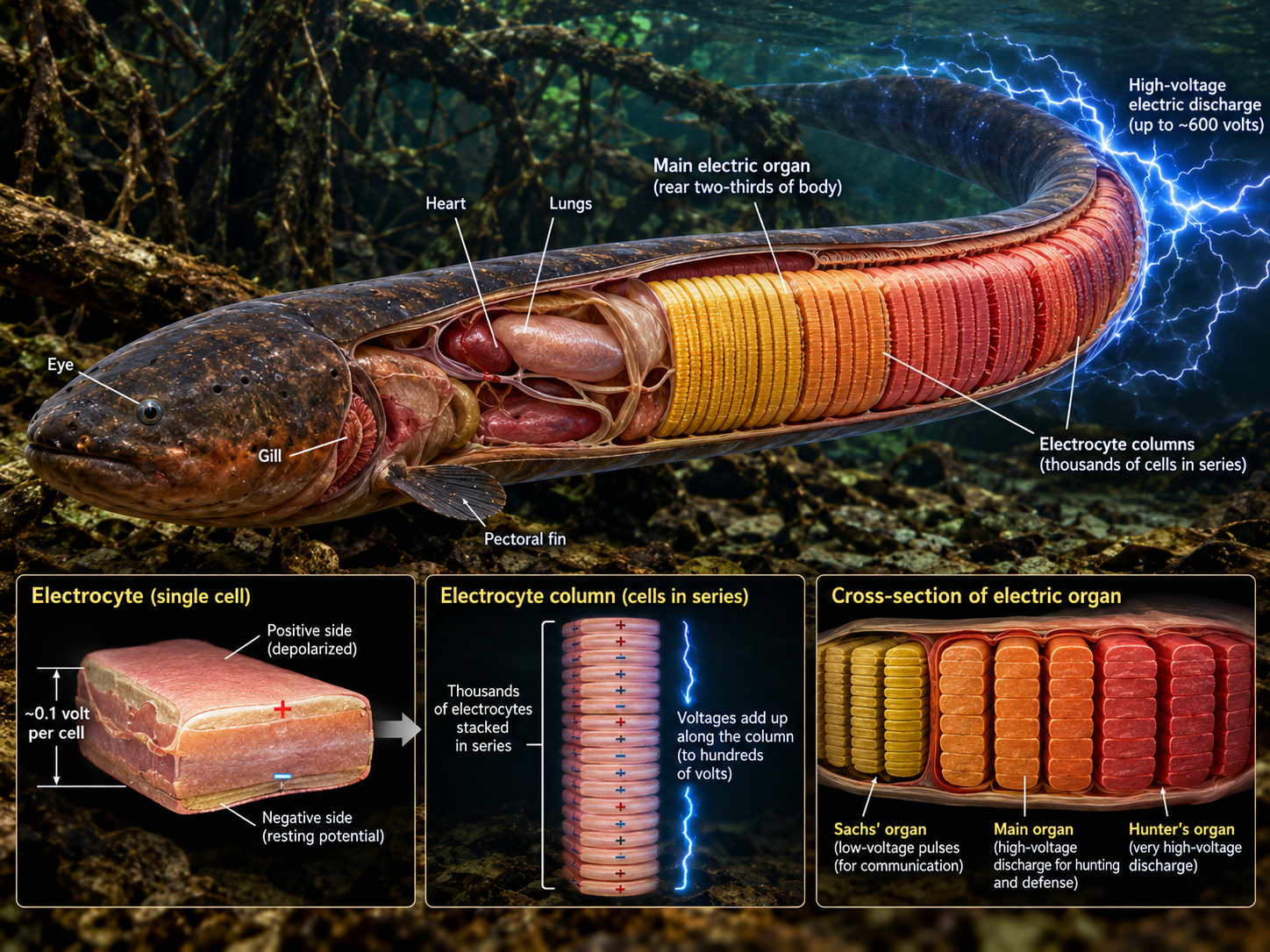
An electric eel does not have a battery hidden inside it.
It has something much more interesting.
Electrocytes.
These are specialized cells that evolved from muscle cells. Instead of contracting like ordinary muscle, they are able to create an electrical potential across their membranes.
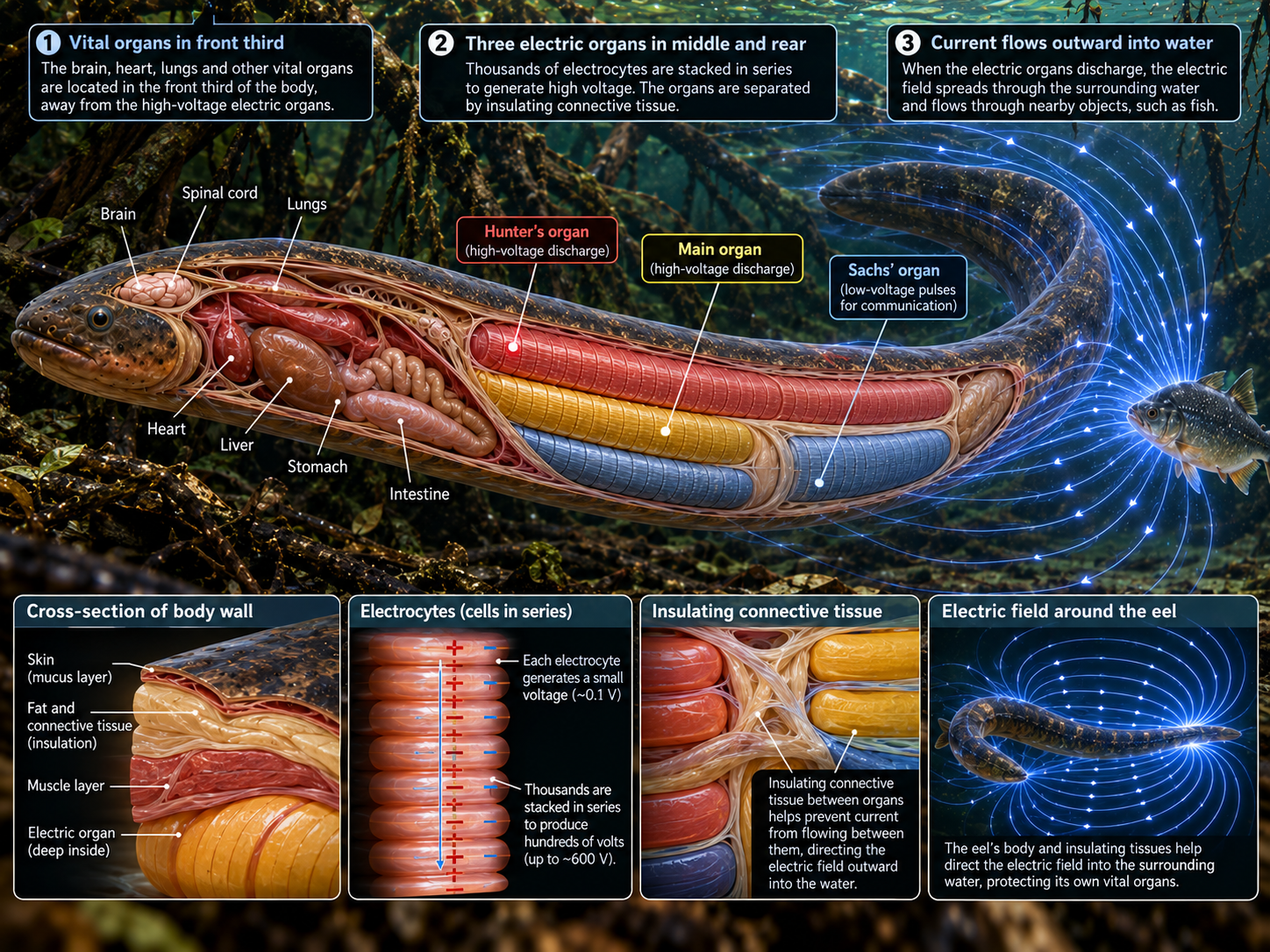
A single electrocyte produces only a small voltage—around 0.15 volts.
That does not sound impressive.
But imagine thousands of them arranged one after another.
Their voltages add together.
It is similar to connecting batteries in series. One small battery does not produce a huge voltage. Stack enough of them in the right arrangement, and the total becomes much larger.
That is what the electric eel does with its cells.
Its electric organs contain thousands of electrocytes arranged in long columns. When the eel's nervous system triggers them at almost the same time, their individual voltages add up.
The result can be enormous.
In Electrophorus voltai, the combined discharge can reach about 860 volts.
So the eel is not creating 860 volts with one giant biological battery.
It is creating a huge voltage from thousands of very small ones working together.
That is the first part of the trick.
How Thousands of Cells Become 860 Volts
Chapter 2 — Most of the Electric Organ Is in the Tail
Here is another clever part of the design.
The electric eel's most important organs are not spread randomly through its body.
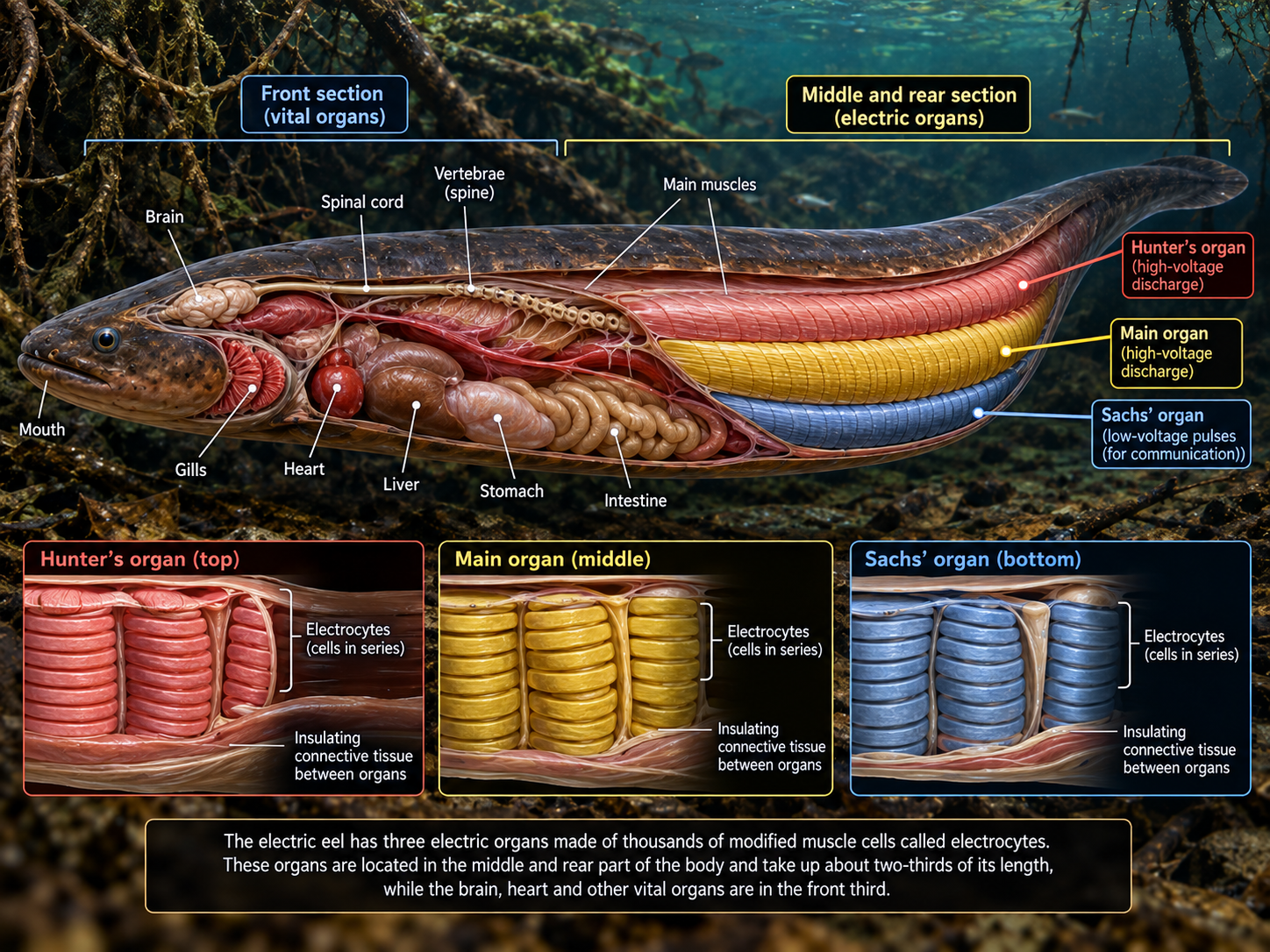
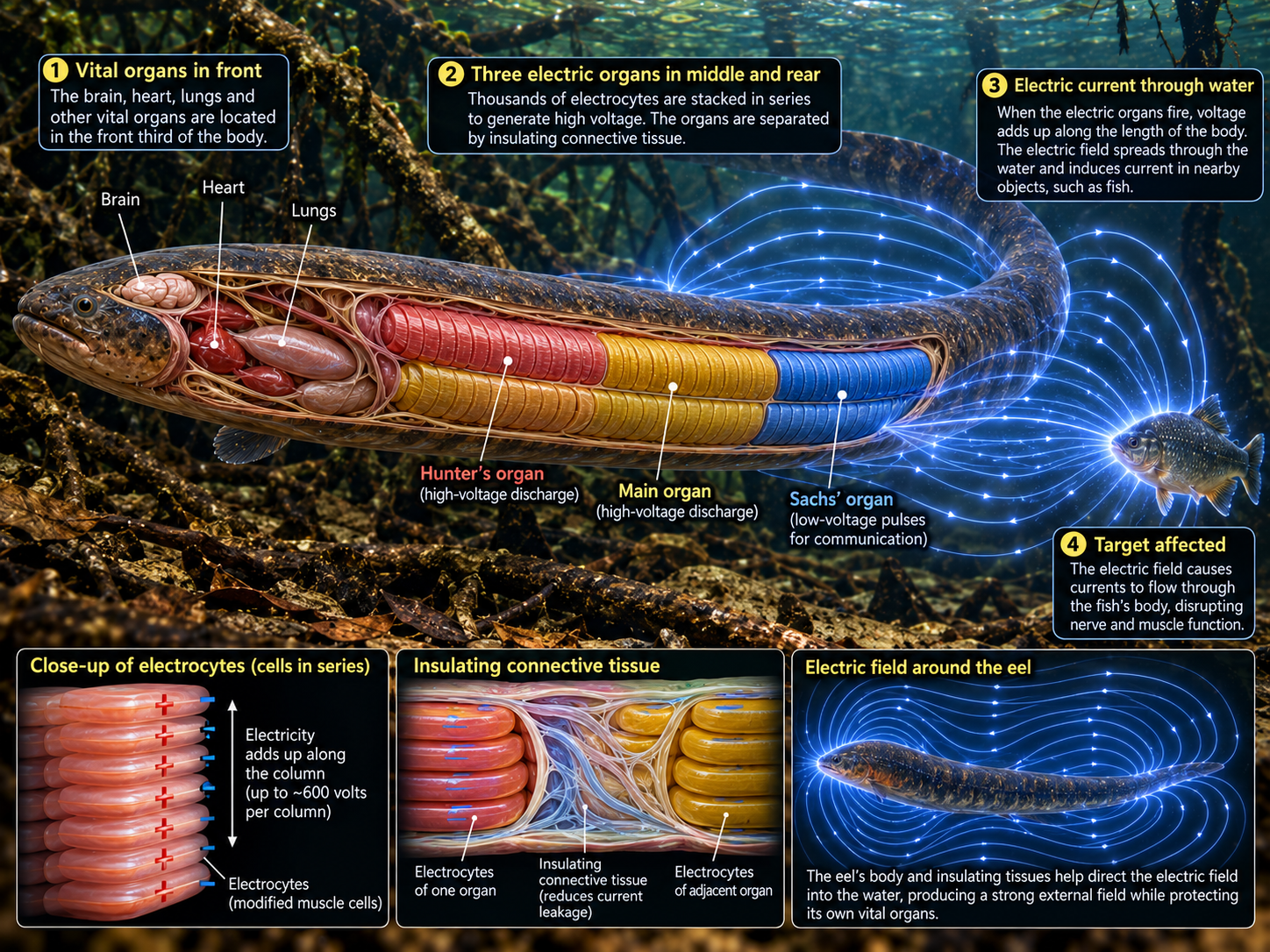
Its three electric organs—the main organ, Hunter's organ and Sach's organ—occupy a large portion of the body, especially toward the rear. Together, the electric organs can make up roughly 80 percent of the eel's body.
That leaves the eel's vital organs, including the brain and heart, farther toward the front.
This separation matters.
The eel's strongest electrical organs are not sitting directly beside its brain in the same way a battery might sit beside delicate electronic components.
Instead, its body has a built-in layout that helps manage the electrical field.
The strongest organs are concentrated toward the tail.
The eel's body also contains insulating connective tissues around the electrocytes. These tissues help stop current from simply flowing around the cells and short-circuiting the electric organ itself.
Think about an extension cord.
If the electricity escapes through the wrong place, the system fails.
The eel has evolved biological “insulation” that helps keep the electrical discharge on the useful path.
That does not mean the eel's entire body is electrically isolated.
It means its anatomy makes the dangerous shortcuts harder.
The Eel’s Built-In Electrical Layout
Chapter 3 — But What Actually Happens When the Eel Fires?
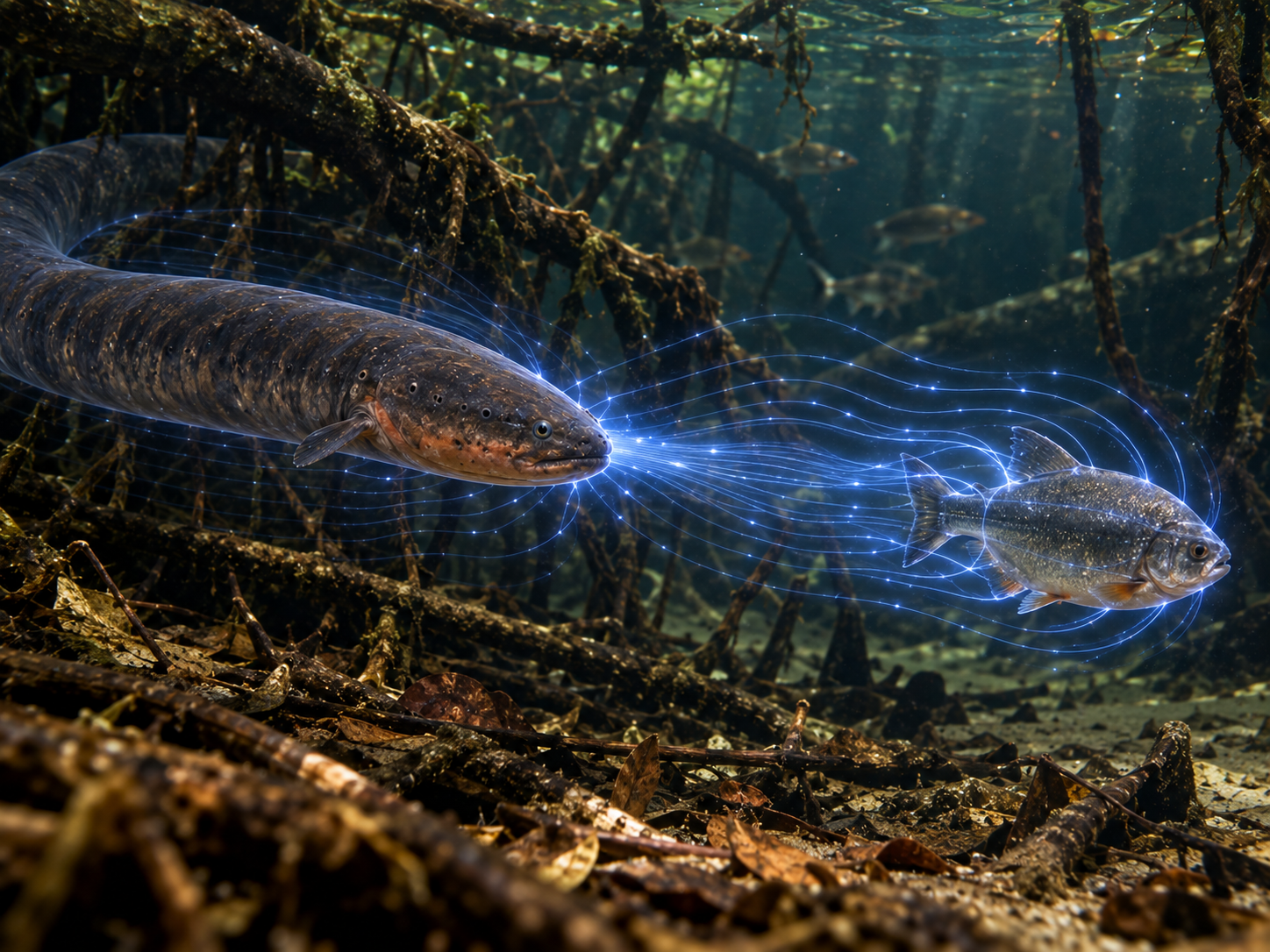
Now imagine the eel sees a fish in the dark water.
It cannot rely entirely on its eyesight. Electric eels live in murky freshwater and use electrical signals to sense their surroundings. They can produce weak electrical pulses for navigation and sensing, while their stronger discharges are used for hunting and defense.
When the eel decides to attack, its nervous system triggers the electrocytes.
The cells change their electrical state.
Thousands of them fire together.
And suddenly the eel has created a large voltage difference along its body.
But voltage alone does not tell you how much damage the electricity will cause.
What matters is current through a target.
The eel's discharge creates an electric field in the surrounding water. A nearby animal can experience a voltage difference across its body, allowing current to pass through its nervous system and muscles.
That is what makes the shock effective.
The eel is not simply throwing electricity randomly into the water.
It is creating an electrical field around itself.
Anything in the right position can become part of the circuit.
And that brings us to the most important part of the puzzle.
If the water carries the electricity, why doesn't the current simply pass through the eel too?
Voltage Is Not the Whole Story
Chapter 4 — The Water Is Actually Part of the Eel’s Electrical System
This sounds backwards.
You might think water protects the eel from its electricity.
It does not.
Water is a conductor.
That is exactly why the eel can use electricity as a weapon.
The eel's electrical discharge can travel through the surrounding water and reach another animal.
But electricity does not spread equally through every possible path.
It tends to follow paths that allow current to flow more easily.
The eel's body has specialized insulating structures around its electric organs that reduce unwanted current flow through the tissues and help keep the electrocytes from short-circuiting. Meanwhile, the surrounding freshwater provides a route for the external electric field.
This is why saying “the eel is insulated from electricity” is misleading.
It is not wrapped in some biological rubber suit.
Its body is a complicated electrical structure.
Some tissues resist current better than others.
The electric organs are arranged in a way that controls the direction and concentration of the discharge.
And the surrounding water becomes part of the circuit.
The eel is essentially using its own body as one part of an electrical system and the water as another.
That is a much better way to picture what is happening.
The Eel, the Water and the Circuit
Chapter 5 — The Eel Can Also Change Its Body Position
Here is where the eel gets even smarter.
When hunting, it does not always remain stretched out in a straight line.
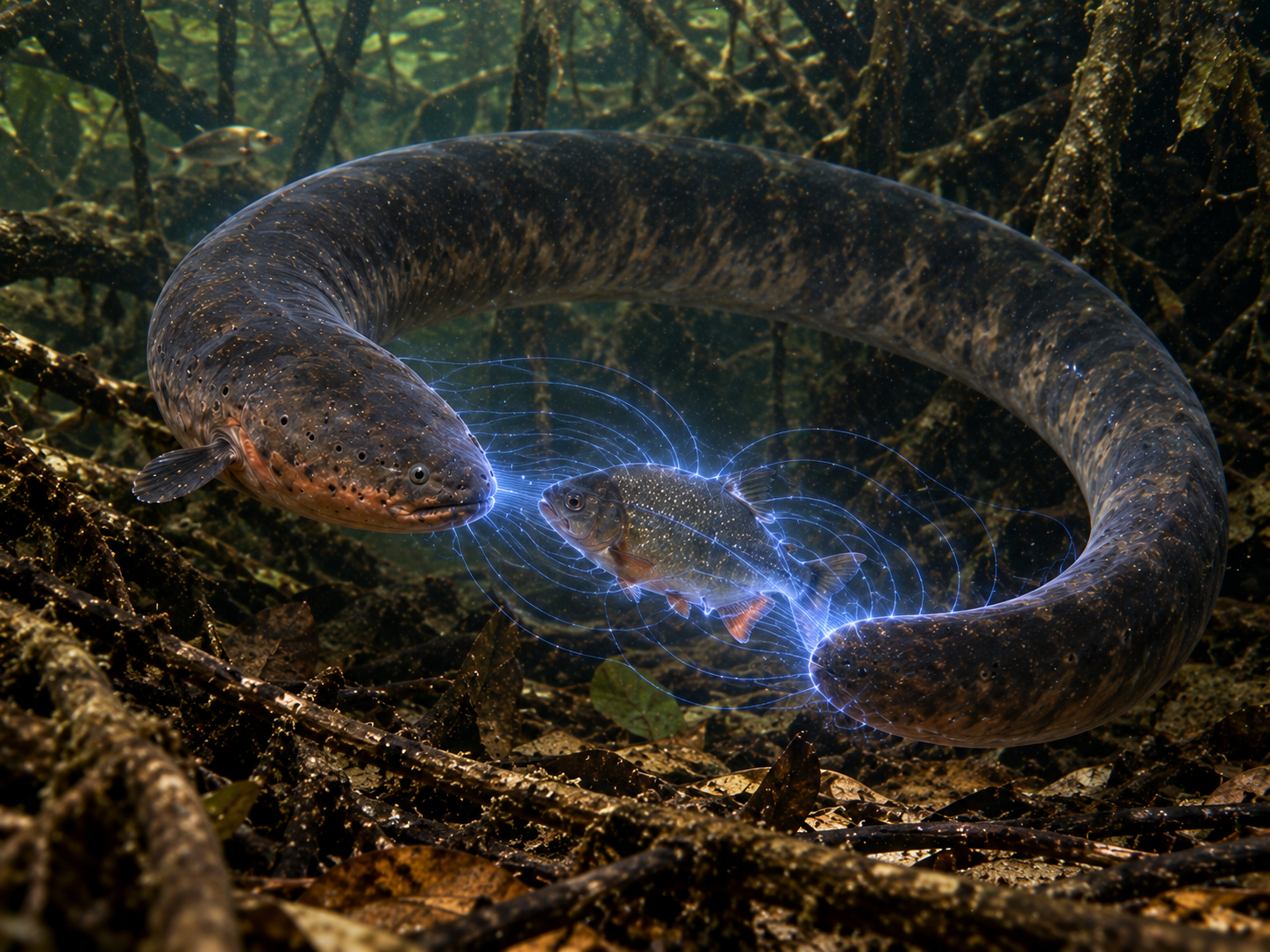
Electric eels have been observed curling their bodies around prey.
Why?
Because body position can change the electrical field.
Researchers found that when an eel curls so that its head and tail surround the prey, the prey is placed between the two poles of the eel's electrical organ. This can greatly strengthen the electric field experienced by the prey.
Think of it as bringing both ends of an electrical system closer around the target.
The eel is not simply making more electricity.
It is using the electricity more effectively.
That is an important distinction.
The animal has evolved not only the ability to generate a huge voltage, but also behaviours that help it deliver that electricity where it matters.
It can even leap partly out of the water when attacking a predator.
The Natural History Museum explains that the eel can press its chin against a predator while keeping its tail in the water, creating a stronger electrical circuit through the predator rather than allowing the charge to disperse broadly through the water.
The eel is therefore doing something remarkably similar to what an engineer might do.
It changes the shape of the circuit.
How Body Position Makes the Shock Stronger
Chapter 6 — So Does the Eel Never Shock Itself?
This is where the popular explanation needs a little correction.
You will often hear that electric eels are immune to their own electricity.
That is too neat.
The eel is not simply immune.
Instead, its anatomy greatly reduces the danger.
Its electric organs are specially organized.
Insulating connective tissues help prevent short circuits.
The strongest electrical organs are concentrated away from much of the eel's vital internal machinery.
And the electrical field normally has a useful path through the surrounding water and toward the target.
The eel's body position also matters.
If the electrical circuit is arranged poorly, more current can potentially pass through the eel.
So it is better to think of the animal as electrically protected, not electrically invulnerable.
This distinction is important.
A car is not “immune” to electricity because it has insulation.
An electrical device is safe because its components and insulation are arranged to control where current can travel.
The electric eel has evolved a biological version of the same basic idea.
It produces electricity.
It controls the circuit.
And it minimizes the amount of dangerous current passing through the wrong tissues.
That is much more impressive than simply being immune.
Why the Eel Usually Avoids Serious Self-Shock
Chapter 7 — The 860 Volts Are Only Part of the Story
It is tempting to finish the story with the number.
860 volts.
It is a spectacular number.
But the number alone does not explain why the electric eel is such an extraordinary animal.
The real achievement is the entire system.
It has cells that generate electrical potential.
Thousands of those cells are organized into electric organs.
Its tissues help prevent internal short-circuits.
Its nervous system controls when the organs fire.
Its body position can concentrate the electrical field.
And the surrounding water becomes part of the circuit.
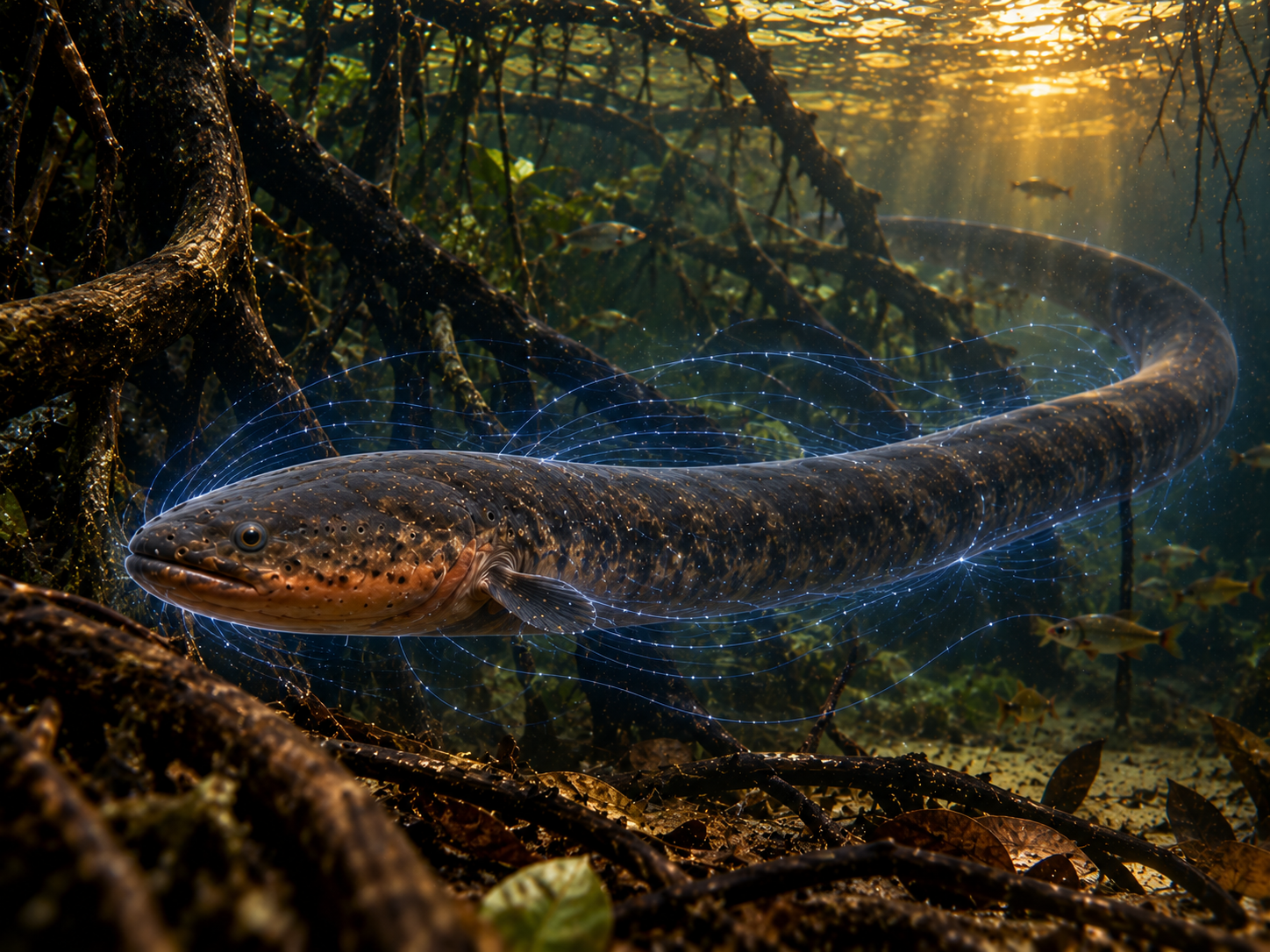
The eel even uses weaker electrical signals for sensing its surroundings and communicating, while its stronger discharges are used for hunting and defense.
So the eel is not simply a fish with a giant battery.
It is a living electrical system.
And that may be the most fascinating part.
Because nature did not solve the problem by making the eel immune to its own weapon.
It solved it by making the weapon controllable.
The eel does not need to stop electricity from existing inside its body.
It needs to make sure the electricity goes where it is useful.
Toward the prey.
Toward the predator.
And mostly—not through itself.
The Complete Electric Eel System
So, How Does an Electric Eel Generate 860 Volts Without Shocking Itself?
The short answer is:
It does not simply avoid electricity. It controls it.
Thousands of specialized electrocytes work together like tiny biological batteries, creating an enormous voltage when they fire at the same time.
The eel's electric organs are arranged through much of its rear body, while insulating tissues help prevent dangerous electrical short-circuits.
The surrounding water then becomes part of the external circuit.
And when the eel hunts, its body position can concentrate the electrical field around its prey, making the shock much more effective.
So the popular idea that an electric eel is simply “immune to its own electricity” misses the most interesting part.
The eel has evolved something much cleverer.
It has learned to build, aim and control its own electrical weapon.
And that 860-volt shock is only the visible result of thousands of tiny biological systems working together.
Frequently Asked Questions
1. How many volts can an electric eel produce?
The strongest known electric eel species, Electrophorus voltai, has been recorded producing up to about 860 volts.
2. Is 860 volts enough to hurt a human?
Yes. A strong electric eel discharge can cause painful muscle contractions and other dangerous effects. In water, a shock could also increase the risk of drowning.
3. How does an electric eel make electricity?
It uses specialized cells called electrocytes. Each cell produces a small electrical potential, but thousands of cells arranged together can produce a very large voltage.
4. Are electric eels actually eels?
No. Despite their name and eel-like shape, electric eels are knifefish rather than true eels. They belong to the South American freshwater fish group Gymnotiformes.
5. Why doesn't an electric eel shock itself?
Its body contains specialized electrical organs, insulating connective tissues and an anatomical arrangement that helps direct the electrical discharge outward. This greatly reduces dangerous current through its vital organs.
6. Are electric eels completely immune to their own electricity?
It is better not to describe them as completely immune. Their bodies are highly adapted to generating and controlling electricity, but the important protection comes from how their electric organs, tissues and electrical pathways are arranged.
7. Does water protect electric eels from their own electricity?
No. Water conducts electricity and is actually an important part of the eel's external electrical circuit. The eel's anatomy helps control where the current flows.
8. Why does an electric eel curl around its prey?
Curling can place the prey between the eel's electrical poles and greatly strengthen the electric field across the prey. This helps the eel immobilize struggling animals more effectively.
9. Do electric eels use electricity only to attack?
No. They also produce weaker electrical signals for sensing their surroundings and communication. Stronger discharges are used mainly for hunting and defense.
10. Which electric eel produces 860 volts?
The record-setting species is Electrophorus voltai. Scientists identified it as one of three distinct electric eel species in 2019, and it produced the highest measured discharge, about 860 volts.