Chapter 1
The Phantom Above the Rainforest
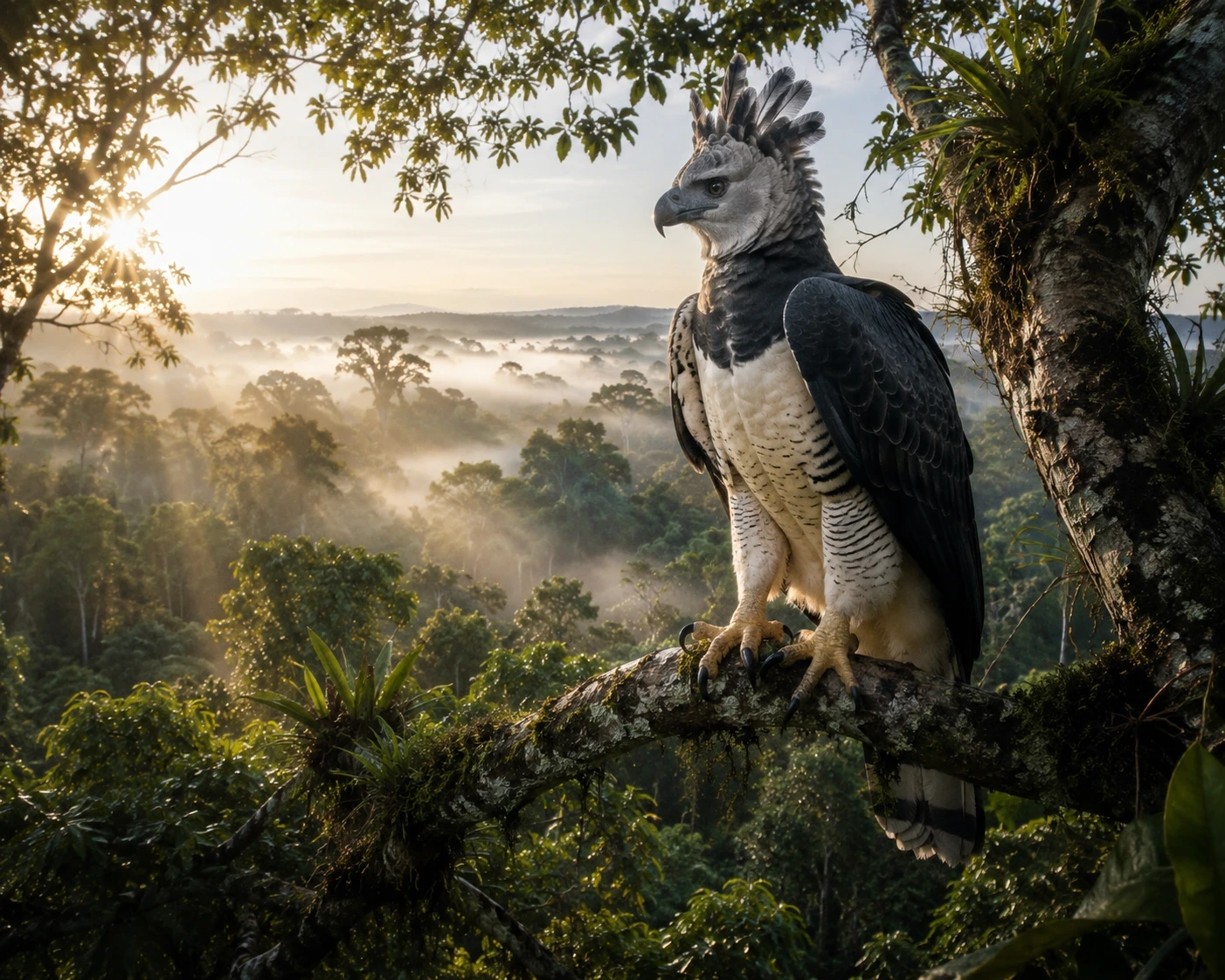
The Amazon rainforest is one of the most complex ecosystems on Earth. Sunlight rarely reaches the forest floor, hidden beneath layers of towering trees that support thousands of species. High above this crowded world lives a predator that few animals ever see—but almost every creature fears.
The harpy eagle (Harpia harpyja) is one of the largest and most powerful birds of prey alive today. Unlike eagles that soar over mountains or coastlines, it spends nearly its entire life within dense tropical rainforests, silently moving through the canopy in search of monkeys, sloths, and other tree-dwelling mammals.
Despite its enormous size, spotting one in the wild is exceptionally rare. Its natural camouflage, quiet flight, and preference for remote forests have earned it the nickname "The Phantom of the Rainforest."
More Than Just a Large Eagle
Size alone does not make the harpy eagle remarkable.
Every feature—from its broad wings and muscular legs to its enormous talons and exceptional eyesight—has evolved for hunting in one of the most challenging environments on Earth.
Flying through dense forest requires precision rather than speed. Instead of chasing prey across open skies, the harpy eagle weaves between branches before launching a sudden attack powerful enough to capture animals that spend their lives in trees.
It is not the fastest eagle.
It is one of the strongest.
Rainforest Giant at a Glance
A Symbol of the Rainforest
The harpy eagle is found across parts of Central and South America, with its largest remaining populations in the Amazon Basin.
Because it requires vast areas of undisturbed forest and reproduces slowly, scientists consider the species an important indicator of rainforest health. Where harpy eagles continue to thrive, the surrounding ecosystem is often still rich enough to support large mammals and ancient trees.
Protecting this eagle means protecting an entire rainforest.
Transition
From the ground, the harpy eagle appears almost mythical.
But its greatest advantage isn't simply its size.
Every feather, every muscle, and every astonishing talon has evolved for life high above the rainforest floor.
In the next chapter, we'll explore the extraordinary adaptations that make the harpy eagle one of the most formidable aerial predators on Earth.
Chapter 2
Built for the Rainforest, Not the Open Sky
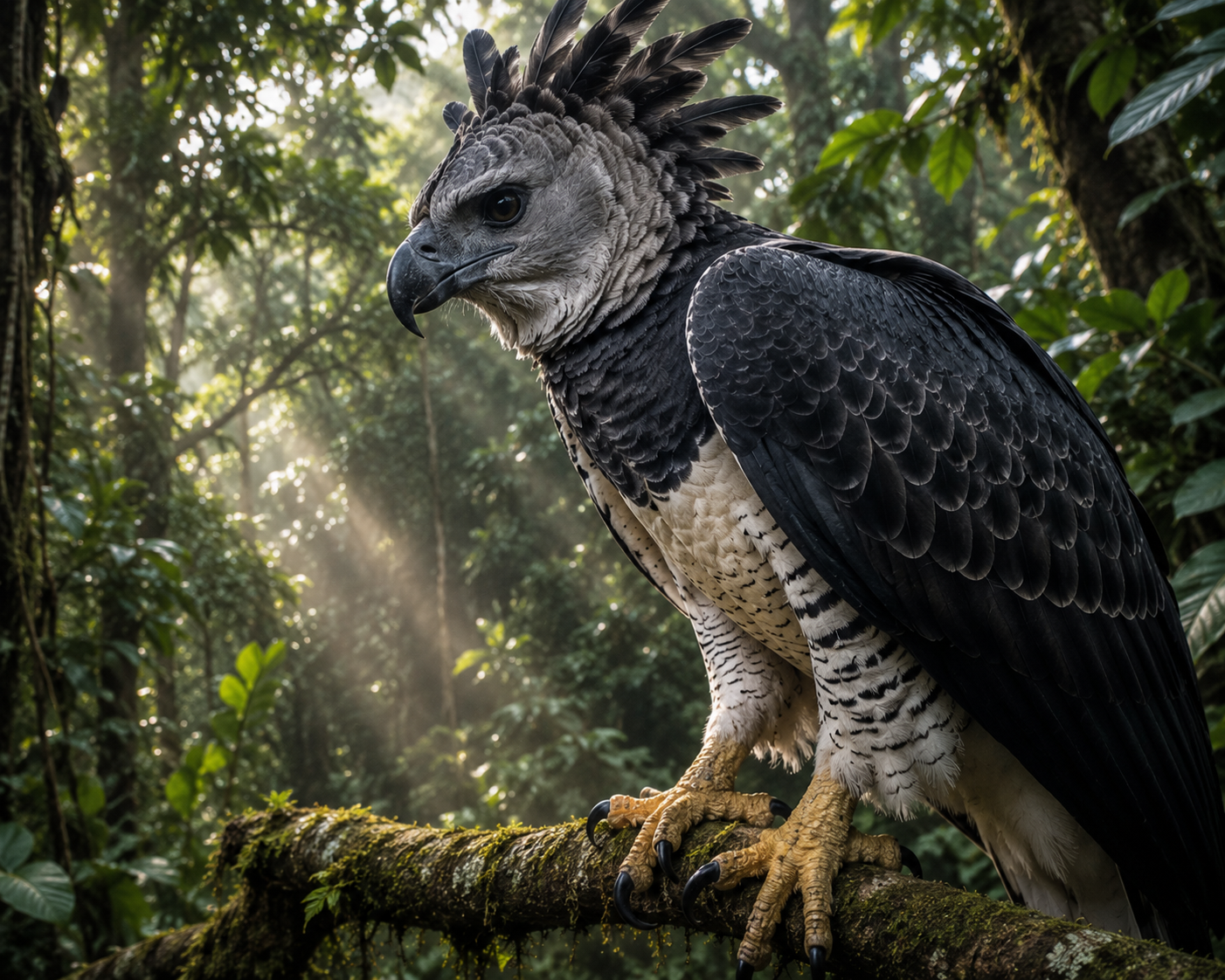
At first glance, the harpy eagle looks heavy compared to other eagles.
That impression is correct.
Unlike species that soar for hours over mountains or coastlines, the harpy eagle has evolved for short, explosive flights through dense rainforest. Every feature of its body prioritizes power, control, and precision over endurance.
In a forest where branches, vines, and giant tree trunks fill the airspace, agility is more valuable than raw speed.
Flying Through a Living Maze
The rainforest canopy is crowded.
Trees often stand more than 40 meters (130 feet) tall, their branches intertwined to create a continuous green roof. Flying here requires constant adjustments, leaving little room for error.
The harpy eagle solves this challenge with relatively short, broad wings. While they generate more drag in open skies, they provide excellent lift and manoeuvrability between closely spaced branches.
Instead of gliding over the forest, the harpy eagle flies through it.
Strength Hidden in Every Strike
The harpy eagle's legs are among the most powerful of any bird of prey.
Its thick toes and enormous talons generate enough gripping force to hold struggling mammals suspended above the forest floor. Rather than chasing prey across long distances, it relies on one decisive attack.
A successful strike often ends the hunt within seconds.
This strategy conserves energy while reducing the risk of injury in a complex environment.
🌿 Predator Engineering
An Unexpected Feature
One of the harpy eagle's most distinctive features is the crown of feathers on its head.
When relaxed, these feathers lie flat.
When the bird becomes alert or senses danger, they rise into a dramatic crest. Researchers believe this display helps with communication and may also improve the eagle's ability to detect sounds by directing them toward its ears.
Although its exact function is still being studied, the crest has become one of the species' defining characteristics.
A Hunter Built for One World
Many birds of prey thrive in mountains, deserts, or open plains.
The harpy eagle belongs to only one kingdom—the tropical rainforest.
Every adaptation, from its wing shape to its muscular legs, reflects millions of years of evolution inside one of Earth's most demanding environments.
That specialization makes it extraordinarily successful where it belongs.
It also makes the species highly vulnerable when those forests disappear.
Chapter 3
A Silent Hunter Above the Canopy
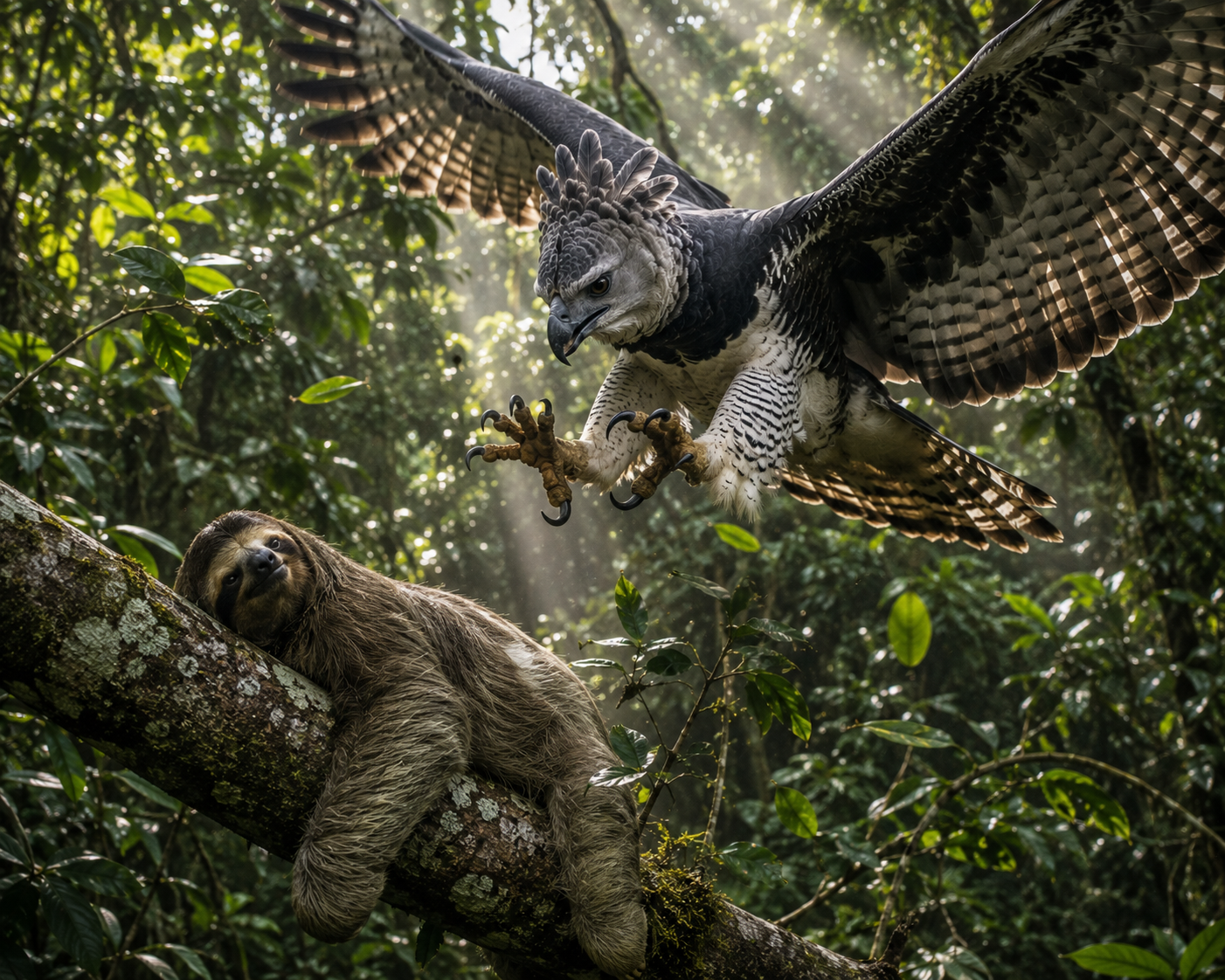
Morning arrives quietly in the rainforest.
High above the forest floor, where sunlight filters through layers of leaves, a sloth hangs motionless from a branch. To most animals, the canopy feels safe. Hidden among thousands of leaves, danger is difficult to detect.
But somewhere nearby, a pair of sharp eyes is already watching.
The harpy eagle has been waiting.
Unlike falcons that dive from great heights or hawks that circle in open skies, the harpy eagle hunts with patience. It may remain perfectly still for long periods, scanning the canopy before making a single, carefully timed attack.
For this predator, surprise is more valuable than speed.
Every Hunt Begins with Observation
The rainforest is constantly moving.
Leaves sway in the wind, monkeys leap between branches, parrots flash through the canopy, and insects fill the air with sound.
Among all this activity, the harpy eagle ignores most movement.
Instead, it searches for opportunity.
A young monkey separated from its group.
A sloth changing branches.
An iguana basking in the morning sun.
Only when success seems likely does the eagle leave its perch.
Every hunt is a calculated decision rather than a reckless chase.
Built for a Single Strike
When the moment comes, everything happens almost instantly.
The harpy eagle launches from its perch with a few powerful wingbeats before weaving effortlessly between tree trunks and hanging vines. There is no dramatic scream and no long pursuit.
The attack is fast, controlled, and incredibly precise.
Its massive talons reach the prey first, locking tightly around the animal before it has time to react.
For many prey species, the hunt is over within seconds.
🌿 The Hunt Sequence
More Than Monkeys and Sloths
Although monkeys and sloths are its best-known prey, the harpy eagle is an adaptable hunter.
Depending on what is available, it may also capture:
- Tree porcupines
- Opossums
- Large iguanas
- Coatis
- Young deer on rare occasions
- Other medium-sized mammals and reptiles
This varied diet helps the eagle survive in different parts of its range, where prey populations change with the seasons.
A Predator That Shapes the Forest
The harpy eagle does more than hunt.
By removing weak, injured, or vulnerable animals, it helps maintain healthier prey populations and supports the balance of the rainforest ecosystem.
As an apex predator, its presence is often a sign that the forest below remains healthy enough to support a complete food web.
When harpy eagles disappear, it is often a warning that something much larger has changed within the rainforest.
Transition
Mastering the hunt is only part of the harpy eagle's story.
Finding a lifelong mate, building one of the largest nests in the rainforest, and raising a single chick may demand even greater patience than catching prey.
In the next chapter, we'll climb into the treetops to explore the remarkable family life of the harpy eagle.
Chapter 4
One Chick, Two Years: The Remarkable Family Life of a Harpy Eagle
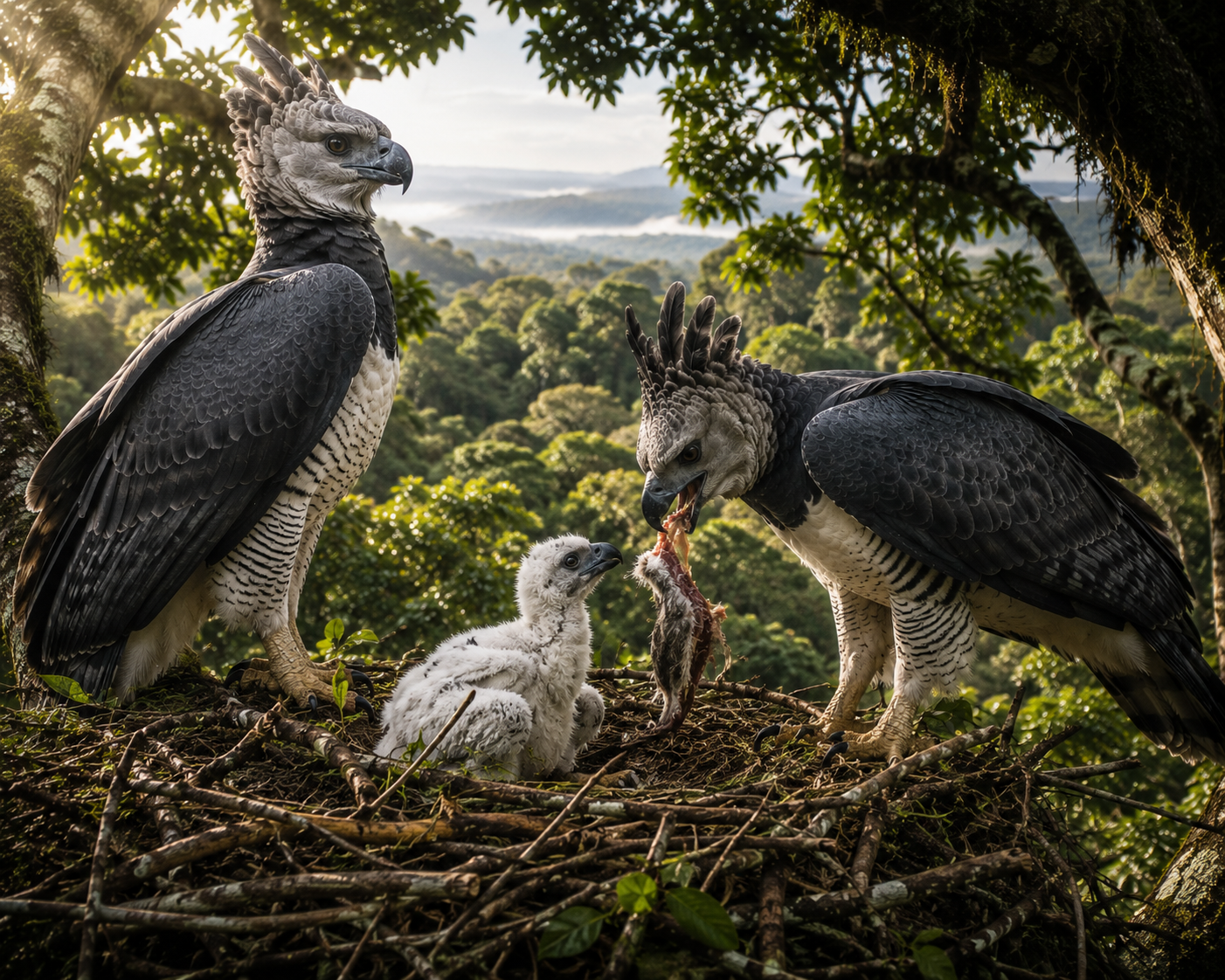
Long before a young harpy eagle learns to fly, its parents have already invested years in its survival.
Unlike many birds that raise several chicks each breeding season, harpy eagles usually raise only one chick every two to three years.
It may seem like a slow strategy, but in the rainforest, producing fewer offspring allows parents to devote almost all of their time and energy to raising a single, healthy juvenile.
For a species that lives for decades, quality matters more than quantity.
A Home Above the Forest
Harpy eagles build enormous nests in the crowns of the tallest rainforest trees, often choosing giant kapok or Brazil nut trees that rise above the surrounding canopy.
Constructed from thick branches and lined with fresh green leaves, these nests may be reused and repaired for many years.
From this elevated platform, the parents have a clear view of the forest while keeping their chick safely beyond the reach of most ground predators.
It is one of the highest nurseries in the rainforest.
Parenting Is a Full-Time Job
During the first months of life, the chick depends entirely on its parents.
The female spends long periods guarding the nest while the male provides much of the food. As the chick grows, both parents share hunting and feeding responsibilities.
Even after the young eagle is capable of flying, it continues to rely on its parents for food and hunting experience.
Learning to survive takes far longer than learning to fly.
🌿From Egg to Rainforest Hunter
Why Every Chick Matters
Because harpy eagles reproduce so slowly, the loss of even one breeding pair can affect a local population for many years.
If an adult disappears, replacing it is not a quick process.
A chick must survive, mature, establish its own territory, find a mate, and eventually raise young of its own.
In nature, this journey may take close to a decade.
That is why conservationists place such importance on protecting adult birds as well as their nesting sites.
A Bond That Lasts
Many birds of prey form long-term breeding pairs, and harpy eagles are no exception.
Season after season, the same pair may return to the same towering tree, repairing their nest and raising another chick when conditions are right.
High above the rainforest, these ancient trees become more than nesting sites.
They become family homes that may be used for generations.
Transition
For thousands of years, this slow and patient cycle allowed harpy eagles to thrive across vast tropical forests.
Today, however, the greatest challenge is no longer raising a chick.
It is finding a forest large enough for that chick to inherit.
The final chapter explores the future of the harpy eagle—and why protecting one bird also means protecting an entire rainforest.
Chapter 5
Guardians of the Rainforest: The Future of the Harpy Eagle
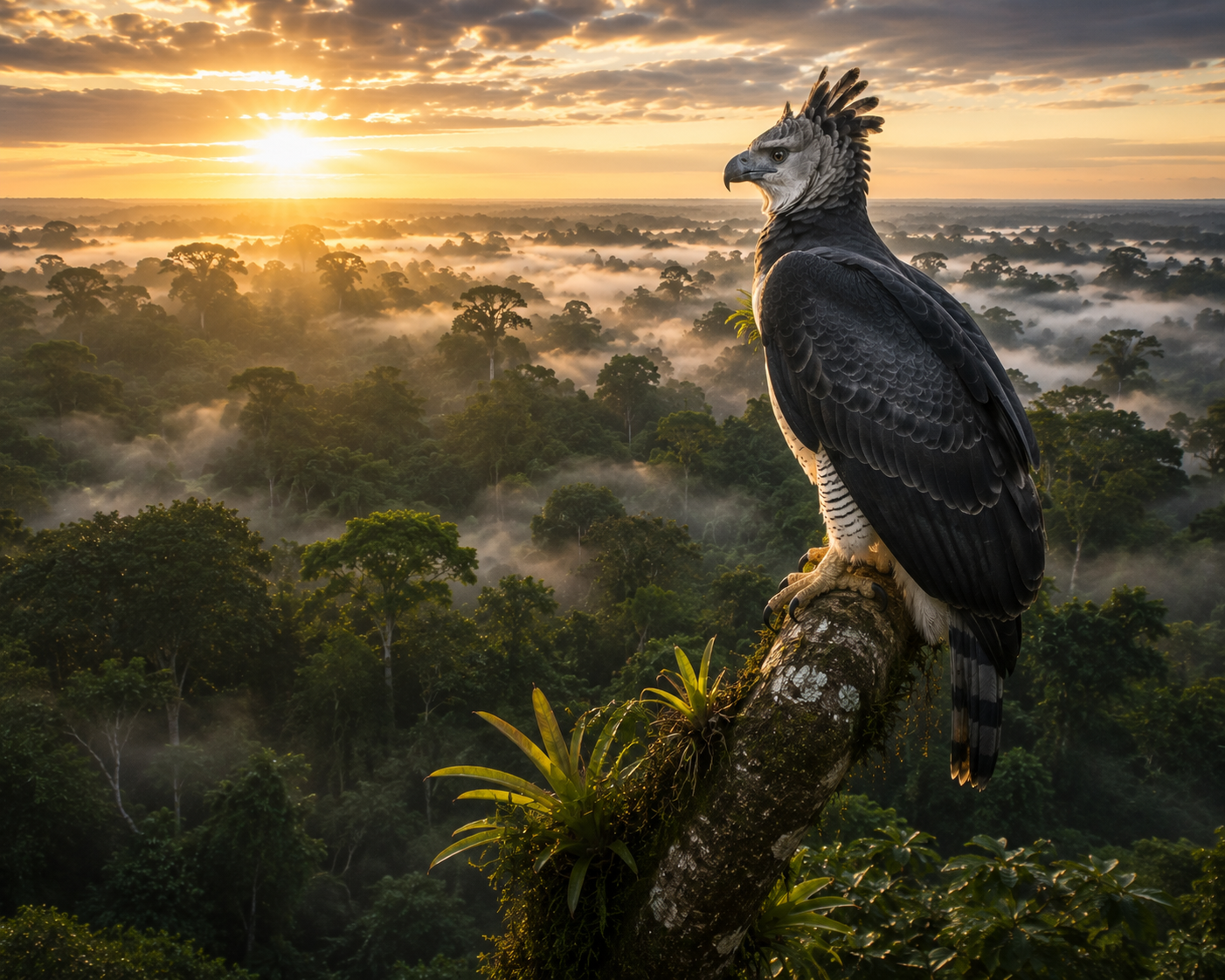
The harpy eagle has ruled the rainforest canopy for millions of years.
It has survived changing climates, shifting rivers, and countless generations of predators and prey. Evolution shaped it into one of the most powerful birds on Earth, perfectly adapted to life among the tallest trees of the tropical forest.
Yet today, its greatest challenge is one it cannot overcome through strength or instinct.
The forest itself is disappearing.
When a Forest Falls Silent
Unlike many birds that can adapt to farmland or cities, the harpy eagle depends on vast, continuous rainforest.
A single breeding pair may require hundreds of square kilometres of hunting territory. As forests are cleared for agriculture, roads, mining, and expanding settlements, these territories become fragmented into isolated patches.
The eagle may still find food.
But finding a mate, raising a chick, and maintaining a healthy population becomes increasingly difficult.
For a species that breeds so slowly, even small habitat losses can have lasting consequences.
More Than a Bird of Prey
The harpy eagle is often called an umbrella species.
Protecting its habitat also protects countless other plants and animals that share the same rainforest.
When conservation efforts preserve ancient trees for nesting, they also safeguard homes for monkeys, sloths, frogs, insects, orchids, and thousands of other organisms.
Saving one species helps protect an entire ecosystem.
🌍One Forest, Thousands of Lives
Hope Above the Canopy
Across Central and South America, scientists, Indigenous communities, conservation organizations, and national parks are working together to protect the harpy eagle.
Researchers monitor nests using climbing teams and remote cameras, while local communities help safeguard nesting trees and reduce habitat destruction.
Every protected forest creates another opportunity for the next generation of harpy eagles to take flight.
Their future depends not on one project, but on thousands of individual decisions to preserve the rainforest.
Final Reflection
Most visitors to the Amazon will never see a harpy eagle.
It spends much of its life hidden high above the forest floor, moving quietly through a world of leaves and branches.
Yet its absence would be impossible to ignore.
A rainforest without its greatest aerial predator would no longer be the same rainforest.
The harpy eagle is more than a magnificent bird.
It is a symbol of healthy forests, thriving wildlife, and the extraordinary balance that has existed in the Amazon for millions of years.
Protecting that balance ensures that future generations will inherit not only a living rainforest—but also the silent guardian that watches over it.
✨ Final Quote
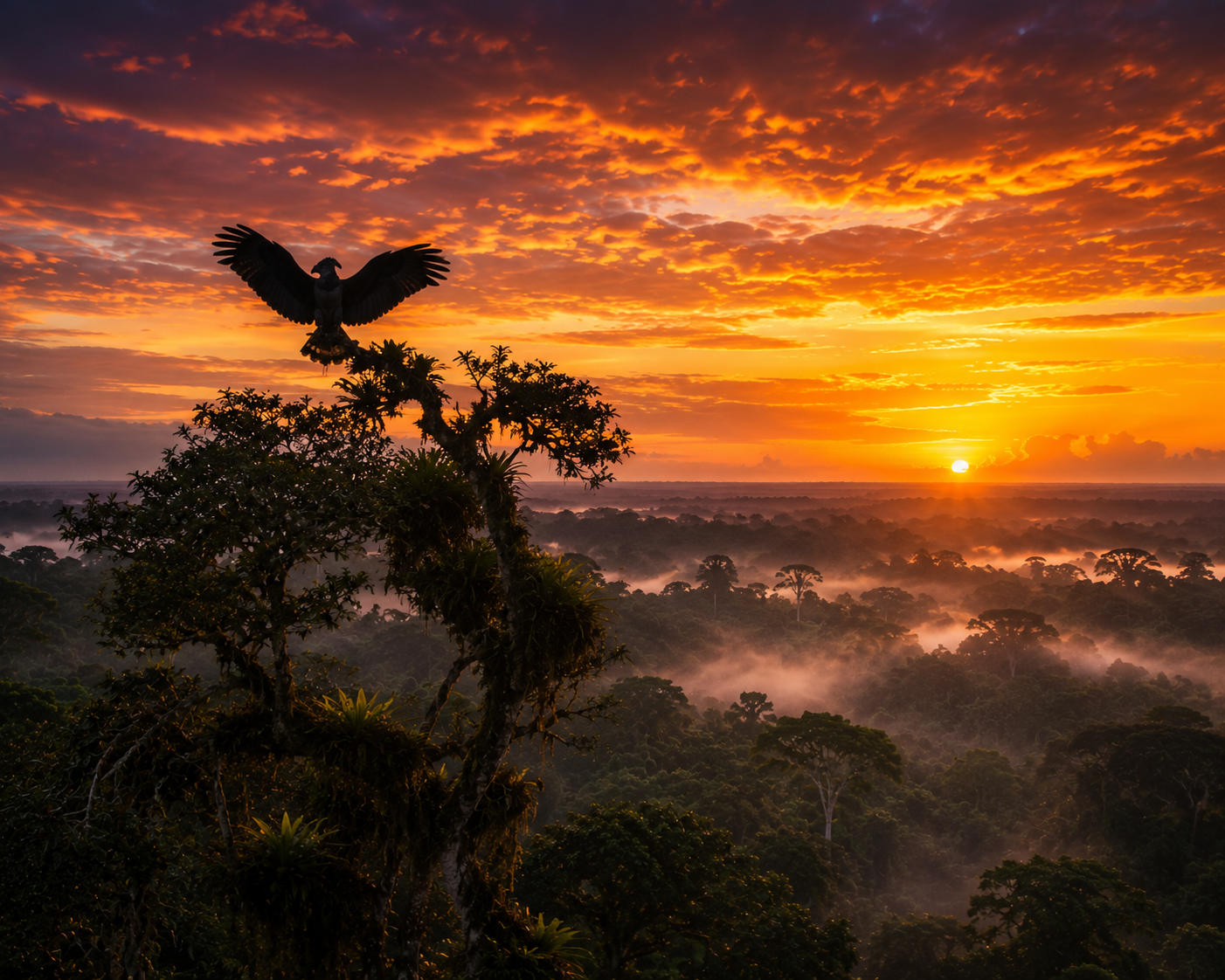
"The harpy eagle does not rule the rainforest through fear alone—it reminds us that the strength of a forest is measured by the life it can still protect."
Yes. Although the Amazon rainforest is their largest stronghold, harpy eagles also live in other tropical forests across Central and South America wherever suitable habitat still exists.