CHAPTER 1
Born to Run: Nature's Ultimate Speed Machine
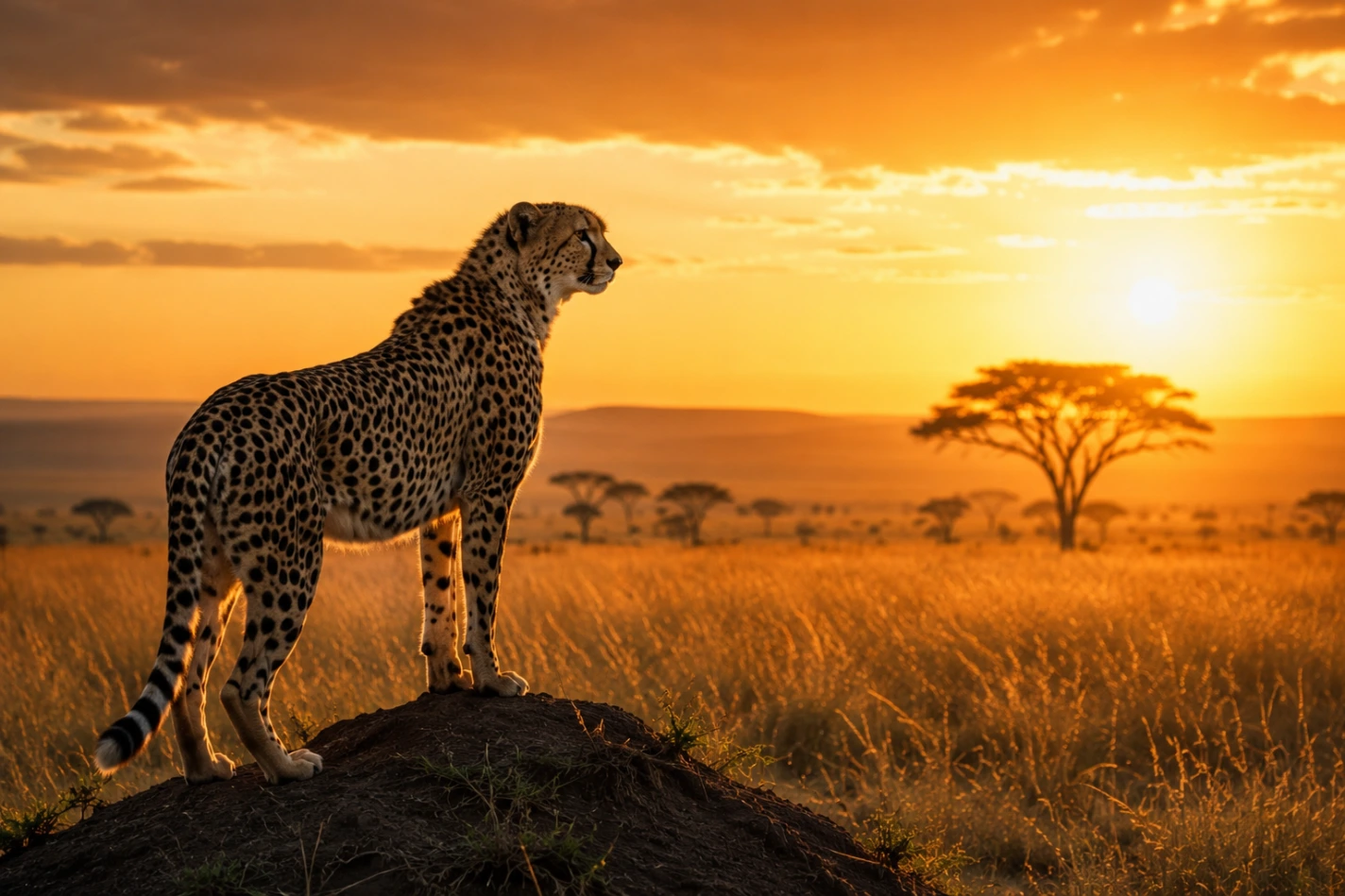
"Before the first sprint, there is silence."
The African savanna wakes slowly beneath the first light of dawn.
Golden sunlight washes over the grasslands as birds begin their morning chorus. Small herds of gazelles step out to feed, calm and unaware that a predator is already watching from a distance.
Perched atop a termite mound, a lone cheetah stands perfectly still.
It isn't wandering or hunting by chance.
Its eyes scan every movement across the plains. The wind carries scents that reveal nearby animals, while even the faintest sound can signal an opportunity—or a warning. Long before it begins to run, the cheetah is already making decisions.
For this predator, the hunt starts with patience.
Unlike lions, which often rely on power and teamwork, or leopards, which use dense cover and ambush, the cheetah has evolved around one remarkable advantage: unmatched speed.
Why Speed Matters
Every predator solves the same problem in a different way.
A lion uses teamwork.
A crocodile relies on surprise.
A wolf depends on endurance.
The cheetah has chosen another strategy entirely.
It sacrifices raw power for explosive acceleration, becoming the fastest land animal ever to evolve.
That incredible speed allows it to catch agile prey such as Thomson's gazelles and impalas that few other predators can pursue successfully.
But this remarkable adaptation comes at a cost.
The cheetah can maintain maximum speed for only 20 to 30 seconds before its body begins to overheat. If the prey escapes during those precious moments, the hunt is usually over.
🧪 Science Behind
Every part of a cheetah's body is engineered for one purpose.
Unlike other big cats, it has:
- A lightweight skeleton.
- An exceptionally flexible spine that acts like a spring.
- Enlarged lungs and heart for rapid oxygen delivery.
- Semi-retractable claws that provide extra grip.
- A long muscular tail that works like a high-speed rudder during sharp turns.
Together, these adaptations transform the cheetah into one of the most specialized hunters on Earth.
💡 Did You Know?
The black lines running from a cheetah's eyes to the corners of its mouth are called tear marks. Scientists believe they help reduce sunlight glare, improving vision while tracking prey across the bright African plains.
🌍 Transition
Standing quietly on the termite mound, the cheetah has already made its decision.
Somewhere in the grass, a young gazelle takes another step.
Within seconds, the stillness of the savanna will explode into one of the fastest pursuits in the natural world.
The next chapter reveals how millions of years of evolution transformed an ordinary wild cat into nature's ultimate speed machine.
Chapter 2
Built for Speed: The Science Behind the Fastest Land Animal
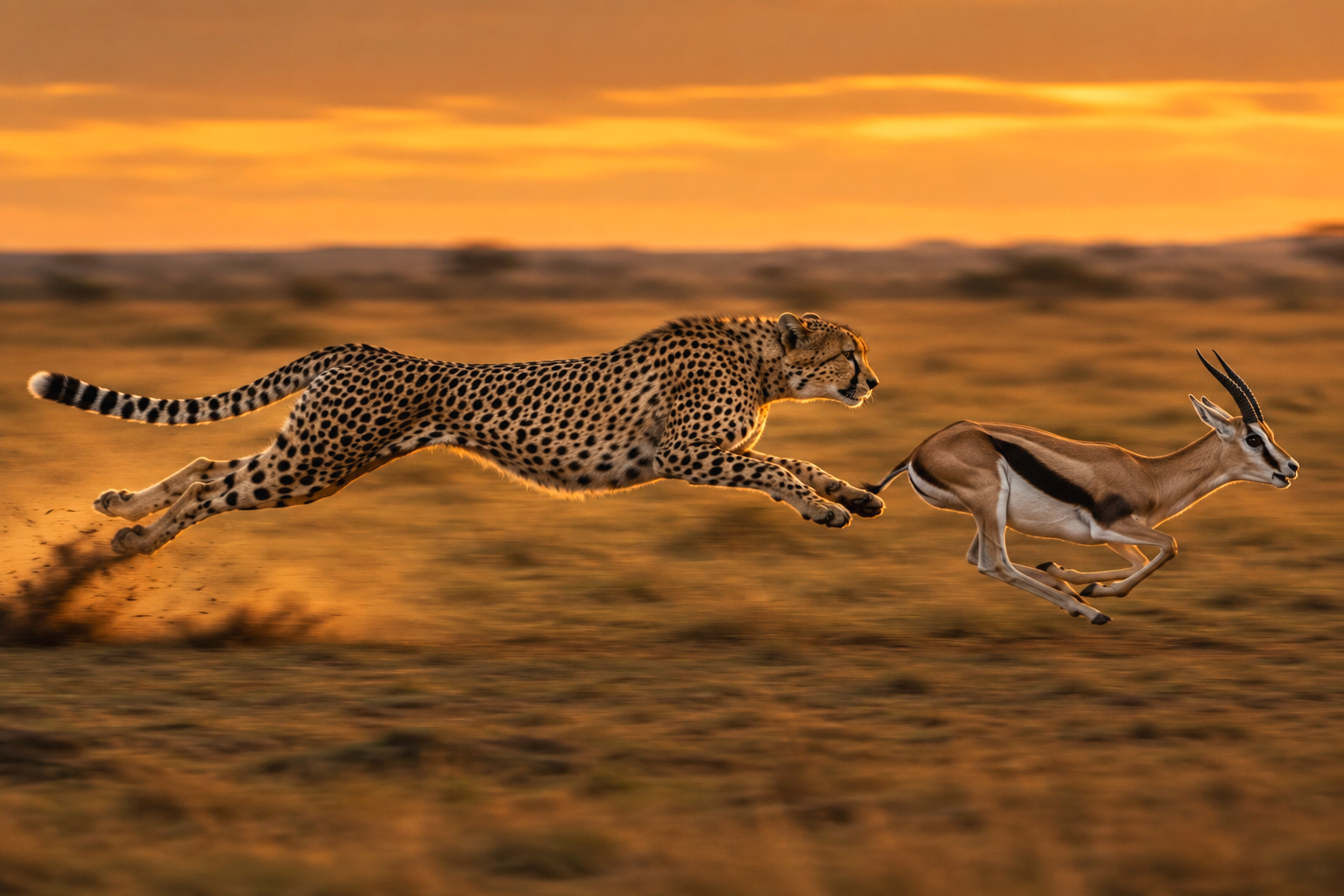
The moment a cheetah launches into a sprint, its body becomes one of nature's most efficient machines.
Unlike most predators that rely on strength, the cheetah has evolved to maximize speed. Nearly every part of its anatomy has been refined over millions of years to help it accelerate, balance, and maintain control during an explosive chase.
This extraordinary specialization allows the cheetah to reach speeds of up to 120 km/h (75 mph)—faster than any other land mammal.
🦴 A Body Designed for Speed
A cheetah's body is built very differently from that of lions or leopards.
Instead of a heavy, muscular frame, it has a lightweight skeleton, long legs, a narrow waist, and a highly flexible spine. These features reduce weight while increasing stride length and acceleration.
Each stride can cover 6–7 meters (20–23 feet), allowing the cheetah to gain ground with astonishing efficiency.
📊 Quick Facts
- 🚀 Maximum speed: 120 km/h
- ⚡ 0–100 km/h: About 3 seconds
- 📏 Maximum stride: Up to 7 meters
- ⏱ Full-speed sprint: 20–30 seconds
- 🌡 Body temperature rises rapidly during a chase
🔬 Science Behind
One of the cheetah's greatest advantages is its flexible spine.
As the spine bends and stretches, it works like a compressed spring. During every stride, the front and back legs extend far apart before snapping back beneath the body. This motion dramatically increases stride length, allowing the cheetah to cover more ground than almost any other mammal with each leap.
💡 Did You Know?
Unlike most cats, a cheetah's claws do not fully retract. This unusual adaptation works like the spikes on an athlete's running shoes, providing extra traction during high-speed chases.
🌍 Transition
Speed alone does not guarantee success.
Every sprint drains enormous amounts of energy, and a failed chase can leave the cheetah exhausted with little chance to hunt again immediately.
The next chapter follows one of nature's most breathtaking moments—a cheetah's high-speed pursuit, where every second can mean the difference between life and starvation.
Chapter 3
The 10-Second Hunt: When Every Second Decides Life or Death
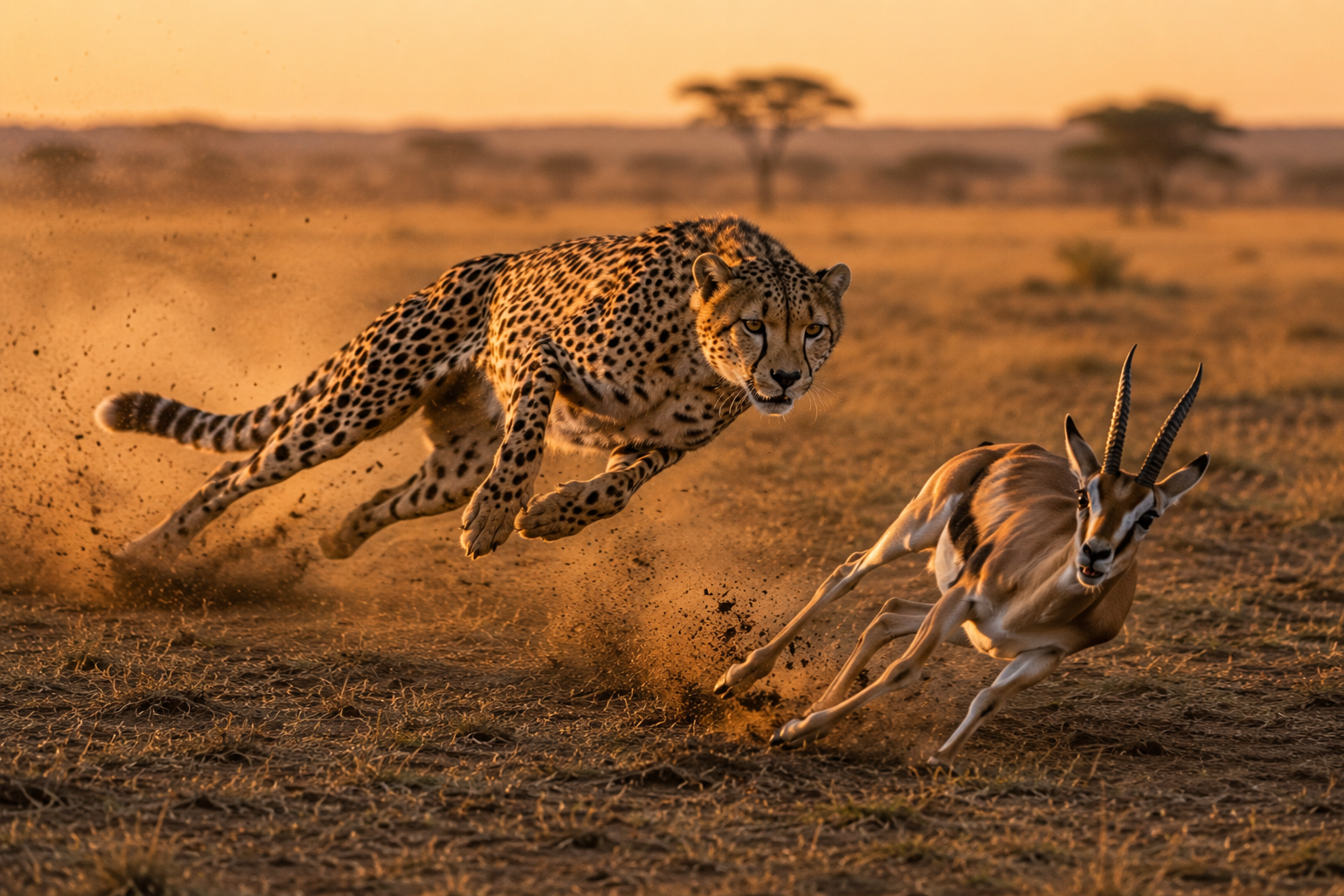
The hunt begins long before the first sprint.
A cheetah may spend several minutes quietly observing a herd, searching for a young, injured, or distracted animal. Every unnecessary chase wastes precious energy, so choosing the right target is just as important as running fast.
Once the target is selected, the cheetah lowers its body and begins to stalk through the tall grass, using every bush, termite mound, and change in terrain as cover.
Only when it is close enough does the real race begin.
⚡ The Explosive Launch
Unlike marathon runners, cheetahs rely on explosive acceleration.
Within just a few strides, they can reach highway speeds that most animals cannot escape.
During the sprint:
- The spine stretches like a spring.
- The tail constantly adjusts balance.
- Semi-retractable claws grip the ground.
- Eyes remain locked on the prey, even during sudden turns.
Every movement is calculated.
Interactive Hunt Timeline
💨 Why Most Hunts Fail
Despite being the fastest land animal, a cheetah is not guaranteed success.
A gazelle can change direction instantly, forcing the cheetah to make equally sharp turns. Every twist increases energy loss and raises body temperature.
If the chase lasts more than 20–30 seconds, the cheetah usually abandons the pursuit to avoid dangerous overheating.
This is why patience before the chase is often more important than speed during it.
🎯 Hunt at a Glance
- 👁️ Target Selection: Cheetahs usually focus on young, isolated, or distracted prey rather than the strongest individuals.
- 🌬️ Approach Strategy: They often stalk to within 60–100 meters before launching a sprint to maximize success.
- ↩️ High-Speed Turns: A cheetah's long tail acts as a counterbalance, allowing rapid direction changes while chasing zigzagging prey.
- 🍽️ Recovery First: After a successful chase, the cheetah often rests and pants before eating because the sprint generates extreme heat.
🌍 Transition
Winning the race does not mean winning the meal.
Exhausted from the chase, the cheetah must now protect its hard-earned prey from lions, hyenas, and vultures that are always watching.
The next chapter explores why life after the hunt can be even more dangerous than the hunt itself.
Chapter 4
Victory Doesn't Last: When Bigger Predators Arrive
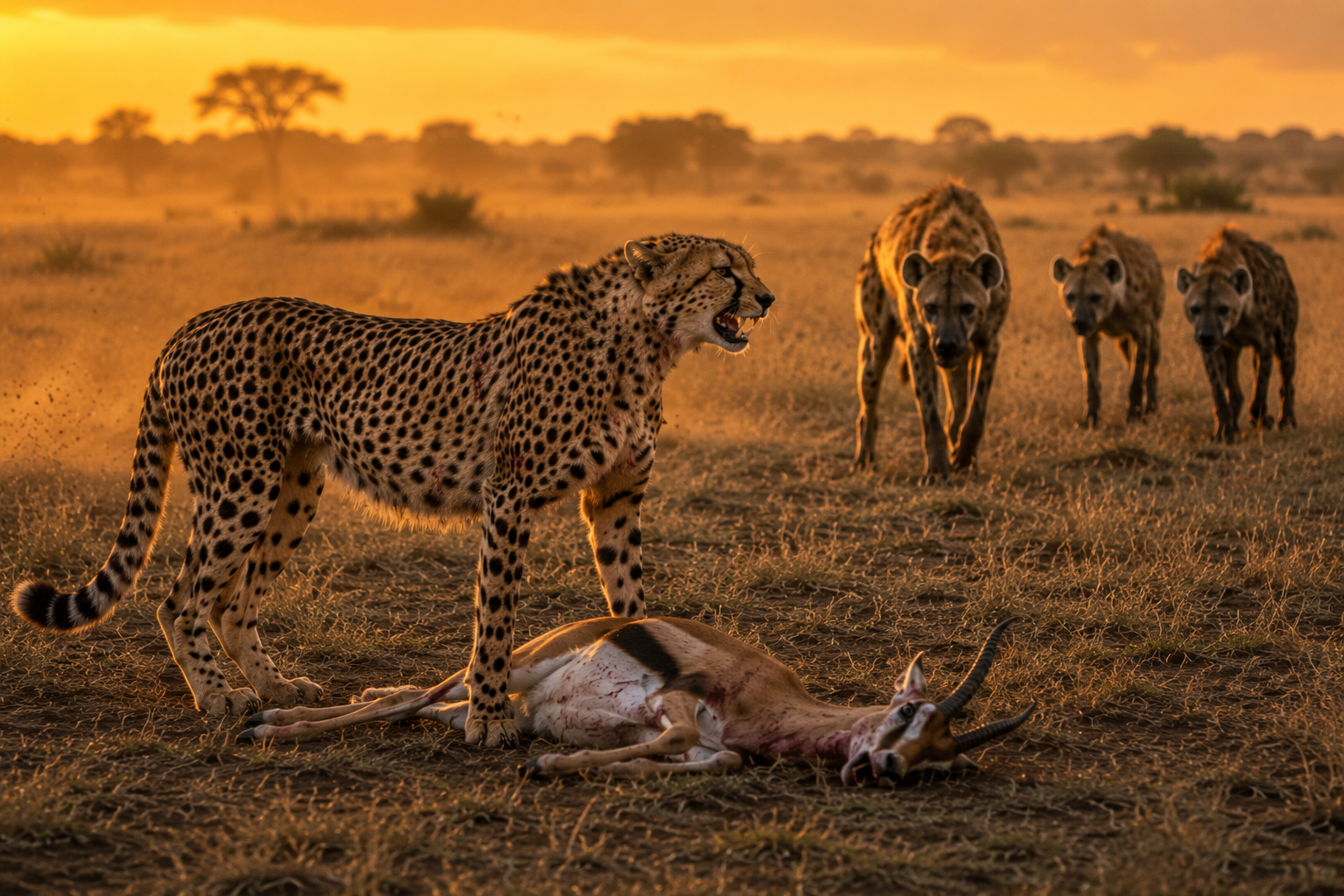
For a few brief moments, the hunt is over.
The gazelle lies still, and the cheetah has done what few predators on Earth can accomplish—catch one of Africa's fastest herbivores through speed alone.
But the celebration never comes.
Breathing rapidly, the cheetah collapses beside its prey. Its body temperature has risen dramatically, its muscles are flooded with fatigue, and every deep breath is a reminder of how much energy the chase has consumed.
This is the most dangerous moment of the hunt.
A Meal Everyone Wants
Unlike lions, cheetahs are not built for fighting.
Their slim bodies, lightweight bones, and relatively small jaws make them exceptional runners but poor defenders.
The scent of fresh blood can travel surprisingly far across the savanna, attracting unwanted visitors within minutes.
Hyenas may arrive first.
Vultures circling overhead often reveal the kill's location to other predators.
If a lion appears, the cheetah almost always abandons its meal rather than risk a fatal confrontation.
For the cheetah, survival is worth more than a single meal.
Who Steals the Meal?
The Cost of Every Mistake
A failed hunt means lost energy.
A successful hunt that is stolen means lost energy and lost food.
Young cheetahs and mothers with cubs face the greatest challenge. A mother may need several successful hunts each week to feed both herself and her growing family. Losing even one meal can have serious consequences.
This constant pressure explains why cheetahs hunt with such precision. Every chase carries a risk, and every decision can affect survival.
🌍 In the Wild
Researchers have observed that cheetahs sometimes drag their prey into taller grass before resting. The extra effort may reduce the chance of larger predators spotting the carcass, buying a few valuable minutes to recover and feed.
Even so, there are no guarantees on the African plains.
💭 Think Like a Cheetah
Imagine running as fast as a sports car for less than half a minute.
Now imagine trying to defend your dinner against an opponent twice your size immediately afterward.
For a cheetah, that isn't imagination—it's everyday life.
🌍 Transition
Despite these challenges, cheetahs have survived on African grasslands for thousands of years.
Today, however, they face an even greater threat—one they cannot outrun.
Roads, fences, shrinking habitats, and human expansion are changing the future of the world's fastest land animal.
The final chapter explores whether the cheetah can continue its race for survival in the modern world.
The Race Isn't Over: Can Cheetahs Survive the Future?
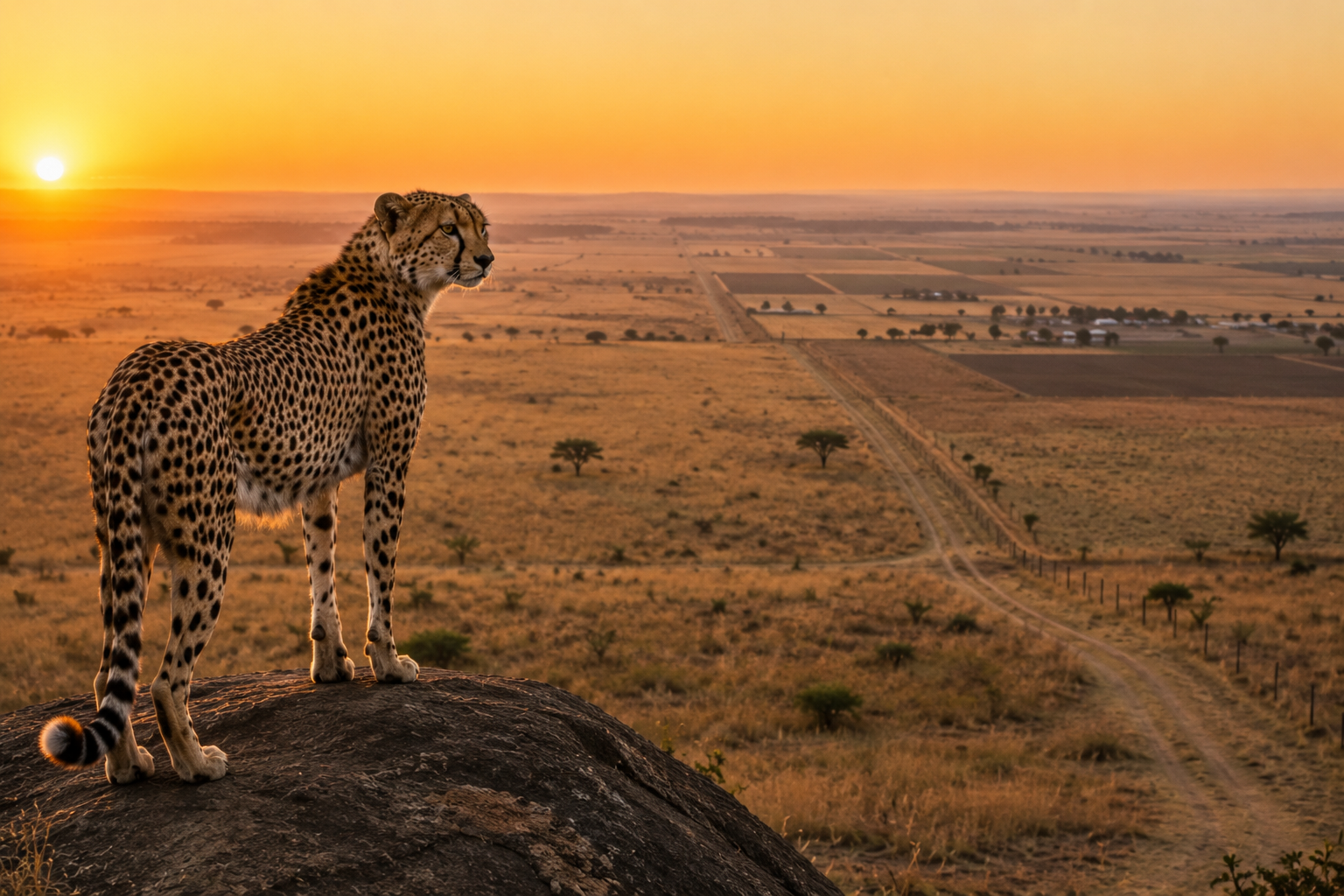
As darkness settles over the savanna, the cheetah begins another journey.
There is no celebration for surviving today's hunt. Tomorrow will bring new challenges, another chase, and another test of endurance.
For thousands of years, cheetahs adapted to changing climates, competing predators, and migrating prey. Evolution shaped them into the fastest land animal the world has ever known.
Today, however, the greatest obstacle is not another predator.
It is a rapidly changing world.
When the Grasslands Disappear
The open plains that cheetahs depend on are slowly becoming smaller.
Across parts of Africa, expanding farms, roads, fences, and human settlements divide once-continuous grasslands into isolated fragments. These barriers reduce the space available for hunting and make it harder for cheetahs to move safely between territories.
For an animal built to run across wide, open landscapes, every new fence is another limit.
Protecting cheetahs often means protecting the people who share the same landscape.
"A Shared Future"
More Than Just Speed
People remember the cheetah for its incredible sprint.
Scientists admire it for its extraordinary anatomy.
Wildlife photographers celebrate its elegance.
But perhaps the most remarkable thing about the cheetah is not how fast it runs.
It is how it continues to survive in a world that is changing faster than ever before.
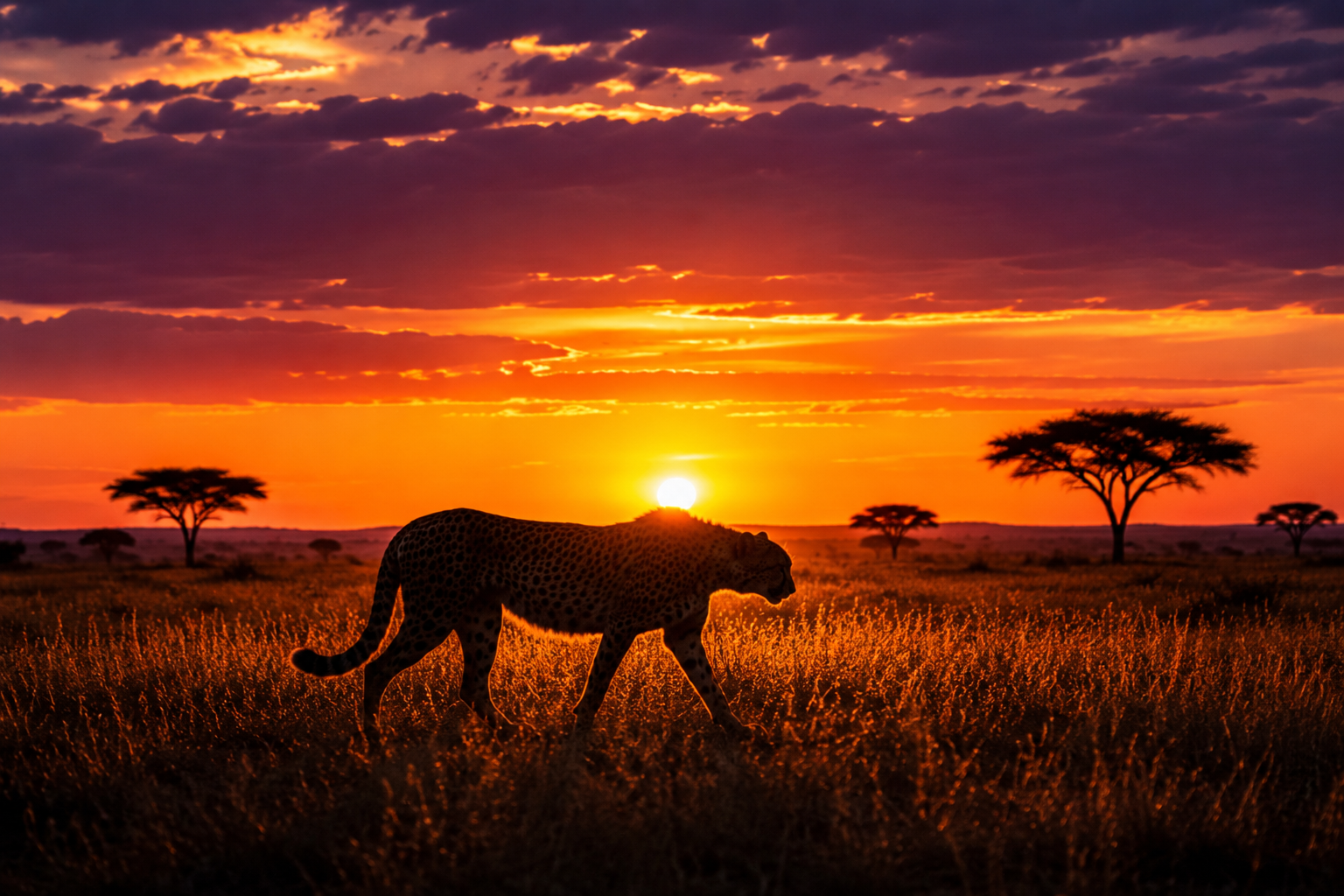
Final Reflection
The next time you see a cheetah racing across the African savanna, remember that you are witnessing more than a hunt.
You are watching millions of years of evolution condensed into a few breathtaking seconds.
Every stride, every turn, and every burst of acceleration tells a story written long before humans walked these grasslands.
Whether future generations will continue to witness that story depends on the choices we make today.
End Quote
"The fastest animal on Earth cannot outrun habitat loss—but together, we can help ensure its race continues."
(FAQ) FREQUENTLY ASKED QUESTION
1.How fast can a cheetah run?
Cheetahs can reach top speeds of about 120 km/h (75 mph), making them the fastest land animal on Earth.
2.How long can a cheetah sustain top speed?
Only about 20-30 seconds — any longer and the cheetah risks dangerous overheating.
3.Why do cheetahs have black tear marks?
These dark lines running from the eyes to the mouth are believed to reduce sunlight glare, helping cheetahs track fast-moving prey.
4.Why are cheetahs endangered?
Habitat loss, shrinking grasslands, and human-wildlife conflict are the biggest threats — combined with naturally low genetic diversity that makes them more vulnerable.
5.Do cheetahs always keep their kills?
No — lions, leopards, and hyenas frequently steal a cheetah's hard-earned meal, since cheetahs are built for speed, not for fighting.