Why the Sun Doesn’t Spin Like Earth
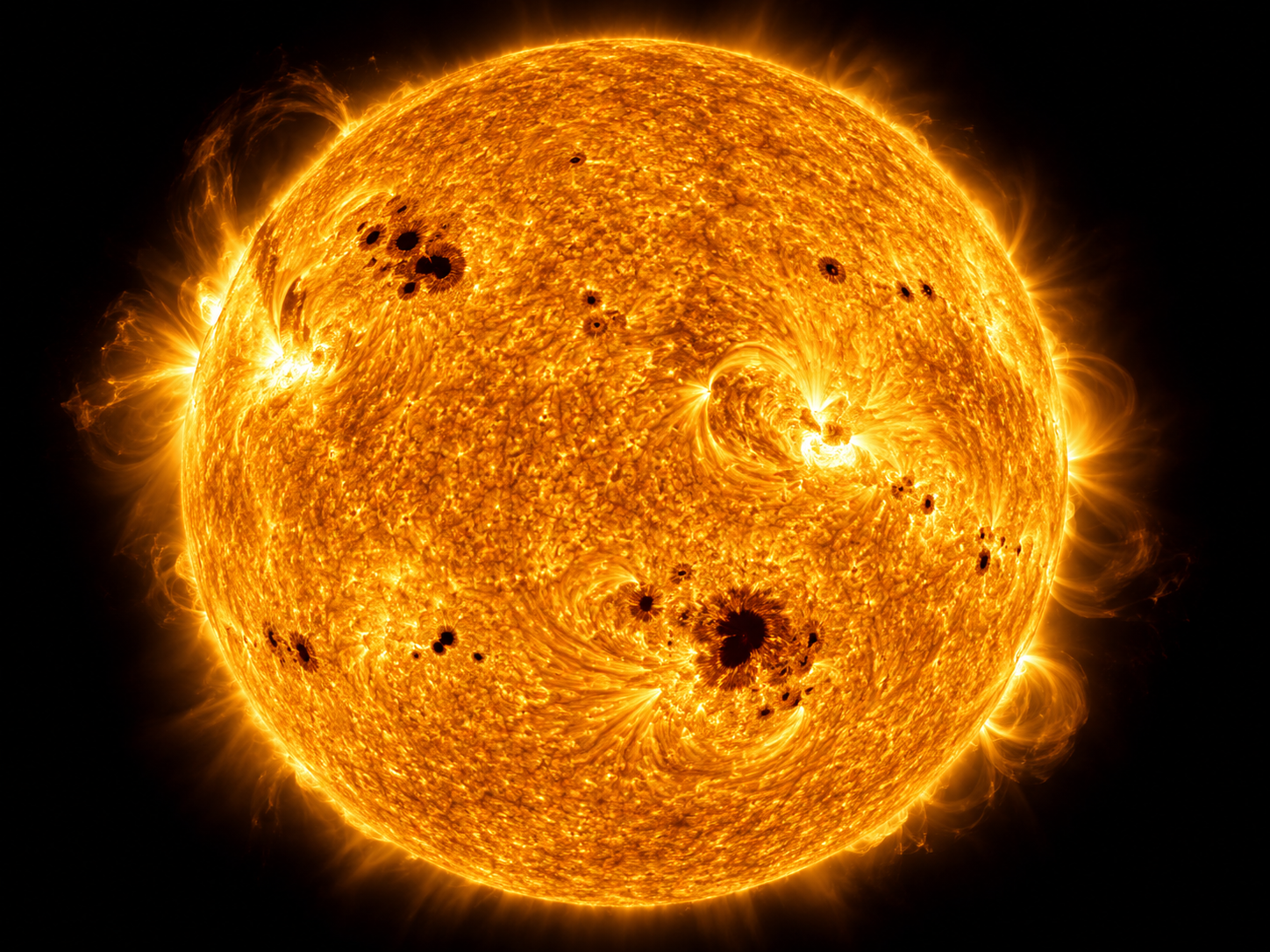
Look at the Sun and it seems simple.
A giant round ball.
Surely, if it spins, the whole thing should turn together.
That is what happens with Earth. One complete rotation takes about 24 hours no matter where you stand on the surface.
The Sun is different.
Its equator takes roughly 25 Earth days to rotate once. Near the poles, it takes about 36 days. So while one part of the Sun is already coming around again, another part is still catching up.
That sounds strange.
But there is a good reason.
The Sun does not have a solid surface.
What we call its surface is a layer of hot plasma. It can flow, rise, sink and move sideways. Different parts are not locked together like pieces of a hard ball.
Scientists call this differential rotation.
And it does much more than make the Sun rotate unevenly.
That difference in speed helps stretch and twist the Sun’s magnetic field—the same magnetic field behind sunspots, solar flares and other forms of solar activity.
So why doesn't the Sun simply spin as one piece?
To answer that, we first have to look at what the Sun is actually made of.
Chapter 1 — The Sun Has No Solid Surface
Imagine Earth for a moment.
Stand at the equator.
Now imagine someone standing near the North Pole.
You are both part of one solid planet.
Earth's surface is attached to the rock beneath your feet, so the planet rotates as one body.
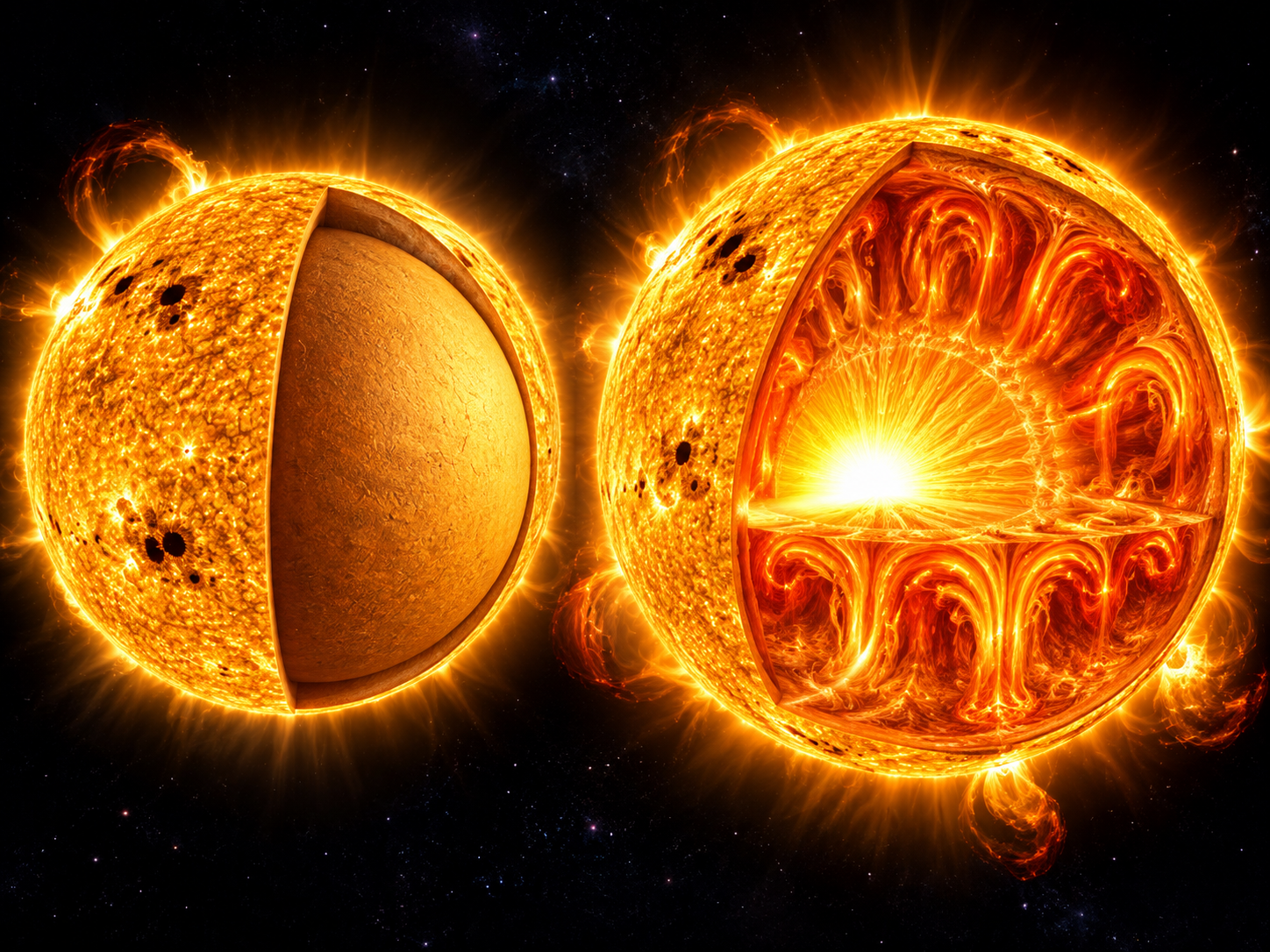
The Sun has no such solid shell.
Its visible surface—the photosphere—is simply the layer we can see. Beneath it is more hot plasma, and that plasma keeps moving.
Think about water in a bathtub.
If the water were perfectly still, you might imagine the whole surface moving together.
But stir different parts and they can move at different speeds.
The Sun is much more complicated than a bathtub, of course. Its plasma is extremely hot, electrically charged and constantly moving because heat is being carried upward from deeper inside the star.
That movement matters.
The outer roughly 30% of the Sun by radius is its convection zone, where hot plasma rises and cooler plasma sinks again. These huge flows are part of the Sun's constant internal motion.
Nothing in that region forces every patch of plasma to keep exactly the same pace.
So the Sun can rotate at different rates at different latitudes.
That is why the equator gets around the Sun faster than the poles.
The difference is not a small detail.
It is one of the defining ways a star behaves like a fluid rather than a solid object.
Earth Spins Together, the Sun Does Not
Chapter 2 — How Did We Discover That the Sun Rotates Differently?
The Sun is too far away to touch.
So how do you measure how fast different parts of it are moving?
You watch something on the surface.
For centuries, astronomers have done exactly that with sunspots.
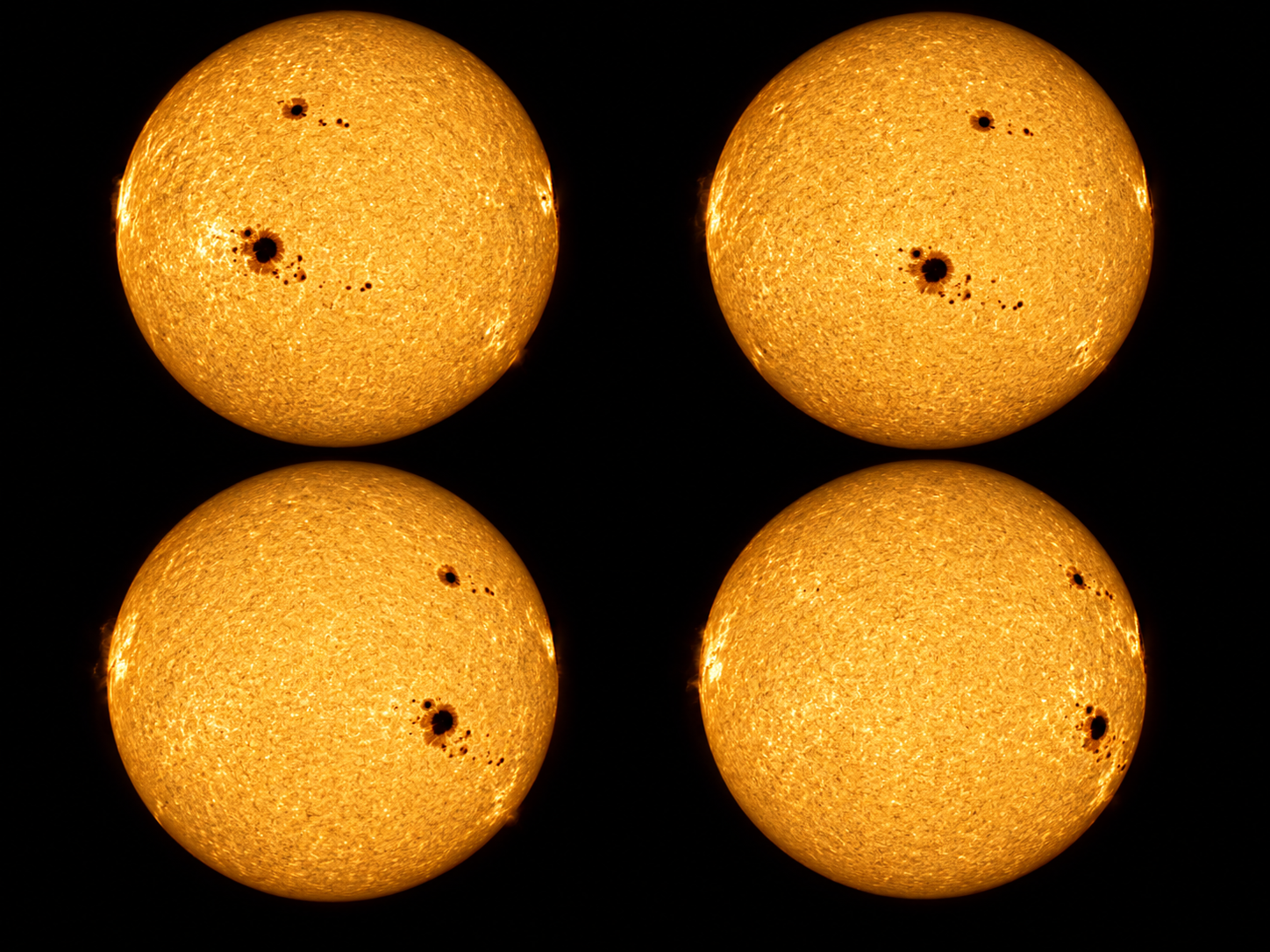
Sunspots are darker regions on the photosphere where strong magnetic fields reduce the movement of hot material. They look dark because they are cooler than the surrounding surface, although they are still extremely hot.
Now imagine a sunspot appearing near the eastern edge of the Sun.
Watch it over several days.
It moves across the visible disk and eventually disappears around the other side.
Track another sunspot closer to the equator.
Then compare the two.
You find something odd.
They do not cross the Sun at exactly the same pace.
Sunspots near the equator move faster than spots at higher latitudes. Astronomers were able to establish this by tracking sunspots across the solar disk, and the difference in rotation was recognized centuries ago.
The Sun had given away one of its secrets simply by carrying dark spots across its face.
Today, scientists can do much more.
Helioseismology lets researchers use waves traveling through the Sun to measure motion far below the visible surface. These measurements show that differential rotation continues through much of the convection zone.
So the sunspots gave us the first clue.
Sound waves gave us a way to look deeper.
Sunspots Reveal the Sun’s Spin
Chapter 3 — So What Makes the Equator Faster?
Knowing that the Sun rotates differently is one thing.
Explaining why is harder.
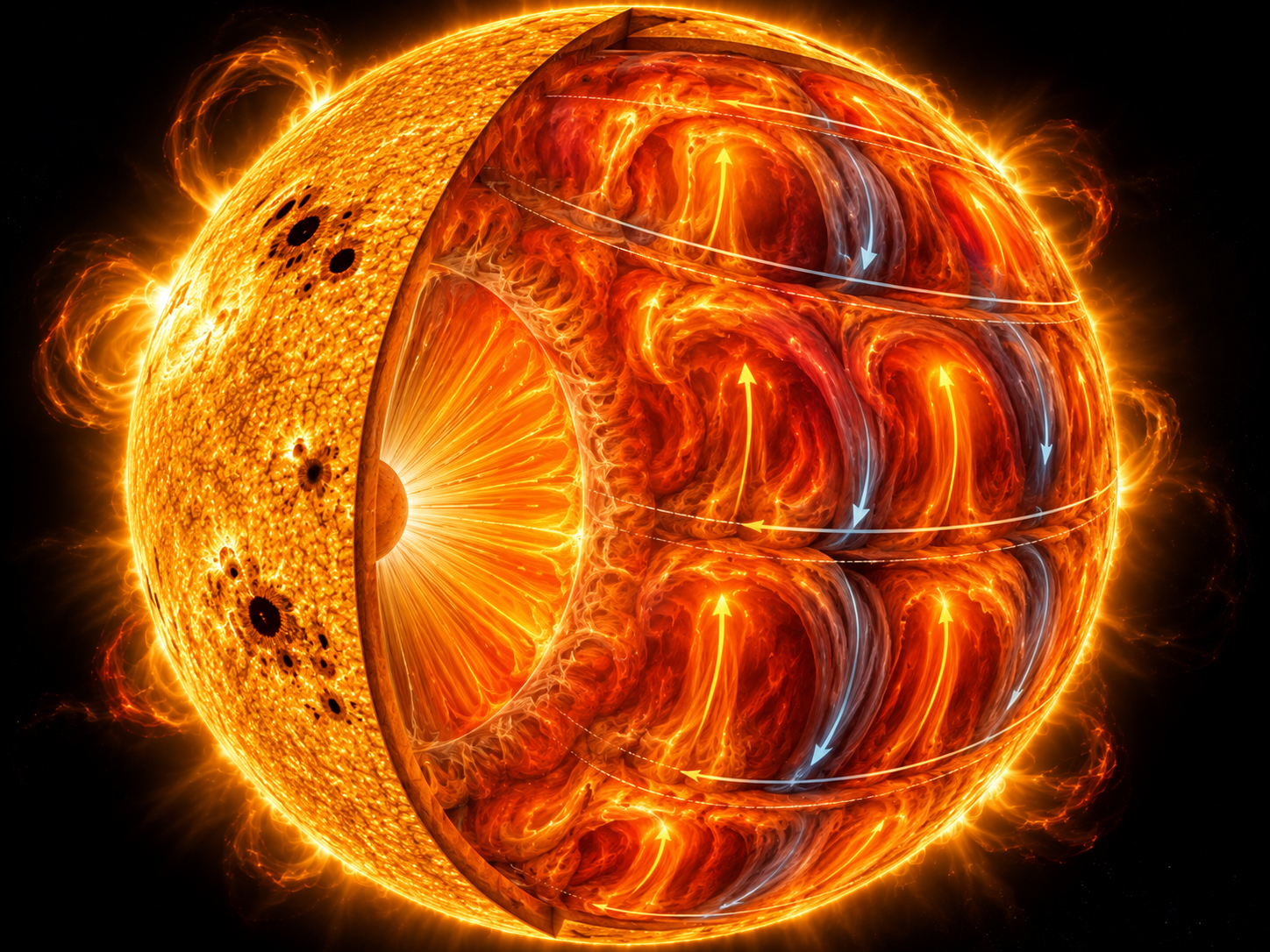
The basic reason is that the Sun is a huge rotating fluid with strong internal flows.
Deep inside the Sun, heat is constantly moving outward.
Plasma rises.
Plasma falls.
Plasma moves sideways.
And because the Sun is rotating, those flows do not behave like simple straight up-and-down movements.
The rotation influences the motion of the plasma, while the plasma flows also move angular momentum around inside the star. Researchers describe differential rotation as being linked to convection, rotation and large-scale fluid motions such as meridional circulation.
That creates an important difference from Earth.
On Earth, the ground does not flow.
On the Sun, the stuff doing the rotating does flow.
One part can speed up.
Another can slow down.
The equator ends up rotating faster than higher latitudes.
But here we should be careful.
Scientists understand the broad picture much better than they understand every detail.
The exact balance of turbulent convection, rotation, magnetic effects and angular-momentum transport is still an active area of research. NASA's current solar-physics programs still list the origin of large-scale differential rotation as a fundamental unanswered question.
So there is a good simple answer.
But there is not yet a single simple equation that explains every part of it.
The Sun is moving too much to be that simple.
Why Different Parts Can Move Differently
Chapter 4 — The Difference Does Not Stop at the Surface
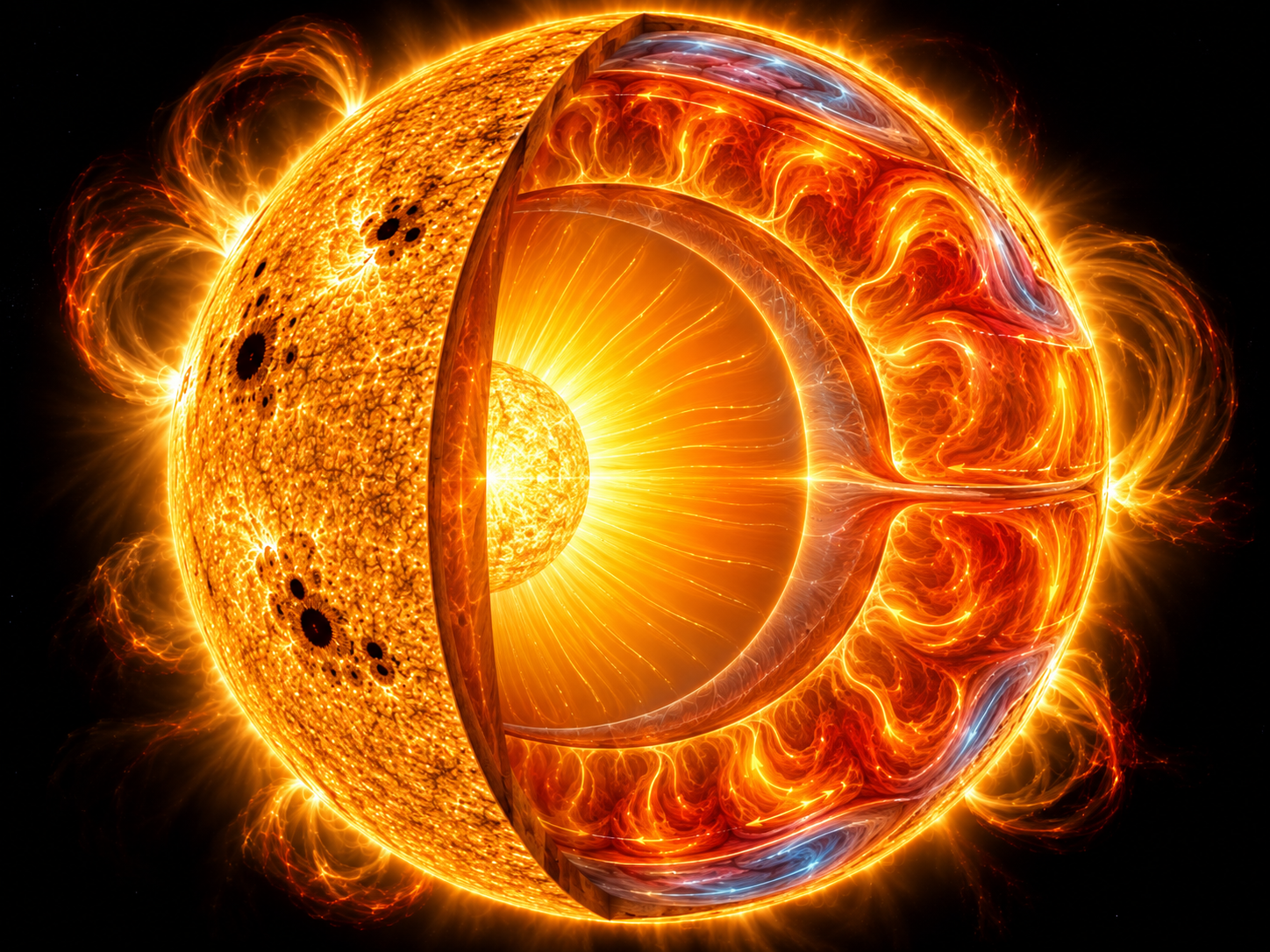
The strange rotation is not limited to the thin layer we can see.
Scientists have used helioseismology to look inside the Sun, and the pattern continues through much of the convection zone. The deeper interior behaves differently. Below the convection zone, the radiative interior rotates much more like a solid body.
Between these regions is one of the most interesting layers in the Sun.
The tachocline.
It is a thin transition zone where the rotation changes sharply from the more uniform rotation below to the differential rotation above. NASA describes it as a key region for understanding the Sun's magnetic field and solar activity.
There is also a second shear region much closer to the surface, called the near-surface shear layer.
So the Sun is not simply:
fast at the equator, slow at the poles.
Its rotation changes with latitude and depth.
That is much more complicated.
And now the Sun starts to look less like a smooth yellow ball and more like a machine made of moving layers.
The surface gives us the most obvious pattern.
But underneath, the rotation is changing again.
The Sun Has Layers of Rotation
Chapter 5 — Why Should We Care Which Part Spins Faster?
At first, differential rotation sounds like an interesting detail.
Then you see what it does.
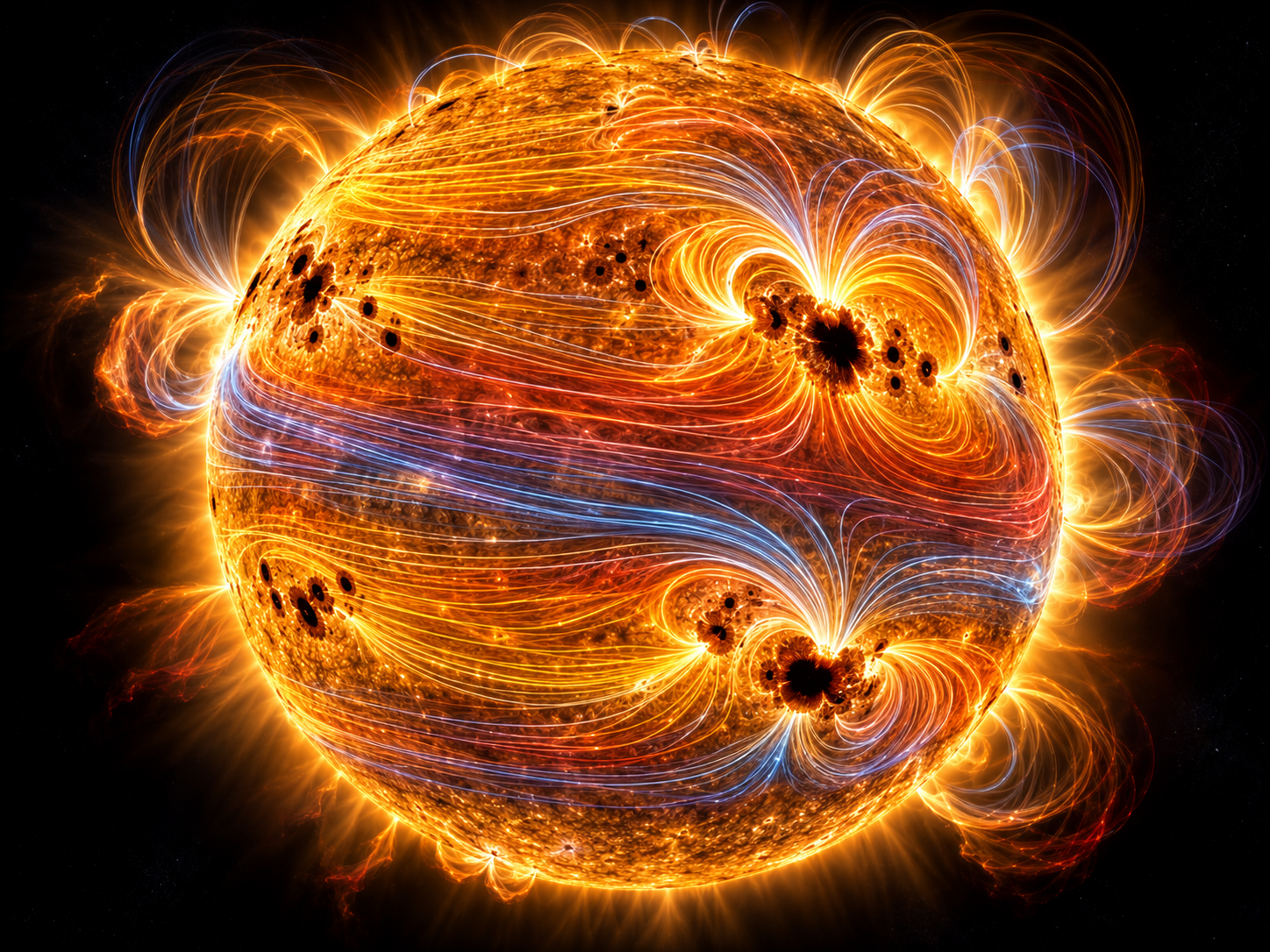
The Sun has a huge magnetic field.
And that field is constantly being moved by the plasma.
Imagine drawing a line on a sheet of soft rubber.
Now grab one end and move it faster than the other.
The line stretches.
Something similar happens to magnetic fields inside the Sun.
Differential rotation takes magnetic fields that run roughly north-south and winds them around the Sun. NASA describes this as the omega effect. The stretching and winding can strengthen the magnetic field and help prepare the conditions for solar activity.
Eventually, magnetic fields can become concentrated and emerge through the photosphere.
That is where we see sunspots.
And the story does not stop there.
Strong magnetic regions can produce solar flares and coronal mass ejections.
So the uneven rotation of the Sun is connected to something much bigger.
Space weather.
The difference between 25 days and 36 days may look like a small curiosity.
It is not.
It is part of the machinery that keeps the Sun's magnetic field changing.
From Rotation to Solar Activity
Chapter 6 — The Sun Is Still Hiding Part of the Answer
By now, the basic picture seems clear.
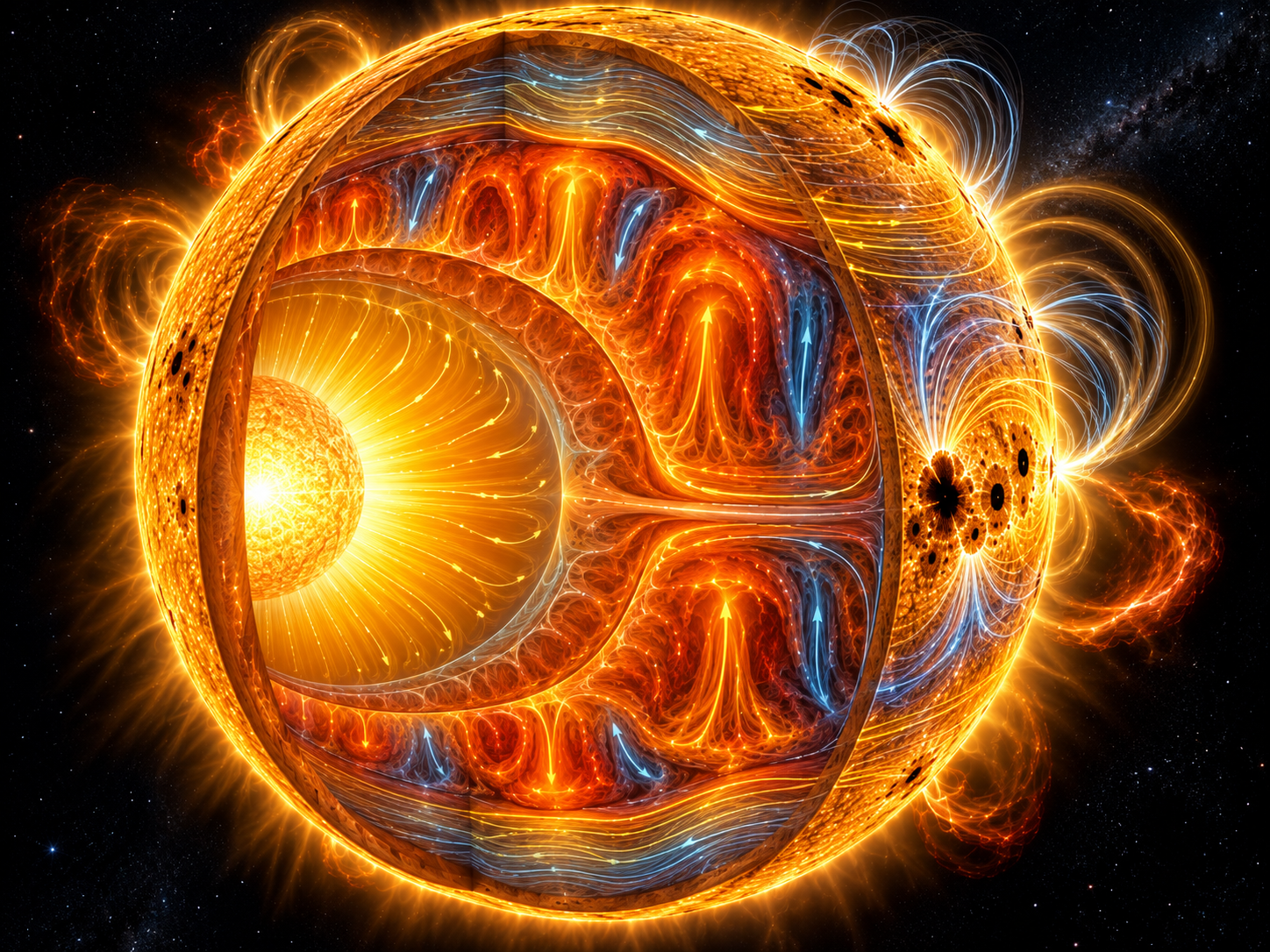
The Sun is made of moving plasma.
Different latitudes rotate at different speeds.
Convection and large-scale flows help maintain that pattern.
The rotation changes with depth too.
And differential rotation stretches the Sun's magnetic field.
But there is still a problem.
Scientists do not have every detail solved.
The Sun is an enormous turbulent system. The convection zone contains countless interacting flows, and models still struggle to reproduce every observed property of solar rotation perfectly. A major review notes that measured convective velocities are lower than some theoretical predictions, creating a challenge for models of the Sun's differential rotation.
Current NASA research is still asking what drives the Sun's large-scale plasma motions and how those flows interact with magnetic fields.
And scientists are still studying the thin shear layers inside the Sun.
Recent NASA-supported work has even focused on the near-surface shear layer and the relationship between these flows and the emergence of magnetic activity.
So the right answer is not:
“Scientists know exactly why the Sun spins this way.”
It is:
We know the main ingredients.
We know the Sun is fluid.
We know convection and rotation interact.
We can measure the resulting flow.
We can see how it affects the magnetic field.
But the full recipe is still being worked out.
That is often how science really looks.
The first strange observation is easy to state.
The deeper explanation takes much longer.
What We Know and What We Are Still Learning
Chapter 7 — So, Why Doesn't the Sun Spin Like Earth?
Because the Sun is not built like Earth.
Earth is a solid world.
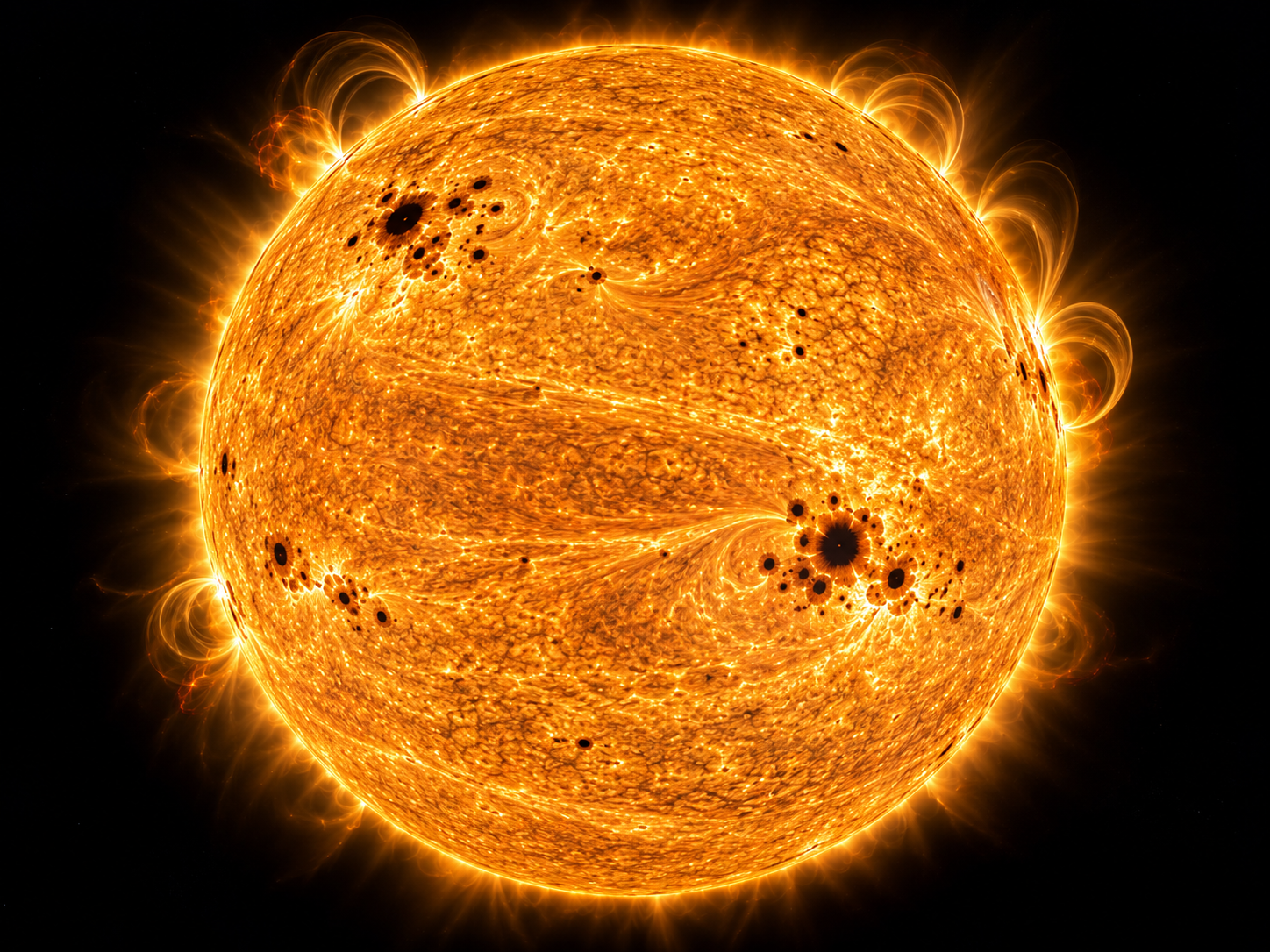
The Sun is a vast sphere of moving plasma.
Earth's surface is tied together.
The Sun's outer layers are free to flow.
That difference lets one part of the Sun move faster than another.
The equator completes a rotation in about 25 days.
The poles take about 36.
Inside the Sun, convection and large-scale plasma motions help maintain this uneven rotation. And deeper down, the rotation changes again through layers such as the tachocline.
Then comes the part that matters most.
The unequal rotation stretches and winds the Sun's magnetic field.
That helps shape the magnetic activity that eventually reaches the surface as sunspots, flares and other eruptions.
So the Sun's unusual spin is not really a flaw in the way it rotates.
It is a clue to what the Sun actually is.
Not a giant solid ball.
A moving star.
And once you see it that way, the strange rotation makes much more sense.
Frequently Asked Questions
1. Does the Sun rotate?
Yes. The Sun rotates on its axis, but because it is made of plasma rather than solid material, different regions rotate at different rates.
2. How long does it take the Sun to rotate?
The Sun rotates about once every 25 days at the equator and about 36 days near the poles. The exact rotation period depends on latitude.
3. What is solar differential rotation?
Solar differential rotation is the difference in rotation speed between different parts of the Sun. The equatorial regions rotate faster than regions closer to the poles.
4. Why doesn't the whole Sun rotate at the same speed?
The Sun is made of hot, moving plasma rather than solid material. Convection, rotation and large-scale flows can transport angular momentum within the Sun, allowing different regions to move at different speeds.
5. How do scientists know the Sun rotates differently?
Astronomers can track sunspots as they move across the solar disk. Comparing sunspots at different latitudes reveals different rotation rates. Scientists can also use helioseismology to study rotation beneath the visible surface.
6. Is the Sun's core rotating at the same speed as its surface?
The Sun's deeper radiative interior appears to rotate much more uniformly than the convection zone, although the core itself is harder to measure directly and has greater uncertainties.
7. What is the tachocline?
The tachocline is a thin transition layer between the more uniformly rotating radiative interior and the differentially rotating convection zone. The strong change in rotation across it makes the layer important in studies of the Sun's magnetic field.
8. What is the near-surface shear layer?
It is a shallow region near the Sun's surface where the rotation rate changes with depth. NASA research identifies it as another important shear region for understanding solar dynamics and magnetic activity.
9. How does differential rotation affect sunspots?
Differential rotation stretches and winds magnetic fields inside the Sun. These magnetic fields can become concentrated and emerge through the photosphere, producing sunspots and active regions.
10. Do scientists completely understand why the Sun has differential rotation?
No. The broad mechanism is well studied, but the exact balance of convection, rotation, large-scale flows and other processes that maintains the observed pattern is still an active research question.