introduction
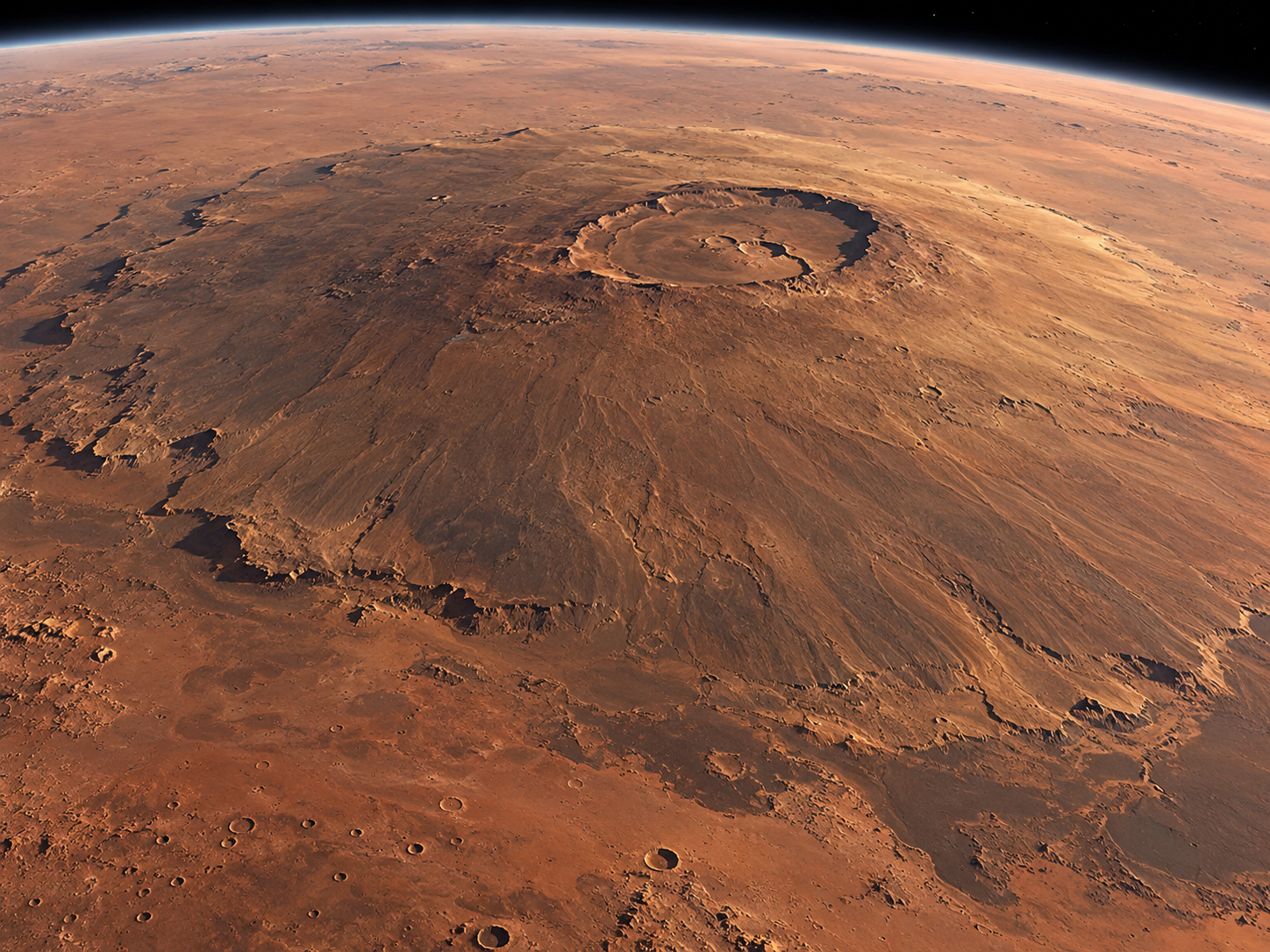
Mount Everest is the highest mountain on Earth.
Olympus Mons is something else entirely.
On Mars, this enormous volcano rises about 26 kilometres above the surrounding plains. Everest rises about 8.85 kilometres above sea level. Using those commonly cited measurements, Olympus Mons is roughly three times higher.
But there is a small detail worth fixing before we go any further.
The exact comparison depends on where you measure from. ESA and other planetary measurements often put Olympus Mons at about 22 kilometres above the Martian reference level, while its summit rises roughly 26 kilometres above the surrounding plains. So “three times Everest” is a useful comparison to its local relief, not a perfectly like-for-like measurement.
Still, the basic question remains.
How did Mars build a volcano this enormous?
The answer starts with something surprisingly simple.
Mars is a smaller world.
Its gravity is much weaker.
And its crust does not move over volcanic hotspots in the same way Earth's crust does.
That gave Olympus Mons something a volcano on Earth rarely gets:
a very long time in almost the same place to keep growing.
Chapter 1 — Everest and Olympus Mons Are Not Really the Same Kind of Mountain
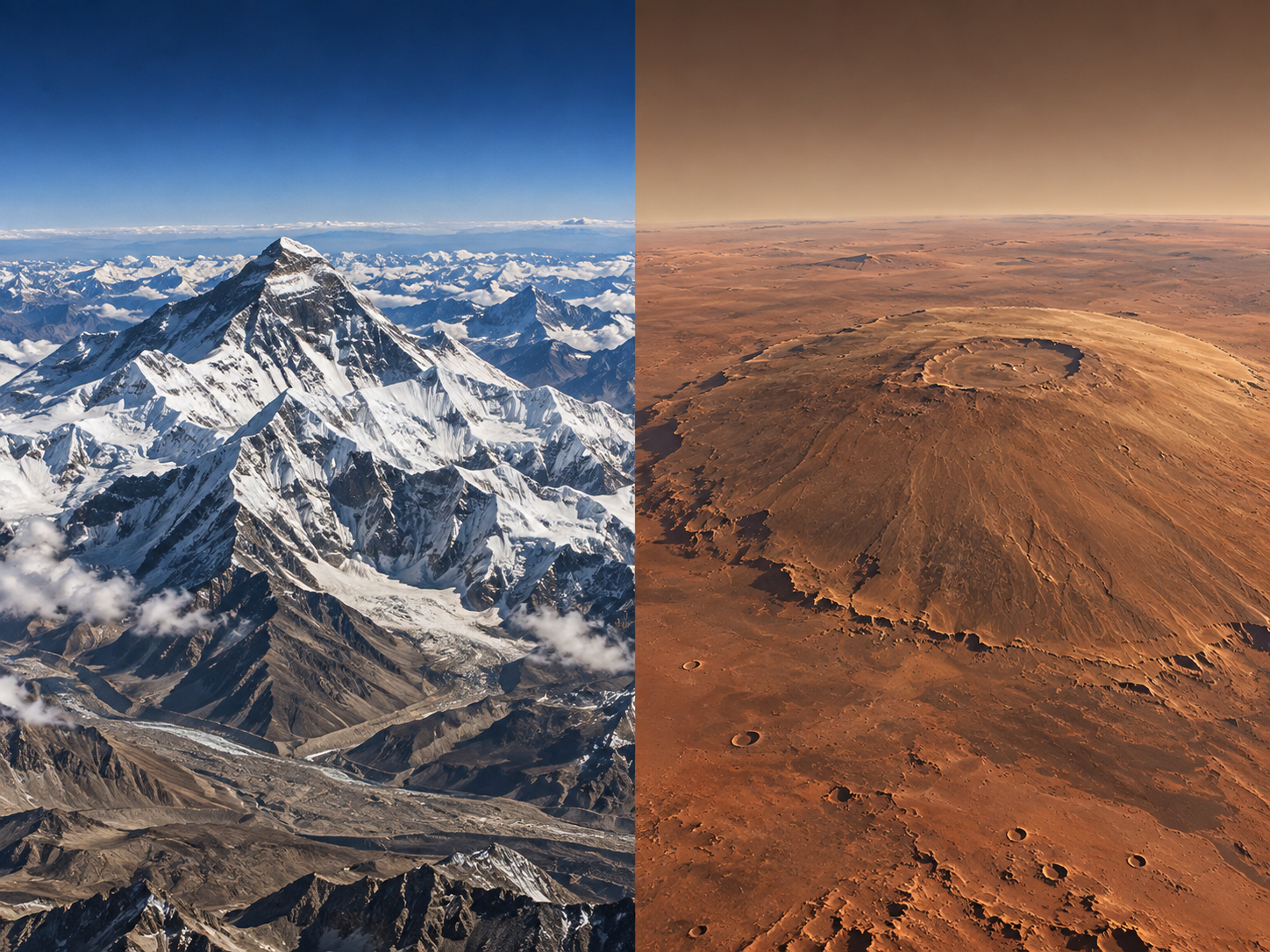
Picture Everest.
It is sharp.
Rugged.
Its upper slopes are covered with snow and ice, and its summit rises above the Himalayan range around it.
Now picture Olympus Mons.
It barely looks like a mountain in the usual sense.
It is incredibly wide and rises very gently. NASA measurements put its slopes at only about 1 to 5 degrees across much of the volcano.
The volcano is so broad that if you stood on its lower slopes, you could be many kilometres from the centre and still technically be climbing Olympus Mons.
That is because Olympus Mons is a shield volcano.
Shield volcanoes are built mostly by repeated flows of relatively runny basaltic lava. Instead of piling into a steep cone, the lava can spread over large areas before cooling. NASA's recent comparison of Martian and terrestrial volcanoes describes Olympus Mons as being built mainly by such effusive lava flows.
So the first mistake is imagining Olympus Mons as a giant version of Everest.
It isn't.
Everest is a mountain formed by the collision of tectonic plates.
Olympus Mons is a volcano built by lava.
One was pushed upward by the moving crust of Earth.
The other was built upward by eruption after eruption on Mars.
That difference matters.
Because once you understand what Olympus Mons is, its enormous size starts to make more sense.
Two Mountains, Two Ways of Growing
Chapter 2 — Mars Has Much Weaker Gravity
Now we reach the first big reason.
Gravity.
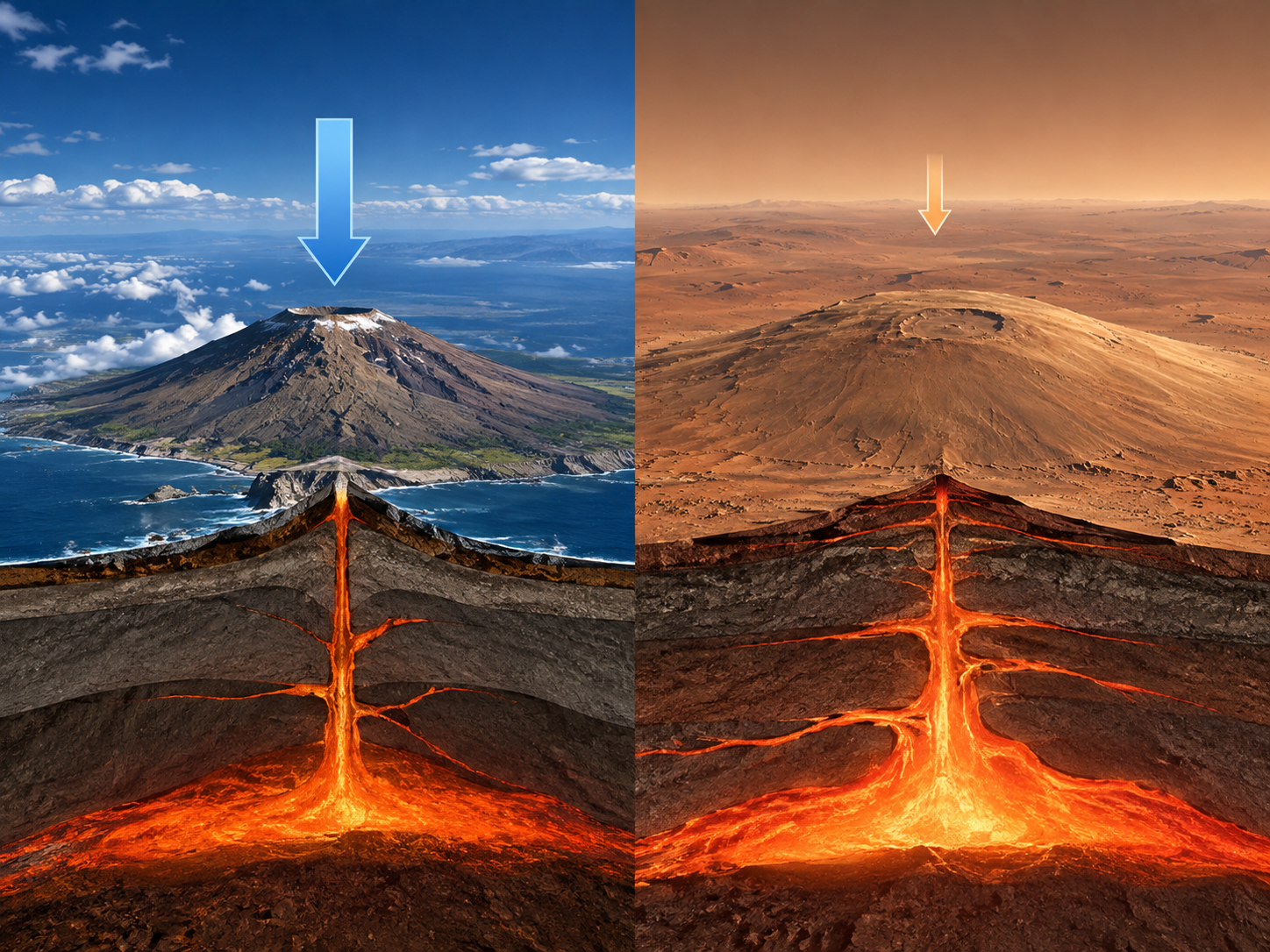
Mars has only about one-third of Earth's surface gravity. NASA specifically identifies this lower gravity as one of the reasons Mars can support such enormous volcanoes.
That does not mean lava becomes lighter.
It means the weight of the mountain pressing downward is lower.
Imagine building a pile of material.
On Earth, gravity is constantly pulling that pile downward.
A mountain has to support its own enormous weight.
Make the same mountain on Mars and the downward pull is weaker.
That gives a giant volcanic structure more room to grow before its own weight becomes such a strong limit.
This is one reason Mars can have enormous volcanic edifices.
But gravity alone is not enough.
If gravity were the whole answer, we would expect every Martian volcano to be equally gigantic.
They are not.
Something else allowed Olympus Mons to keep adding rock.
And that brings us to the most important part of the story.
The ground beneath it stayed put.
Why Lower Gravity Helps
Chapter 3 — On Earth, the Crust Moves
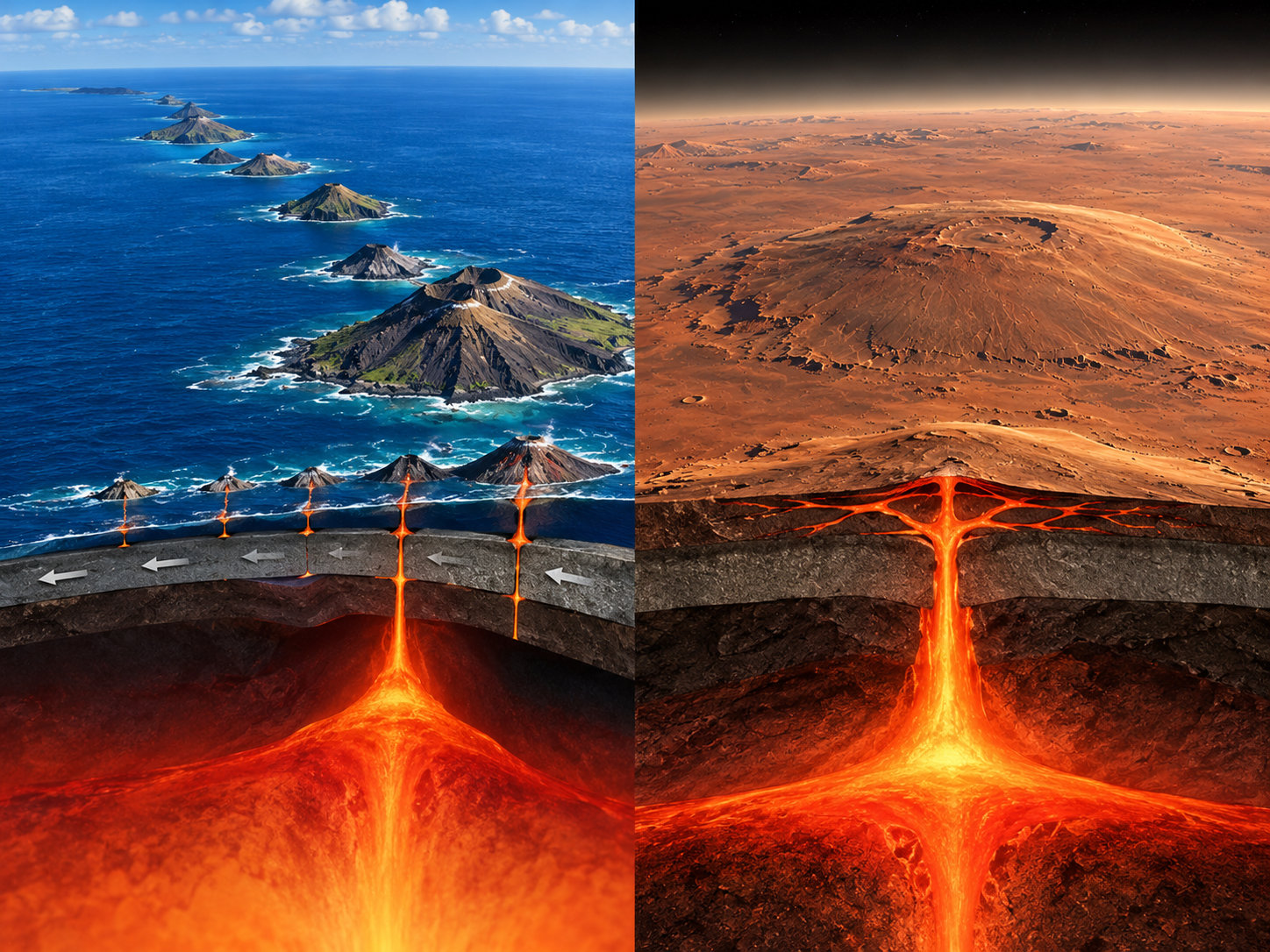
Now imagine a volcano sitting above a source of rising hot rock.
The source stays roughly in one place.
But on Earth, the surface above it can move.
That is what happens at places such as Hawaii.
The Hawaiian Islands formed as the Pacific Plate moved over a relatively stationary hotspot. As the plate moved, new volcanoes formed in a chain rather than one volcano growing forever in exactly the same location.
Mars is different.
NASA explains that Mars does not have the kind of active plate tectonic system that moves its crust over hotspots in the way Earth's Pacific Plate moves over the Hawaiian hotspot. That allowed Martian volcanoes to remain over their volcanic sources and keep building in one place.
That is a huge advantage for a volcano trying to become enormous.
Imagine pouring layer after layer of lava onto one spot.
Now imagine doing it while the ground underneath barely moves away from the heat source.
Layer after layer stays in the same region.
Older lava gets buried.
New lava spreads over it.
The volcano grows.
On Earth, plate movement can carry a volcano away from its hotspot.
On Mars, Olympus Mons could keep building over its source for a very long time.
One place.
One volcanic centre.
A great deal of lava.
The Stationary-Volcano Advantage
Chapter 4 — Then the Lava Kept Coming
There is another reason Olympus Mons became so wide.
The lava was not piling up in one small cone.
It was spreading.
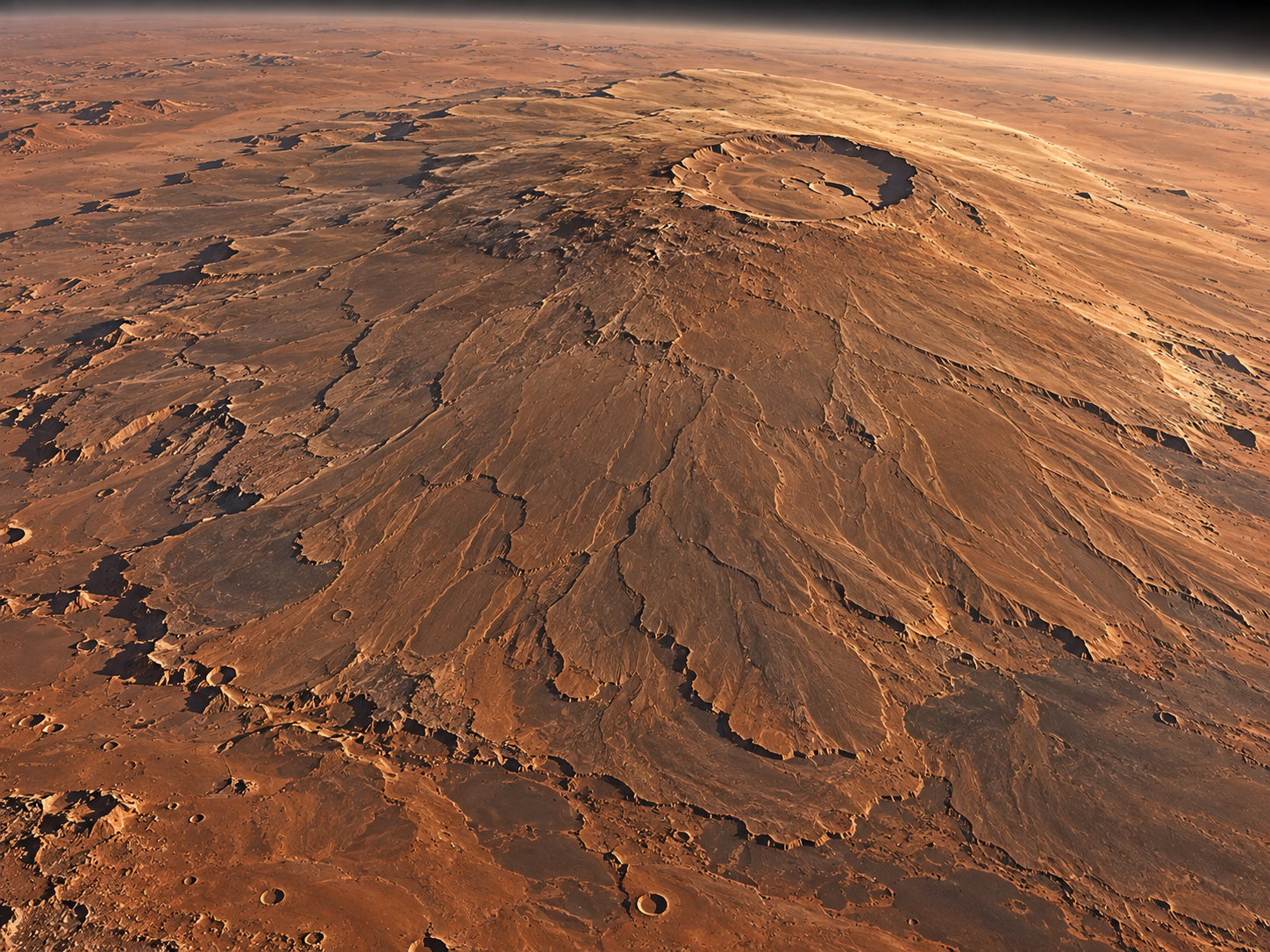
Olympus Mons is a shield volcano, and its lava flows were mostly basaltic and relatively fluid. Those flows could travel outward over broad areas before cooling. NASA imagery shows hundreds of overlapping lava flows across the volcano's flanks.
Think about pouring honey onto a flat table.
It spreads.
Now imagine doing it again.
And again.
The first layer cools.
Another layer covers part of it.
Then another.
Over enormous periods of volcanic activity, those layers can build a mountain that is incredibly wide before it becomes incredibly steep.
That is exactly what makes Olympus Mons so unusual.
It is tall.
But it is also enormous across.
NASA and ESA measurements place its width in the hundreds of kilometres, with NASA describing it as about 585 kilometres across in some datasets.
So perhaps we should stop picturing a giant cone.
Olympus Mons is more like a gigantic volcanic shield spread across Mars.
Its height is impressive.
Its width explains part of how it got there.
Why Olympus Mons Is So Wide
Chapter 5 — Mars Also Gave It Time
There is one more ingredient.
Time.
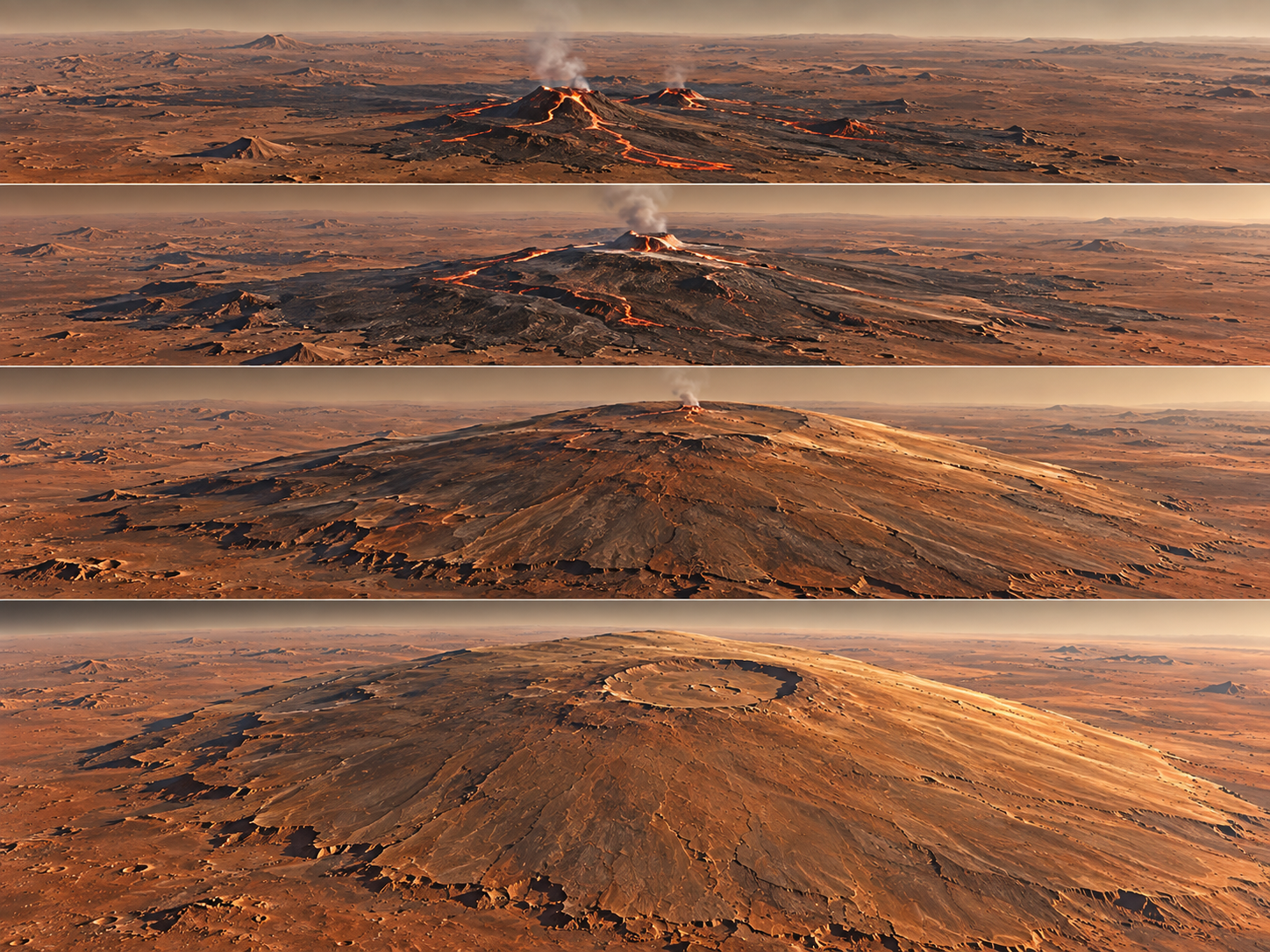
Olympus Mons did not become enormous in one eruption.
Its surface contains many overlapping lava flows, showing repeated volcanic activity over a very long period. NASA imagery describes extensive overlapping flows across its flanks, while geological studies have found evidence for volcanism spanning a wide range of ages.
The exact growth history is complicated.
Different parts of the volcano formed at different times.
Some lava surfaces are relatively young on the geological timescale, while much of the structure is far older.
That matters because a volcano does not need one enormous eruption to become enormous.
It can simply keep adding.
One flow.
Then another.
Then another.
The older surface becomes the foundation for the next one.
Over enough time, small additions become a structure hundreds of kilometres wide.
This is a different kind of geological violence.
Not one giant explosion.
Persistence.
Mars kept feeding lava into the same broad volcanic region for a very long time.
And the volcano kept growing.
A Mountain Built One Lava Flow at a Time
Chapter 6 — Why Didn't the Giant Volcano Collapse Under Its Own Weight?
At some point you might wonder:
Surely a mountain this big should collapse?
There is a limit.
A volcano cannot keep growing forever.
Its own weight creates stresses inside the crust beneath it.
But Mars gives Olympus Mons two important advantages.
The first is the weaker gravity we already saw.
The second is its enormous, broad shape.
Olympus Mons is not a thin tower.
It spreads across hundreds of kilometres.
That broad base distributes the weight over a huge area.
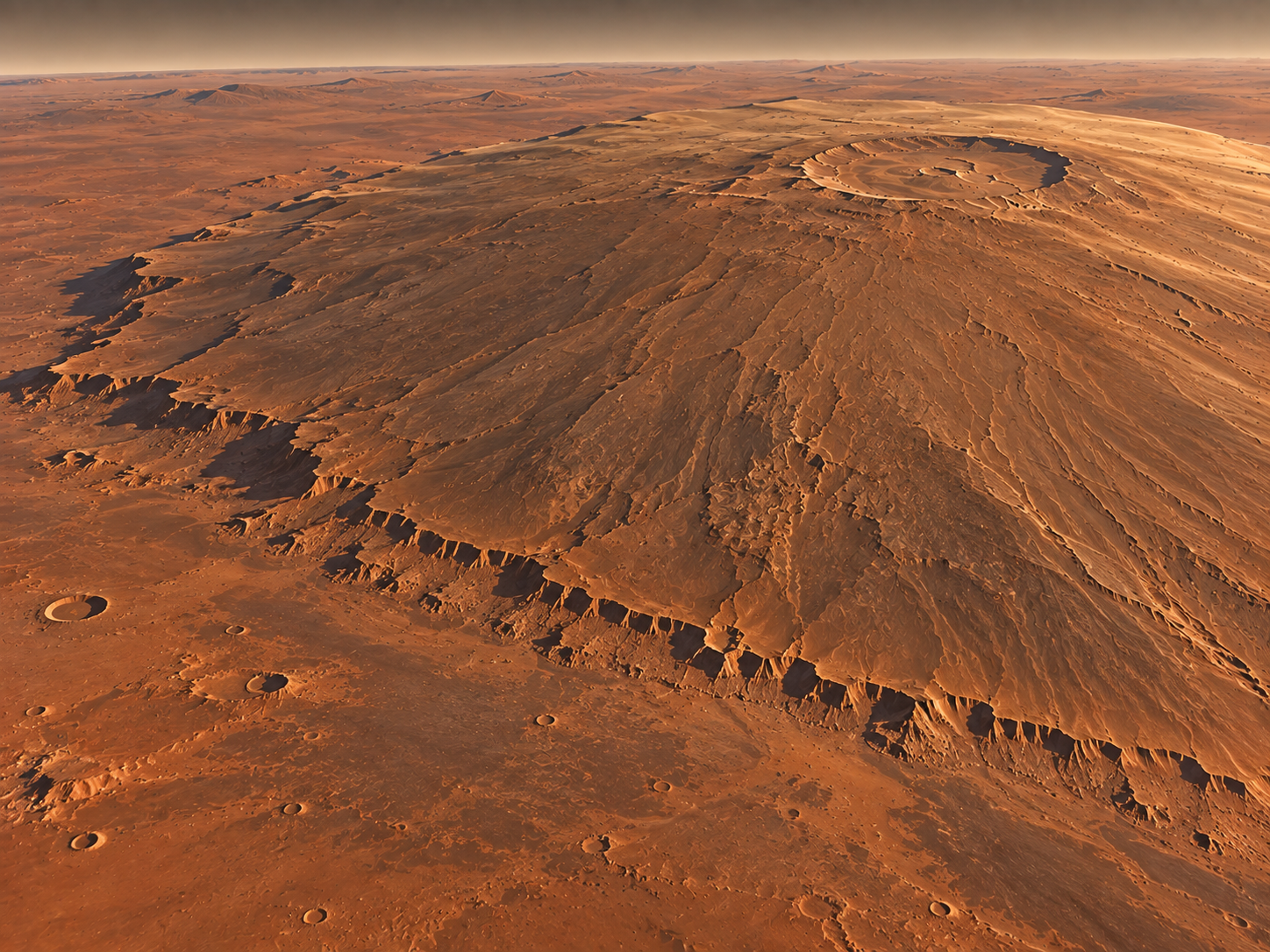
Its slopes are also extremely gentle—generally only a few degrees across much of the volcano.
That is why the mountain does not look like a giant rocky needle.
It is more like a huge shield resting across the Martian surface.
There are still signs that the structure has experienced instability.
A massive escarpment, known as Olympus Rupes, surrounds much of the volcano, and NASA notes that the elevation change along parts of it can reach several kilometres.
So Olympus Mons has not escaped gravity.
It has simply found a very efficient way to spread its weight.
Low gravity helps.
A giant broad base helps too.
And together they let the volcano become much larger than an Earth volcano could easily become.
How Can Such a Huge Volcano Stay Standing?
Chapter 7 — So Why Couldn't Earth Build One Like It?
Now put the pieces together.
Earth has volcanoes.
Earth has hotspots.
Earth has huge mountains.
So why doesn't Earth have an Olympus Mons?
It comes down to the combination.
Earth's stronger gravity makes supporting enormous volcanic mountains harder.
More importantly, Earth's tectonic plates move.
A hotspot can remain in one place while the plate moves across it.
That is why Hawaii is a chain of volcanoes rather than one volcano that keeps growing over the same source forever.
Mars does not have that same active plate-tectonic conveyor belt today.
NASA identifies the lack of moving tectonic plates over hotspots, combined with lower Martian gravity, as a major reason its volcanoes can become so enormous.
Then add the volcano itself.
Olympus Mons is a shield volcano.
Its basaltic lava spread widely.
Its slopes stayed gentle.
Its volcanic centre remained in one region.
And the eruptions continued over huge spans of geological time.
Put all of those together and the result is extraordinary.
Not because Mars has some mysterious rule that allows impossible mountains.
It simply has different rules and different history.
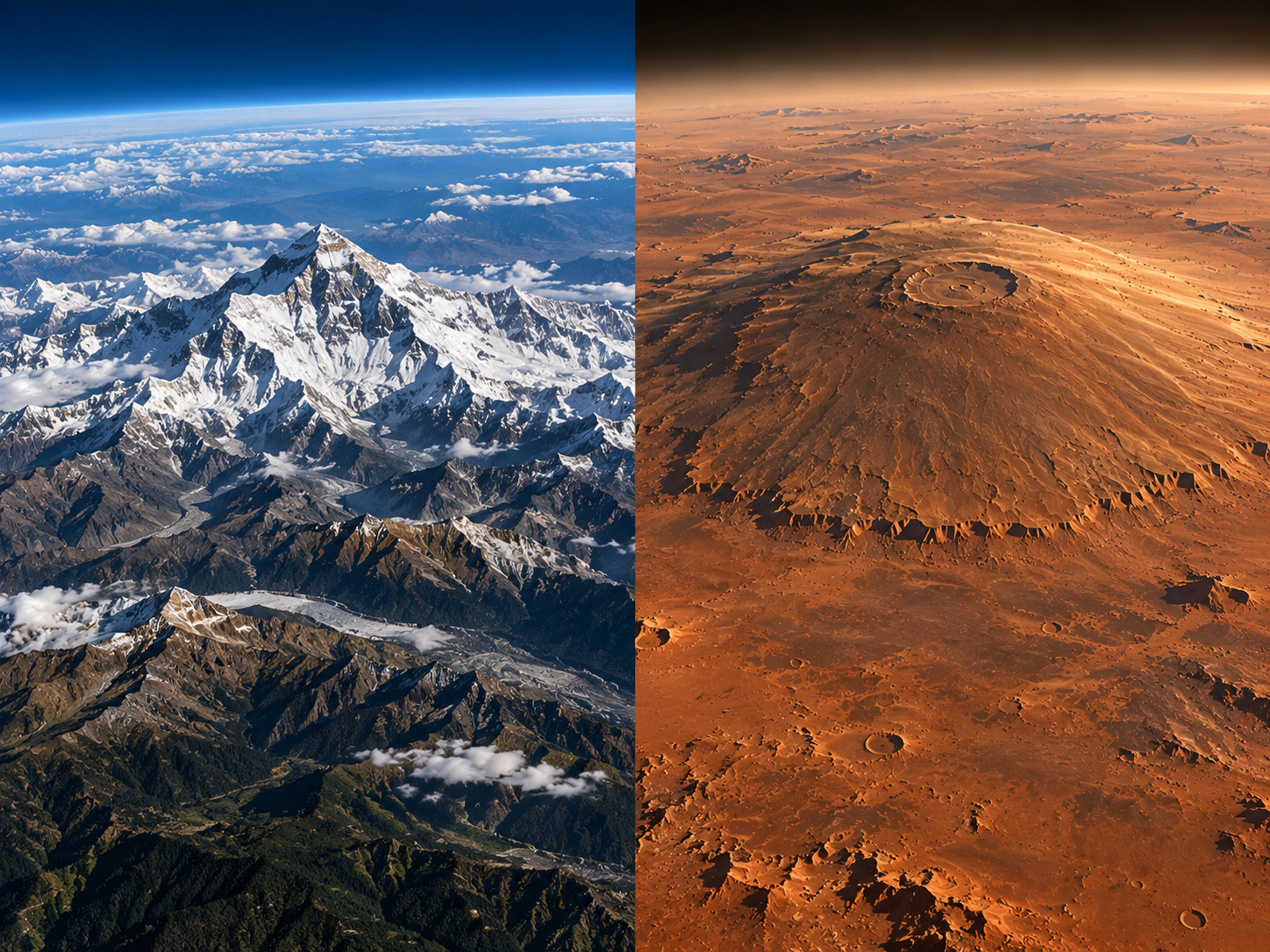
Everest grew where Earth's moving plates pushed the crust upward.
Olympus Mons grew where Mars let one volcanic centre keep adding layer after layer.
That is why one is a steep Himalayan peak.
And the other is a volcano almost the size of a small world in itself.
The Full Olympus Mons Story
Frequently Asked Questions
1. Is Olympus Mons really three times taller than Mount Everest?
Using NASA's commonly cited measurement of about 26 kilometres above the surrounding Martian plains, compared with Everest's 8.85 kilometres above sea level, the comparison is roughly three times. However, Olympus Mons is also commonly measured at about 22 kilometres above the Martian reference surface, so the exact ratio depends on the reference points used.
2. How tall is Olympus Mons?
Common NASA and ESA measurements put Olympus Mons at roughly 22–26 kilometres high, depending on the reference surface. NASA describes it as about 26 kilometres above the surrounding plains.
3. Why is Olympus Mons so much taller than Everest?
Several factors work together: Mars has much weaker gravity, its crust does not move over hotspots in the same way Earth's tectonic plates do, Olympus Mons is a broad shield volcano made from fluid basaltic lava, and volcanic activity built it over a very long period.
4. Is Olympus Mons a mountain or a volcano?
It is both a mountain and a shield volcano. Its enormous height comes from its volcanic origin, while the term mountain simply describes its large elevated form.
5. Why is Olympus Mons so wide?
Its basaltic lava was relatively fluid and spread outward across large areas. Repeated eruptions created many overlapping flows, producing a very broad shield with gentle slopes rather than a steep cone.
6. Does Mars have plate tectonics?
Mars does not have the active global plate-tectonic system that moves Earth's plates over hotspots. NASA identifies this difference as one of the major reasons Martian volcanoes could grow exceptionally large.
7. Why does lower gravity help Olympus Mons grow?
Mars's surface gravity is about one-third of Earth's. The weaker gravitational force reduces the weight that a huge volcanic structure must support, helping very large volcanoes remain stable.
8. Could Olympus Mons have formed in one enormous eruption?
No. Its many overlapping lava flows show that the volcano was built through repeated volcanic activity rather than one single eruption.
9. Is Olympus Mons still active?
There is no confirmed eruption of Olympus Mons happening today. Its volcanic surfaces span a range of geological ages, showing that it remained volcanically active for a very long period in Mars's past.
10. Would Olympus Mons look like Everest if you stood at its summit?
Probably not. Olympus Mons has very gentle slopes across most of its huge shield, typically only a few degrees, so the ascent would feel more like a very long climb across a broad volcanic landscape than a steep Himalayan mountain.