Why Is Jupiter’s Great Red Spot Shrinking?
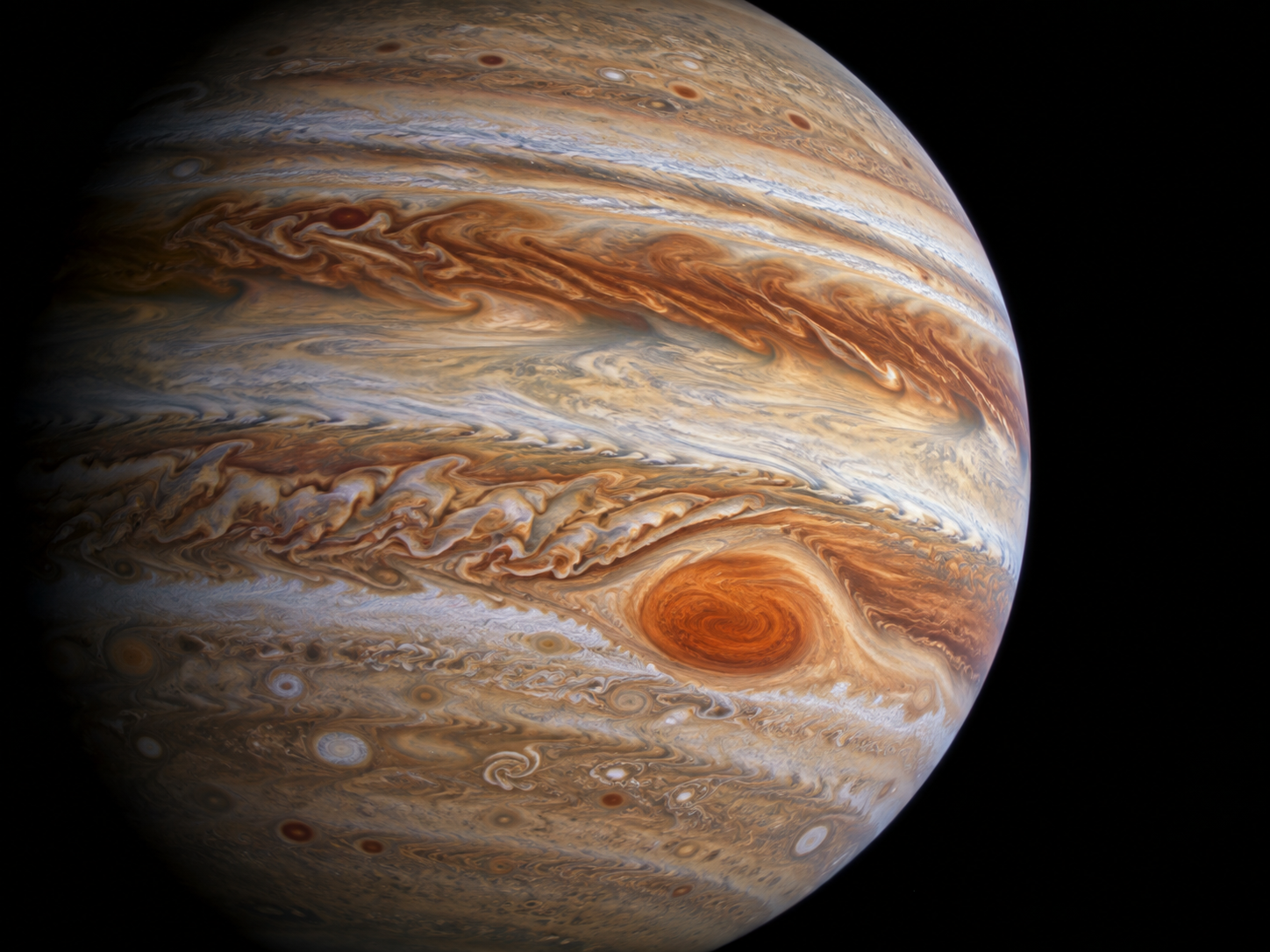
There is a storm on Jupiter that has been watched for generations.
It is enormous.
Even now, the Great Red Spot is wider than Earth. But it used to be much larger. Historical observations show that its long axis has fallen from roughly 40,000 kilometres in the late 19th century to about 15,000 kilometres in recent measurements.
So the obvious question is:
Why is it getting smaller?
We know that the Great Red Spot has been shrinking for a long time.
What we do not know is one simple reason why.
Scientists have found several clues. The storm interacts with smaller storms around it. Its shape has changed. Its winds behave differently as the storm gets smaller. And NASA’s Juno spacecraft found that the Great Red Spot is much deeper than anyone could see from above the clouds.
That last detail matters.
Because when you look at the Red Spot, you are only seeing its top.
The real storm reaches hundreds of kilometres down into Jupiter’s atmosphere.
So perhaps the better question is not simply why the red oval is getting smaller.
It is:
What is happening inside this enormous storm as it shrinks?
Chapter 1 — How Do We Know It Is Shrinking?
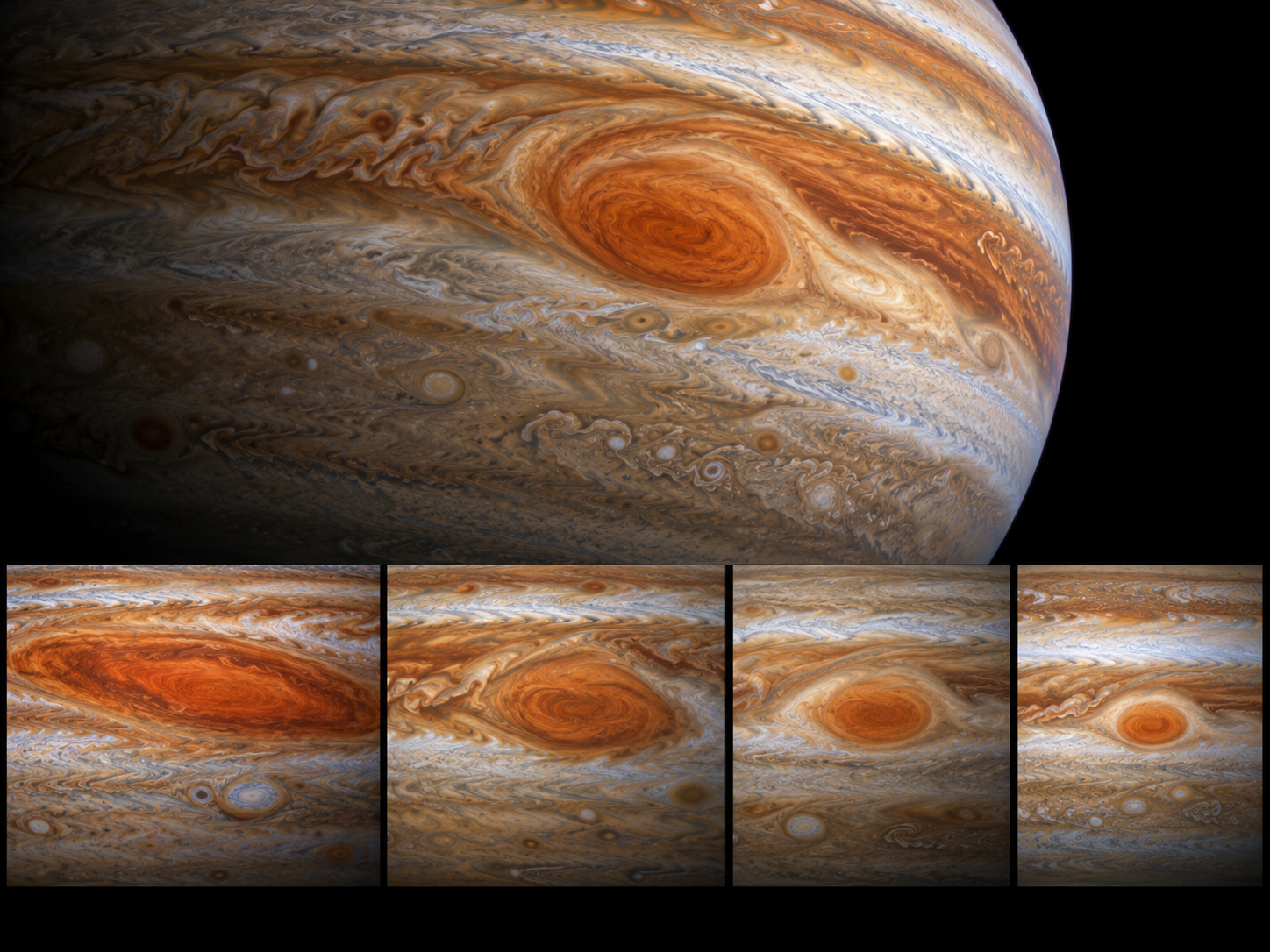
Look at old pictures of Jupiter.
The Great Red Spot is huge.
Then look at Jupiter today.
Still huge.
But smaller.
The change is not something scientists noticed from two photographs taken years apart. Astronomers have been measuring the storm for well over a century.
There is a continuous record of at least one size measurement per year going back to 1878. Earlier observations exist too, although scientists are not certain that every red or dark spot recorded in the 1600s was the same storm we call the Great Red Spot today.
That gives scientists something unusual.
A long history.
In the late 19th century, the Great Red Spot was roughly 40,000 kilometres long according to the historical measurements used in modern studies. By the Voyager era in 1979, its long axis was about 14,500 miles, or roughly 23,000 kilometres. Later Hubble observations found it becoming smaller still.
The shape changed too.
The old storm was more stretched out.
Today, it is much closer to an oval—and at times nearly circular.
That is why scientists are confident about the basic fact:
The Great Red Spot has been getting smaller over the long term.
The difficult part begins with the next question.
Why?
The Great Red Spot Is Shrinking
Chapter 2 — A Smaller Storm Does Not Mean a Dead Storm
There is another detail worth knowing.
The Great Red Spot is not simply shrinking and becoming weaker in every way.
In one study, researchers found that while the storm was getting smaller, it was also becoming taller.
That sounds strange.
If you make a storm smaller, you might expect everything about it to decrease.
But Jupiter does not work like that.
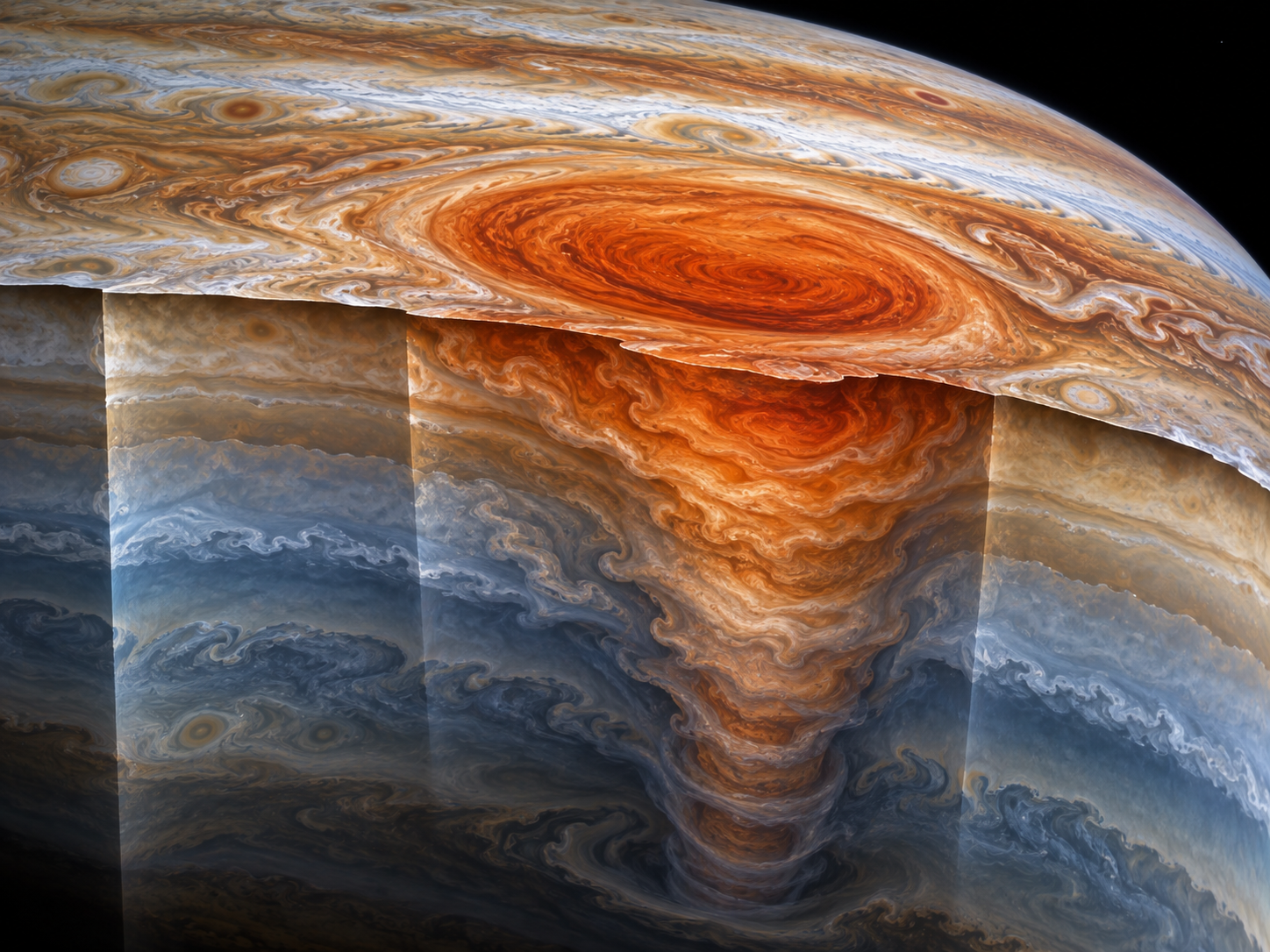
The Great Red Spot is a giant rotating column of atmosphere. Its visible oval is only the part we can see at the cloud tops.
Juno showed just how deep the storm goes.
The spacecraft found that the Great Red Spot extends about 320 kilometres into Jupiter’s atmosphere. That is deeper than the ocean on Earth.
So when the storm becomes narrower at the top, the whole thing is not necessarily simply disappearing.
Its shape can change in three dimensions.
Think about a lump of clay.
Push it inward from the sides and it becomes narrower.
But it can also become taller.
Researchers saw something similar in the Great Red Spot.
The storm's visible shape changed.
Its depth remained a very different part of the story.
That is why a shrinking picture does not automatically mean the storm is about to vanish.
Smaller at the Top, Deep Below
Chapter 3 — Jupiter Does Not Have a Solid Floor to Slow It Down
Here is another reason the Great Red Spot can survive for so long.
Jupiter has no solid surface like Earth.
Its atmosphere simply gets deeper and denser as you go down.
That changes what happens to storms.
On Earth, a hurricane eventually reaches land.
The ground and friction can weaken it.
Jupiter has no similar solid surface waiting underneath the clouds.
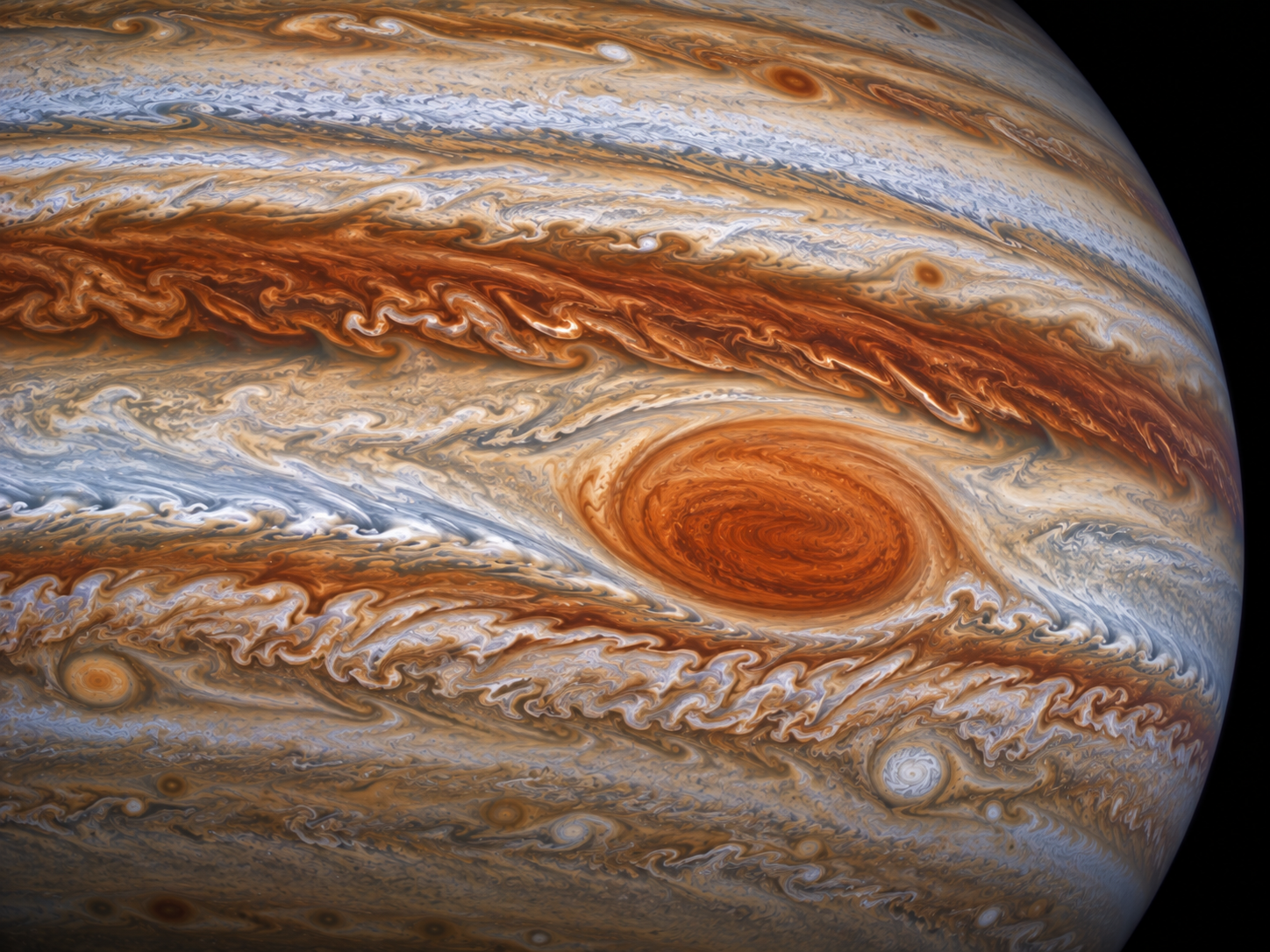
Instead, enormous bands of wind wrap around the planet.
These jet streams help shape Jupiter's weather and keep the Great Red Spot trapped between strong eastward and westward flows.
The storm is therefore not drifting freely across the planet.
It lives in a particular part of the atmosphere.
And that environment can help a giant vortex survive for a very long time.
But surviving and staying the same are different things.
The Red Spot can remain alive while its size, shape, colour and winds change.
That appears to be what we are watching now.
The storm is not simply disappearing.
It is changing.
Why Jupiter Can Keep a Storm for So Long
Chapter 4 — Small Storms Keep Coming Along
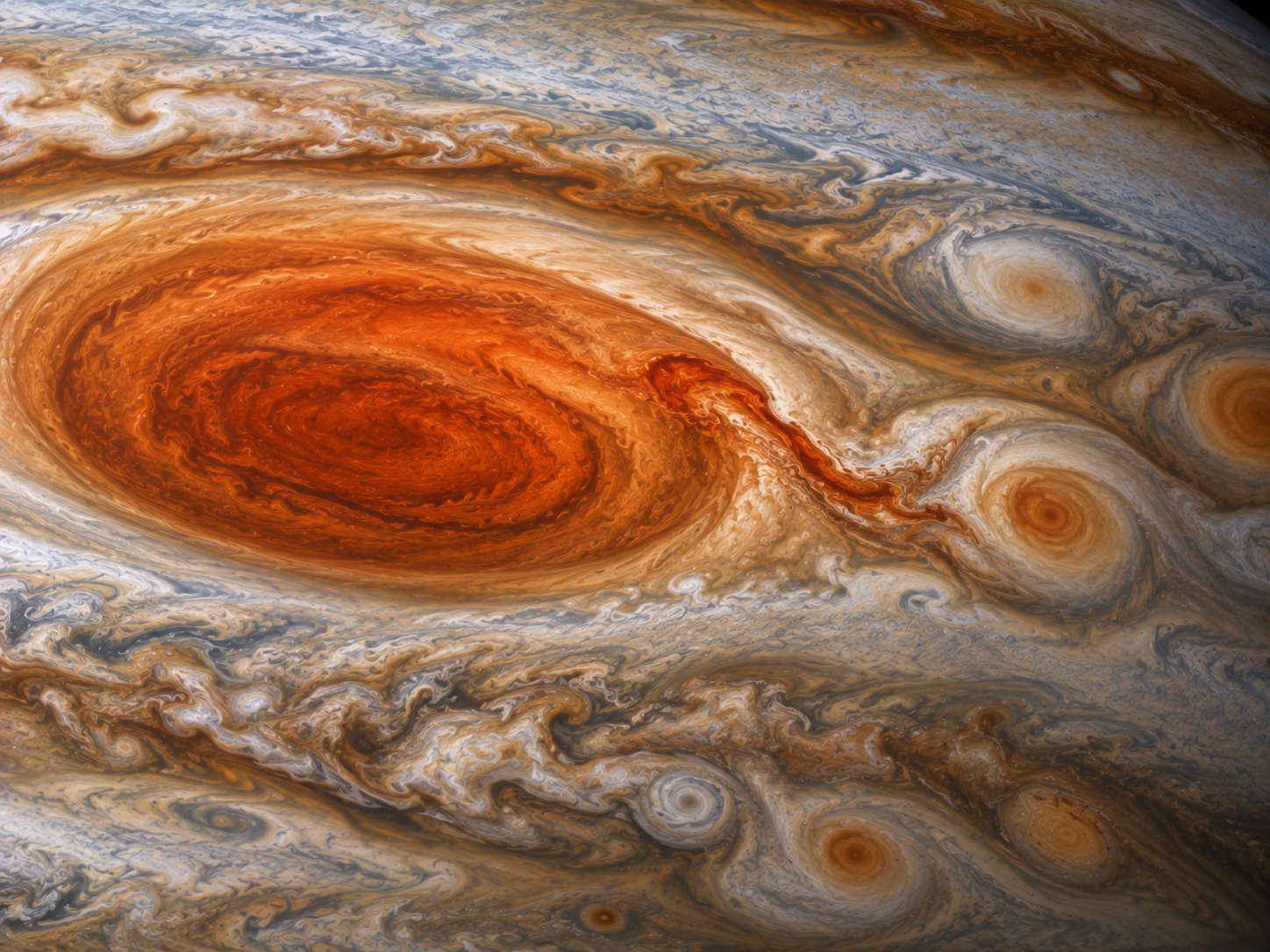
Now we reach one of the more interesting clues.
Jupiter is not calm around the Great Red Spot.
Smaller storms and vortices are constantly moving through the planet's atmosphere.
Sometimes they reach the Red Spot.
And when they do, the meeting can be violent.
Researchers studying encounters between the Great Red Spot and smaller anticyclones found that these smaller systems can tear pieces from the visible red oval and change its shape. But the interactions are not always destructive. Some of the smaller vortices can also transfer energy into the Great Red Spot.
That makes the storm much harder to understand.
Imagine a giant spinning system being bumped by smaller spinning systems again and again.
Some encounters may take energy away.
Others may give energy to the larger storm.
Some may simply disturb the clouds near its surface.
In 2018–2020, several smaller anticyclones interacted strongly with the Great Red Spot. Large pieces of its visible red area were temporarily pulled away. Yet the deeper storm survived and much of the visible structure recovered afterward.
So the smaller storms are not simply eating the Great Red Spot.
They are interacting with it.
And those interactions may be one part of the reason its visible size changes.
Scientists are still working out how much.
The Great Red Spot Does Not Live Alone
Chapter 5 — Then What Is Actually Making It Shrink?
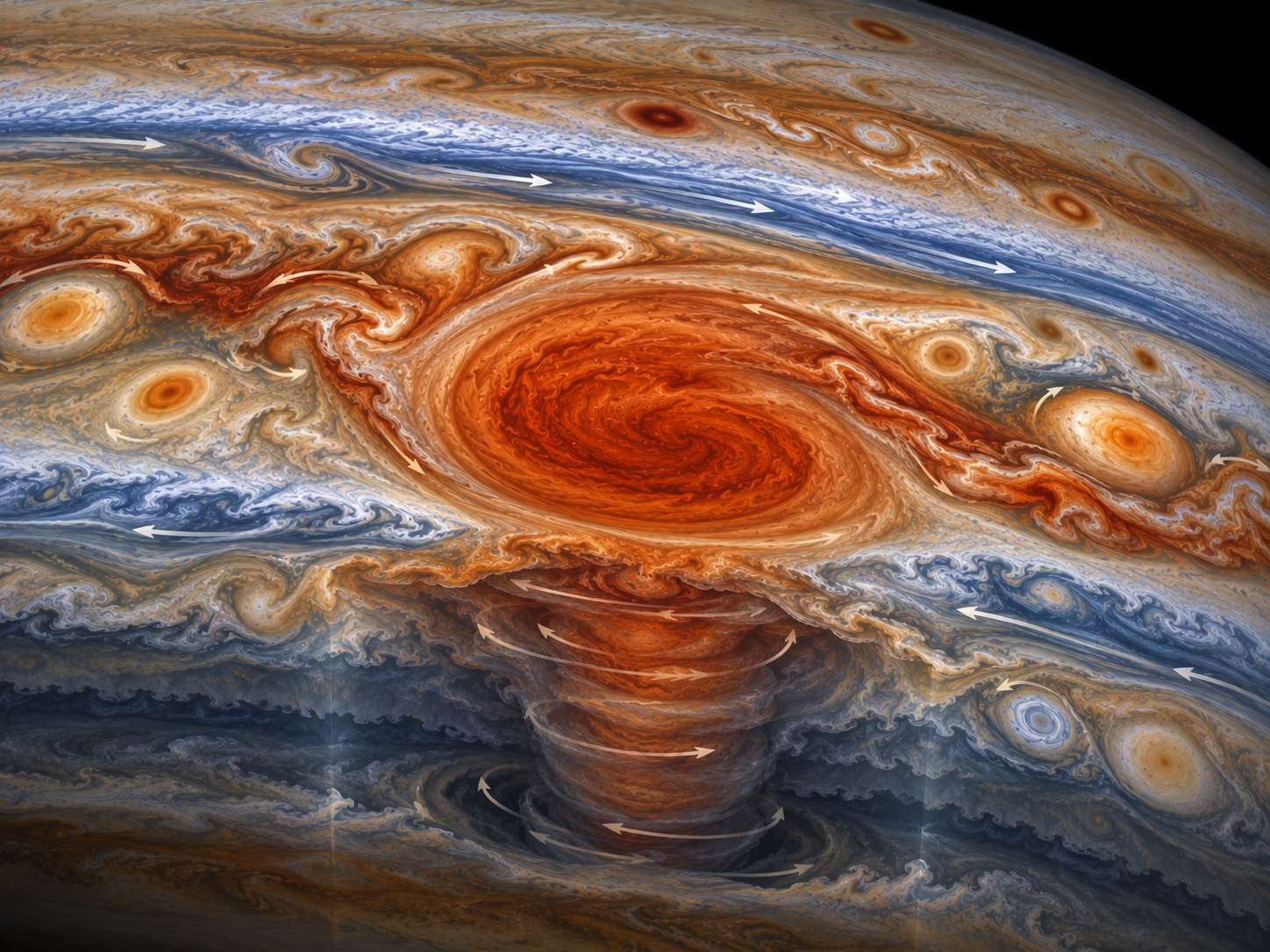
This is where the honest answer becomes important.
Scientists do not yet have one proven cause.
Several ideas have been investigated.
One involves the small vortices we just met.
When smaller storms interact with the Red Spot, they can remove visible material and alter its internal motion. A 2021 study found that some of these encounters reduced the visible red area while also increasing the storm's internal rotation.
Another clue comes from long-term changes in the storm itself.
Researchers found that its internal velocities are not changing in exactly the same way in every direction. The storm has also become more rounded as it shrinks.
There are also ideas about how energy moves through Jupiter's atmosphere.
A storm needs energy to maintain its powerful circulation.
If energy enters the vortex, it can help keep it alive.
If energy is lost, the storm may gradually change.
But Jupiter's atmosphere is so complicated that scientists cannot point to one switch and say:
“That is what is shrinking the Red Spot.”
Even NASA still describes the future of the storm as uncertain. It may shrink further. It may stabilize. Its behaviour may change again.
So the best scientific answer today is not very dramatic.
The Red Spot is shrinking.
We have several clues about why its shape and energy are changing.
But the exact cause of its long-term contraction remains an open problem.
And that is the honest answer.
What Scientists Think Is Happening
Chapter 6 — The Storm Is Also Changing Shape
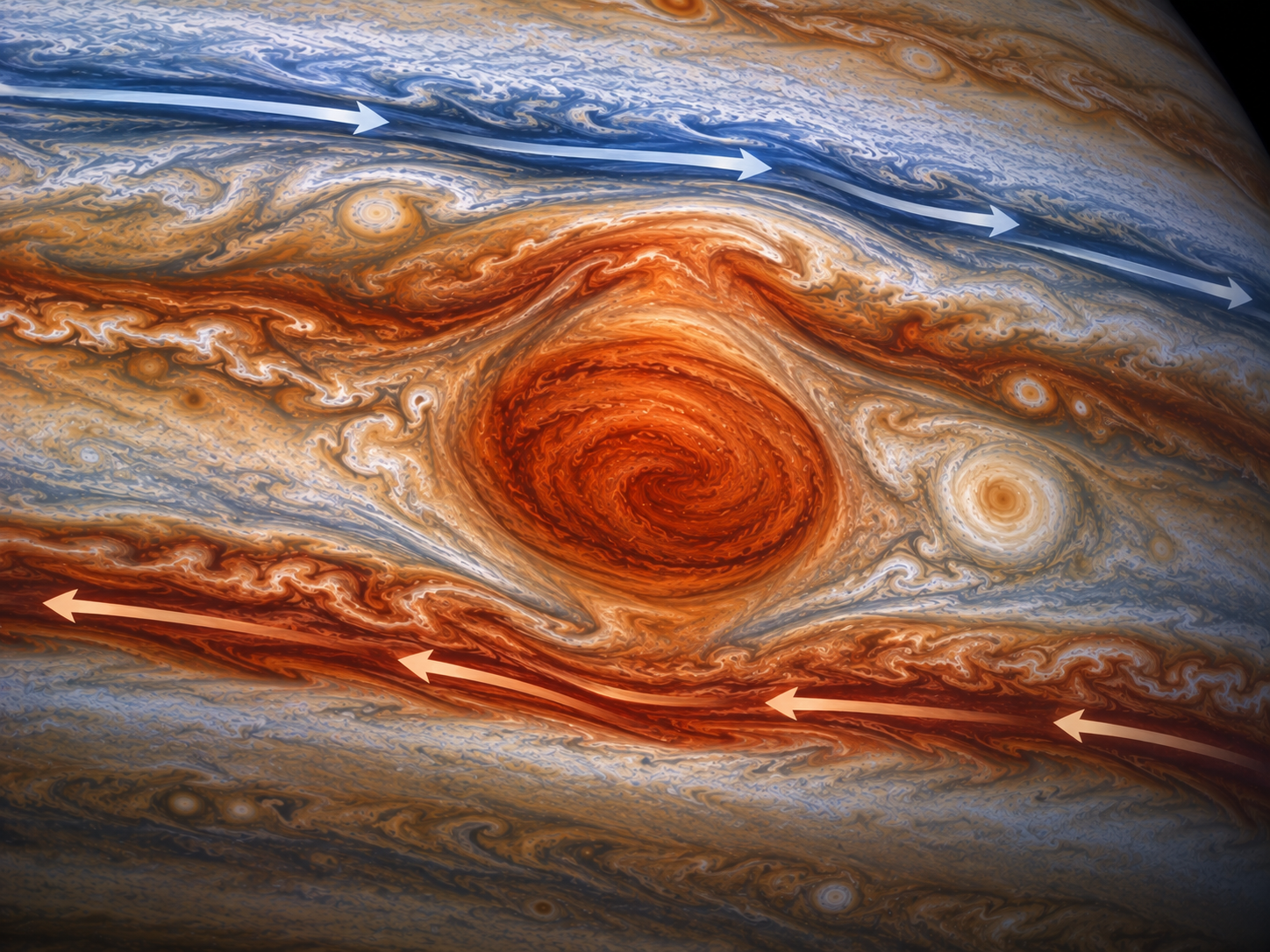
Size is only one measurement.
Shape tells another story.
The Great Red Spot used to look much more like a long, stretched oval.
Now it is rounder.
And that matters because a vortex's shape is connected to the way its winds move.
In 2018, NASA reported that the Red Spot was shrinking in area while also becoming taller. The study found that the storm was not simply spinning faster as it became smaller. Instead, its changing shape suggested that the circulation was being reorganized.
Then there are the jet streams.
The Red Spot sits between two powerful bands of wind. As it speeds up and slows down in longitude, it presses against those surrounding flows. Hubble observations from 2023–2024 showed the storm behaving somewhat like a flexible object being squeezed and released by the winds around it.
That is a useful way to imagine Jupiter.
Nothing is still.
The Great Red Spot is moving.
The jet streams are moving.
Small storms are moving.
The shape you see is the result of all those motions meeting together.
So the shrinking is not simply the storm getting “smaller.”
It is the storm changing its entire shape as the atmosphere around it changes.
Size Is Only Part of the Story
Chapter 7 — Will the Great Red Spot Disappear?
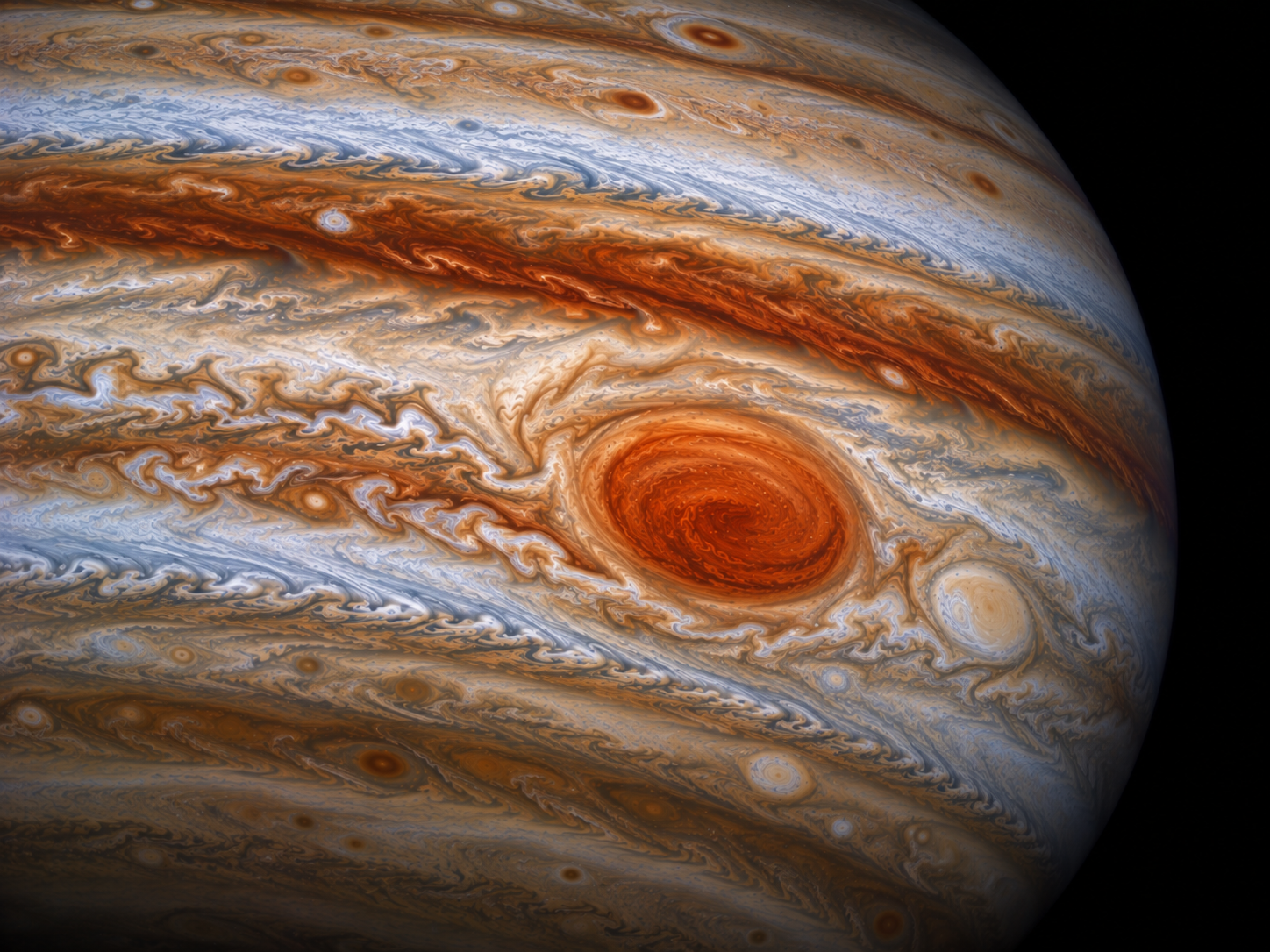
This is the question people naturally ask.
If the storm keeps shrinking, will it eventually vanish?
Maybe.
But scientists cannot say that yet.
NASA has previously noted that the storm could eventually disappear, stabilize or change again, and the complex behaviour of giant atmospheric vortices makes long-term prediction difficult.
There is another reason to be careful.
The Great Red Spot has not simply followed one perfectly straight line downward.
Historical records show periods when its area increased again.
And recent observations show that its interactions with smaller storms can temporarily change its visible size.
So there is no reliable countdown clock.
No scientist can look at today's size and tell us the exact year when the last red oval will disappear.
For now, it is still enormous.
NASA's current Juno mission information describes it as roughly 1.3 times Earth's width, with roots extending about 320 kilometres deep.
That is an extraordinary amount of atmosphere.
And it has survived for centuries—or at least the storm we now call the Great Red Spot has been observed for a very long time.
So perhaps the more interesting question is not:
“When will it die?”
It is:
“How does something this large keep changing without disappearing?”
We do not have the complete answer.
And that is what makes the Great Red Spot worth watching.
Every new image is another measurement of a storm that has been changing in front of us for generations.
Frequently Asked Questions
1. Why is Jupiter’s Great Red Spot shrinking?
The Great Red Spot has been shrinking for more than a century, but scientists do not have one confirmed explanation for the long-term contraction. Interactions with smaller vortices, changes in its internal circulation and its surrounding jet-stream environment are among the important factors being studied.
2. How big is the Great Red Spot now?
NASA's current Juno mission information describes the Great Red Spot as roughly 1.3 times the width of Earth. Its measured dimensions change over time as the storm changes.
3. How big was the Great Red Spot in the past?
Historical measurements indicate that its long axis was roughly 40,000 kilometres in the late 19th century. Voyager measured it at about 23,000 kilometres along its long axis in 1979.
4. Is the Great Red Spot actually a storm?
Yes. It is a huge anticyclonic vortex in Jupiter's atmosphere. Unlike Earth's hurricanes, it is a high-pressure system and rotates in the opposite direction.
5. How deep is the Great Red Spot?
NASA's Juno observations found that the storm's roots extend about 320 kilometres below the cloud tops.
6. Are smaller storms making the Great Red Spot shrink?
Smaller vortices do interact with the Great Red Spot and can remove visible cloud material or change its shape. Some interactions may also transfer energy into the storm. They are therefore part of the story, but scientists have not shown that these interactions alone explain its entire long-term shrinkage.
7. Why has the Great Red Spot become more round?
Its horizontal dimensions have decreased over time, changing its shape from a long oval toward a more rounded form. Changes in its internal circulation and interactions with surrounding atmospheric flows are being studied as part of this evolution.
8. Does a smaller Great Red Spot mean it is getting weaker?
Not necessarily. The storm has changed in size, shape, depth and internal wind behaviour. Some interactions that reduce its visible area can also transfer energy to the vortex. A smaller visible oval therefore does not automatically mean the entire storm is simply becoming weaker.
9. Will the Great Red Spot disappear?
Scientists do not know. It could shrink further, stabilize or change in ways that are difficult to predict. NASA has emphasized that the future of such a complex atmospheric vortex is uncertain.
10. How long has the Great Red Spot existed?
The storm has been observed for centuries, but scientists are careful about connecting historical observations. The first confirmed sighting of the current Great Red Spot is generally dated to 1831, while a reddish feature recorded by Giovanni Domenico Cassini in 1665 may not have been the same storm.