Why Does Mercury Have Ice Craters When It Is So Close to the Sun?
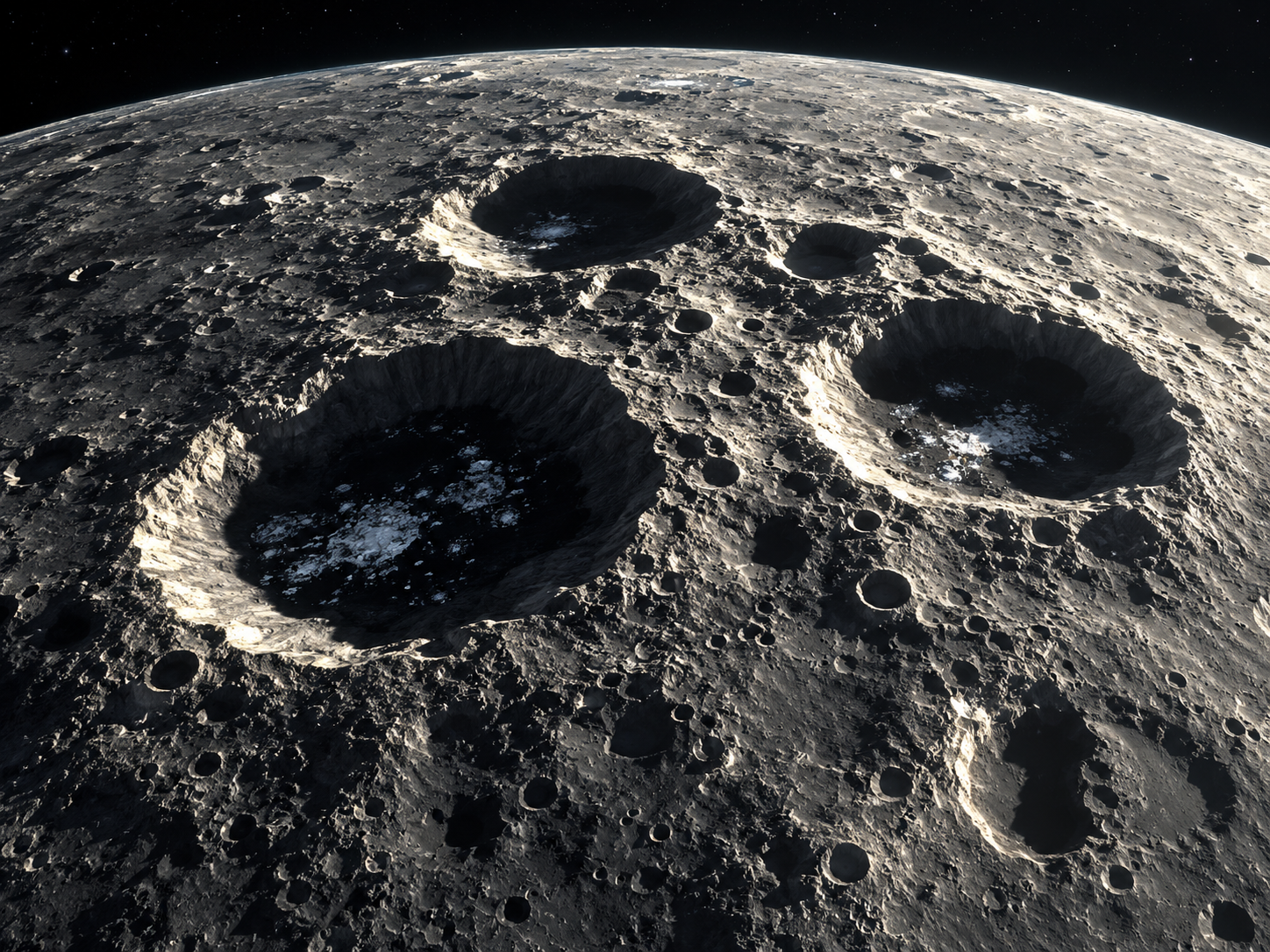
Mercury is the closest planet to the Sun.
So you would expect it to be one of the last places in the Solar System where you could find ice.
During the day, parts of its surface can reach about 430°C. At night, the temperature can fall to about −180°C because Mercury has almost no atmosphere to hold heat.
And yet, near Mercury's poles, there are craters containing water ice.
That sounds impossible.
How can ice survive on a planet so close to the Sun?
The answer is hiding in the shadows.
Mercury's axis is tilted by only a tiny amount. Because of that, some deep craters near the north and south poles never receive direct sunlight. Their floors can remain in permanent darkness, with temperatures low enough for water ice to survive for extremely long periods.
So Mercury has two very different worlds.
One side is being baked by the Sun.
Another side, deep inside certain craters, has hardly seen sunlight at all.
And that darkness can be cold enough to protect ice.
Chapter 1 — Mercury Is Extremely Hot. But Not Everywhere.
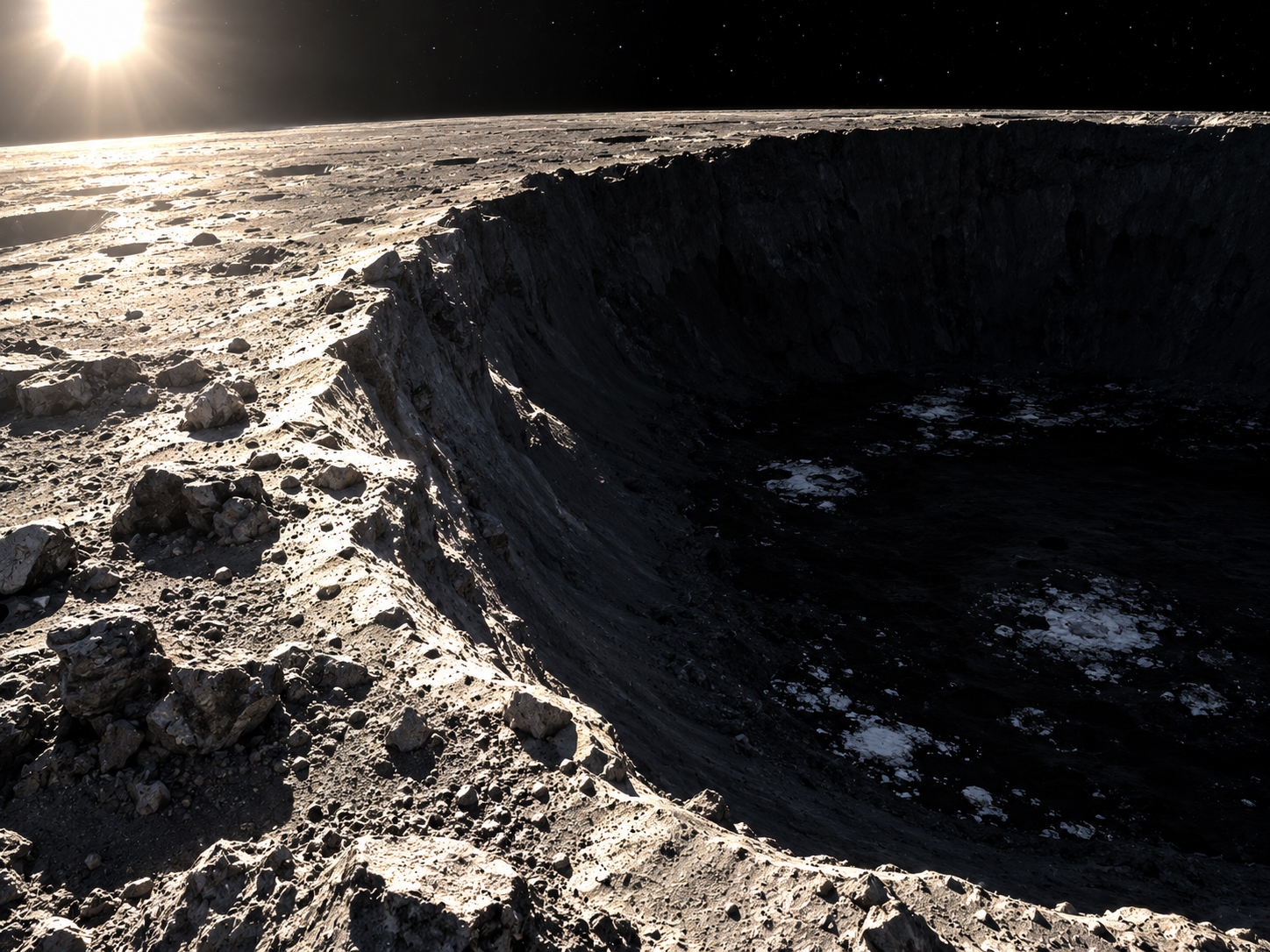
The first thing to understand is that Mercury does not have one temperature.
Its surface changes dramatically depending on whether sunlight reaches it.
The Sun-facing surface can become extremely hot. NASA gives daytime temperatures of about 430°C. But when the Sun goes down, temperatures can fall to around −180°C.
That huge difference happens partly because Mercury has almost no atmosphere.
On Earth, our atmosphere moves heat around.
Mercury has no thick atmosphere doing that job.
So a sunlit surface can become scorching while a dark surface loses heat very quickly.
Now add the planet's poles.
Some craters there are deep enough that sunlight never reaches parts of their floors.
Those places are different.
They are not experiencing the normal Mercury day.
They are trapped in darkness.
NASA measurements have found that some permanently shadowed polar regions can remain below 100 kelvin, or about −173°C, and some areas can be even colder. At those temperatures, water ice can remain stable over very long periods.
So the strange part is not really that Mercury has ice.
It is that Mercury has places where the Sun cannot reach the ground.
Mercury Has Two Very Different Temperatures
Chapter 2 — The Craters Have Their Own Little Night
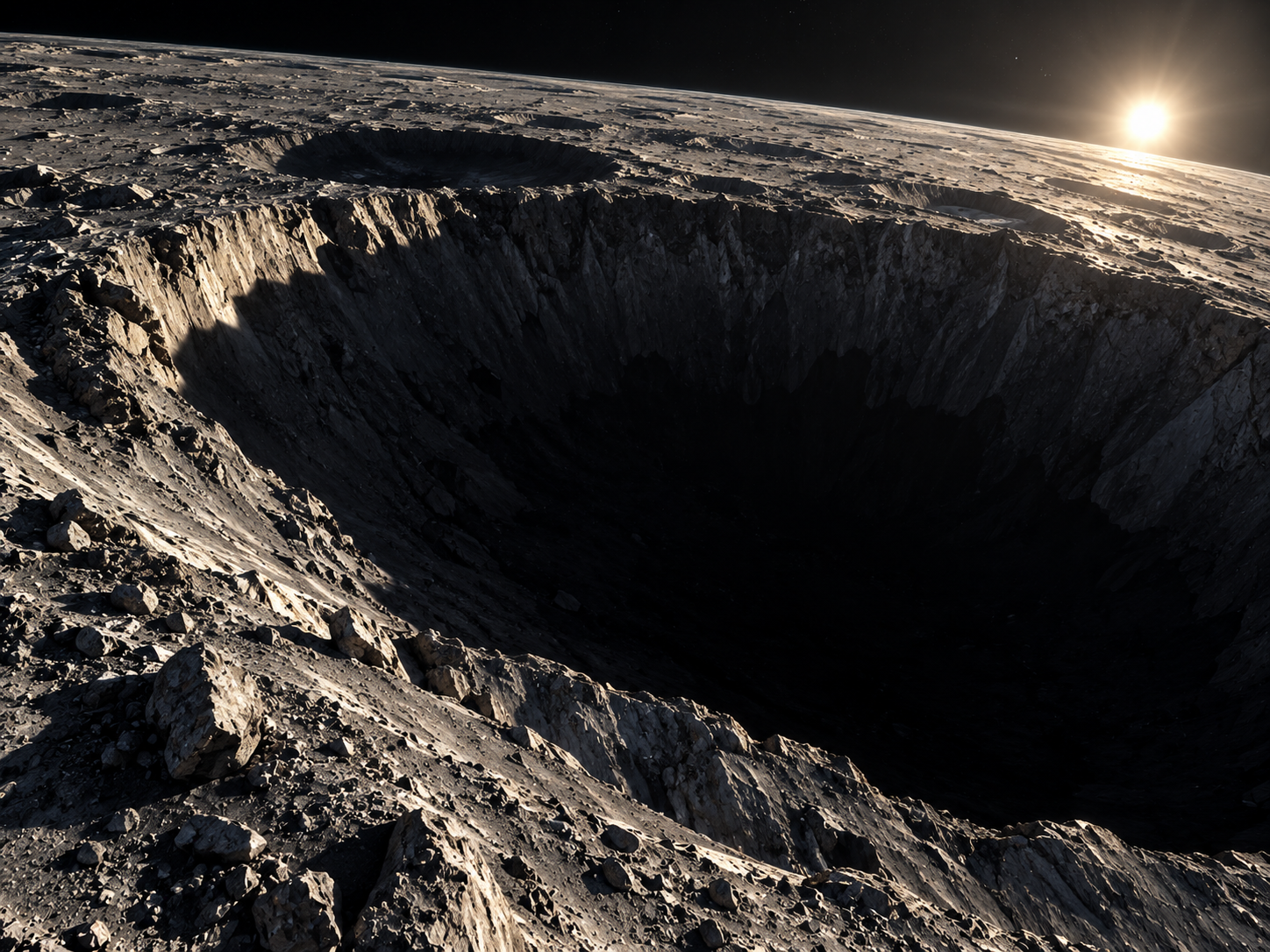
Now imagine standing inside one of those polar craters.
The Sun is somewhere above you.
But you cannot see it.
The crater walls block it.
For some deep craters near Mercury's poles, this is not temporary darkness.
It can be permanent shadow.
Mercury's rotational axis is tilted by only about 0.03 degrees, so the Sun stays very close to the horizon near the poles. Deep crater walls can therefore block direct sunlight year-round.
That tiny axial tilt is a huge part of the story.
Earth is noticeably tilted, giving us seasons.
Mercury barely tilts at all.
Near its poles, the Sun can circle around the horizon without climbing high enough to shine deep into some craters.
The result is a strange landscape.
The crater rim can receive sunlight.
The walls can glow.
But the bottom can remain in darkness.
And once the sunlight is gone, something else happens.
Heat escapes.
There is no thick atmosphere to bring much of it back.
The floor becomes a natural cold trap.
This is why the shape of the crater matters so much.
A shallow depression may still get sunlight.
A deep one can hide its floor completely.
How a Crater Creates Permanent Shadow
Chapter 3 — But Where Did the Ice Come From?
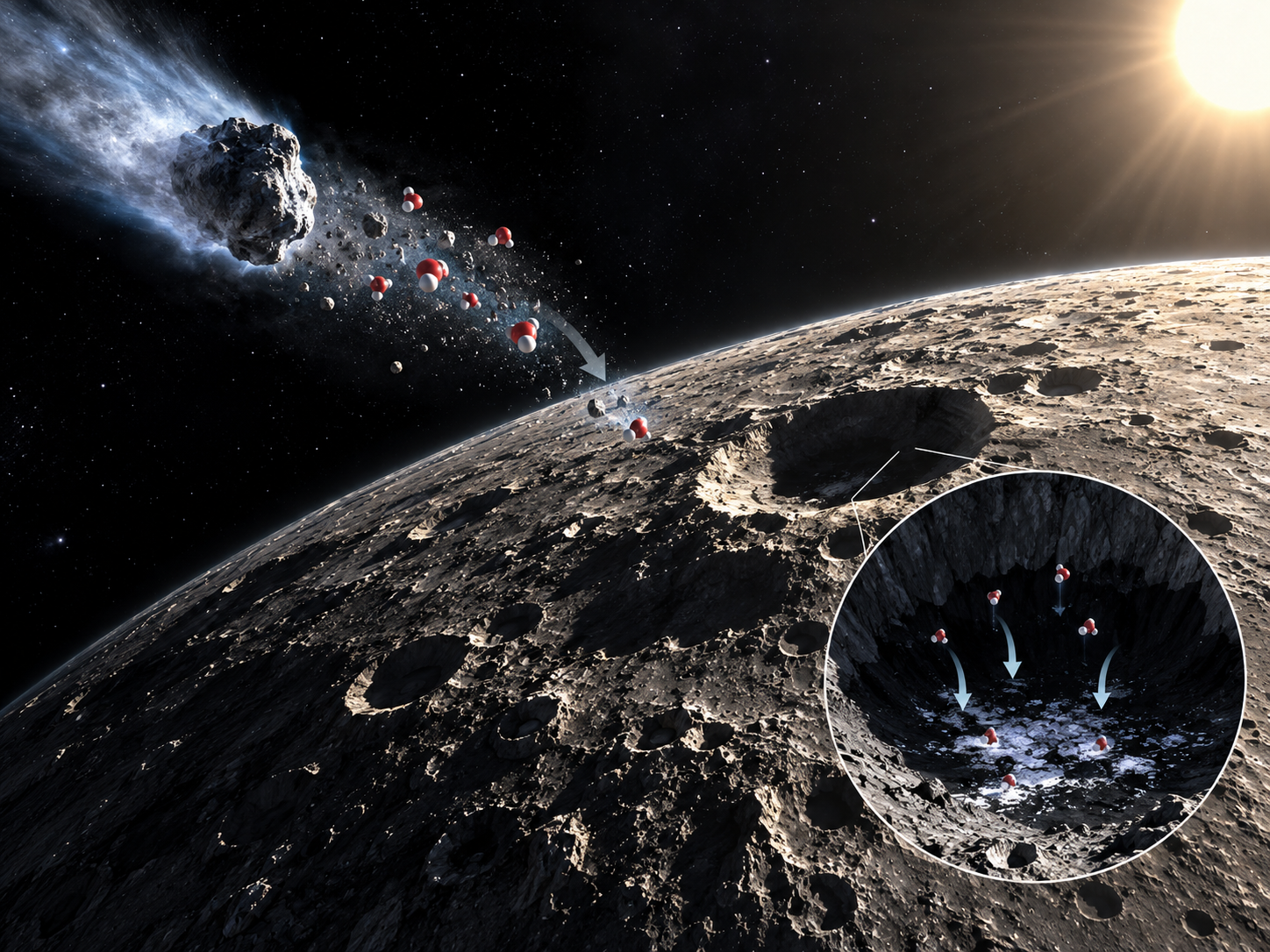
Finding a cold place is only half the problem.
You also need water.
Mercury is dry compared with Earth, so where did the ice come from?
Scientists think much of it may have arrived from space.
Comets and water-rich asteroids can contain water and other volatile materials. When they collide with Mercury, some of that material can reach the surface.
At the poles, certain crater floors offer somewhere for the water to stay.
The sunlight cannot reach them.
Temperatures remain extremely low.
Water molecules can become trapped.
NASA's MESSENGER mission found evidence that Mercury's polar ice deposits were likely delivered by impacts from comets and volatile-rich asteroids, although water from Mercury's interior could also have contributed.
So the process is not:
Mercury had an ocean → it froze.
Nothing like that happened.
It is closer to:
Water arrived → some reached the poles → some entered permanent shadows → the cold prevented it from escaping.
Over time, more material could accumulate.
The crater became a storage place.
Not because Mercury was naturally icy.
Because the environment allowed small amounts of water to survive once they arrived.
How Could Water Reach Mercury?
Chapter 4 — Scientists First Saw a Strange Signal
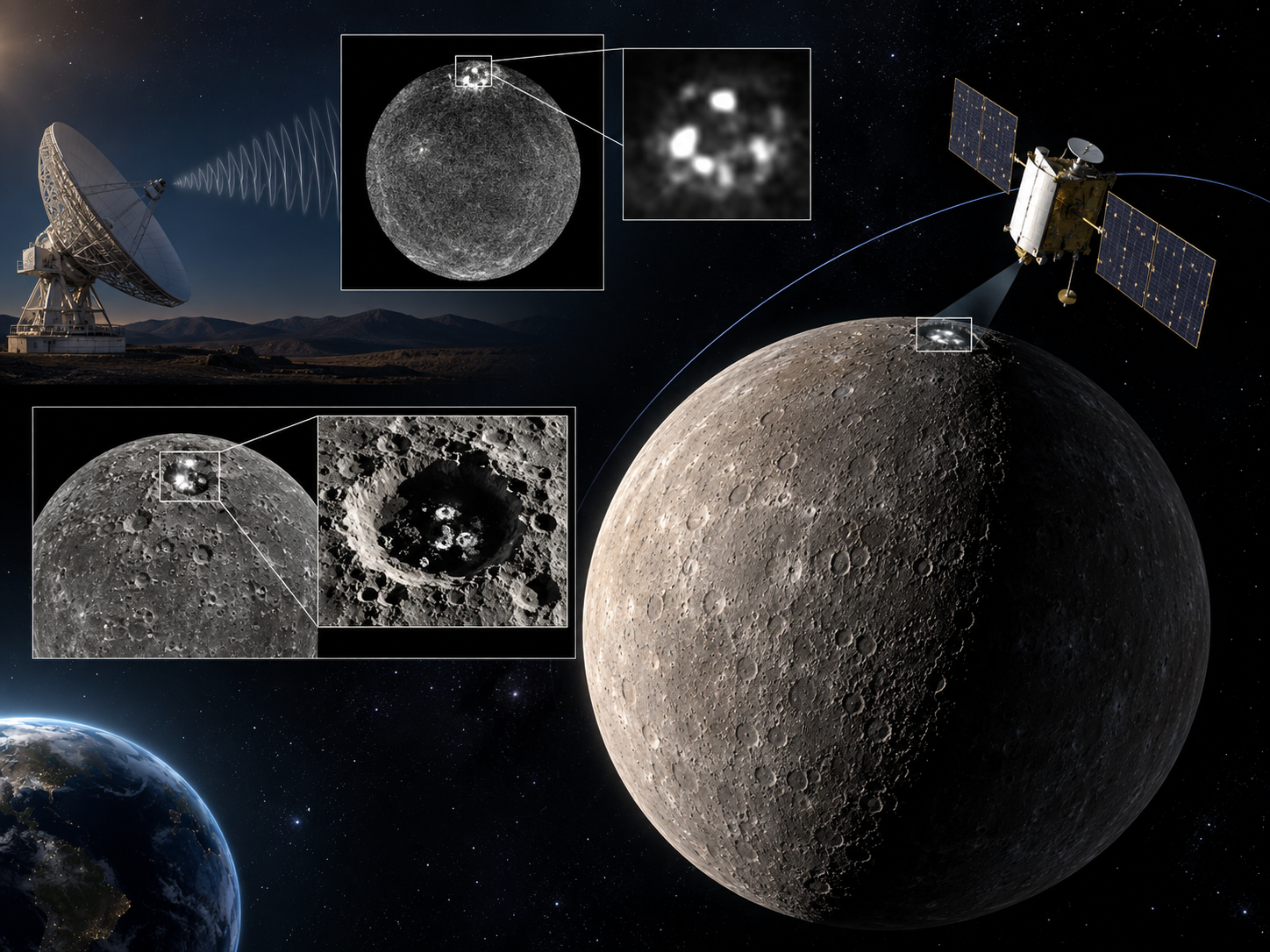
The ice was not discovered by someone looking through a telescope and simply seeing snow inside a crater.
That would be impossible from Earth.
Instead, scientists noticed something unusual in radar observations.
In the early 1990s, radar observations from Earth showed bright patches near Mercury's poles.
Bright radar reflections can come from several things.
But some of these bright areas had a very interesting location.
They lined up with deep polar craters.
Scientists had already predicted that permanently shadowed craters could become cold enough for water ice to survive.
The radar observations therefore raised a possibility.
Could those bright patches be ice?
Years later, NASA's MESSENGER spacecraft finally got close enough to investigate Mercury's poles in detail.
Its images confirmed that the radar-bright regions corresponded to permanently shadowed areas.
MESSENGER then provided additional evidence using several instruments.
The evidence became much harder to ignore.
There was a cold place.
There was radar brightness.
There were surface and subsurface deposits in the expected locations.
And some of the deposits behaved like water ice.
The discovery was surprising for an obvious reason.
Nobody expected the hottest-looking planet in the inner Solar System to be hiding frozen water.
But the observations did not care what seemed intuitive.
They showed what was actually there.
How Scientists Found the Ice
Chapter 5 — Not All the Ice Is Sitting on the Surface
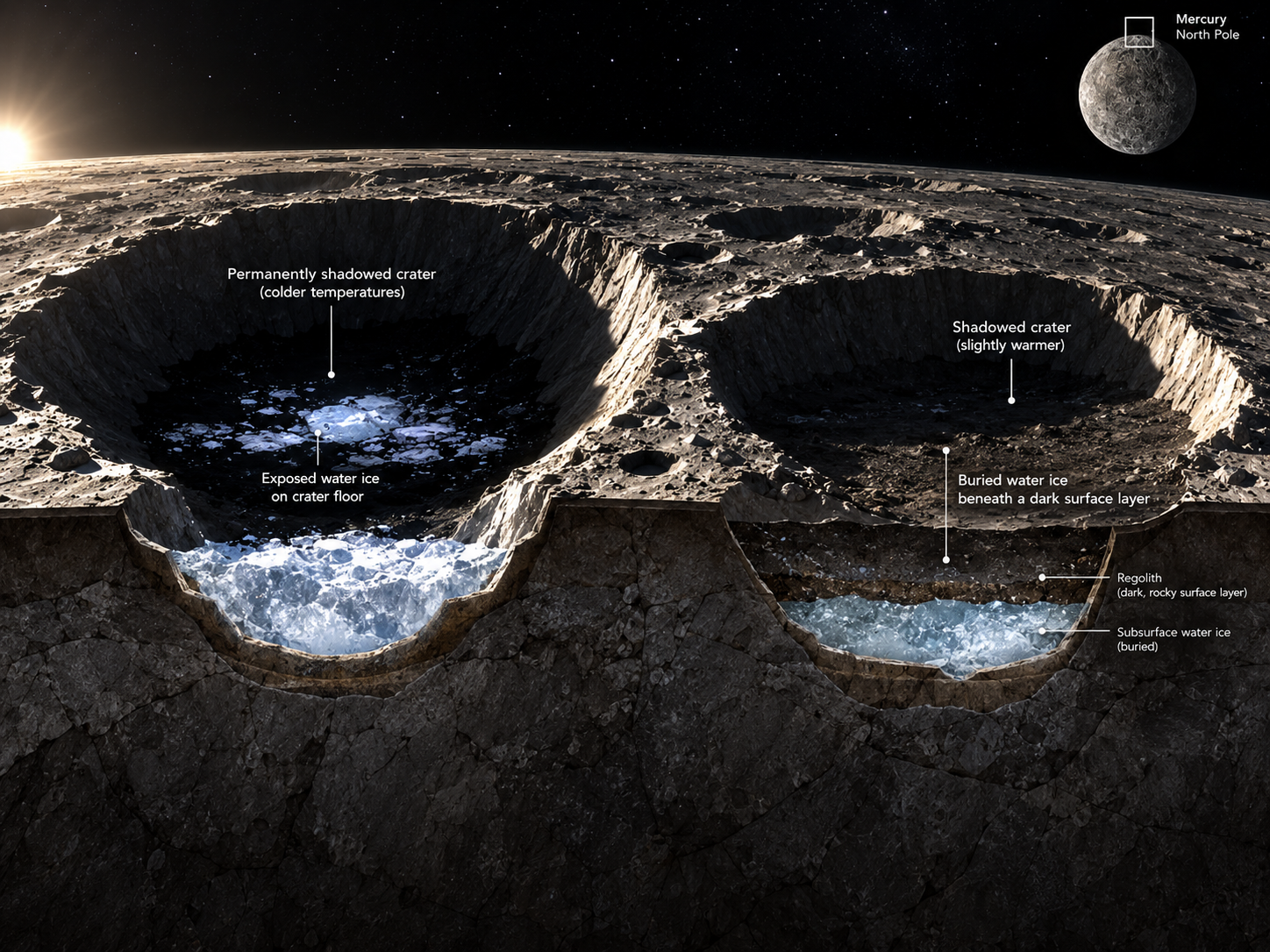
There is another detail that makes Mercury's ice even more interesting.
Not all of it is sitting in plain sight.
In the coldest polar craters, water ice can be exposed directly at the surface.
But farther from the poles, some permanently shadowed areas are not quite cold enough to keep exposed ice stable.
There, the ice can survive beneath a darker layer of material.
NASA's thermal studies found this difference between craters such as Prokofiev and Berlioz. Prokofiev contains surface ice in extremely cold regions, while Berlioz is warm enough in permanent shadow that its water ice can persist below the surface.
That dark covering is important.
It acts like a blanket.
The ice is not directly exposed to the full environment of the crater.
Some of the volatile material is buried underneath.
So when scientists talk about “ice on Mercury,” they do not necessarily mean a shiny frozen lake sitting on the surface.
Some of it may be hidden below a thin layer of darker material.
The planet is hiding its water in more than one way.
Two Ways Mercury Stores Ice
Chapter 6 — The Crater Is More Important Than the Planet
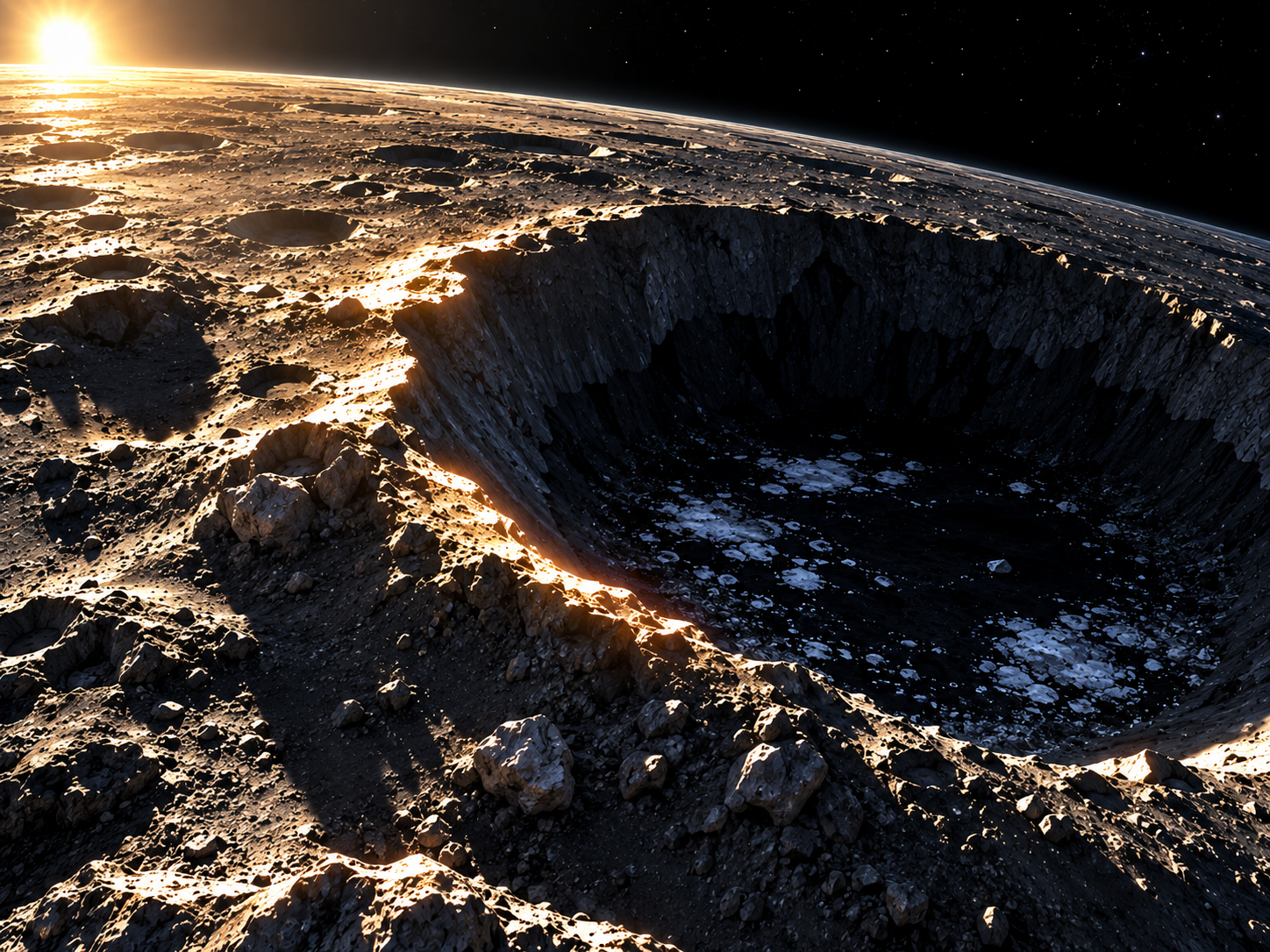
This may be the easiest way to understand Mercury's ice.
Do not think about the whole planet.
Think about one crater.
Its latitude.
Its depth.
Its walls.
Its slope.
And where the Sun can reach.
A crater near Mercury's pole can have one part that receives sunlight and another part that never does.
NASA's temperature maps show this clearly. Some crater interiors near the poles remain below 100 kelvin, while other areas close by can become extremely hot.
So two places only a short distance apart can have completely different thermal environments.
One surface is baked.
Another is frozen.
That is the strange trick.
The distance from the Sun has not changed.
The shape of the ground has.
And on Mercury, shape matters enormously.
A crater wall can block the Sun for billions of years.
Once that happens, the bottom becomes a cold trap.
Water arrives.
Water freezes.
And if sunlight never reaches the ice strongly enough to make it escape, the deposit can survive for a very long time.
The planet's distance from the Sun matters.
But in these craters, geometry matters more.
Why the Shape of the Crater Matters
Chapter 7 — Mercury's Ice Changes the Story of the Planet
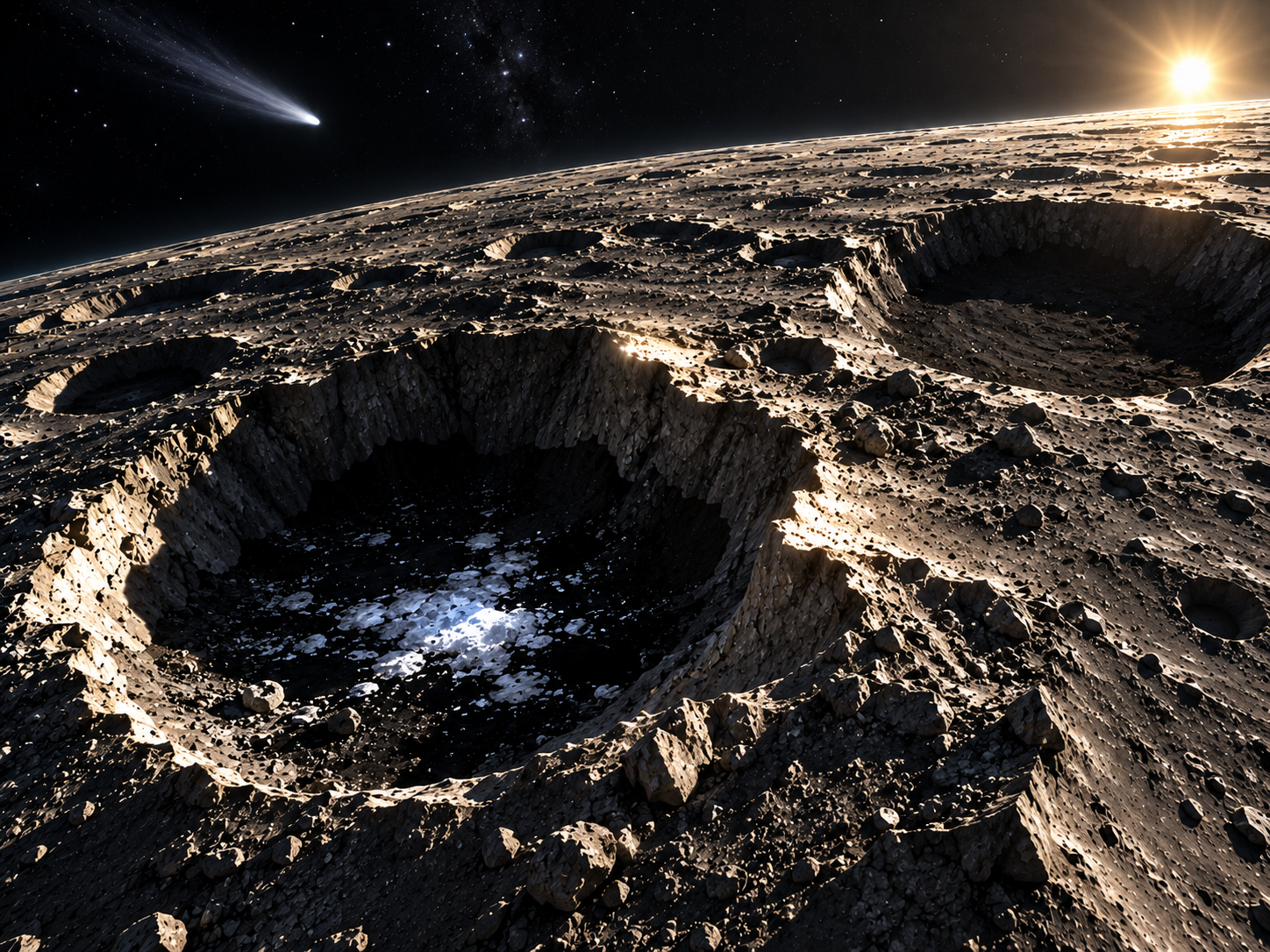
The ice itself is fascinating.
But it also tells scientists something about Mercury.
Water must have reached the planet somehow.
It must then have found places where it could survive.
And it had to remain there long enough to accumulate.
The leading explanation is that much of Mercury's polar water was delivered by impacts from comets and volatile-rich asteroids. NASA scientists have also considered contributions from material released from Mercury's interior.
The dark material covering some ice deposits is interesting too.
NASA's MESSENGER observations support the idea that organic-rich material may accompany some of the polar ice, possibly arriving with the same volatile-rich impactors that delivered water.
That does not mean Mercury has life.
It does not.
But it does show something important.
Even close to the Sun, volatile materials can survive when the right conditions exist.
Mercury is not simply a world of fire.
It is a world of extremes.
Sunlight can make the surface incredibly hot.
A crater wall can create permanent darkness only a short distance away.
And that darkness can preserve water ice for geological periods of time.
So why does Mercury have ice craters when it is so close to the Sun?
Because being close to the Sun does not mean every part of a planet sees sunlight.
Mercury's poles contain shadows so deep and so long-lasting that some of them have become natural refrigerators.
The strange part was never the ice.
The strange part was that the Sun cannot reach it.
Frequently Asked Questions
1. Does Mercury really have water ice?
Yes. Evidence from Earth-based radar observations and NASA's MESSENGER mission supports the presence of water ice in permanently shadowed polar craters.
2. How can ice survive so close to the Sun?
Some deep craters near Mercury's poles never receive direct sunlight. Their permanently shadowed floors can become extremely cold, allowing water ice to remain stable for very long periods.
3. How hot does Mercury get?
Sunlit parts of Mercury's surface can reach about 430°C. Because Mercury has almost no atmosphere, temperatures can fall to about −180°C at night.
4. How cold are Mercury's icy craters?
Some permanently shadowed polar regions can remain below 100 K, or roughly −173°C, and some may be even colder. These temperatures are low enough for surface water ice to remain stable.
5. Why don't the polar craters receive sunlight?
Mercury's rotational axis has an extremely small tilt, only about 0.03 degrees. Near the poles, the Sun therefore stays very low above the horizon, allowing deep crater walls to keep their floors in permanent shadow.
6. Where did Mercury's water come from?
Scientists think much of the water may have arrived through impacts from comets and volatile-rich asteroids. Water released from Mercury's interior may also have contributed. The exact balance between these sources remains uncertain.
7. Is all Mercury's ice visible on the surface?
No. In the coldest craters, water ice can be exposed at the surface. In somewhat warmer permanently shadowed areas, ice can survive beneath a darker surface layer.
8. How was Mercury's ice discovered?
Earth-based radar observations first detected unusually bright polar patches. Later, NASA's MESSENGER spacecraft mapped Mercury's poles and showed that the deposits corresponded closely with permanently shadowed regions.
9. Does Mercury have more ice than the Moon?
Both Mercury and the Moon contain polar water-ice deposits, but their amounts and distributions are different. NASA analyses have found evidence for substantial ice deposits on both worlds, particularly inside permanently shadowed craters.
10. Is Mercury completely hot because it is closest to the Sun?
No. Mercury has some of the Solar System's most extreme temperature differences. Sunlit areas become extremely hot, while permanently shadowed polar craters can remain cold enough for water ice to survive.