Introduction
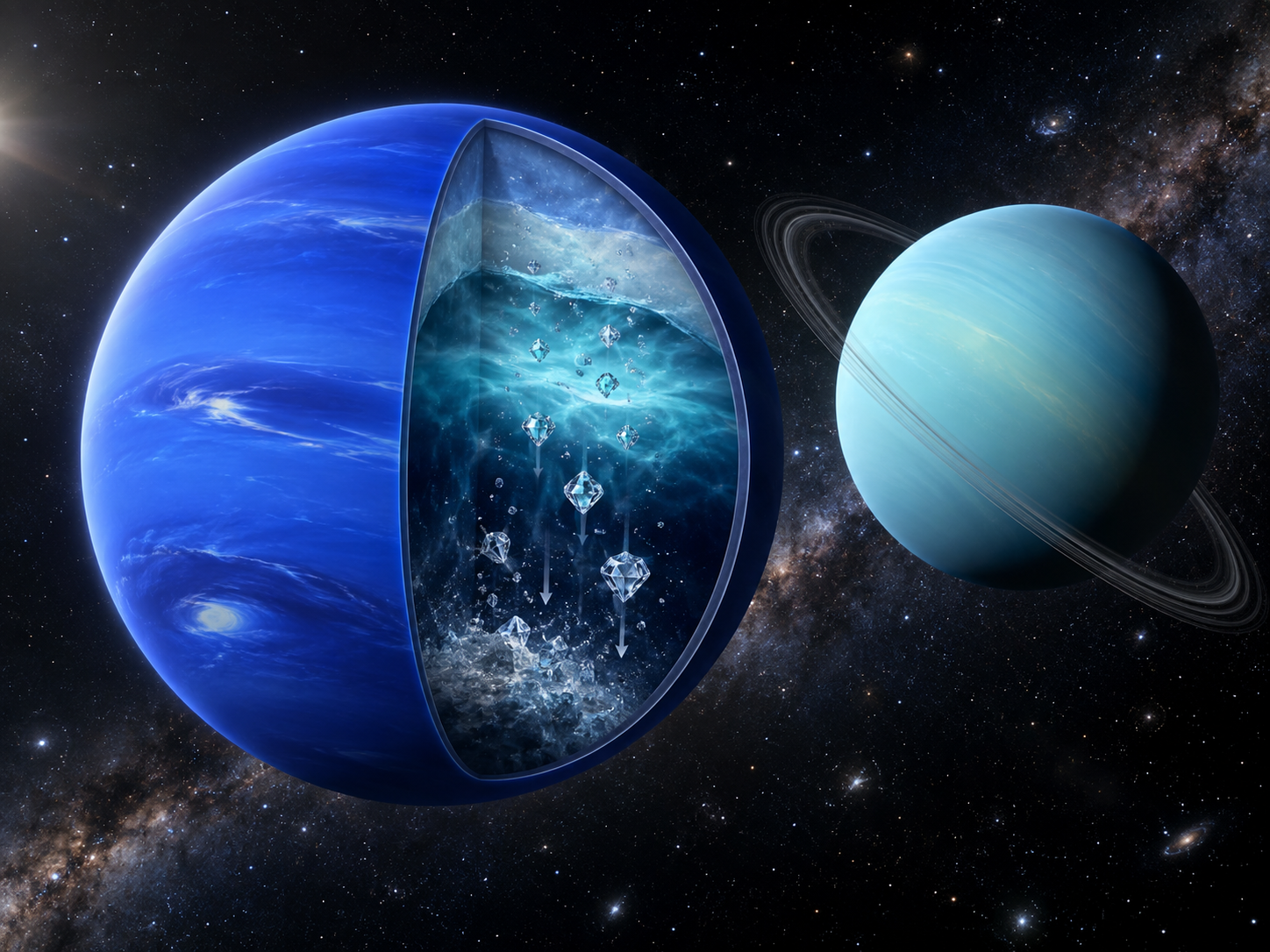
Imagine dropping a diamond.
It falls.
Now imagine dropping one inside a planet.
It would not simply land on a floor.
There is no solid ground waiting below.
Deep inside Neptune and Uranus, the pressure becomes so extreme that carbon can separate from hydrogen-rich material and form diamond. Once those diamonds become dense enough, gravity pulls them deeper into the planet.
Scientists call the idea “diamond rain.”
It sounds like science fiction.
But laboratory experiments have actually recreated some of the extreme conditions found inside these planets and observed diamond formation in carbon-rich material. A 2024 Nature Astronomy study found diamond formation at pressures and temperatures consistent with parts of the shallow interiors of Uranus and Neptune, while earlier experiments had produced nanodiamonds under even more extreme conditions.
There is one important detail, though.
Nobody has watched diamonds falling inside Neptune.
The planets are far too deep and inaccessible for that.
“Diamond rain” is a scientific model supported by laboratory experiments, planetary physics and our knowledge of what these planets contain.
So how could a gas-rich planet make diamonds?
And why would the diamonds fall?
The answer begins with something that seems much less impressive:
methane.
Chapter 1 — These Planets Are Not Solid Worlds
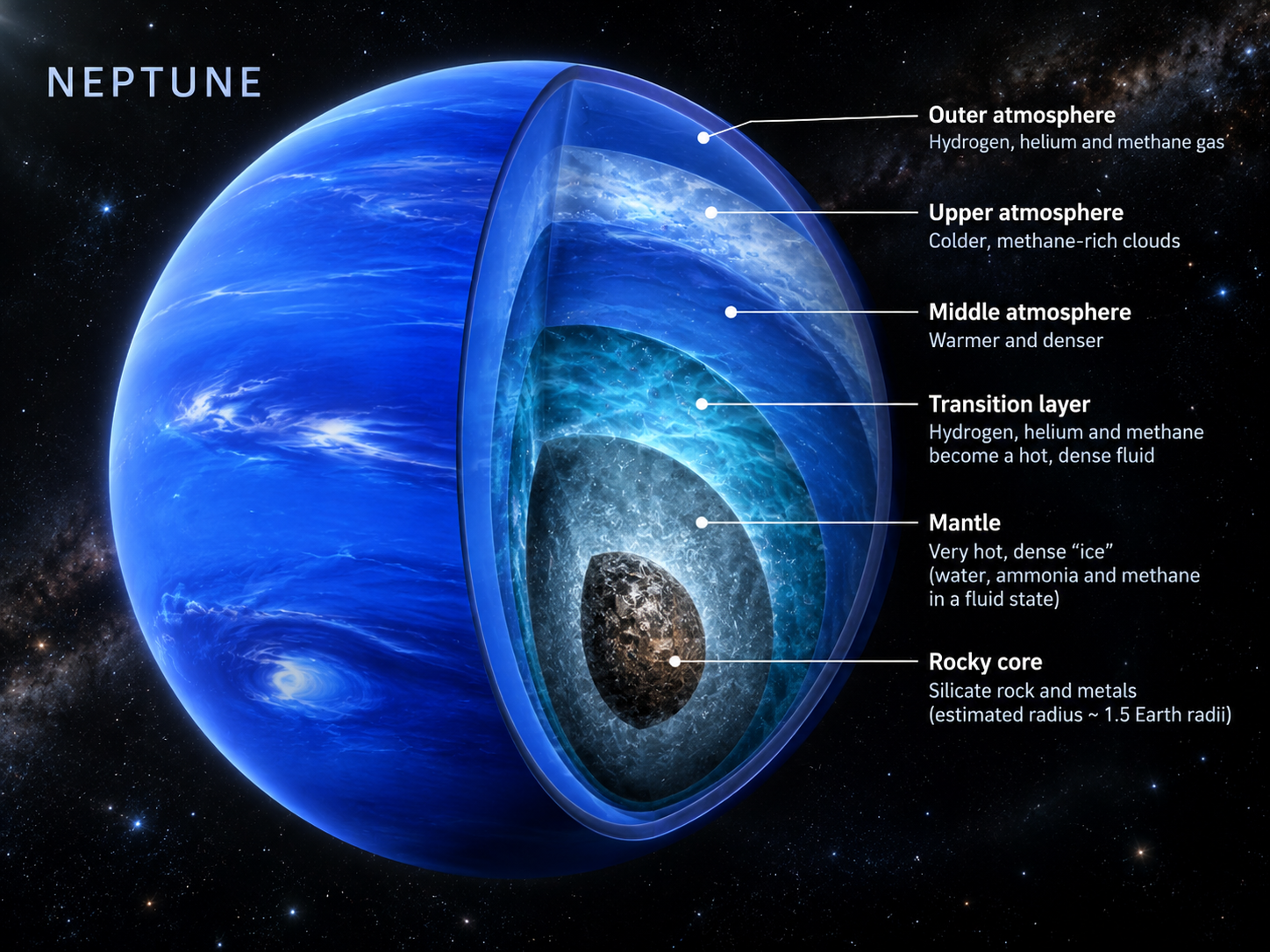
Before we get to the diamonds, there is something important to understand about Neptune and Uranus.
They are not rocky planets with a hard surface like Earth.
They are ice giants.
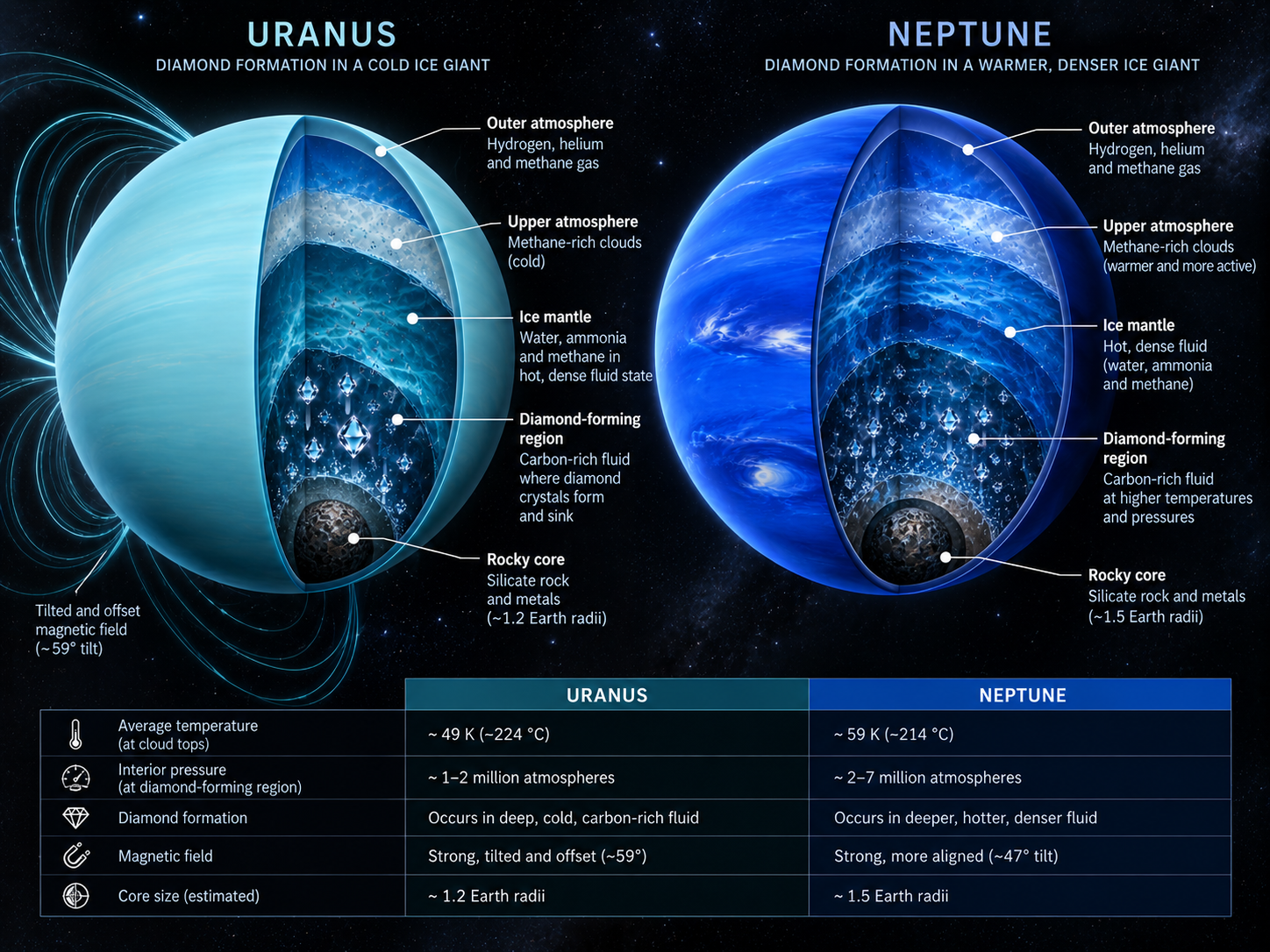
NASA says that 80% or more of the mass of Neptune and Uranus is made up of a hot, dense fluid rich in water, ammonia and methane, surrounding a smaller rocky core. Their atmospheres are mostly hydrogen and helium, with methane present in smaller amounts.
That means you could not stand on Neptune and look up at diamond clouds.
There is no ordinary surface to stand on.
As you travel downward through the atmosphere, the pressure and temperature keep rising.
The gases become denser.
The materials behave differently.
Eventually, you reach a deep interior that is nothing like the cold blue atmosphere we see from Earth.
This is where the diamond story begins.
The methane matters because it contains carbon.
Methane is made from one carbon atom joined to four hydrogen atoms.
At the top of Neptune and Uranus, methane is just one gas in the atmosphere.
Far deeper down, the pressure is another matter entirely.
The carbon and hydrogen do not have to stay together in the same form forever.
Under the right conditions, the carbon can separate out.
And something remarkable can happen next.
It can become diamond.
What Is Inside Neptune and Uranus?
Chapter 2 — Pressure Changes What Carbon Can Do

Now go deeper.
The pressure becomes enormous.
On Earth, we usually think of pressure as something that squeezes an object.
Deep inside an ice giant, it becomes hard to imagine just how strong that squeeze is.
Scientists cannot send a spacecraft into these depths.
So they do something else.
They recreate the conditions in a laboratory.
In one major experiment, researchers compressed a carbon-hydrogen material with powerful lasers and X-rays. The experiment reached about 150 gigapascals and 5,000 kelvin, conditions comparable to roughly 10,000 kilometres below the surfaces of Uranus and Neptune. The researchers observed carbon separating and forming diamond.
The 2024 experiment added an important piece.
Using longer-timescale heating and X-ray measurements, researchers observed diamond formation from compressed polystyrene at about 19–27 gigapascals and above 2,500 kelvin. Those conditions are relevant to shallower parts of Uranus and Neptune than earlier experiments had suggested.
The numbers are huge.
But the important idea is simple.
Pressure and heat can change how carbon behaves.
The carbon does not remain locked inside methane forever.
Under the right conditions, hydrogen separates away.
Carbon atoms begin joining together in a solid structure.
That structure can be diamond.
So the planet is not somehow manufacturing diamonds from nothing.
It is rearranging carbon that was already there.
What Extreme Pressure Does
Chapter 3 — So Where Does the Diamond “Rain” Come From?
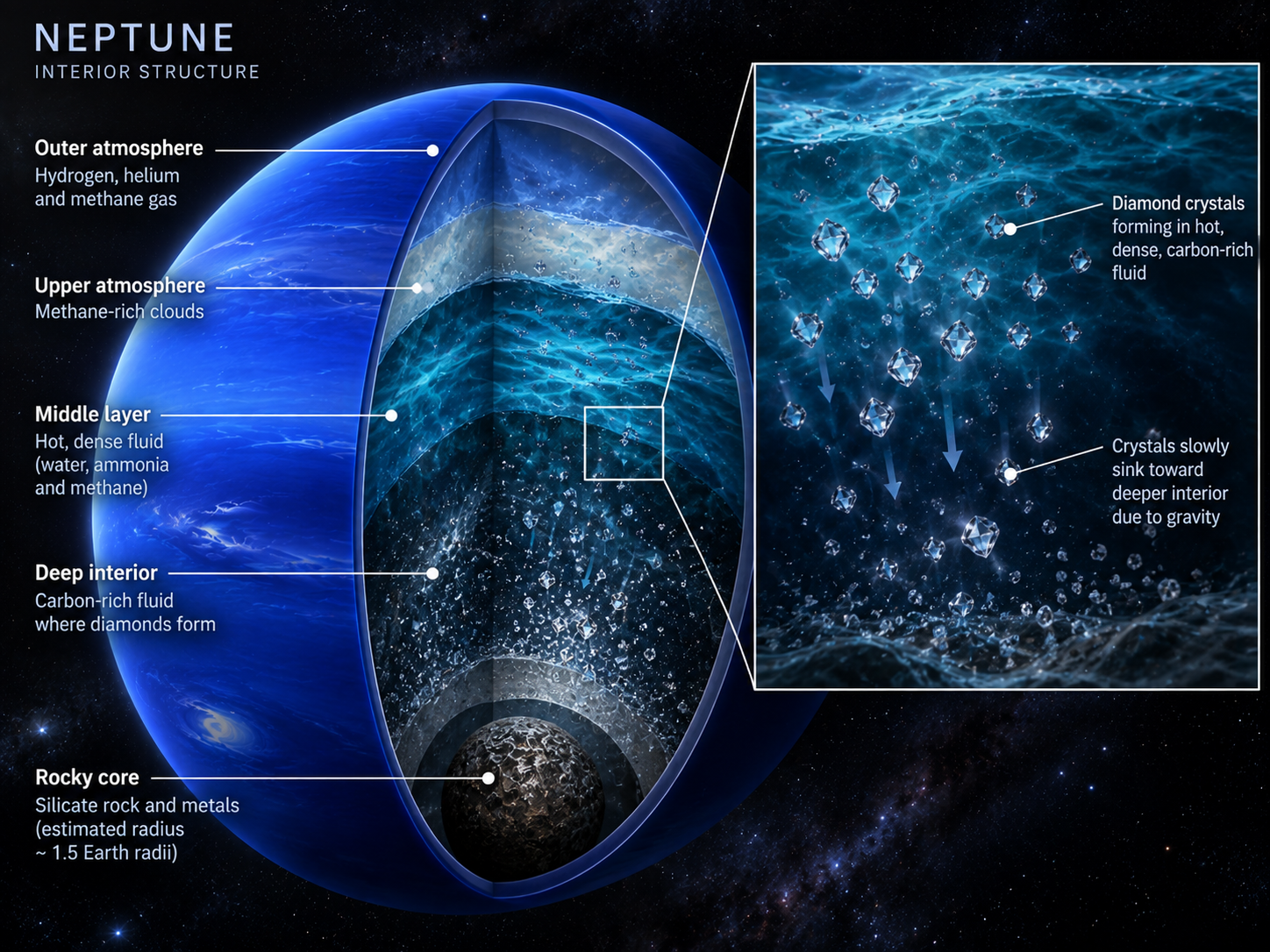
Making a diamond is only half the story.
A diamond has to go somewhere.
And inside Neptune or Uranus, a diamond is much denser than the surrounding fluid.
So gravity pulls it downward.
Imagine a tiny solid crystal forming inside a thick fluid.
It does not stay suspended forever.
It begins to sink.
Then another diamond forms.
And another.
And another.
Across enormous areas and over extremely long periods, countless crystals could form and move downward.
That is the “rain.”
It is not rain like we know on Earth.
There are no clouds releasing sparkling drops of diamonds.
The crystals are falling through the dense interior of the planet.
And they are moving incredibly slowly by human standards.
The process is expected to continue as carbon-rich material reaches the right conditions deeper inside the planet. SLAC researchers describe the diamonds as slowly sinking deeper under gravity after they form.
That gives the planet an unusual kind of weather.
The sky we see is not where the interesting precipitation happens.
The “rain” is happening thousands of kilometres below it.
Why Do Diamonds Fall?
Chapter 4 — Scientists Have Actually Made the Diamonds

This is the part that turns the story from an interesting idea into a serious scientific result.
Scientists cannot travel to Neptune.
So they brought a tiny piece of Neptune-like physics into the laboratory.
The experiments started with carbon-rich materials containing hydrogen.
Researchers then used intense lasers, high-pressure equipment and ultrafast X-rays to compress and heat the material.
For a very short time, the sample experienced conditions similar to those expected deep inside the ice giants.
Then the X-rays showed what happened.
Diamond formed.
The 2017 experiment provided direct experimental evidence of diamond formation under planetary-interior conditions.
The 2024 experiment went further by studying the process over longer timescales and observing diamond formation at lower pressures and temperatures than the earlier dynamic experiments required.
That does not mean scientists have produced a miniature Neptune.
The experiment is tiny.
The planet is enormous.
And laboratory material is a simplified stand-in for the complex mixture inside a real ice giant.
But the basic physics can be tested.
That is what makes the experiments so valuable.
They take something happening billions of kilometres away and ask:
Can we make the same thing happen here?
The answer appears to be yes.
How Scientists Tested Diamond Rain
Chapter 5 — The Diamonds Could Change the Planet Itself
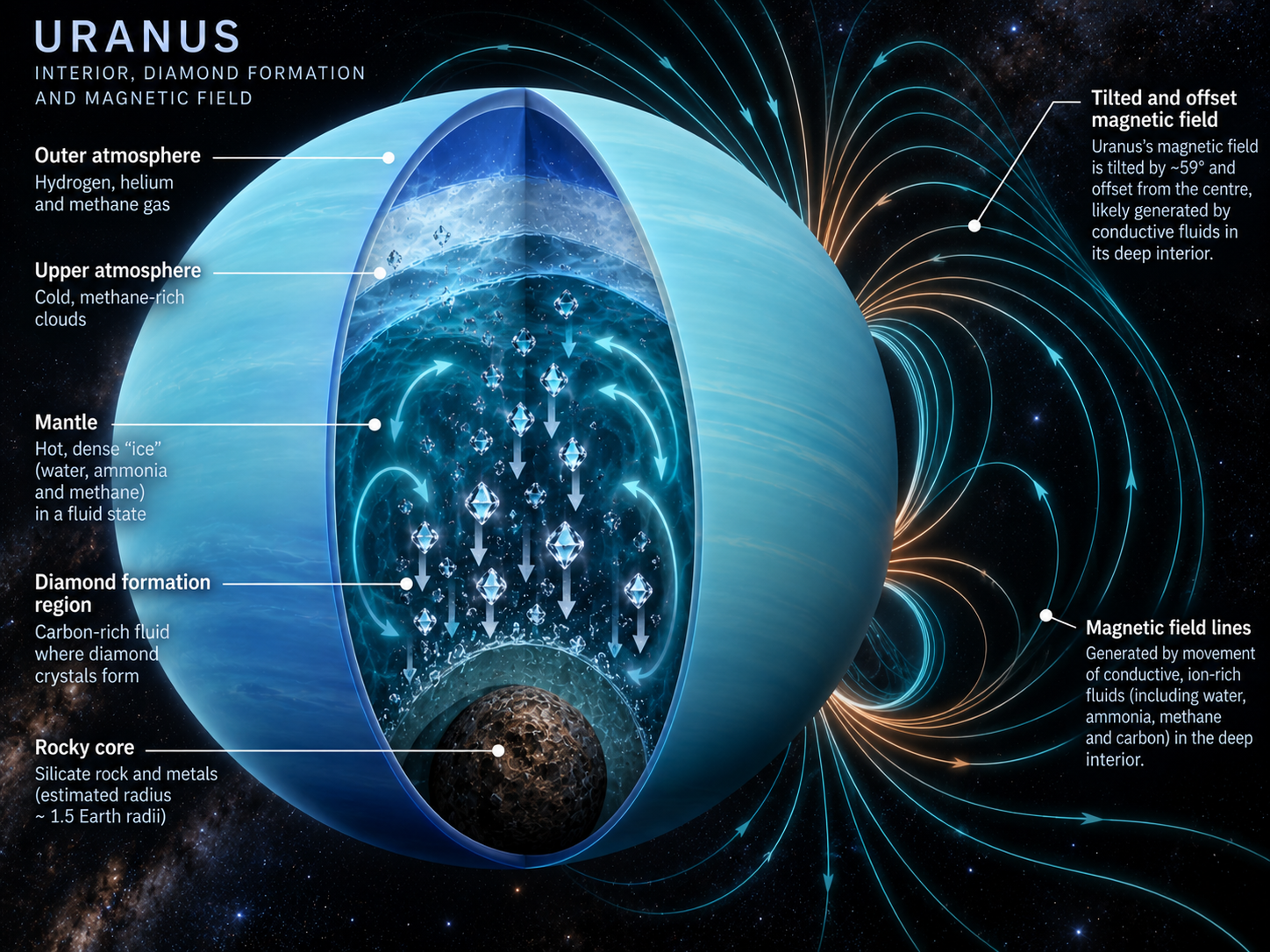
There is a reason scientists care about this beyond the fun fact that diamonds may be falling inside Neptune.
The diamonds could affect the planet.
Think about what happens when a large number of dense crystals move downward.
They carry carbon deeper into the planet.
They also release gravitational energy as they sink.
And according to the 2024 research, diamond formation and sinking could help stir the conductive interior and contribute to the way heat moves through these planets. That process may also influence their unusual magnetic fields.
This is where the story gets much bigger.
The diamonds are not simply decoration.
They may be part of the planet's internal machinery.
Neptune and Uranus have magnetic fields that are very different from Earth's. Their fields are tilted and offset rather than behaving like the familiar dipole generated mainly within Earth's core. Research into diamond precipitation suggests that sinking diamonds could help drive movement in conductive layers deeper inside the ice giants.
So a tiny diamond falling through a hidden layer may not sound important.
Multiply that process across an entire planet.
Now it becomes interesting.
The rain could help move heat.
It could move carbon.
And it may help stir the material involved in making the planet's magnetic field.
The diamonds are not just falling.
They may be helping the planet work.
Diamond Rain May Affect the Planet
Chapter 6 — Does It Really Rain Diamonds on Both Planets?
This is where we need to slow down.
It is tempting to say:
“Scientists proved it rains diamonds on Neptune and Uranus.”
That is stronger than the evidence allows.
We have never sent an instrument into the deep interiors of either planet to watch diamonds form and fall.
What we have are models and laboratory experiments.
Those experiments show that carbon-rich material can form diamonds under conditions that are similar to parts of the interiors of the ice giants.
That makes diamond formation physically plausible.
But the exact amount of diamond produced inside each planet is still uncertain.
Some theoretical work also suggests the conditions may not be identical in Uranus and Neptune. One 2023 study found that Neptune's cooler interior may overlap more strongly with conditions favourable for diamond formation than Uranus's interior does.
So the safest picture is this:
Neptune and Uranus probably contain regions where diamond formation can occur.
But scientists are still working out exactly how much diamond forms, where it forms, how large the crystals become and how strongly the process affects each planet.
The phrase “diamond rain” is useful because it captures the basic idea.
It just should not make us think the entire planet has been directly observed.
Sometimes science gives you a very strong explanation without giving you a direct photograph of the event.
This is one of those cases.
What We Know and What We Still Don't Know
So, Why Does It Rain Diamonds on Neptune and Uranus?
The answer begins with carbon.
Neptune and Uranus contain methane and other carbon-bearing material deep inside their atmospheres and interiors. NASA describes both planets as ice giants with deep, hot fluids rich in water, ammonia and methane.
As you go deeper, pressure and temperature rise to extraordinary levels.
Under the right conditions, carbon can separate from hydrogen-rich material.
The carbon can then form diamond.
The diamonds are denser than the surrounding fluid.
So gravity pulls them downward.
More diamonds form.
More sink.
That is the basic idea behind diamond rain. Laboratory experiments have reproduced diamond formation under relevant high-pressure and high-temperature conditions, strengthening the case that this process can occur inside ice giants.
But there is still a line between strong scientific evidence and direct observation.
Nobody has watched diamond rain inside Neptune.
What scientists have done is much more practical: they recreated pieces of the physics here on Earth.
And the tiny samples behaved in a way that fits the larger planetary picture.
So somewhere deep inside these distant blue worlds, diamonds may be forming in darkness, then slowly sinking toward deeper layers.
Not as a glittering storm in the sky.
As a quiet process happening thousands of kilometres below the clouds.
The strange part is not really that Neptune may have diamond rain.
It is that the same carbon found in an ordinary gas can be transformed into one of the hardest materials we know simply because the planet squeezes it hard enough.
Frequently Asked Questions
1. Does it really rain diamonds on Neptune and Uranus?
Scientists think diamond formation and sinking can occur inside the two ice giants, based on planetary models and laboratory experiments. However, no spacecraft has directly observed diamond rain inside either planet.
2. How are diamonds formed on Neptune?
Deep inside Neptune, extreme pressure and temperature can cause carbon-rich hydrocarbons to separate. The carbon can then form solid diamond, according to laboratory experiments and models of the planet's interior.
3. Where does the carbon come from?
Methane and other hydrocarbons contain carbon. Neptune and Uranus contain methane in their atmospheres and deeper carbon-bearing material in their interiors.
4. Why do the diamonds fall?
Diamond is denser than the surrounding material. Once crystals form, gravity pulls them toward deeper parts of the planet.
5. Are the diamonds like Earth's diamonds?
The basic crystal structure of diamond is the same, but the conditions are very different. The diamonds expected inside Neptune and Uranus would form under extreme pressure and temperature, far below any place humans could reach.
6. How do scientists know diamond rain is possible?
Scientists have recreated relevant pressure and temperature conditions in laboratories and observed diamond formation in carbon-rich materials. Experiments were performed both at very high dynamic pressures and, more recently, at lower pressures over longer timescales.
7. Have scientists actually seen diamonds inside Neptune or Uranus?
No. The planets' deep interiors cannot currently be observed directly. The evidence comes from laboratory experiments, planetary models and our knowledge of the planets' composition and internal conditions.
8. Does diamond rain happen only on Neptune and Uranus?
They are the Solar System's classic examples because their interiors contain abundant hydrogen, carbon, water and ammonia under enormous pressure. Similar chemistry may occur in some Neptune-like exoplanets, but the details would depend on each planet's composition and interior conditions.
9. Could the diamonds reach the centre of Neptune?
They are expected to sink into deeper layers, but the exact path is complicated. Models suggest that diamond precipitation can transport carbon and heat deeper into the planet, while the diamonds may eventually change form or interact with the extremely hot interior. The exact final fate remains an area of study.
10. Why is diamond rain important to planetary science?
It may help explain how carbon moves inside ice giants, how their interiors transport heat and possibly how their unusual magnetic fields are generated. The process is therefore more than an interesting weather fact—it may be part of how these planets evolve.