Why Do Saturn’s Rings Have an Expiration Date?
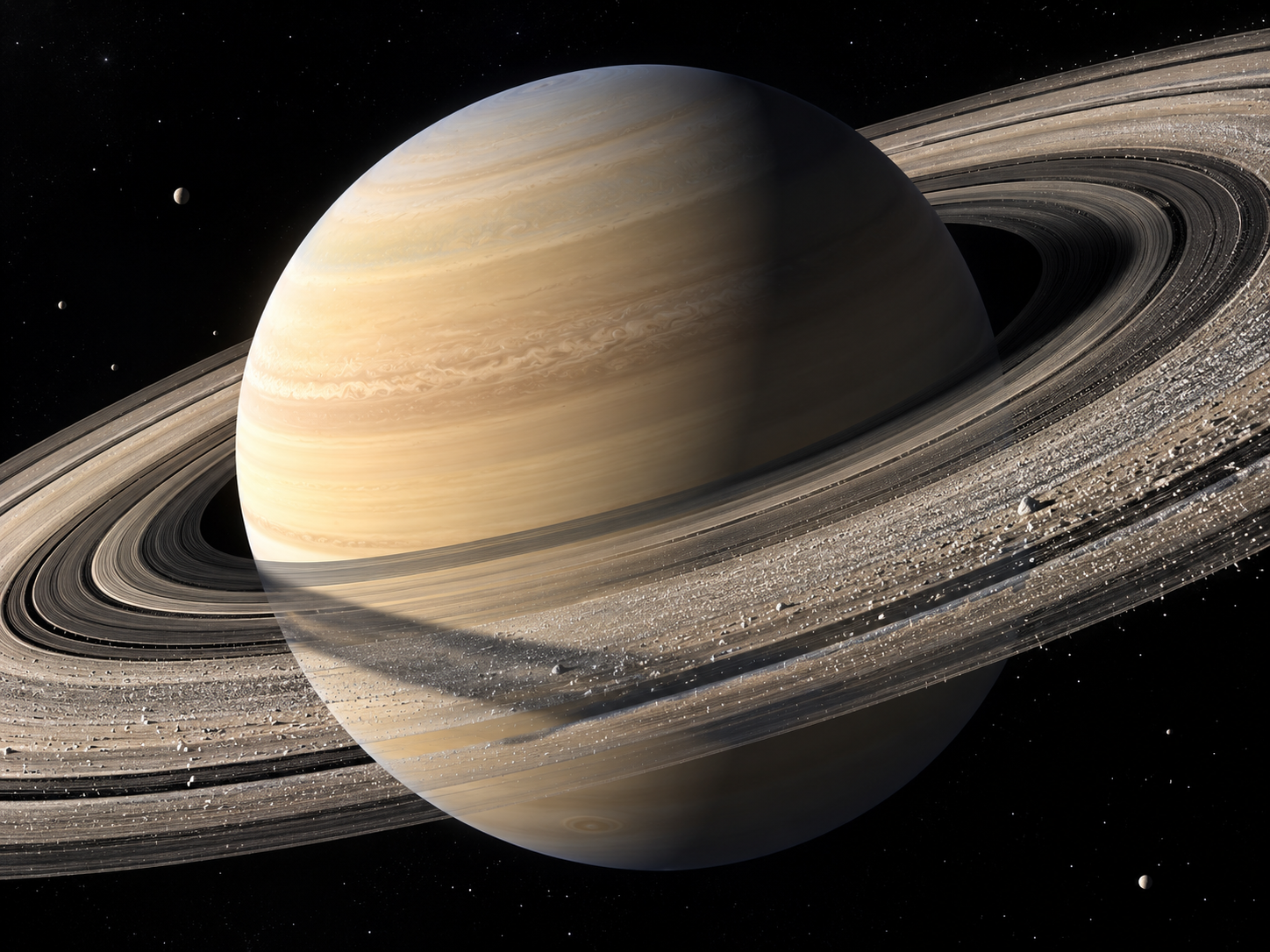
Saturn’s rings look permanent.
They stretch around the planet in a huge, bright disk of ice, so large that they are one of the first things you notice about Saturn.
But they are not permanent.
Very slowly, Saturn is taking them back.
Tiny pieces of the rings are falling into the planet. Scientists call this “ring rain.” Cassini found that water-rich material from the rings is being pulled along Saturn’s magnetic field and into the upper atmosphere.
The process is happening now.
And one day, the rings will be much thinner than they are today.
That gives Saturn’s most famous feature something unusual for a planetary ring system:
an expiration date.
But there is a catch.
Scientists cannot simply look at Saturn and say, “The rings will disappear on this exact date.”
The best estimates depend on how quickly ring material is being lost, how the particles move, and how those rates change over time. NASA studies have suggested that the main rings could disappear within the next few hundred million years, while a 2018 estimate gave a much shorter figure of less than 100 million years under the highest measured loss rate.
So what is actually happening to them?
Chapter 1 — Saturn Is Already Losing Its Rings
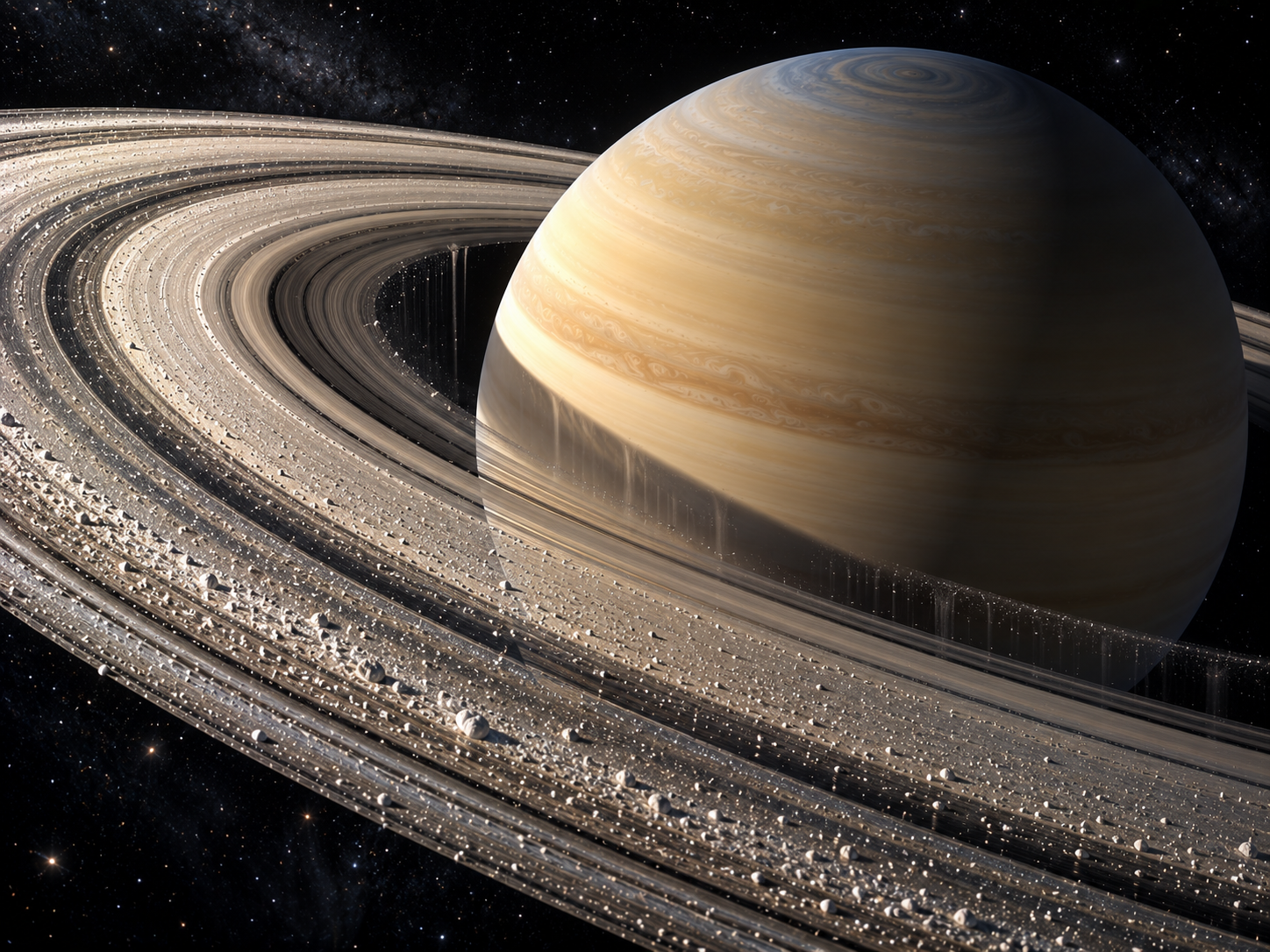
The easiest way to understand the problem is to stop thinking of Saturn’s rings as one solid object.
They are not.
The rings are made mostly of water ice, broken into countless pieces ranging from tiny dust grains to much larger chunks. Each piece is orbiting Saturn.
From far away, all those pieces look like one enormous ring.
Up close, it is more like a vast swarm.
And some of that material is slowly leaving the swarm.
Gravity pulls everything toward Saturn, but the particles' orbital motion keeps them circling the planet. Most of the ring stays in orbit because those two effects balance in the right way.
But some particles become electrically charged.
This is where Saturn’s magnetic field enters the story.
Charged particles can interact with the planet’s magnetic field and follow paths that eventually carry them down toward Saturn.
They fall.
Not as giant chunks of ice.
As a very thin, almost invisible rain of water-rich material.
NASA calls it ring rain.
You cannot look at Saturn through a telescope and watch the rings visibly getting smaller.
The change is far too slow.
But the loss is happening.
Saturn is quietly wearing away its own rings.
Saturn Is Losing Ring Material
Chapter 2 — So What Exactly Is “Ring Rain”?
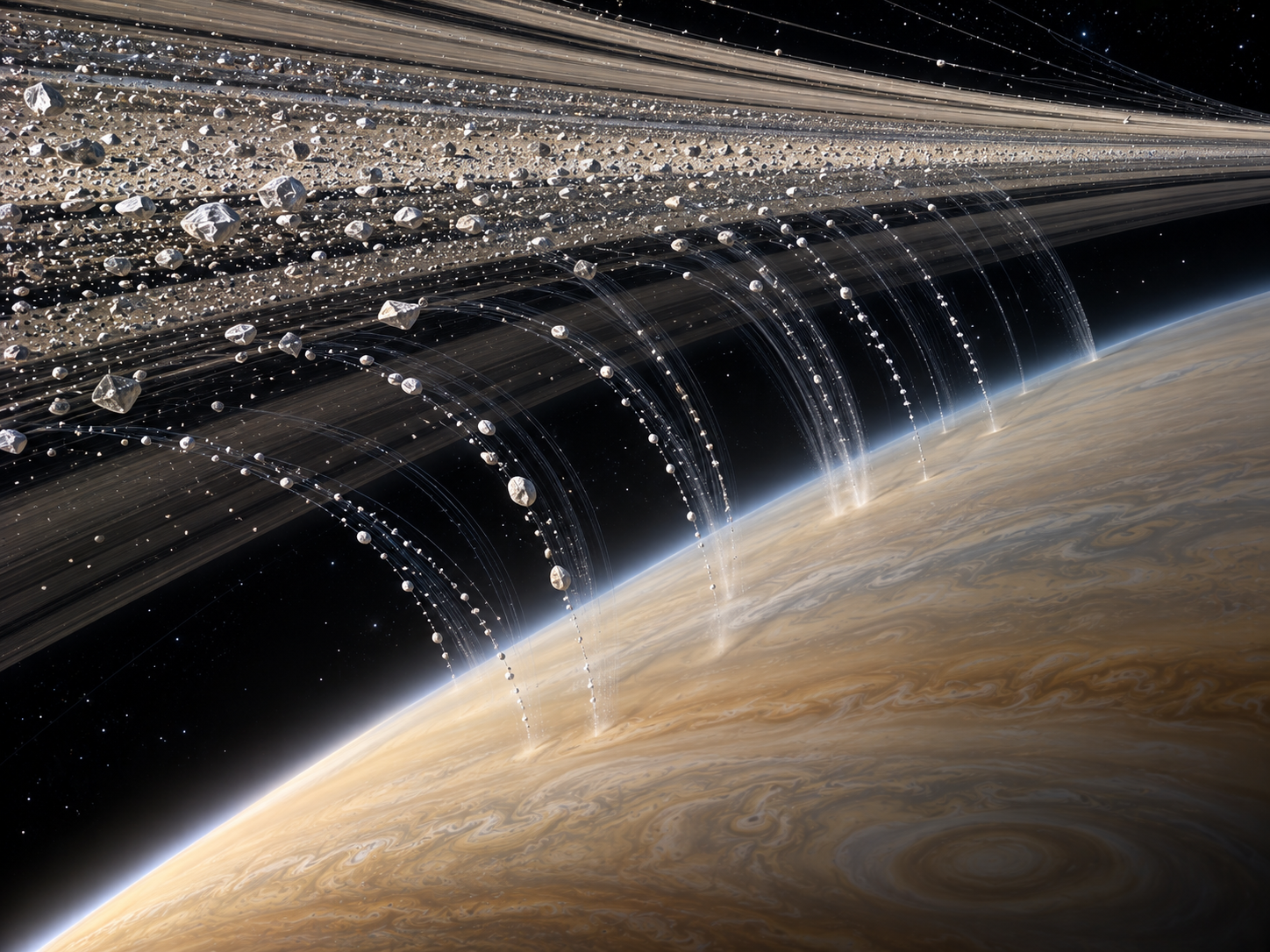
The name makes it sound as if pieces of the rings are falling like snow.
That is not quite what is happening.
Some particles in Saturn’s rings become electrically charged.
Saturn has a powerful magnetic field.
When charged material interacts with that field, the particles can be guided along magnetic field lines toward the planet.
The material eventually enters Saturn’s upper atmosphere.
The water-rich particles do not remain as little ice blocks all the way down. They can break apart and vaporize as they enter the atmosphere, delivering water and related products to Saturn.
Cassini measurements made this process much harder to ignore.
Scientists had suspected ring rain for decades.
Voyager had already found mysterious dark bands in Saturn’s atmosphere. In the 1980s, researchers proposed that water from the rings might be responsible. Later observations detected the predicted pattern in Saturn’s upper atmosphere.
Cassini then went much closer.
During its final orbits, the spacecraft passed between Saturn and the rings, where it could directly sample the region around the ring system. Those measurements became important for understanding how much material was moving from the rings toward the planet.
So the rings are not simply sitting there.
They are interacting with their planet.
Saturn is pulling material from its own rings through a process that scientists can actually measure.
How Ring Rain Works
Chapter 3 — Why Doesn't Saturn's Gravity Just Pull Everything Down?
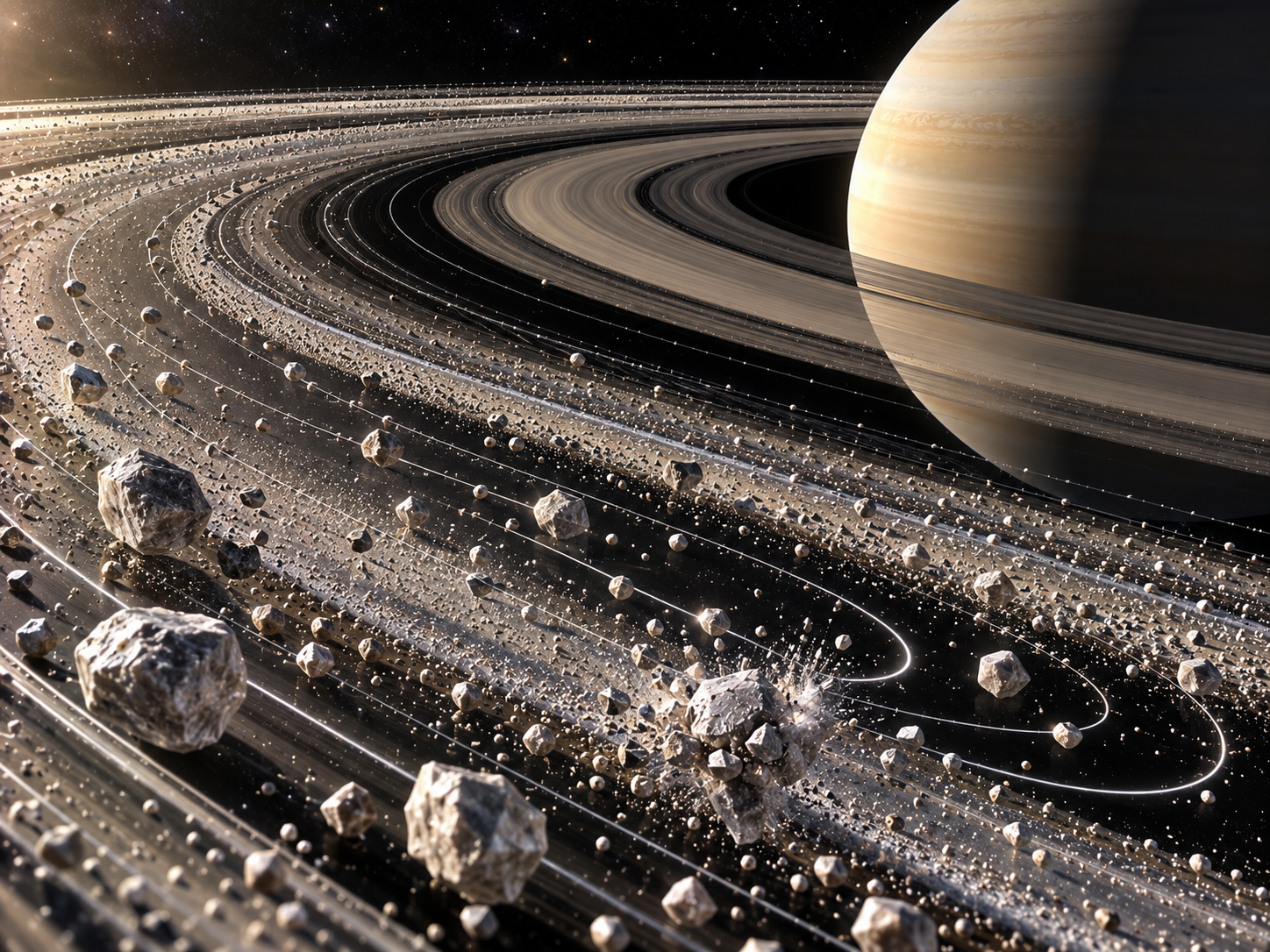
This is the part that makes Saturn’s rings possible in the first place.
Saturn is massive.
So why don't all the ring particles simply fall straight into the planet?
Because they are moving.
Very quickly.
Each ring particle is orbiting Saturn. Its forward motion keeps carrying it around the planet while gravity pulls inward.
The result is an orbit.
It is the same basic idea that keeps a spacecraft circling a planet.
The ring particles are constantly falling toward Saturn.
They just keep missing it.
For most of the ring system, that orbital motion keeps the particles around Saturn instead of sending them directly downward.
But this balance is not perfect forever.
Particles collide.
Some become charged.
Small particles can interact with Saturn’s magnetic environment.
And particles can be knocked into different orbits.
Micrometeoroids also strike the rings, producing debris and changing how material moves through the system. NASA’s Cassini research found that these collisions contribute to the long-term evolution and loss of ring material.
So the rings are not frozen in place.
They are constantly moving.
Particles collide.
Some spread outward.
Others move inward.
Some eventually end up on Saturn.
The ring system looks calm from a distance.
Inside it, there is a lot going on.
Why the Rings Stay in Orbit
Chapter 4 — The Rings Are Also Being Shaken Apart
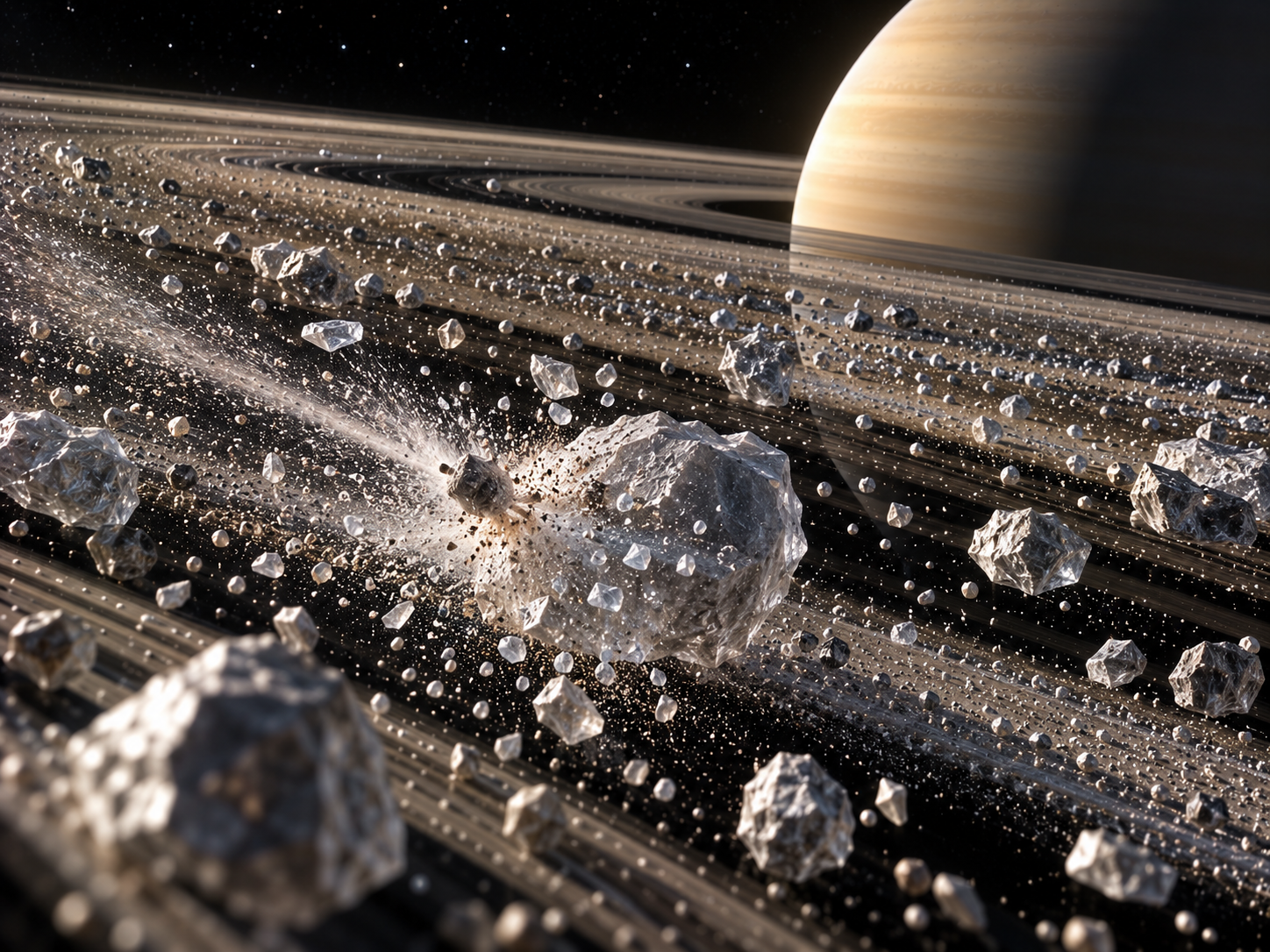
There is another force working on the rings.
Tiny objects from space.
Micrometeoroids—small pieces of material moving through the solar system—continually strike Saturn’s rings.
They are tiny.
The damage they cause adds up.
When a micrometeoroid hits a ring particle, some material can be knocked apart and spread through the rings.
NASA researchers studying Cassini data found that this bombardment contributes to the transport and evolution of ring material. Their 2023 studies described a kind of long-term conveyor-belt effect in which impacts help redistribute material and move some of it inward toward Saturn.
That gives the rings another problem.
They are not just losing particles through ring rain.
Their particles are constantly being disturbed.
Material can move from one part of the rings to another.
Some can spread outward.
Some moves inward.
Eventually, some of it ends up falling toward Saturn.
So imagine the rings as a giant swarm being gently battered from all directions.
Nothing dramatic happens in one collision.
But there are millions of collisions over enormous stretches of time.
Slowly, the structure changes.
Tiny Impacts, Big Changes
Chapter 5 — So When Will the Rings Actually Disappear?
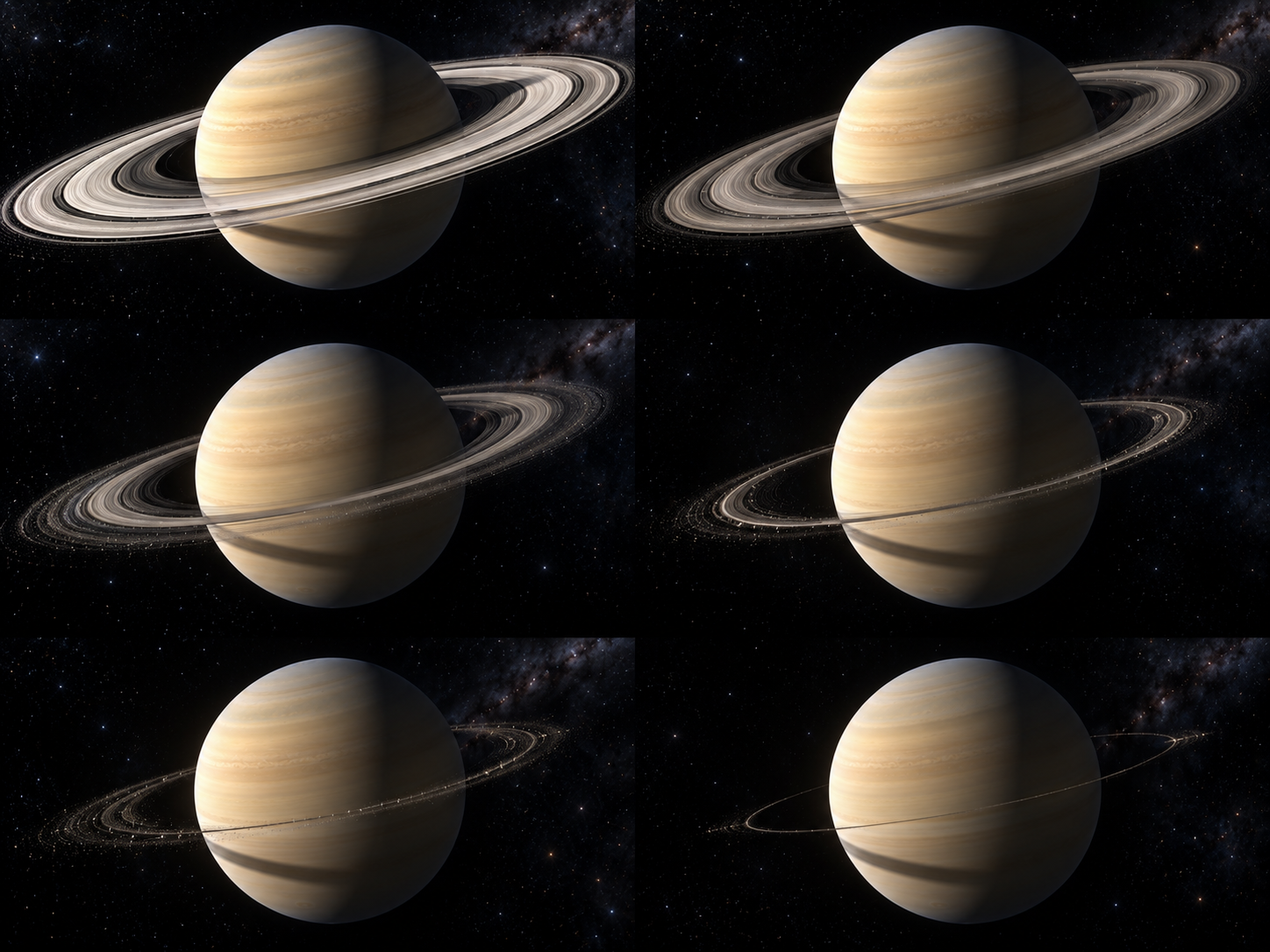
Now we reach the question behind the title.
How much time is left?
The uncomfortable answer is:
We do not have one exact number.
NASA reported in 2018 that, based on the highest ring-rain rate estimated from Voyager-era observations, the rings could disappear in about 300 million years from ring rain alone. When another measured flow of ring material was included, the estimate fell to less than 100 million years.
Later NASA Ames studies published in 2023 gave a broader picture, suggesting that the rings may last another few hundred million years.
That is a much better way to think about the “expiration date.”
Not:
“Saturn's rings disappear on this exact date.”
But:
“At the rates we currently understand, the main rings are temporary on astronomical timescales.”
And the difference matters.
The observed loss rates are not a perfect clock.
They can change.
Our models can improve.
Some material may move differently than expected.
And scientists are still working out exactly how the different loss processes fit together.
So a headline saying “Saturn’s rings will disappear in 100 million years” is too certain.
The science supports something more careful:
The rings are losing material now, and models suggest they will eventually fade over hundreds of millions of years, but the exact remaining lifetime is uncertain.
That is still an extraordinary fact.
Saturn’s Ring Lifetime
Chapter 6 — Then How Old Are the Rings?
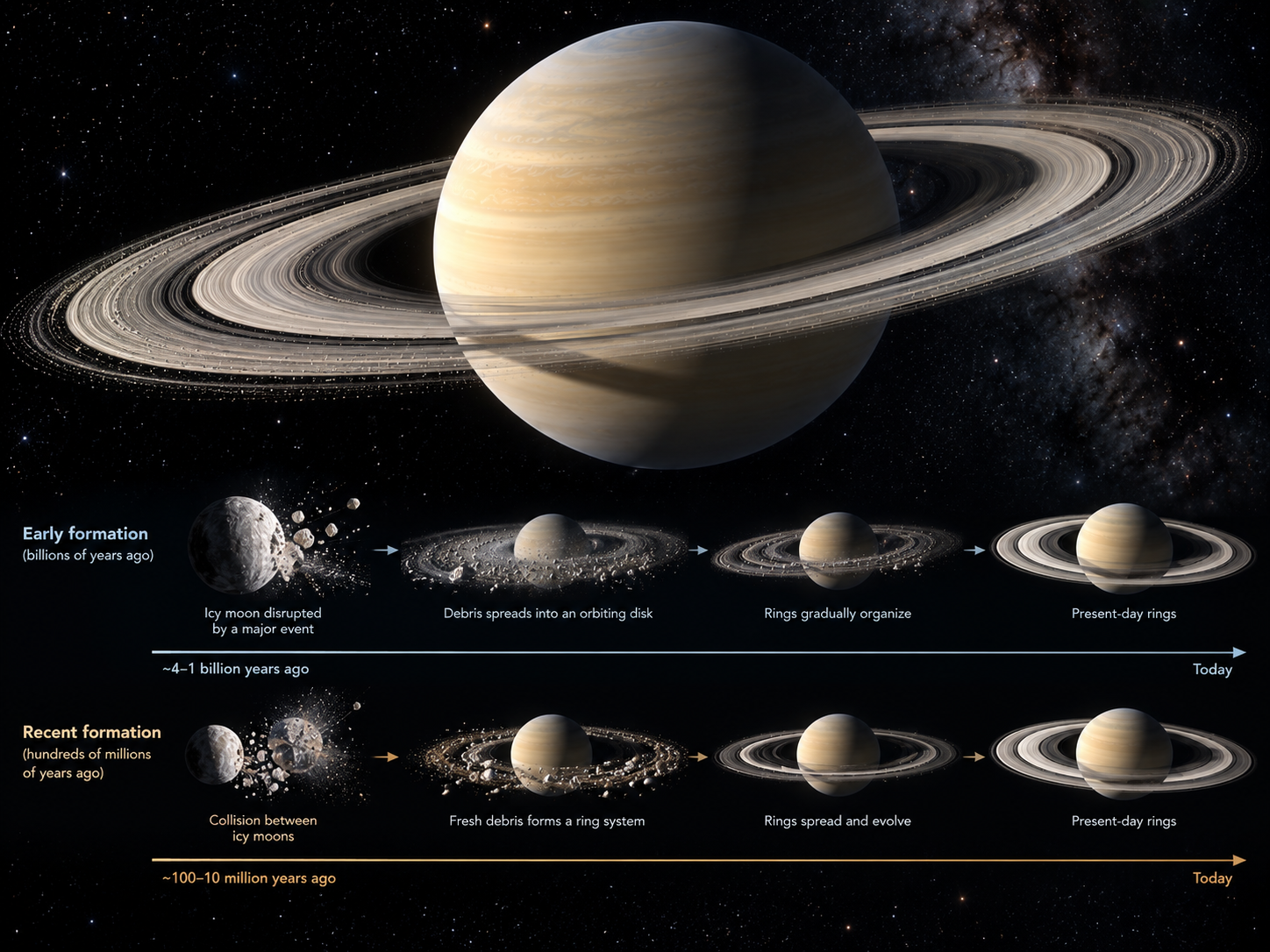
Here the story gets surprisingly messy.
You might think that if scientists know the rings are disappearing, they should also know how old they are.
Not necessarily.
For years, researchers have debated whether Saturn's rings are almost as old as Saturn itself or whether they formed much later.
Cassini's measurements of the ring mass produced strong evidence for relatively young rings. A 2019 NASA report said the best Cassini-based estimate placed their formation between about 10 million and 100 million years ago.
NASA Ames studies published in 2023 also argued that the rings were relatively young and probably formed within the last few hundred million years.
But newer research has complicated that picture.
A 2025 Nature Geoscience study argued that micrometeoroid material may not accumulate in the rings as efficiently as earlier models assumed. If so, the rings' apparent cleanliness would not necessarily prove that they formed recently. The authors noted that, under their model, the rings' possible age could extend into billions of years.
That does not mean scientists have discovered that Saturn's rings definitely are billions of years old.
It means one important method for estimating their age is less certain than previously thought.
And there is an important distinction here.
How old are the rings?
is one question.
How long will they survive from today?
is another.
The first remains debated.
The second is supported by direct evidence that ring material is currently being lost.
That distinction saves us from making the science sound more settled than it is.
Age and Lifetime Are Different Questions
Chapter 7 — One Day, Saturn May Look Different
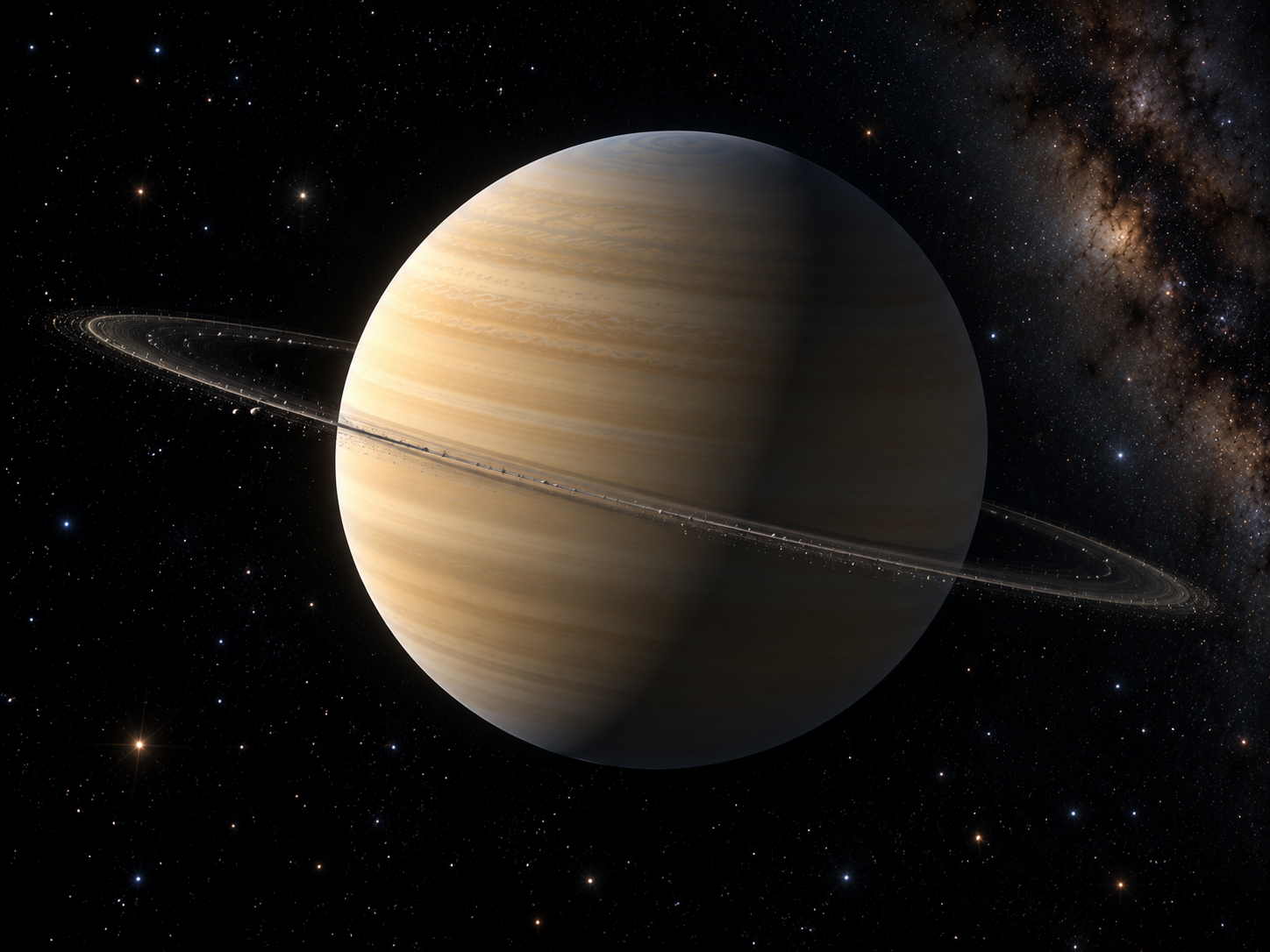
If the rings really are temporary, there is a strange thought hiding inside the science.
Saturn has not always looked the way we see it now.
And future Saturn will not look exactly this way either.
NASA's 2023 studies described the rings as a relatively recent and temporary feature and noted that the planet could eventually return to a much less impressive ring system.
The main rings will not suddenly vanish.
There will be no final moment when Saturn's great rings simply switch off.
The change will be slow.
The inner regions lose material.
The ring system becomes less massive.
Its appearance changes.
And over a very long time, the bright main rings we know today become much thinner.
To us, that sounds unimaginably long.
A hundred million years is far beyond a human lifetime.
But Saturn has existed for more than four billion years.
Against that scale, even a few hundred million years is not very long.
That makes the rings strangely temporary.
We happened to live at a time when Saturn has them.
We are seeing a phase of the planet's history.
Not the final form.
Not necessarily the original form.
Just our moment.
And perhaps that is the most interesting thing about Saturn's rings.
They look like a permanent part of the planet.
They are actually a chapter.
Saturn Through Time
So, Do Saturn’s Rings Really Have an Expiration Date?
Yes—but not in the way a carton of milk has one.
There is no exact date written somewhere in Saturn's future.
What scientists have found is more interesting.
The rings are made of countless pieces of ice.
Some of that material is already falling into Saturn.
Some is being moved around by collisions and other processes.
Cassini gave scientists direct evidence that Saturn is losing ring material, while later models suggest that the main rings may not survive for more than a few hundred million years at their present scale.
The exact number is still uncertain.
And even the age of the rings remains debated. A 2025 study showed that one major method used to argue for young rings may be less reliable than previously thought.
But the basic picture remains clear.
Saturn's rings are changing.
They are not a permanent decoration attached to the planet.
They are a moving, colliding, slowly disappearing system of ice.
And we happen to be here while they are still spectacular.
For now, Saturn is still wearing its rings.
But on the scale of a planet's lifetime, they are not forever.
Frequently Asked Questions
1. Are Saturn’s rings really disappearing?
Yes. Material from Saturn’s rings is falling into the planet in a process called ring rain. Cassini measurements and earlier Voyager observations provided evidence that the rings are gradually losing material.
2. How are Saturn’s rings disappearing?
Tiny particles from the rings can become electrically charged and interact with Saturn’s magnetic field. Some of this material is guided into Saturn’s upper atmosphere. Collisions with micrometeoroids can also disturb and redistribute ring material.
3. What is Saturn’s ring rain?
Ring rain is the flow of water-rich material from Saturn’s rings into the planet’s upper atmosphere. The material follows paths influenced by Saturn’s magnetic field and eventually falls into the atmosphere.
4. How long will Saturn’s rings last?
There is no single exact expiration date. A 2018 NASA estimate suggested that ring rain alone could remove the rings within about 300 million years, while combining it with another measured loss process produced an estimate of less than 100 million years. Later NASA Ames studies suggested a remaining lifetime of a few hundred million years.
5. Will Saturn’s rings suddenly disappear?
No. The rings are expected to fade gradually as material is lost. There would not be one sudden moment when the entire ring system vanishes.
6. What are Saturn’s rings made of?
Saturn’s main rings are made mostly of water ice, broken into huge numbers of particles ranging from tiny grains to larger pieces.
7. Why don't Saturn’s rings fall straight into the planet?
The ring particles are orbiting Saturn. Their forward motion keeps them moving around the planet while Saturn’s gravity pulls them inward. Most particles therefore remain in orbit rather than falling directly into Saturn.
8. Do micrometeoroids make Saturn’s rings disappear?
Micrometeoroid impacts can contribute to the rings’ evolution by disturbing and redistributing material. A 2025 Nature Geoscience study also found that much of the non-icy material produced by these impacts may be removed from the rings rather than accumulating there.
9. How old are Saturn’s rings?
That is still debated. Earlier Cassini-based work supported relatively young rings, with estimates around tens to hundreds of millions of years. However, a 2025 study argued that micrometeoroid material may be incorporated into the rings much less efficiently than previously assumed, meaning their apparent youth may not be a reliable measure of their actual age.
10. Are Saturn’s rings younger than Saturn?
The age of the rings is still uncertain. Saturn itself is about 4.5 billion years old, while some studies have argued that the main rings formed much later. Other research now leaves open the possibility that the rings could be far older than those young-age estimates suggested.