(CHAPTER 1)
🌌 Where Light Comes to an End
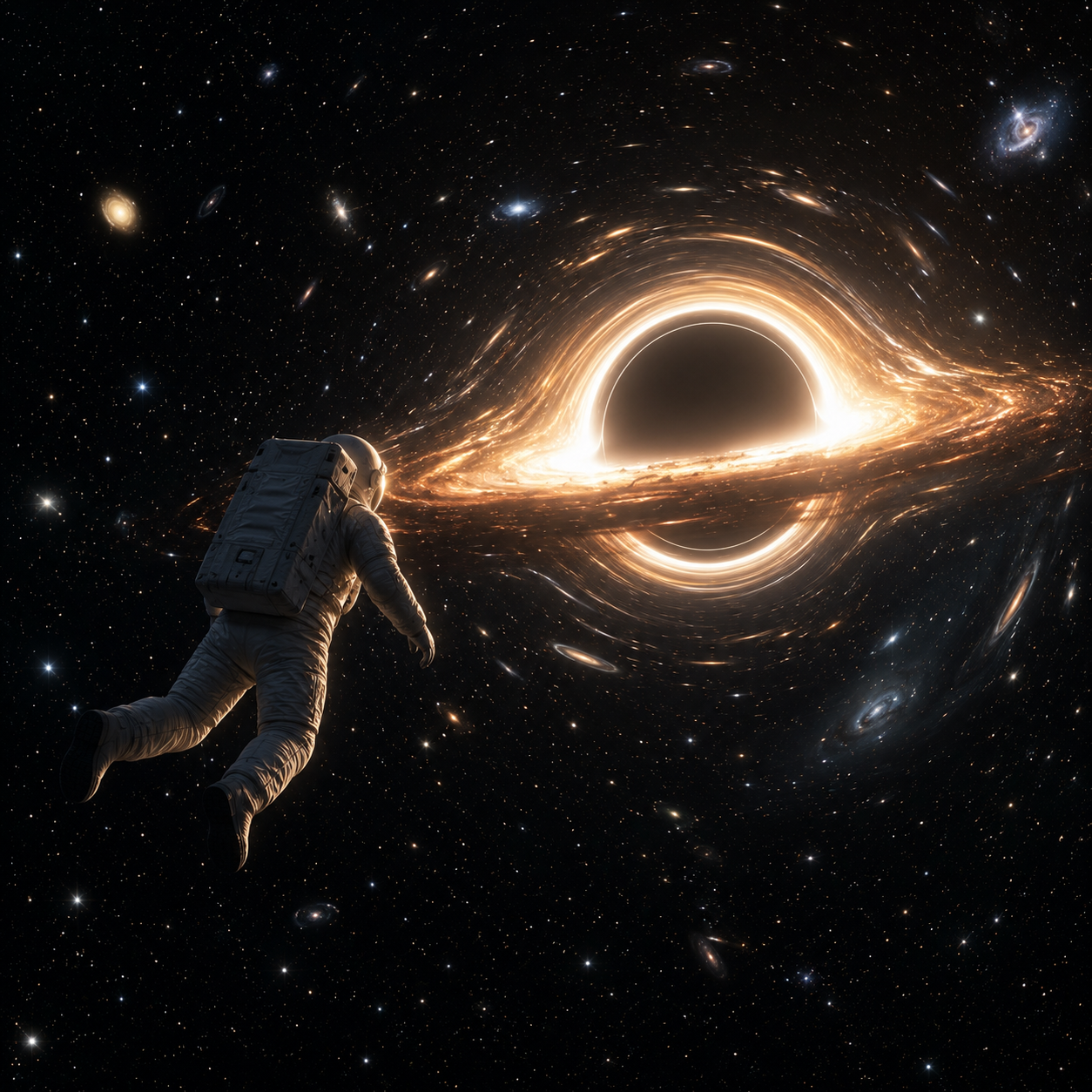
Imagine you're floating silently through the endless darkness of space.
Behind you, the stars sparkle like tiny diamonds scattered across an infinite black canvas. Ahead, there is... nothing.
No glowing planet.
No brilliant star.
No colorful nebula.
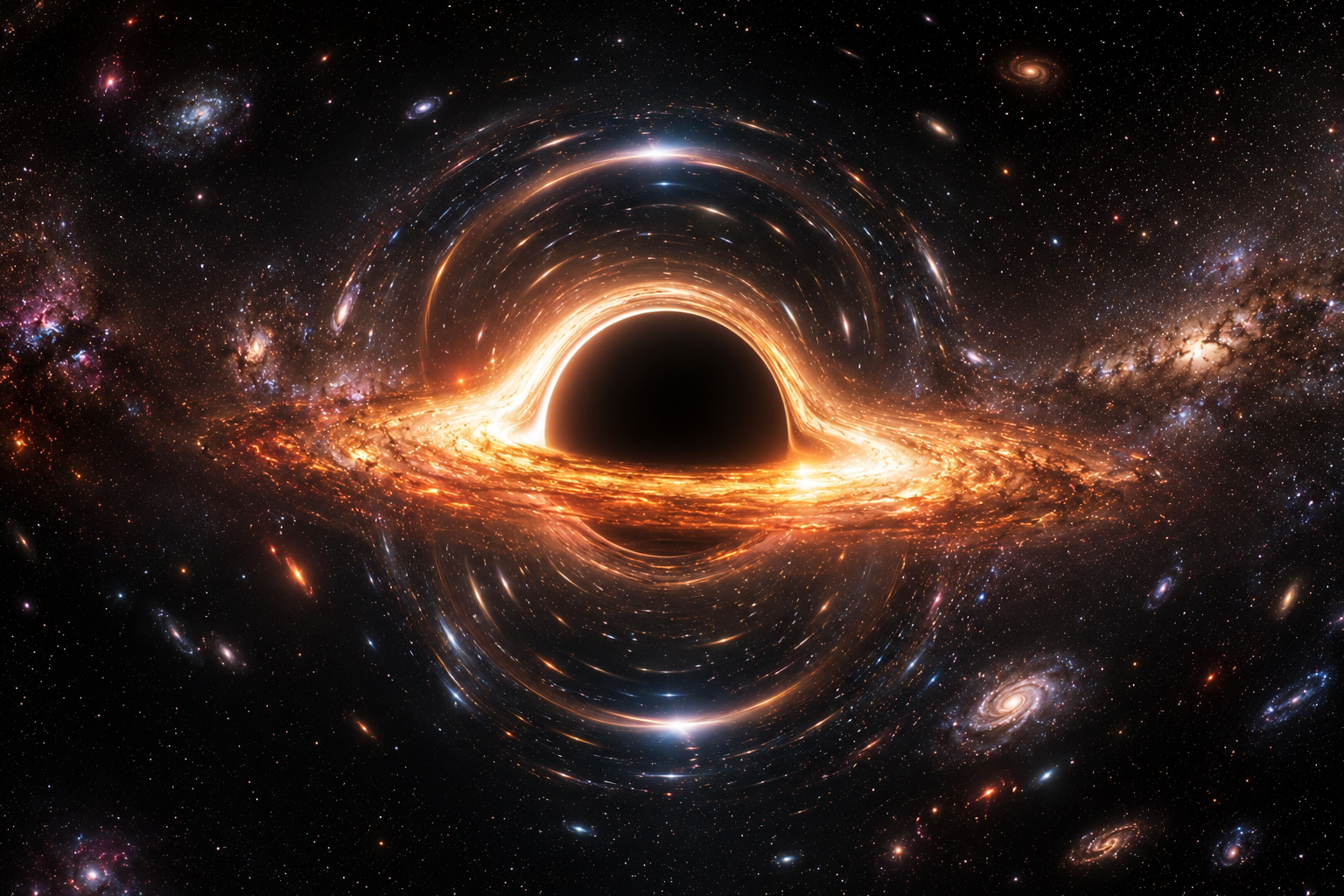
Only a perfect circle of darkness surrounded by a ring of blazing light.
It doesn't make a sound.
It doesn't explode.
It simply waits.
As you drift closer, something strange begins to happen.
The stars behind it appear stretched and twisted, as though space itself has become a giant mirror. Light bends into impossible shapes, and the familiar universe no longer behaves the way it should.
You've arrived at one of nature's most mysterious creations—
a black hole.
For centuries, black holes existed only as strange predictions hidden inside Albert Einstein's equations. They sounded so unbelievable that even many scientists questioned whether they could actually exist.
Today, we know they are real.
Astronomers have photographed one. They have detected two black holes colliding over a billion light-years away. Nearly every large galaxy—including our own Milky Way—appears to hide a supermassive black hole at its heart.
But despite decades of research, black holes remain among the greatest mysteries in science.
They cannot be seen directly.
They trap light itself.
And they challenge everything we think we know about space, time, and gravity.
So what would really happen if you got too close?
To answer that question, we first need to witness one of the most spectacular events in the universe—
the death of a giant star
⬇
⭐ When a Giant Star Takes Its Final Breath
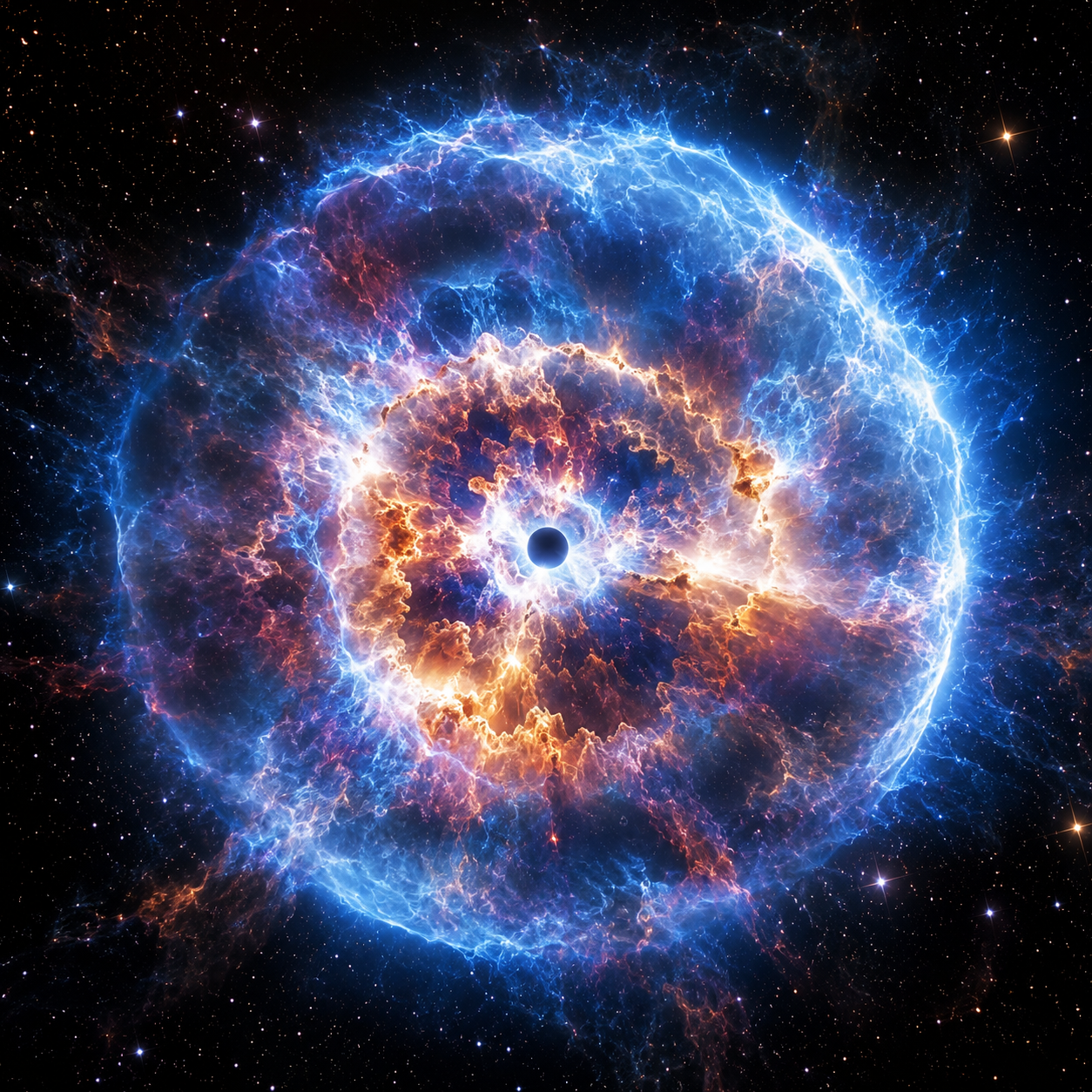
Every black hole begins with a star.
But not just any star.
Imagine a star more than 20 times the mass of our Sun. For millions of years, it shines with unimaginable power, producing enormous amounts of energy by fusing lighter elements into heavier ones inside its blazing core.
This invisible battle keeps the star alive.
Gravity constantly tries to crush the star inward.
The intense energy produced by nuclear fusion pushes outward.
For millions of years, these two forces remain perfectly balanced.
But no star lives forever.
Eventually, the star runs out of fuel.
The outward pressure that once held gravity back suddenly disappears.
In a matter of seconds, gravity wins.
The star collapses inward at incredible speed.
Its core is compressed so violently that atoms themselves are crushed together. The outer layers rebound in a titanic explosion known as a supernova, briefly outshining entire galaxies.
What's left behind depends on the star's mass.
Some become neutron stars.
But the most massive stars suffer a different fate.
Their cores continue collapsing until an object forms with gravity so powerful that nothing—not even light—can escape.
A black hole is born.
It isn't a cosmic vacuum cleaner roaming through space.
It doesn't hunt planets or swallow galaxies whole.
Instead, it behaves like any other massive object, following the same laws of gravity as stars and planets.
The difference is that its mass has been compressed into an unimaginably tiny region, creating one of the most extreme environments in the known universe.
And around this invisible object lies a boundary unlike any other—
a point where turning back becomes impossible.
Scientists call it the Event Horizon.
The Last Line You Can Never Cross
(CHAPTER-2)
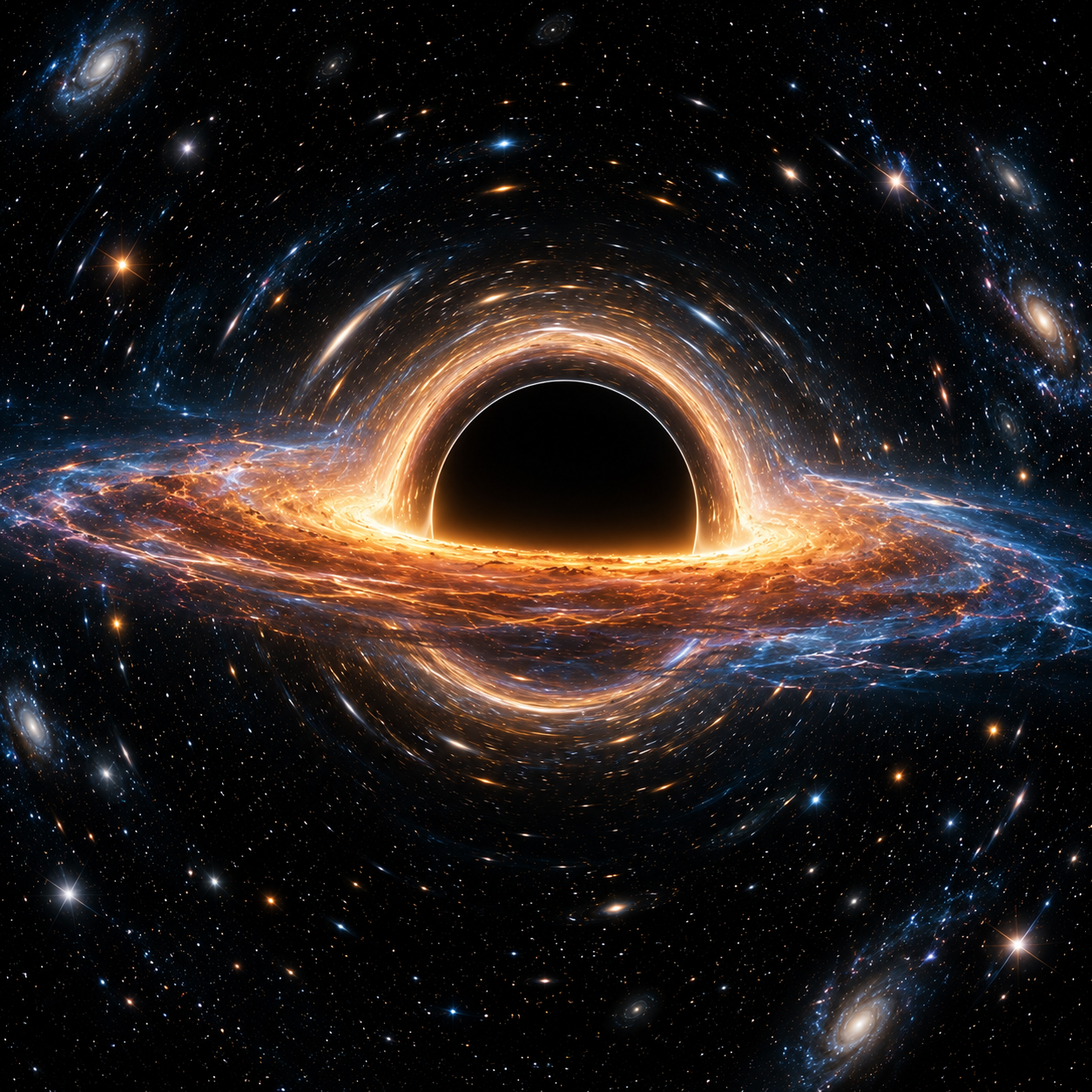
Imagine you're floating toward a black hole.
At first, nothing seems unusual.
There are no giant whirlpools pulling everything inward. No cosmic vacuum cleaner swallowing nearby stars. In fact, if our Sun were magically replaced by a black hole of the same mass—something that's physically impossible, but useful as a thought experiment—Earth would continue orbiting almost exactly as it does today. The only difference is that our planet would be plunged into darkness because the Sun's light would be gone.
That surprises many people.
A black hole's gravity isn't "magical." Far away, it behaves just like the gravity of any other object with the same mass.
So, what makes it different?
The answer lies in an invisible boundary surrounding it—a boundary unlike anything else in the universe.
Scientists call it the Event Horizon.
Think of it as the universe's ultimate point of no return.
Cross this boundary, and every possible path through space and time leads deeper into the black hole. There is no road back out. No engine is powerful enough. No future technology can simply reverse course.
Even light, traveling at nearly 300,000 kilometers (186,000 miles) every second, cannot escape once it crosses the Event Horizon.
That's why black holes appear perfectly black.
They don't absorb darkness.
They imprison light.
According to Einstein's Theory of General Relativity, gravity isn't an invisible force pulling objects through space. Instead, massive objects bend the very fabric of space and time around them.
Imagine placing a heavy bowling ball on a stretched rubber sheet.
The sheet bends, and smaller balls roll toward the center.
Now imagine replacing the bowling ball with something so dense that the sheet folds into an almost bottomless pit.
That gives a rough idea of what a black hole does to spacetime—although the real universe is far more complex than a rubber sheet.
Near a black hole, space becomes so severely curved that every possible direction points inward.
Escaping isn't like trying to climb a steep mountain.
It's more like trying to swim upstream in a waterfall that's already carrying you over the edge.
The closer you move toward the Event Horizon, the stranger the universe begins to look.
Light from distant stars bends into glowing rings around the black hole, creating one of nature's most beautiful illusions. Astronomers call this gravitational lensing. Entire galaxies can appear stretched, distorted, or duplicated because the black hole warps the path of light itself.
What you're seeing isn't an optical trick.
It's gravity reshaping the appearance of the universe.
For someone watching safely from far away, your journey toward the Event Horizon would seem to slow down. Your movements would become slower and slower until you appeared almost frozen at the edge of the black hole.
But from your own perspective, something completely different would happen.
You wouldn't feel time slowing at all.
You would continue falling, unaware that the rest of the universe was watching your final moments unfold differently.
This strange disagreement between two observers is one of the most fascinating consequences of Einstein's theory.
And it raises an unsettling question.
If two people can witness the same event in completely different ways..., what would you actually experience after crossing the Event Horizon?
To answer that, we have to take one final step into the darkness.
If You Fell into a Black Hole
(CHAPTER-3)
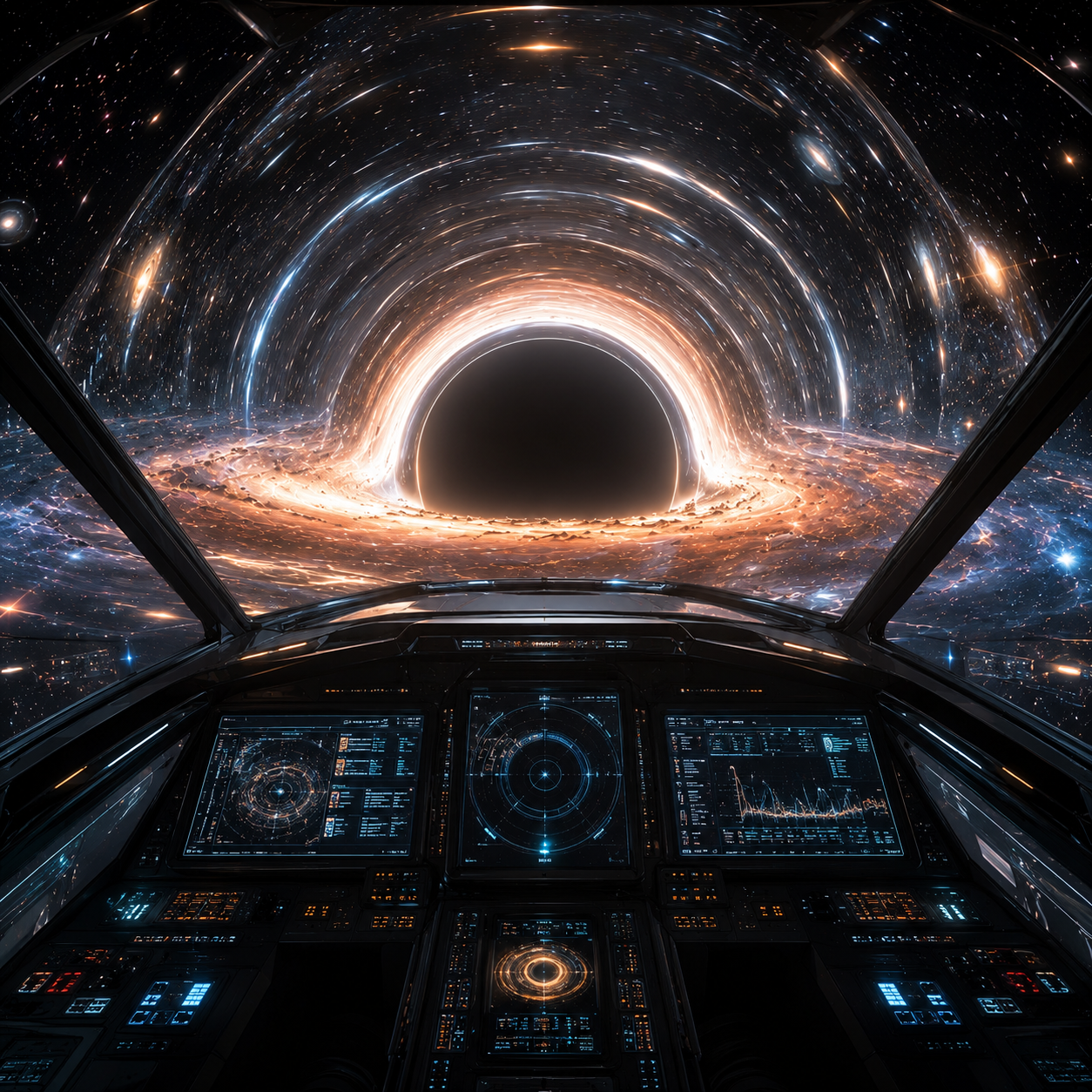
For a moment, forget everything you know about space.
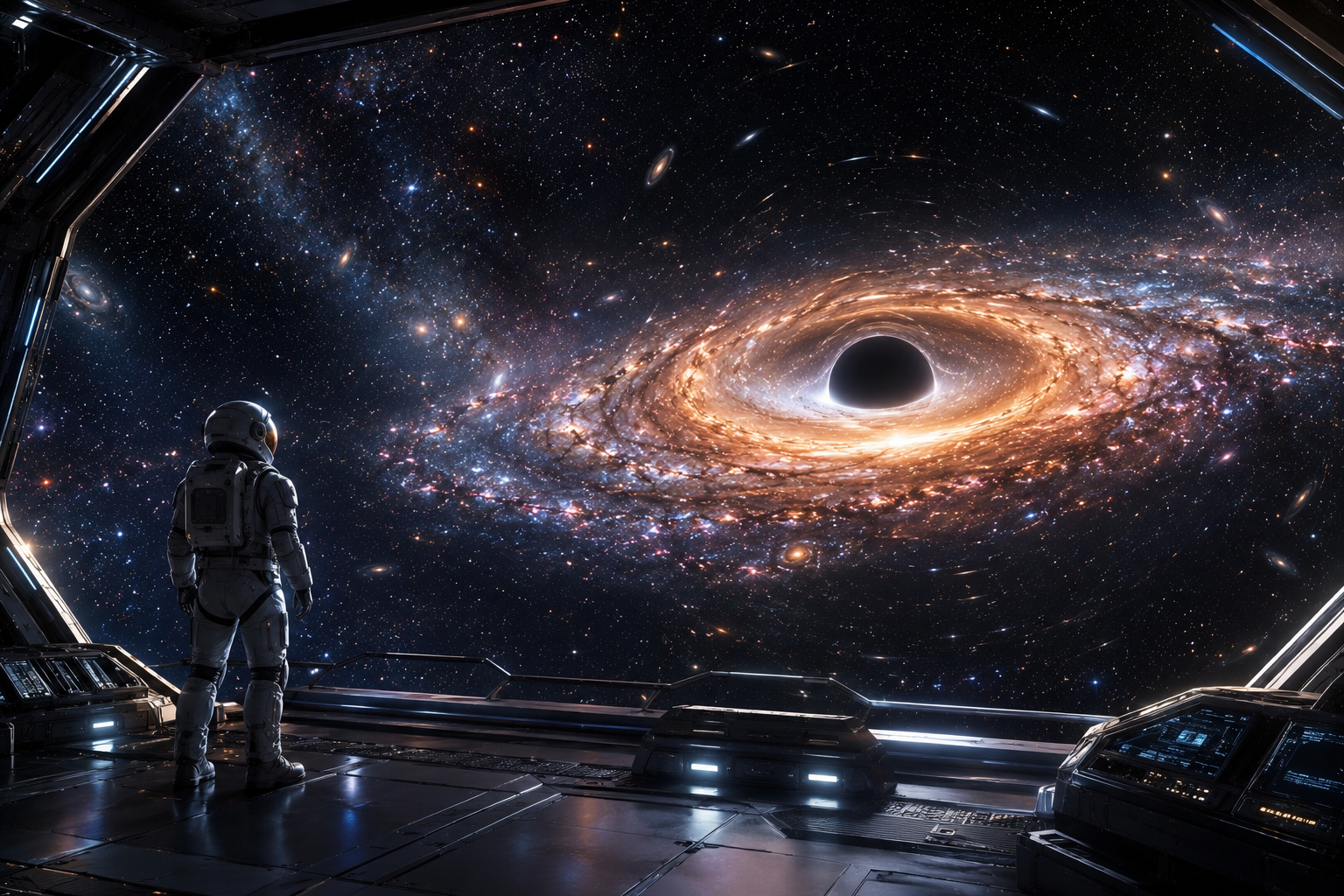
Imagine you've climbed aboard a futuristic spacecraft built to survive the impossible. Ahead of you, the black hole fills your view—a perfectly dark sphere surrounded by a brilliant whirlpool of glowing gas. There is no turning back now.
You cross the Event Horizon.
Surprisingly...
Nothing happens.
No explosion.
No invisible wall.
No sudden jolt.
If the black hole is large enough, you wouldn't even realize you had crossed the boundary. The Event Horizon isn't a physical surface—it's an invisible line in space where escape becomes impossible.
And that's what makes it so unsettling.
You can cross it without noticing, yet from that instant onward, every path leads deeper into the black hole.
⬇
Time Begins to Tell Two Different Stories
Something extraordinary is now happening—but not in the way you might expect.
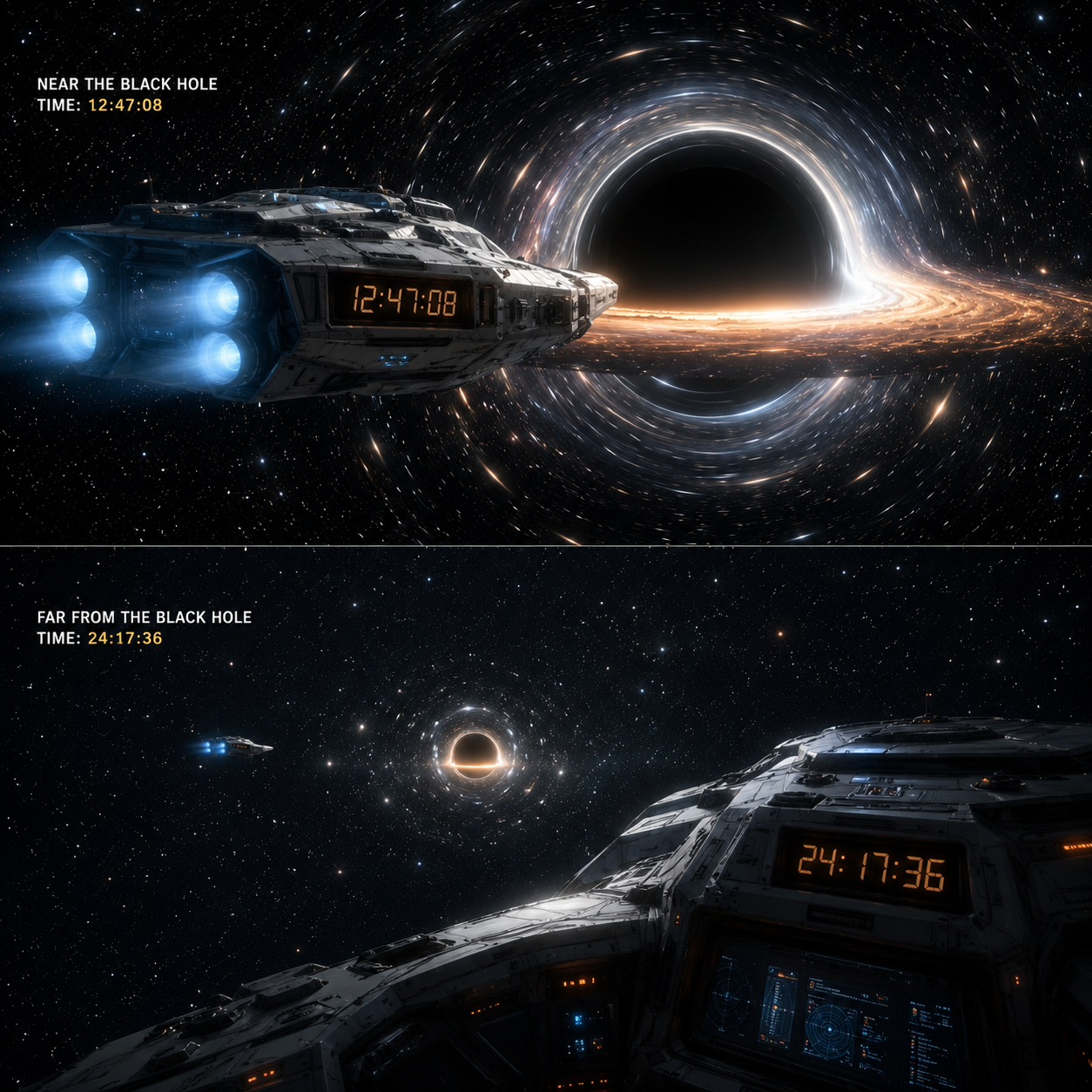
Imagine your friend is watching your spacecraft from a safe distance, millions of kilometers away.
To your friend, your clock appears to tick more slowly.
Your movements become increasingly sluggish.
The light coming from your spacecraft shifts toward the red end of the spectrum, becoming dimmer and dimmer.
Eventually, you seem to freeze at the edge of the black hole, fading until you disappear from view.
From your friend's perspective...
You never truly cross the Event Horizon.
But inside the spacecraft, your experience is completely different.
Your heartbeat feels normal.
Your watch keeps perfect time.
The engines respond exactly as they always have.
You continue falling without sensing anything unusual.
Both observations are correct.
This strange disagreement isn't science fiction—it's one of the remarkable predictions of Einstein's Theory of General Relativity.
Near a black hole, gravity doesn't just pull-on matter.
It changes the flow of time itself.
⬇
The Universe Changes Around You
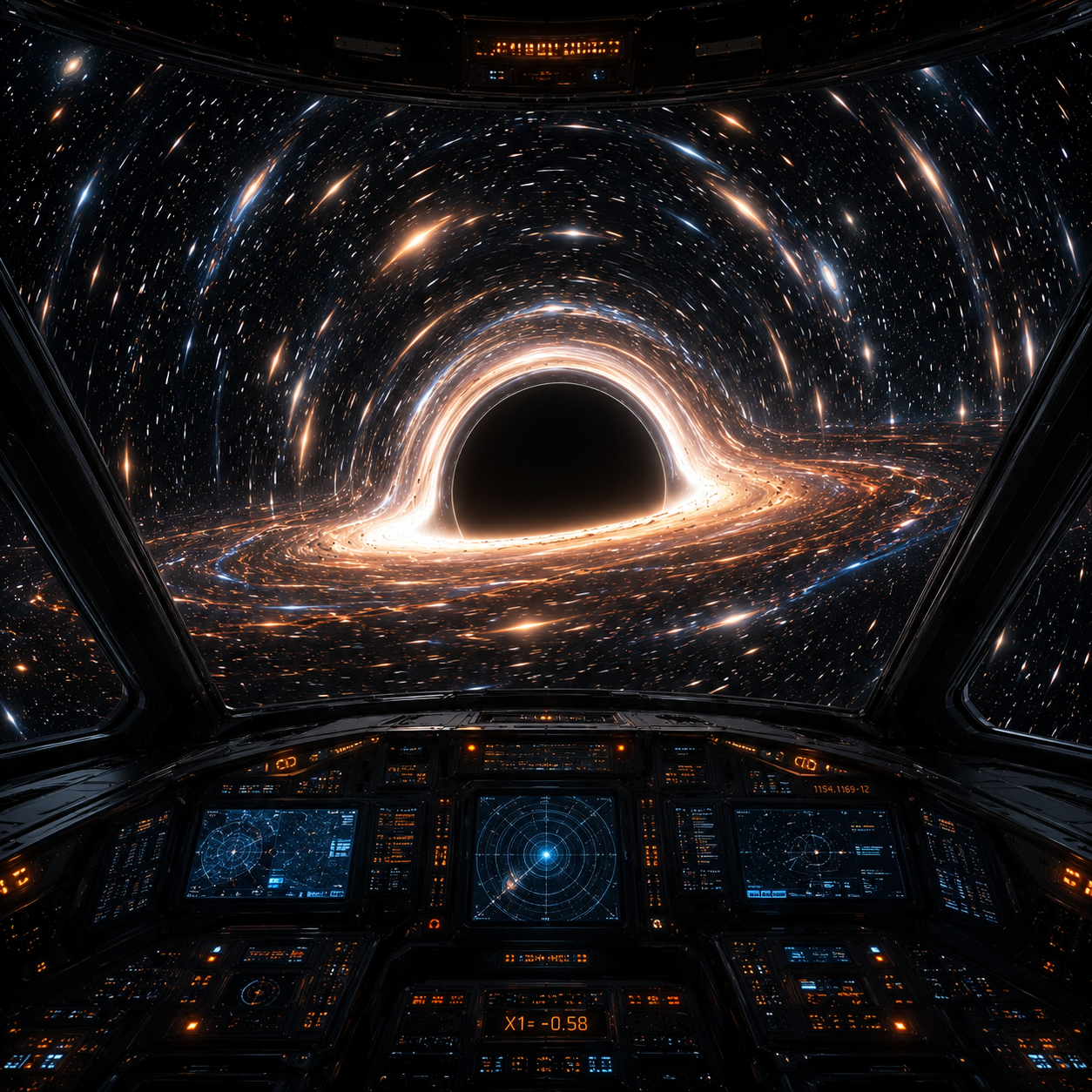
As you fall deeper, the view outside becomes almost surreal.
The stars ahead seem to gather into bright arcs.
Behind you, the universe appears increasingly distorted.
Light bends around the black hole, creating glowing rings and warped patterns unlike anything seen anywhere else in the cosmos.
If you could somehow look back toward Earth, millions—or perhaps billions—of years might appear to pass in what feels like only a short time to you, depending on the black hole and your trajectory.
Black holes don't simply distort space.
They reshape our understanding of time.
⬇
The Fate Scientists Call "Spaghettification"
Eventually, gravity begins to reveal its true power.
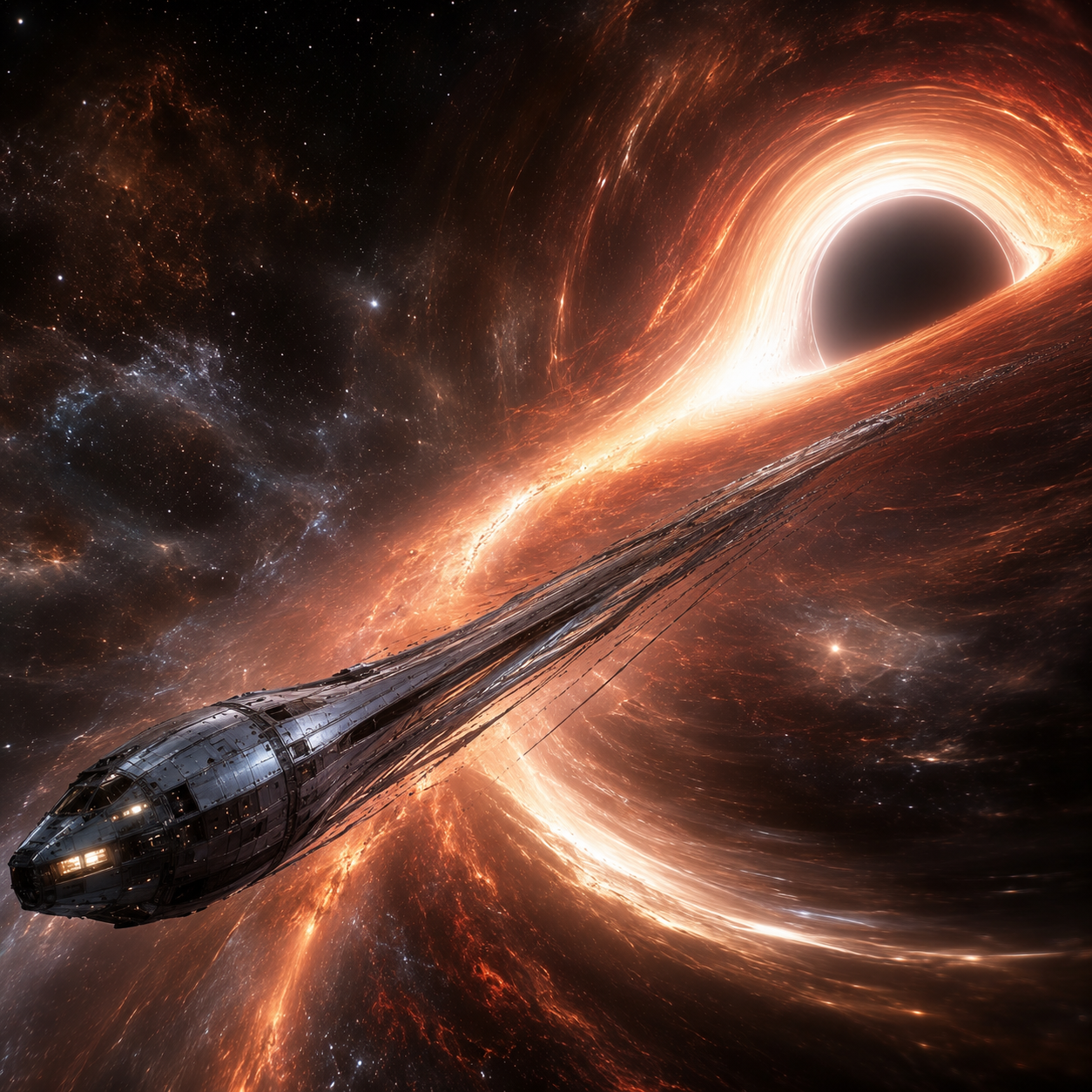
The pull on your feet becomes slightly stronger than the pull on your head.
At first, the difference is tiny.
But with every kilometer you fall, it grows.
These differences in gravity are called tidal forces.
Near a small black hole, tidal forces become so extreme that they would stretch your body longer and longer while squeezing it thinner and thinner.
Scientists have given this dramatic process an unforgettable nickname:
Spaghettification.
No human—or spacecraft built with today's technology—could survive it.
Interestingly, this doesn't happen immediately around every black hole.
For supermassive black holes, like the one at the center of the Milky Way, the Event Horizon is so enormous that you might cross it before tidal forces become deadly.
Your journey inward would continue...
But it could only end one way.
⬇
Beyond the Reach of Physics
What happens after that?
Here, science reaches its limit.
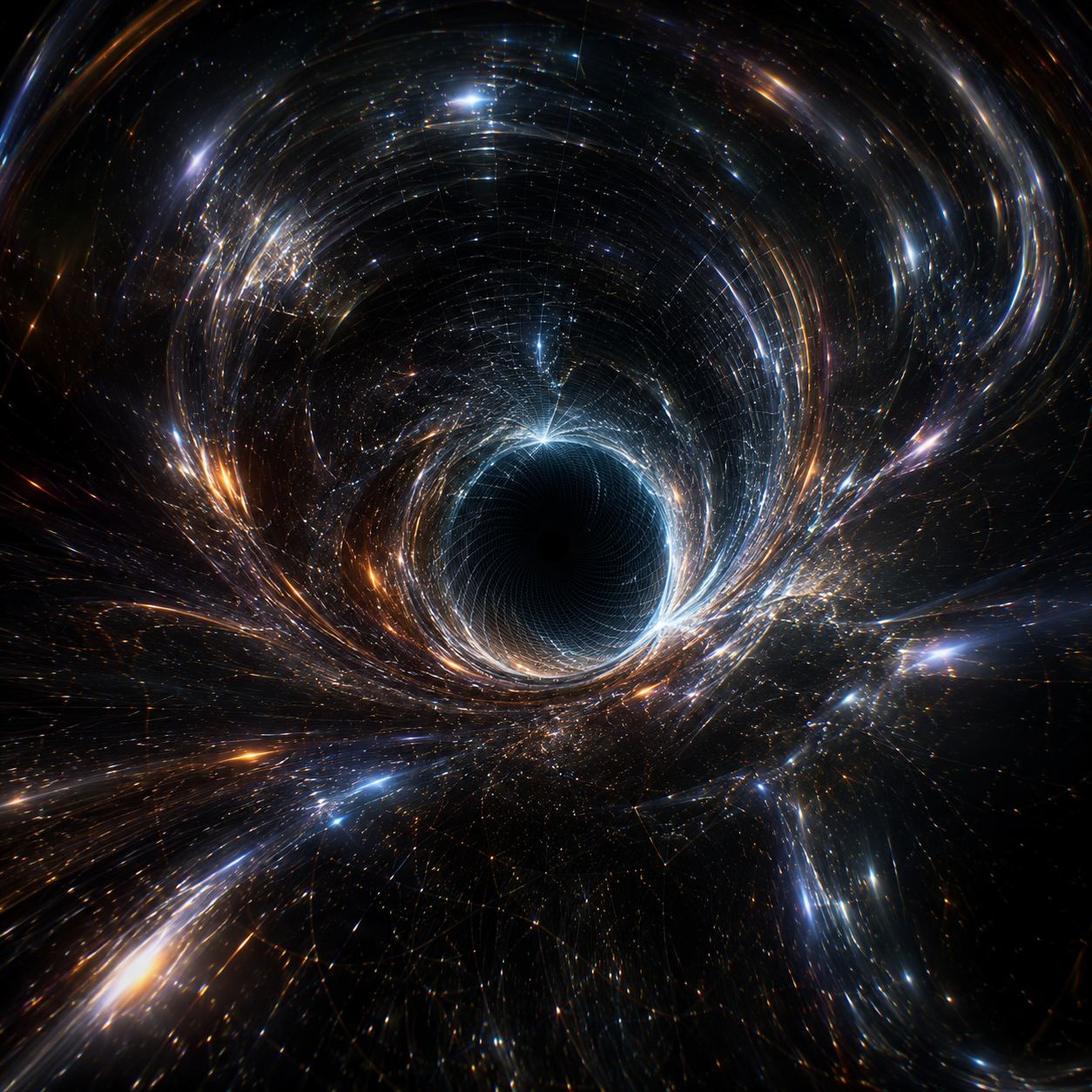
According to Einstein's equations, everything eventually collapses toward a point of almost unimaginable density called a singularity.
At this point, gravity becomes so extreme that our current understanding of physics breaks down.
The equations that describe planets, stars, and even black holes no longer provide reliable answers.
Some physicists believe a future theory of quantum gravity will explain what truly happens.
Others think the singularity may not exist in the way we imagine.
For now...
No one knows.
And that uncertainty is what keeps black holes at the very frontier of modern science.
The deeper we look into them, the more they challenge everything we thought we understood about the universe.
Our journey isn't over yet.
Because while stellar black holes are astonishing, there are others so immense that they shape the evolution of entire galaxies—including our own.
The Giants Hidden Inside Galaxies (CHAPTER-4)
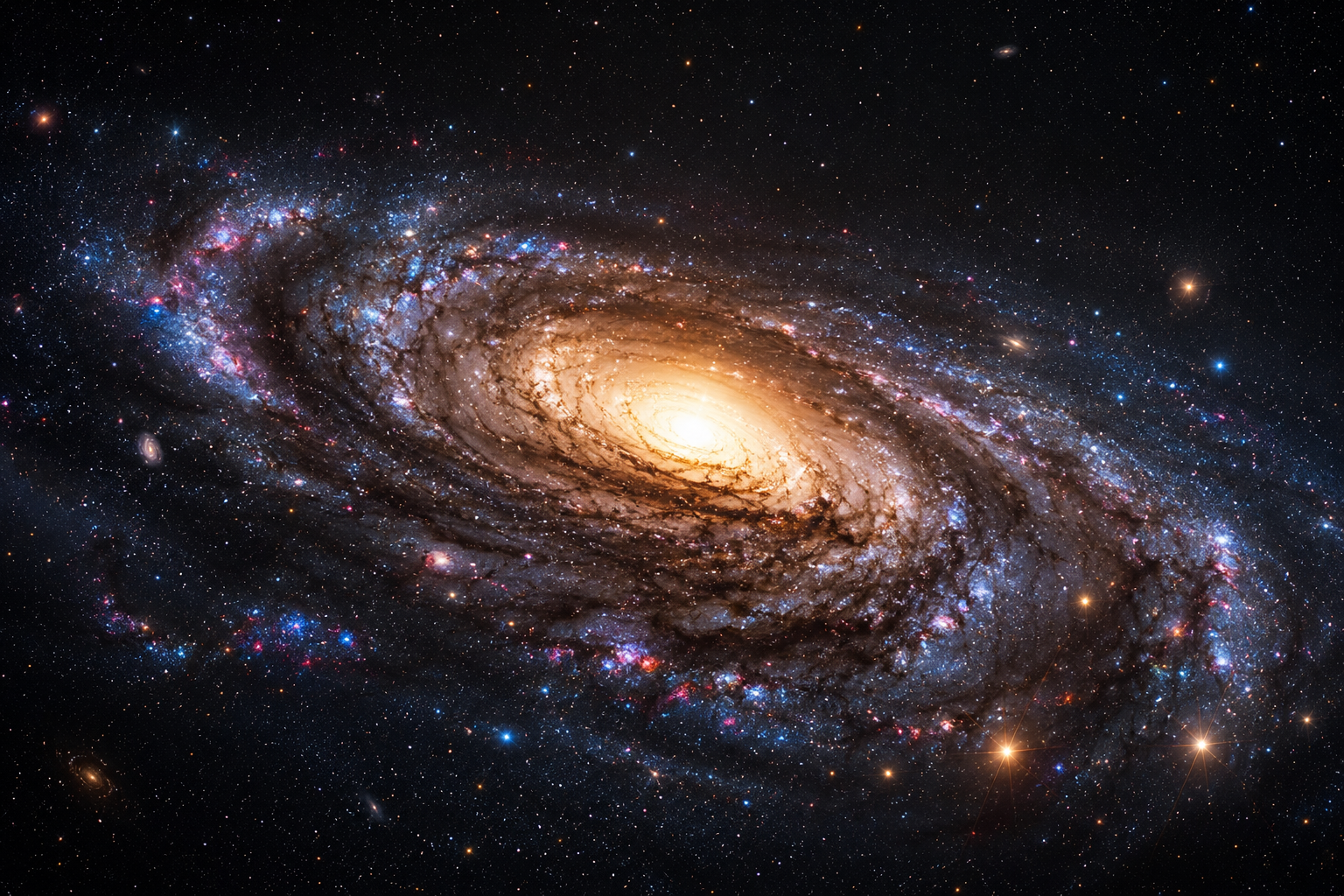
If you've imagined black holes as lonely monsters drifting through space, it's time to think much bigger.
Far beyond the stellar black holes created by dying stars exists another class so enormous that it reshapes entire galaxies.
These are supermassive black holes.
Unlike their smaller cousins, which may contain a few times the mass of our Sun, supermassive black holes can hold millions—or even billions—of solar masses within a region smaller than our Solar System.
They are among the largest and most influential objects in the known universe.
Even more astonishing, astronomers have discovered that nearly every large galaxy appears to hide one at its center.
That includes our own home—the Milky Way.
⬇
The Invisible Heart of Our Galaxy
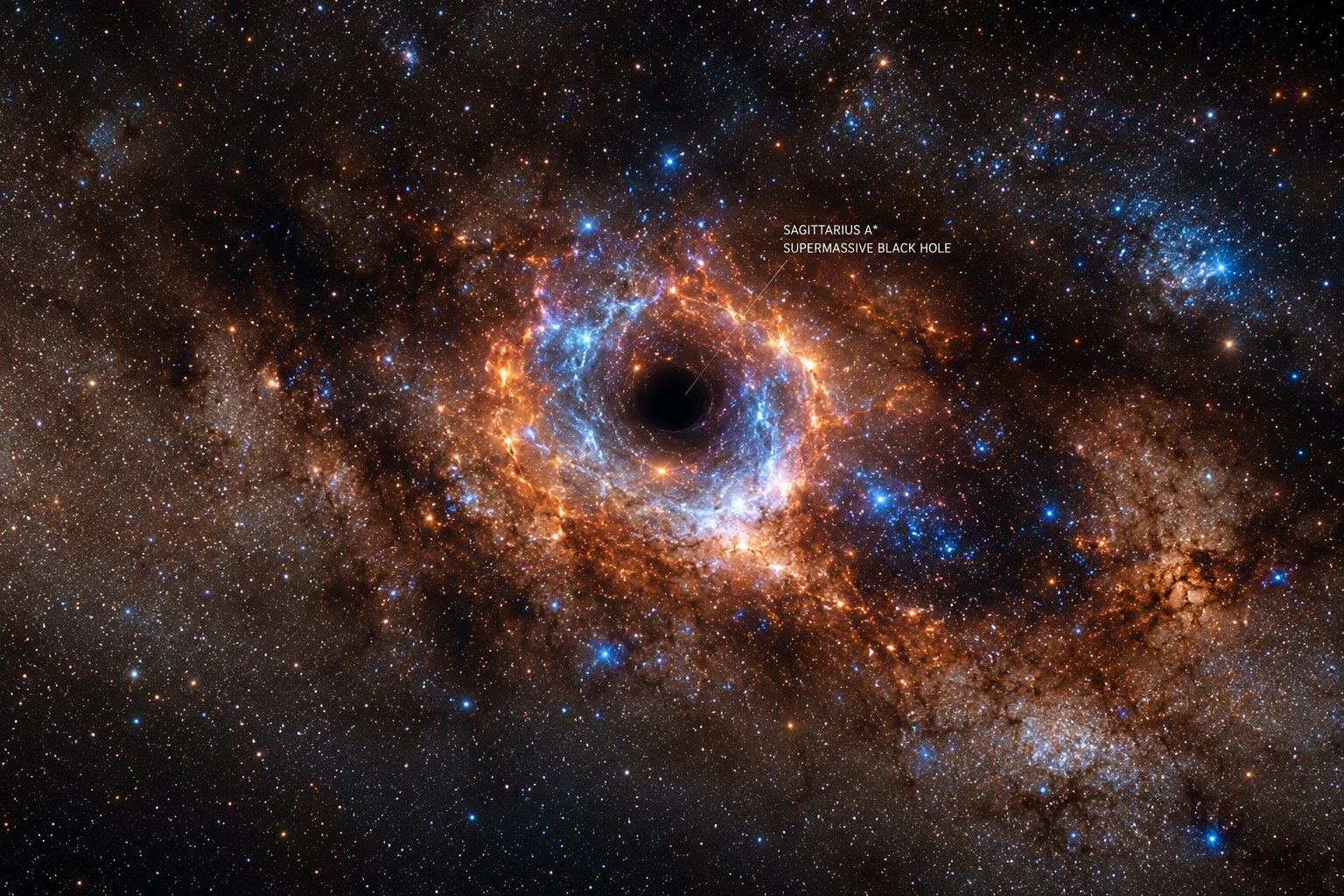
For centuries, the center of the Milky Way remained hidden behind enormous clouds of dust, making it impossible for ordinary telescopes to see what lay within.
But by observing invisible infrared light and tracking the motion of stars, astronomers uncovered something extraordinary.
Thousands of stars were racing around an object they couldn't see.
They weren't orbiting a bright star.
They weren't circling a cluster of planets.
Instead, they were moving around an invisible object with the mass of more than four million Suns packed into an incredibly small space.
This cosmic giant is known as Sagittarius A* (pronounced Sagittarius A-Star).
Although it dominates the center of our galaxy, Sagittarius A* is located about 26,000 light-years from Earth, posing no danger to our Solar System.
In 2022, astronomers achieved something once thought impossible.
Using the Event Horizon Telescope, they captured humanity's first image of Sagittarius A*, revealing the glowing ring of superheated gas surrounding its shadow.
It wasn't just another scientific photograph.
It was the first glimpse into the hidden heart of our own galaxy.
⬇
The Engines That Shape Entire Galaxies
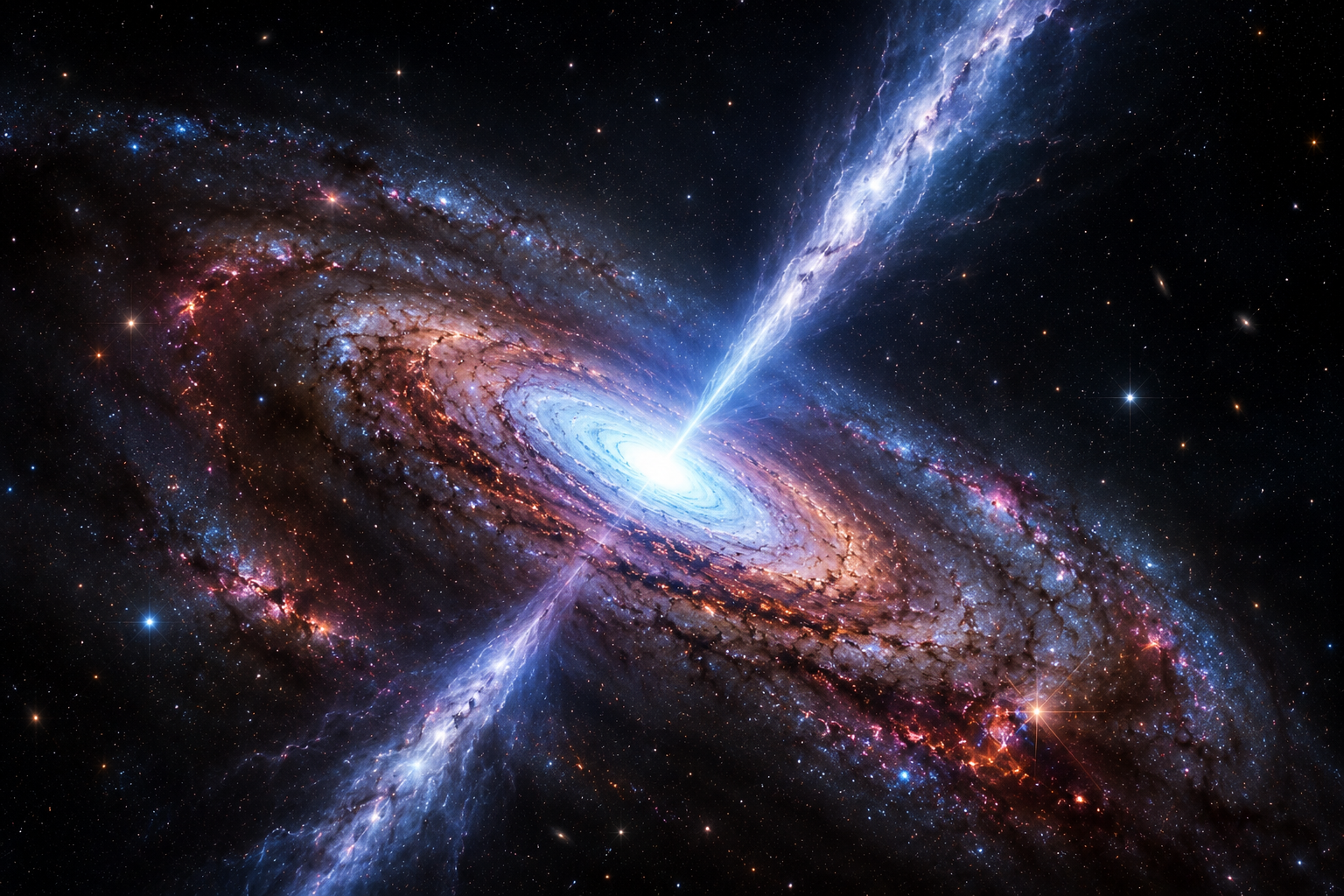
A supermassive black hole doesn't simply sit quietly at the center of a galaxy.
It influences everything around it.
As nearby gas, dust, and even unlucky stars spiral inward, they form an accretion disk—a rapidly rotating ring of superheated matter.
The intense friction inside this disk heats the material to millions of degrees, causing it to shine brighter than billions of stars combined.
Some actively feeding black holes become the brightest objects in the universe.
These extraordinary objects are called quasars.
A single quasar can outshine an entire galaxy, even though the light comes from a region much smaller than the galaxy itself.
Powerful jets of energy can also erupt from the poles of these black holes, stretching thousands of light-years into space.
These jets heat surrounding gas, influence the birth of new stars, and help determine how galaxies grow over billions of years.
Far from being simple destroyers, supermassive black holes play a surprising role in shaping the very galaxies that surround them.
Without them, many galaxies—including our own—might have evolved very differently.
⬇
A Collision Written Across the Universe
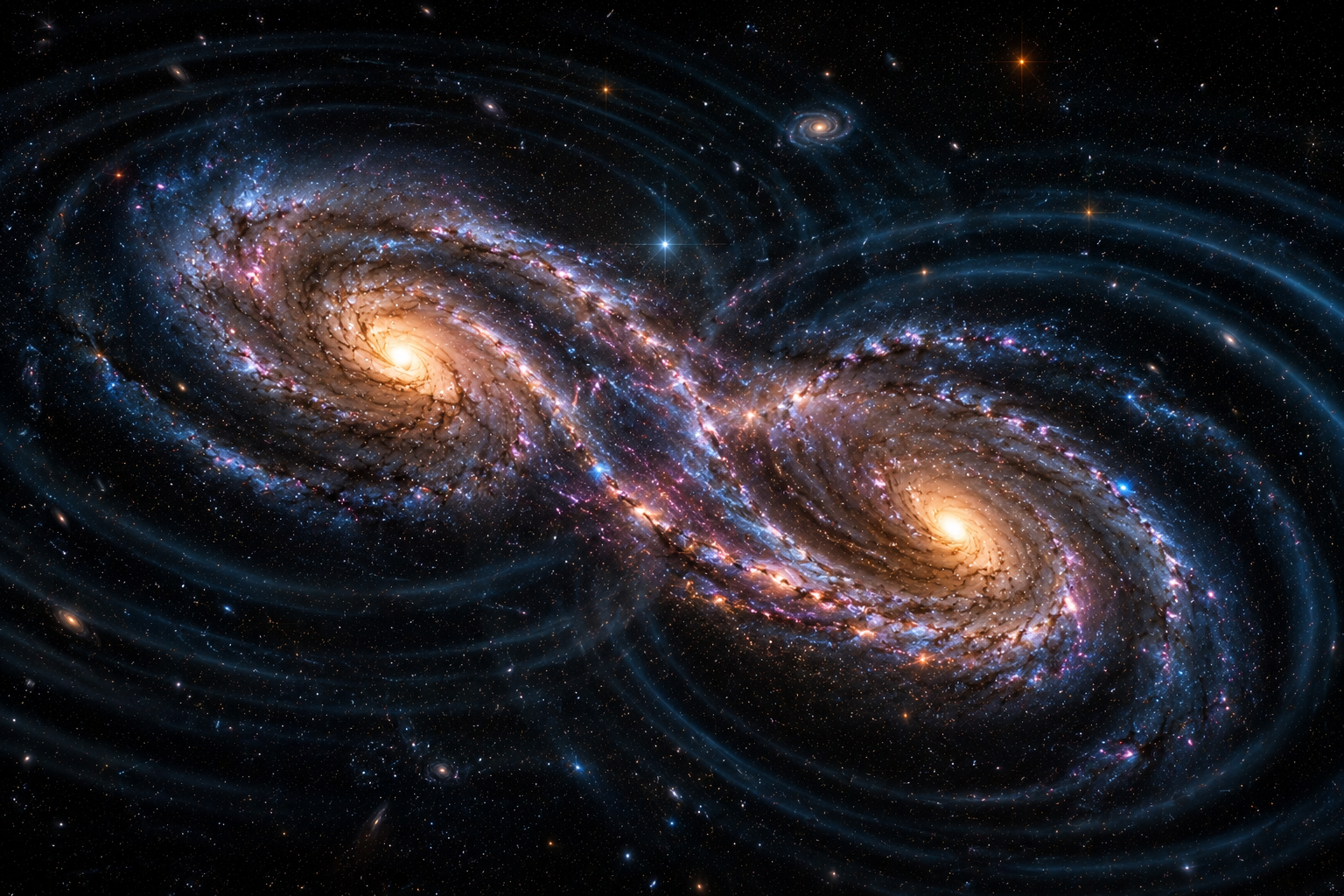
Galaxies are not fixed islands drifting forever through space.
Over billions of years, gravity pulls them together in slow-motion collisions that can completely reshape their structure.
When two galaxies merge, something remarkable happens at their centers.
Their supermassive black holes begin an immense gravitational dance, orbiting one another for millions of years before finally colliding.
The merger releases an enormous burst of gravitational waves—ripples in the fabric of spacetime itself.
These waves travel across the universe at the speed of light, carrying the story of one of the most powerful events nature can produce.
In 2015, scientists made history by detecting gravitational waves for the first time, confirming a prediction Albert Einstein had made a century earlier.
It was more than a scientific milestone
For the first time, humanity wasn't just seeing the universe.
We were listening to it.
The deepest regions of space had found a new way to tell their story.
Looking Into the Abyss
(CHAPTER-5)
Our journey has taken us from the explosive death of massive stars to the invisible giants hidden at the centers of galaxies. We've crossed the Event Horizon, experienced the strange effects of warped space and time, and discovered that black holes are far more than cosmic destroyers.
Yet, despite everything we've learned, the greatest mystery still lies ahead.
What truly happens inside a black hole?
The honest answer is surprisingly simple.
No one knows.
The Event Horizon marks the limit of what we can observe. Once anything crosses this invisible boundary, no information can escape to tell us what happened. It's like trying to describe a world beyond a door that can never be opened.
At the heart of every black hole, Einstein's theory predicts the existence of a singularity—a place where matter is compressed to unimaginable densities and gravity becomes infinitely strong. Here, the equations of General Relativity begin to fail, suggesting that our understanding of the universe is incomplete.
For scientists, this isn't a dead end.
It's an invitation.
Some researchers believe a future theory known as quantum gravity will finally unite Einstein's theory of gravity with quantum mechanics, revealing what truly happens beyond the Event Horizon. Others suggest that singularities may not exist at all, but instead hide entirely new forms of physics waiting to be discovered.
One of the biggest puzzles is called the Black Hole Information Paradox.
According to quantum mechanics, information can never be completely destroyed. Every particle carries information about its past, and the laws of physics say that information should always be preserved.
But black holes seem to do exactly the opposite.
If a star, planet, or even a beam of light falls into a black hole, where does that information go?
Is it destroyed forever?
Hidden inside the black hole?
Or somehow released back into the universe?
For decades, physicists have debated this question, and no single answer has been proven correct.
In the 1970s, the renowned physicist Stephen Hawking proposed an idea that changed our understanding of black holes forever.
He suggested that black holes are not completely black.
Tiny quantum effects near the Event Horizon may cause them to emit an extremely faint glow, now known as Hawking Radiation.
This radiation is so weak that it has never been directly detected from a black hole in space. Yet, if Hawking's prediction is correct, black holes slowly lose energy over unimaginable timescales.
A stellar black hole could take far longer than the current age of the universe to disappear.
The largest supermassive black holes may survive for trillions upon trillions of years before finally evaporating into the darkness.
It is a reminder that even the mightiest objects in the cosmos are not eternal.
Quick Cosmic Facts🏃
- 🌌 The first-ever image of a black hole was released in 2019 by the Event Horizon Telescope.
- ⭐ The Milky Way's central black hole, Sagittarius A*, contains about 4 million times the mass of the Sun.
- 🌍 Nearly every large galaxy studied by astronomers appears to contain a supermassive black hole.
- ⏳ Gravity near a black hole slows the passage of time, one of the remarkable predictions of Einstein's General Relativity.
- 📡 Black holes themselves are invisible. Scientists detect them by observing the motion of nearby stars, glowing gas, and gravitational waves.
- 🌠 The collision of two black holes releases gravitational waves that travel across the universe at the speed of light.
- 🚀 The largest known black holes contain tens of billions of solar masses, making them among the most massive objects ever discovered.
The Universe's Greatest Mystery
Black holes have transformed from mathematical predictions into some of the most important laboratories in modern science.
They test Einstein's theories under the most extreme conditions. They shape galaxies, influence the birth of stars, and may hold clues to a deeper understanding of space, time, and reality itself.
With every discovery, scientists answer one question only to uncover many more.
Perhaps that's what makes black holes so captivating.
They remind us that the universe is not a finished story. It is still being explored, one observation at a time.
Tonight, as you look toward the night sky, remember that somewhere among the billions of stars are silent giants invisible to our eyes—bending light, shaping galaxies, and guarding secrets that humanity has yet to unlock.
The deeper we look into the abyss, the more we realize that the universe is far more extraordinary than we ever imagined.
🌌 AtlasNova Perspective
Every mystery we solve opens the door to another. Black holes remind us that the universe isn't just a place to observe—it's a story we're still learning to understand. And perhaps, the most extraordinary chapters have yet to be written.
Frequently Asked Questions
1. What would happen if you fell into a black hole?
As you approached a black hole, its gravity would become increasingly extreme. For a stellar-mass black hole, tidal forces could stretch and eventually tear you apart—a process called spaghettification.
2. Would you feel yourself crossing a black hole's event horizon?
For a sufficiently large black hole, you might not notice anything special at the exact moment you crossed the event horizon. The event horizon is a boundary beyond which escape is impossible.
3. Can anything escape from a black hole?
Nothing that crosses the event horizon can escape, including light. This is why black holes appear dark. Hawking radiation is a separate quantum effect predicted to originate near the black hole's horizon.
4. What is spaghettification?
Spaghettification happens when the difference in gravitational pull between different parts of an object becomes enormous. One end can be pulled much more strongly than the other, stretching the object lengthwise.
5. Would time stop if you fell into a black hole?
Not from your own perspective. You would experience your own time normally while falling. However, a distant observer could see your signals becoming increasingly delayed and redshifted as you approached the event horizon.
6. Could you survive inside a black hole?
According to current physics, surviving indefinitely after crossing the event horizon is not possible. Eventually, you would encounter extreme conditions as you moved deeper into the black hole.
7. What would you see while falling into a black hole?
The view would be highly distorted by gravitational lensing. Light from distant objects could appear bent, stretched, or wrapped around the black hole.
8. Would a black hole immediately suck up everything nearby?
No. A black hole's gravity behaves like that of any other object of the same mass when you're far away. Objects can orbit black holes without falling into them if they have the appropriate speed and trajectory.
9. What happens at the center of a black hole?
According to classical general relativity, matter falling into a non-rotating black hole reaches a singularity, where density and spacetime curvature become mathematically extreme. However, we do not yet have a complete theory of quantum gravity, so the true physical nature of the center remains unknown.
10. Can humans ever enter a black hole and come back?
No. Once something crosses the event horizon, it cannot return to the outside universe. A human mission to a black hole would therefore be a one-way journey.