A Telescope That Changed Everything
For thousands of years, humans looked up at the night sky and wondered what lay beyond the stars.
Early astronomers used simple telescopes to study the Moon and planets. Later, powerful observatories revealed distant galaxies, black holes, and exploding stars.
But many of the universe's greatest mysteries remained hidden.
How did the very first galaxies form?
What are the atmospheres of distant planets like?
Could worlds beyond our Solar System support life?
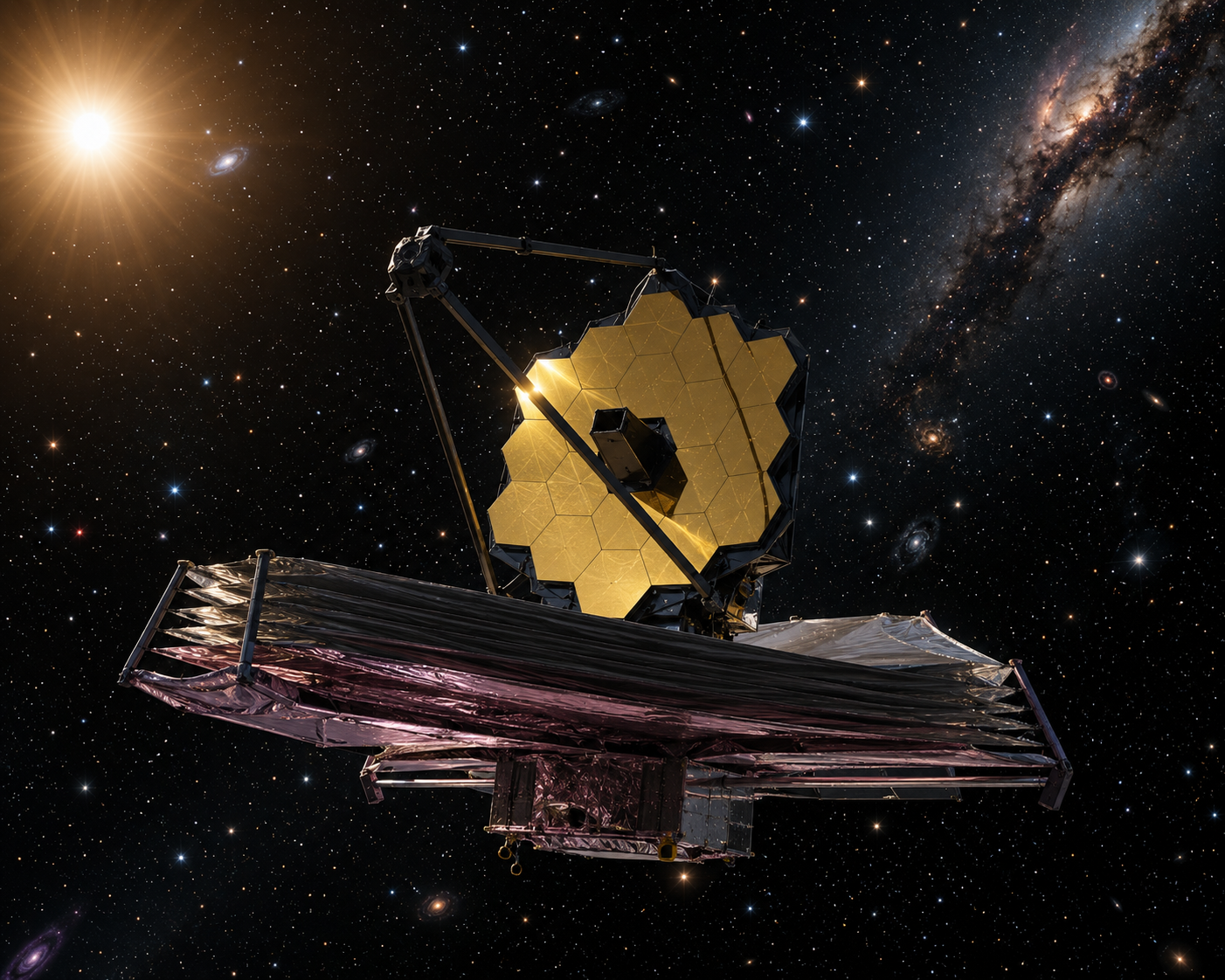
To answer these questions, scientists built the James Webb Space Telescope (JWST)—the most advanced space observatory ever created.
Unlike any telescope before it, Webb can peer deeper into space and farther back in time, revealing parts of the universe that had never been seen by human eyes.
It is opening a new chapter in our exploration of the cosmos.
Meet the James Webb Space Telescope
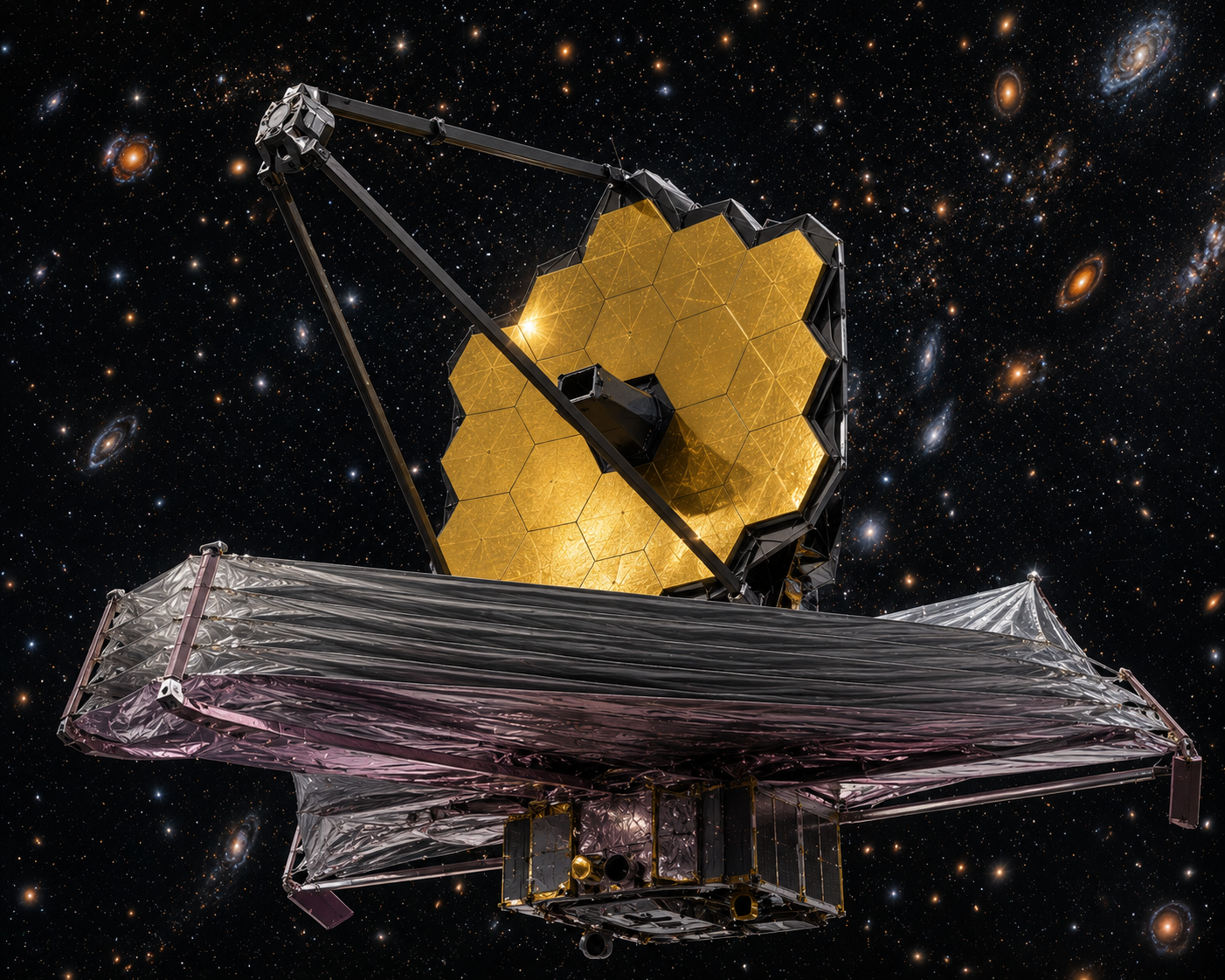
The James Webb Space Telescope is often called the successor to the famous Hubble Space Telescope, but it is much more than a replacement.
Launched on December 25, 2021, Webb was designed through an international partnership between NASA, the European Space Agency (ESA), and the Canadian Space Agency (CSA).
Its most recognizable feature is its enormous 6.5-meter (21-foot) golden primary mirror, made from 18 hexagonal segments coated with a thin layer of gold.
This giant mirror collects far more light than previous space telescopes, allowing Webb to observe extremely faint and distant objects.
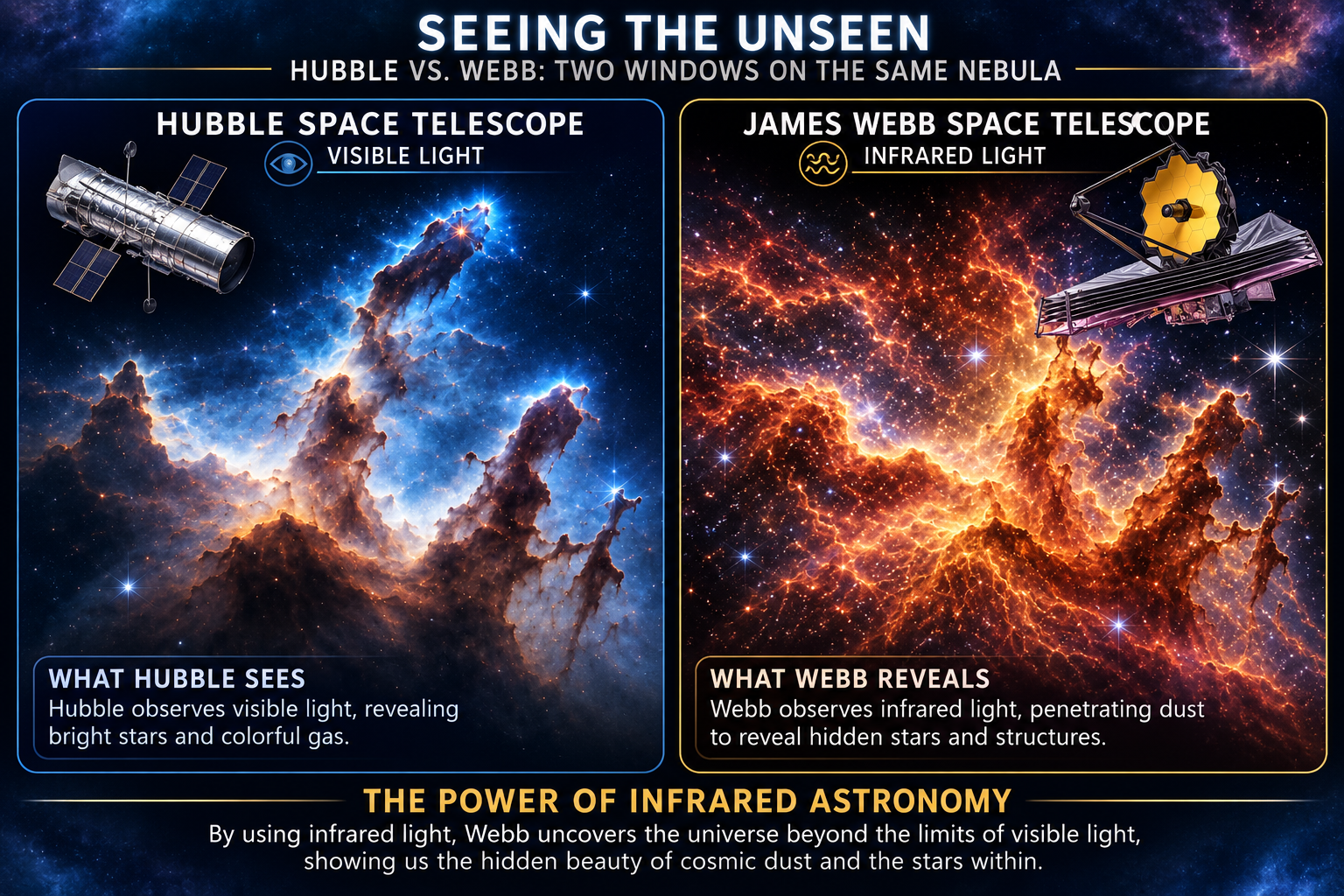
Unlike Hubble, which mainly sees visible light, Webb specializes in infrared light. Infrared observations allow scientists to look through cosmic dust and study objects that would otherwise remain invisible.
Why Build Another Space Telescope?
The Hubble Space Telescope transformed astronomy and captured some of the most famous images ever taken.
So why build another telescope?
The answer lies in the limits of visible light.
Many of the universe's oldest galaxies are so far away that their light has stretched into the infrared part of the spectrum as the universe expanded.
Visible-light telescopes cannot clearly observe these ancient objects.
Infrared light also passes through clouds of dust where new stars and planets are forming, allowing Webb to study places hidden from earlier telescopes.
By observing the universe in infrared, Webb reveals details that were impossible to see before.
Instead of replacing Hubble, the two telescopes complement each other, giving scientists a more complete view of the cosmos.
The Most Powerful Space Telescope Ever Built
Building the James Webb Space Telescope was one of the greatest engineering challenges in history.
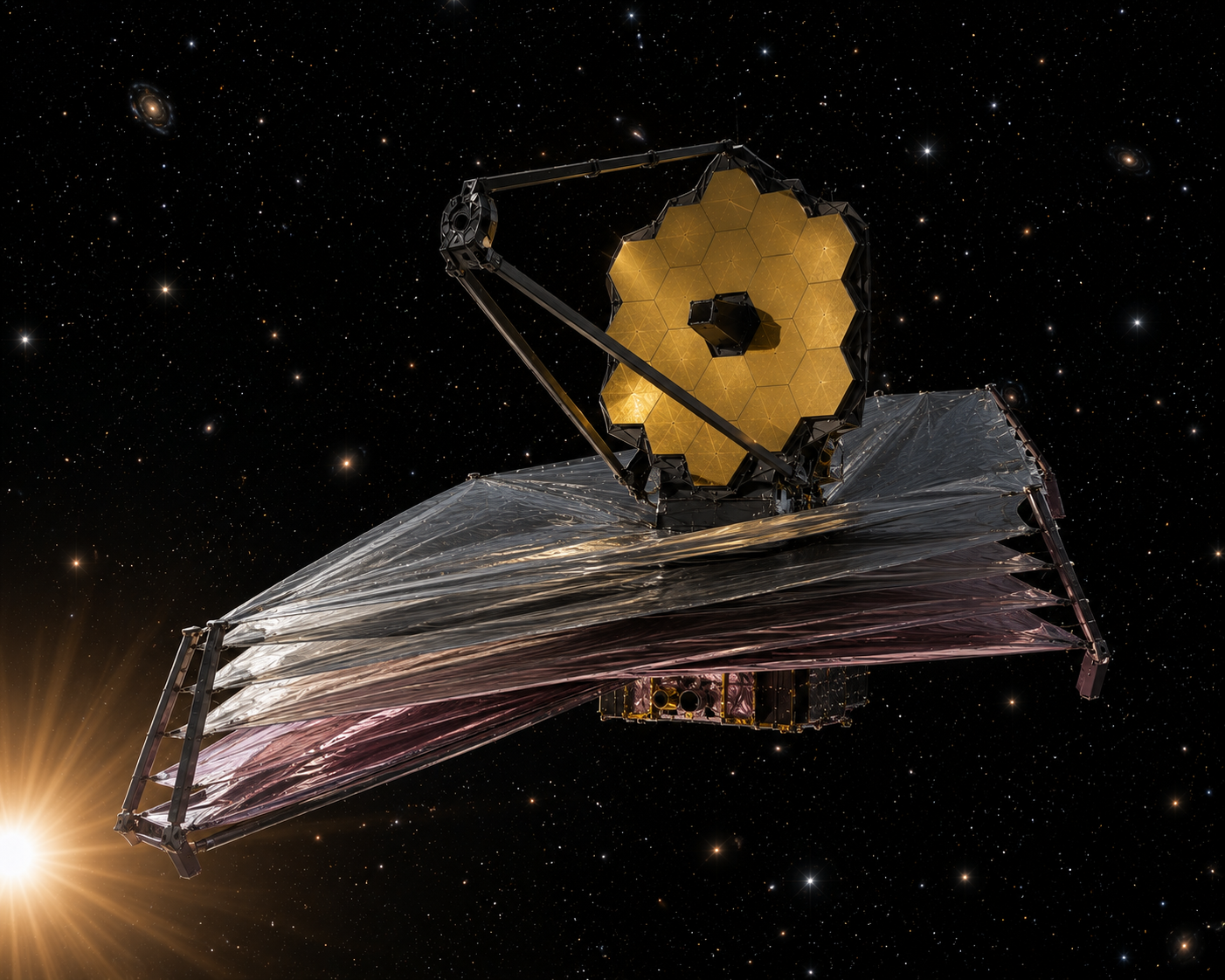
Its mirror is nearly three times wider than Hubble's, giving it a much larger light-collecting area.
To detect faint infrared signals, Webb must remain incredibly cold.
A giant five-layer sunshield, about the size of a tennis court, blocks heat from the Sun, Earth, and Moon, keeping the telescope's instruments at temperatures below −223°C (−369°F).
Each layer of the sunshield is thinner than a human hair but works together to reduce heat dramatically.
Without this remarkable cooling system, Webb would be unable to detect the faint infrared light arriving from the distant universe.
A Million Miles From Home
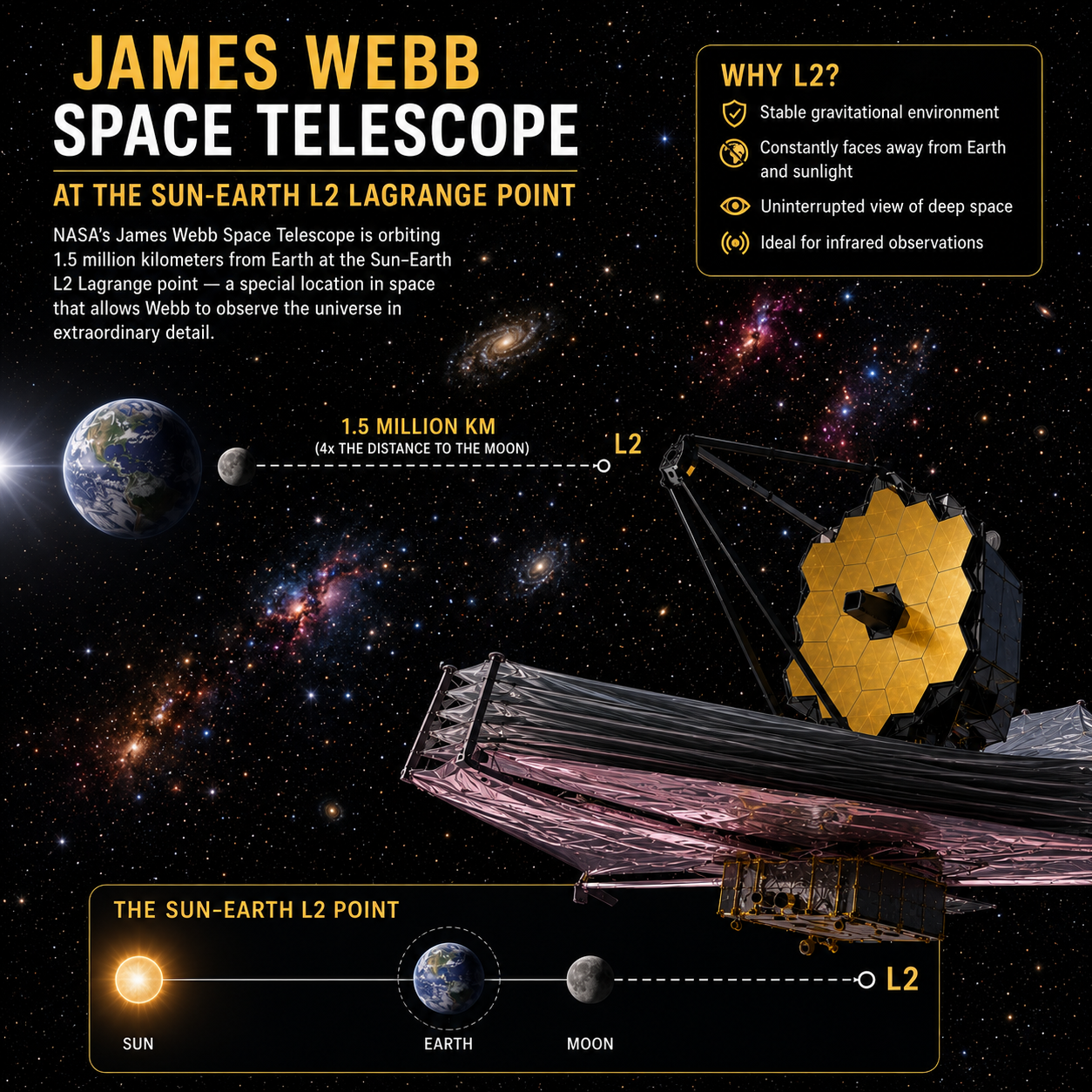
Unlike Hubble, which orbits Earth, the James Webb Space Telescope operates nearly 1.5 million kilometers (930,000 miles) away.
It circles a special location in space called the second Lagrange point (L2).
At L2, the gravitational pull of the Earth and the Sun creates a stable environment where Webb can keep its sunshield facing the Sun while its mirror observes deep space.
This location provides a clear, uninterrupted view of the universe and allows the telescope to operate continuously.
Although astronauts cannot easily repair Webb at this distance, its unique position gives it the perfect conditions to perform groundbreaking scientific observations.
Every image it sends back travels across nearly one and a half million kilometers before reaching Earth.
Looking Back in Time
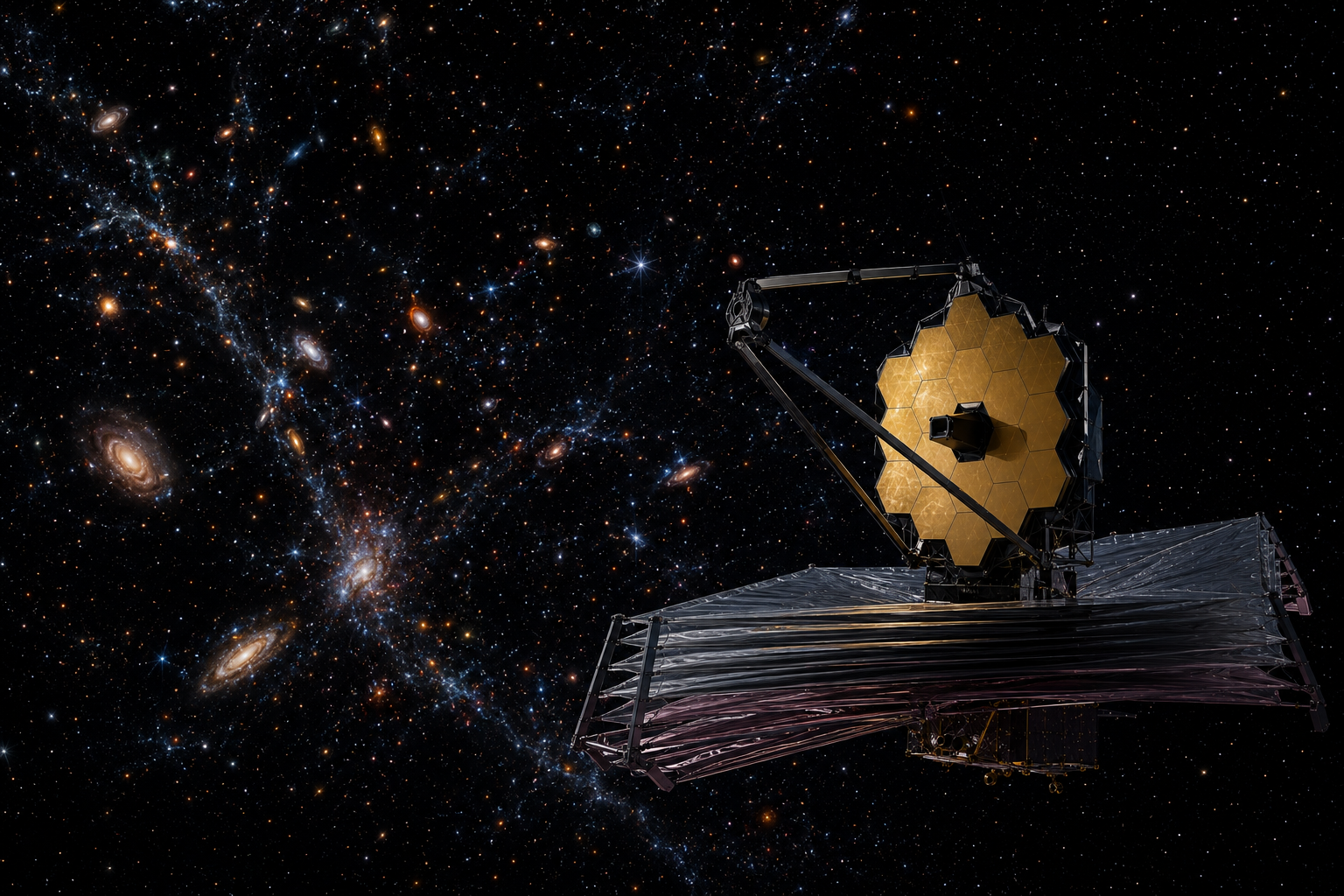
When we look into space, we are also looking into the past.
Light travels at a finite speed—about 300,000 kilometers (186,000 miles) per second. That means sunlight takes around 8 minutes to reach Earth. The light from our nearest neighboring star takes more than 4 years, while the light from distant galaxies can take billions of years.
Because of this, the James Webb Space Telescope acts like a time machine.
By capturing ancient light that has traveled across the universe for over 13 billion years, Webb allows scientists to witness galaxies that formed only a few hundred million years after the Big Bang.
Some of these galaxies are among the oldest and most distant objects ever observed.
Every image sent back by Webb helps astronomers' piece together the story of how the universe evolved from a hot, dense beginning into the vast cosmos we see today.
Exploring Alien Worlds
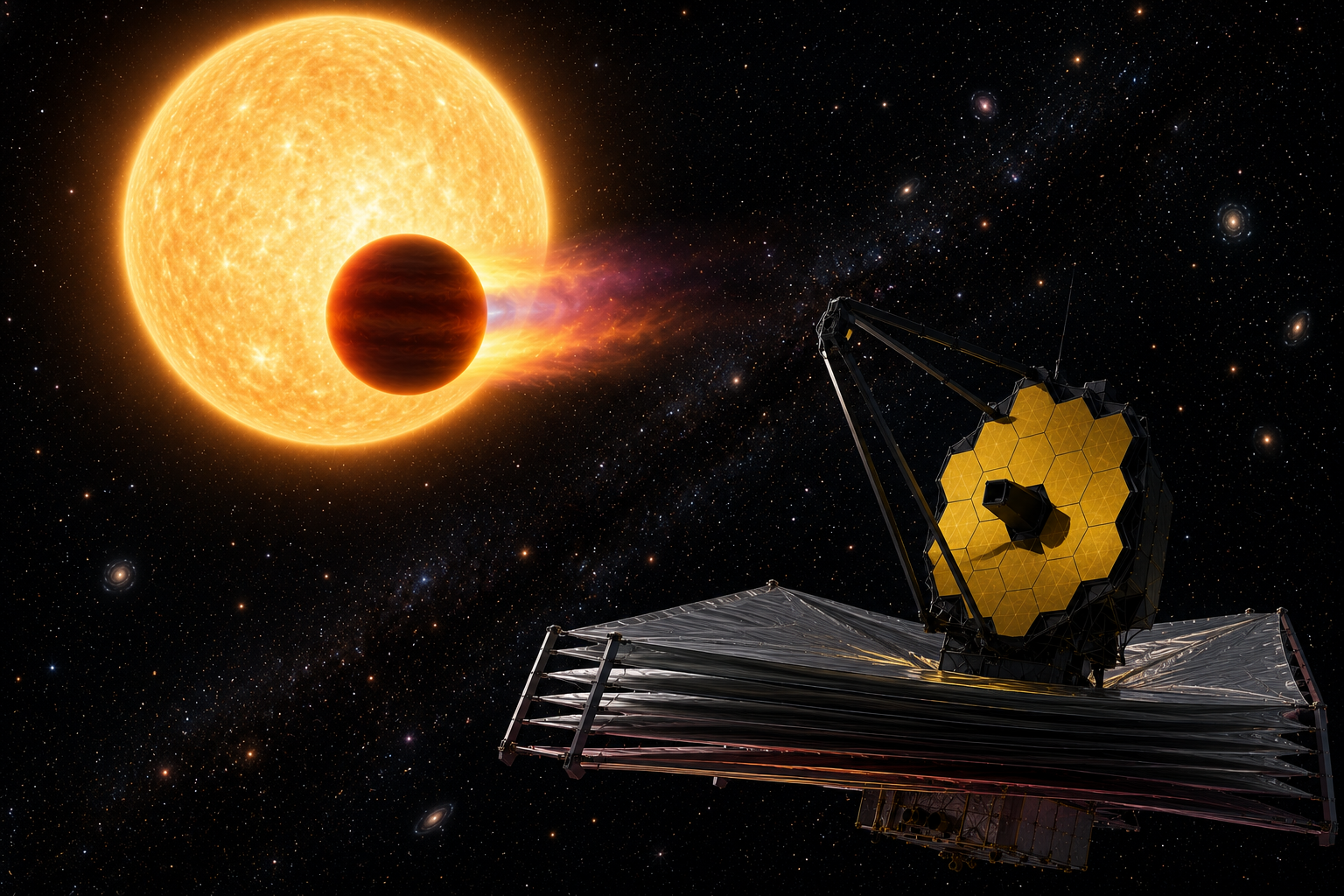
One of Webb's most exciting missions is searching for clues about planets beyond our Solar System.
These distant worlds, called exoplanets, orbit stars hundreds or even thousands of light-years away.
Although Webb cannot directly photograph most of these planets, it can analyze the tiny amount of starlight passing through their atmospheres.
This technique allows scientists to detect gases such as water vapor, carbon dioxide, methane, and carbon monoxide.
Studying these atmospheres helps researchers understand what these planets are made of, how they formed, and whether some may have conditions suitable for life.
While Webb has not discovered extraterrestrial life, it is bringing humanity closer than ever to answering one of our oldest questions:
Are we alone in the universe?
How Stars and Galaxies Are Born
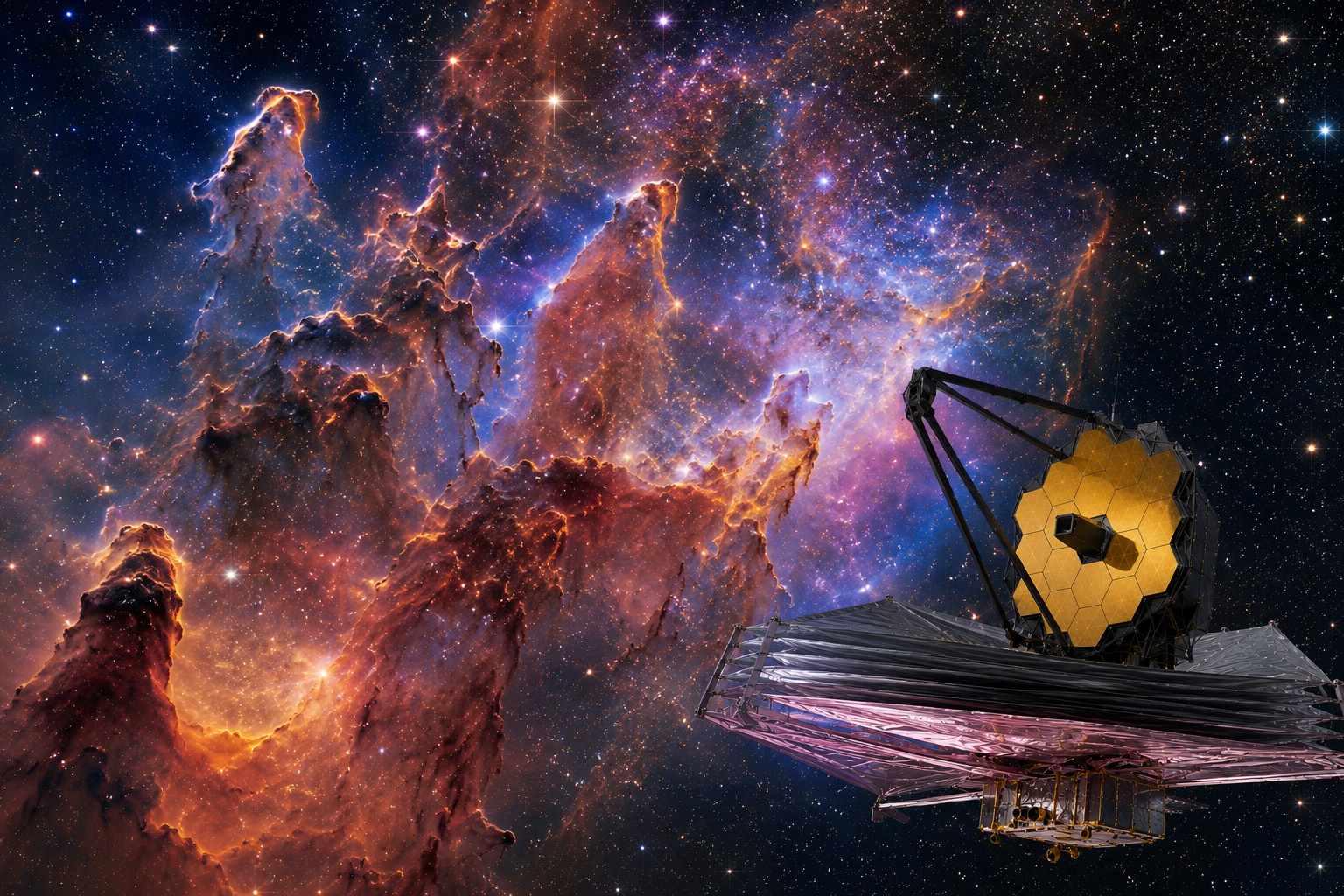
The universe is constantly creating something new.
Inside enormous clouds of gas and dust called nebulae, gravity slowly pulls material together until new stars begin to form.
Before Webb, many of these stellar nurseries remained hidden behind thick cosmic dust.
Because infrared light can pass through dust clouds, Webb reveals these regions in extraordinary detail.
Its images show newborn stars, glowing disks where planets may eventually form, and entire galaxies evolving over millions of years.
These discoveries help scientists understand how our own Sun and Solar System may have formed billions of years ago.
The Beautiful Images That Captivated the World
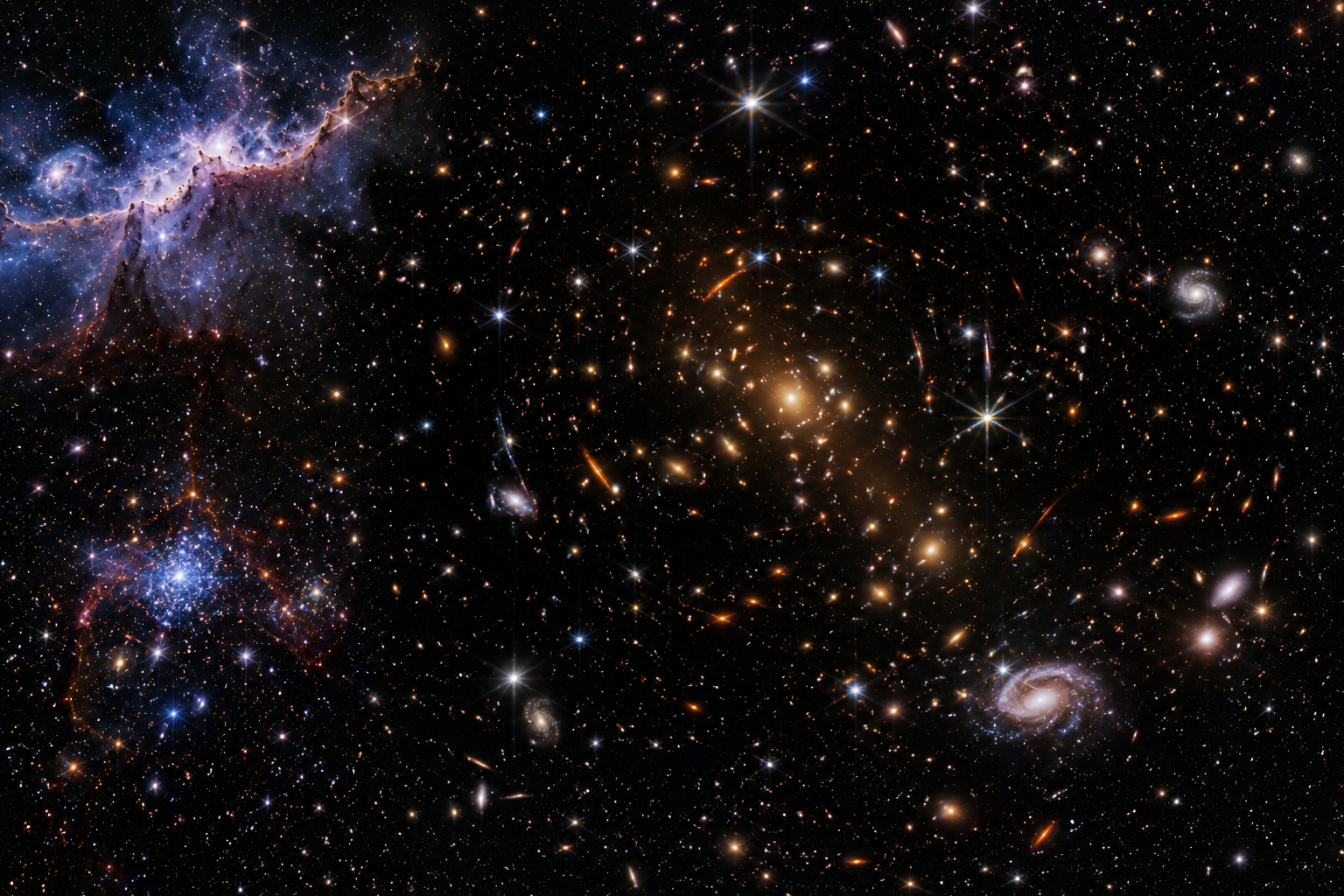
Beyond its scientific discoveries, Webb has transformed the way we see the universe.
Its breathtaking images have revealed galaxies colliding, colorful nebulae sculpted by powerful stars, and immense clouds where future solar systems are taking shape.
One of its first released images, known as Webb's First Deep Field, showed thousands of galaxies packed into a tiny patch of sky no larger than a grain of sand held at arm's length.
Each image combines scientific precision with extraordinary beauty, inspiring millions of people around the world to look up at the night sky with renewed curiosity.
What Webb Could Discover Next
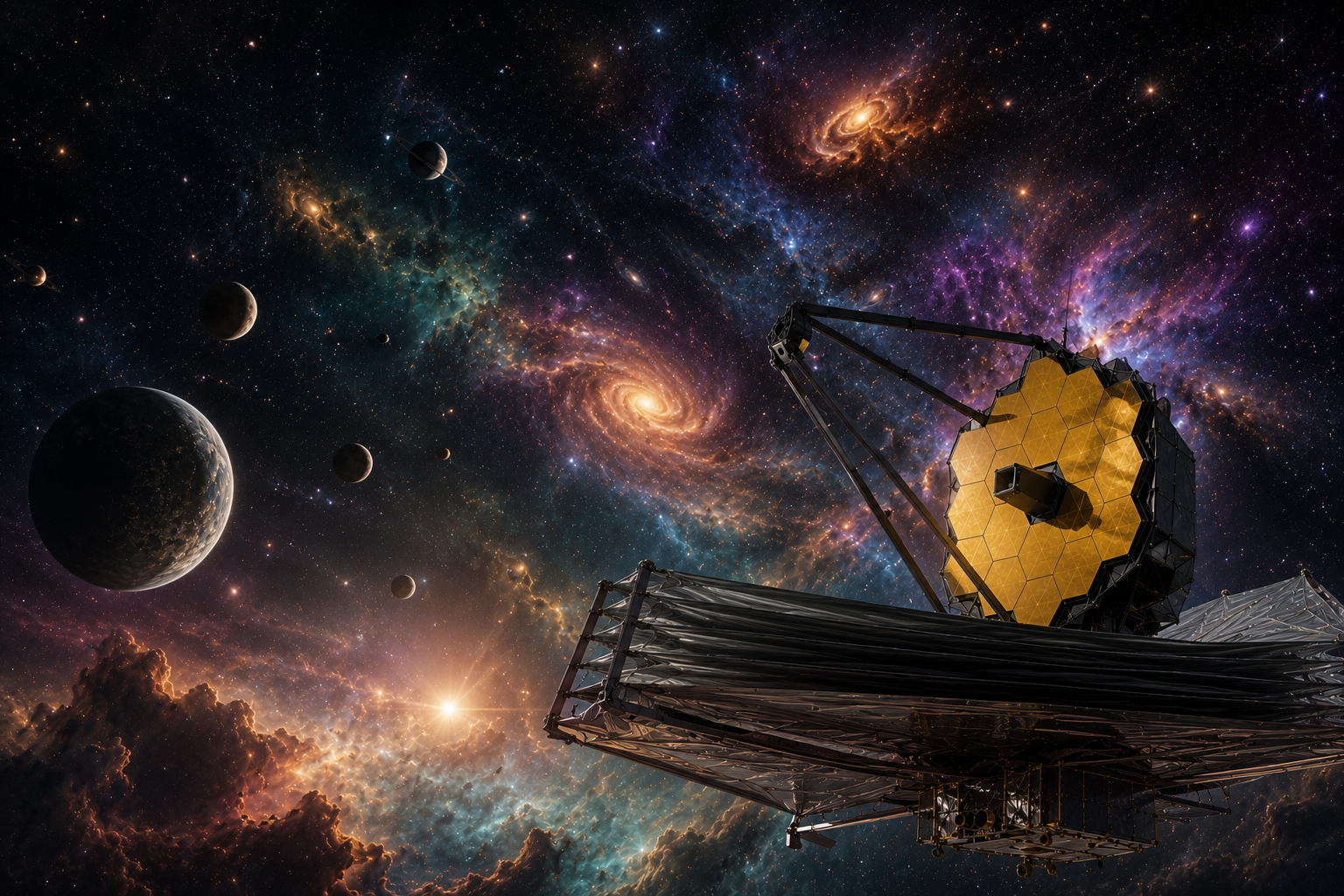
Although the James Webb Space Telescope has already rewritten astronomy textbooks, its greatest discoveries may still lie ahead.
Scientists hope Webb will reveal the first generation of stars, study the atmospheres of Earth-sized exoplanets, uncover how supermassive black holes formed, and investigate the mysterious evolution of galaxies.
Every observation raises new questions.
Every discovery opens another door.
As technology and scientific knowledge continue to advance, Webb will remain one of humanity's greatest tools for exploring the universe.
Somewhere in the darkness of space, the telescope may already be collecting light from a discovery that will change our understanding of the cosmos forever.
Amazing James Webb Space Telescope Facts
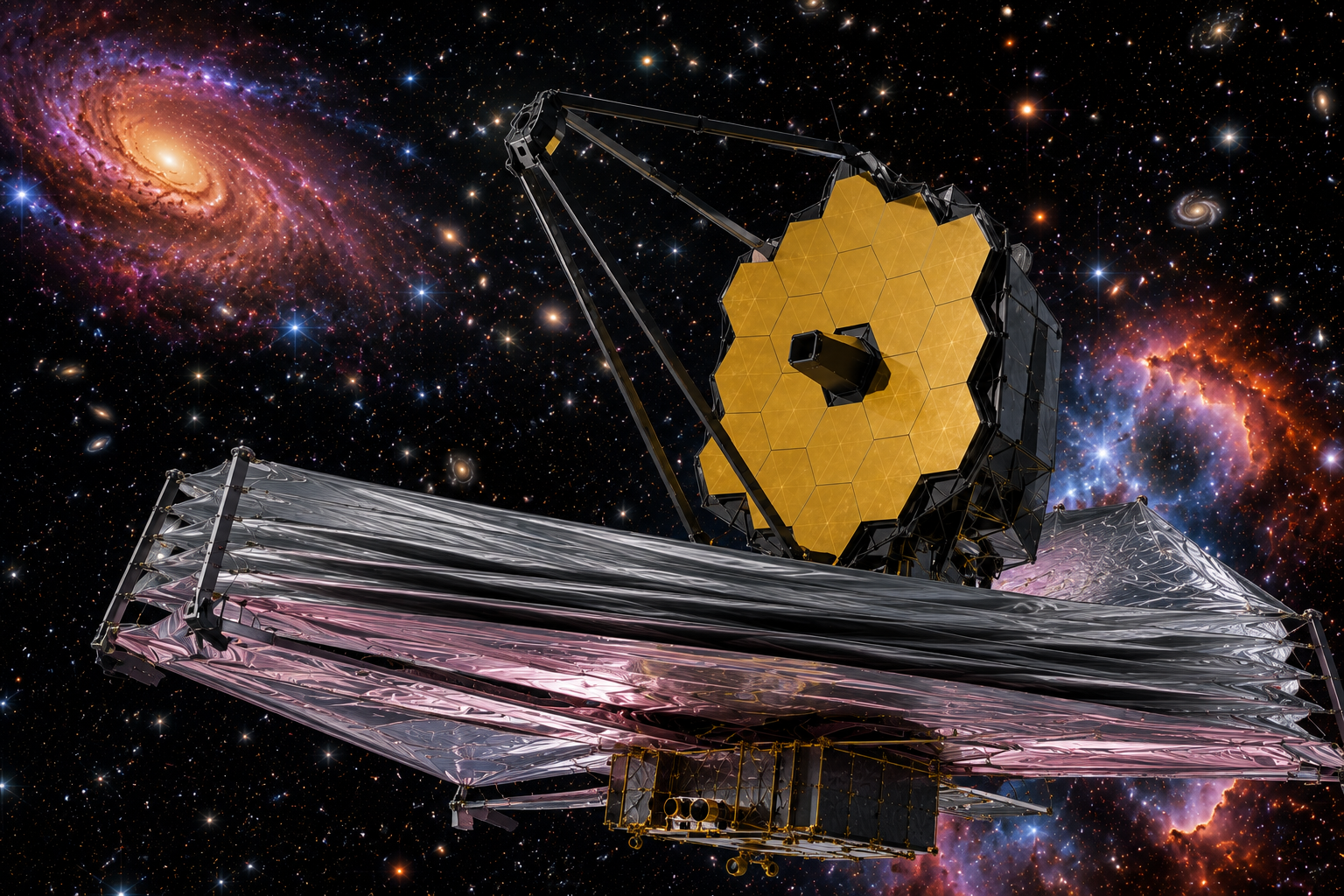
The James Webb Space Telescope is one of the most advanced scientific instruments ever built. Behind its stunning images lies decades of engineering, innovation, and international collaboration.
Here are some fascinating facts about Webb:
- 🔭 The telescope's primary mirror is 6.5 meters (21 feet) wide and made of 18 gold-coated hexagonal segments.
- 🚀 Webb launched on December 25, 2021, aboard an Ariane 5 rocket from French Guiana.
- 🌌 It operates around 1.5 million kilometers (930,000 miles) from Earth at the Sun–Earth L2 Lagrange Point.
- 🛡️ Its five-layer sunshield, about the size of a tennis court, keeps the telescope's instruments extremely cold.
- 👁️ Webb observes the universe mainly in infrared light, allowing it to see through cosmic dust.
- ⭐ It can detect light from galaxies that formed over 13 billion years ago, giving scientists a glimpse of the early universe.
- 🪐 Webb studies the atmospheres of distant exoplanets, searching for molecules such as water vapor, carbon dioxide, and methane.
- 🤝 The telescope is a joint mission of NASA, the European Space Agency (ESA), and the Canadian Space Agency (CSA).
- 📡 Every image and scientific observation travels nearly 1.5 million kilometers before reaching Earth.
- 🌠 Webb is expected to make discoveries that will shape astronomy for many years to come.
The James Webb Space Telescope isn't just observing the universe—it's helping humanity understand where we came from and what might exist beyond our own world.
Our Greatest Window into the Cosmos
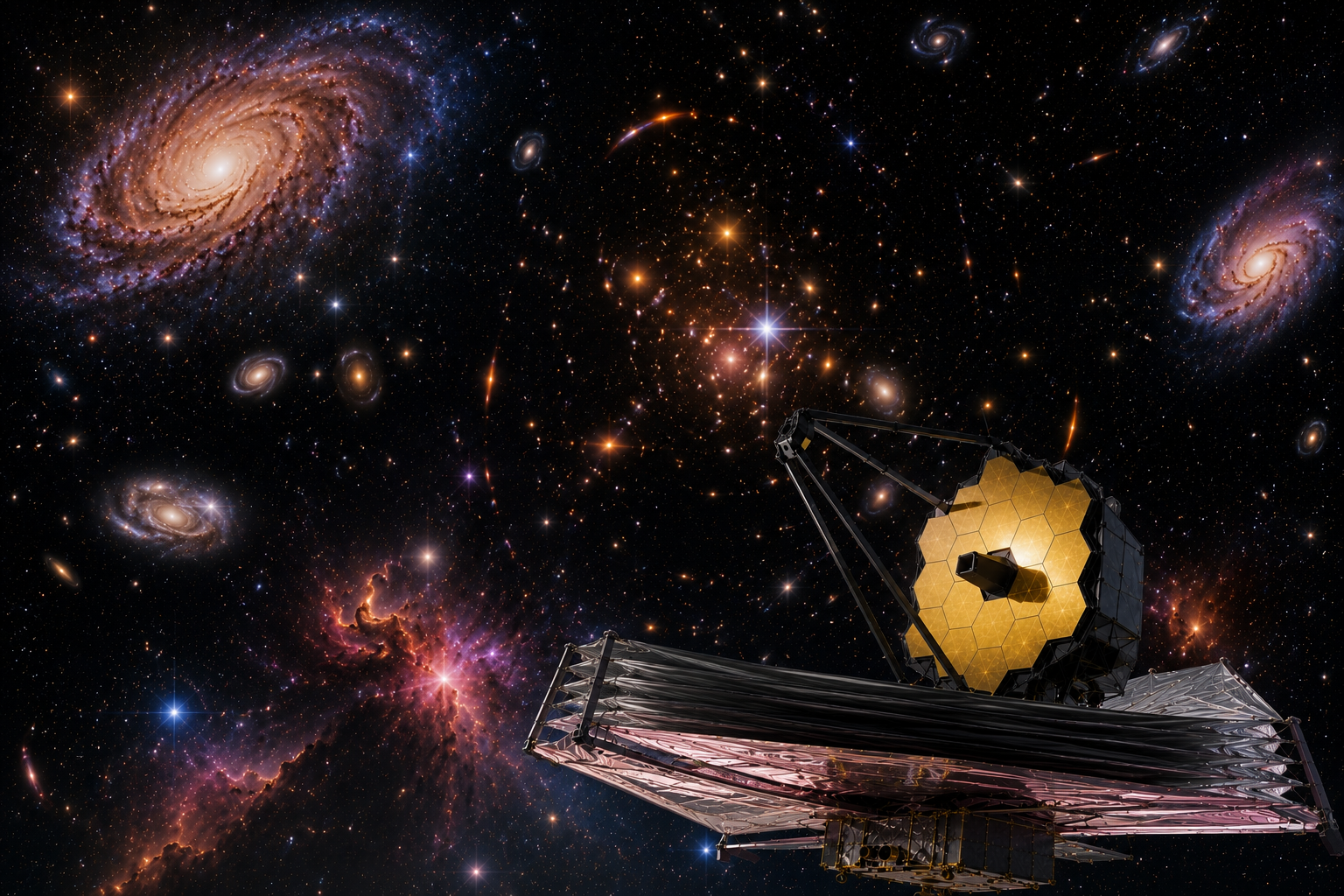
For centuries, humanity has searched the night sky for answers.
The James Webb Space Telescope is helping us uncover those answers by revealing galaxies born shortly after the Big Bang, exploring distant planetary systems, and uncovering details of the universe that were once beyond our reach.
Every image reminds us that space is far larger, older, and more complex than we ever imagined.
As Webb continues its mission, it will inspire new discoveries, challenge existing theories, and deepen our understanding of the cosmos.
The next great discovery could already be traveling toward us as a tiny beam of light crossing the vast darkness of space.
FAQ section.
1.How is the James Webb Space Telescope different from Hubble?
Webb primarily observes infrared light rather than visible light, letting it see through cosmic dust and detect much older, more distant galaxies than Hubble can.
2.Where is the James Webb Telescope located?
It orbits the Sun near a stable point called L2, about 1.5 million kilometers from Earth — far beyond the Moon's orbit.
3.How far back in time can James Webb see?
It can capture light that has traveled for over 13 billion years, letting scientists observe galaxies that formed just a few hundred million years after the Big Bang.
4.Can the James Webb Telescope detect alien life?
Not directly — but it can analyze exoplanet atmospheres for gases like water vapor and methane, which could hint at habitability.
5.When did the James Webb Telescope launch?
It launched on December 25, 2021, aboard an Ariane 5 rocket from French Guiana.
6.What is Webb's sunshield made of?
A five-layer shield about the size of a tennis court, each layer thinner than a human hair, which keeps Webb's instruments below -223°C so it can detect extremely faint infrared light.