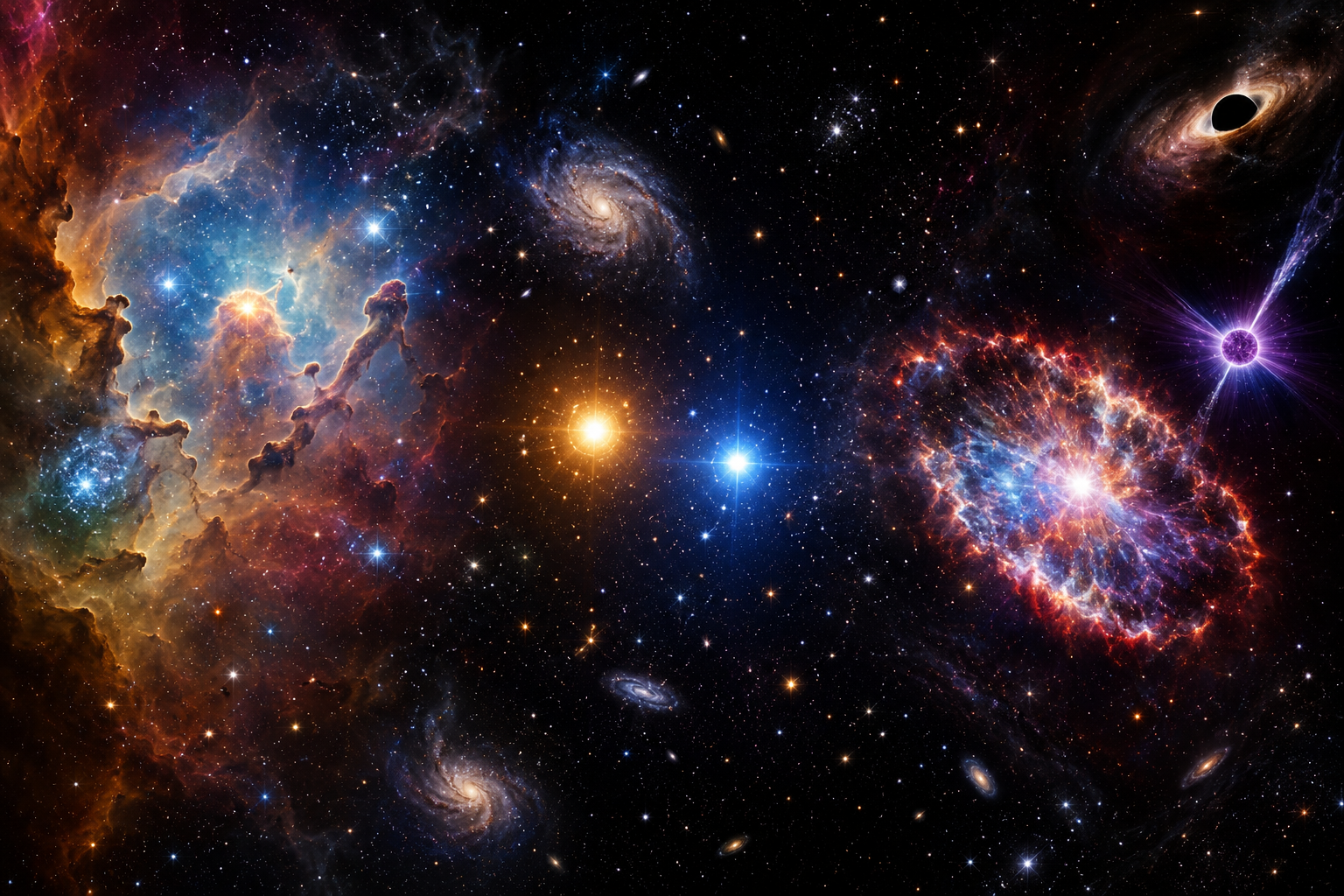
⭐ Chapter 1 — A Universe Filled with Stellar Nurseries
⬇
Where Every Star Begins
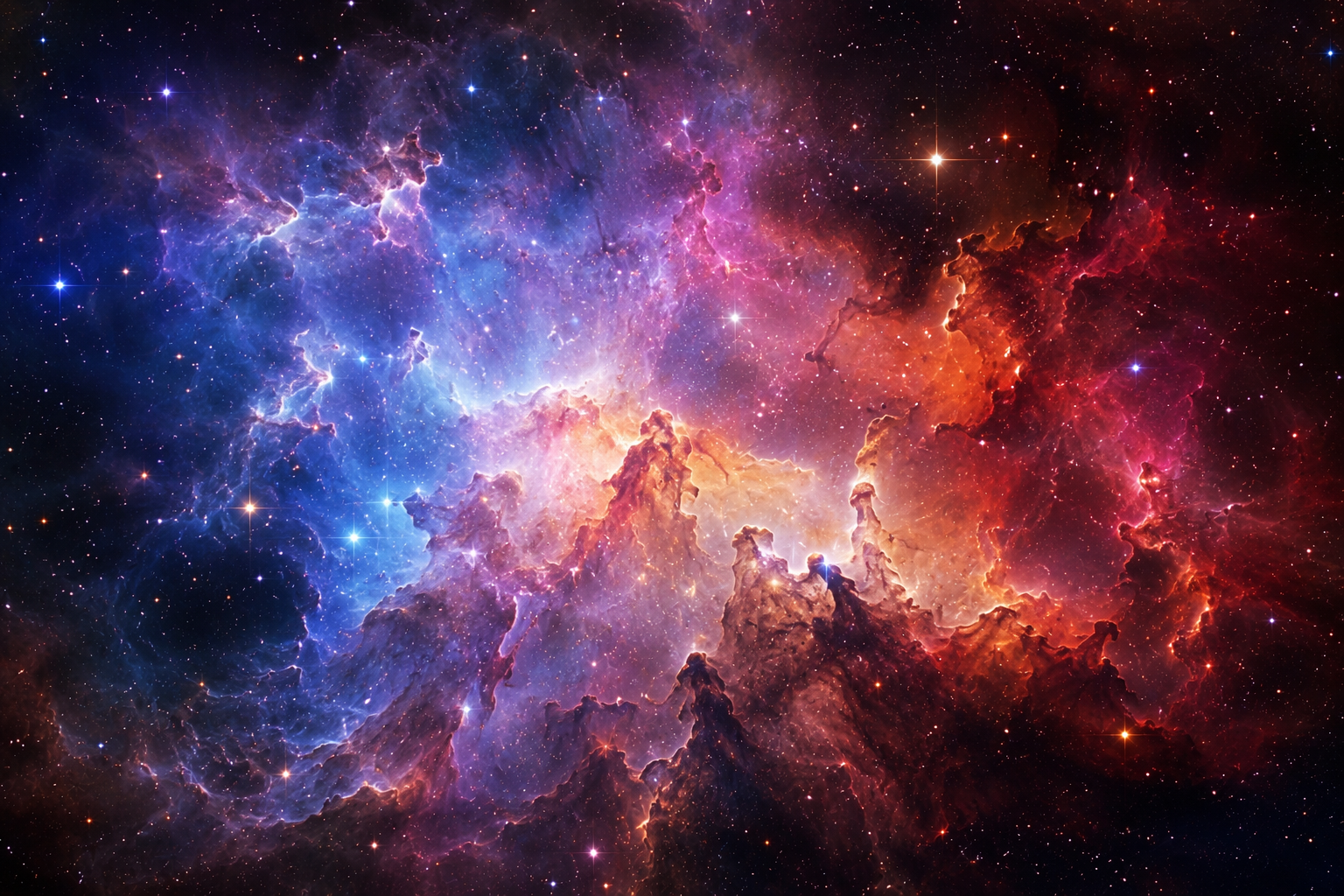
On a clear night, the sky appears calm and unchanging.
Thousands of stars shine peacefully above us, each one looking as though it has always existed.
But every star has a story.
Long before it became a brilliant point of light, it was hidden inside an enormous cloud drifting silently through space.
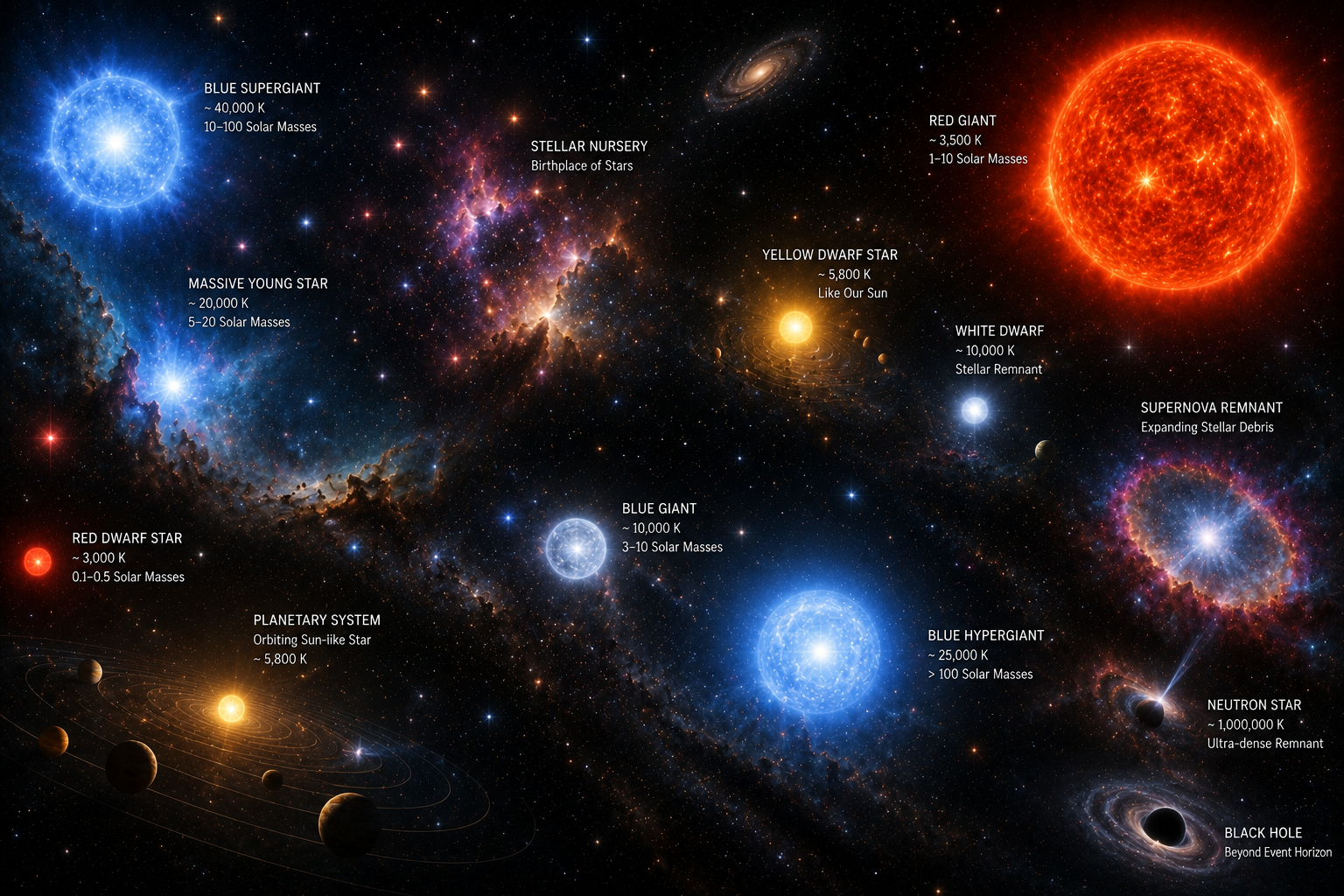
These vast clouds, called nebulae, are among the most beautiful objects in the universe. Stretching across hundreds of light-years, they are made of hydrogen gas, tiny grains of cosmic dust, and the raw ingredients from which new stars are born.
Rather than being empty regions of space, nebulae are the universe's great nurseries.
Here, the next generation of stars begins its journey.
⬇
Gravity Starts an Extraordinary Journey
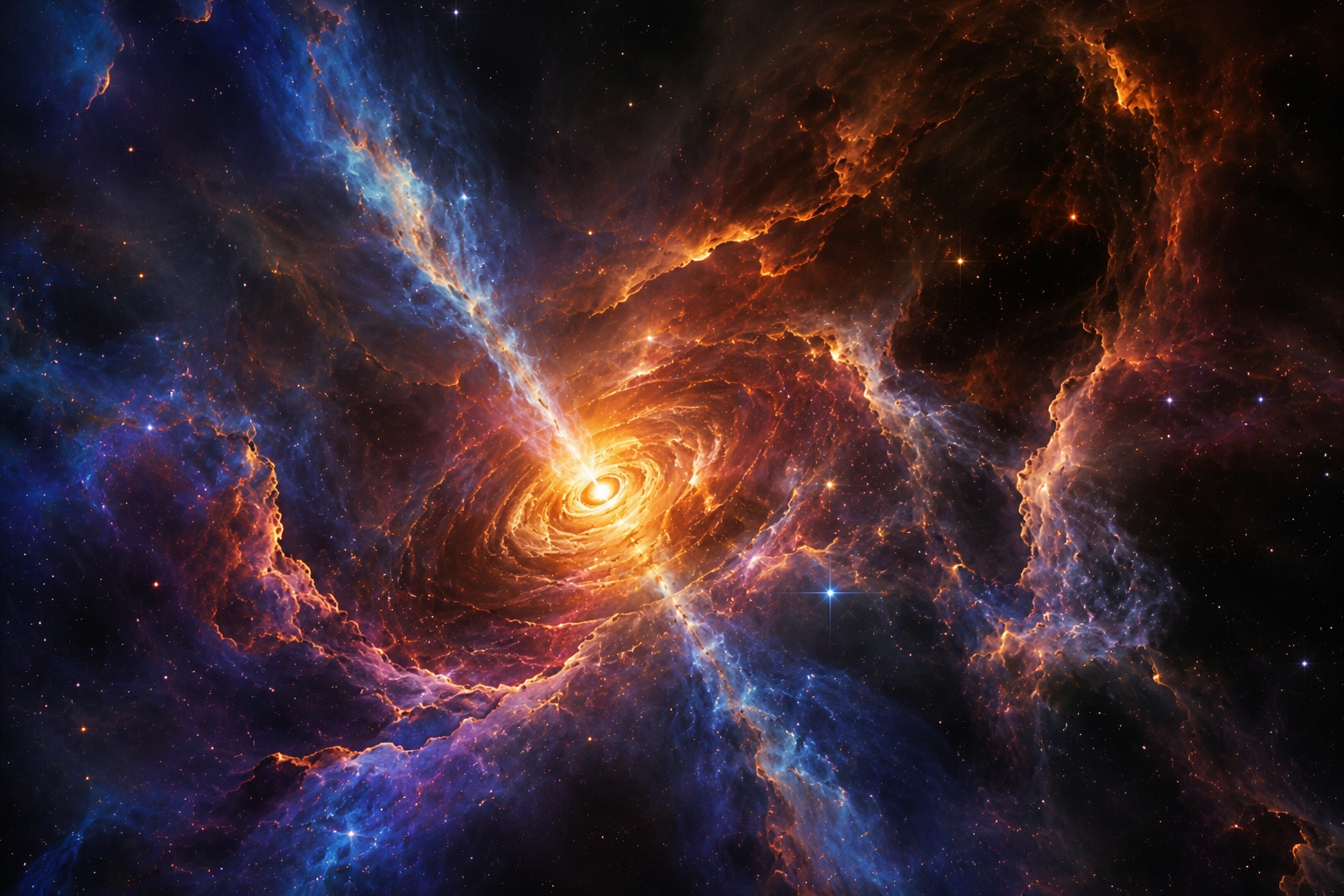
For millions of years, these enormous clouds drift quietly through space.
Then something changes.
Perhaps a nearby supernova sends a powerful shockwave through the cloud.
Perhaps gravity slowly becomes stronger than the outward pressure of the gas.
Little by little, the cloud begins to collapse.
As billions upon billions of particles move closer together, gravity squeezes the material into an ever-growing sphere.
The center becomes hotter.
The pressure rises.
The collapse accelerates.
Over hundreds of thousands of years, this growing object becomes known as a protostar—a young star that has not yet begun producing its own light.
At this stage, the future star is still gathering material from the surrounding nebula, becoming larger and denser with every passing year.
The universe is patiently preparing something extraordinary.
⬇
The First Spark
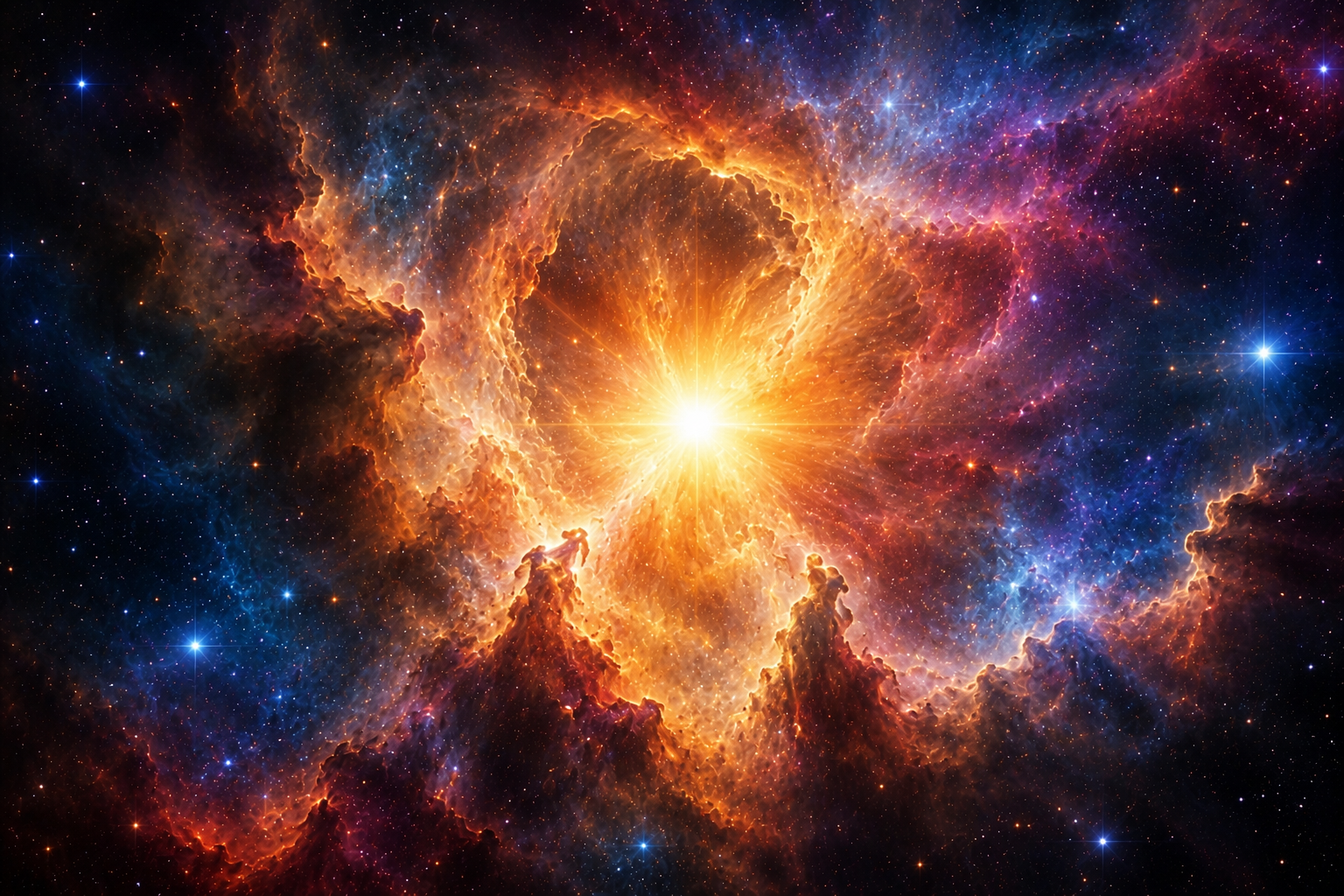
Deep inside the protostar, temperatures continue rising.
They climb into the millions of degrees.
Atoms begin moving faster than ever before.
Eventually, the pressure becomes so immense that hydrogen atoms can no longer remain separate.
They collide.
They merge.
In that instant, one of the most powerful processes in nature begins.
Nuclear fusion.
Hydrogen atoms combine to form helium, releasing enormous amounts of energy in the form of heat and light.
The sleeping protostar awakens.
A new star is born.
Its light begins a journey across the universe that may continue for billions of years.
Some of that light may eventually reach distant planets.
Perhaps even one where life is waiting to look back.
⬇
A Sky Filled with Future Suns
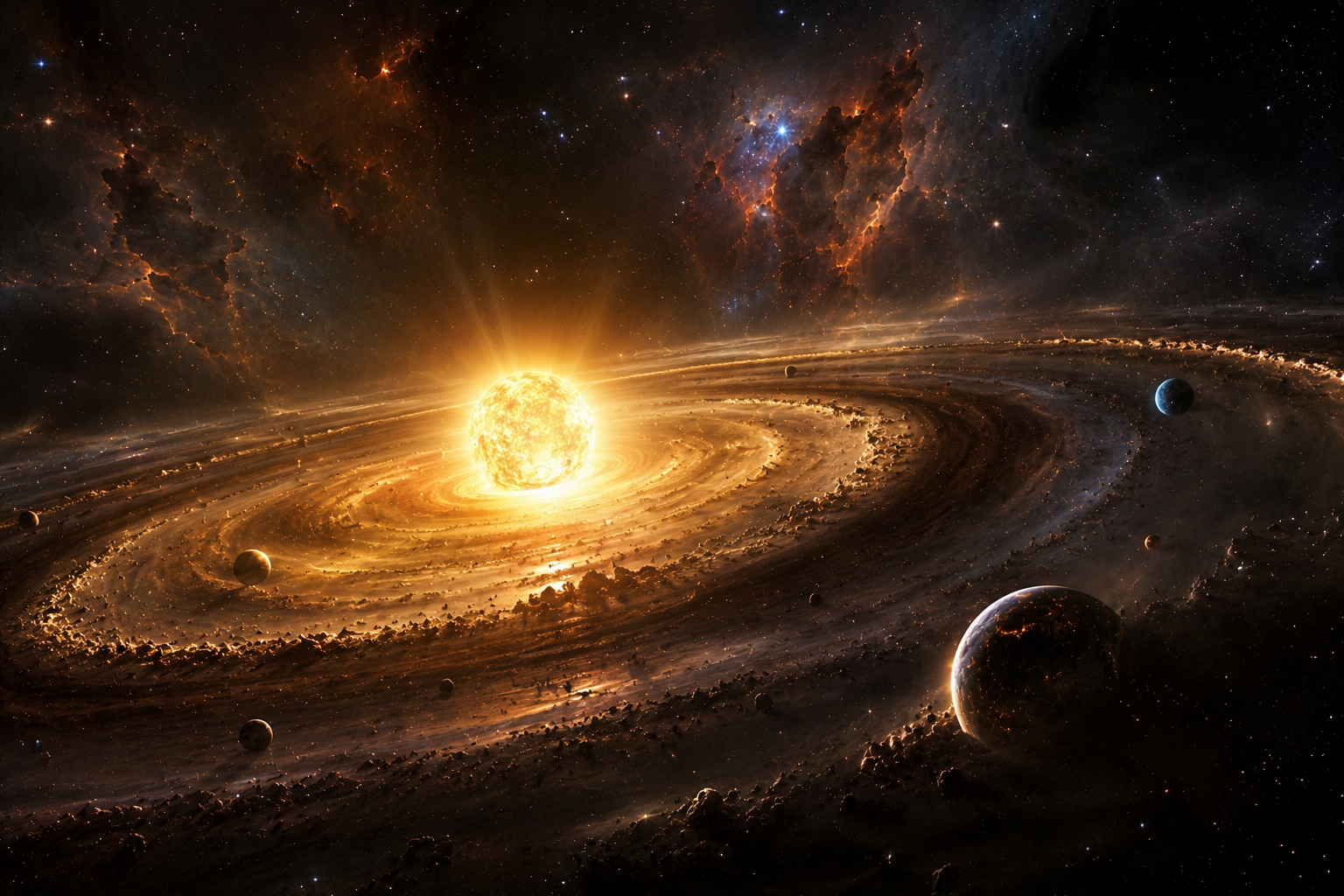
Every bright star visible in the night sky began in a stellar nursery much like this.
Our own Sun was born from a collapsing cloud of gas about 4.6 billion years ago.
The remaining dust surrounding it gradually came together to form planets, moons, asteroids, and comets—including Earth itself.
Without stellar nurseries, there would be no stars.
Without stars, there would be no planets.
And without planets...
There would be no life as we know it.
Every sunrise you have ever seen began with a silent cloud drifting through space billions of years ago.
The story of every star starts not with light—
But with darkness.
⭐ Chapter 2 — The Moment a Star Comes Alive
⬇
The Fire That Can Burn for Billions of Years
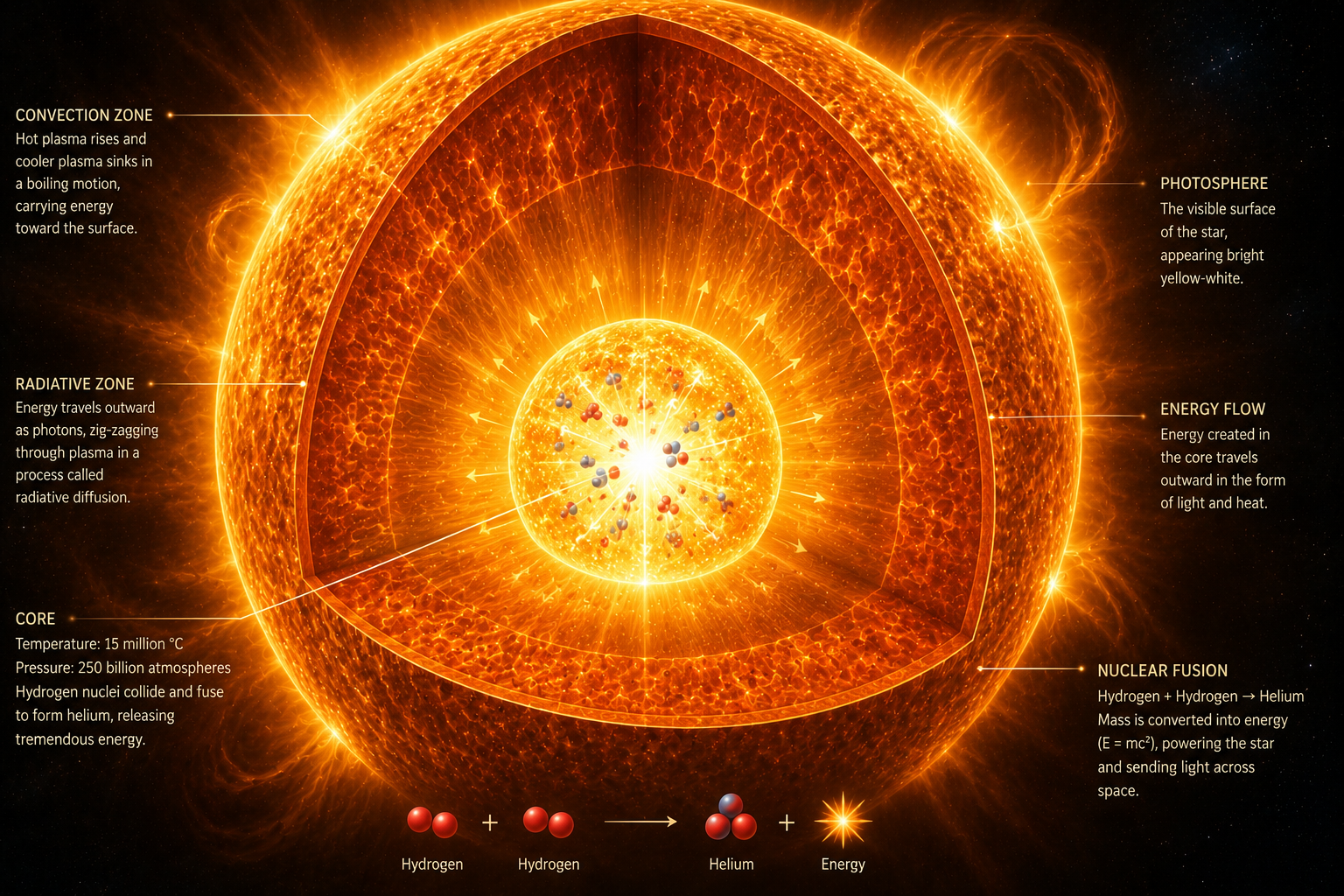
The moment a star ignites, everything changes.
For millions of years, gravity had been pulling enormous clouds of gas inward, compressing them into a dense, glowing protostar.
Now, deep inside its core, temperatures soar beyond 15 million degrees Celsius.
The pressure becomes so overwhelming that hydrogen atoms begin colliding with unimaginable force.
Most collisions fail.
But eventually, some succeed.
Four tiny hydrogen atoms combine through nuclear fusion to form a single helium atom.
In the process, a small amount of mass disappears.
It doesn't vanish.
Instead, it is transformed into pure energy, following Einstein's famous equation:
E = mc²
That tiny loss of mass releases an astonishing amount of heat and light.
The star has awakened.
What appears peaceful from Earth is actually a gigantic nuclear furnace more powerful than anything humanity could ever build.
⬇
A Perfect Balance
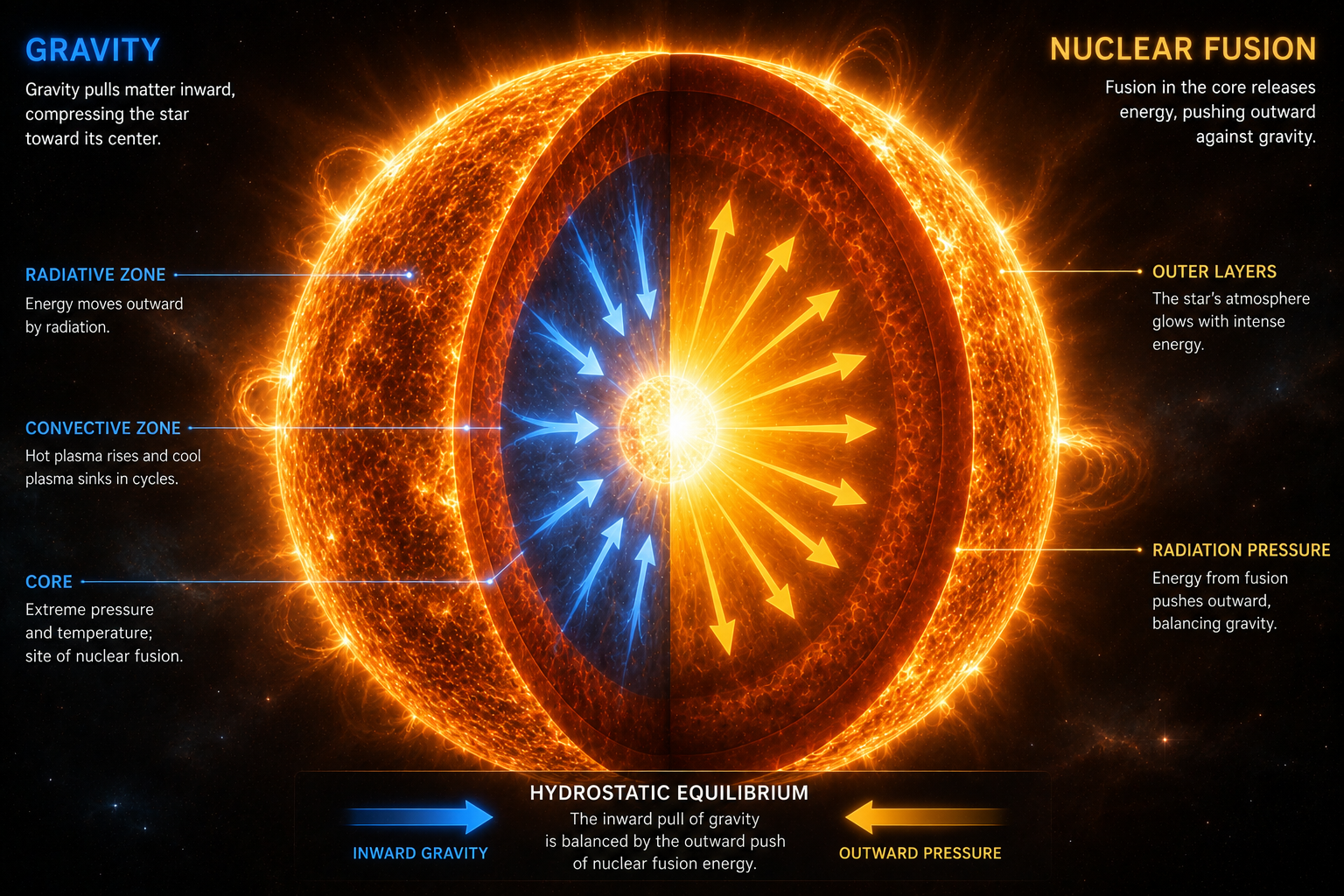
At first glance, a star seems calm.
In reality, it is locked in an endless battle.
Gravity constantly pulls the star inward, trying to crush it under its own enormous weight.
At the same time, the energy produced by nuclear fusion pushes outward with incredible force.
These two powerful forces continuously oppose each other.
Neither side wins.
Instead, they create a perfect balance known as hydrostatic equilibrium.
This invisible balance keeps a star stable for millions—or even billions—of years.
If gravity ever became stronger than the outward pressure, the star would collapse.
If fusion became stronger, the star would expand uncontrollably.
Every second, the universe carefully maintains this delicate equilibrium.
It is one of nature's greatest balancing acts.
⬇
Not All Stars Shine the Same
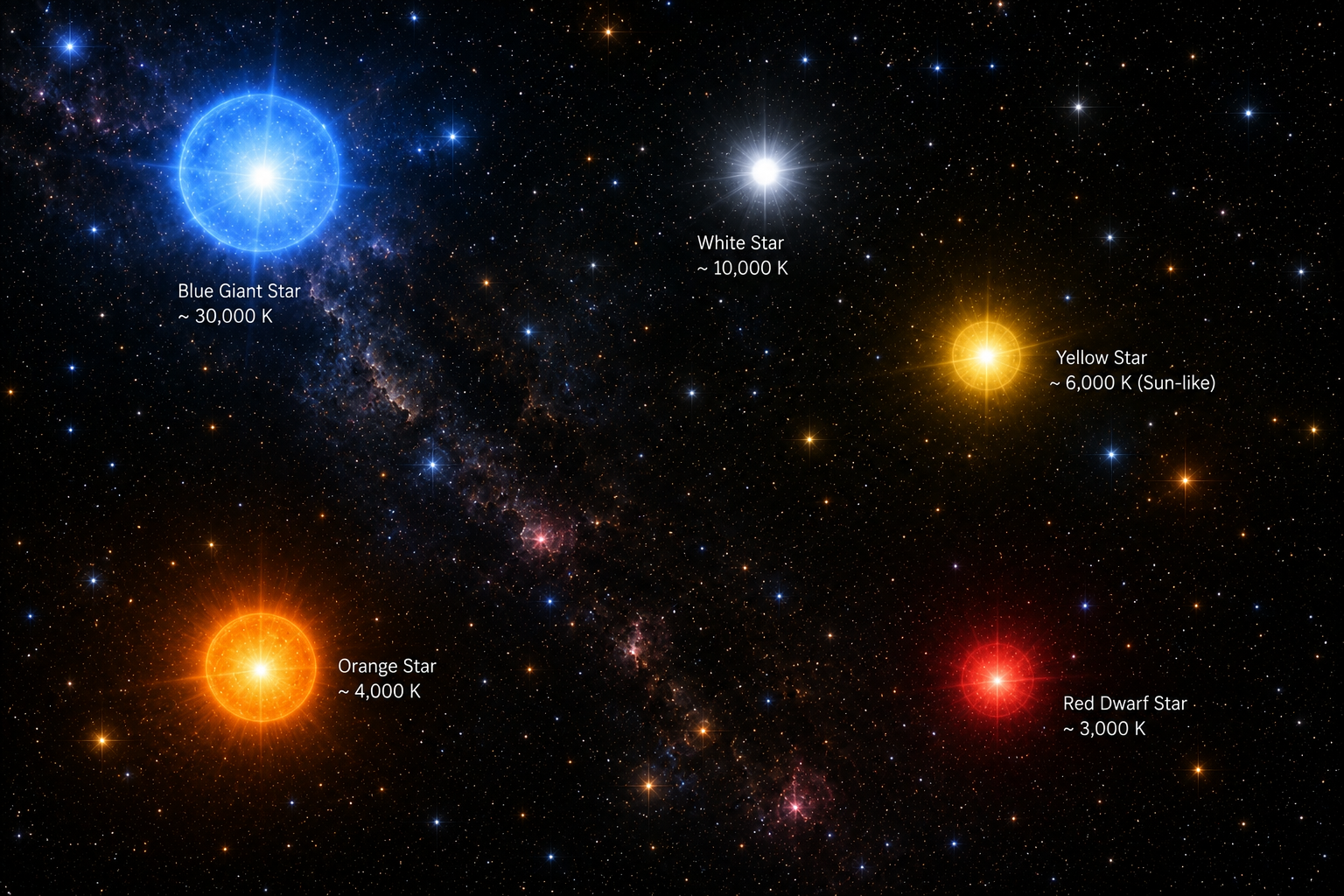
If you look closely at the night sky, you'll notice something surprising.
Not every star is white.
Some appear bluish.
Others glow yellow, orange, or deep red.
These colors are not random.
They reveal a star's temperature.
Blue stars are the hottest, with surface temperatures exceeding 30,000°C.
White stars are slightly cooler.
Yellow stars, like our Sun, have temperatures of around 5,500°C.
Orange stars are cooler still.
Red stars are the coolest, though even they remain thousands of degrees hotter than molten lava on Earth.
Color is a star's fingerprint.
By studying its light, astronomers can estimate its temperature, size, age, and even the elements hidden within it.
Every color tells a different story.
⬇
A Lifetime of Quiet Brilliance
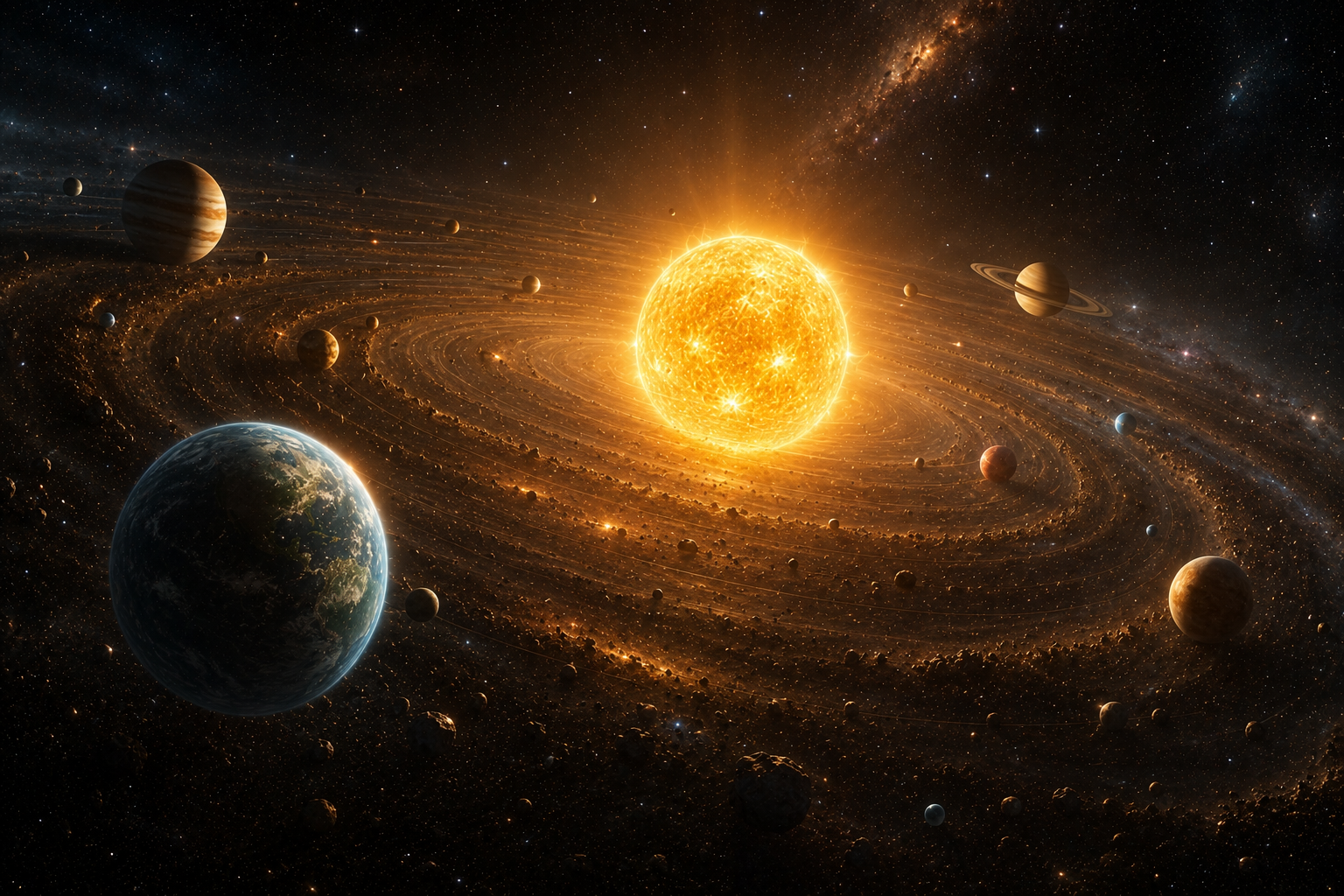
Once nuclear fusion becomes stable, a star enters the longest stage of its life.
Astronomers call this the Main Sequence.
Our Sun has remained in this stage for about 4.6 billion years, and scientists estimate it will continue shining for another 5 billion years before beginning its final transformation.
During this immense span of time, stars provide light and warmth to the planets orbiting them.
On Earth, every sunrise, every season, and every living organism ultimately depends on the energy released deep inside the Sun's core.
Without stars, planets would become frozen worlds drifting silently through space.
Stars do more than illuminate the universe.
They make life possible.
⭐ Chapter 3 — The Different Lives of Stars
⬇
Not Every Star Shares the Same Destiny
When we look into the night sky, stars seem almost identical.
Tiny points of light scattered across the darkness.
Yet each one is living a completely different life.
Some are small enough to burn quietly for trillions of years.
Others are so enormous that they race through their lives in only a few million years before exploding in spectacular fashion.
The fate of every star is decided at the moment it is born.
Not by where it forms.
Not by its color.
But by one thing alone.
Its mass.
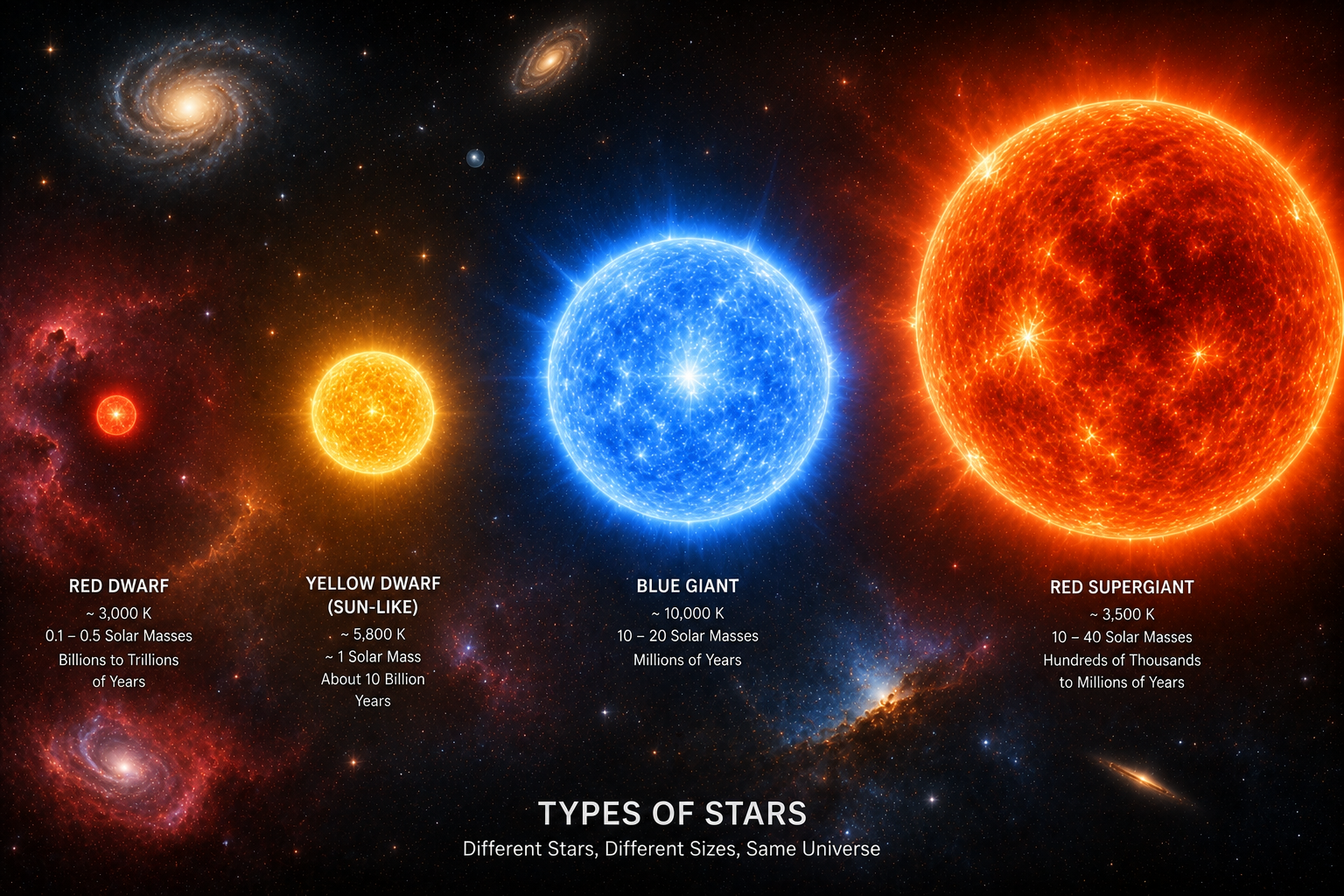
Mass determines how quickly a star burns its fuel, how bright it shines, how long it lives, and how it will ultimately die.
⬇
The Patient Red Dwarfs
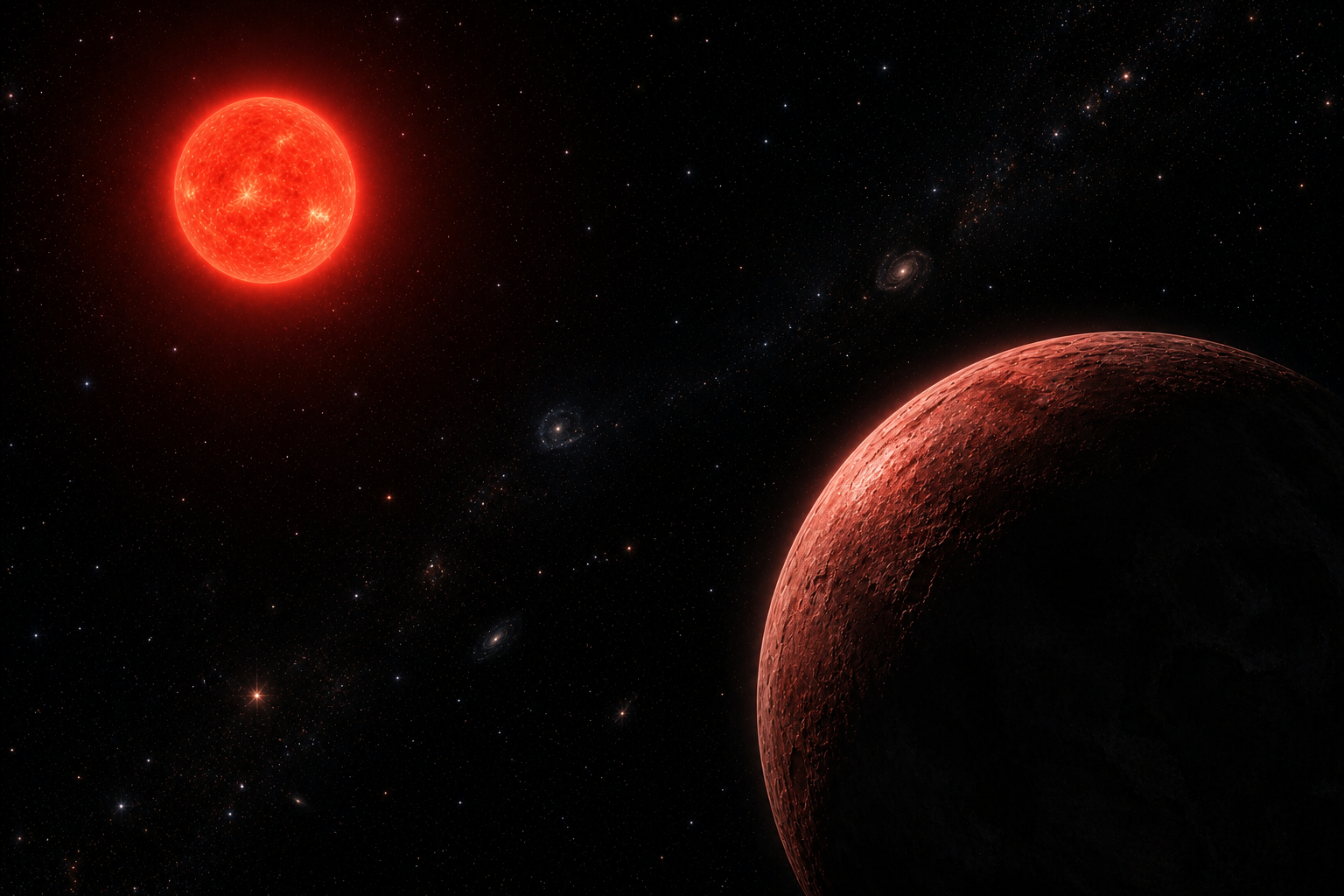
The smallest stars in the universe are called red dwarfs.
They are cooler, dimmer, and far less massive than our Sun.
At first glance, they may seem unremarkable.
But appearances can be misleading.
Because they burn their hydrogen fuel incredibly slowly, red dwarfs are also the longest-lived stars in existence.
Some are expected to shine for trillions of years—hundreds of times longer than the current age of the universe.
In fact, the universe is not yet old enough for a single red dwarf to have reached the end of its life.
Every red dwarf that has ever formed is still shining today.
These quiet stars may one day become the last surviving lights in an aging universe.
⬇
Stars Like Our Sun
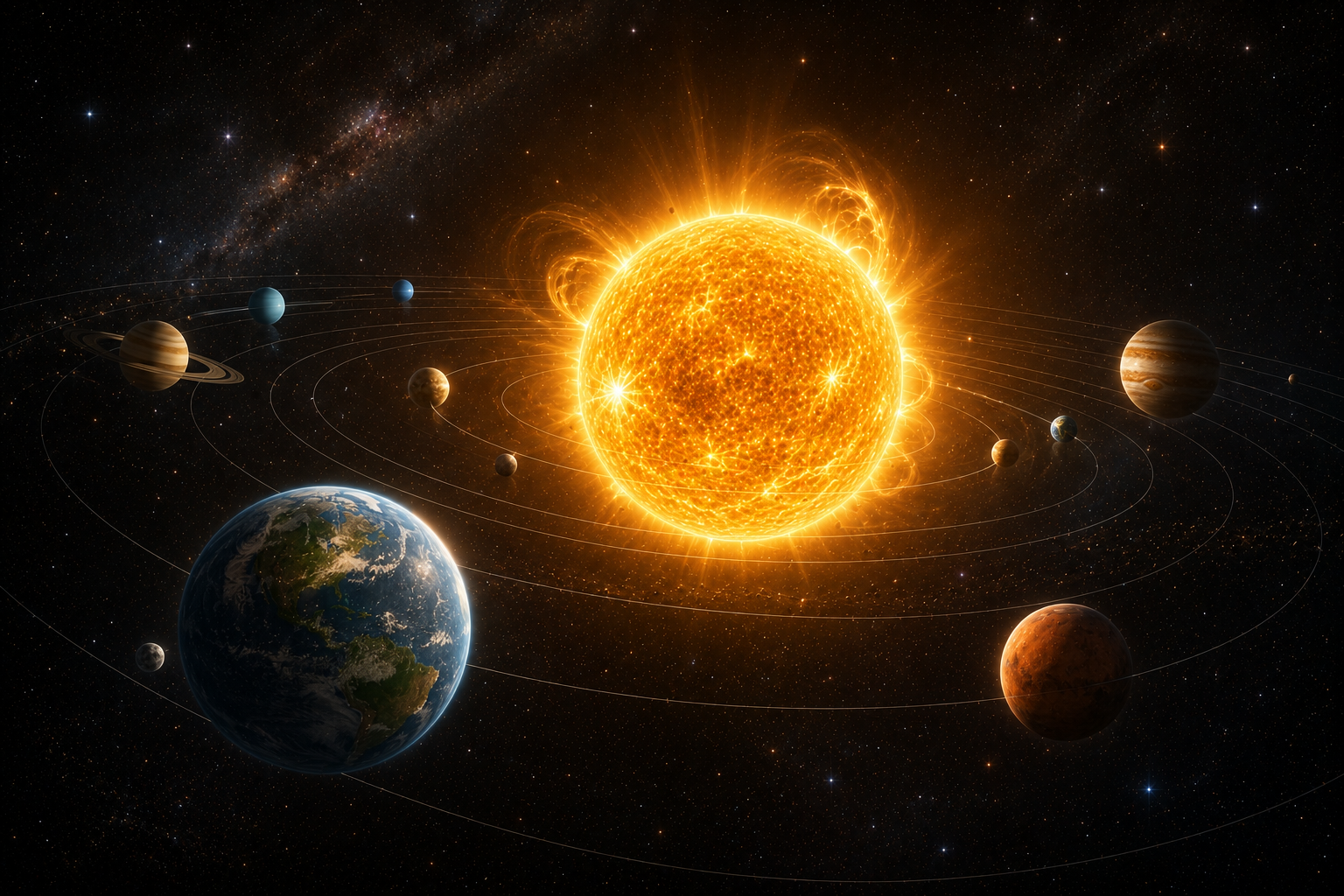
Our Sun belongs to a much larger family known as yellow dwarf stars.
Unlike red dwarfs, these stars burn their fuel at a faster pace.
Their average lifetimes are about 10 billion years.
For nearly half that time, our Sun has provided the energy that allowed oceans to remain liquid, climates to stabilize, and life to flourish on Earth.
One day, billions of years from now, the Sun will exhaust the hydrogen in its core.
Its peaceful life will slowly come to an end.
But unlike the most massive stars, it will not explode.
Its final journey will be far more graceful.
⬇
The Giants That Burn Too Bright
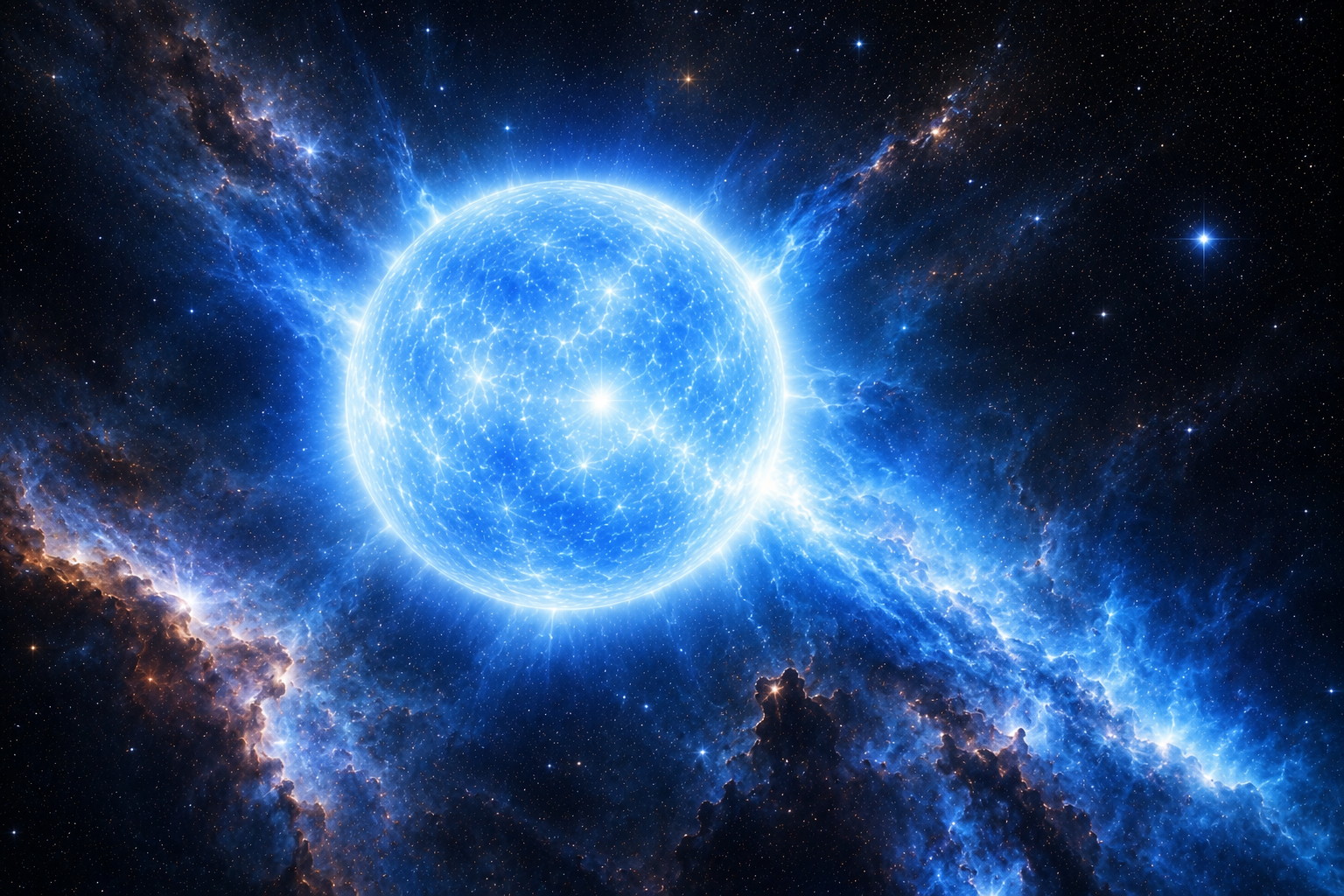
At the opposite extreme are the blue giants and blue supergiant's.
These stars contain many times the mass of the Sun.
Their enormous gravity compresses their cores to extraordinary temperatures, causing nuclear fusion to occur at an incredible rate.
As a result, they become some of the hottest and brightest objects in the universe.
But there is a price for such brilliance.
These stellar giants consume their fuel so rapidly that many survive for only a few million years—a brief moment compared to the billions of years enjoyed by smaller stars.
They live fast.
They shine brilliantly.
And they die young.
⬇
The Universe Needs Every Kind of Star
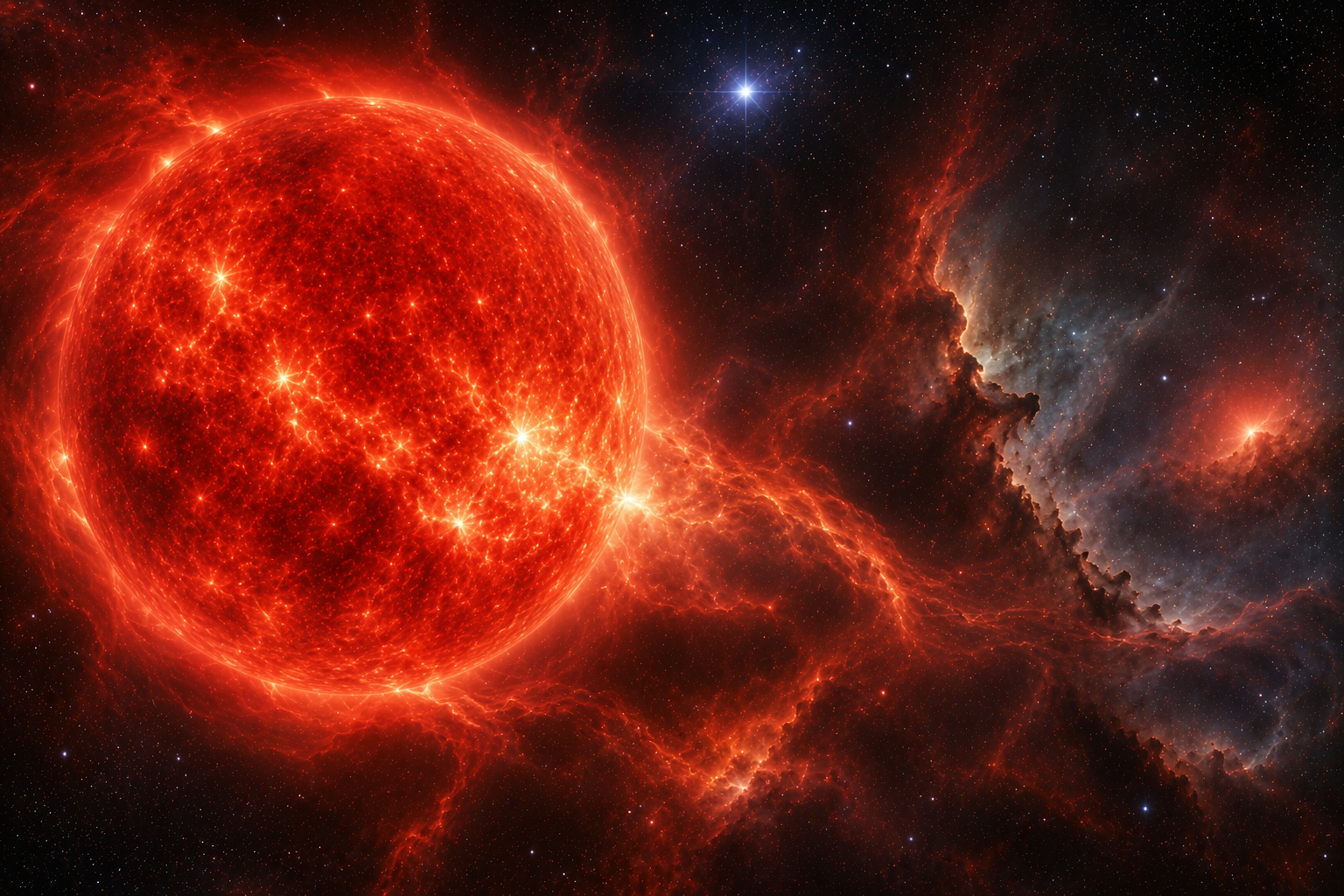
The universe does not favor one type of star over another.
Small stars provide extraordinary stability for unimaginable lengths of time.
Medium-sized stars, like our Sun, create environments where life can emerge.
Massive stars, though short-lived, forge the heavy elements that become planets, oceans, mountains, and even living organisms.
Every type of star plays a unique role in the cosmic story.
Without small stars, the universe would lose its longest-lasting lights.
Without giant stars, there would be no carbon, oxygen, iron, or gold.
Different stars live different lives.
Yet together, they build the universe we know today.
⭐ Chapter 4 — The Most Spectacular Deaths in the Universe
⬇
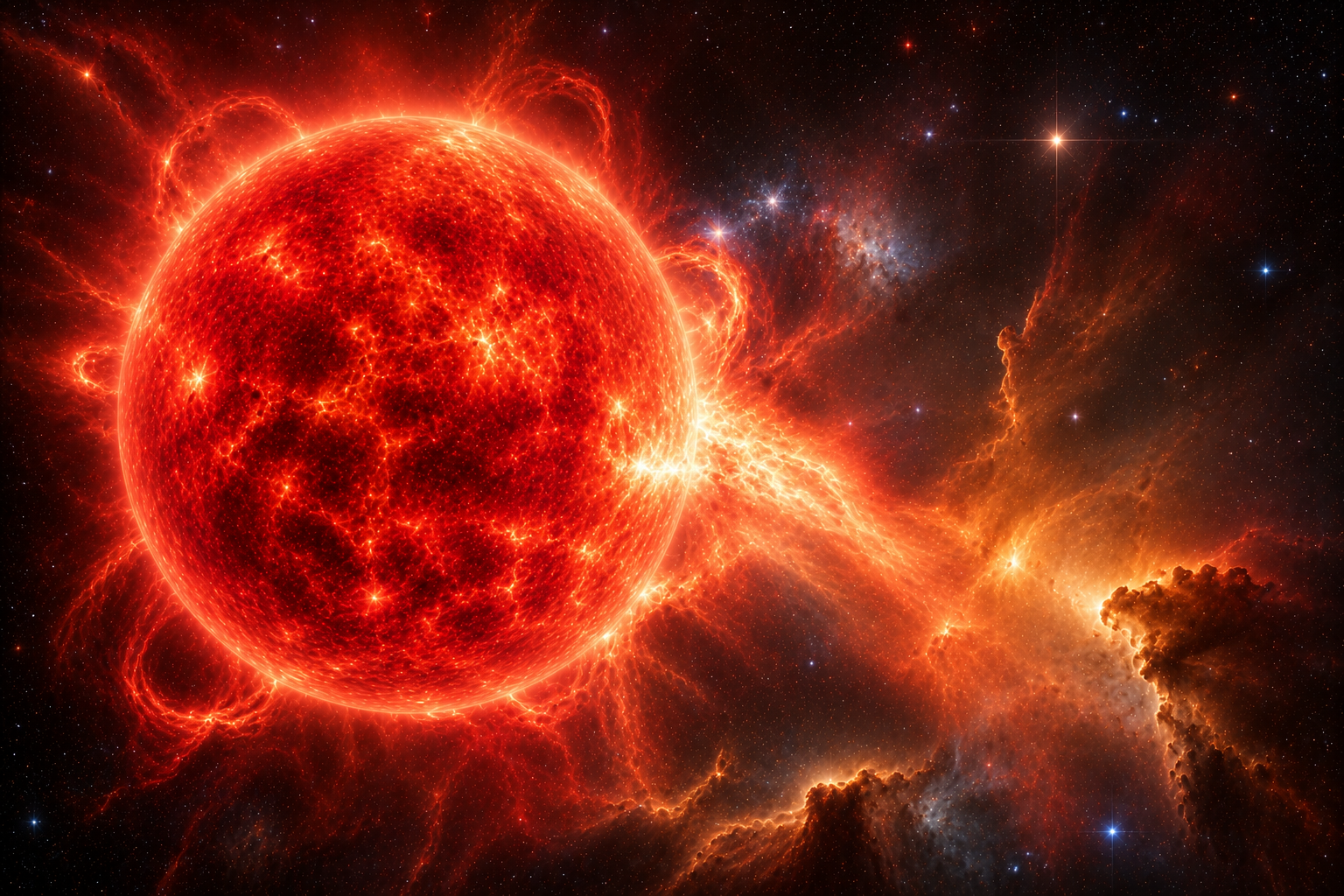
Every Star Must Say Goodbye
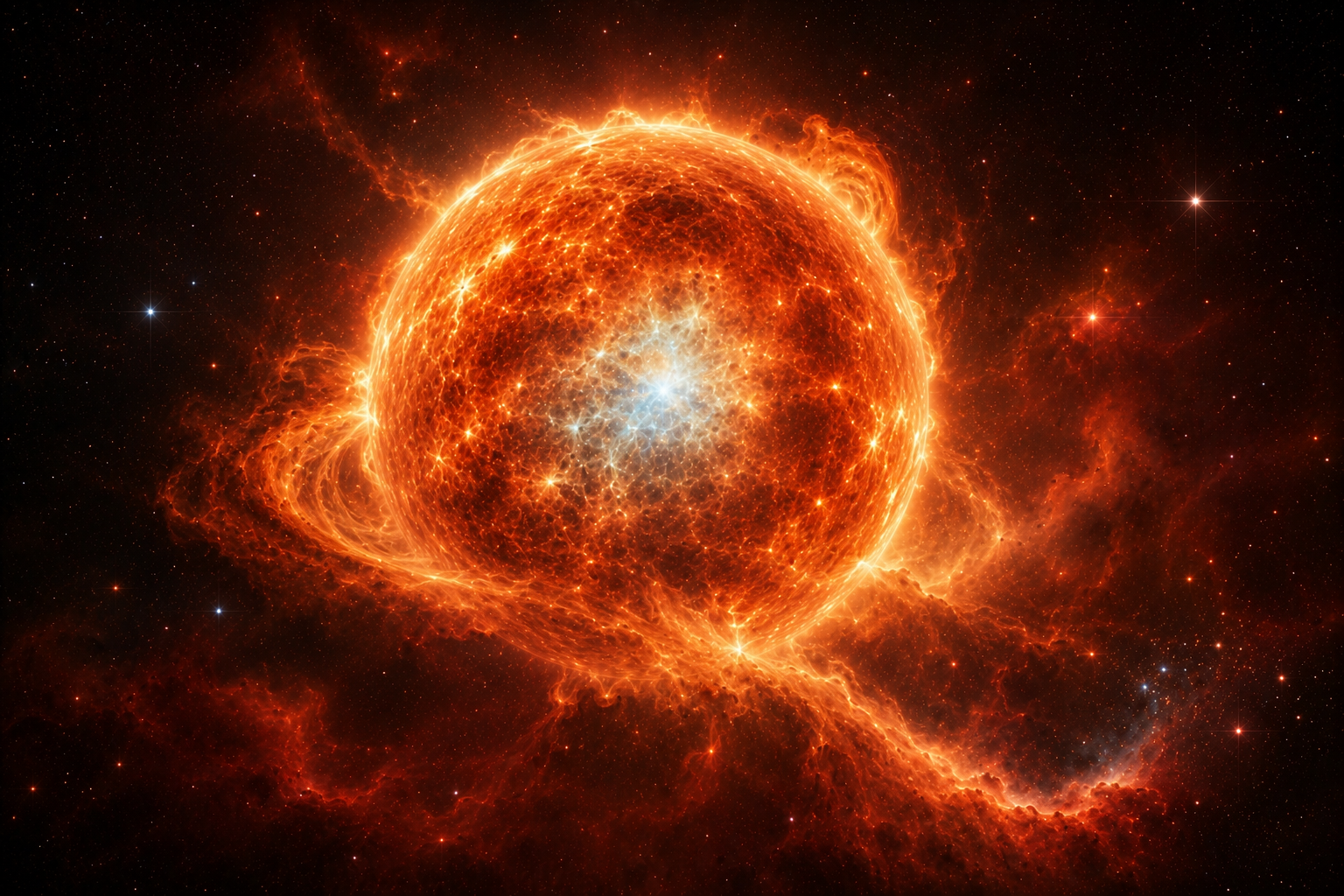
No star can shine forever.
For millions—or even billions—of years, nuclear fusion has fought against gravity, keeping the star alive.
But eventually, the fuel that powers this cosmic furnace begins to run out.
Without enough hydrogen to sustain fusion, gravity slowly gains the upper hand.
The balance that held the star together for its entire lifetime begins to fail.
What happens next depends entirely on the star's mass.
Some stars fade away quietly.
Others die in explosions so violent that they briefly outshine every star in their galaxy combined.
Death, for a star, is not the end.
It is the beginning of something entirely new.
⬇
The Quiet Farewell of Sun-Like Stars
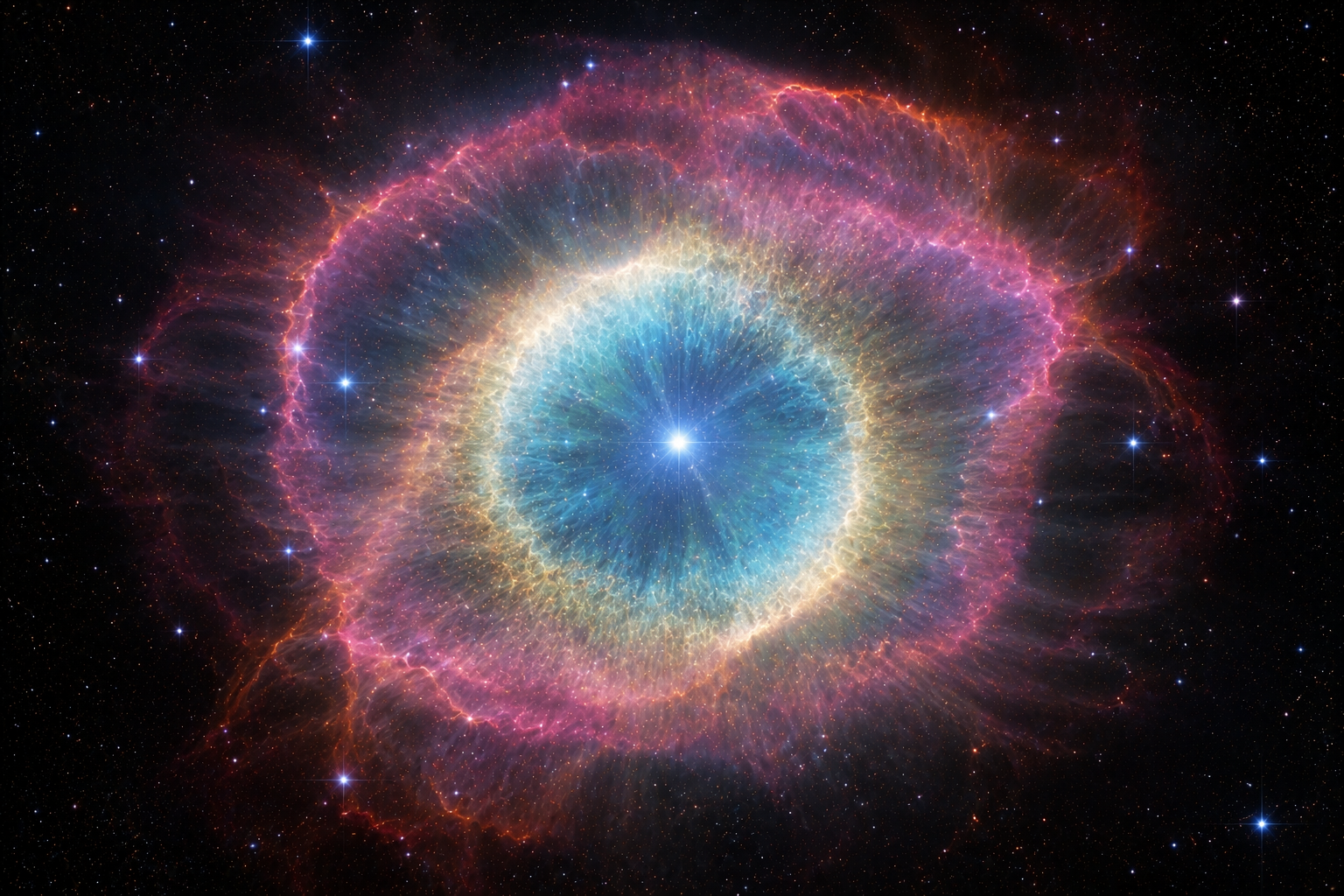
Stars similar to our Sun experience a peaceful ending.
As the hydrogen in their cores becomes exhausted, they begin fusing helium instead.
The outer layers slowly expand until the star transforms into a magnificent red giant, growing hundreds of times larger than before.
Billions of years from now, our own Sun is expected to swell so dramatically that it will likely engulf Mercury and Venus, and it may even reach Earth's orbit.
Eventually, the giant star gently sheds its outer layers into space.
These colorful clouds become a planetary nebula—one of the most beautiful sights in the universe.
At the center, the remaining core survives as a white dwarf.
Although no longer producing nuclear fusion, the white dwarf remains incredibly hot, slowly cooling over billions of years like the fading embers of a once-great fire.
⬇
When Giants Explode
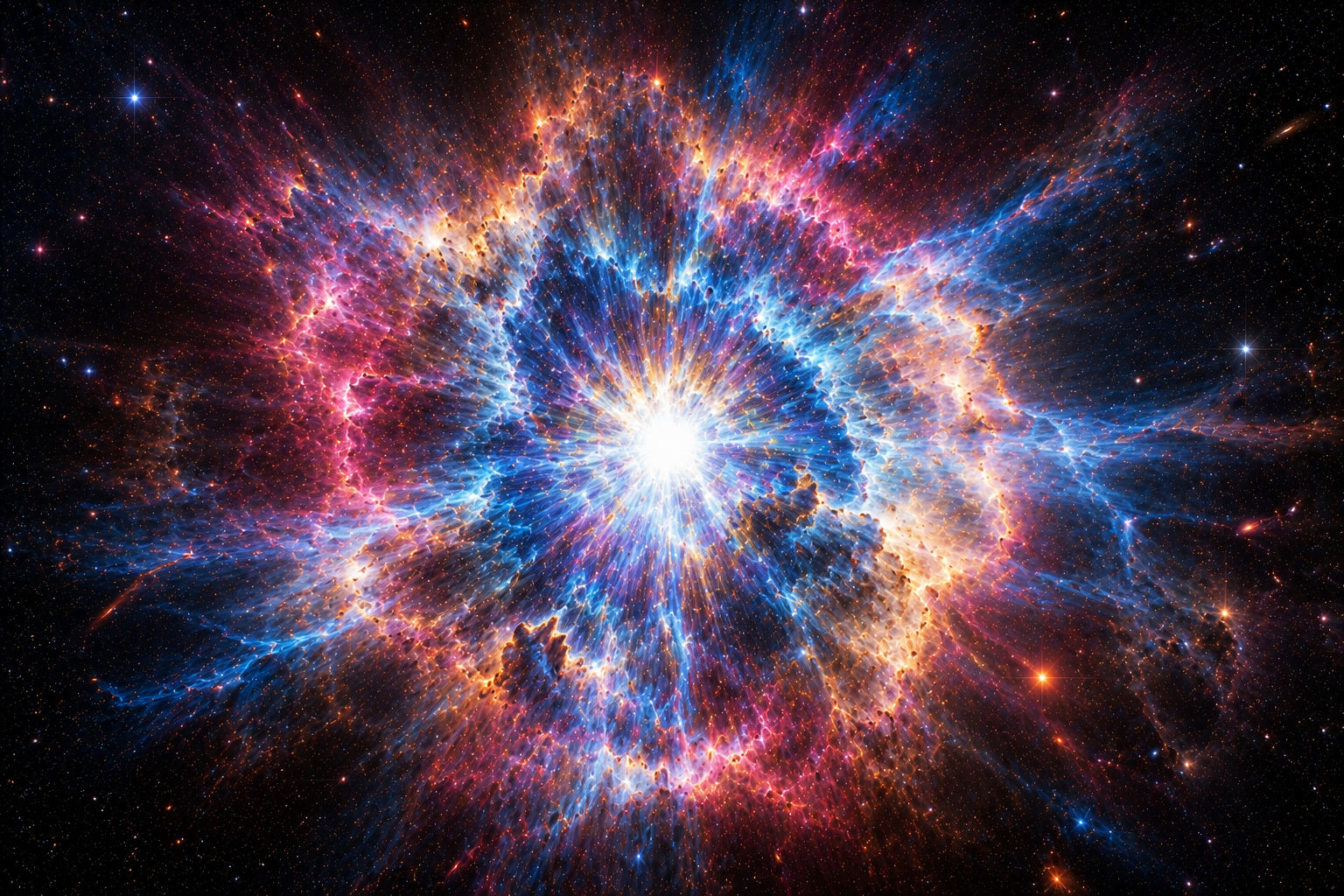
The largest stars face a far more dramatic fate.
As they consume heavier and heavier elements inside their cores, they eventually begin producing iron.
Unlike previous fusion reactions, iron cannot release energy through fusion.
Instead, it signals the beginning of the end.
Within seconds, the core collapses under its own gravity.
The entire star suddenly crashes inward before rebounding outward in an unimaginably powerful explosion.
This event is called a supernova.
For a brief time, a single exploding star can shine brighter than billions of stars combined.
The shockwave races across space, carrying newly created elements into the surrounding galaxy.
Gold.
Silver.
Calcium.
Uranium.
Many of the heaviest elements found throughout the universe are scattered by these extraordinary explosions.
A supernova is both an ending...
and the beginning of countless new worlds.
⬇
The Final Choice
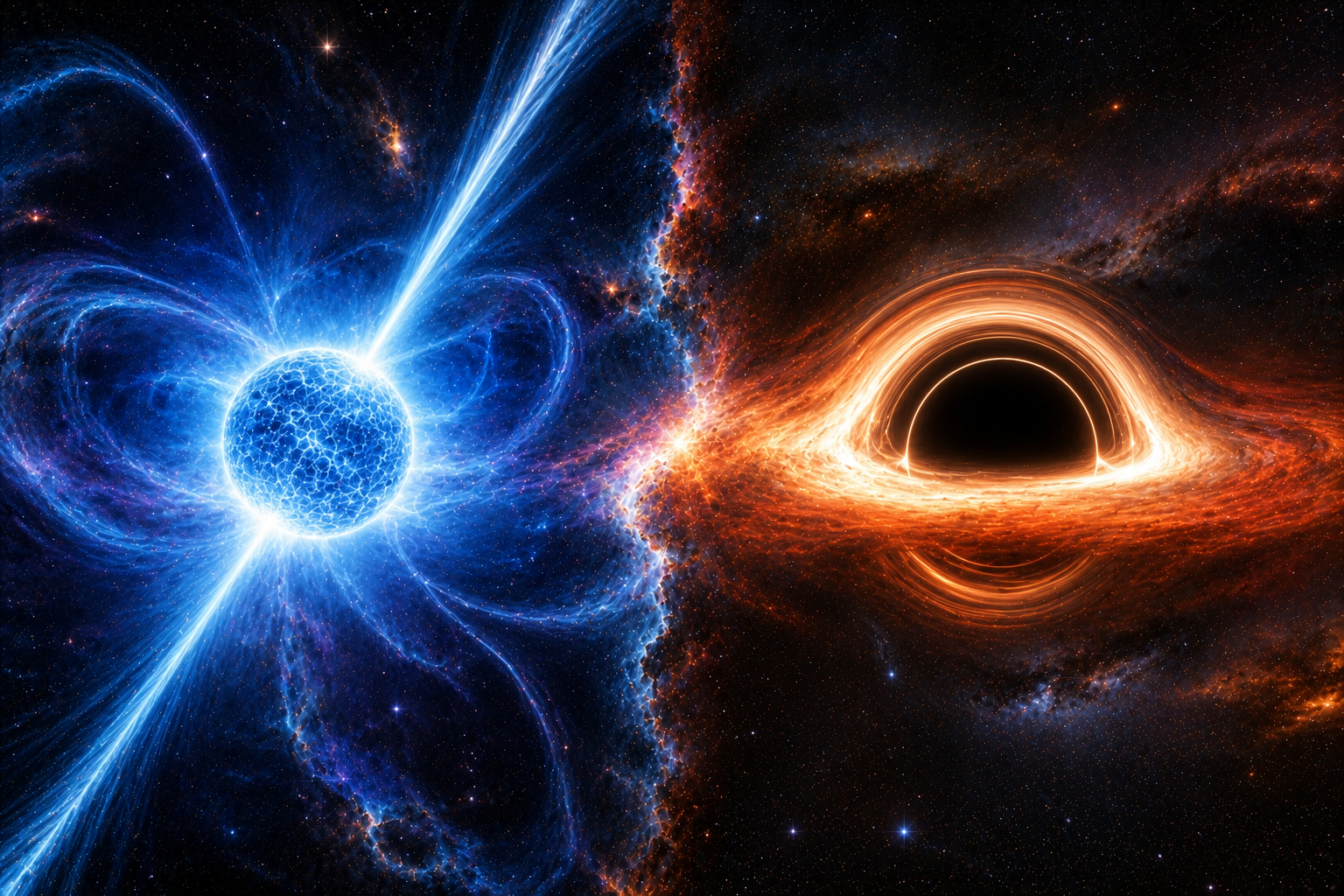
After the explosion, gravity makes one final decision.
If the remaining core is relatively small, it collapses into a neutron star.
A neutron star packs more mass than our Sun into a sphere only about 20 kilometers across.
A single teaspoon of its material would weigh billions of tons on Earth.
Some neutron stars spin hundreds of times every second, sending powerful beams of radio waves across space.
Astronomers observe these remarkable objects as pulsars, whose signals arrive with astonishing precision.
But if the remaining core is even more massive...
Gravity wins completely.
The collapsing star disappears behind an invisible boundary.
A black hole is born.
The same silent giants we explored in our previous documentary begin their existence here—from the spectacular death of a massive star.
The life of one star becomes the beginning of one of the universe's greatest mysteries.
⬇
Death Creates New Life
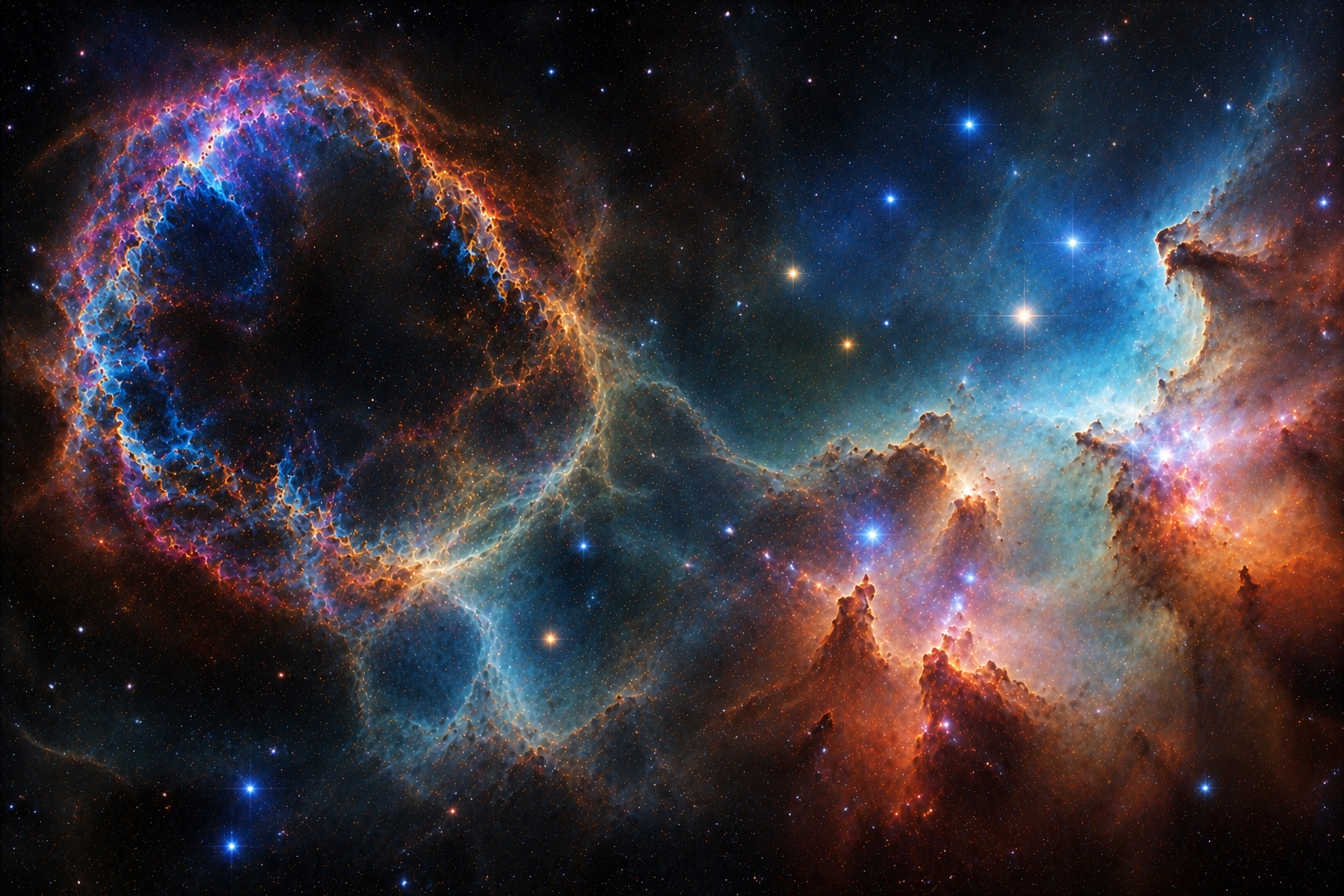
Every atom released by a dying star drifts through space for millions of years.
Eventually, those elements become part of new nebulae.
New stars begin to form.
New planets appear.
Perhaps life emerges once again.
The universe does not waste anything.
Every stellar ending becomes the foundation for another beginning.
The cycle continues across billions of years, quietly shaping galaxies one generation of stars at a time.
⭐ Chapter 5 — We Are Made of Stardust
⬇
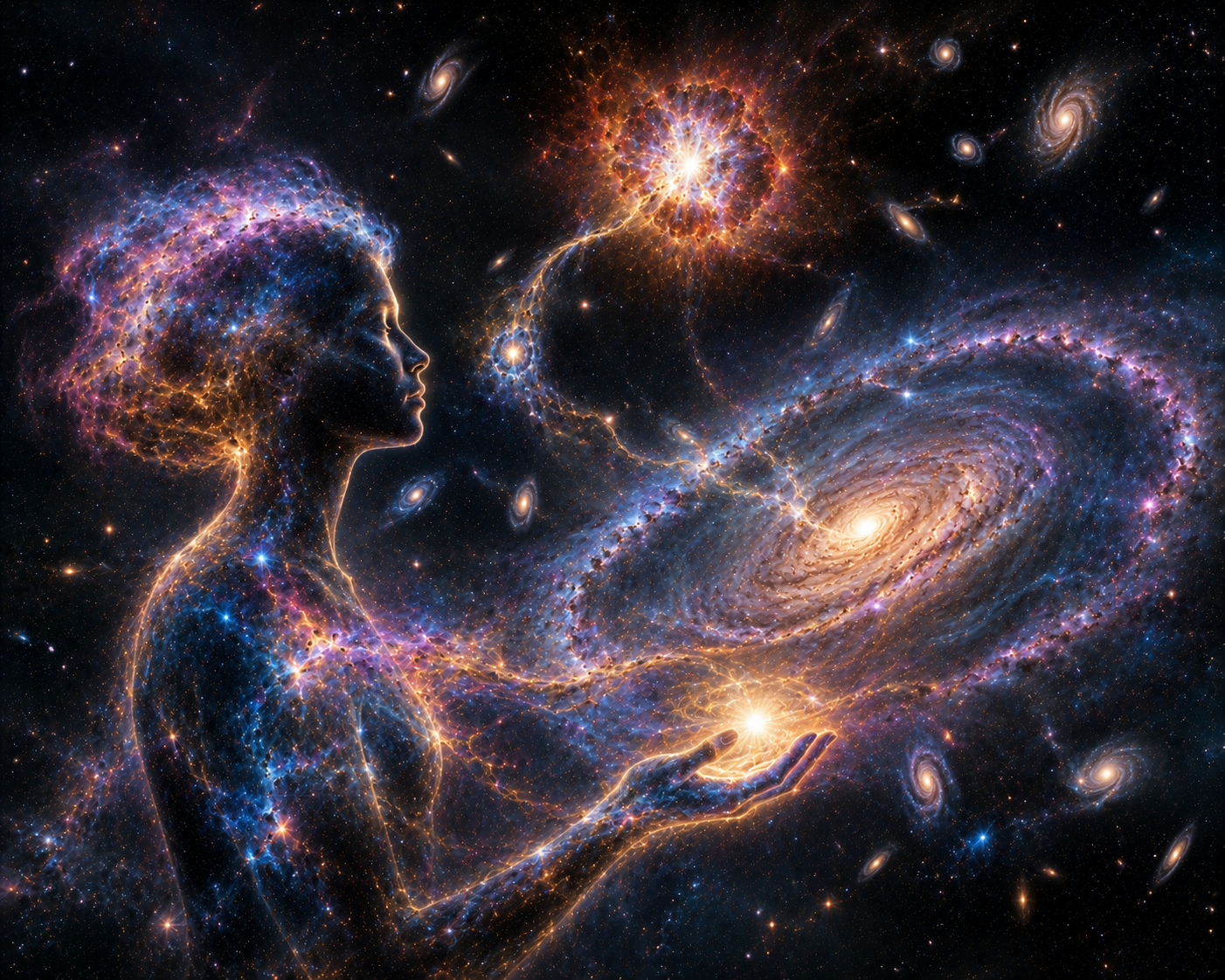
A Story That Ends with You
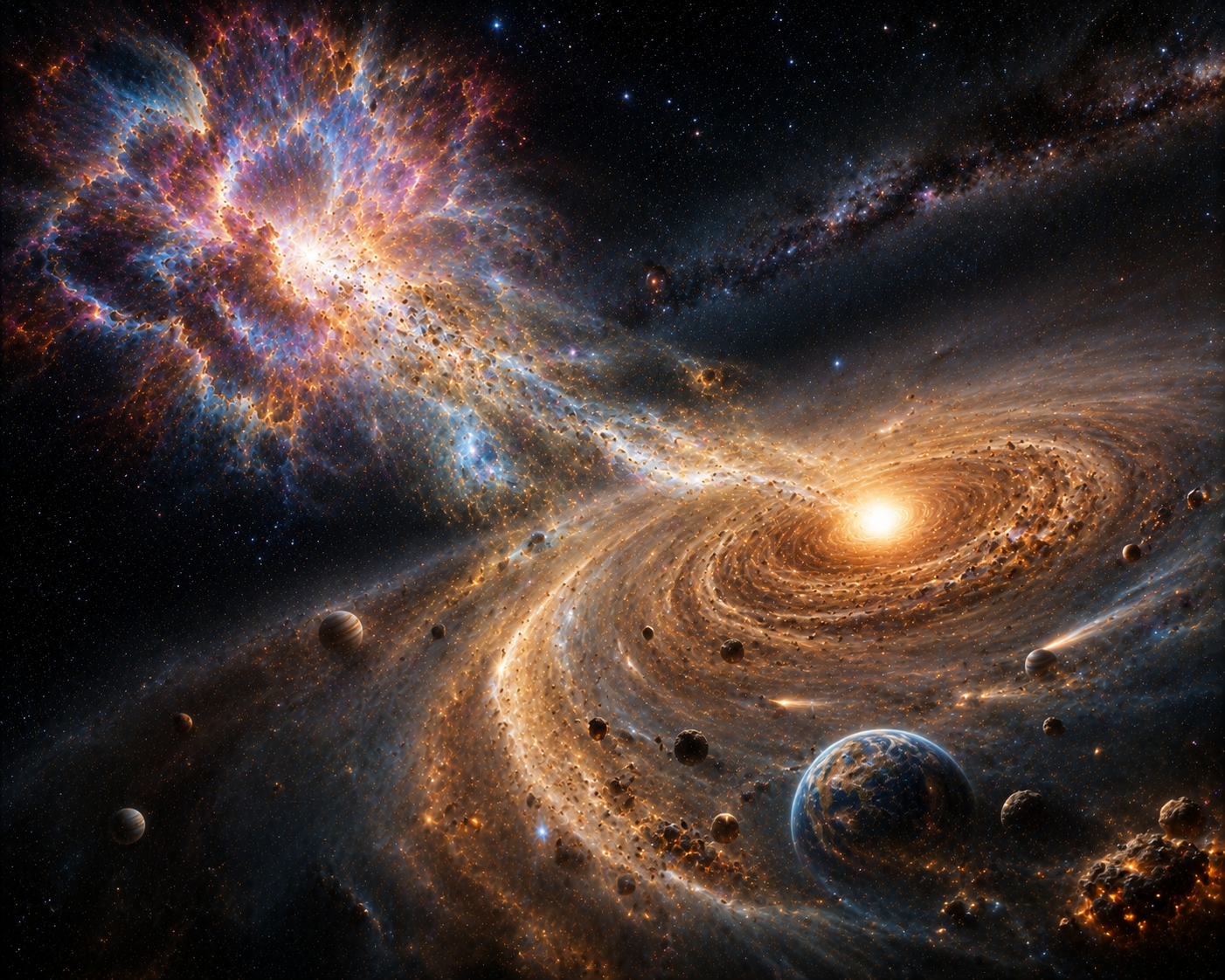
For billions of years, stars have been quietly shaping the universe.
They were born from vast clouds of gas.
They spent millions—or even billions—of years lighting the darkness.
And when their lives came to an end, they scattered their contents across the cosmos.
Those tiny particles drifted through space.
Some became part of new stars.
Some formed planets.
And a small fraction eventually became something extraordinary.
Us.
The story of stars is not only the story of the universe.
It is also the story of every person who has ever lived.
⬇
The Atoms That Built Humanity
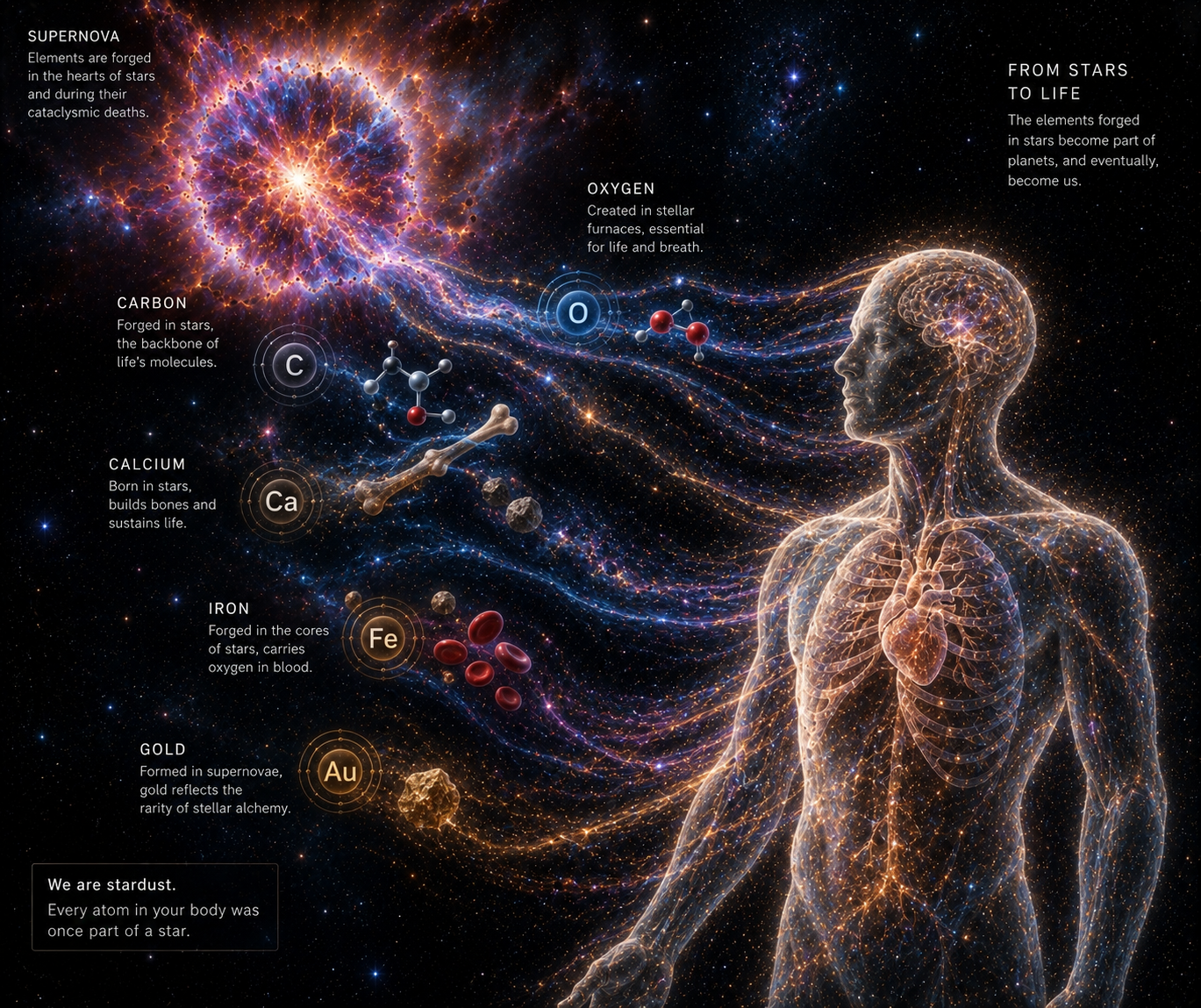
The hydrogen in your body was created shortly after the Big Bang.
But many of the elements that make life possible were forged much later inside stars.
The carbon that forms every cell.
The oxygen you breathe.
The calcium in your bones.
The iron carried through your bloodstream.
Even precious metals like gold and platinum.
All were created in stars or during the violent explosions that marked their deaths.
Every heartbeat is powered by atoms born billions of years before the Earth existed.
Without generations of stars living and dying, our planet would have remained a lifeless world of simple elements.
Life itself is a gift from ancient suns.
⬇
Amazing Star Facts
⭐ More than 100 billion stars are estimated to exist in the Milky Way alone.
🌌 The observable universe contains hundreds of billions of galaxies, each with millions or billions of stars.
☀️ The Sun is about 4.6 billion years old and is expected to shine for roughly another 5 billion years.
🔴 Red dwarf stars may survive for trillions of years, making them the longest-lived stars in the universe.
💥 A supernova can briefly outshine an entire galaxy.
🪐 Every planet in our Solar System formed from the leftover gas and dust surrounding the young Sun.
✨ Every atom of carbon, oxygen, calcium, and iron in the human body was created through stellar processes.
⬇
Atlas Nova Perspective
When we gaze at the night sky, it is easy to feel small.
The universe is unimaginably vast, filled with galaxies separated by millions of light-years and stars that have burned for billions of years.
Yet the greatest connection between humanity and the cosmos is invisible.
The universe is not separate from us.
It lives within us.
Every atom in our bodies has traveled an extraordinary journey across space and time.
In a very real sense, we are not merely observers of the universe.
We are one of its creations.
⬇
The Light That Never Truly Dies
Stars may disappear from the night sky.
They may collapse, explode, or slowly fade into darkness.
But their legacy never ends.
The light they released continues traveling across the universe.
The elements they forged become new stars, new planets, and perhaps new forms of life.
Every ending becomes another beginning.
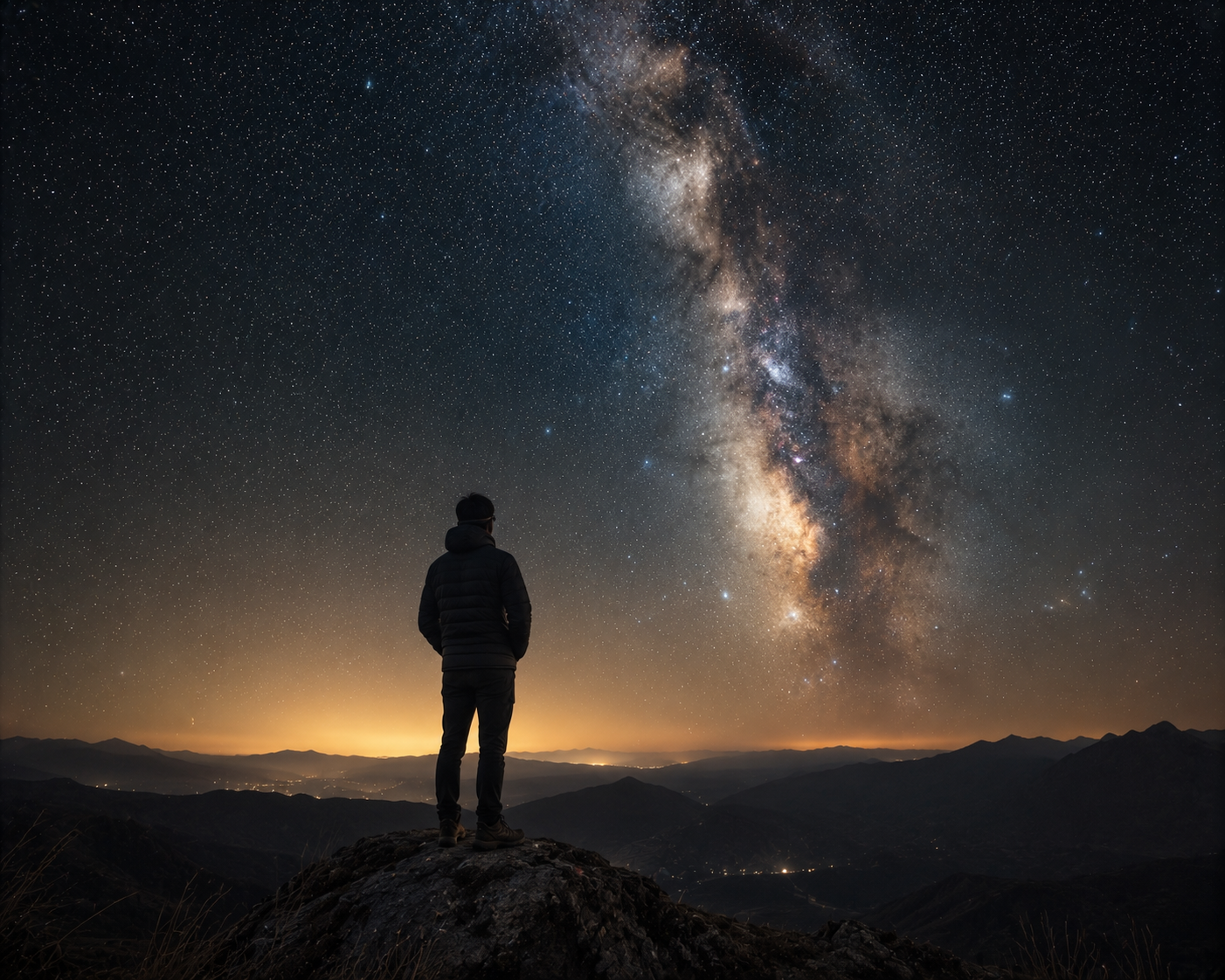
The next time you stand beneath a sky filled with stars, remember that they are more than distant points of light.
They are ancient storytellers.
Their lives gave birth to worlds.
Their deaths made life possible.
And somewhere, billions of years ago, one forgotten star created the atoms that would one day become you.
The universe has been writing this story for over 13 billion years.
And remarkably...
You are one of its newest chapters.
Frequently Asked Questions
⭐ How are stars born?
Stars form inside huge clouds of gas and dust called molecular clouds. Gravity pulls material together until the central region becomes hot and dense enough for nuclear fusion to begin.
🔥 What powers a star?
Stars are powered by nuclear fusion. In most stars, hydrogen nuclei combine to form helium, releasing enormous amounts of energy as light and heat.
⏳ How long does a star live?
A star's lifetime depends mainly on its mass. Massive stars can live only millions of years, while smaller stars such as red dwarfs can potentially shine for trillions of years.
🌞 What happens when a star runs out of fuel?
When a star can no longer sustain its main source of fusion, its structure changes. Depending on its mass, it may become a white dwarf, or undergo a supernova and leave behind a neutron star or black hole.
💥 Do all stars explode as supernovas?
No. Most stars are not massive enough to end their lives in a core-collapse supernova. Stars similar to the Sun eventually shed their outer layers and leave behind white dwarfs.
🕳️ Can a star become a black hole?
Yes. A sufficiently massive star can collapse after exhausting its nuclear fuel. If its remaining core is massive enough, the collapse can produce a black hole.
🌌 What happens to the material from dead stars?
Stellar explosions and stellar winds can spread elements into space. This material can later become part of new stars, planets, and other cosmic objects.
☀️ What will happen to the Sun?
The Sun will eventually exhaust the hydrogen in its core, expand into a red giant, shed its outer layers, and end as a white dwarf. It will not become a black hole or supernova.
🔄 Is the death of a star also the beginning of something new?
In a sense, yes. Material released by dying stars can enrich interstellar space and contribute to the formation of future generations of stars and planets.