Why Is There an Underwater Forest in Lake Kaindy?
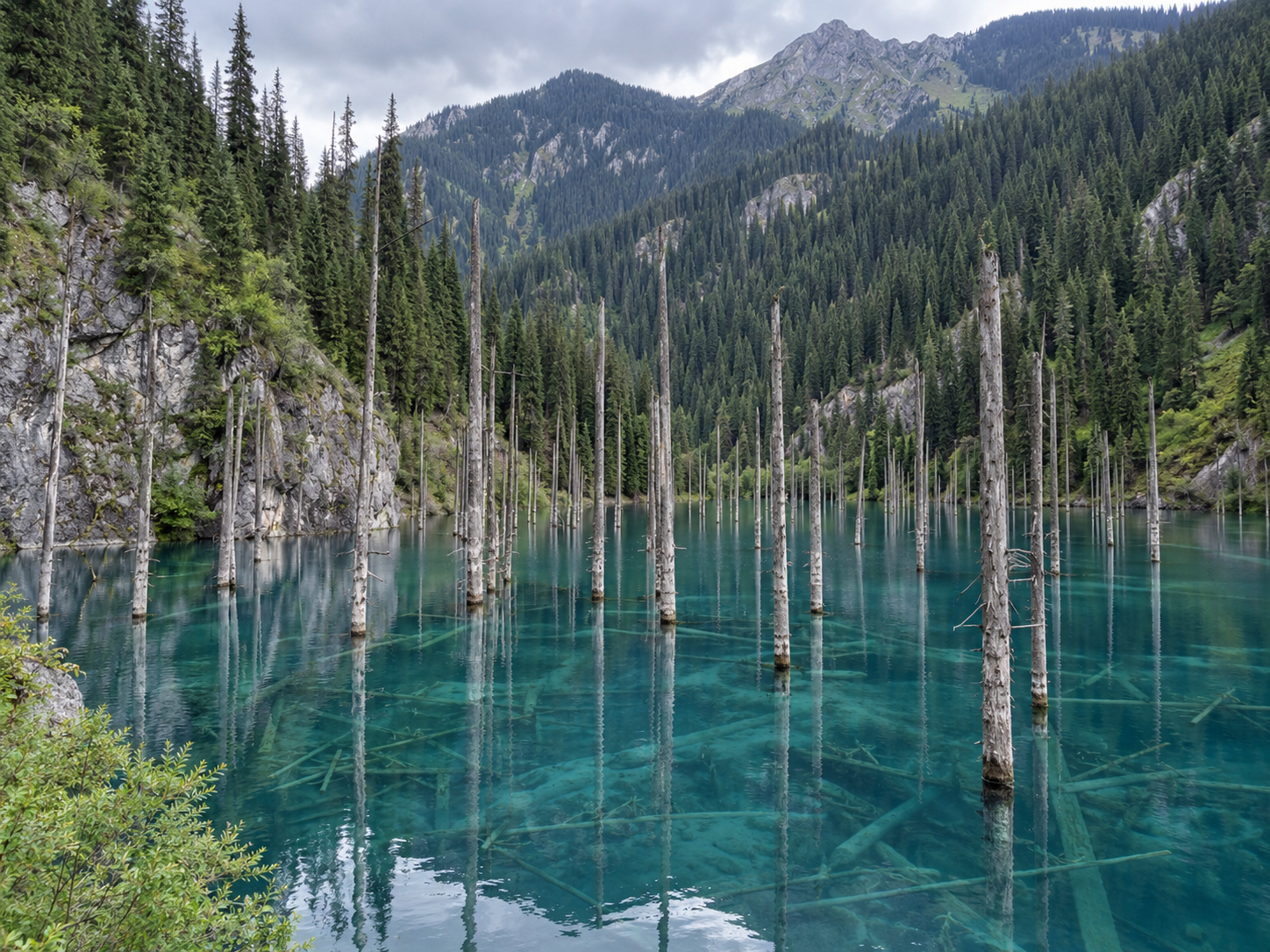
There are trees standing in the middle of a lake.
That is the first thing you notice at Lake Kaindy in Kazakhstan.
Pale trunks rise straight out of the blue-green water. Some are still standing almost as if the forest never moved. Others have disappeared below the surface.
It looks like someone flooded a forest and forgot to take the trees out.
In a way, that is almost what happened.
Lake Kaindy was created after a major earthquake in 1911 triggered a landslide that blocked a mountain valley. Water slowly filled the valley and covered a spruce forest that had been growing there.
The lake is therefore much younger than it looks.
And the strangest part is still waiting below the surface.
The cold mountain water has helped preserve the submerged trees, leaving an underwater forest more than a century after the lake was formed.
So how did a forest end up underwater?
And why are the trees still there?
Chapter 1 — The Forest Was There First
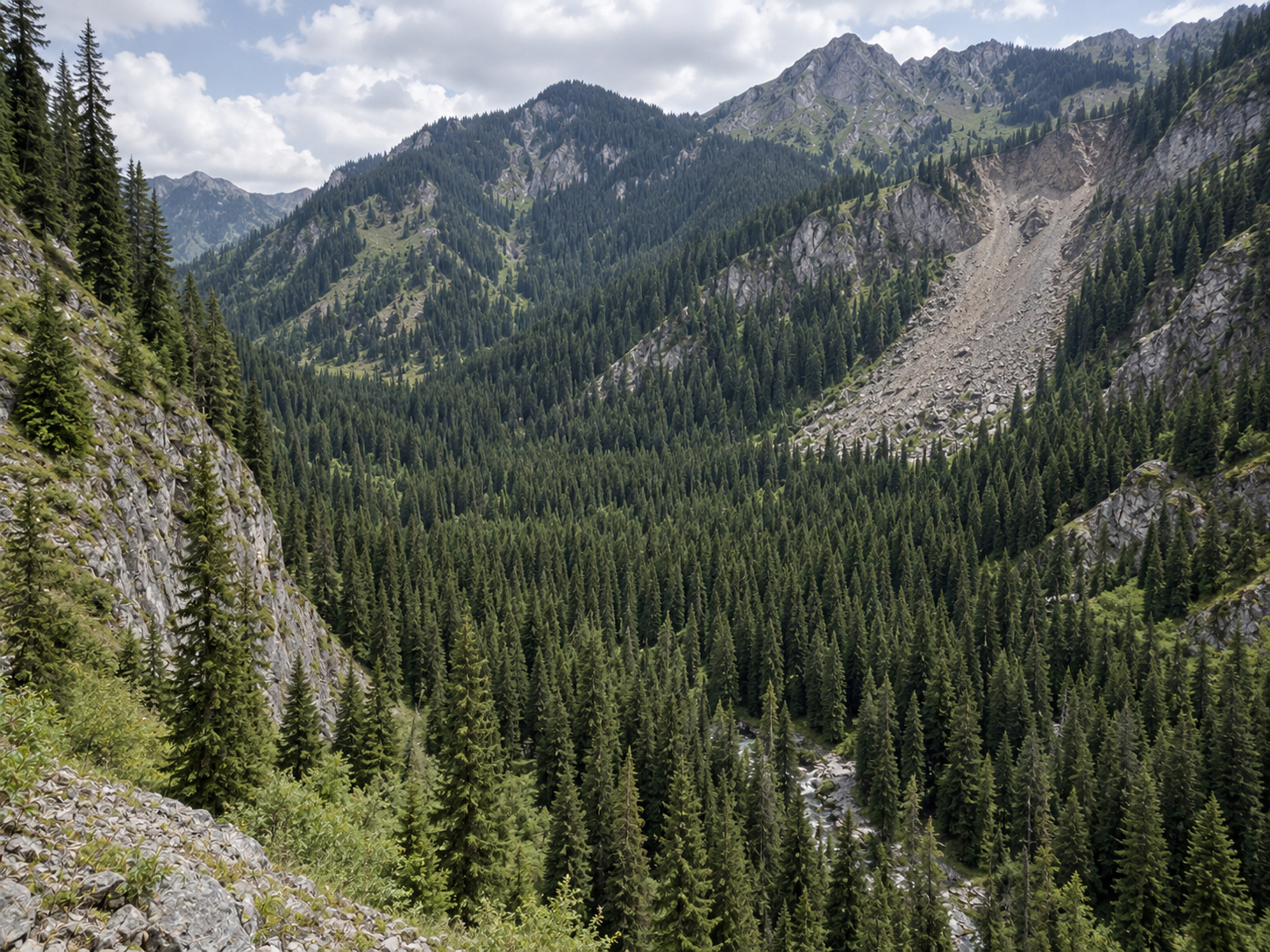
Before Lake Kaindy appeared, there was no lake here.
There was a mountain valley.
And in that valley stood spruce trees.
Then, in January 1911, a powerful earthquake struck the region. The earthquake caused a huge landslide that blocked the valley and created a natural dam. Water then began collecting behind it.
Nothing about this happened quickly.
The earthquake created the barrier.
Rain and other water sources then filled the newly blocked valley.
As the water level rose, the trees that had been growing there were gradually surrounded.
Then they disappeared beneath the surface.
That is why the trunks look so strange today.
They are not trees that somehow grew out of the lake.
They are the remains of a forest that was already there.
This also explains why the lake looks so young.
It is.
The natural dam was created only about a century ago. Government information from Kazakhstan describes Kaindy as a relatively young lake formed after a large rock collapse blocked the gorge.
The mountains may look ancient.
The forest around the lake may be old.
But the lake itself is a newcomer.
How Lake Kaindy Was Born
Chapter 2 — The Trees Did Not Sink
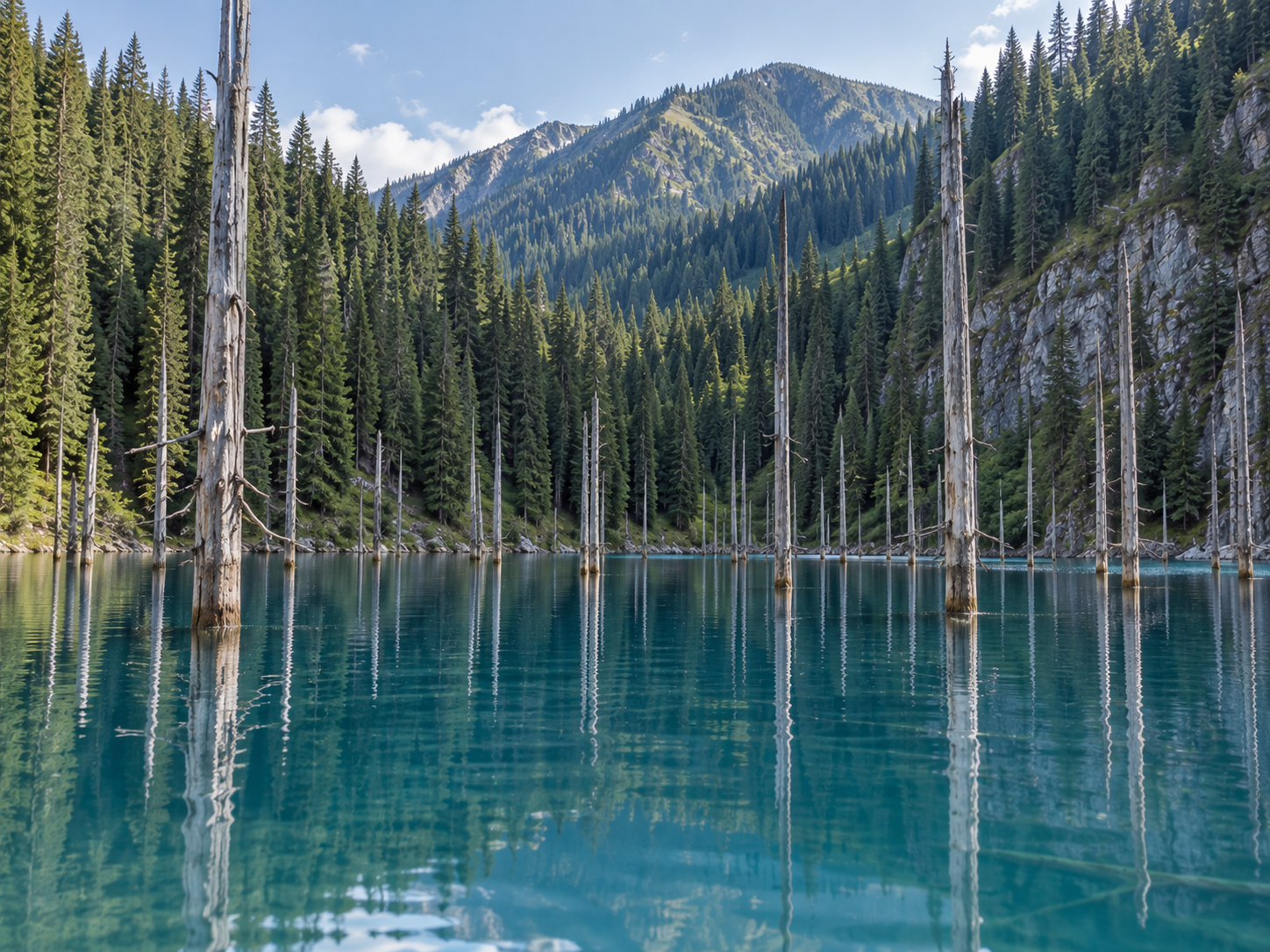
Look at the trunks above the water.
They seem to disappear straight into the lake.
It is tempting to imagine that the trees were somehow pulled underwater.
They were not.
The ground around them was flooded.
As water filled the valley, the lower parts of the spruce forest became submerged. The trunks that had once stood on dry land were suddenly standing in a lake instead.
That is why the trees can still look strangely upright.
The trees were already growing vertically.
The flood simply changed what was around them.
One day there was forest floor.
Later there was lake water.
Above the water, only the upper parts of some trunks remain visible.
Below it, the rest of the old forest continues into the depths.
There is something almost ordinary about the process.
The trees did not become an underwater forest overnight.
The valley became a lake.
The forest happened to be in the way.
And because the flood followed the shape of the valley, the trees remained standing where they had grown.
Why Are the Trees Still Standing?
Chapter 3 — Why Haven't the Trees Disappeared?
This is the part that makes Lake Kaindy especially strange.
Trees usually rot.
Leave fallen wood outside for long enough and it breaks down. Water does not always stop that process.
So why are these trunks still here after more than a hundred years?
The answer is the mountain water.
Lake Kaindy sits high in the Tian Shan, and its water is famously cold. The cold environment has helped slow the processes that normally break down wood. Sources describing the lake specifically point to its cold water as one reason the submerged trees have remained remarkably well preserved.
But “preserved” does not mean perfectly frozen in time.
The trees have changed.
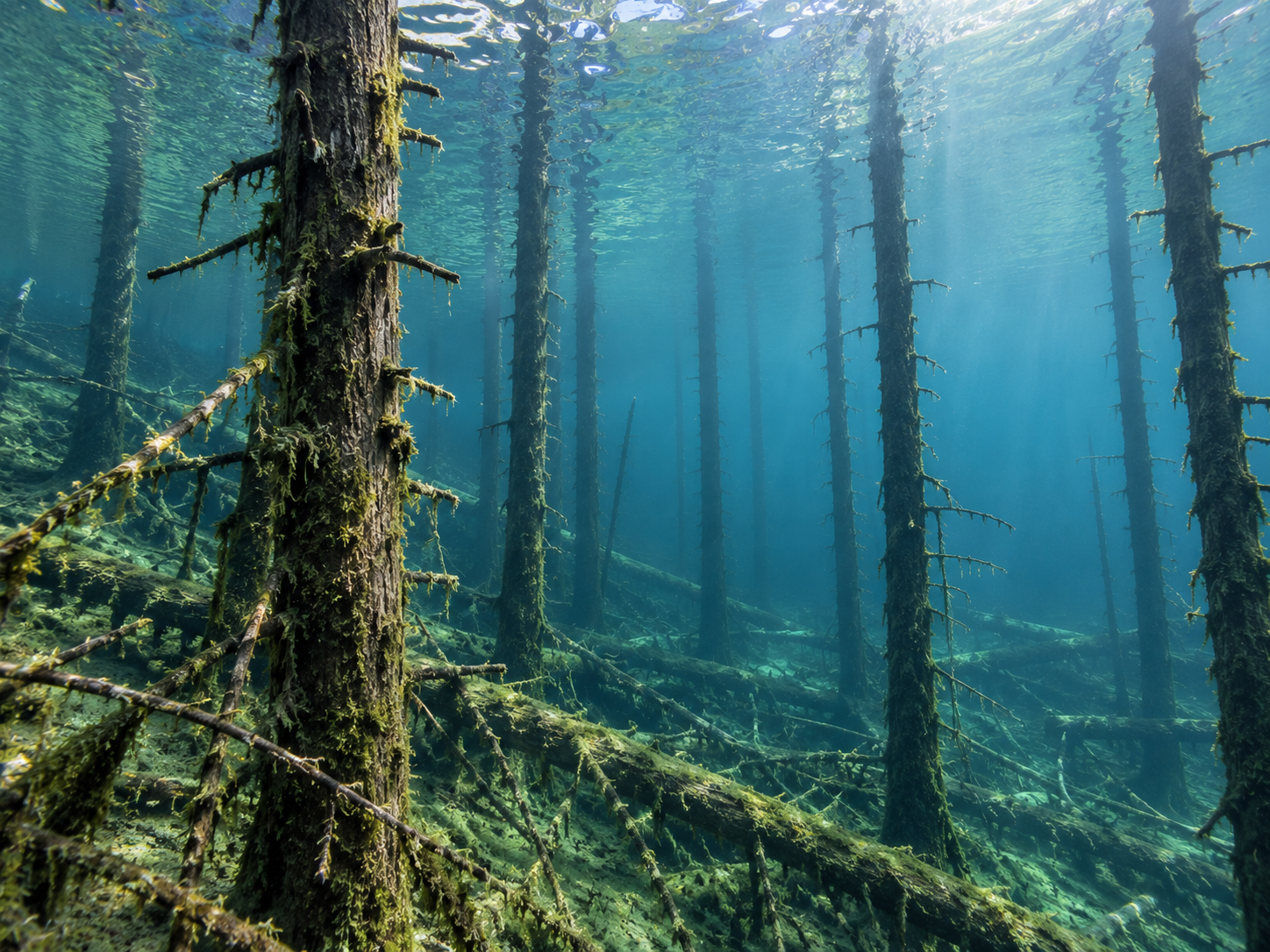
The exposed trunks above the water have been stripped of their branches and bark by weather. Underwater, branches and fallen wood can still be seen in the clear water, with algae growing across parts of them.
So there are really two different trees to notice.
Above the surface, pale bare trunks.
Below the surface, a darker underwater world.
The cold water did not make the trees immortal.
It simply slowed their decay enough for the remains to survive for generations.
That is why the forest is still visible.
Why the Forest Survived
Chapter 4 — The Forest Changes When You Go Underwater
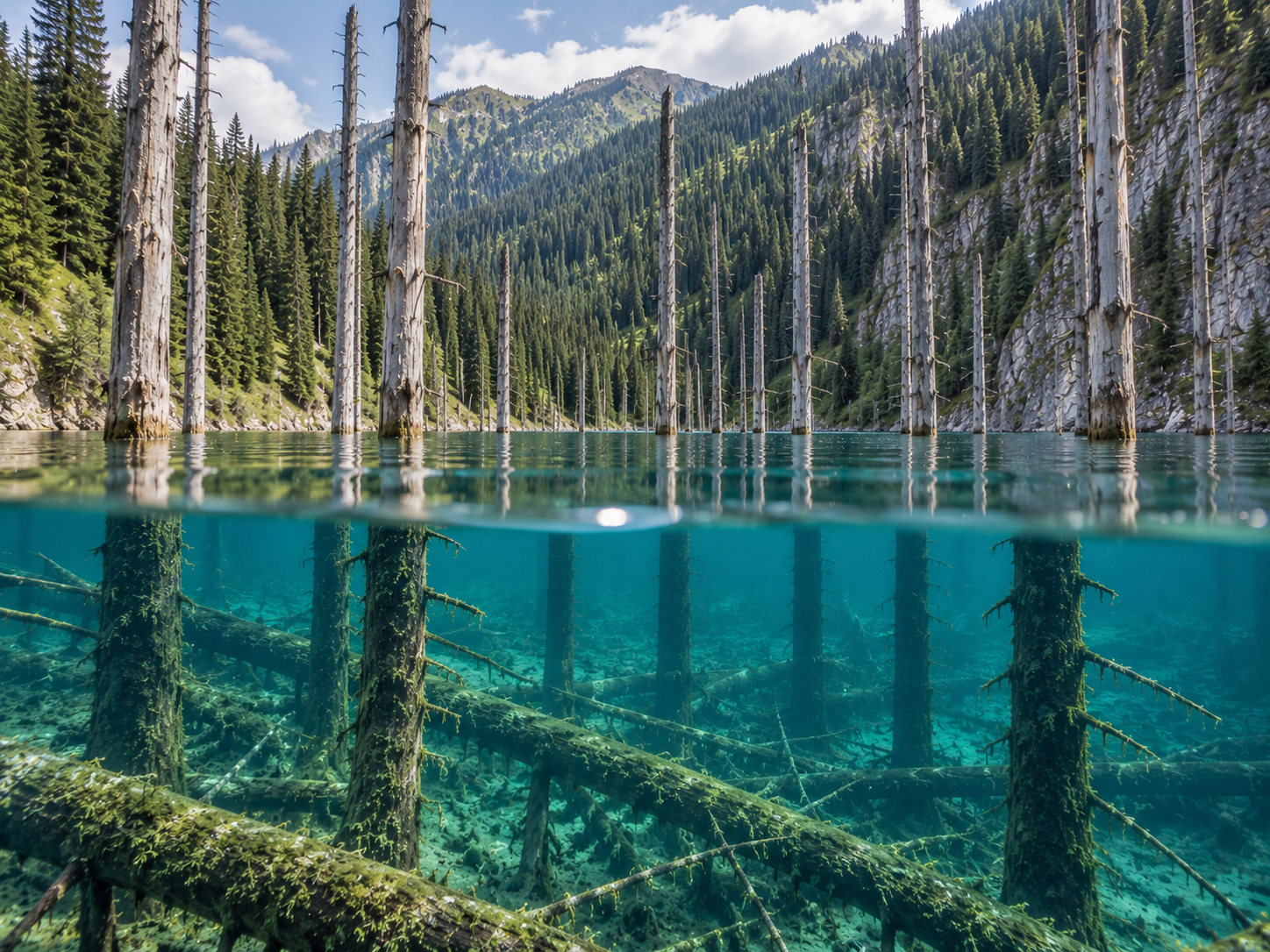
From the shore, Lake Kaindy looks like a forest of dead tree trunks.
Go below the surface and the picture changes.
The water is clear enough in good conditions to reveal trunks, branches and fallen wood beneath you. Algae can cover the submerged trees, giving them a very different appearance from the pale trunks above the lake.
It can feel as though there are two forests.
One is above the water.
The other is underneath it.
Of course, the underwater one is not a living forest in the usual sense. These are the remains of the spruce woodland that was flooded when the lake formed.
Still, the shape of the old forest has survived.
That is what makes the place so unusual.
Most forests disappear as forests when they are destroyed.
At Kaindy, the landscape changed first.
The trees remained as a record of what had been there before.
You can read the history in the trunks.
The tall dead trees above the water tell you how high the lake rose.
The submerged branches tell you that a forest once occupied the valley below.
The lake is almost like a photograph taken by nature.
Two Forests in One View
Chapter 5 — Why Is the Water So Blue?
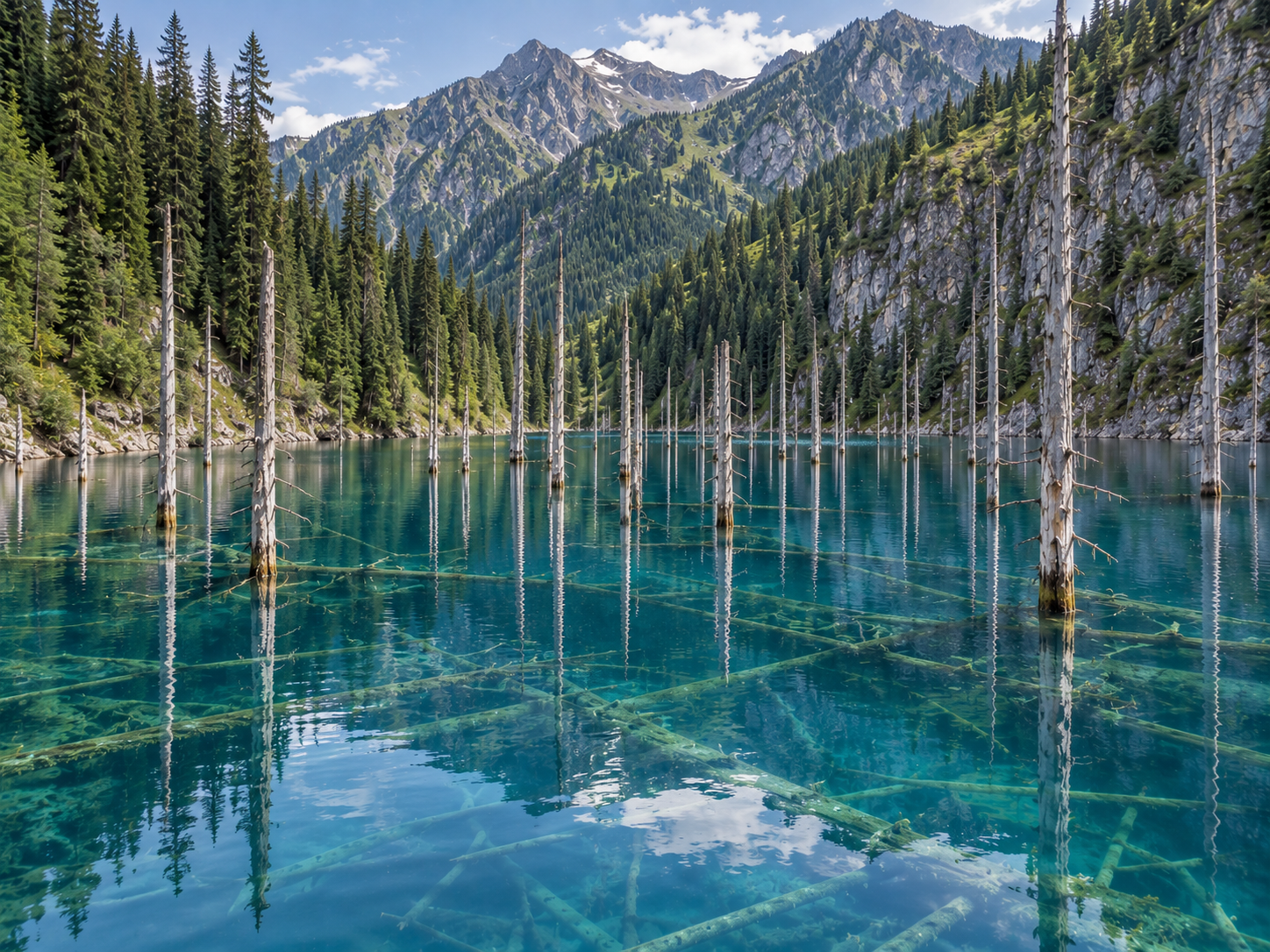
There is another reason the lake looks almost unreal.
The water.
Lake Kaindy is known for its clear blue-green appearance, surrounded by steep mountain slopes and conifer forest. Kazakhstan's tourism information describes the lake as having clear emerald-coloured water, while other descriptions note its striking turquoise appearance.
The colour can change with conditions and light, so there is no single shade that every photograph will show.
But the important thing is what that clear water allows you to see.
The deeper forest.
At an ordinary lake, trees standing underwater would quickly become difficult to see if the water were cloudy.
At Kaindy, the visibility can reveal what is happening beneath the surface.
That is why photographs of the lake can be so misleading.
A picture may show ten tree trunks sticking out of the water.
But there can be many more below.
The visible trunks are only the part of the old forest that happens to rise above the lake.
The rest is waiting underneath.
Why the Underwater Forest Can Be Seen
Chapter 6 — A Lake Only About a Century Old
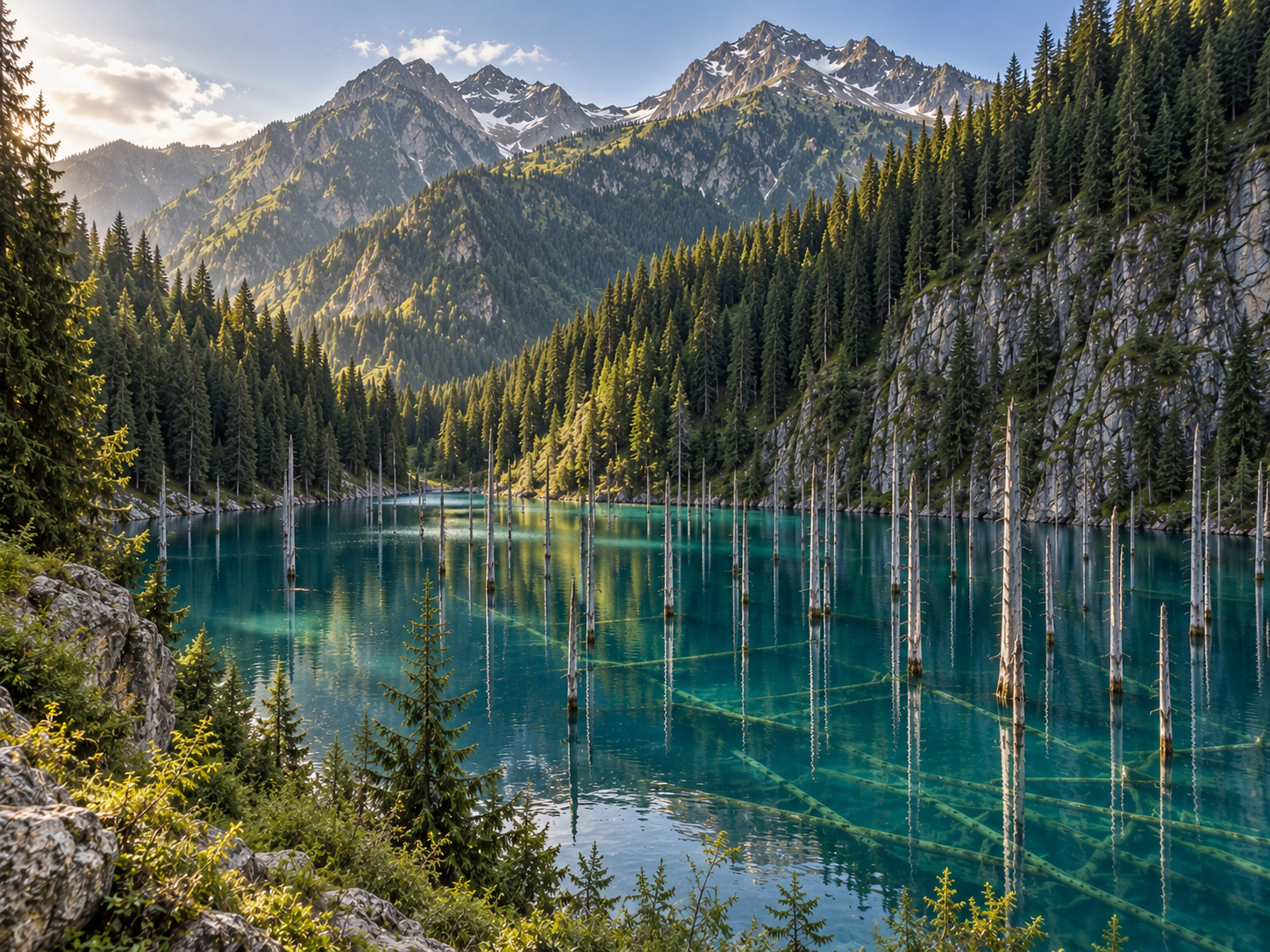
There is something easy to miss when looking at Lake Kaindy.
It looks ancient.
The mountains around it are dramatic. The forest is dense. The submerged trees give the lake an almost timeless feeling.
But the lake is remarkably young.
The earthquake and landslide that created it happened in 1911. The water then filled the blocked valley and produced the lake we see today.
That means the trees and the lake belong to two different stories.
The forest existed first.
The lake came later.
The earthquake is what joined them.
And perhaps that is why Lake Kaindy feels so unusual.
It is not an ancient forest that somehow survived beneath an ancient lake.
It is a relatively recent lake holding the remains of a much older landscape.
The trees are telling you what was here before the water arrived.
And the water is telling you that the valley itself has changed.
More than a century later, both stories are still visible in the same place.
A Century of Change
The Forest That Became a Lake
Lake Kaindy is strange for a very simple reason.
The trees were there first.
Then the mountain changed.
An earthquake triggered a landslide. The landslide blocked the valley. Water collected behind the new natural dam and slowly covered the spruce forest.
The trees did not rise from the lake.
The lake rose around the trees.
More than a century later, some of those trunks are still standing above the surface, while the cold water has helped preserve much of the forest below.
That is why Lake Kaindy can look like two places at once.
A mountain lake.
And a drowned forest.
Look at the trunks and you are seeing the remains of a forest that once filled the valley.
Look into the water and you are seeing what happened when the valley itself became something new.
The trees are not just the attraction.
They are the evidence.
Frequently Asked Questions
1. Why are there trees in Lake Kaindy?
The trees were already growing in the valley before the lake existed. A 1911 earthquake caused a landslide that blocked the valley, and the resulting lake flooded the spruce forest.
2. How did Lake Kaindy form?
A major earthquake triggered a landslide that created a natural dam across a mountain gorge. Water then collected behind the dam and formed the lake.
3. When was Lake Kaindy formed?
Lake Kaindy was formed after the 1911 earthquake and subsequent landslide in the Tian Shan region of Kazakhstan.
4. Why are the trees still preserved underwater?
The lake's cold mountain water has slowed the decay of the submerged wood, allowing many of the tree trunks and branches to remain visible for more than a century.
5. Are the trees in Lake Kaindy alive?
No. The trees are the remains of a spruce forest that was flooded when the lake formed. The living forest is now found around the lake on the surrounding mountain slopes.
6. Why do the trees stick out of the water?
They were standing in the valley before it was flooded. As the water level rose, the trunks became submerged, leaving only their upper sections above the surface.
7. What kind of trees are underwater in Lake Kaindy?
The famous submerged trees are spruce trees. Government sources and other descriptions of the lake specifically identify the flooded forest as spruce.
8. Why is Lake Kaindy blue or turquoise?
Its clear mountain water can appear blue, turquoise or green depending on conditions and light. The unusually clear water also makes the submerged forest visible.
9. Where is Lake Kaindy?
Lake Kaindy is in southeastern Kazakhstan, in the Tian Shan mountain region and within the Kolsai Kolderi National Park area.
10. Is the underwater forest actually ancient?
The forest is older than the lake, but the lake itself is only about a century old. The trees were flooded after the 1911 earthquake and landslide, so the underwater forest is better understood as the remains of a pre-lake landscape rather than an ancient forest beneath an ancient lake.