Why Is Pamukkale White?
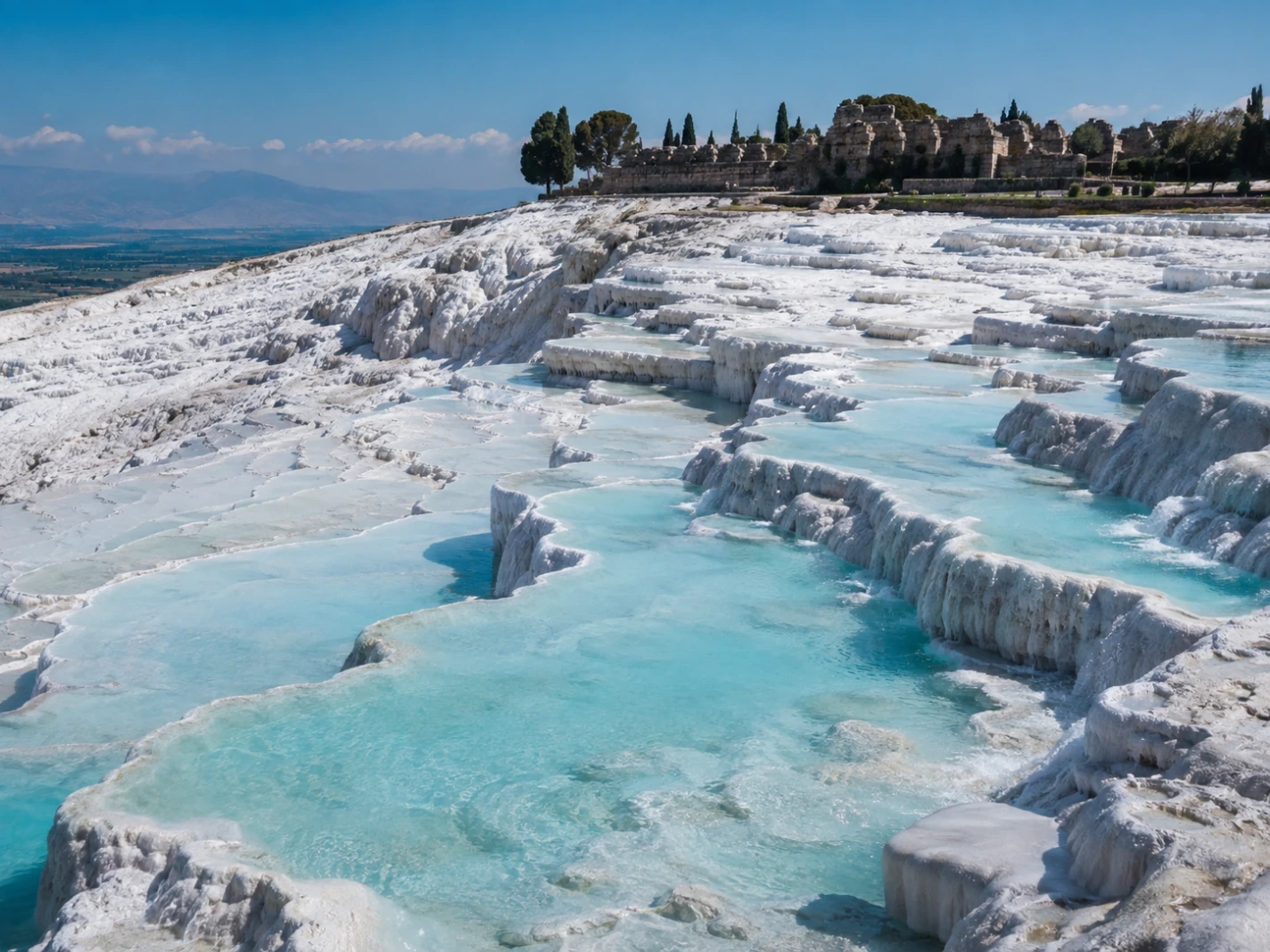
There is something slightly confusing about Pamukkale.
From a distance, the hillside looks frozen.
White terraces spill down the slope. Small pools sit one above another. Water moves through them, but the rock beneath it is almost completely white.
It looks like snow.
Except this is southwestern Türkiye, not a snowy mountain.
So why is Pamukkale white?
The answer begins underground.
Hot spring water rises through the earth carrying dissolved minerals. When that water reaches the surface and flows down the steep hillside, some of those minerals are left behind.
Over a very long time, layer after layer builds up.
The result is the strange white landscape we see today.
The white material is mainly calcium carbonate, the same basic mineral found in limestone. Fresh deposits give the terraces their bright white coating. UNESCO describes Pamukkale as a series of terraced pools and “petrified waterfalls” formed by calcite-rich hot spring water.
But the white terraces are only part of the story.
Just above them are the ruins of an ancient city.
For people who lived there more than 2,000 years ago, the hot springs were not simply something beautiful to look at.
They were useful.
And that is where Pamukkale becomes much more interesting.
Chapter 1 — What Are You Actually Looking At?
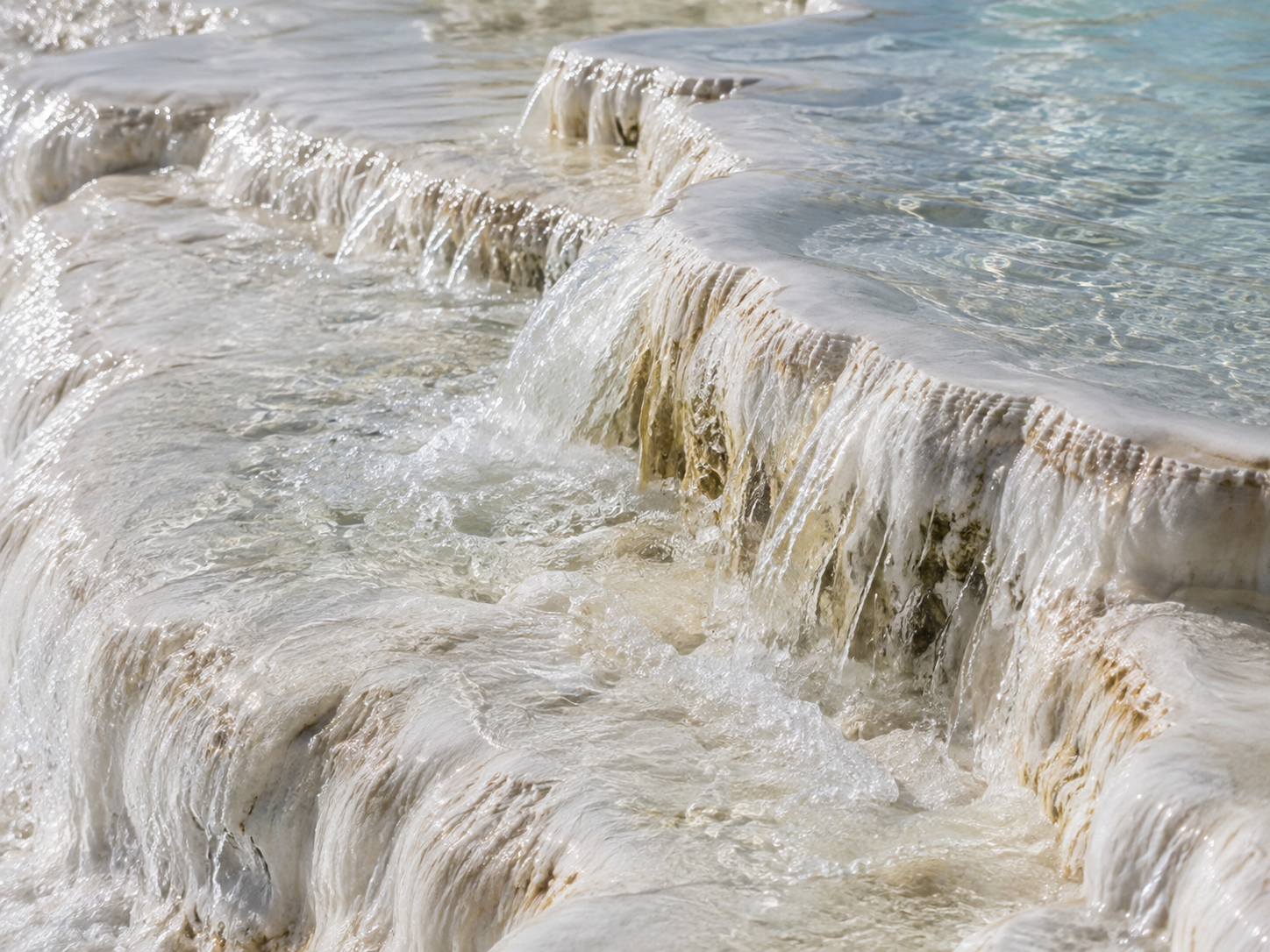
The first surprise is that Pamukkale is not made of snow-white rock.
It is being built by water.
Hot springs emerge from a cliff almost 200 metres above the plain. The water is rich in dissolved minerals, especially calcium and carbonate. As it flows over the hillside, those materials can come out of the water and form deposits of calcium carbonate.
Those deposits are called travertine.
You can think of travertine as rock that is being built a little at a time.
Water flows.
A thin mineral layer is left behind.
More water comes.
Another layer forms.
Then another.
Over many years, the layers can become thick enough to create pools, ridges and terraces.
And the shape of the land helps.
The water does not simply run straight down a bare slope. It spreads, slows, spills over small edges and settles in shallow basins.
That is why Pamukkale looks almost as if someone carved steps into the mountain.
Nobody did.
The water made them.
UNESCO describes the result as terraced basins, mineral formations and petrified waterfalls created by the spring water.
Once you know that, the view changes.
You are no longer looking at a strange white mountain.
You are looking at a landscape that is still being shaped by water.
How Pamukkale Is Made
Chapter 2 — Where Does the White Come From?
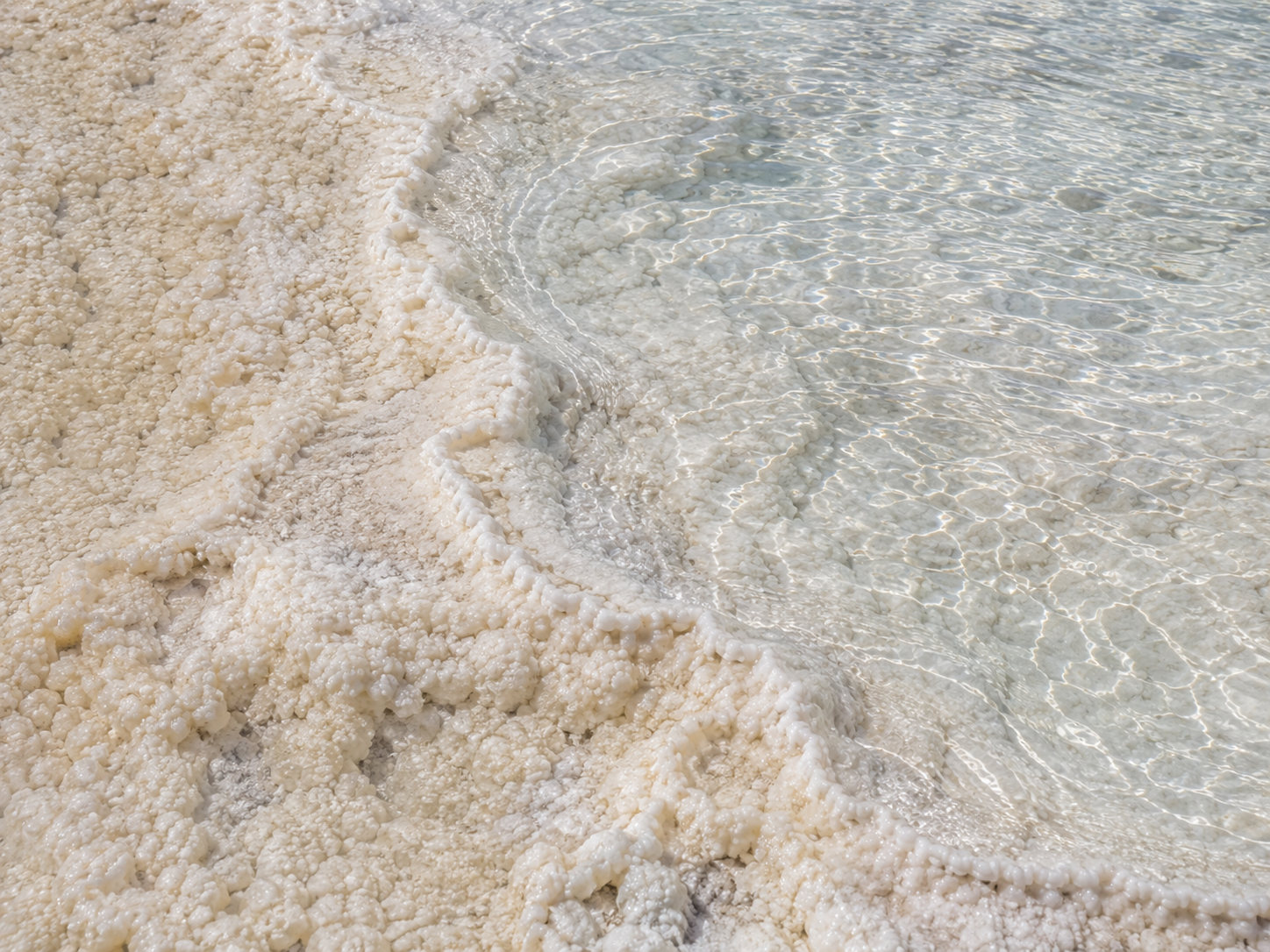
So what exactly makes the terraces white?
The answer is hiding in the water.
The hot spring water picks up dissolved minerals as it moves through the rocks beneath the ground. By the time it reaches Pamukkale, the water contains a large amount of calcium and carbonate.
Once the water reaches the open air and begins to lose carbon dioxide, conditions change.
Some of the dissolved calcium carbonate can come out of the water and settle onto the surface.
Tiny deposits collect.
Then more deposits arrive.
The process continues.
That is why a surface that begins as an ordinary wet slope can gradually become covered with pale mineral material.
Fresh calcium carbonate deposits are bright white, which gives Pamukkale its famous appearance. UNESCO specifically identifies fresh calcium carbonate as the reason for the terraces' dazzling white coating.
There is something almost backwards about the view.
The water is what creates the white rock.
And yet the water itself is clear.
You do not see the minerals waiting inside it.
You only see the result after they have been left behind.
So the colour of Pamukkale is really a record of what the water has been carrying.
Why Is the Travertine White?
Chapter 3 — How Does Water Build a Terrace?
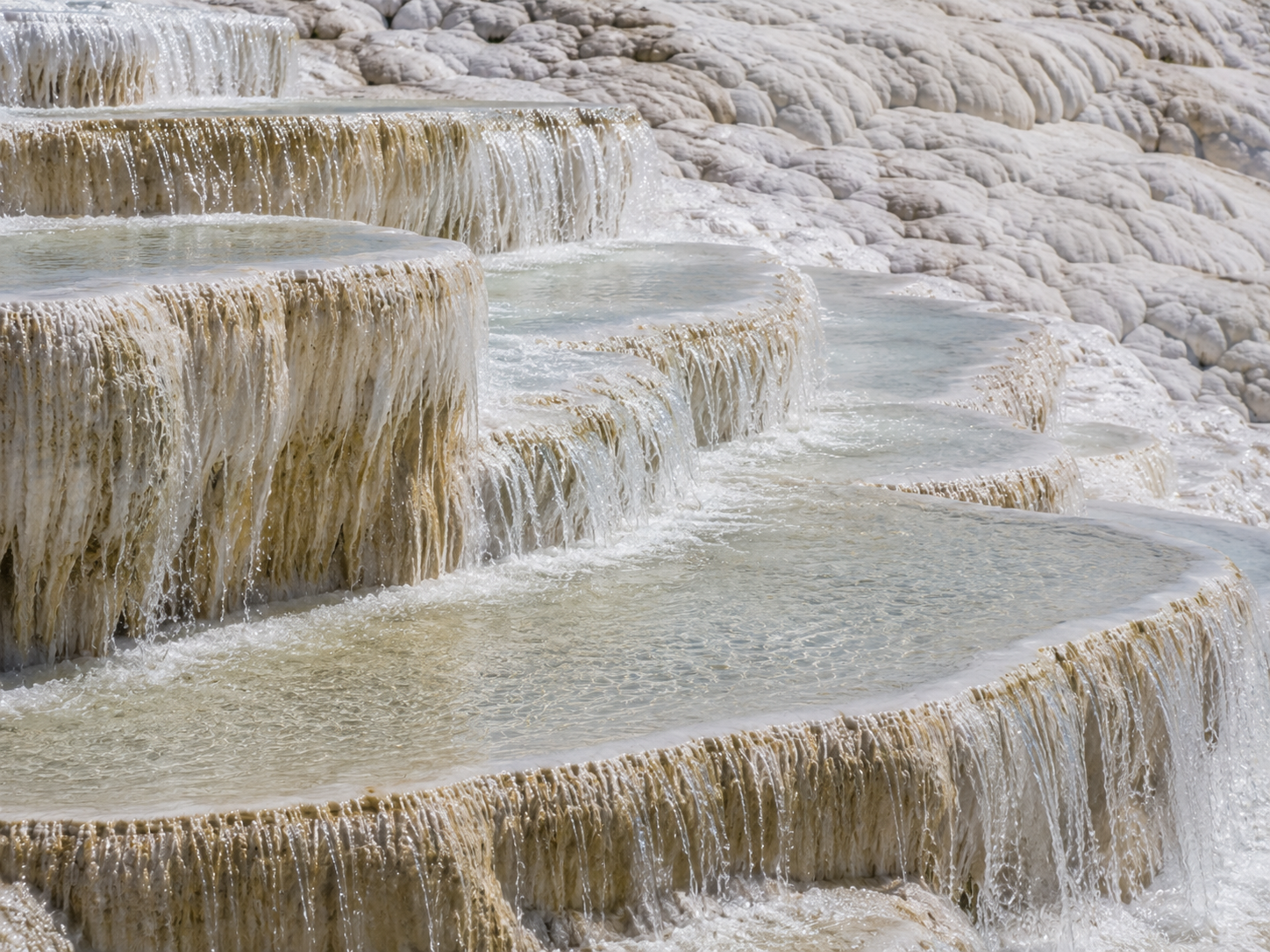
Look closely at one of the pools.
It is not just a puddle sitting on a white hillside.
There is a lip around it.
Then another pool below.
Then another.
So why does flowing water make steps?
Part of the answer is the shape of the slope.
When mineral-rich water spreads across the surface, it does not always move at the same speed. It can slow down, spread out and flow over small edges. As calcium carbonate is deposited, those edges can grow.
The new mineral surface changes the path of the water.
The water then flows over the new shape.
More mineral is deposited.
The shape changes again.
And the process continues.
Over time, this can create the stepped forms that make Pamukkale look so unusual.
UNESCO describes the site as having a series of pools and terraces, including step-like terraces ranging from less than a metre to several metres in height.
It is a slow process.
There is no moment when a new terrace suddenly appears.
The landscape changes through many small deposits.
That may be the most useful way to picture Pamukkale.
Not as something that was built.
As something that keeps being built.
How the Terraces Grow
Chapter 4 — Then People Built a City Beside It
The white terraces were already there.
Then people came.
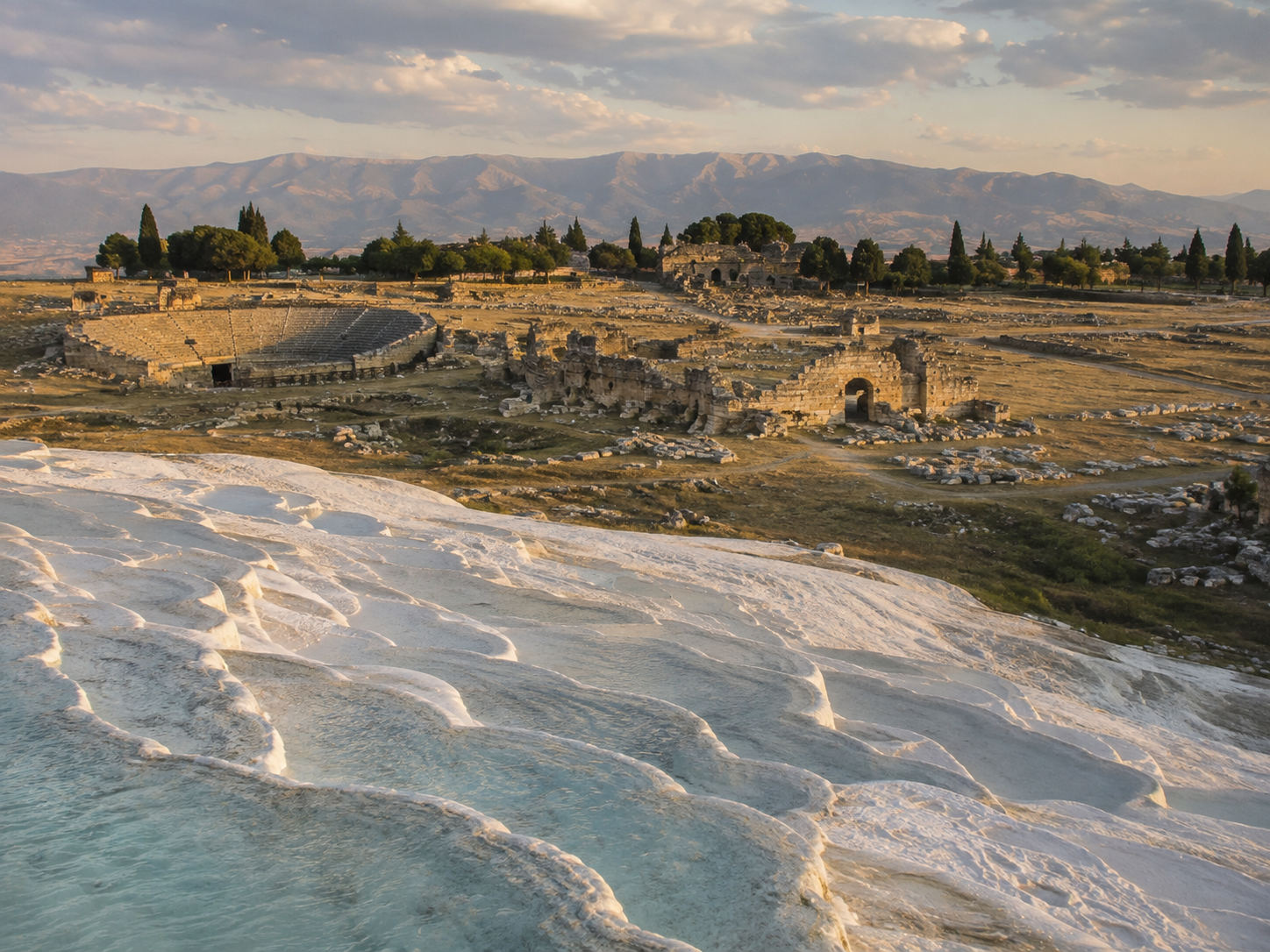
At the end of the 2nd century BC, the Attalid rulers of Pergamon established the thermal spa city of Hierapolis beside the springs. Later, under Roman rule, the city grew into an important centre with baths, temples, a theatre and a large necropolis.
Why here?
The obvious answer is the water.
The springs were useful.
People could bathe in them. The thermal waters became part of the city's life. UNESCO describes Hierapolis as a Greco-Roman thermal installation built around an extraordinary natural site, with large hot pools and bathing facilities.
The landscape and the city therefore belonged together.
From the top of the terraces, you can see the ruins spreading across the plateau.
It is an unusual combination.
One part of the site was made slowly by geology.
The other was made by people.
The white terraces formed from hot water.
The streets, baths and temples formed from stone.
And for centuries, the two sat side by side.
That is why visiting Pamukkale is not quite the same as visiting a natural wonder and then driving to an archaeological site.
They are part of the same story.
Pamukkale and Hierapolis Together
Chapter 5 — Why Can't Everyone Walk on the White Terraces?
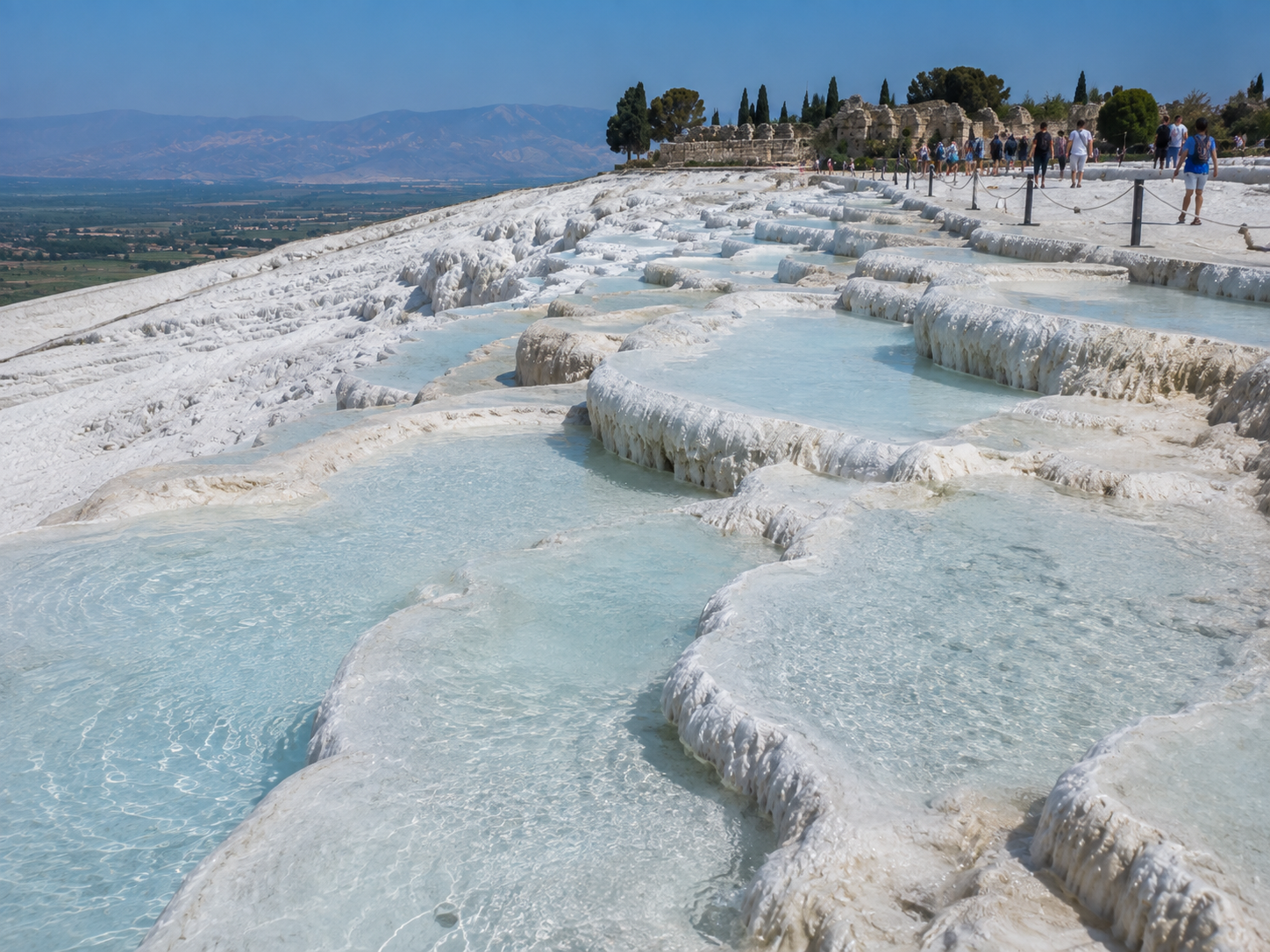
That makes it easier to understand why protection matters.
Why Pamukkale Needs Protection
Chapter 6 — Why Isn't Every Part of Pamukkale Pure White?
Once you know why Pamukkale is white, another question appears.
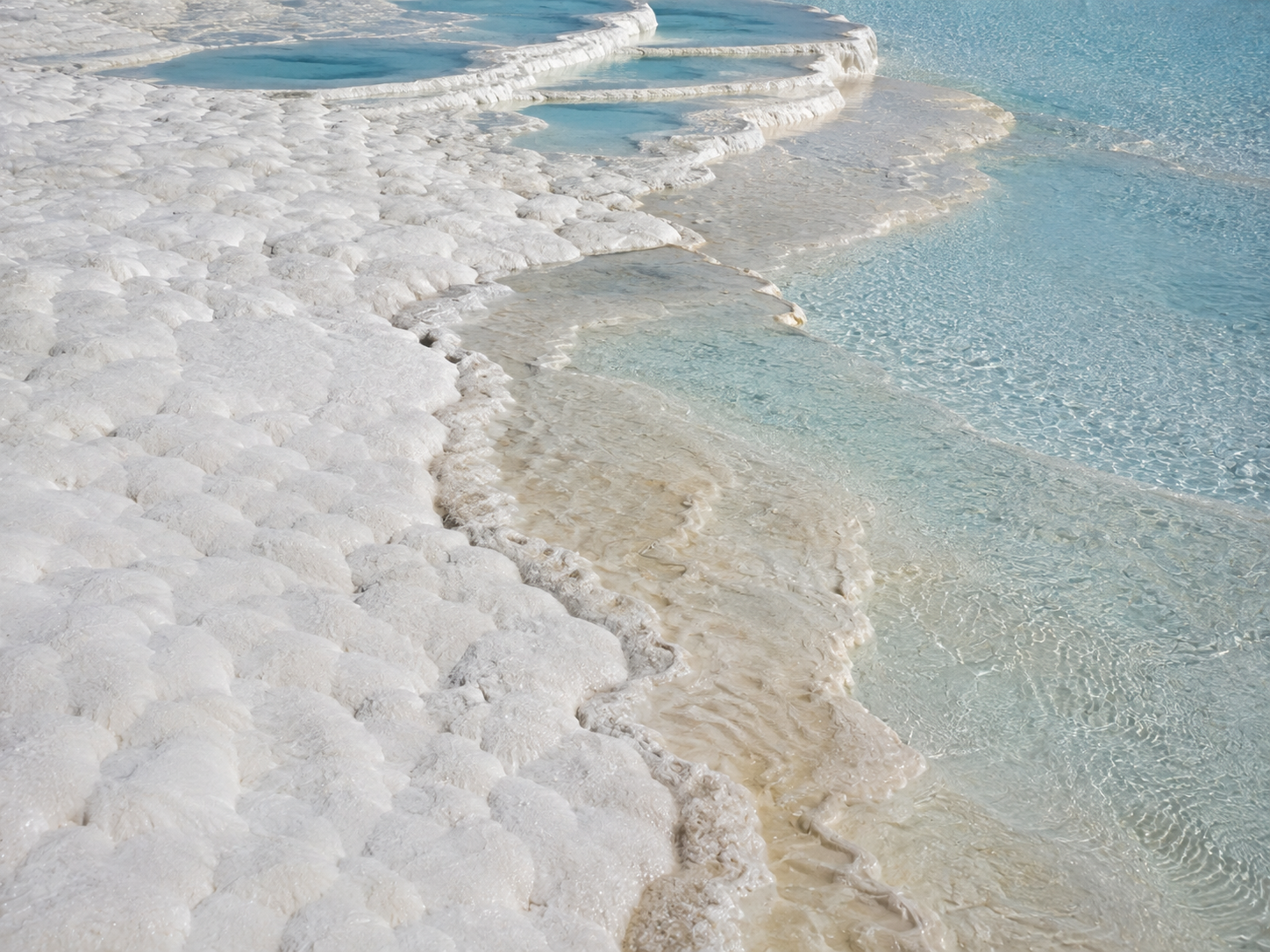
Why are some parts brighter than others?
Why can the pools look blue?
Why can the terraces sometimes appear cream, tan or slightly different from one another?
The answer is that Pamukkale is not one perfectly uniform surface.
Water does not flow over every part of the site in exactly the same way. Mineral deposits can change with the movement and amount of water, the condition of the surface and other local factors.
Sunlight also changes what you see.
A shallow pool of clear thermal water over white mineral deposits can look blue. A wet surface can look different from a dry one. Fresh mineral deposits can appear especially bright.
And areas receiving less water may not look exactly like areas that are actively being coated.
So the familiar photograph of a completely white Pamukkale is real, but it is also a particular view of a landscape that is constantly changing.
The white is not painted on once and left alone.
It depends on water.
And water does not behave in exactly the same way everywhere.
UNESCO notes that maintaining the water flow is important to maintaining the colour and structure of the travertine terraces.
That is why the colour of Pamukkale is not just a visual detail.
It is part of the story of the water.
Why Does the Landscape Change Colour?
Frequently Asked Questions
1. Why is Pamukkale white?
Pamukkale is white because hot spring water deposits calcium carbonate as it flows across the hillside. Fresh mineral deposits create the bright white travertine surface.
2. What is Pamukkale made of?
The famous white terraces are made mainly of travertine, a form of mineral rock created by deposits from the hot springs.
3. How was Pamukkale formed?
Hot spring water rises from underground, flows down the hillside and leaves behind calcium carbonate. Over a very long period, repeated deposits created the terraces, pools and other formations seen today.
4. Why does Pamukkale look like snow?
Its fresh calcium carbonate deposits are bright white and cover the stepped terraces, making the hillside look almost snow-covered from a distance.
5. Is Pamukkale a natural or man-made site?
It is both a natural and cultural site. The white travertine terraces are formed naturally by thermal springs, while the nearby ruins belong to the ancient city of Hierapolis.
6. Why was Hierapolis built at Pamukkale?
Hierapolis was established beside the springs as a thermal spa city. Its hot waters were used in baths and became an important part of the city's life.
7. Why can't visitors walk everywhere on the terraces?
The terraces are sensitive to changes in water flow and human use. Visitor access is controlled to help protect their colour and structure.
8. Why are some parts of Pamukkale blue?
Shallow clear water over the white travertine can appear blue because of the way light interacts with the water and pale mineral surface. The exact appearance also changes with water depth, wetness and sunlight.
9. Is Pamukkale still forming today?
Yes. The terraces are geological formations created by continuing spring activity and mineral deposition. Their appearance depends on the flow of thermal water and the minerals it deposits.
10. What does Pamukkale mean?
Pamukkale means “Cotton Castle” in Turkish, a name inspired by the striking white terraces covering the hillside.