Why Is Lake Hillier Pink?
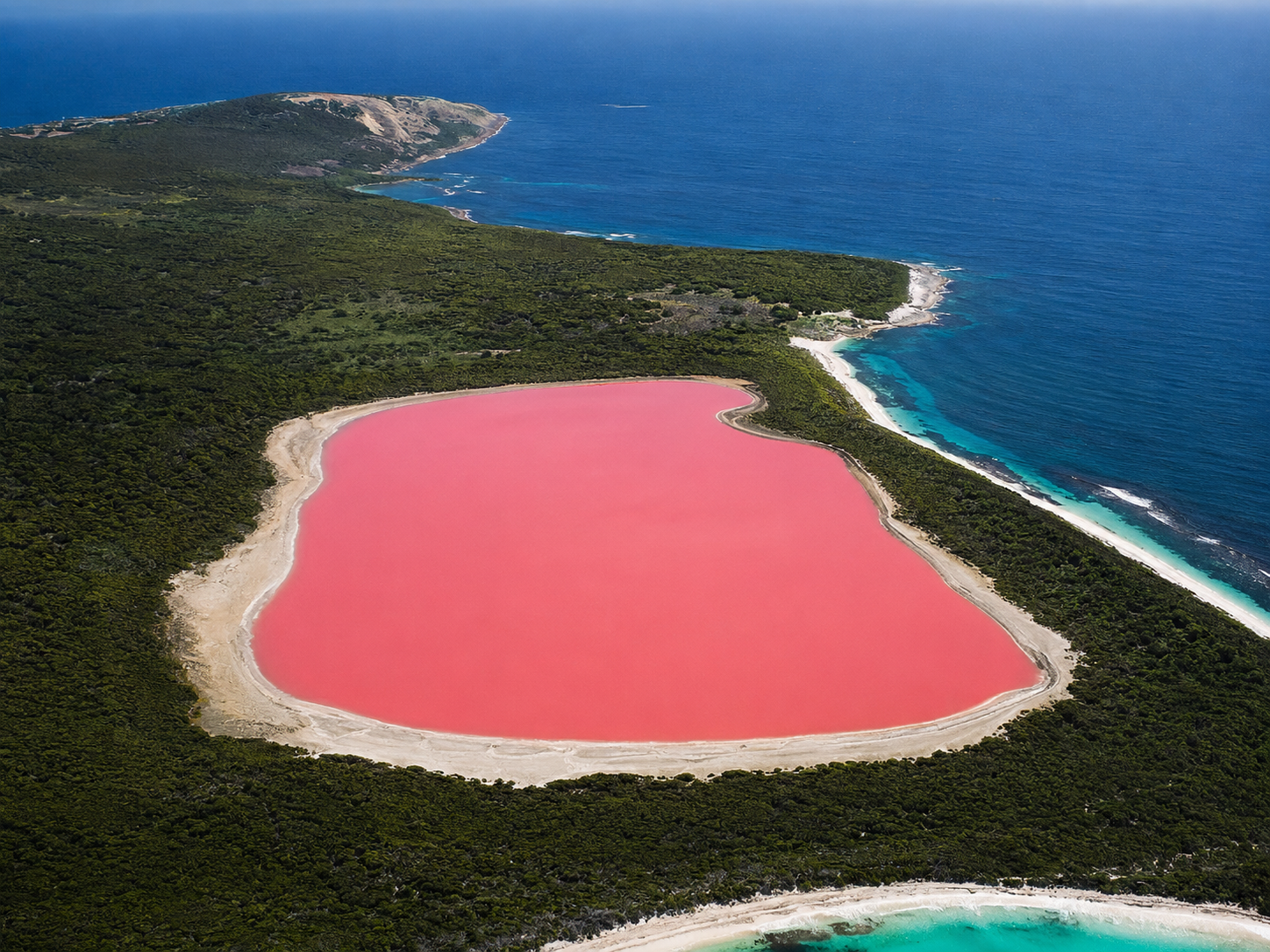
A lake should be blue.
That is what makes Lake Hillier so strange.
Seen from above, the water can look like bright bubble-gum pink, sitting beside the dark blue Indian Ocean on Middle Island in Western Australia.
It looks almost as though someone has put colour into it.
They have not.
Lake Hillier is a real, extremely salty lake. Its water can contain around 28% salt, far more than ordinary seawater. And living inside that harsh water are microorganisms that produce strong red and orange pigments.
But there is an important twist.
For years, people often said that a salt-loving alga called Dunaliella salina was responsible for the pink colour. Scientists did find that alga in Lake Hillier. But a detailed study found that Salinibacter ruber, a red-pigmented bacterium, was especially abundant in the lake's water. The study concluded that several pigment-producing microorganisms may work together to create the colour.
And that makes Lake Hillier more interesting than simply being “the pink lake.”
The colour comes from a tiny world living in water that is far too salty for most life.
Chapter 1 — Is the Lake Really Pink?
Before asking why Lake Hillier is pink, there is a simpler question.
Is it actually that colour?
Yes.
It is not a camera trick. It is not water that has been digitally edited. Scientists who have studied the lake describe its water as distinctly pink, and people who have seen it in person report the same thing.
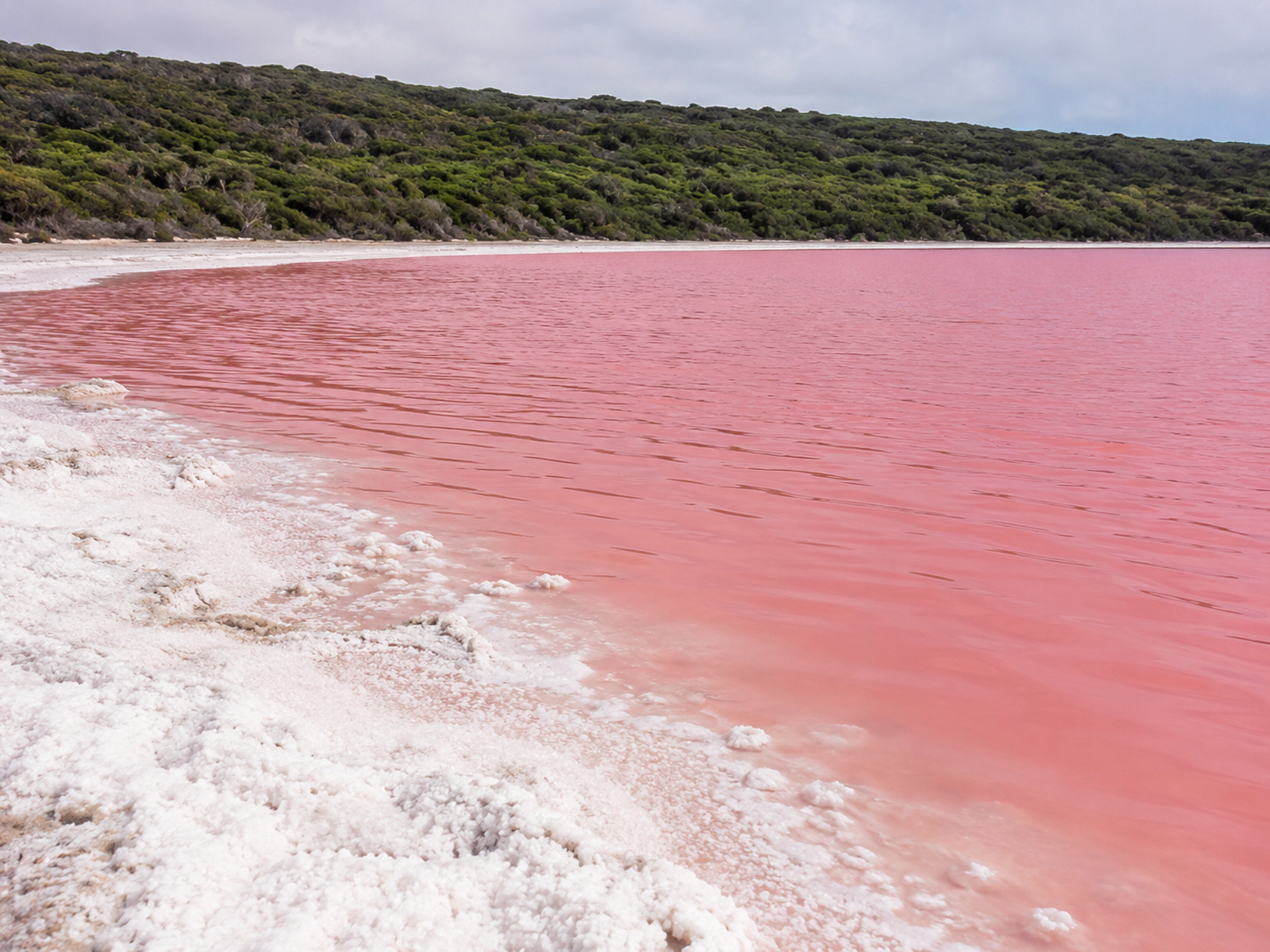
But the colour can look different depending on where you are looking from.
From above, the lake can appear intensely pink.
From closer to the shore, the water may look paler or more reddish, with salt deposits around the edges.
That difference is partly about light, distance and what else is in view.
And there is another reason photographs can make Lake Hillier seem almost unreal.
You are looking at a small, highly coloured lake surrounded by dark green vegetation and deep blue ocean.
The contrast is enormous.
Your brain expects the ocean to be blue and a lake to be blue or green.
Pink breaks that expectation.
So the first surprise is not really the science.
It is that the science is visible.
The lake really does look strange.
Is Lake Hillier Really Pink?
Chapter 2 — Why Is There So Much Salt?
The answer starts with the lake itself.
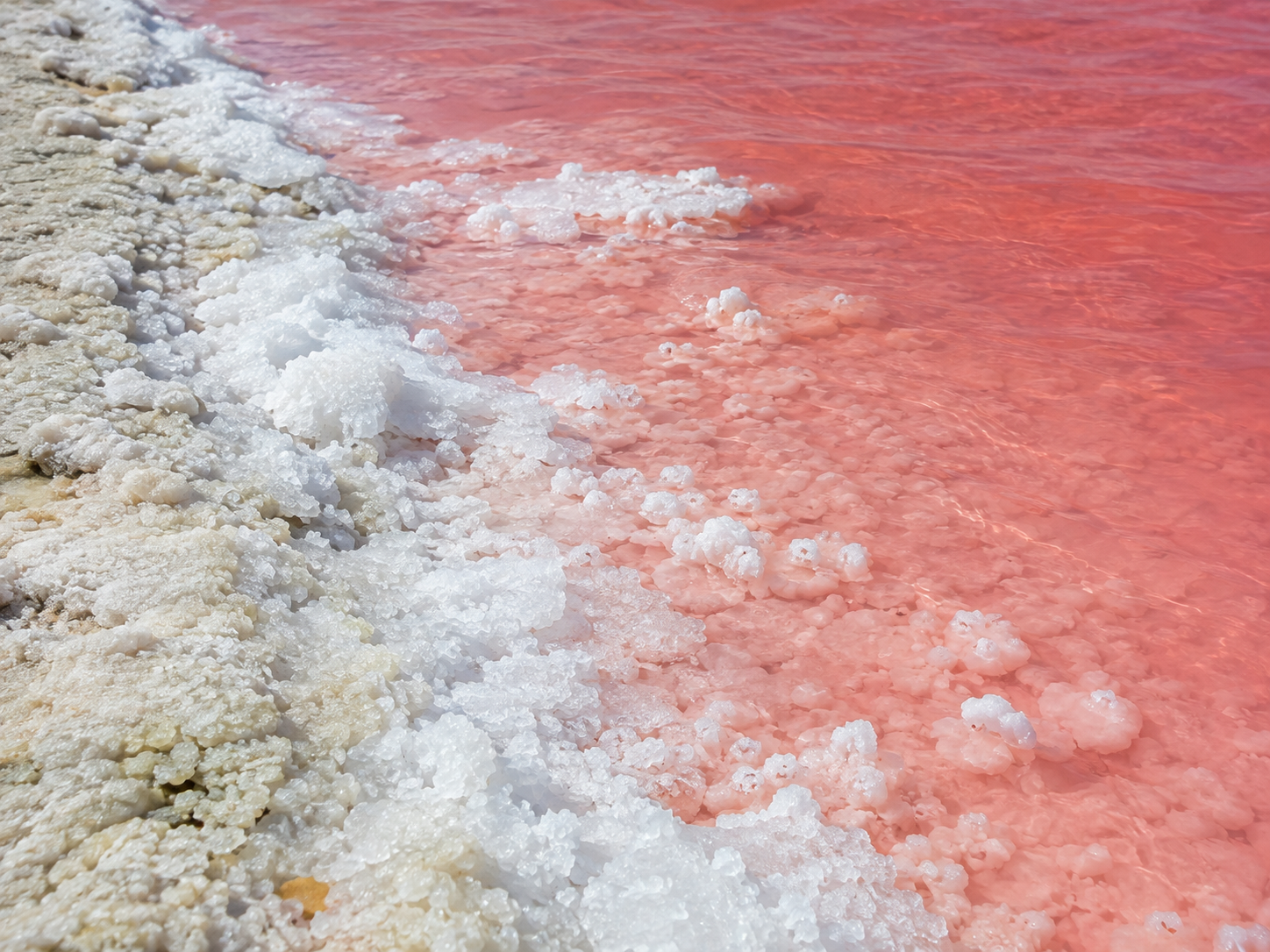
Lake Hillier is hypersaline.
That simply means it contains an unusually large amount of salt.
Researchers involved in the Extreme Microbiome Project measured the lake at about 28% salt concentration, compared with roughly 3.5% for average seawater.
That is an extreme environment.
Most organisms do not do well in water that salty.
But some microorganisms have the opposite relationship with salt.
They are built for it.
These are called halophiles, meaning salt-loving organisms.
And they are important to the story because many halophiles produce pigments.
Why?
That is not completely random.
Pigments can help microorganisms cope with the difficult conditions around them. Some salt-loving microbes produce carotenoids and other compounds that can give cells strong red, orange or pink colours.
So the lake is not simply full of “pink water.”
It is full of water containing an unusual microbial community.
The colour is one visible result.
The salt makes the whole thing possible.
Without such extreme salinity, the community of organisms living there would be very different.
That is why the first clue to the pink colour is not actually pink.
It is salt.
Why Salt Matters
Chapter 3 — The Colour Comes From Living Things
Now we get to the real surprise.
The pink colour is not simply caused by salt.
Salt creates the right environment.
But the colour comes from pigments made by living organisms.
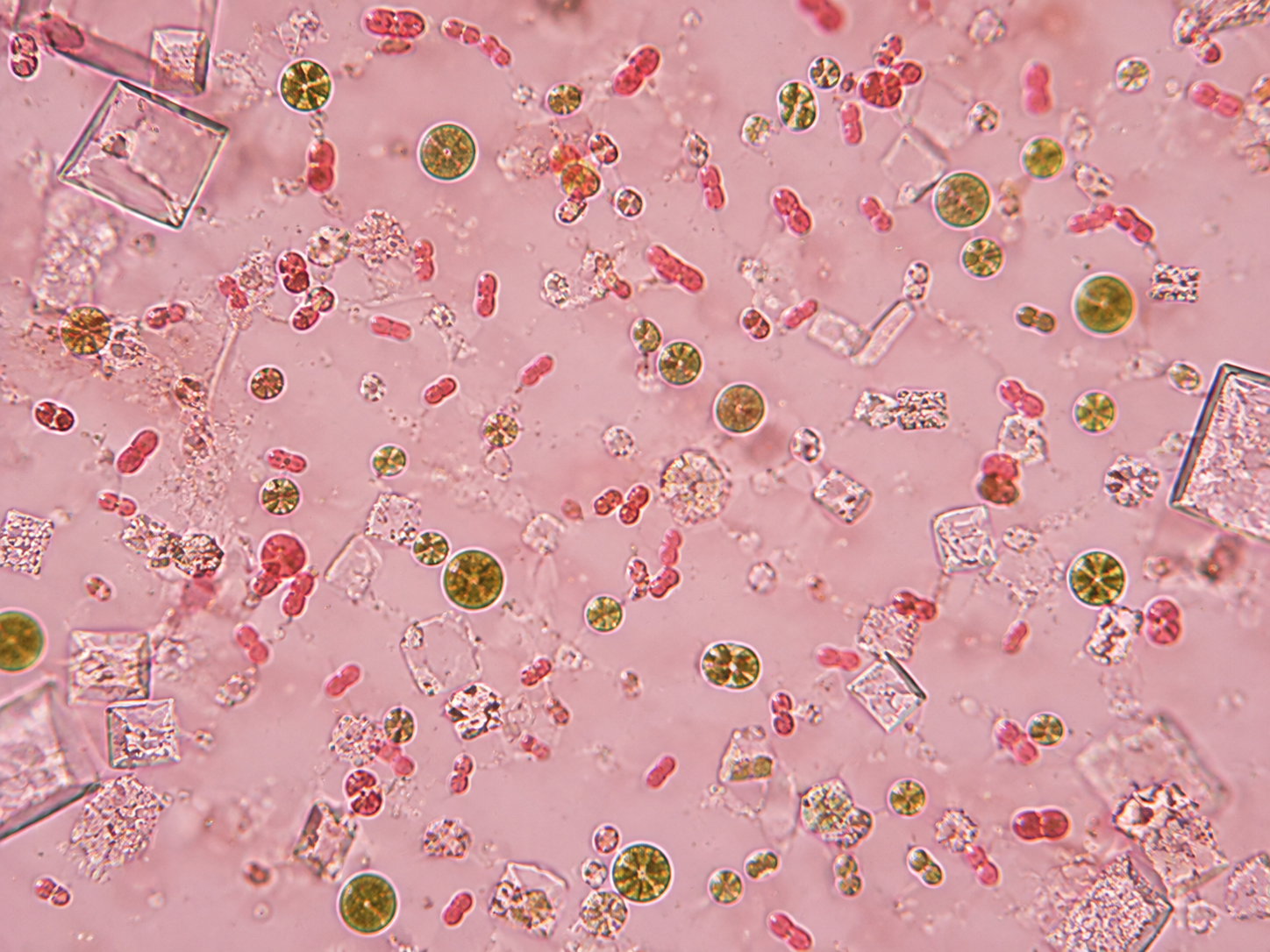
Scientists studying Lake Hillier found a whole community of microorganisms in the water and sediment, including bacteria, archaea and algae. Several of these organisms can produce pigments.
One of the most interesting was Salinibacter ruber.
It is a red-pigmented bacterium that can live in very salty environments. In the Lake Hillier study, it was the most abundant bacterial species detected in the water and was much more prominent than the researchers expected.
There was also Dunaliella salina.
This is a salt-loving alga that produces beta-carotene, the same pigment family that gives carrots their orange colour. Dunaliella has long been linked with the colour of many pink salt lakes.
But Lake Hillier did not fit the simple version of that story.
The algae was present.
The bacterium was present in much greater abundance in the water samples.
The researchers therefore suggested that the lake's colour may come from a combination of pigment-producing organisms, rather than one single species doing everything.
So there is no little bottle of pink dye hidden at the bottom.
The colour is biological.
Tiny organisms are making it.
Who Makes the Pink Colour?
Chapter 4 — Why Are These Microbes Red?
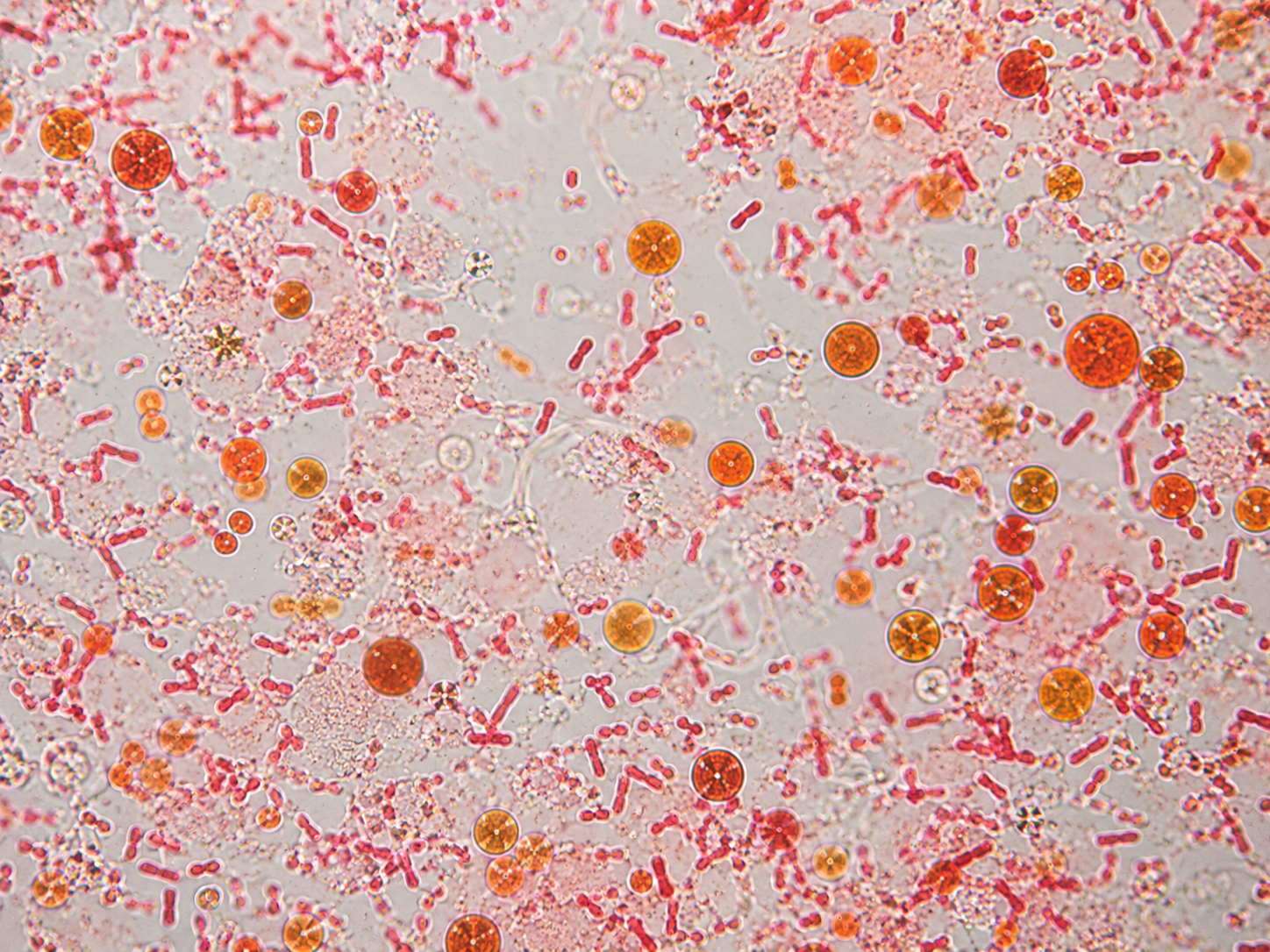
The next question is even more interesting.
Why would a tiny organism living in salt water make something red in the first place?
Pigments are not just there to make the lake beautiful.
For microorganisms living in harsh conditions, pigments can have useful biological roles.
The Lake Hillier research found many pigment-producing microbes, including organisms associated with carotenoids and other coloured compounds. The study identified Salinibacter as a dominant organism in the water and noted its production of pigments linked with the lake's strong colour.
Salinibacter ruber, for example, produces a red pigment called bacterioruberin. Dunaliella salina produces beta-carotene. Both compounds are strongly coloured.
You can think of the lake as a giant mixture.
One tiny cell is almost invisible.
Millions or billions of pigmented cells are not.
When enough of them are present, their pigments begin to affect the colour you see from outside the lake.
This is why the colour can be so strong.
The lake is not pink because each microorganism is enormous.
It is pink because there are so many tiny sources of colour together.
That is a very different picture.
The pink lake is really a microscopic crowd.
How Tiny Pigments Become a Pink Lake
Chapter 5 — Why Does the Pink Look So Intense?
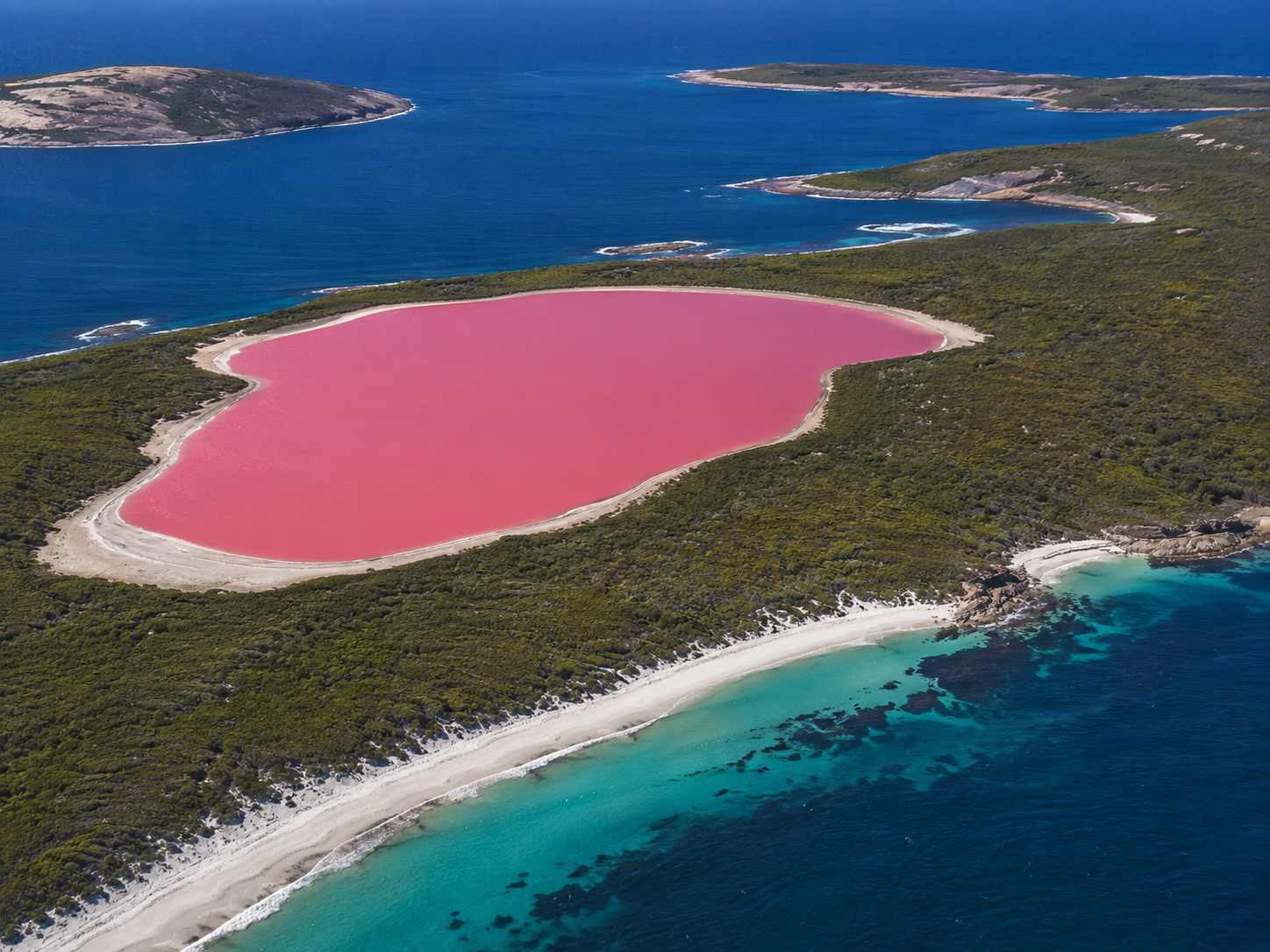
There is another part of the mystery.
Even if microorganisms produce pigments, why does Lake Hillier look so pink?
Part of the answer is concentration.
The lake is extremely salty, and its microbial community lives in that concentrated environment. The pigments from many organisms combine with the highly coloured cells and material in the water.
Then there is the landscape around it.
Lake Hillier is surrounded by pale shoreline, dense vegetation and the blue ocean. From above, that contrast makes the pink appear even stronger.
There is also the way light reaches your eyes.
Water colour is affected by the substances suspended or dissolved in it, as well as by the way light passes through and reflects from the water. A shallow lake containing strong biological pigments can therefore look very different from a large blue body of ordinary water.
But we should be careful here.
It is tempting to reduce the whole explanation to one sentence such as:
“The salt makes it pink.”
Or:
“The algae makes it pink.”
Neither is good enough for Lake Hillier.
The lake's colour comes from a combination of its extreme chemistry and its unusual microbial community. The detailed metagenomic study found many pigment-producing organisms and suggested that several could contribute to the colour.
The simple-looking pink is therefore sitting on top of a complicated little ecosystem.
Why Does the Pink Look So Strong?
Chapter 6 — Is It Always That Pink?
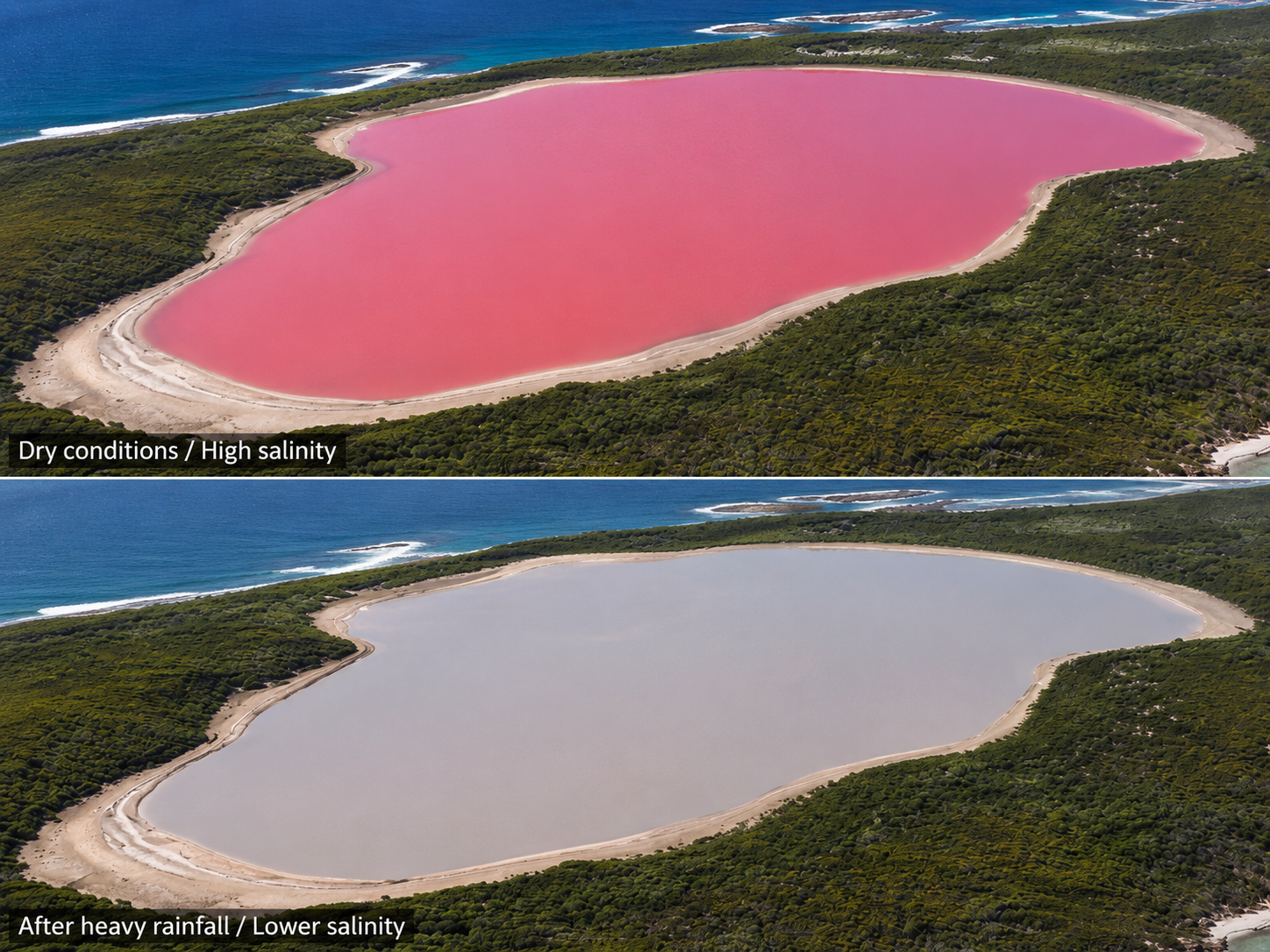
For a long time, Lake Hillier was famous for seeming unusually stable in colour.
It was often described as a lake that stayed pink even while many other pink lakes changed with the weather.
But that story has become less simple.
A major rainfall event in 2022 brought enough water into the lake to dilute its extreme salt concentration. By early 2025, the famous bright pink colour had noticeably faded and the water had become more discoloured and grey. Scientists expected the colour to return as the water evaporated and salinity increased again, but the timing was uncertain.
This is a useful reminder that nature rarely follows a perfect postcard.
The colour depends on conditions.
Too much fresh water changes the salt balance.
As water evaporates, the salt becomes more concentrated again.
The microbial community can respond to those changes.
So the lake's colour can change.
And that matters because it also changes one of the most common descriptions of Lake Hillier.
Calling it “permanently pink” is now too strong.
Its pink colour has been famous for a long time, but recent observations show that the intensity can change when the lake's water balance changes.
The pink is real.
It is just not frozen in time.
What Can Change the Colour?
Chapter 7 — Why Study a Pink Lake?
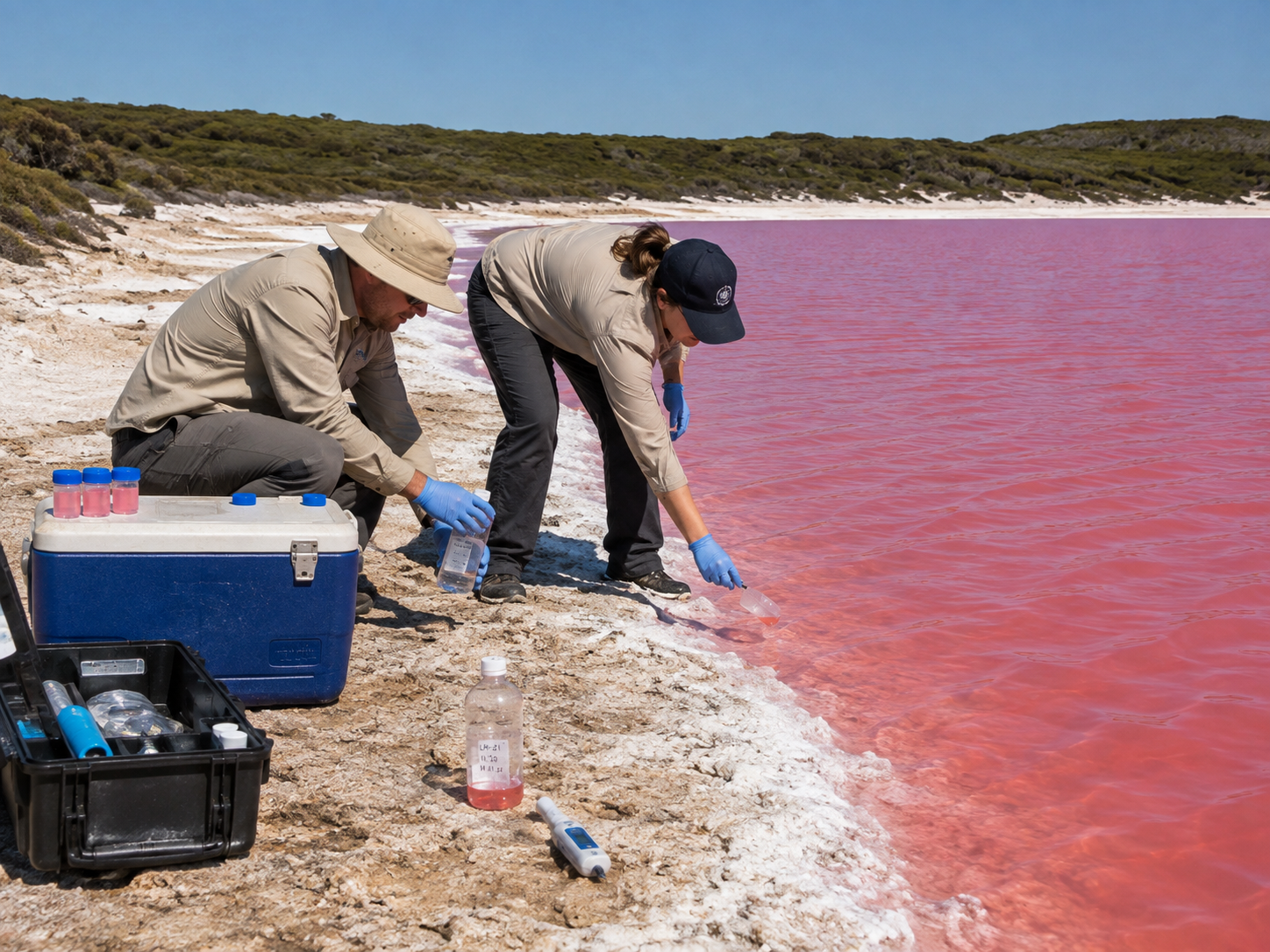
At first, Lake Hillier looks like a strange travel photograph.
But to scientists, it is something more useful.
It is an extreme environment.
The lake is salty enough to exclude many ordinary organisms, yet it supports a community of bacteria, archaea, algae and other microscopic life. The Extreme Microbiome Project studied Lake Hillier specifically because environments like this can reveal how life adapts to conditions that seem almost impossible.
The researchers found a surprisingly diverse microbiome.
More than one kind of organism was producing pigments.
Some were bacteria.
Some were archaea.
Some were algae.
And many had adaptations that allow them to survive in very salty conditions.
That makes Lake Hillier useful for a question much bigger than:
“Why is it pink?”
It lets scientists ask:
How does life survive where ordinary life struggles?
How do cells protect themselves from extreme salt?
How do they make energy?
How do different microorganisms live together?
And what can these organisms tell us about life in other extreme environments?
Scientists have even considered hypersaline environments useful analogues for thinking about possible life in places such as Mars, although that does not mean Lake Hillier is a model of Mars itself.
So the pink colour is the part we can see.
The more interesting story is underneath it.
A strange-looking lake is also a living laboratory.
Why Scientists Study Lake Hillier
So, Why Is Lake Hillier Pink?
The answer begins with salt.
Lake Hillier is far saltier than the ocean.
That extreme environment allows unusual microorganisms to thrive.
Some of them produce strong red, orange and pink pigments.
One of the most important organisms found in the lake is the red-pigmented bacterium Salinibacter ruber. The salt-loving alga Dunaliella salina is there too, along with many other microorganisms. Scientists therefore think the colour comes from a community of pigment-producing life rather than one simple ingredient.
And the story is still changing.
Heavy rainfall has recently made the lake less intensely pink, showing that the colour depends on the lake's salt and water balance rather than being permanently fixed.
So when you look at Lake Hillier, you are not really looking at pink water.
You are looking at an extreme ecosystem.
The colour is simply the part that reaches your eyes first.
Frequently Asked Questions
1. Why is Lake Hillier pink?
Lake Hillier is pink because its extremely salty water supports microorganisms that produce red, orange and pink pigments. Scientists have found several pigment-producing organisms in the lake, including Salinibacter ruber and Dunaliella salina.
2. Is Lake Hillier really pink?
Yes. Its unusual colour is natural and has been documented by researchers and visitors. However, the intensity of the pink can change under different conditions.
3. What makes Lake Hillier so salty?
Lake Hillier is a hypersaline lake, with very high salt concentration. Water loss through evaporation can leave salts concentrated in the remaining water, creating conditions that favour salt-loving microorganisms.
4. Is Dunaliella salina responsible for Lake Hillier’s pink colour?
It may contribute, but it is not the whole explanation. Scientists found Dunaliella salina in the lake, but a metagenomic study found Salinibacter ruber to be especially abundant in the water and suggested that several pigment-producing microorganisms contribute to the colour.
5. What is Salinibacter ruber?
Salinibacter ruber is a salt-loving bacterium that can produce a strong red pigment called bacterioruberin. It was found to be one of the dominant organisms in Lake Hillier water in the detailed microbiome study.
6. Does Lake Hillier always stay pink?
Not always at the same intensity. After a major rainfall event in 2022, the lake became noticeably less pink as its salt concentration was diluted. Scientists expect the pink colour to return as evaporation raises the salinity again, but the exact timing is uncertain.
7. Can you drink Lake Hillier’s water?
No. The lake is extremely salty, with salt concentration far above normal seawater. It is not drinking water.
8. Why do pink lakes turn pink?
Different pink lakes can have different mixtures of microorganisms and chemical conditions. Salt-loving algae, bacteria and archaea can all play a role in producing pigments, so the exact cause should not automatically be assumed to be the same for every pink lake.
9. Where is Lake Hillier?
Lake Hillier is on Middle Island in Western Australia, in the Recherche Archipelago. It is separated from the Southern Ocean by a narrow strip of land and is one of Australia's best-known pink lakes.
10. Why do scientists study Lake Hillier?
Scientists study Lake Hillier because its extremely salty environment supports unusual microorganisms. Studying those organisms can help researchers understand how life adapts to harsh environments and how different microbes survive together.