Skip to Content
AtlasNova
  • 0
  • 0
  • Contact Us
  • Home
  • Wildlife
  • Space
  • Places
  • History and Culture
  • About Us
AtlasNova
  • 0
  • 0
    • Home
    • Wildlife
    • Space
    • Places
    • History and Culture
    • About Us
  • Contact Us

Why Is Lake Baikal Able to Produce Crystal Ice Bubbles?

Explore how 7km of ancient organic sediment and deep thermal vents generate millions of 3D frozen methane bubbles in Siberia's crystal-clear Lake Baikal.
  • All Blogs
  • Places
  • Why Is Lake Baikal Able to Produce Crystal Ice Bubbles?
  • 24 September 2026 by
    Arpit Kaintura
    | No comments yet

    Introduction

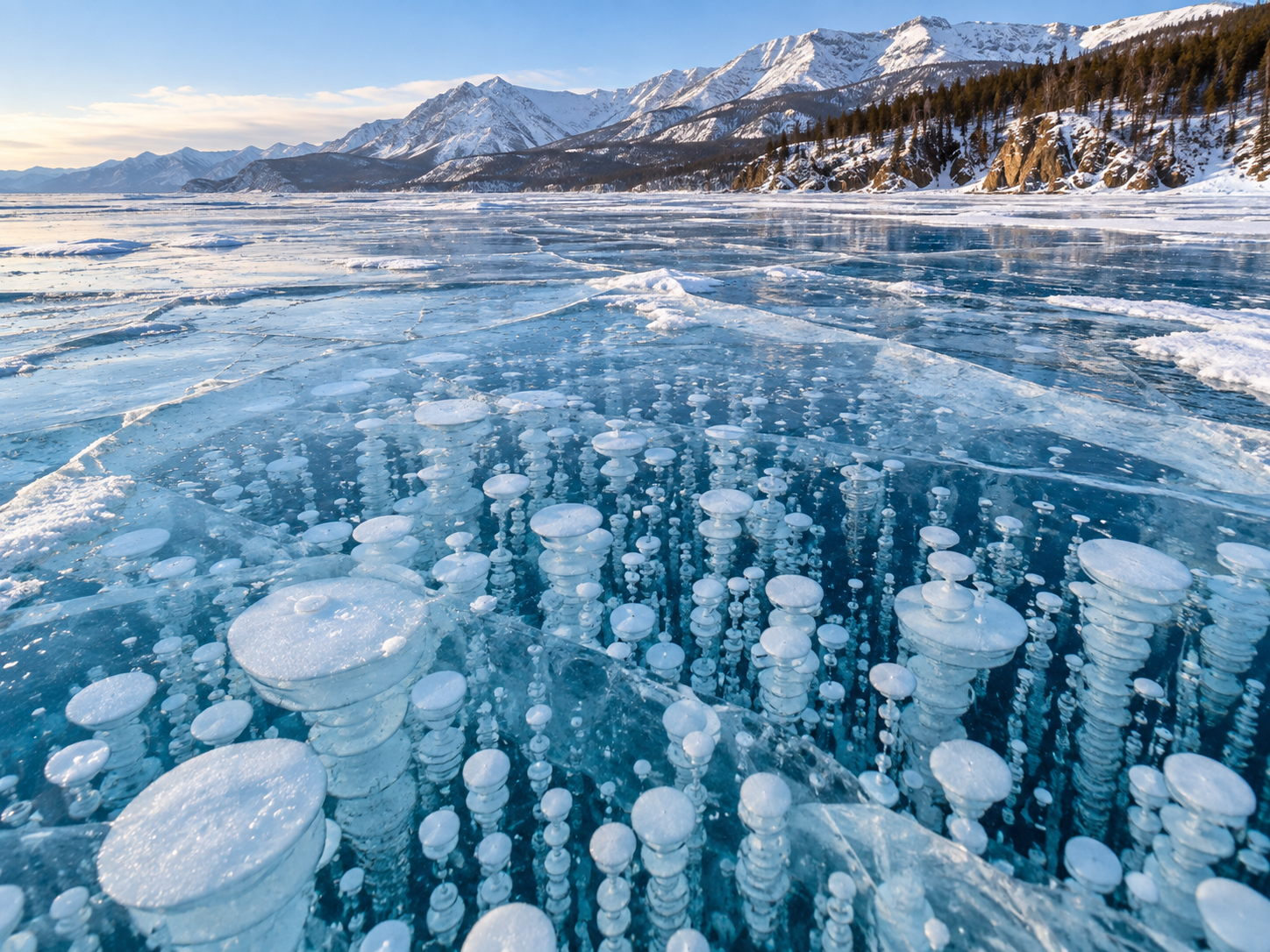
    Clear winter ice on Lake Baikal reveals hundreds of gas bubbles trapped beneath the frozen surface.

     Look down through the ice on Lake Baikal and you may feel as though you are looking through glass.

    White bubbles hang underneath your feet.

    Some are tiny.

    Some are large and round.

    Others form long columns that seem to rise from deep below the frozen lake.

    They look like little pearls trapped inside crystal.

    But they are not really “ice bubbles.”

    They are gas bubbles trapped in ice—and many of the famous ones contain methane. NASA's explanation of the phenomenon describes methane rising through Lake Baikal and becoming frozen into the exceptionally clear winter ice.

    So where does the gas come from?

    Why does it rise?

    And why does the ice trap it so neatly instead of letting it escape?

    The answer begins at the bottom of the lake.

    There, sediments can produce methane. The gas moves upward through the water. Then winter arrives, the surface freezes, and the rising bubbles meet a growing sheet of ice.

    Some of them get caught.

    And because Baikal's ice can become remarkably clear, you can still see exactly where they were trapped.


    Chapter 1 — The Bubbles Begin at the Bottom
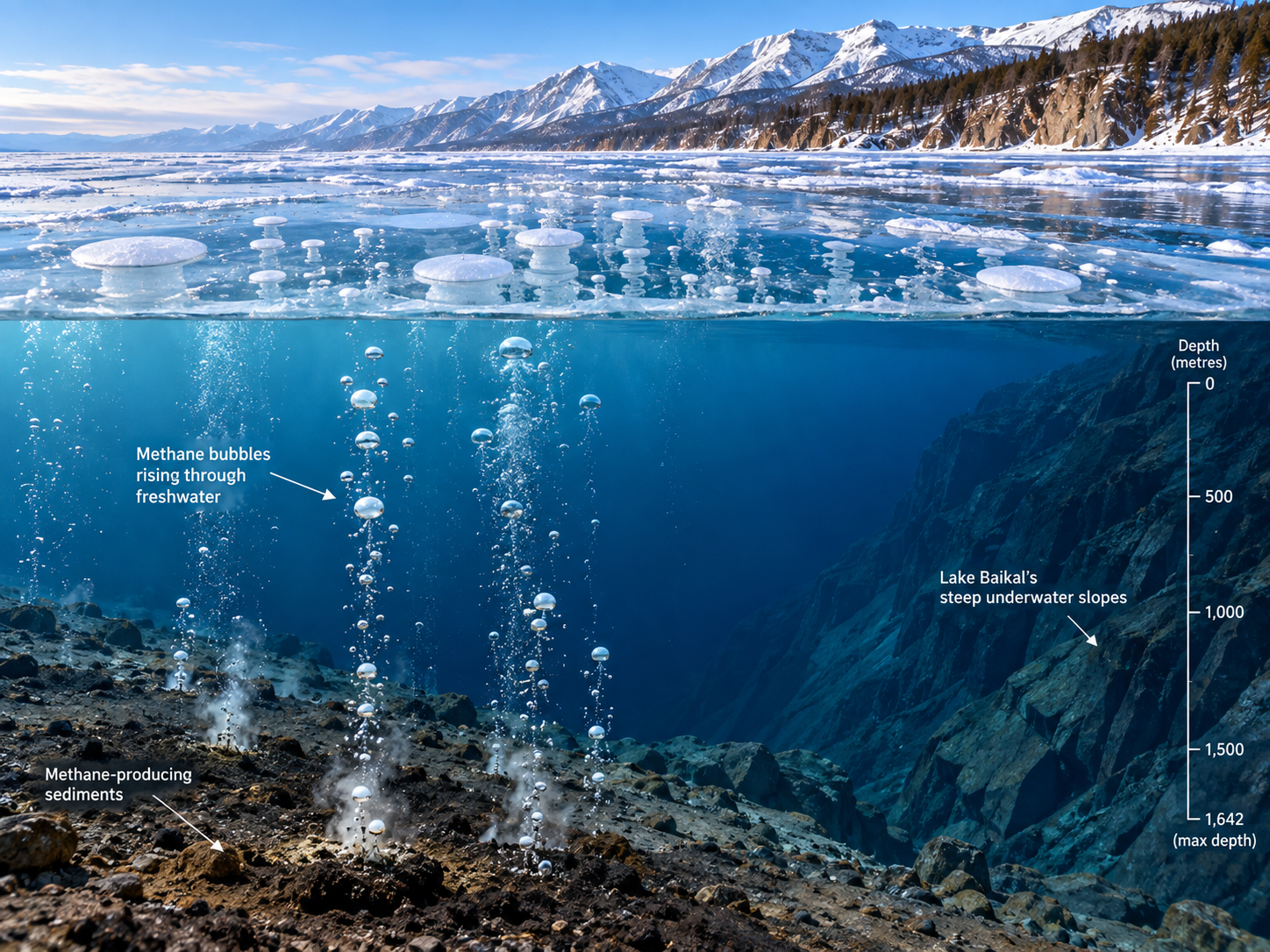
    Methane forms in Lake Baikal sediments and rises through the water as gas bubbles.

     The first place to look is not the ice.

    It is the lake floor.

    Lake Baikal contains methane in its sediments, and the lake has many areas where gas can seep upward through the water. Researchers have directly observed methane bubbles and methane hydrates rising from Baikal's sediments.

    But why is there methane down there?

    Part of it comes from the natural breakdown of organic material in the sediments.

    As microorganisms break down organic matter without oxygen, methane can be produced.

    The gas then moves through the sediment and enters the water.

    If enough gas gathers, it can escape as bubbles.

    Think of opening a fizzy drink.

    The gas does not all stay dissolved.

    Some escapes as bubbles and rises.

    Lake Baikal is doing something similar, although on a much larger natural scale.

    The difference is that the gas is coming from beneath the lake rather than from a bottle.

    And the bubbles have a long way to travel.

    Lake Baikal is extraordinarily deep, reaching about 1,642 metres.

    Most bubbles would never survive that entire journey unchanged.

    Some dissolve back into the water.

    Others continue upward.

    And under the right conditions, some methane can make it close enough to the surface to become part of the frozen ice.

    That is where the famous bubbles begin.


    Where Do the Bubbles Come From?

    Educational geological and limnology infographic titled Where Do Lake Baikal's Bubbles Begin? Features a large vertical cross-section of Lake Baikal showing the frozen surface ice layer, deep blue water column, and layered sediment bed containing organic matter pockets. Tiny methane gas bubbles originate in the oxygen-poor lake-bottom sediment and move upward through the water column toward the surface ice. Four separate text boxes detail processes at the lake floor, inside the water, on the way up, and at the surface. Includes direct scientific research evidence on methane seeps and methane hydrates, concluding that bubbles in the ice originate deep below.
    Limnology & Biogeochemistry

    Where Do Lake Baikal’s Bubbles Begin?

    A geological cross-section revealing the subsurface origin, vertical transport, and surface trapping of methane in Earth’s deepest lake.

    Lake Baikal Geological Cross-Section
    Surface Winter Ice
    Water Column
    Organic Sediment Layer
    Methane Nucleation / Bubble
    Limnological Mechanics
    At the lake floor

    Microorganisms break down organic matter and methane can form in oxygen-poor sediments.

    Inside the water

    Methane can move upward as dissolved gas or bubbles.

    On the way up

    Some bubbles dissolve before reaching the surface.

    At the surface

    Some gas can become trapped in winter ice.

    Evidence Note

    “Lake Baikal contains methane-rich sediments and gas seeps. Researchers have directly observed rising methane bubbles and methane hydrates.”

    “The bubbles in the ice begin with a process happening deep below it.”


    Chapter 2 — Why Does the Ice Trap Them?
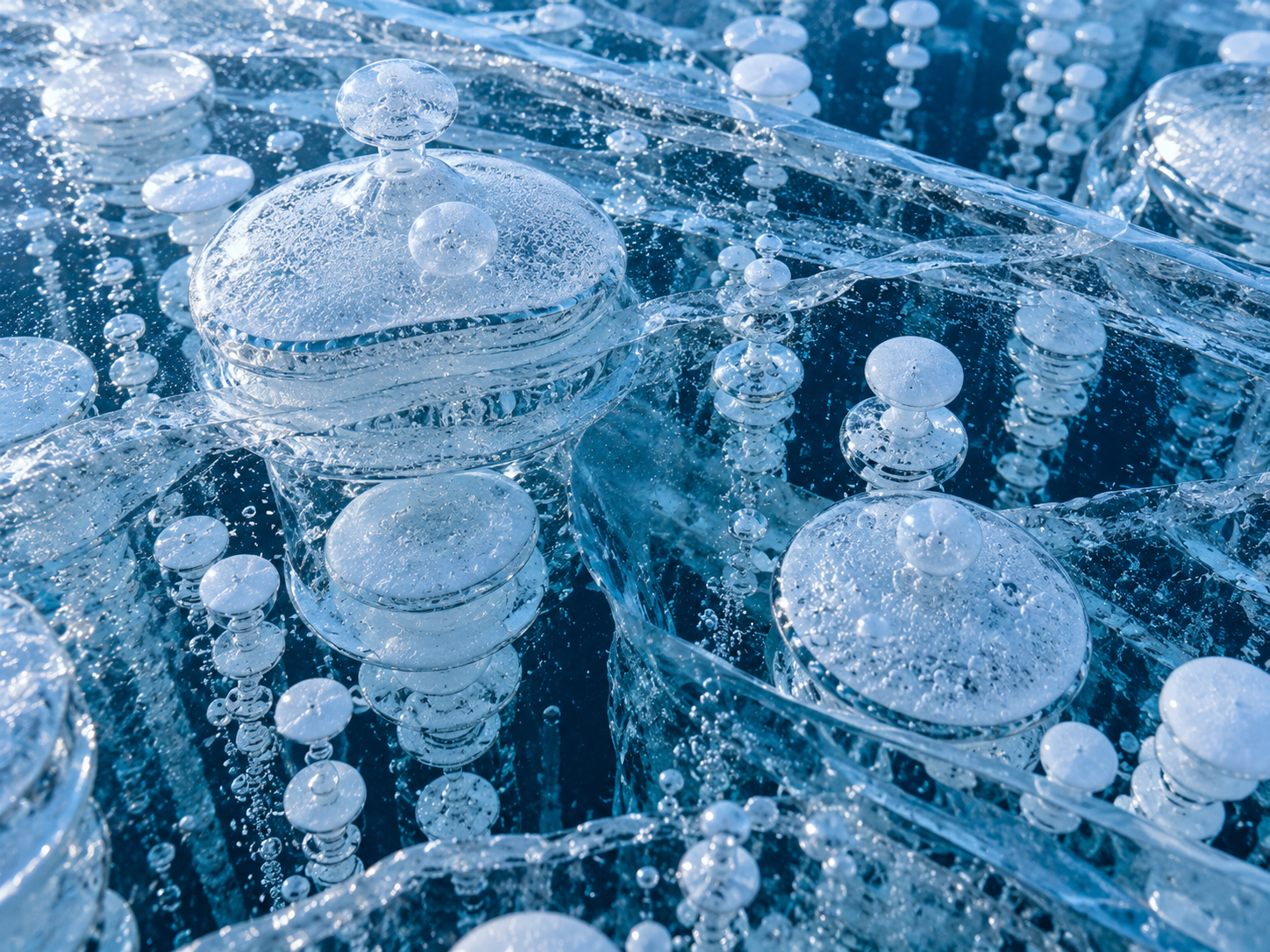
    Gas bubbles become trapped in successive layers as Lake Baikal water freezes into clear ice.

     Now imagine a bubble rising toward a lake that is beginning to freeze.

    At first, the surface is open water.

    The gas can escape.

    Then ice begins to form.

    As water freezes, most dissolved gases do not fit easily into the growing ice crystal structure. They are pushed out of the freezing water. But some gas can collect into tiny bubbles near the freezing front and become trapped as the ice continues to grow. Laboratory research has shown how freezing ice can capture and reshape gas bubbles.

    This happens layer by layer.

    A little more ice forms.

    Another layer traps gas.

    More ice grows.

    Another bubble is caught.

    That is why some Baikal bubbles appear stacked in columns.

    They can record repeated gas release while the ice was forming.

    The shape of a bubble can even tell scientists something about the freezing process.

    A slowly growing bubble has time to change shape.

    A bubble trapped quickly may look different.

    Research on bubble shapes in ice has shown that these forms can contain information about how quickly the ice formed and how much gas was dissolved in the water.

    So the ice is doing more than freezing.

    It is recording what was happening in the water while it froze.

    And that record remains visible long after the bubble has been trapped.


    How Does Freezing Trap the Bubbles?

    Fluid-mechanics infographic titled How Does a Bubble Get Trapped in Ice? Features a four-stage side-view sequence of a lake section showing: Stage 1 - Open water with rising gas bubble; Stage 2 - Thin ice sheet growing from the surface; Stage 3 - Downward moving freezing front meeting an ascending bubble; Stage 4 - Solid ice enclosing and trapping the bubble. Text boxes explain that water freezes from the surface downward, gas is excluded from solid ice, dissolved gas gathers into bubbles near the freezing front, and growing ice closes around them. Includes a scientific note explaining how bubble size and shape record ice formation conditions.
    Fluid Dynamics & Cryology

    How Does a Bubble Get Trapped in Ice?

    A step-by-step fluid-mechanics visualization showing how downward ice growth overtakes rising gas bubbles in freezing lakes.

    Physical Encapsulation Sequence
    Stage 1
    Stage 2
    Stage 3
    Stage 4
    Liquid Water
    Solid Ice Sheet
    Freezing Front
    Gas Bubble
    Thermodynamic & Mechanical Steps

    Water freezes from the surface

    A sheet of ice gradually grows downward.

    Gas is pushed out

    Most dissolved gas does not fit easily into solid ice.

    Some gas gathers into bubbles

    Tiny bubbles can form near the freezing front.

    The ice closes around them

    The bubbles become trapped inside the growing ice.

    Cryological Insight

    “Bubble shape can record how the ice formed.”

    Bubble size and shape can depend on gas content and freezing conditions. Rapid freezing rates produce elongated, vertical tube-like bubbles, while slower cooling yields rounded, discrete spheres.

    “The ice freezes around the gas faster than the gas can escape.”


    Chapter 3 — Why Is Baikal’s Ice So Clear?
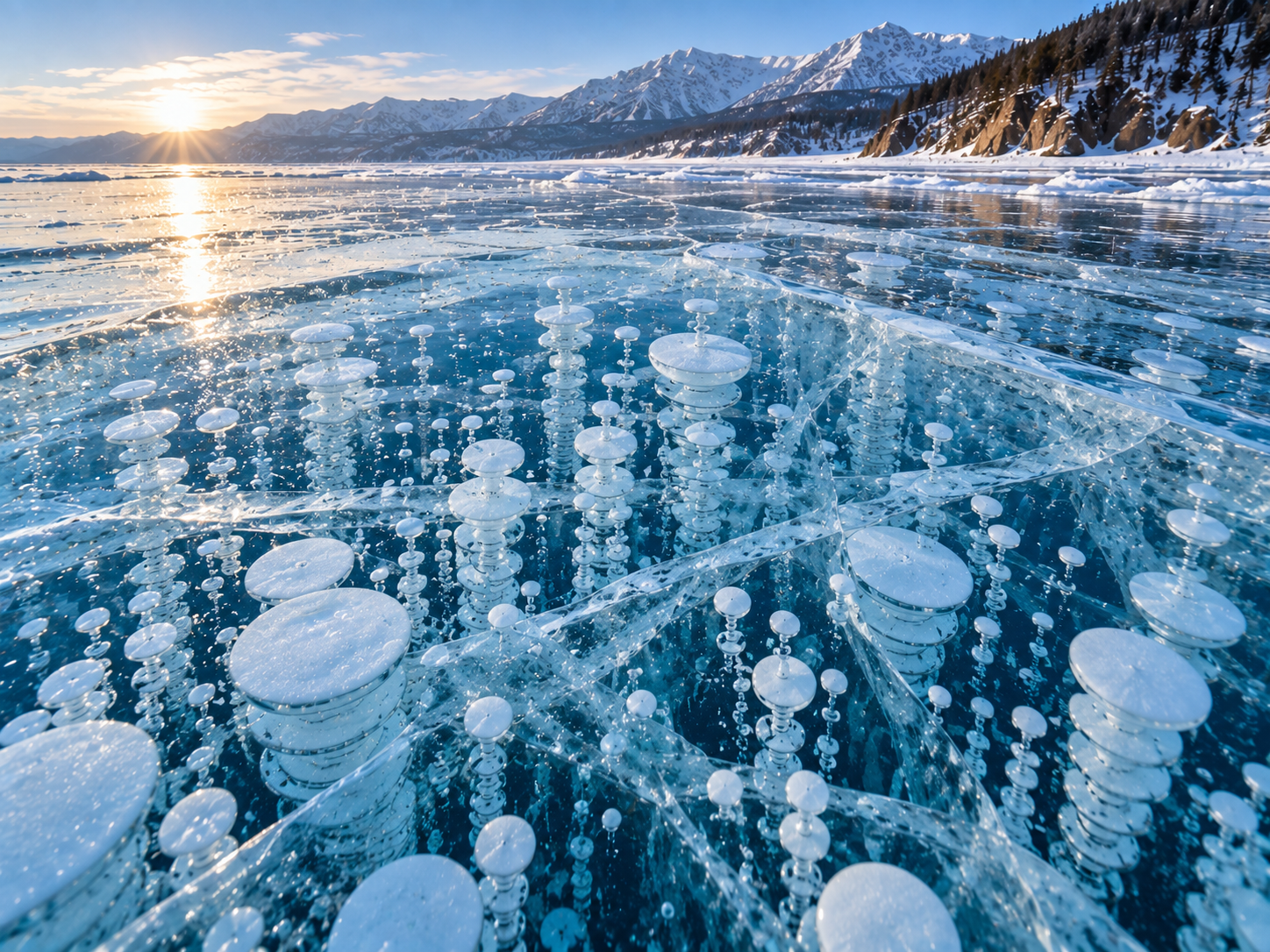
    Transparent Baikal ice allows sunlight to reveal white gas bubbles suspended at different depths.

     The bubbles would not look nearly as spectacular if the ice around them were cloudy.

    That is the other half of the trick.

    Baikal can produce stretches of remarkably transparent winter ice. NASA specifically describes the methane bubbles as being frozen into exceptionally clear ice.

    Clear ice lets light pass through it.

    That means you can see into the ice instead of seeing only its white surface.

    When light encounters bubbles, cracks and other structures inside the ice, some of it is scattered. The gas bubbles therefore stand out against the darker blue ice around them.

    That is why they can look like white coins or pearls.

    The bubbles themselves are not necessarily white gas.

    Their appearance comes partly from the way light interacts with the bubble and surrounding ice.

    You can see the same basic idea in foam.

    A single tiny bubble is hard to notice.

    A huge collection of bubbles suddenly becomes bright.

    Lake Baikal simply gives you a gigantic natural version of the effect.

    A clear sheet of ice.

    Thousands of trapped bubbles.

    And sunlight passing through the whole thing.


    Why Can We See the Bubbles So Clearly?

    Optics and natural-history infographic titled Why Does Baikal Ice Look Like Glass? Features a cross-section diagram of ultra-clear transparent lake ice showing sunlight entering from above, passing straight through clear ice areas, and scattering outward around trapped gas bubbles at multiple depth levels while an observer looks through the surface. Four text boxes explain that clear ice has low internal scattering allowing deep visibility, bubbles interrupt the clear ice, light scatters at bubble boundaries making them pop, and viewers perceive white bubble shapes inside blue-transparent ice. Includes a comparison card between cloudy ice and clear ice, concluding that the clear ice is what allows the bubbles to be seen.
    Optical Physics & Limnology

    Why Does Baikal Ice Look Like Glass?

    An optical cross-section showing how extreme water purity and slow freezing produce glass-like clarity that reveals deep trapped gas structures.

    Optical Cross-Section of Transparent Ice
    Sunlight Ray
    Clear Ice Column
    Gas Bubble
    Scattered Light
    Optical Mechanics
    Clear ice

    Less internal scattering lets you see deeper into the frozen lake.

    Gas bubbles

    Bubbles interrupt the otherwise clear ice.

    Scattered light

    Light spreads at the bubble surfaces, making them stand out.

    What you see

    White bubble shapes suspended inside blue-transparent ice.

    Visual Clarity Comparison
    Cloudy ice Surface mostly blocks your view.
    Clear ice Internal structures remain visible.

    “The bubbles are amazing. The clear ice is what lets you see them.”


    Chapter 4 — Why Do Some Bubbles Form Perfect Columns?
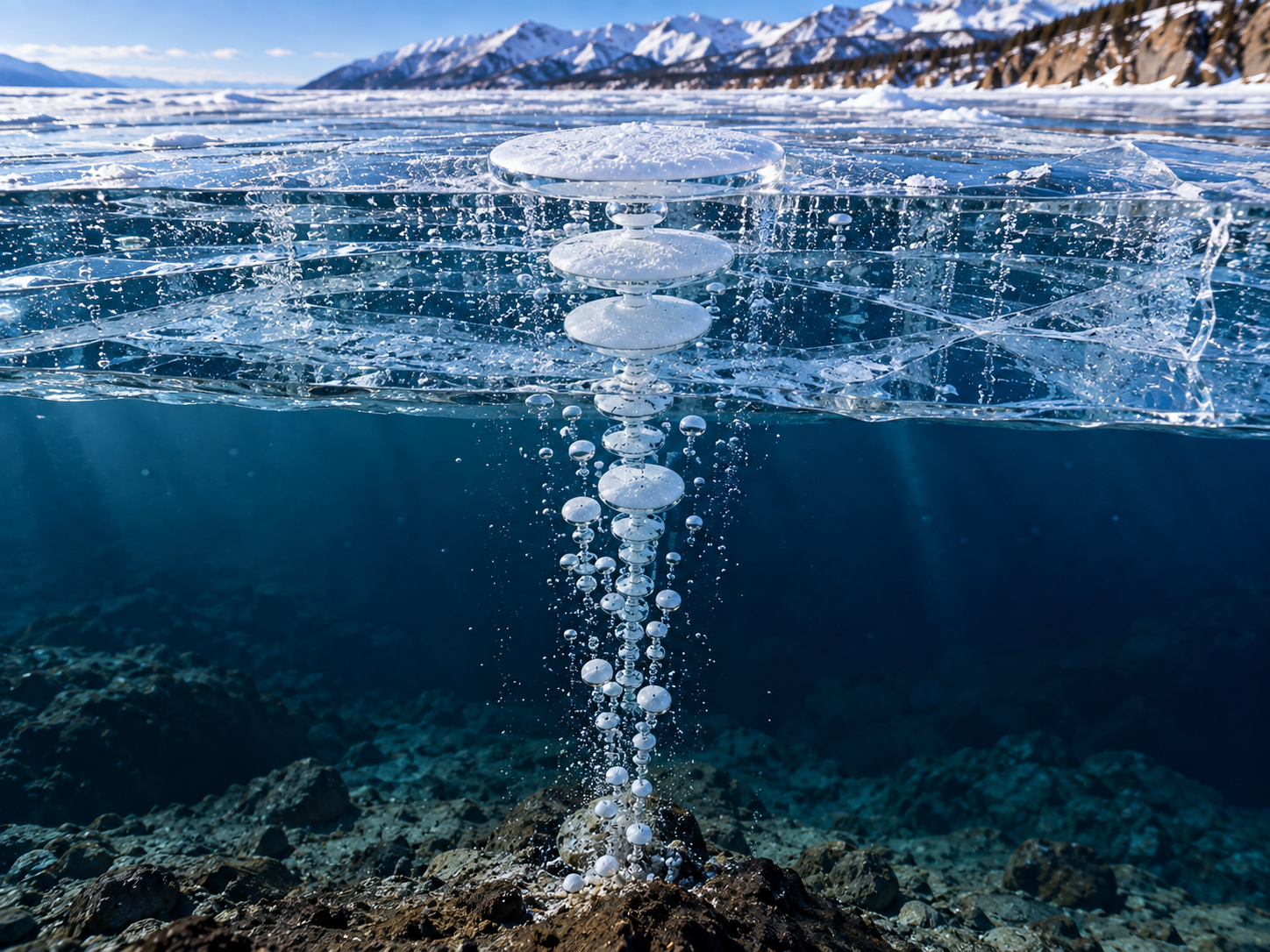
    A column of gas bubbles rises from a seep and becomes trapped in successive layers of Lake Baikal ice.

     Look closely at photographs of Baikal ice.

    The bubbles are not always scattered randomly.

    Some appear one above another.

    A small bubble.

    Then another.

    Then another.

    Together they form a vertical line.

    Why?

    Because the gas source below can remain active while the ice is forming.

    A steady seep can send bubbles upward from roughly the same area again and again. If the ice is growing during the same period, new bubbles can become trapped above older ones.

    The result is a kind of frozen trail.

    Researchers studying Lake Baikal have found gas seeps and observed rising bubbles, while studies of Baikal's unusual ice structures have linked some forms to methane transport from below the lake.

    But there is an important detail.

    Not every bubble pattern in Baikal ice has to come from methane.

    Later research on Baikal's ice found that some vertical bubble structures are produced by changes in the ice itself during spring melting and sunlight-driven metamorphism, rather than directly by methane activity in the sediments.

    So when you see a beautiful column of bubbles, it is better not to assume that every single bubble has the same origin.

    Some are records of gas moving upward.

    Others can be created by changes happening inside the ice.

    The photograph may look simple.

    The physics is not.


    How Do Bubble Columns Form?

    Educational geological cross-section infographic titled Why Do Some Bubbles Stack in Columns? Features a large vertical cross-section of Lake Baikal with a gas seep at the bottom sediment, a continuous vertical stream of rising bubbles in the water column, and growing ice layers at the freezing surface trapping successive bubbles one above another over time. Four text boxes explain that a single seep repeatedly releases bubbles from one stationary location, while downward growing ice layers enclose bubbles sequentially to create vertical stacked columns. Includes a scientific caution box noting that not all bubble columns are methane, as spring melting and ice metamorphism can also alter bubble shapes. Concludes that bubble columns record repeated release events over time.
    Geophysics & Cryology

    Why Do Some Bubbles Stack in Columns?

    A vertical cross-section showing how stationary sediment seeps and progressive ice growth create stacked gas columns in Lake Baikal.

    Vertical Column Formation Cross-Section
    Stratified Ice Layers
    Water Column
    Trapped / Rising Bubble
    Sediment Gas Seep
    Temporal & Physical Mechanism
    One gas source

    A seep can release bubbles from roughly the same location.

    Repeated release

    New bubbles can rise while the ice continues to grow.

    Growing ice

    Different layers trap bubbles at different times.

    Final pattern

    A vertical column can form.

    Scientific Caution

    “Not every Baikal bubble column is methane.”

    Some bubble structures can also form from changes in the ice during spring melting and metamorphism. Thermal expansion, solar ray absorption, and recrystallization alter existing gas pockets inside the ice sheet.

    “A bubble column can be a record of repeated events, not one single burst of gas.”


    Chapter 5 — Methane Is Not the Only Strange Thing Beneath Baikal
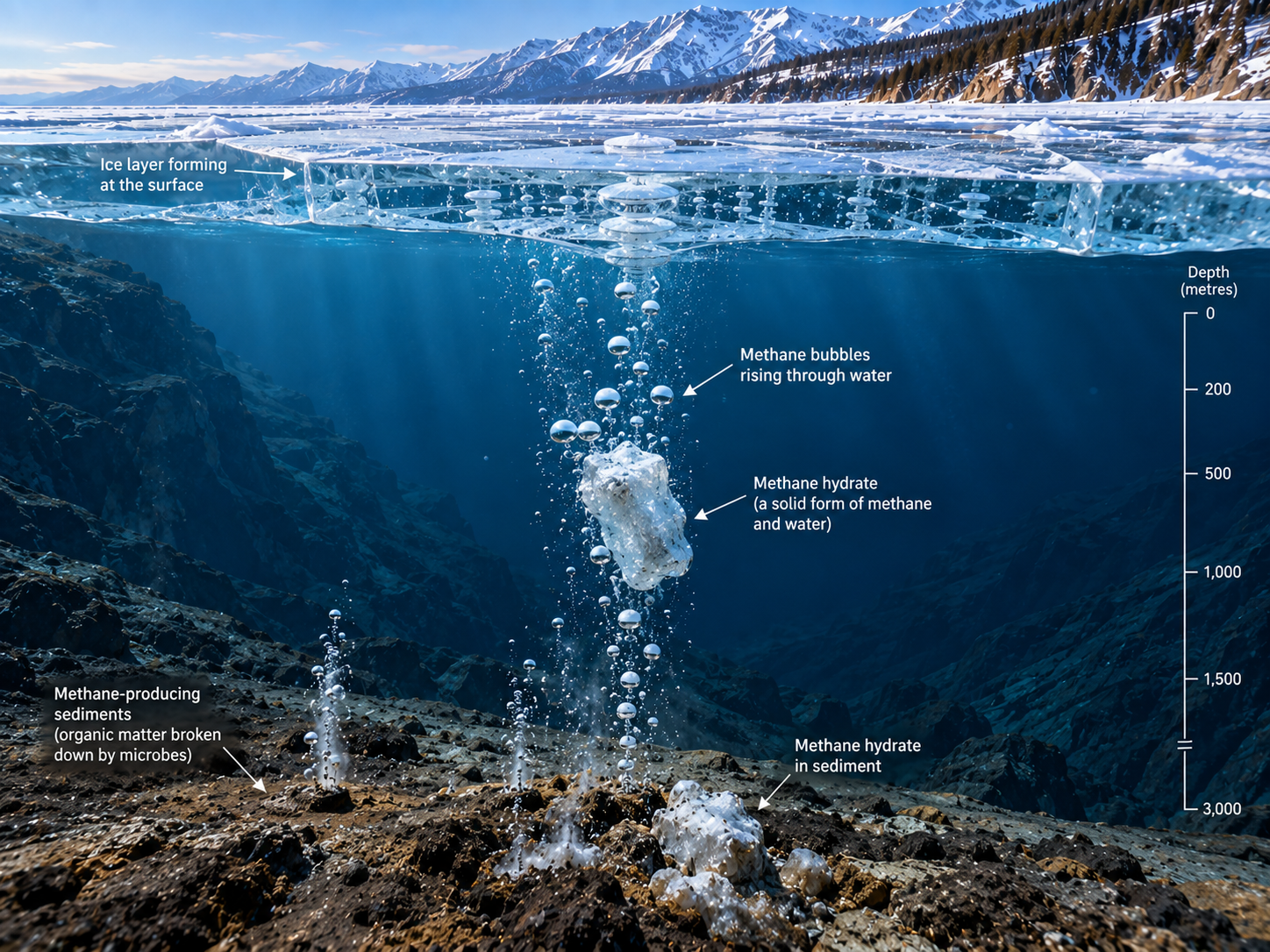
    Methane hydrates and methane bubbles can rise from deep sediments beneath Lake Baikal toward the ice-covered surface.

     Lake Baikal has another reason to make scientists look twice.

    It contains methane hydrates.

    These are solid, ice-like structures in which methane molecules are trapped inside a cage made of water molecules.

    They form under the right combination of pressure and temperature, especially in deep sediments.

    Lake Baikal is unusual because methane hydrates occur in its deep sediments, and researchers have directly observed methane hydrate fragments rising through the water.

    That matters because a normal methane bubble and a methane hydrate are not quite the same thing.

    A small gas bubble can dissolve as it rises through deep water.

    A methane hydrate is much more stable under the right conditions.

    The 2019 study proposed that rising methane hydrates can carry methane upward and that their interaction with freezing water may help produce some unusual Baikal ice structures.

    Scientists even found unusually high methane concentrations in certain types of unusual ice associated with these processes.

    So the famous bubble photographs are connected to a much bigger system.

    Methane is moving through the lake.

    Ice is forming above it.

    And sometimes the gas does not travel in the simple form we might imagine.

    It can travel as part of a solid hydrate structure.

    That makes Lake Baikal more than a beautiful winter photograph.

    It is also a place where scientists can watch methane move through a very unusual freshwater environment.


    Bubble or Methane Hydrate?

    Geochemistry educational infographic titled Not All Methane Travels the Same Way. Features a vertical Lake Baikal cross-section contrasting two methane transport pathways from deep sediment: Path A shows gaseous spherical bubbles rising through water and shrinking or dissolving; Path B shows crystalline solid methane hydrate fragments rising under high pressure and low temperature, carrying methane upward to interact with forming ice. Three text boxes define gas bubbles, solid methane hydrates, and why stability at depth matters. Includes an evidence box noting direct scientific observation of rising hydrate fragments in Lake Baikal, a caution box emphasizing that not all Baikal ice bubbles come from hydrates, and concludes that methane moves under ice in more than one form.
    Geochemistry & Limnology

    Not All Methane Travels the Same Way

    A deep vertical cross-section comparing gaseous bubble ascent with solid methane hydrate transport through Lake Baikal’s water column.

    Sub-Surface Transport Pathways
    0m 300m 700m 1100m+
    Gaseous Bubble
    Solid Hydrate Fragment
    Surface Ice
    Deep Sediment Seep
    State & Stability Mechanisms
    Gas bubble

    Methane in gaseous form.

    Methane hydrate

    A solid water-and-methane structure that can form under pressure and low temperature.

    Why it matters

    Hydrates can be more stable than ordinary bubbles at depth.

    Observational Evidence

    Researchers directly observed methane hydrate fragments rising in Lake Baikal and linked some unusual ice structures with methane transport.

    Scientific Caution

    “Scientists proposed that hydrates help explain some unusual ice forms. Not every bubble in Baikal ice comes from a hydrate.”

    “Under the ice, methane can move in more than one form.”


    Chapter 6 — The Ice Is Keeping a Record
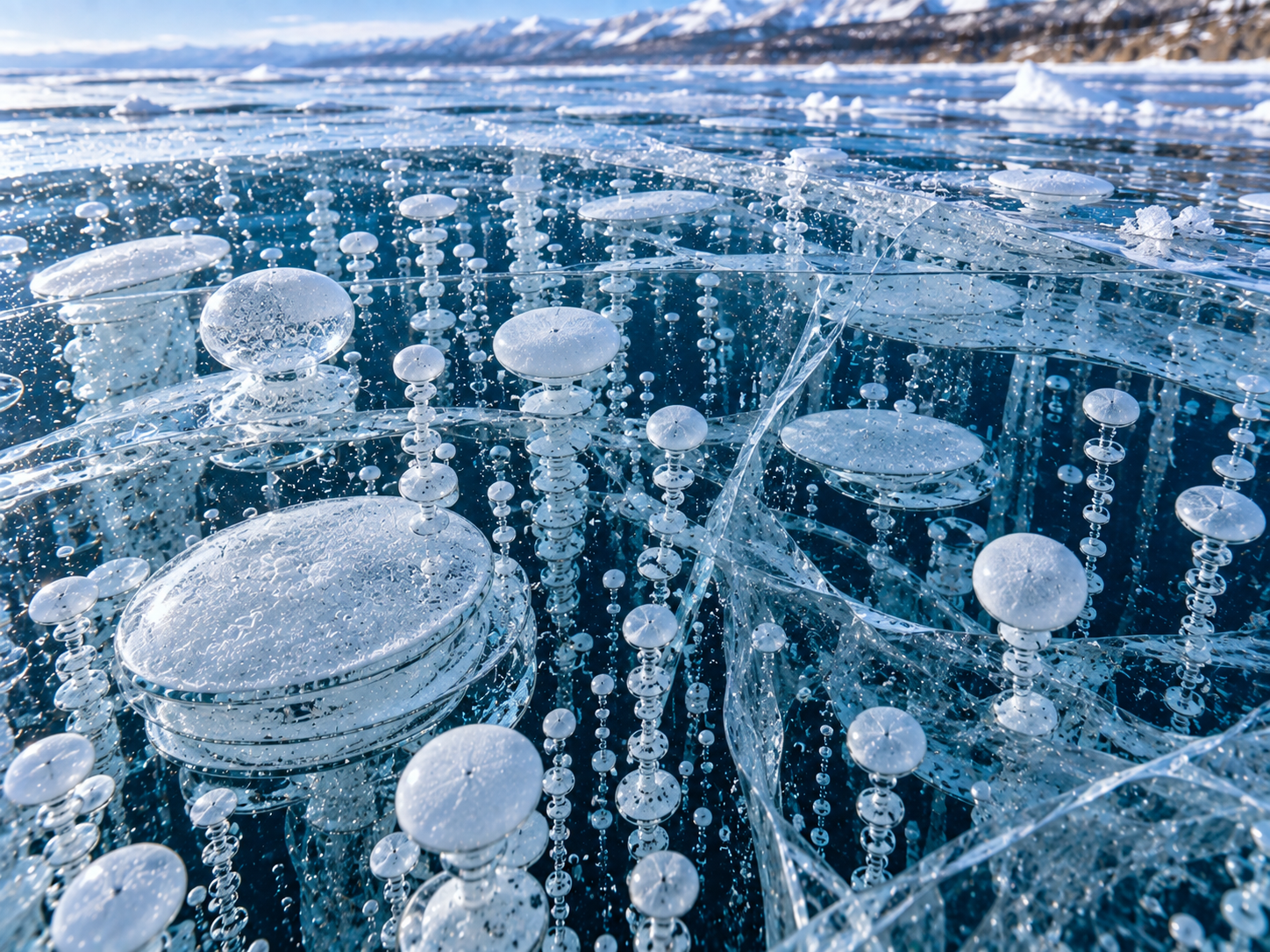
    Different bubble shapes and layers inside clear Baikal ice record the conditions under which the ice formed.

     Now look at the bubbles one more time.

    A photograph makes them look decorative.

    A scientist can see something else.

    Information.

    The shape, size and position of bubbles can tell researchers about how the ice formed and how much gas was present in the water. Laboratory experiments have shown that bubble shape changes with freezing speed and dissolved gas conditions.

    The ice can therefore preserve a little history.

    A bubble trapped near the surface formed at one moment.

    Another trapped deeper down may have been caught earlier.

    A column can suggest repeated gas release.

    A strange shape can reveal something about how quickly the surrounding ice froze.

    And unusual concentrations of methane in some Baikal ice structures can provide clues about how methane moves through the lake.

    This is why those bubbles are more than a beautiful winter curiosity.

    They are evidence.

    They tell scientists something about what happened before the lake became completely frozen.

    And the clearest ice makes that evidence unusually easy to see.

    So when you look through Baikal's winter surface, you are not simply looking into a frozen lake.

    You are looking at a record of what happened while the lake was freezing.


    What Can the Bubbles Tell Scientists?

    Educational scientific infographic titled The Bubbles Are a Record. Features a macro visual cross-section of a transparent Lake Baikal ice block containing five distinct bubble pattern records without embedded text: a single round bubble, a flattened bubble, a small bubble cluster, a vertical stacked bubble column, and a bubble trapped directly along a distinct ice layer boundary. Four separate cards detail how bubble size provides clues on gas content, bubble shape reveals freezing conditions, bubble position shows trapping timing, and bubble columns record repeated gas release events. Includes a science note highlighting how researchers study gas movement and ice history, and concludes that the ice has frozen a moment in the lake's life.
    Cryology & Geological Archives

    The Bubbles Are a Record

    How trapped gas morphology, arrangement, and depth preserve a physical archive of Lake Baikal’s freezing history and sub-surface dynamics.

    Ice Block Macro Illustration
    Gas Bubble Structure
    Ice Layer Boundary
    Pattern Focus Area
    Diagnostic Morphologies
    Bubble size

    Can provide clues about gas content and bubble growth.

    Bubble shape

    Can reveal how the surrounding ice formed.

    Bubble position

    Shows when and where gas became trapped during freezing.

    Bubble columns

    Can record repeated gas release from a similar location.

    Science Note

    “Researchers can use bubble patterns to study both gas movement and the history of ice formation.”

    “The ice has frozen a moment in the life of the lake.”


    So, Why Does Lake Baikal Have Those Crystal Ice Bubbles?

    The answer starts deep below the surface.

    Methane can form in lake sediments.

    Gas can rise through the water.

    Winter freezes the lake from above.

    As the ice grows, some bubbles become trapped.

    And Baikal's unusually clear ice lets you see them.

    Some form single white spheres.

    Some line up into columns.

    Some become distorted as the ice around them changes.

    And some unusual structures are linked to methane hydrates rather than ordinary gas bubbles.

    There is one final correction worth remembering.

    The bubbles are not made of ice.

    The ice is around them.

    The bubbles are gas trapped inside it.

    That small difference explains the whole phenomenon.

    The lake produces the gas.

    Winter provides the trap.

    And the clear ice turns the hidden process into something you can actually see.

    What looks like a collection of pearls beneath your feet is really a frozen record of the lake breathing gas upward from below.


    Frequently Asked Questions


    1. Why does Lake Baikal have bubbles trapped in its ice?

    Gas released from the lake and its sediments can rise toward the surface. When the lake freezes, some of that gas becomes trapped in the growing ice. NASA identifies many of the famous visible bubbles as methane.

    2. Are the bubbles in Lake Baikal made of methane?

    Many of the famous bubbles are methane bubbles. Lake Baikal also contains methane hydrates, and researchers have linked some unusual ice structures to methane transport from below. However, not every bubble structure in Baikal ice necessarily has the same origin.

    3. Where does the methane come from?

    Methane can be produced in lake sediments when microorganisms break down organic material under oxygen-poor conditions. Lake Baikal also has numerous gas seeps where methane-rich gases move upward through the water.

    4. Why don't the methane bubbles simply escape?

    Some do. Many ordinary methane bubbles can dissolve back into the water as they rise. But some gas reaches the surface during ice formation and becomes trapped in the growing ice. Methane hydrates can also transport methane upward under suitable conditions.

    5. Why is Lake Baikal's ice so clear?

    Baikal can produce exceptionally clear winter ice, allowing structures beneath the surface to remain visible. NASA specifically describes the famous methane bubbles as being trapped in exceptionally clear ice.

    6. Why do some bubbles form long vertical columns?

    Repeated gas release from a similar location can produce streams of bubbles. If the surface is freezing at the same time, successive bubbles can become trapped above one another, creating columns.

    7. Are all the strange bubble patterns in Baikal caused by methane?

    No. Research on Baikal ice has shown that some vertical bubble structures can also form during changes in the ice caused by sunlight and melting, rather than directly from methane activity in the sediments.

    8. Why do some bubbles look flat instead of round?

    A trapped bubble can change shape as the surrounding ice freezes and presses against it. Research on ice bubbles shows that their shapes depend on factors such as freezing conditions, bubble growth and dissolved gas.

    9. Does Lake Baikal contain methane hydrates?

    Yes. Scientists have found methane hydrates in Baikal's deep sediments and have directly observed hydrate fragments rising through the lake under some conditions.

    10. Why do scientists study these bubbles?

    The bubbles can provide information about gas movement, methane release and how the ice formed. Their shapes, positions and concentrations can act as clues to processes happening inside the lake and during freezing.


    in Places
    Arpit Kaintura 24 September 2026
    Share this post

    Share

    Tags
    Our blogs
    • Our blog
    • Wildlife
    • Space
    • Places
    • History and Culture
    Archive
    Sign in to leave a comment
    Why Is Ethiopia’s Danakil Depression So Uninhabitable?
    From boiling acid springs to surface temperatures over 120°F, discover the three extreme geological forces that make the Danakil Depression unlivable.
    Helpful Links
    • Home
    • About us
    • Privacy Policy
    • Contact us
    About us

    Welcome to Atlasnova, my personal website where I share interesting discoveries about space exploration, the solar system, world wildlife. My goal is to make space and wildlife easy to explore and fun to learn for curious minds everywhere. 

    Connect with us
    • Contact us
    • arpitkaintura2025@gmail.com

    Copyright © Atlasnova
    Powered by Odoo - The #1 Open Source eCommerce