Why Doesn’t Eternal Flame Falls Go Out?
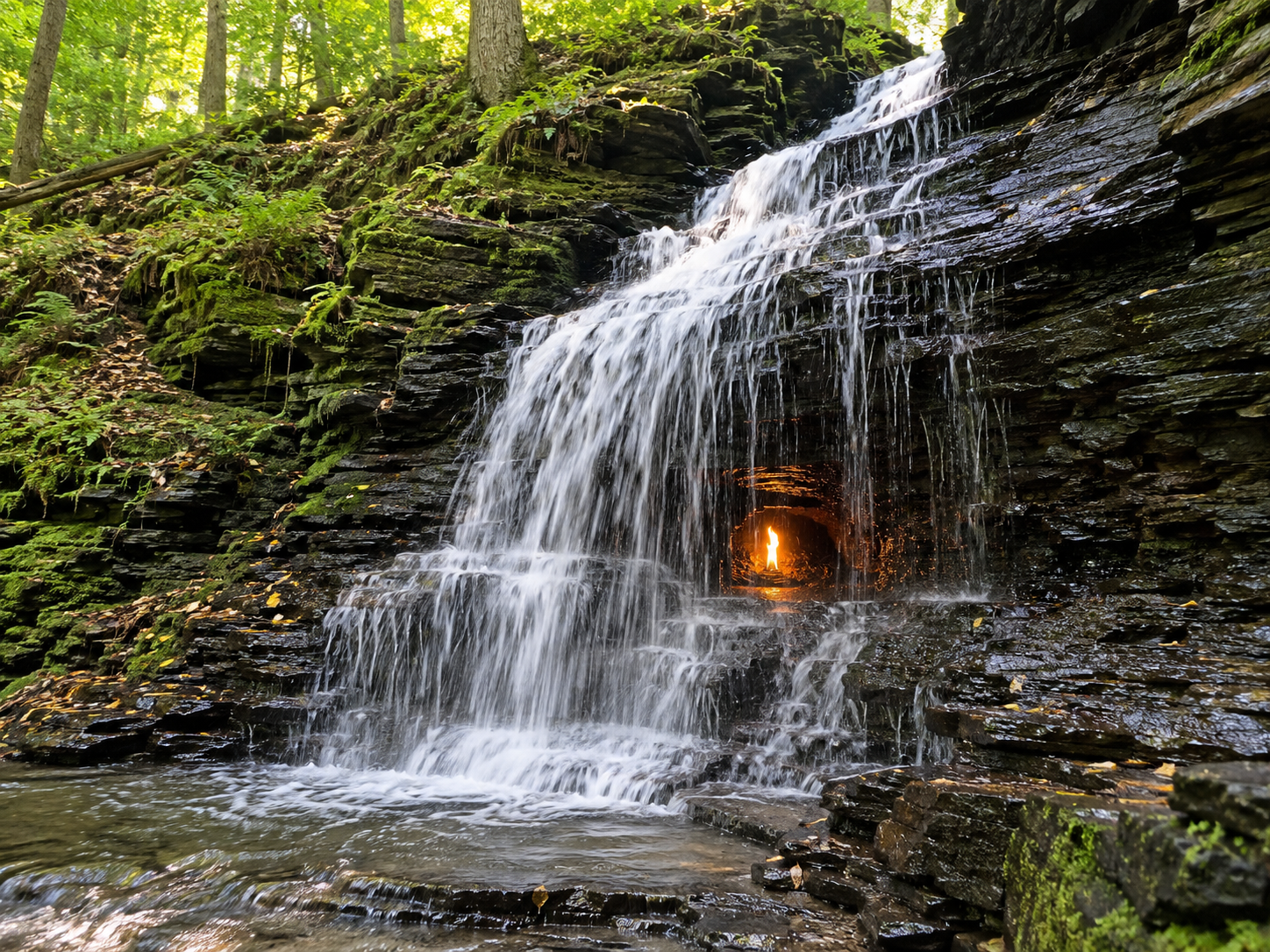
Water is falling.
Fire is burning.
And they are only a few feet apart.
At Eternal Flame Falls in Chestnut Ridge Park, New York, a small orange flame burns inside a rocky hollow behind a waterfall. The flame is usually only a few centimetres high, yet it can keep burning while water rushes past the opening.
It looks impossible.
How can fire survive beside a waterfall?
The answer starts with something you cannot see.
Natural gas is leaking out of the rock.
The gas reaches a small grotto, mixes with air and burns.
But there is an important correction to the name.
The flame is not literally eternal.
Wind, water and changing conditions can extinguish it, and it can be relit when the gas is still seeping. What has remained remarkably persistent is the natural gas supply, not one unbroken flame.
And that leads to the more interesting question.
Where is all that gas coming from?
Because scientists discovered that the rock beneath the waterfall is not quite the kind of place they expected to produce it.
Chapter 1 — The Fire Is Not Under the Water
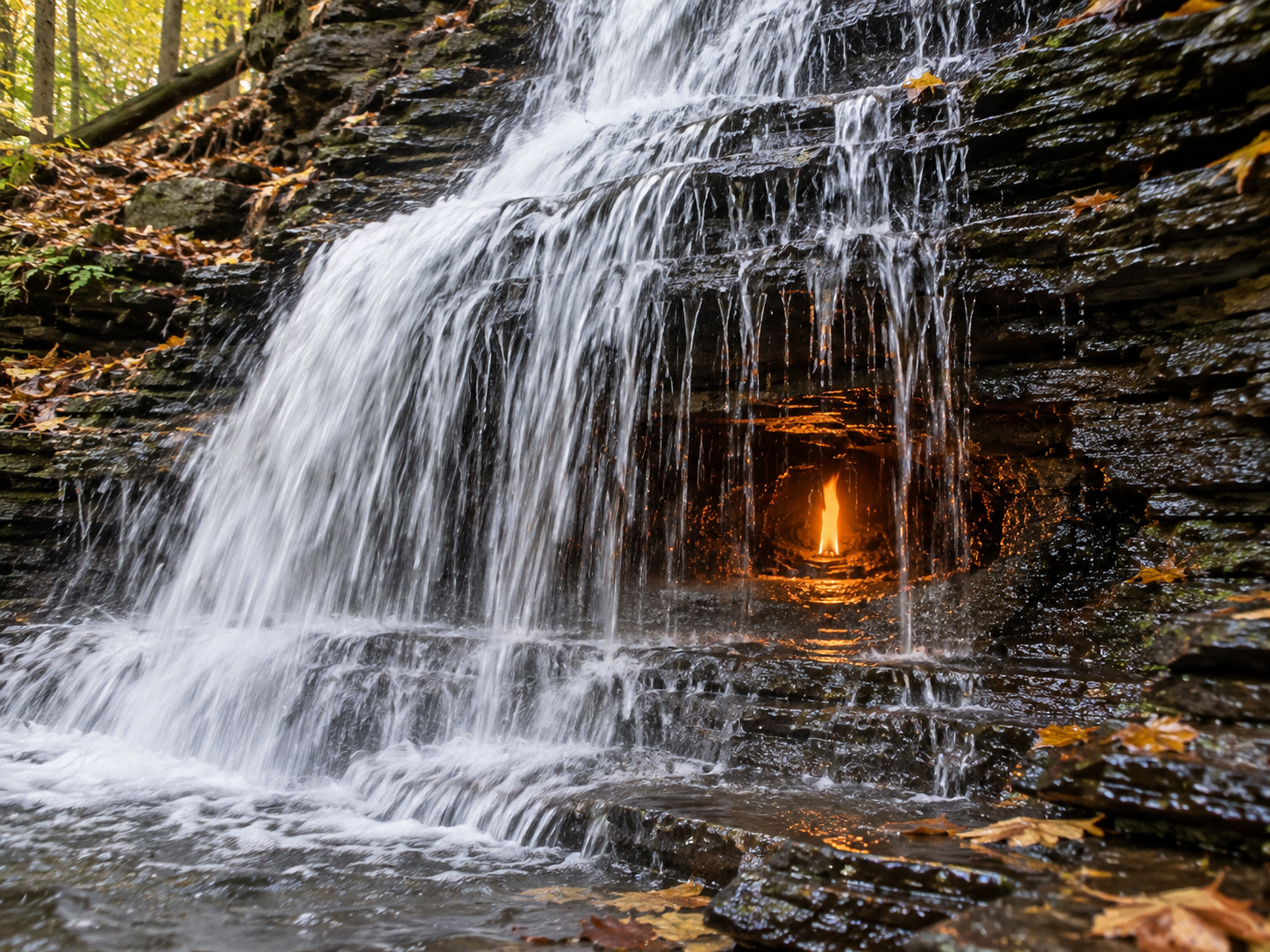
You might expect the flame to be sitting inside the waterfall.
It is not.
Look more closely and you can see the trick.
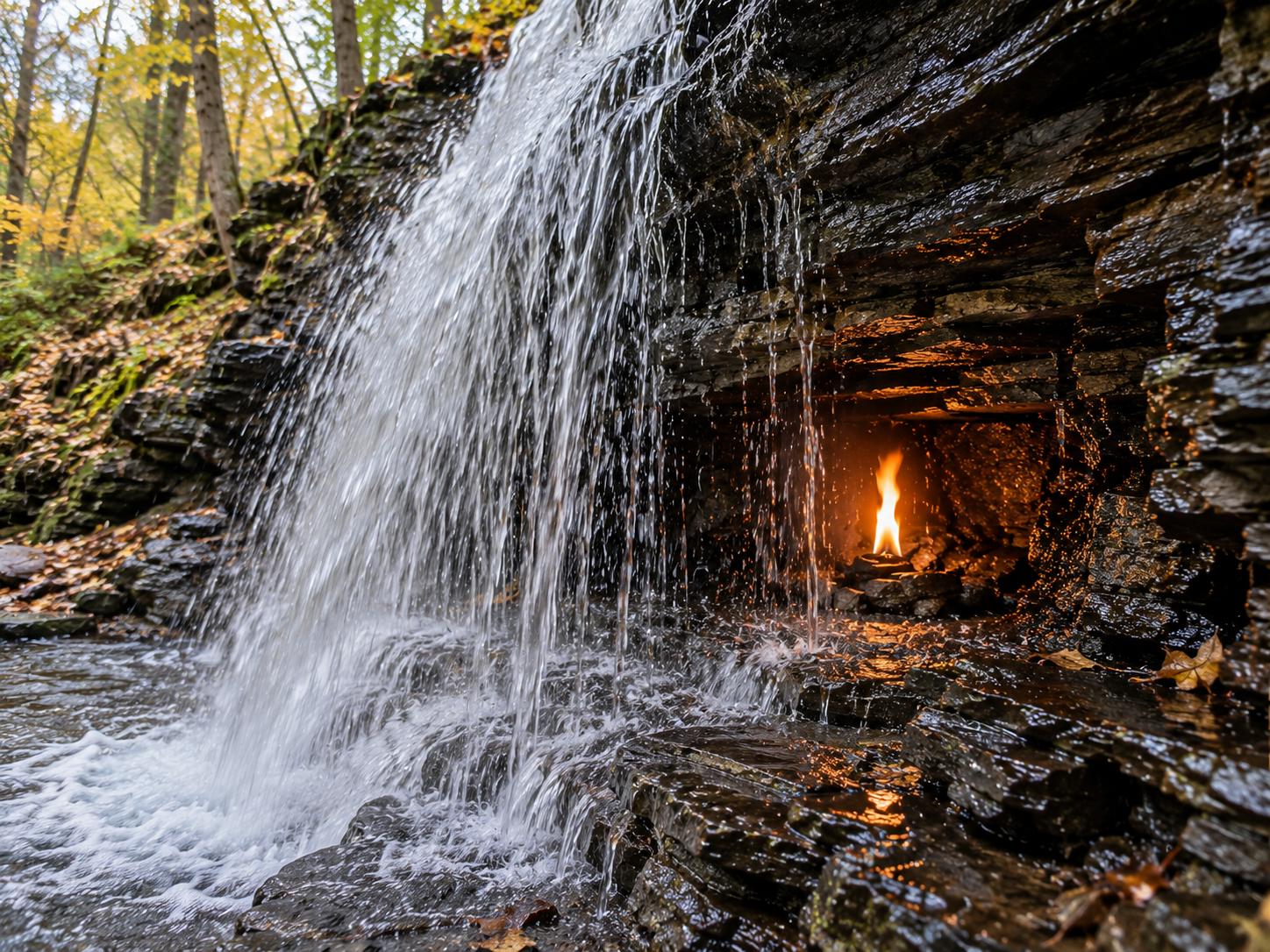
The flame sits inside a small rocky grotto. Water falls in front of the opening, while the fire burns farther back where the rock gives it some shelter. The natural gas escapes through fractures in the shale and reaches the sheltered space.
So the water and fire are not actually fighting for the same space.
They are next to each other.
That small difference changes everything.
The waterfall can pour down outside the grotto while the gas collects inside it.
Then oxygen from the surrounding air mixes with the gas.
Add an ignition source, and you get a flame.
The fire is small because the gas flow is small.
A 2013 scientific study measured the main seep and estimated that it releases about 1 kilogram of methane per day, along with unusually large amounts of ethane and propane for a natural gas seep.
So the waterfall is not keeping a giant fire alive.
It is hiding a tiny gas flame.
And that is what makes the scene so strange.
Water and Fire in the Same Place
Chapter 2 — The Flame Runs on Gas From the Rock
The next question is easier.
What is actually burning?
Natural gas.
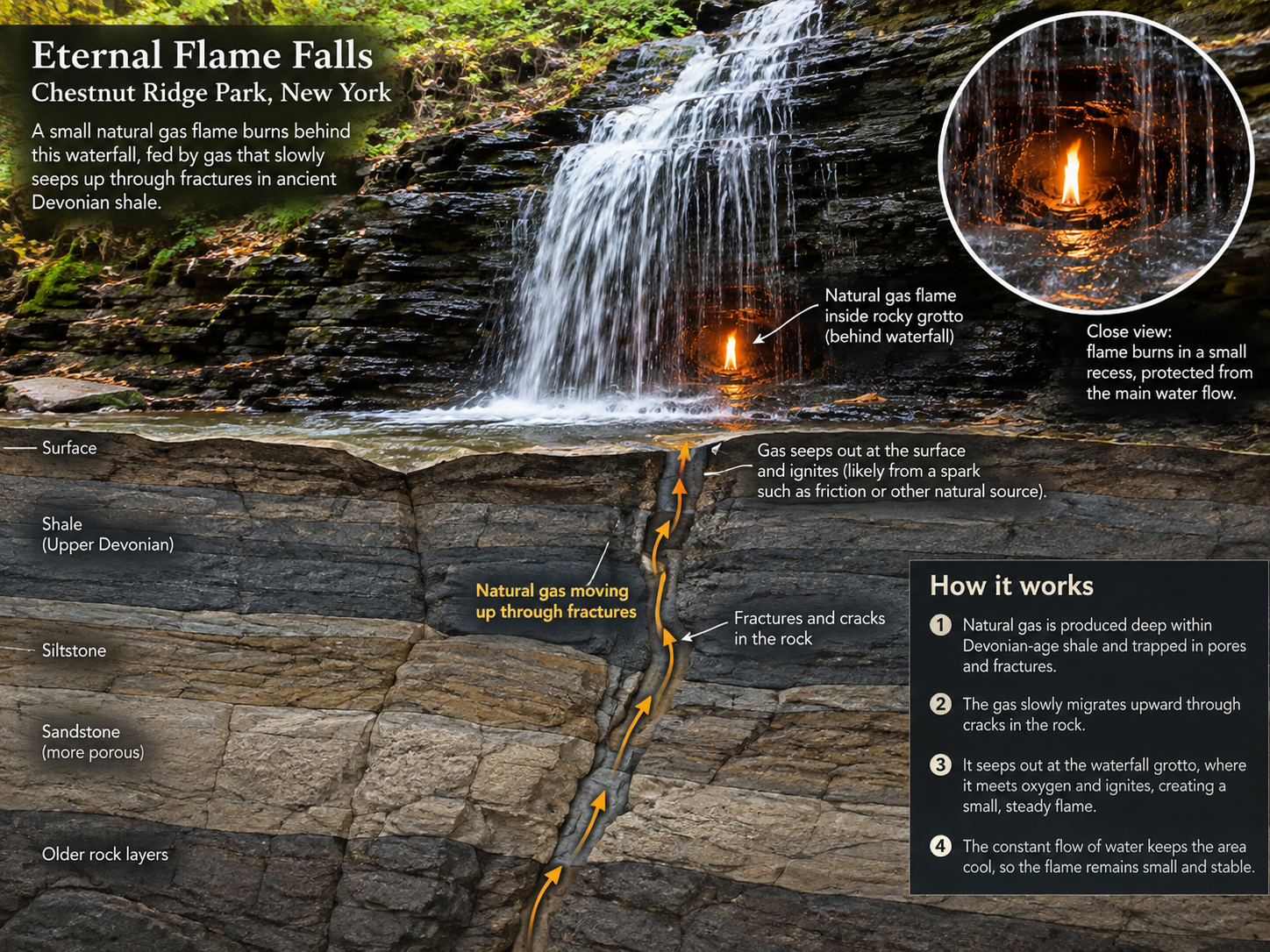
Researchers studying the site found that the seep at Eternal Flame Falls is a natural gas seep coming from deep geological formations. Their chemical analysis showed the gas is mainly methane but also contains unusually high proportions of ethane and propane.
That matters because not every natural gas seep produces a visible flame.
Most seeps simply release gas.
This one happens to release enough combustible gas in the right place for a small fire to keep burning.
The gas does not pour out like water from a pipe.
It moves through cracks and fractures in the rock.
Those fractures provide pathways from deeper underground toward the surface.
The 2013 study connected the seep to the Rhinestreet Shale, part of the Upper Devonian rock sequence beneath the area. The researchers also found that the local bedrock contains fractures aligned with a fault system.
So the waterfall is sitting on top of something much larger.
Under the trees.
Under the creek.
Under the rock.
Gas is moving upward.
The flame is simply the place where that hidden movement becomes visible.
Where Does the Gas Come From?
Chapter 3 — This Is Where the Mystery Gets Interesting
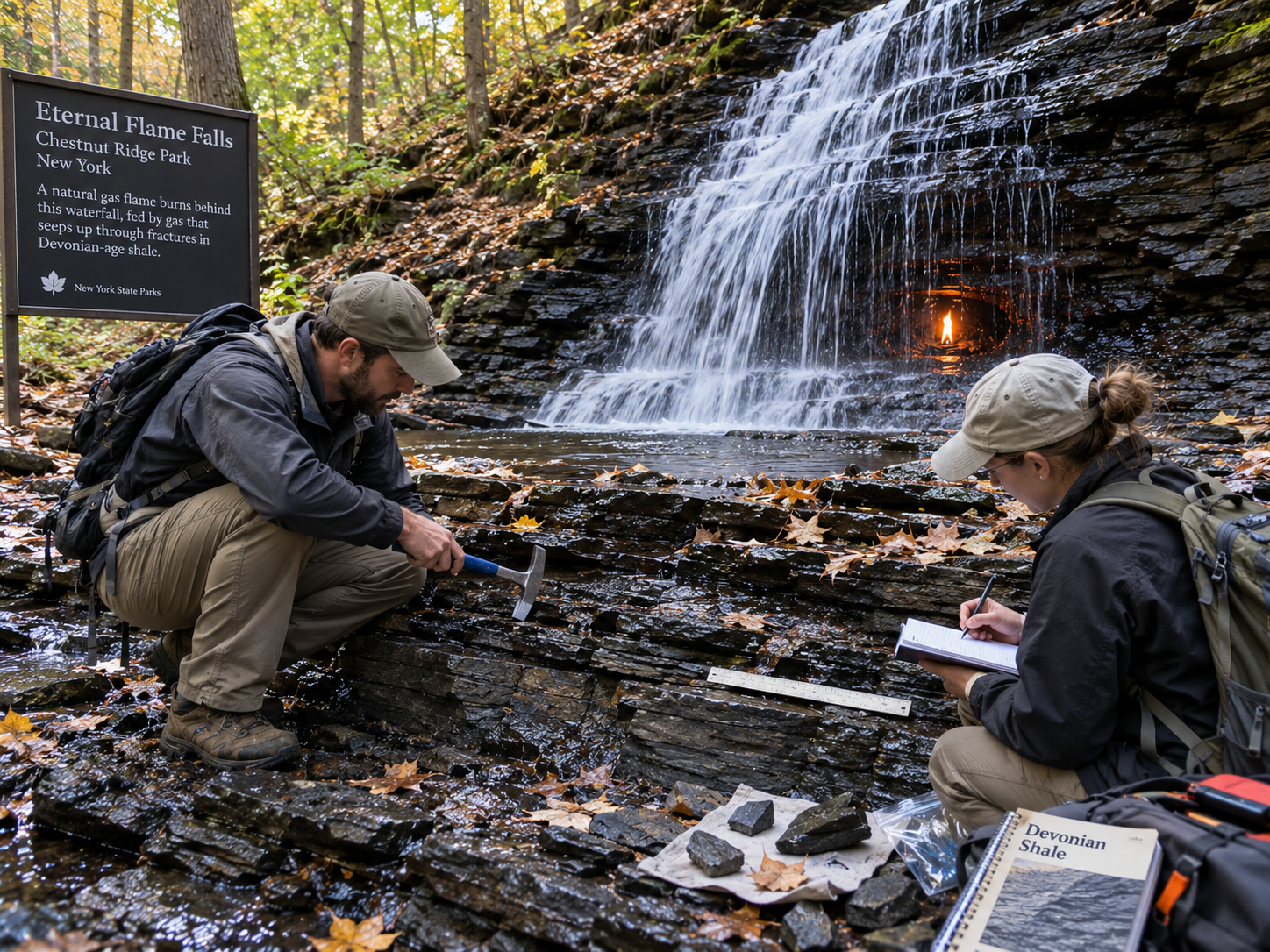
You might think the science ends there.
Gas comes from shale.
Gas burns.
Case closed.
But the geologists who studied Eternal Flame Falls found something odd.
The rocks did not seem to have the temperature normally expected for producing this kind of thermogenic natural gas.
The researchers concluded that the gas was of predominantly thermogenic origin, but the shallow shale involved at the surface was too cool and relatively immature to explain the gas production by the usual process alone. They suggested that another mechanism may help generate or release the gas within the fractured shale system.
That is a much more interesting problem.
Normally, when geologists talk about thermogenic natural gas, they are talking about organic material that has been buried and heated over geological time.
More heat.
More pressure.
More transformation.
But at Eternal Flame Falls, the story does not fit that simple picture.
The gas has the chemical signature of thermogenic gas.
Yet the nearby source rock is not as hot or mature as you would expect.
So something unusual may be happening underground.
The scientists did not claim that they had solved every part of it.
Instead, their work pointed to a geological system that does not fit the simplest textbook explanation.
That is why the flame is scientifically interesting.
Not because nobody knows that gas burns.
Because scientists are still interested in why this particular rock system produces and releases the gas in this particular way.
Why Is the Gas Geologically Unusual?
Chapter 4 — Why Doesn't the Water Put the Fire Out?
Now return to the waterfall.
Water is falling.
The flame is still burning.
How?
Because the fire is in a sheltered pocket.
The grotto sits behind the main flow of water. The rock protects the flame from being hit directly by the entire waterfall.
That does not mean the flame is completely protected.
Water spray can reach it.
Strong wind can disturb it.
High water flow can change the conditions inside the grotto.
But enough gas continues to seep into the space for the flame to remain lit under ordinary conditions. The scientific study recorded flame heights varying with weather and season, while modern descriptions of the site note that wind and water can extinguish the flame temporarily.
So there is no battle between fire and a waterfall.
The fire has a small protected room.
Water passes in front of it.
Gas comes from behind it.
Air reaches the flame.
And the three things needed for burning—fuel, oxygen and an ignition source—can exist in the same small space.
That is enough.
How Fire Survives Beside Falling Water
Chapter 5 — The “Eternal” Flame Actually Goes Out
This is the part the name hides.
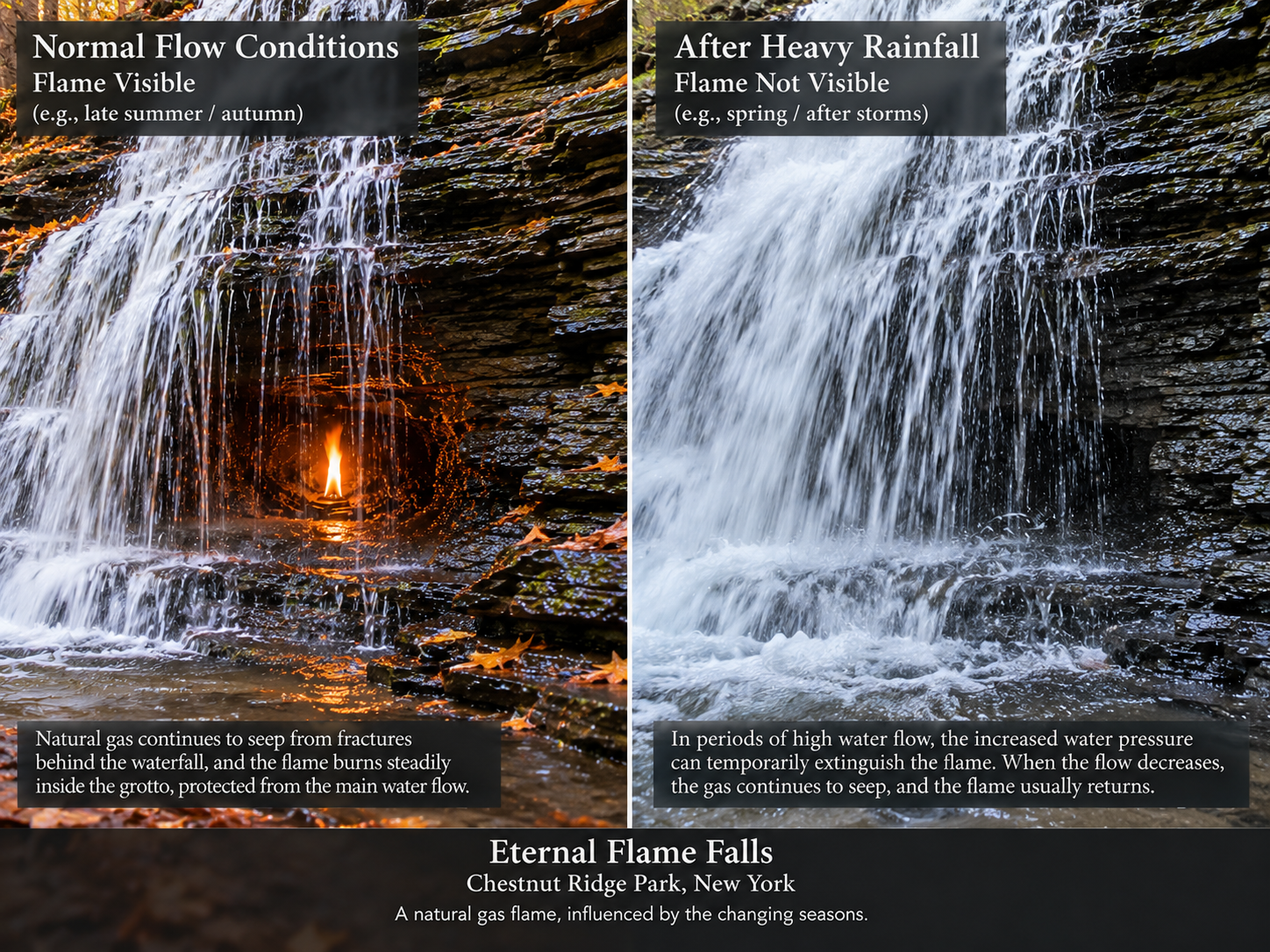
The flame can go out.
Heavy water flow can extinguish it.
Wind can blow it out.
Changing conditions around the gas seep can also affect the flame.
Visitors and local accounts have long reported relighting it when necessary.
So why call it eternal?
Because the gas supply is remarkably persistent.
Once the flame goes out, gas can continue escaping.
Relight it, and the flame returns.
That makes the whole thing feel like one unbroken fire even though individual flames may not last forever.
It is a useful distinction.
The flame is temporary.
The seep is persistent.
And that is actually more interesting than a fire that simply refuses to go out.
A candle can burn for a while because it has fuel.
Eternal Flame Falls is different.
The fuel is being supplied naturally from underground.
The source keeps feeding the fire.
So as long as the conditions are right and the gas keeps coming, the flame can return again and again.
That is where the word “eternal” really belongs.
Not to one flame.
To the phenomenon.
Why Is It Called “Eternal”?
Chapter 6 — Why Is the Gas Still Coming?
Now we reach the deepest question.
If the gas is coming from underground, why hasn't it simply run out?
A flame that burns year after year needs a continuing fuel supply.
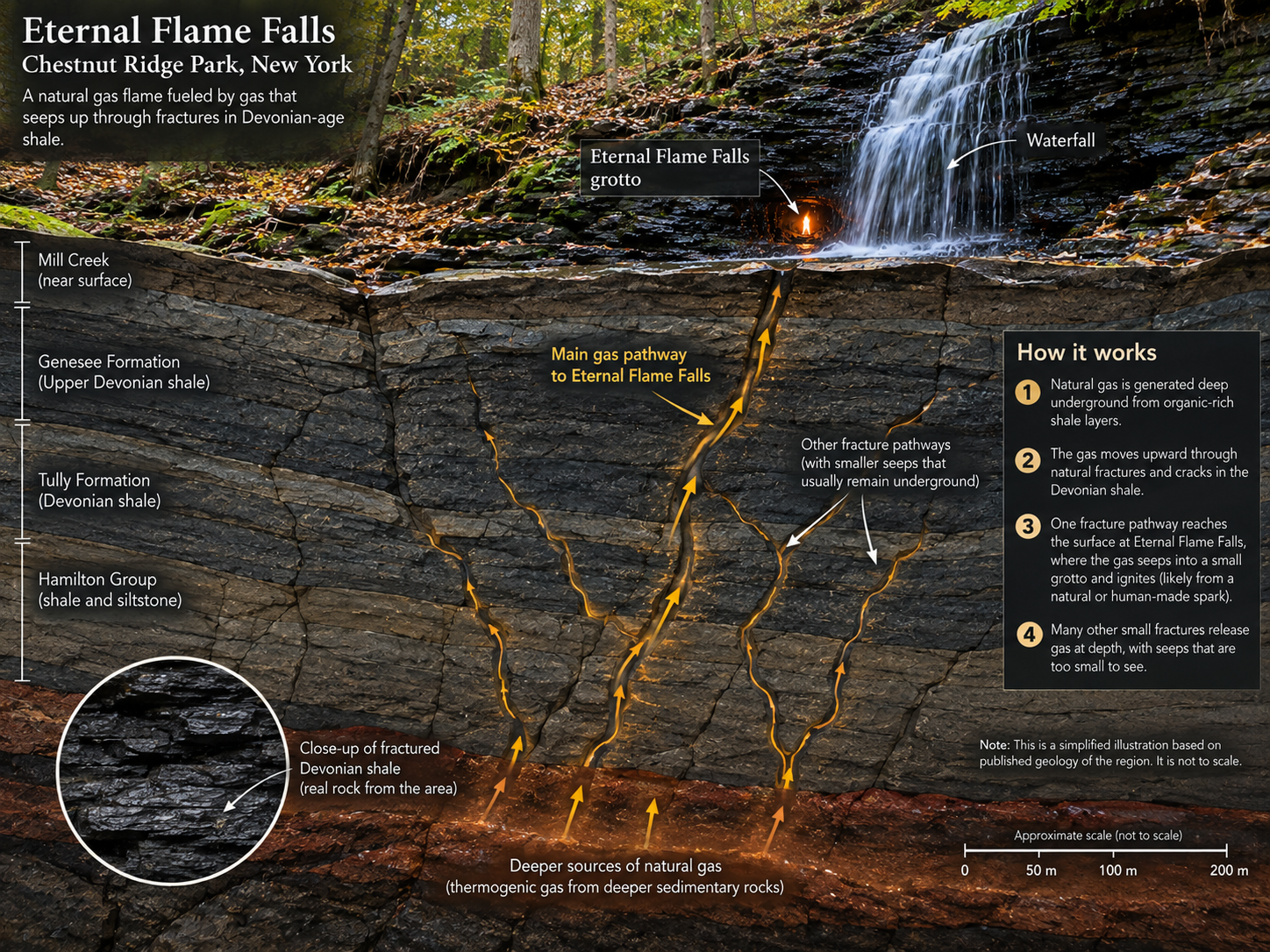
The 2013 study found the main seep was releasing about one kilogram of methane per day and concluded that the gas was associated with a pressurized gas system in the deeper shale. The researchers also found other smaller, invisible gas seeps around the area.
That means the flame is not burning through one small pocket like a bottle of fuel.
There is a larger geological system behind it.
Gas moves through fractures.
Pressure pushes it toward the surface.
Some of it reaches the grotto.
And some escapes invisibly into the surrounding ground and air.
The exact processes underground are more complicated than the simple picture of “a pocket of methane.”
The researchers' work suggested that tectonic fractures in the shale provide pathways for the gas.
And because the rock system is unusual, scientists have continued to be interested in how gas can be generated and transported through it.
The flame is small.
The system feeding it is not.
That is the part you cannot see.
The Flame Is Only the Surface
Chapter 7 — The Fire Is the Visible Part of a Geological Story
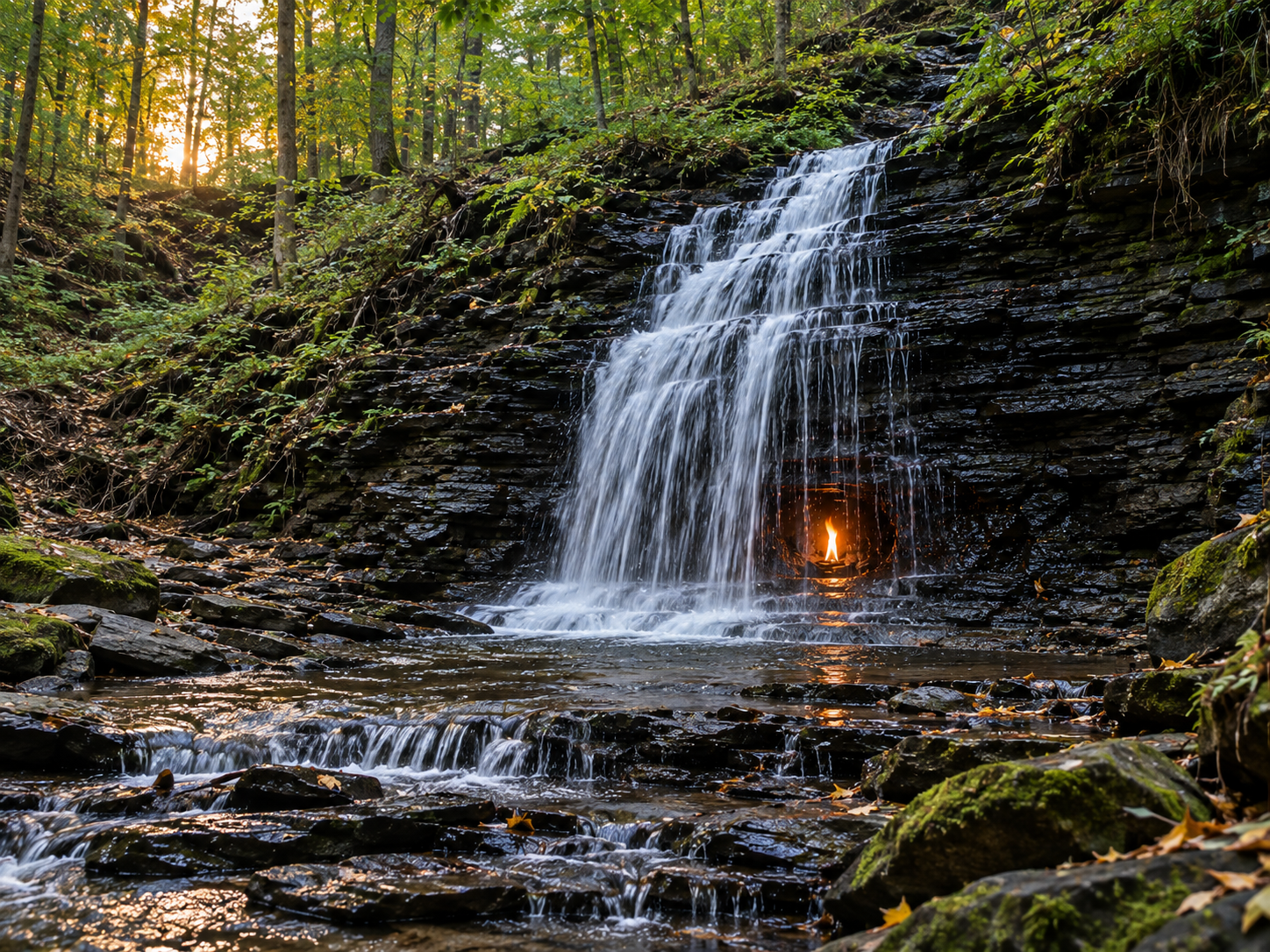
The easiest thing to remember about Eternal Flame Falls is the image.
Water.
Rock.
Fire.
But the flame is really the final step in a much longer story.
Millions of years ago, organic-rich sediments became part of Devonian rocks.
Much later, geological forces fractured the rocks.
Gas found pathways upward.
A creek cut through the shale and created the waterfall and grotto.
The gas reached the surface.
Someone—or something—provided the ignition.
And now a tiny flame can appear beneath falling water.
The surprising thing is that most of the story is invisible.
You cannot see the gas moving underground.
You cannot see the fractures.
You cannot see the deep geological source.
You only see the last few centimetres of the process.
And even the word “eternal” needs a little care.
The flame can go out.
What makes the place special is that the natural gas seep can persist and allow the fire to return.
So why doesn't Eternal Flame Falls go out?
It sometimes does.
But the fuel beneath it keeps coming.
And that is the real wonder.
The waterfall is what you see.
The gas beneath the rock is what keeps the story alive.
Frequently Asked Questions
1. Why does Eternal Flame Falls have a fire?
A natural gas seep emerges through fractures in the shale behind the waterfall. When the gas mixes with air and is ignited, it produces the small flame seen inside the grotto.
2. Is the flame at Eternal Flame Falls really eternal?
Not literally. The flame can be extinguished by wind, water and changing conditions. What is unusually persistent is the natural gas seep that supplies the fuel.
3. What gas burns at Eternal Flame Falls?
The seep contains natural gas dominated by methane but with unusually high concentrations of ethane and propane. A 2013 study estimated the main seep released about 1 kilogram of methane per day.
4. Where does the gas come from?
Scientific research linked the gas to Upper Devonian shale beneath the area, particularly the Rhinestreet Shale. The gas reaches the surface through fractures in the rock.
5. Why doesn't the waterfall put out the flame?
The flame sits inside a recessed grotto rather than directly in the main stream of falling water. The rock provides some shelter while gas and air continue reaching the flame. Strong water flow or wind can still extinguish it.
6. Can the Eternal Flame actually go out?
Yes. The visible flame can go out, especially when conditions change. The natural gas can continue seeping after the flame disappears, which allows it to be relit.
7. Why does the gas keep coming?
The gas is connected to a deeper geological system within fractured shale. Researchers found evidence of a pressurized gas source and pathways through tectonic fractures.
8. Is the gas source completely understood?
Not entirely. The gas has characteristics of thermogenic natural gas, but the local shale is not as thermally mature as expected for producing such gas through the simplest conventional explanation. Researchers have suggested that another mechanism may contribute.
9. Where is Eternal Flame Falls?
It is in the Shale Creek Preserve section of Chestnut Ridge Park in Orchard Park, Erie County, New York. Erie County Parks identifies the falls as one of the park's distinctive natural features.
10. Why is Eternal Flame Falls unusual?
Natural gas flames exist in other places, but here the seep burns inside a small grotto behind a waterfall. The combination of persistent gas, fractured shale, falling water and a sheltered flame creates the unusual natural scene.