Introduction
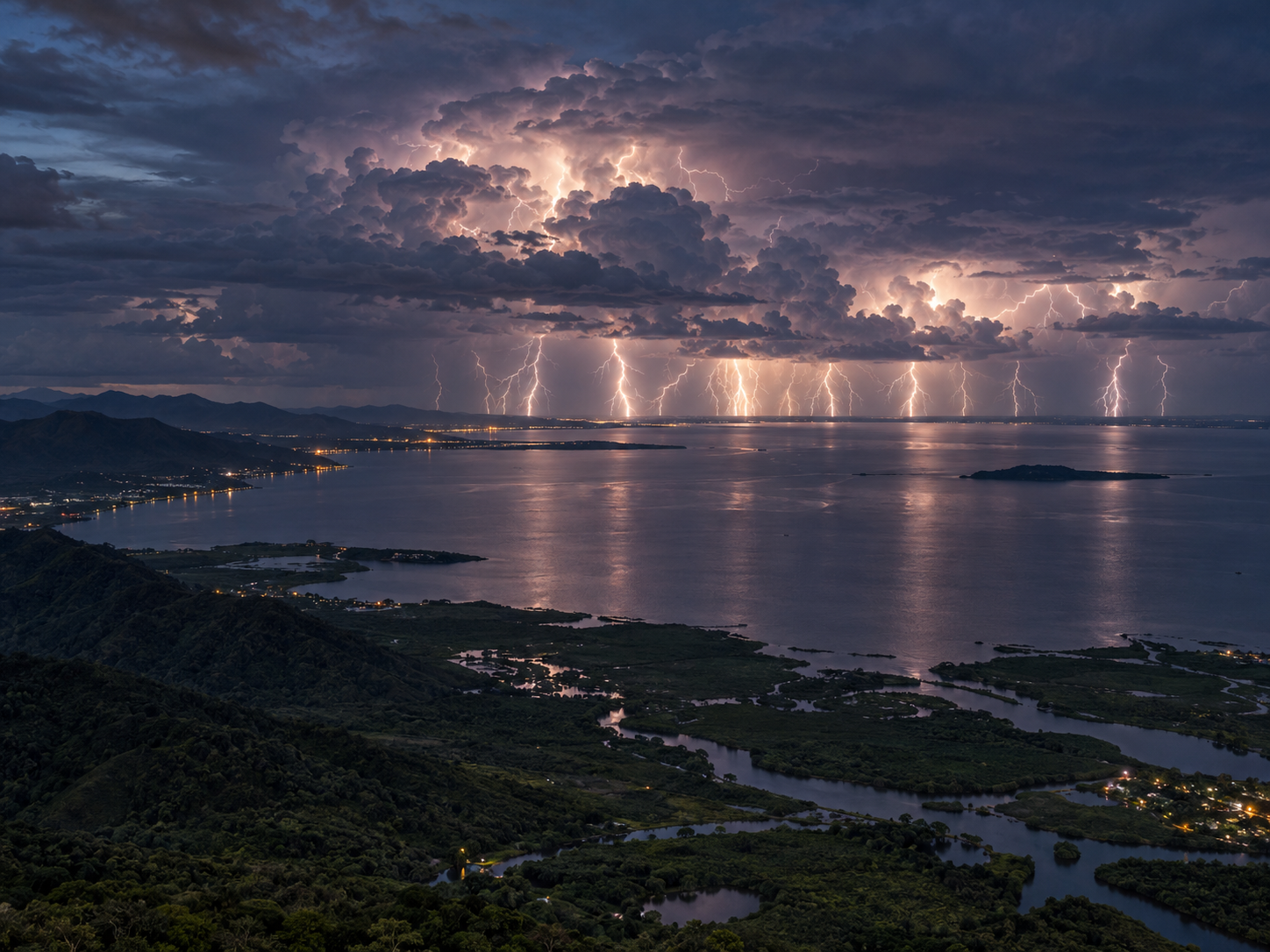
Imagine standing beside Lake Maracaibo at night.
The sky is dark.
Then lightning appears.
Another flash follows.
Then another.
And another.
Storm after storm forms over the same part of Venezuela, so often that the phenomenon has been known for centuries as the Catatumbo Lightning.
It is not literally lightning every second of the year. But it is remarkably regular. Satellite observations found thunderstorms at the Catatumbo region on about 297 nights a year on average, making Lake Maracaibo the world's principal lightning hotspot in that study.
So why here?
Why does this particular place keep producing thunderstorms?
The answer begins with the lake, the warm air above it, and the mountains surrounding it.
At night, warm moist air moves across Lake Maracaibo. Winds from different directions meet in the region, while the surrounding mountains help keep that air from simply escaping.
The air rises.
Clouds grow.
And inside those clouds, ice, water and strong updrafts create the conditions needed for lightning.
The remarkable part is not that Venezuela gets thunderstorms.
It is that the geography keeps helping them form in almost the same place, again and again.
Chapter 1 — Why Does the Storm Keep Coming Back?
A thunderstorm usually moves.
That is what makes Catatumbo so unusual.
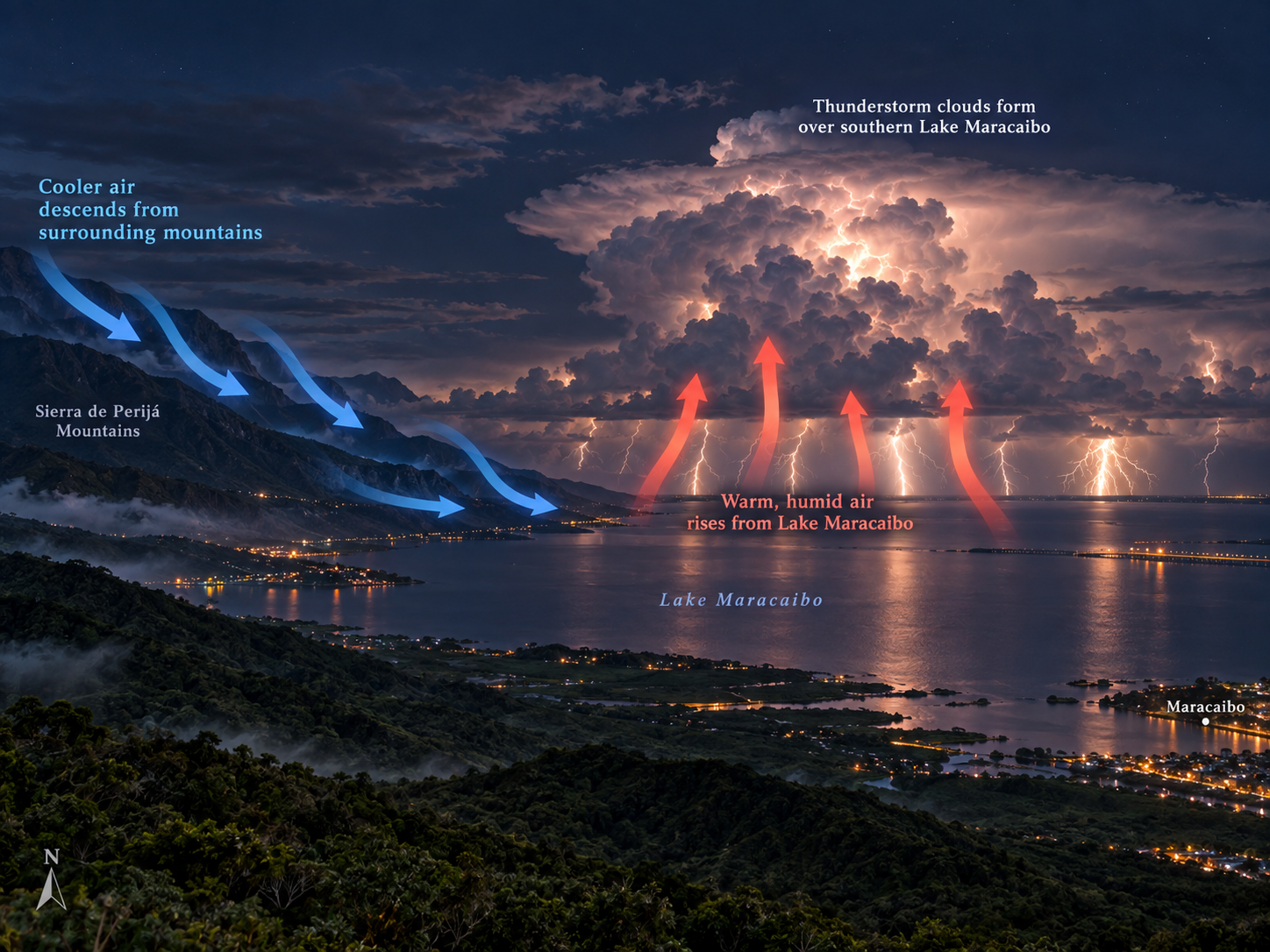
Again and again, storms develop around the southern end of Lake Maracaibo.
The reason is not one strange ingredient.
It is the geography.
Lake Maracaibo is a huge warm body of water surrounded by mountains. During the evening and night, the warm lake helps supply moisture to the lower atmosphere.
At the same time, air flows down from the surrounding mountains and moves across the region.
These different airflows meet.
The air is pushed upward.
That rising air helps thunderstorms grow. NOAA describes the area as having a unique combination of moisture, temperature and topography that tends to trap storms over the plains.
A detailed lightning climatology found that Lake Maracaibo has a pattern of converging mountain-valley, lake and sea breezes over warm lake water. That combination contributes to nocturnal thunderstorm development on an average of 297 days each year.
So the storm is not being called back.
The landscape is simply creating the same conditions again.
Night after night, the atmosphere gets another chance.
And often, it takes it.
Why Catatumbo Storms Form So Often
Chapter 2 — Why Does It Happen Mostly at Night?
This is another strange part.
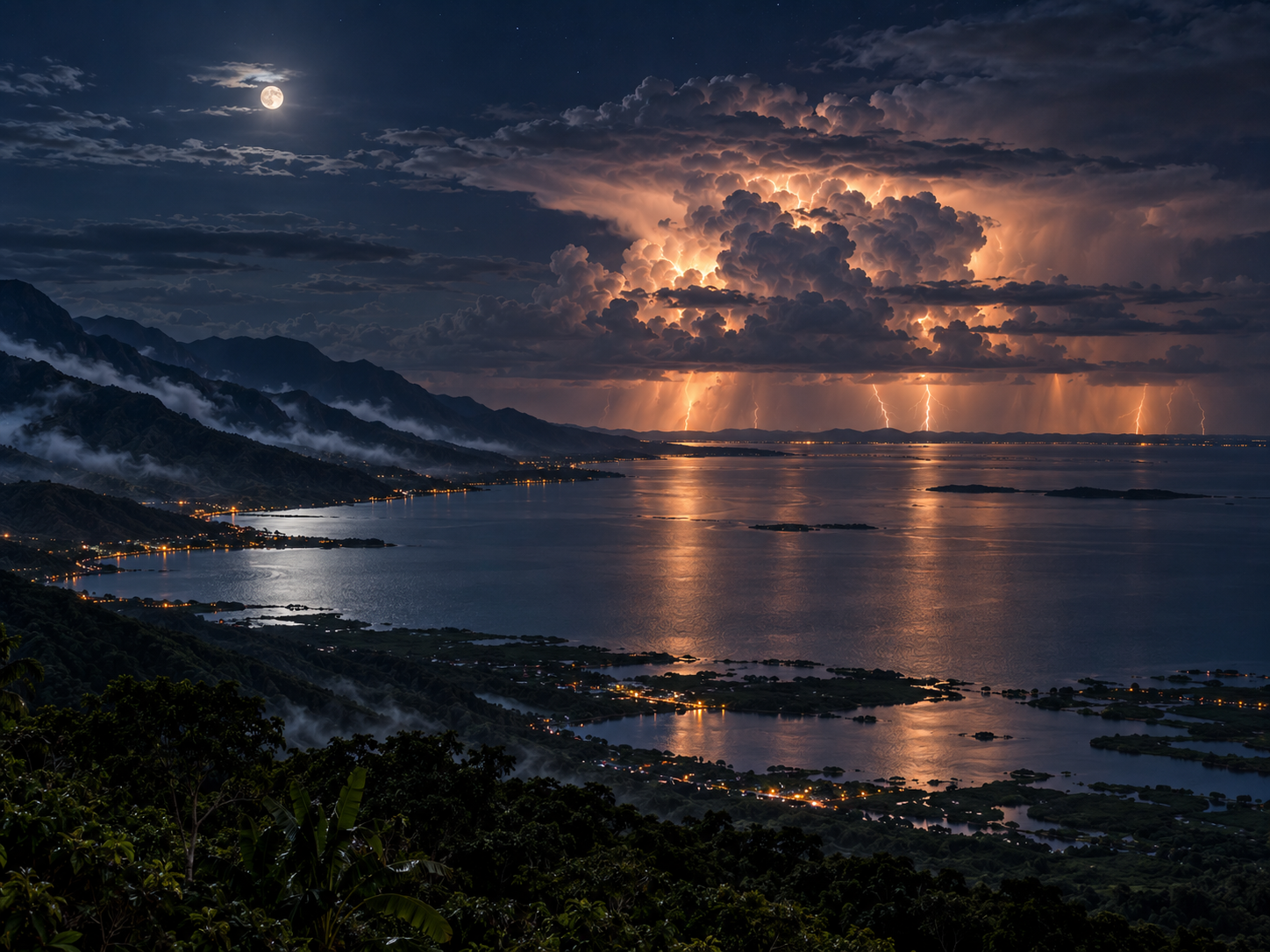
Catatumbo Lightning is especially famous for its nighttime storms.
That is not an accident.
During the day, the land and water are being heated by the Sun.
After sunset, the balance changes.
The lake remains warm.
The surrounding land and mountains cool more quickly.
That difference changes the movement of the air.
Lake and mountain breezes become important, and air can converge over the southern part of the lake. The resulting upward motion helps thunderstorms develop during the night.
It is almost like the landscape has its own daily rhythm.
Day warms the system.
Night rearranges it.
Moist air gathers.
Air rises.
Clouds build.
And once the clouds become tall enough, the electricity begins.
This helps explain why Catatumbo is not simply a place with a lot of lightning.
It is a place where the atmosphere repeatedly reaches the same storm-building stage at around the same time of day.
The clock is not causing the lightning.
The changing temperature and winds are.
Why Night Matters
Chapter 3 — Where Does the Lightning Come From?
Now we have a storm.
But a storm alone does not guarantee lightning.
Something else has to happen inside the cloud.
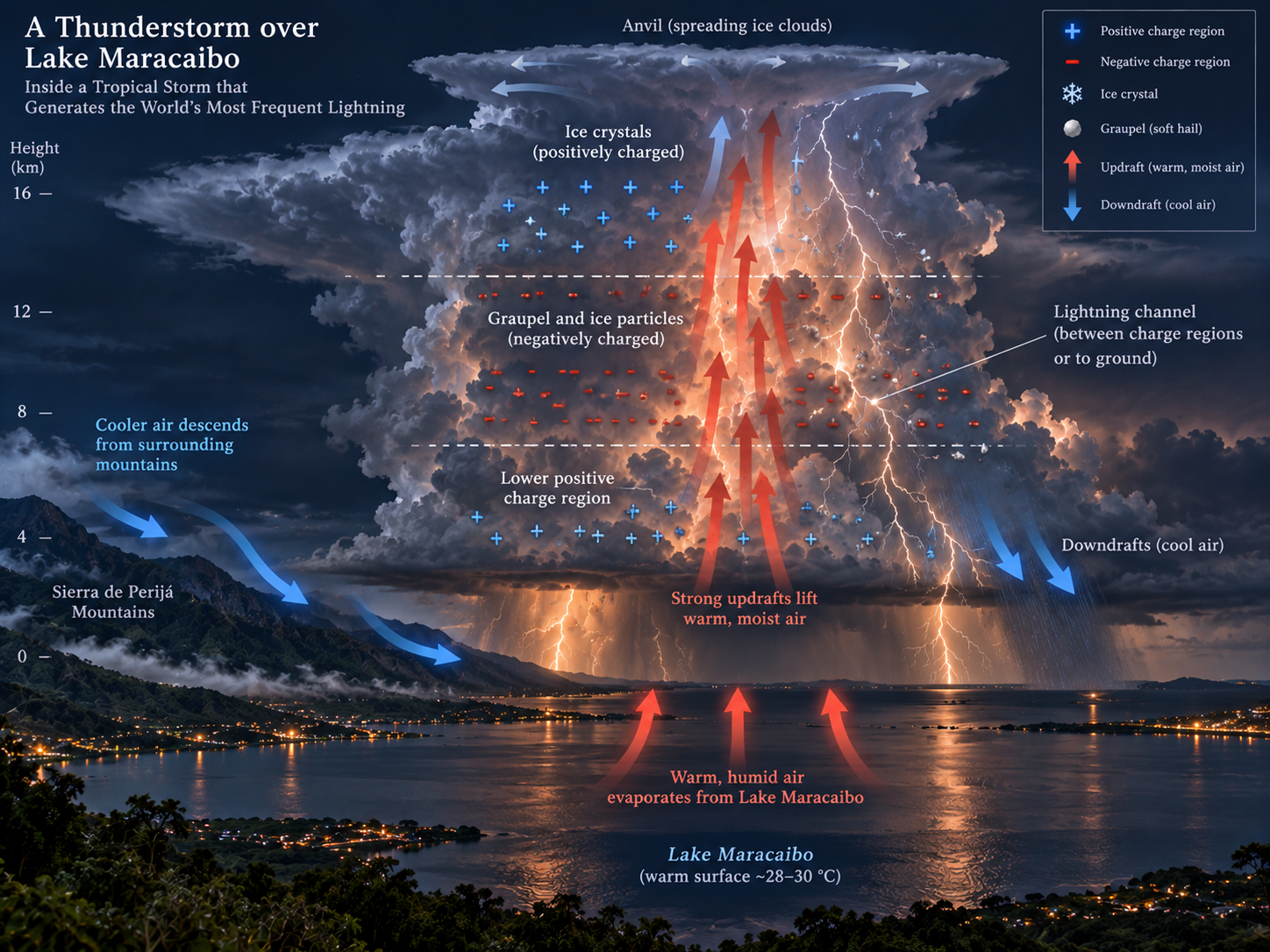
A thundercloud is full of movement.
Warm air rises.
Rain and ice move in different directions.
Tiny ice crystals collide with larger pieces of ice and soft hail called graupel.
During these collisions, electrical charges can separate inside the cloud. NOAA explains that this process creates regions of opposite charge, building a strong electric field. When the electrical difference becomes large enough, the air can no longer insulate the charges and a lightning discharge occurs.
So the lightning is not really created by the lake.
The lake helps create the storm.
The storm creates the conditions for the electricity.
That distinction matters.
Otherwise, it is easy to imagine that Lake Maracaibo itself somehow produces lightning.
It does not.
It supplies heat and moisture to a landscape that is unusually good at producing thunderstorms.
The electricity is made inside those storms.
How Lightning Forms Inside the Storm
Chapter 4 — Why Does the Same Area Produce So Much Lightning?
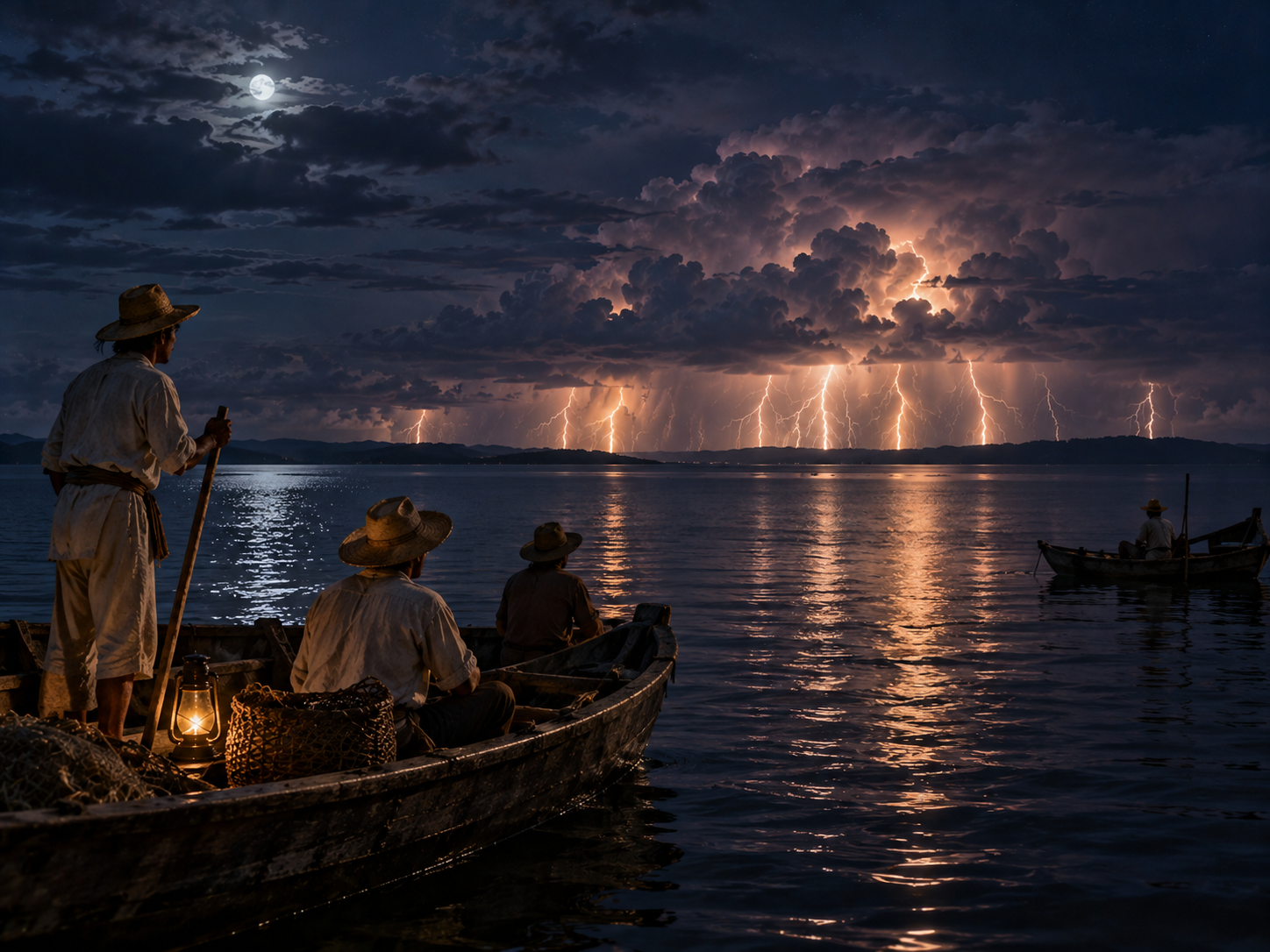
A storm can produce lightning.
Catatumbo produces a lot of it.
Satellite observations have identified Lake Maracaibo as Earth's principal lightning hotspot in high-resolution global lightning climatology. The study found that the storms are unusually localized and that their repeated development in the same area helps explain the high lightning density.
NOAA also describes thunderstorms forming over the Catatumbo River area on an average of around 160 nights per year, with displays lasting up to nine hours in some cases.
That is why Catatumbo became famous long before satellites existed.
For people on the lake, the flashes could be seen from far away.
The display was so dependable that it became known as the “Lighthouse of Maracaibo.” NOAA notes that fishermen and sailors used the regular flashes as a navigation aid.
There is something wonderful about that.
A natural phenomenon that scientists now measure with satellites was once simply part of people's understanding of the landscape.
They knew the light would return.
They did not need a weather satellite to tell them.
They had watched it happen.
Again and again.
Why Catatumbo Became Famous
Chapter 5 — Is Methane the Secret?
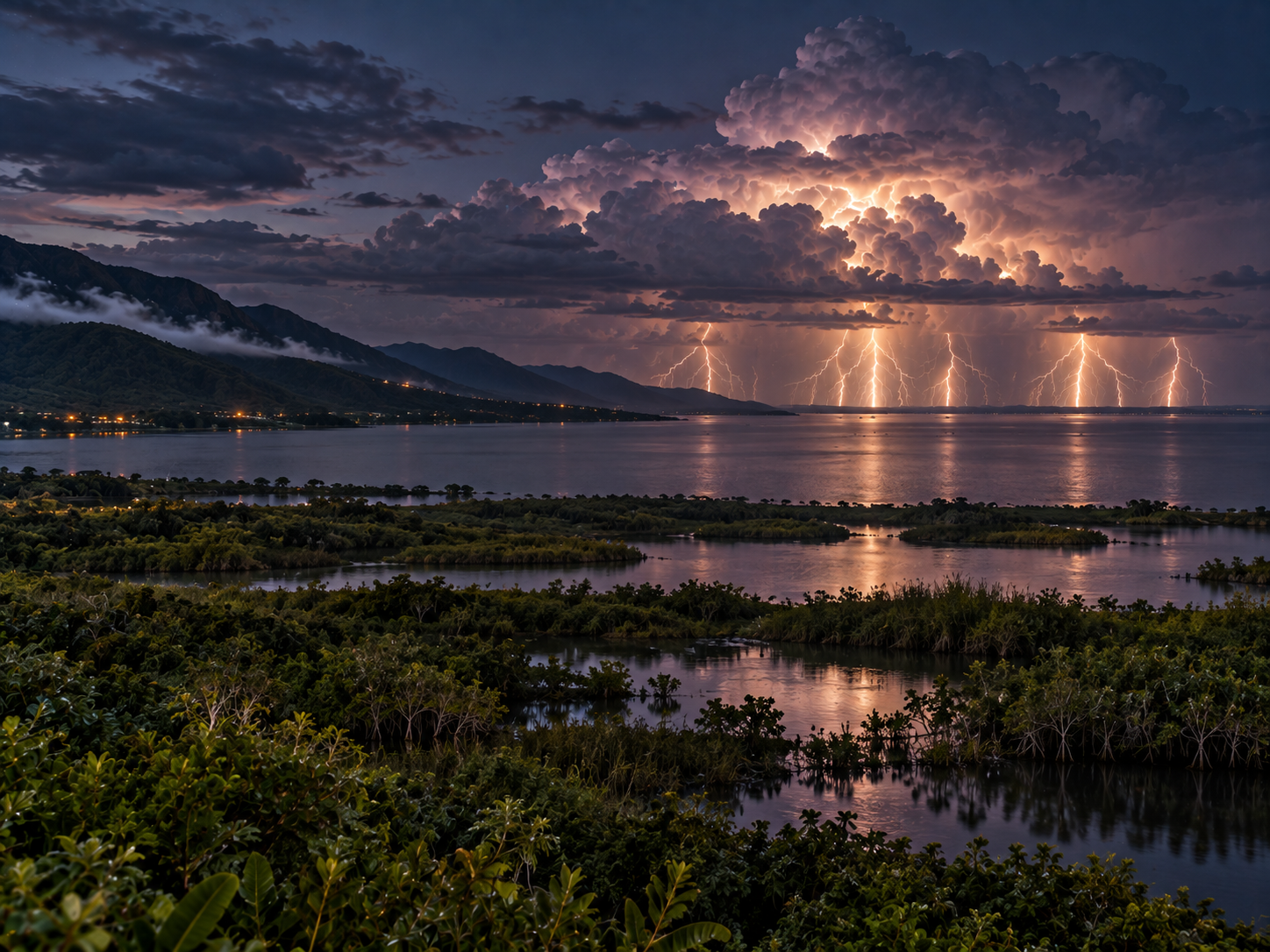
There is one explanation you will often hear when Catatumbo Lightning is discussed.
Methane.
The wetlands around Lake Maracaibo produce methane, and some scientists have proposed that methane could help explain the unusual electrical activity.
It is an interesting idea.
But it is not the whole answer.
The strongest modern evidence points to the combination of warm water, moisture, converging winds and surrounding topography as the main reason thunderstorms repeatedly form there. The global lightning climatology specifically identifies mountain-valley, lake and sea breezes and the warm lake surface as important factors.
There have also been scientific models proposing a role for methane in cloud electrification. One published model suggested that methane from wetlands and other regional sources could influence charge separation. But this is a proposed mechanism, not a reason to throw out the better-established meteorological explanation.
So the careful answer is:
Methane may play a role.
But the reason Catatumbo storms keep returning is much bigger than methane.
It is the geography.
The lake.
The mountains.
The moist air.
And the way they work together.
What About Methane?
Chapter 6 — Why Does It Not Happen Every Night?
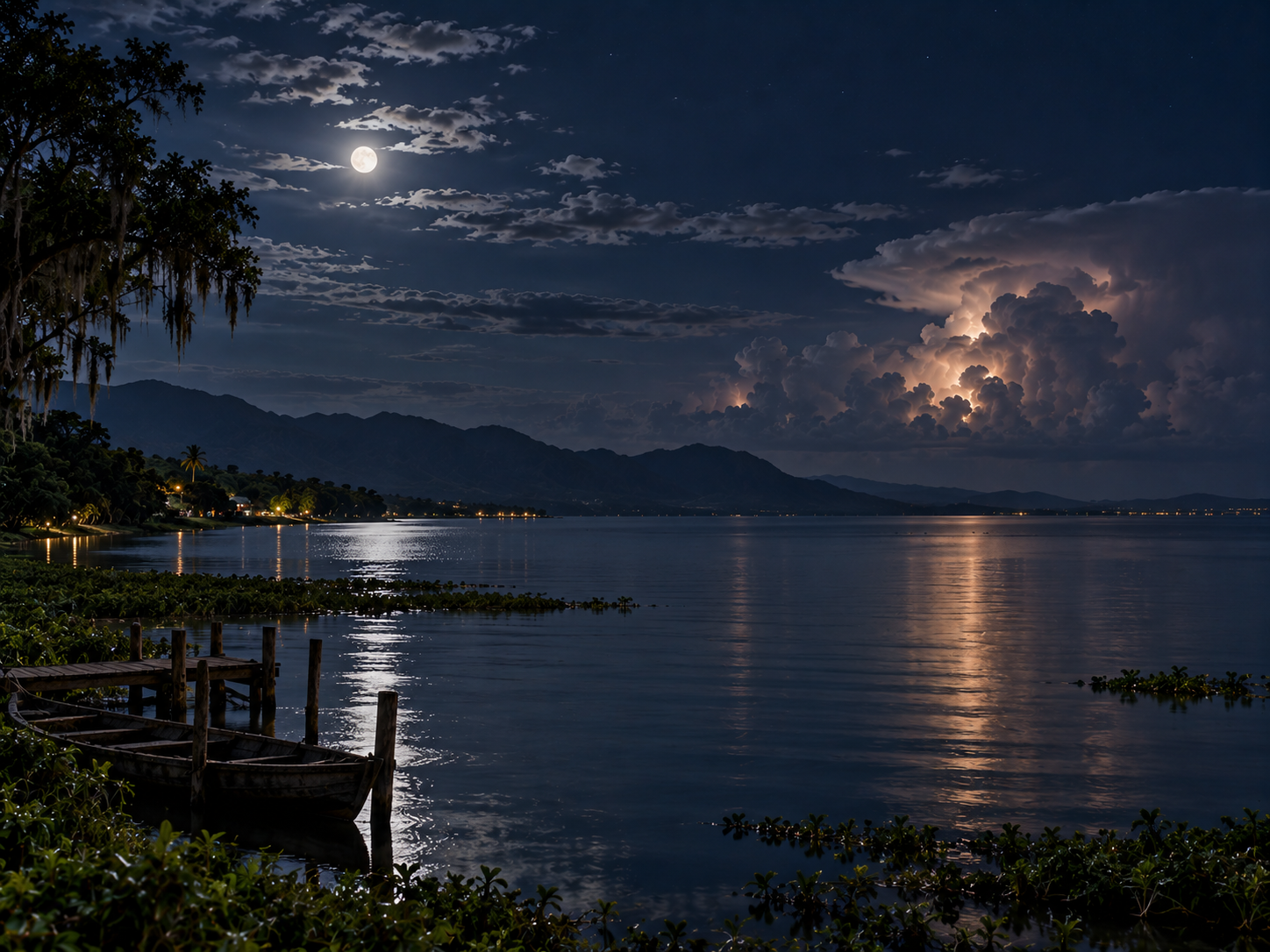
“Constant lightning” is a useful phrase.
But it can also be misleading.
Catatumbo Lightning is not a machine that runs every night without interruption.
There are quieter periods.
Historical observations show that the phenomenon has seasonal changes, and modern satellite studies also find that thunderstorm activity varies through the year.
That makes sense.
The atmosphere is never exactly the same twice.
Rainfall changes.
Wind patterns change.
Moisture changes.
The lake's surface temperature changes.
The balance between mountain and lake breezes changes too.
When the pieces line up, the storms can return.
When they do not, the sky can remain dark.
That is why “constant” is better understood as remarkably frequent and recurrent, rather than literally continuous.
The phenomenon is predictable.
It is not mechanical.
And there is a difference.
“Constant” Does Not Mean Every Night
Chapter 7 — A Storm Written Into the Landscape
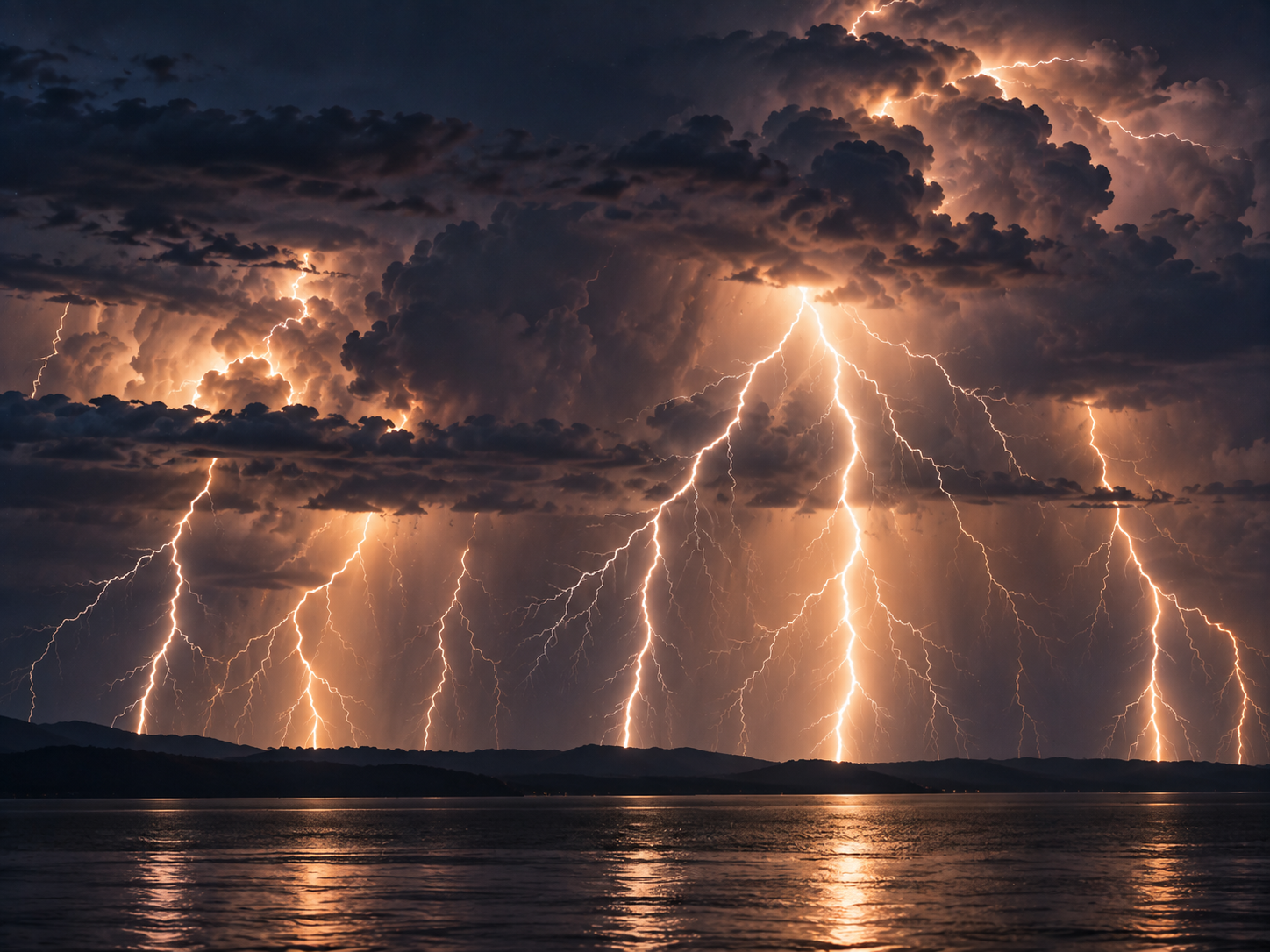
The most interesting thing about Catatumbo Lightning is not one flash.
It is the repetition.
Lake Maracaibo is warm.
The surrounding mountains shape the wind.
Moist air gathers.
Night changes the temperature balance.
The air rises.
A thunderstorm grows.
Inside that storm, ice and water separate electrical charges.
And lightning flashes across the sky.
Then the storm weakens.
The next night, the same landscape begins the process again.
Not always.
Not perfectly.
But often enough to make Catatumbo one of Earth's great lightning hotspots.
That is why the phenomenon feels almost impossible when you first see it.
Lightning usually seems random.
At Catatumbo, geography gives it a pattern.
The mountains are part of the pattern.
The lake is part of it.
The night is part of it.
And the storm is the final result.
So why does Venezuela experience such frequent lightning at Catatumbo?
Because this particular corner of the country repeatedly creates the conditions a thunderstorm needs.
The lightning is spectacular.
But the real wonder is quieter.
The landscape keeps making the storm.
Frequently Asked Questions
1. Why does Venezuela have so much lightning at Catatumbo?
The Catatumbo region near Lake Maracaibo has a combination of warm lake water, abundant moisture, converging winds and surrounding mountains that encourages frequent nighttime thunderstorms.
2. Where does Catatumbo Lightning happen?
It occurs mainly near the southern end of Lake Maracaibo in Venezuela, around the mouth of the Catatumbo River. Satellite observations show that the strongest activity is highly localized in this region.
3. Why does Catatumbo Lightning happen mostly at night?
Temperature differences between the warm lake and the surrounding land and mountains help change the local winds after sunset. These airflows can converge and force moist air upward, helping thunderstorms develop.
4. Is Catatumbo Lightning really constant?
No. “Constant” is an informal description of how frequent and regular the phenomenon is. It does not mean lightning occurs every second or every night without interruption.
5. How often does Catatumbo Lightning occur?
The exact figure depends on the dataset and how lightning is measured. A major 16-year satellite climatology found nocturnal thunderstorm development over Lake Maracaibo on an average of about 297 days per year. NOAA has also described storms forming over the Catatumbo area on roughly 160 nights per year.
6. Is Catatumbo Lightning caused by methane?
Methane has been proposed as one possible additional influence on cloud electrification, but it is not the main established explanation. The strongest evidence points to the combination of warm lake water, moisture, converging winds and local topography.
7. Why is Lake Maracaibo important to Catatumbo Lightning?
The warm lake provides moisture and helps drive local air circulation. Its interaction with mountain, valley and sea breezes contributes to the repeated formation of nighttime thunderstorms.
8. What causes the lightning inside Catatumbo storms?
As in other thunderstorms, strong updrafts move water and ice through the cloud. Collisions between different ice particles help separate electrical charges, creating conditions for lightning.
9. Can Catatumbo Lightning be seen from far away?
Yes. The flashes can be visible across large parts of the Lake Maracaibo region. Their reliability was one reason the phenomenon became known historically as the “Lighthouse of Maracaibo,” and NOAA notes that fishermen and sailors used it as a navigation aid.
10. Why is Catatumbo Lightning scientifically important?
It is an unusually persistent and localized lightning hotspot. Studying it helps scientists understand how lakes, mountains, moisture, wind patterns and thunderstorms interact to produce repeated electrical activity.