Introduction
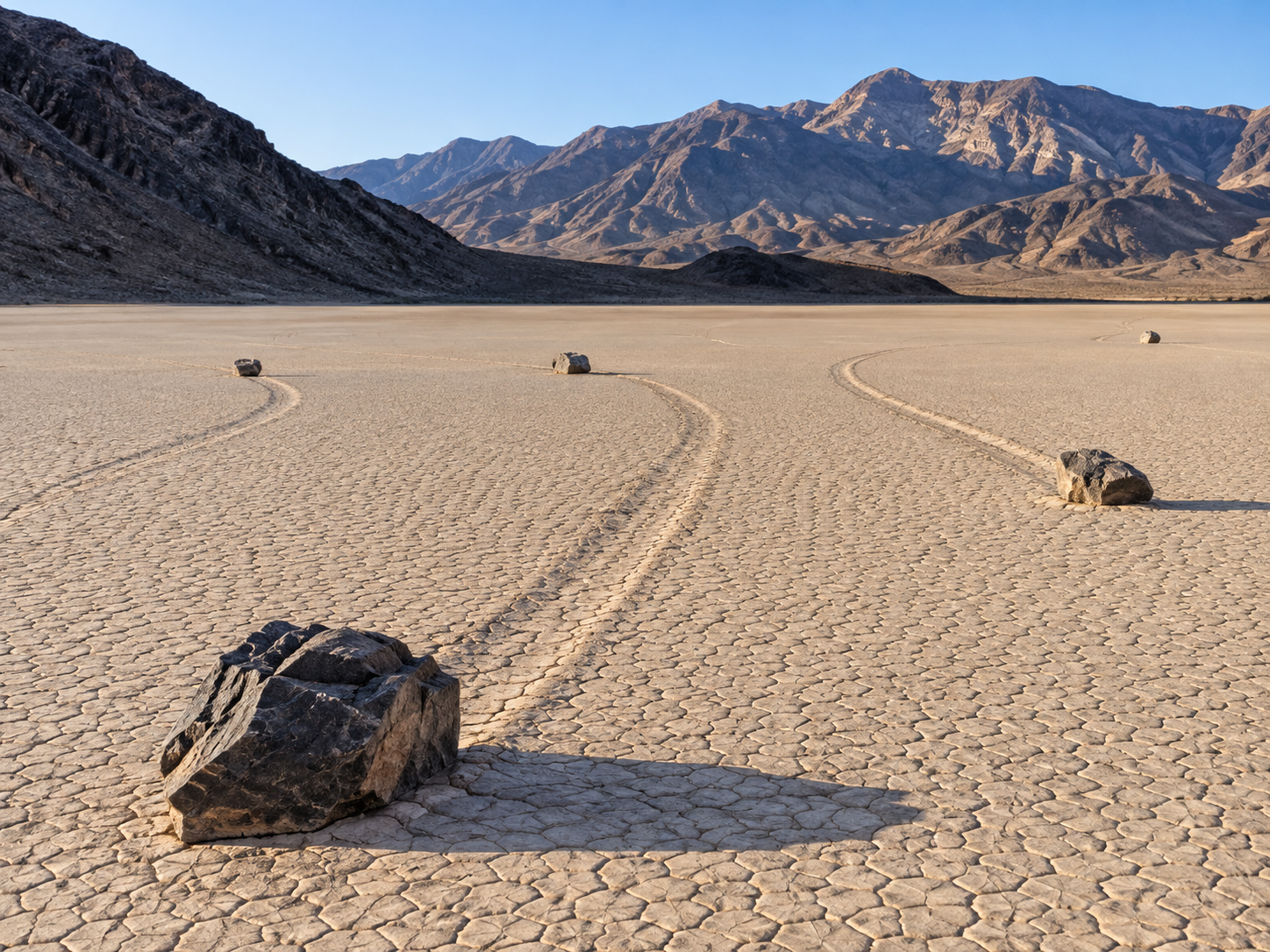
There are rocks in Death Valley that seem to travel across the ground by themselves.
You can find one sitting on the cracked floor of Racetrack Playa.
Behind it is a long trail.
No footprints.
No tire marks.
No obvious person who could have pushed it.
Some rocks have travelled hundreds of metres, and some have left trails that change direction along the way. A few weigh as much as 320 kilograms (700 pounds).
For decades, nobody could watch the rocks move.
So people came up with plenty of ideas.
Strong winds.
Dust devils.
Ice.
Water.
Nobody knew exactly.
Then, in December 2013, researchers finally saw it happen.
The rocks were not moving by themselves at all.
The playa had filled with a shallow layer of water. A cold night froze that water into thin sheets of ice. When the Sun came up, the ice began to break apart.
Wind pushed the floating pieces.
The ice pushed the rocks.
And the rocks began to slide.
The movement was so slow that you could easily miss it.
That is what makes the mystery even better.
The rocks were never secretly racing across the desert.
They were waiting for a very unusual combination of water, cold, ice and wind.
Chapter 1 — You See the Trail, but Not the Movement
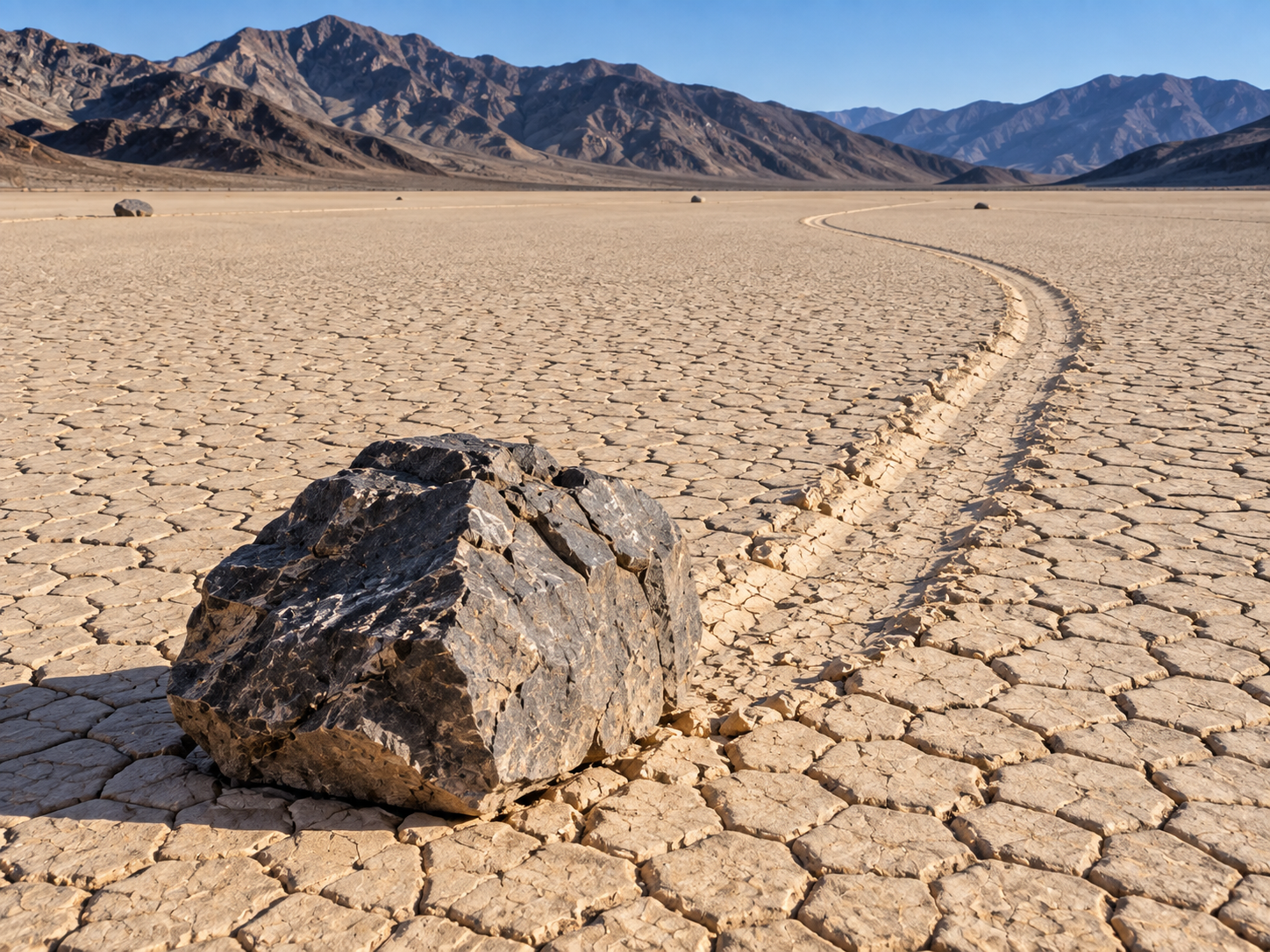
The strange thing about the rocks is not that they leave trails.
You can see those.
It is that the trails seem to have no explanation.
Imagine walking across Racetrack Playa and finding a large rock sitting at the end of a long groove.
You look behind it.
The trail stretches across the hard, cracked ground.
There are no footprints around it.
The rock looks too heavy to have been pushed easily.
Then you notice another one.
And another.
Some trails run almost straight.
Others curve.
Some rocks have travelled in different directions at different times. Researchers have documented trails hundreds of metres long, including rocks that moved more than 200 metres during several movement events.
The rocks became known as sailing stones because they appeared to sail across the dry lakebed.
But the name created another mystery.
What could possibly move a 700-pound rock?
For years, nobody had watched one move.
That left room for many explanations.
Perhaps the wind was much stronger there than it seemed.
Perhaps thin ice was somehow lifting the stones.
Perhaps water made the ground slippery.
Each idea explained part of the evidence.
None explained everything.
The answer would require seeing the rocks move in real time.
And that finally happened.
The Mystery Before Scientists Saw It
Chapter 2 — The Playa Needs Water First
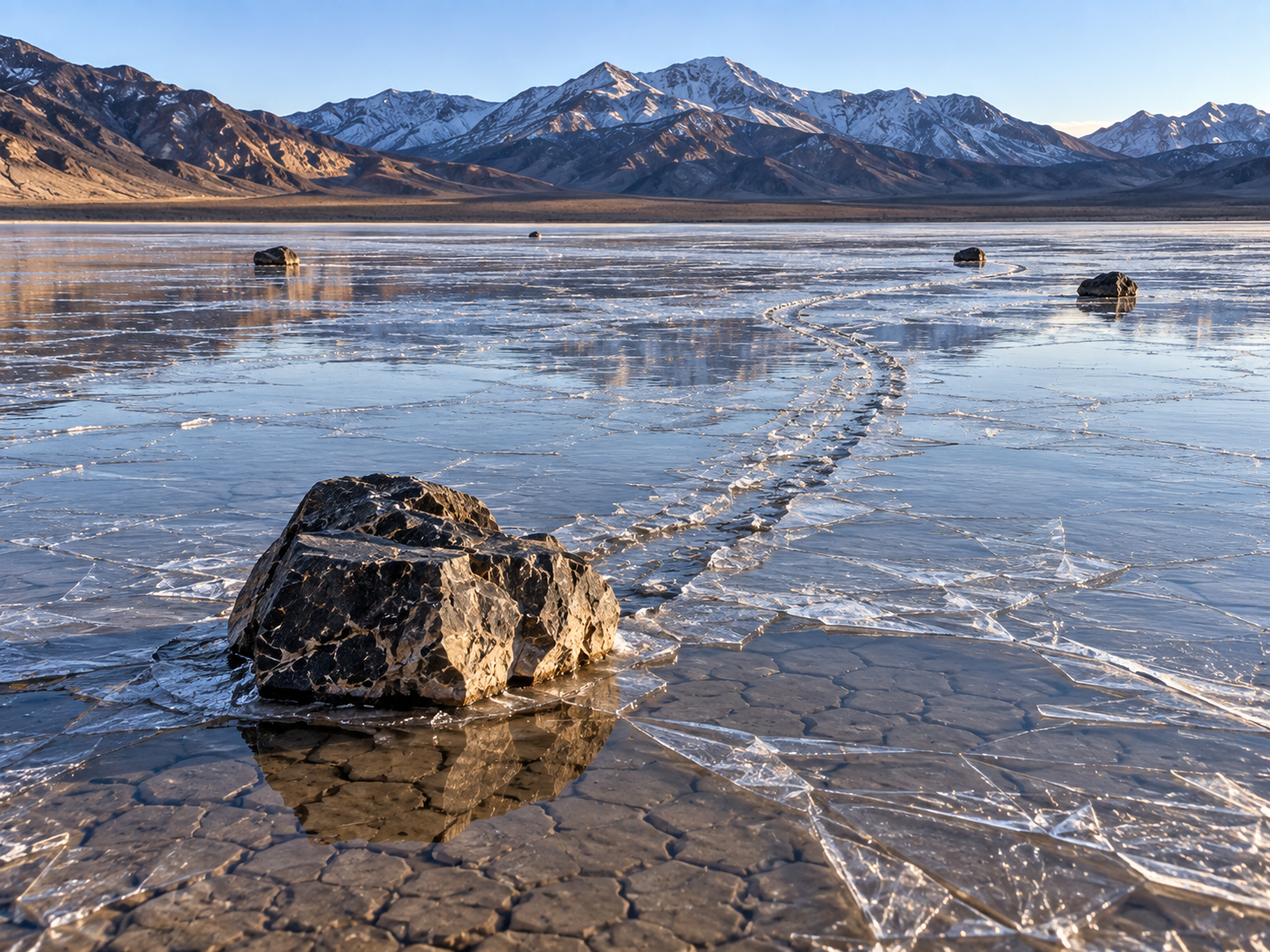
Racetrack Playa looks like a desert.
Most of the time, it is one.
The ground is dry and covered with the familiar polygon-shaped cracks you see in photographs.
But every so often, rain or snowmelt puts water onto the playa.
That changes everything.
The water does not have to form a deep lake.
A shallow pond is enough.
During the winter of 2013–14, researchers recorded a temporary pond on Racetrack Playa. The water was only a few centimetres deep, but it was enough to create the conditions needed for the rocks to move.
That seems like a small detail.
It is actually the beginning of the whole process.
Without water, the rocks sit on dry mud.
Dry mud creates too much resistance for ordinary wind to push many of the larger stones.
With water covering the surface, things become much easier to move.
Then winter arrives.
Temperatures fall below freezing.
The shallow pond freezes.
And now the playa has a thin sheet of ice lying across it.
This is where the mystery starts to change.
The rocks are still sitting on the bottom.
But above them is something that can move.
Water Starts the Process
Chapter 3 — The Ice Is the Part Nobody Expected
Now imagine that the water freezes.
You might think the story is over.
Instead, this is where it becomes strange.
The ice is very thin.
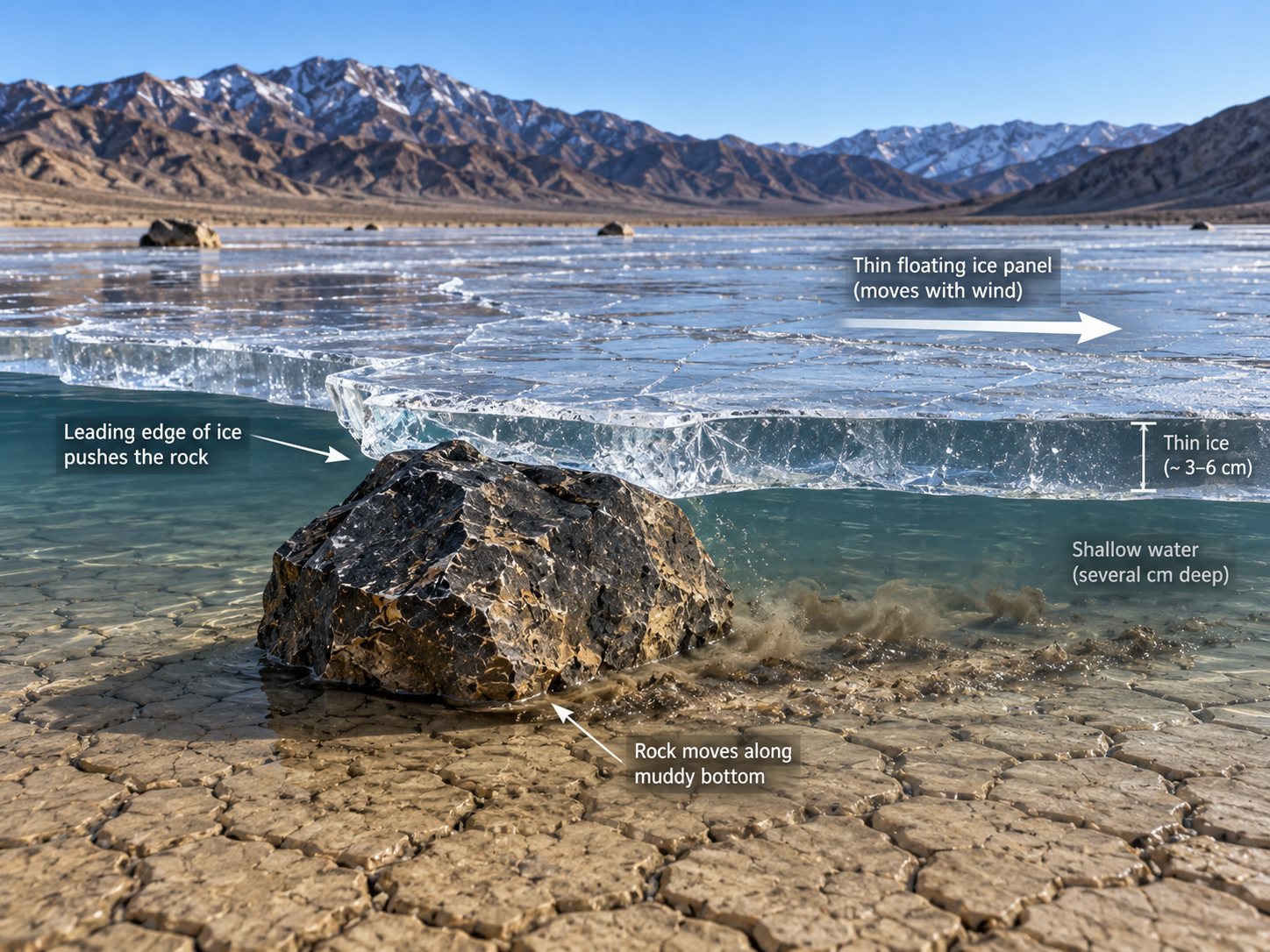
Researchers studying the rocks directly observed sheets only about 3–6 millimetres thick. That is thinner than a pencil eraser.
It does not look powerful enough to move a huge rock.
But the ice does not need to pick the rock up.
That was one of the important discoveries.
As the Sun rises, the thin ice sheet begins to break into large floating pieces.
Some pieces can be several metres or even tens of metres across.
The pieces float on the shallow water.
Then wind begins to push them.
And the rocks are caught in front of the moving ice.
The ice acts like a very wide, very slow bulldozer.
It pushes the rocks across the muddy bottom.
That is why the old idea of a giant sheet of thick ice floating the rocks like little boats was not quite right.
The ice is not carrying them.
It is pushing them.
A sheet only a few millimetres thick can move a rock because it can be enormous compared with the rock.
The force is spread across a large moving panel.
That is the detail that finally made the impossible-looking trails make sense.
How Thin Ice Can Move a Heavy Rock
Chapter 4 — Then the Sun Comes Up
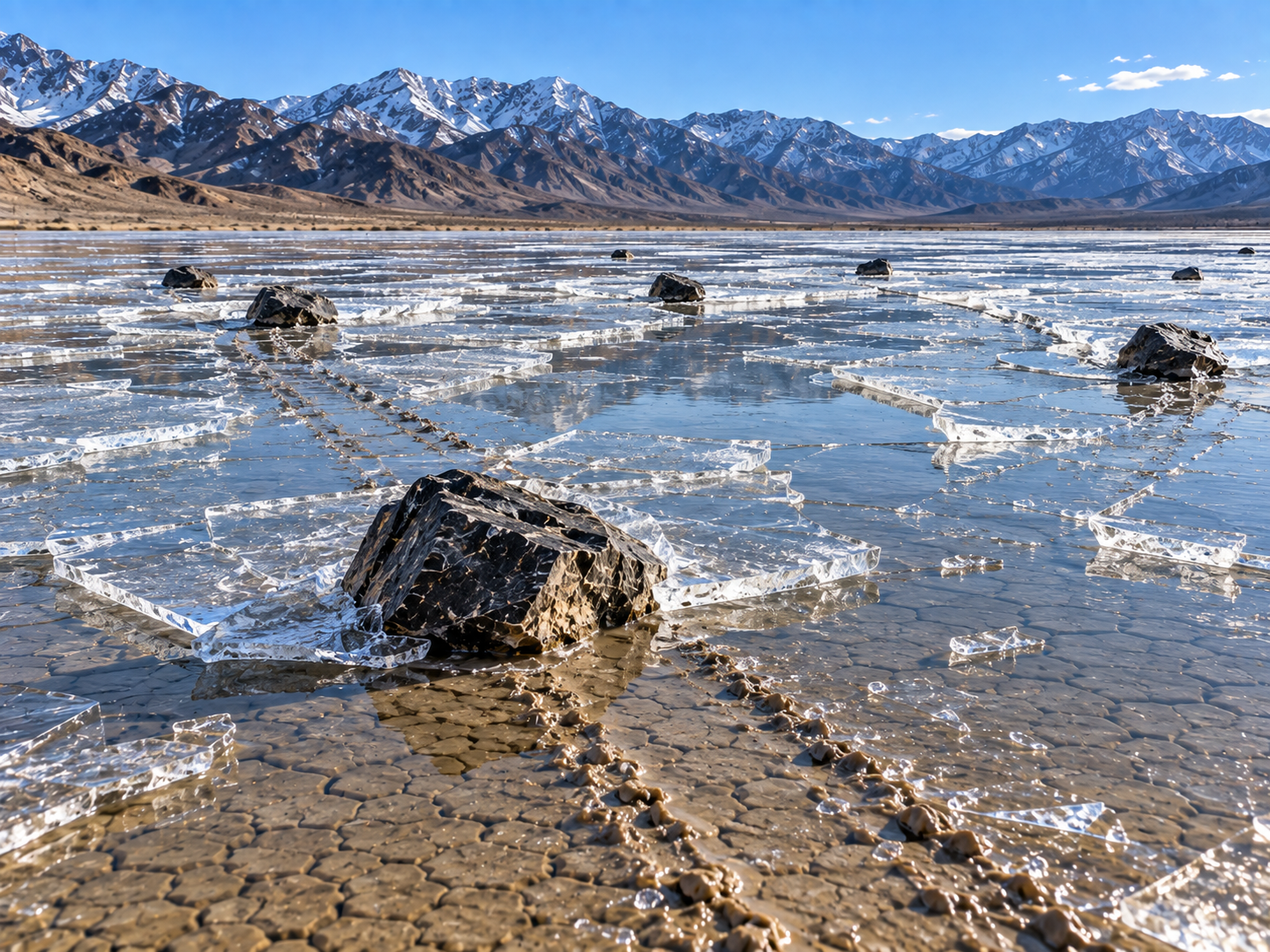
The rocks do not usually move in the middle of a freezing night.
The important moment comes later.
Morning.
The Sun warms the ice.
The ice begins to weaken.
Cracks spread through it.
Large panels break free and start floating.
Then wind catches them.
Researchers observed rock movement around the middle of the day, after freezing nights followed by sunlight. The rocks moved slowly, often only a few metres per minute, and individual movement events could last seconds to several minutes.
That is another reason nobody noticed the movement for so long.
You might imagine a huge rock suddenly shooting across the playa.
It does not.
It creeps.
During one observed event, rocks moved at only about 2–5 metres per minute. That is slow enough that, without a fixed reference point, you might struggle to notice the movement at all.
And while the rocks move, the ice is moving too.
The panels can push several rocks at once.
In December 2013, researchers watched more than 60 rocks begin moving during one event. Some travelled more than 60 metres before stopping.
The mystery had finally been caught in the act.
Not by a person standing there with binoculars.
By researchers who happened to be in exactly the right place when the ice broke.
The Moment the Rocks Start Moving
Chapter 5 — Why Do the Trails Curve?
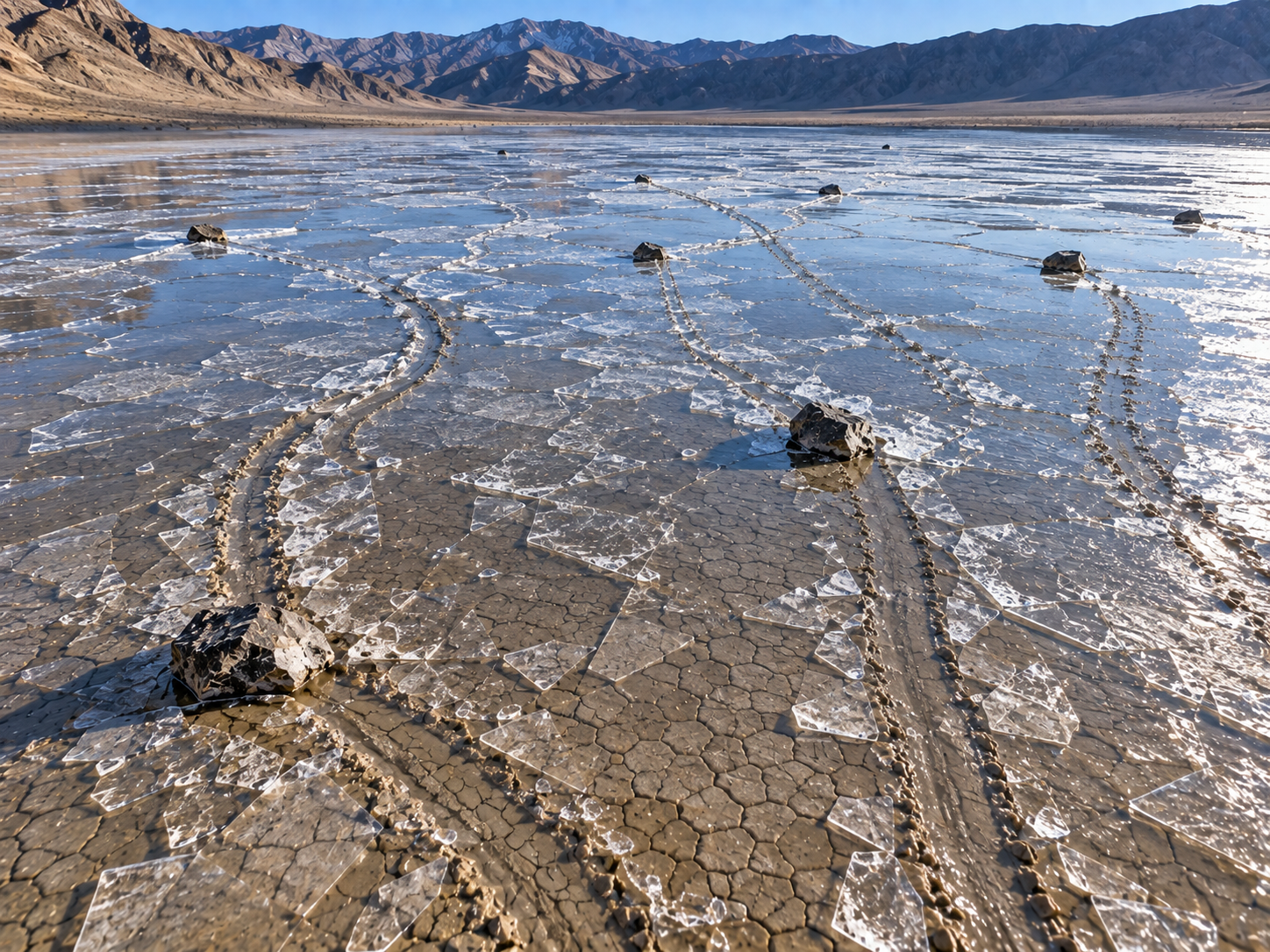
Now look at the trails again.
Some are surprisingly straight.
Others bend.
Some rocks seem to change direction.
That used to make the mystery even harder.
If one force was pushing every rock, why did the trails not all look the same?
The answer is that the ice and water are moving too.
Researchers found that rock paths are influenced by both the direction and speed of the wind and the movement of water beneath the ice. Changes in wind and water flow can therefore produce different trail directions.
Imagine sliding a piece of wood across a shallow puddle while the water itself is moving.
The final direction would depend on more than just the wind.
The same idea applies here.
A floating ice panel may turn.
Water can flow underneath it.
Another panel can push against it.
A rock can stop.
Then it can move again when the conditions return.
That explains why a single trail can sometimes contain several sections pointing in noticeably different directions.
The rock is not choosing a path.
The moving ice and water are.
And that is another clue hiding in the mud.
The trails are not random.
They are records of what the ice was doing.
Why Don't All the Rocks Move Straight?
Chapter 6 — Why Don't the Rocks Move Every Winter?
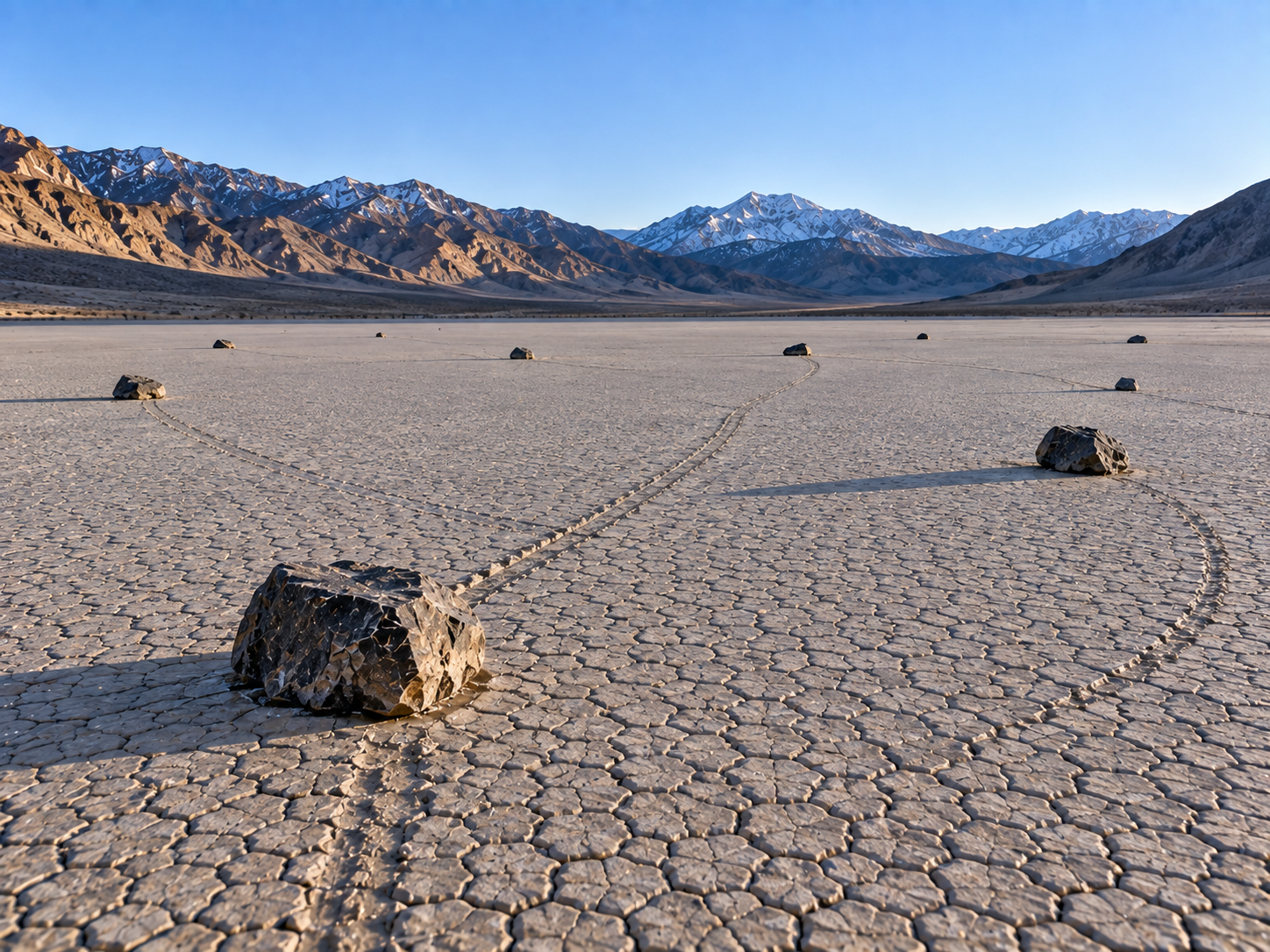
Now we know what makes the rocks move.
So why don't they move all the time?
Because the complete recipe is rare.
You need enough water to make a shallow pond.
You need cold enough weather to freeze that water.
You need sunlight to break the ice apart.
And you need wind strong and steady enough to move the floating panels.
Miss one part and the rocks stay where they are.
This explains why some rocks can sit on the playa for years without moving.
The National Park Service describes the movement as requiring a rare combination of water, ice and wind.
The researchers who directly observed the rocks also found that the necessary rain or snow events were unusual enough to explain why movement can be separated by years or even decades.
That is the real trick behind the mystery.
Not one powerful force.
A very specific chain of ordinary forces.
Water arrives.
Cold freezes it.
Sun breaks the ice.
Wind pushes it.
And a rock moves.
For the rest of the time, nothing happens.
The rock simply waits.
The Rare Recipe
Chapter 7 — The Mystery Was Solved, but the Trails Remain
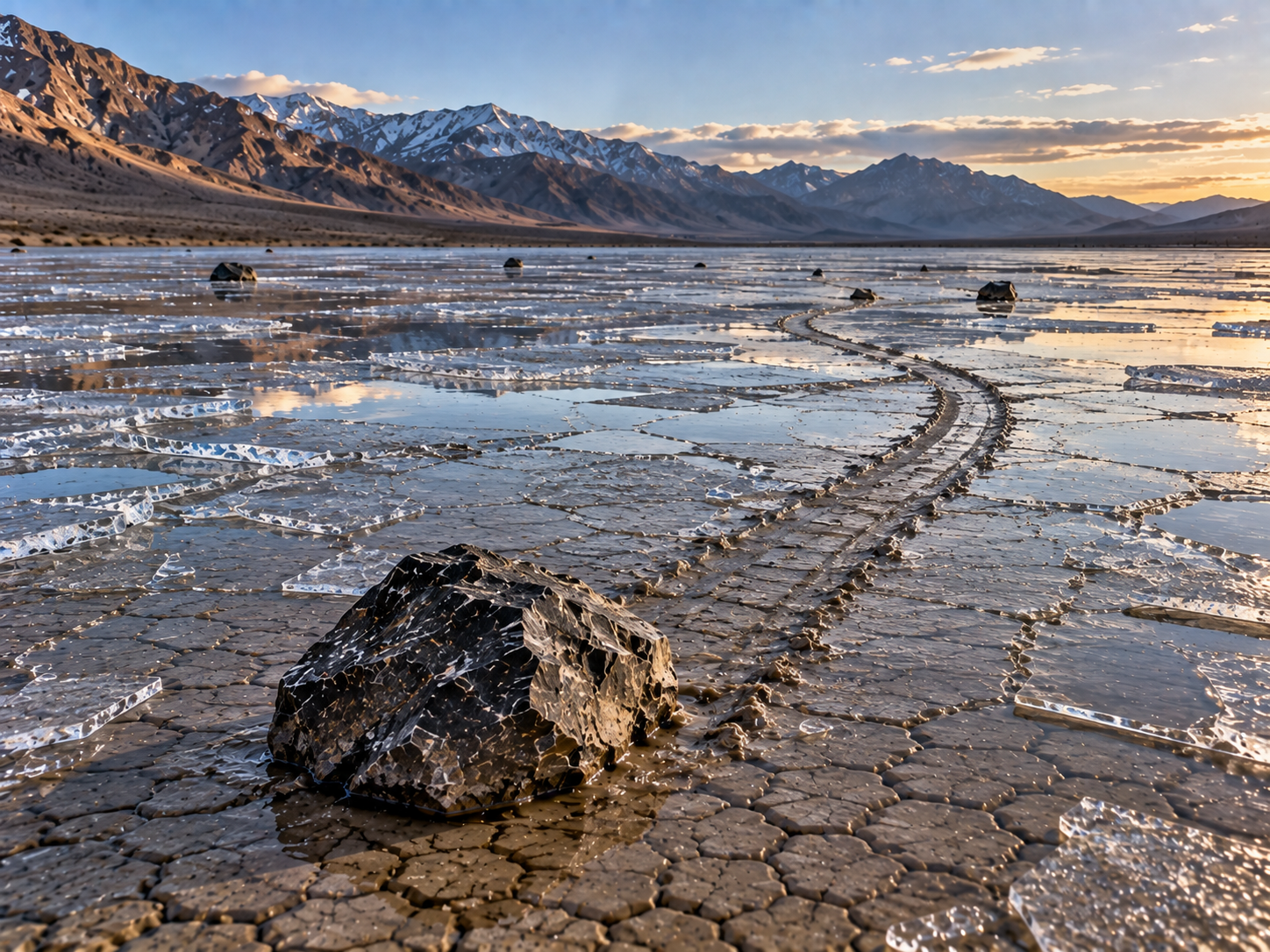
Once researchers watched the rocks move, the mystery changed.
The question was no longer:
“Do these rocks really move?”
They do.
The better question became:
“How often does the whole process happen?”
And the answer is: not very often.
Movement events can be separated by long periods because the exact combination of rain or snow, freezing temperatures, sunlight and wind is unusual.
That also explains why the mystery survived for so long.
The rocks were moving too slowly to notice easily.
The movement happened only under unusual conditions.
And the trails often became visible only after the water and ice disappeared.
By the time someone returned to the playa, the rock had stopped.
All that remained was the trail.
A mystery written into the mud.
Today, the National Park Service asks visitors not to move the rocks or drive across the fragile playa surface. When the ground is wet, footsteps and vehicle tracks can damage the surface and remain visible for a long time.
So the trails are more than strange marks.
They are records.
Each one tells a small part of a winter event that may have lasted only minutes.
A rock sat still for years.
Then, for a few minutes, the desert changed.
Ice moved.
The rock moved.
And the trail stayed behind.
That is why the sailing stones are such a satisfying mystery.
Nothing supernatural was happening.
The desert simply had one very strange way of moving its rocks.
Frequently Asked Questions
1. Why do rocks move by themselves in Death Valley?
The rocks on Racetrack Playa move when a rare combination of shallow water, thin ice, sunlight and wind occurs. Floating ice panels pushed by wind move across the water and shove rocks along the wet playa surface.
2. Where are Death Valley's moving rocks?
The famous sailing stones are found on Racetrack Playa, a dry lakebed in Death Valley National Park, California.
3. How heavy are the moving rocks?
Some of the rocks weigh up to about 320 kilograms (700 pounds). Despite their weight, researchers observed them being pushed slowly by floating ice panels.
4. How fast do the rocks move?
They move surprisingly slowly. Researchers recorded movement of roughly 2–5 metres per minute during observed events. Individual movements could last only seconds or several minutes.
5. Does wind push the rocks directly?
Not usually. Wind pushes large floating ice panels, and those panels push the rocks. The rocks move along wet, saturated mud rather than being lifted and carried by the wind.
6. How thick is the ice that moves the rocks?
Researchers directly observed ice sheets about 3–6 millimetres thick. The important point is that the ice panels can be very large even though they are thin.
7. Why does Racetrack Playa need water?
Water allows a shallow pond to form over the playa. During cold conditions, that water can freeze into the thin ice sheets needed for the rock-moving process.
8. Why don't the rocks move every day?
The full combination of conditions is rare. The playa needs enough water, freezing temperatures, ice breakup, sunlight and suitable wind. That is why rocks can remain still for years before another movement event occurs.
9. Why do the rock trails have different shapes?
The trails depend on the movement of the floating ice and water beneath it, as well as wind direction and speed. Changes in these conditions can make individual rocks travel in different directions.
10. Have scientists actually seen the rocks move?
Yes. In December 2013, researchers directly observed numerous rocks moving after a shallow pond froze and then broke up into floating ice panels. Their observations were published in PLOS ONE in 2014.