The Journey Begins
The first thing you notice...
Is not what you see.
It is what you hear.
A distant bird calls somewhere above the canopy.
Insects hum from every direction.
Leaves rustle high overhead, even though there is no wind where you stand.
The forest is speaking.
With every step, the sounds grow louder.
Not chaotic.
Not random.
But woven together into a rhythm that has echoed through these trees for millions of years.
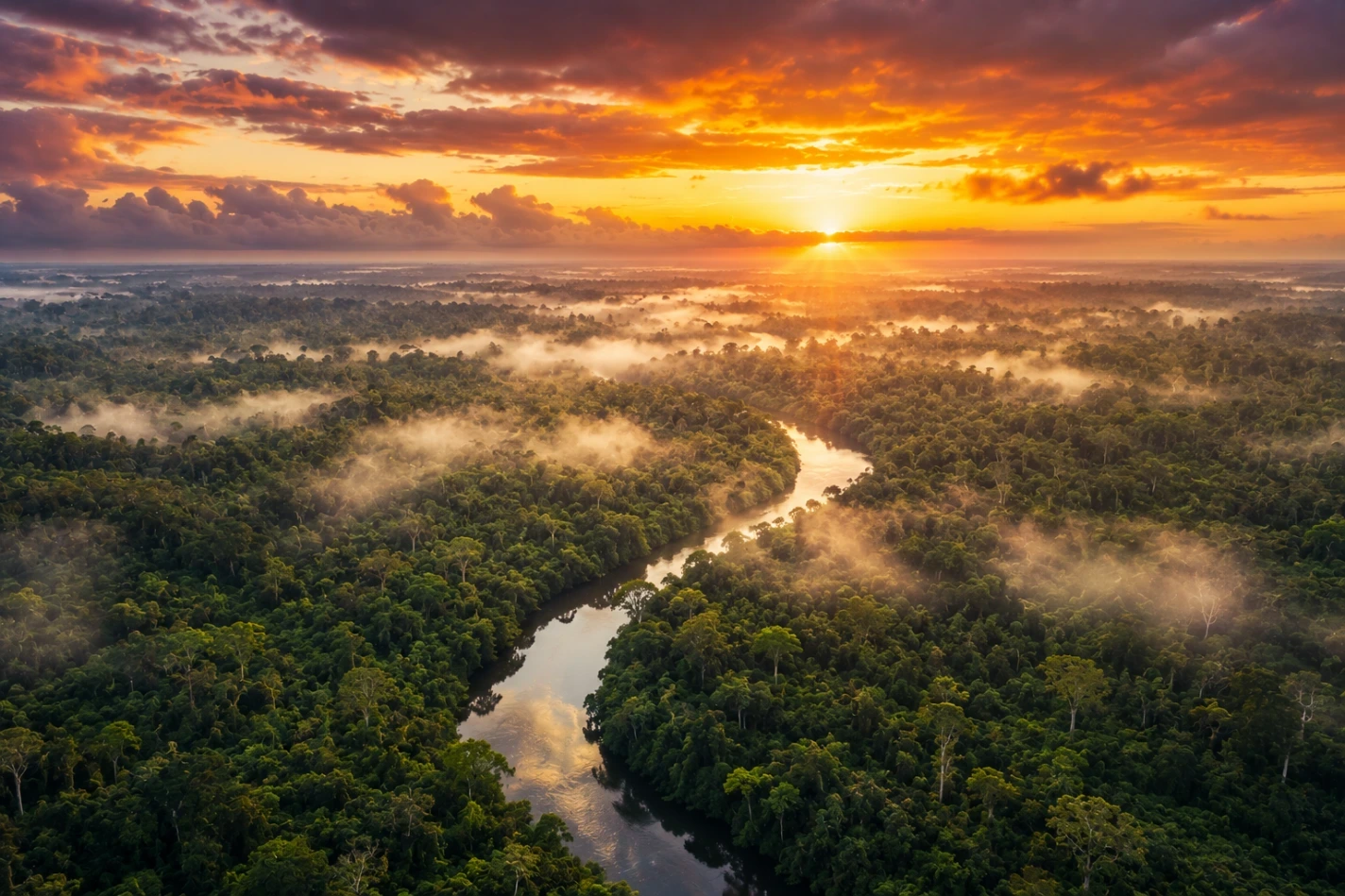
Then the river appears.
Wide.
Silent.
Its dark waters reflect the towering walls of green that rise from either bank.
This is the Amazon River.
The lifeline of the greatest rainforest on Earth.
As your boat drifts forward, the outside world begins to disappear.
There are no city skylines.
No highways.
No distant noise of civilization.
Only water...
Trees...
And a wilderness so vast that it seems to have no end.
The Amazon Rainforest covers more than 5.5 million square kilometers, an area larger than many countries combined.
It stretches across nine South American nations, with most of it lying within Brazil.
Yet numbers alone cannot describe this place.
Because the Amazon is more than a forest.
It is a living world.
Every branch supports life.
Every fallen tree becomes a home.
Every drop of rain begins another story.
Scientists estimate that around one in every ten known species on Earth lives somewhere within the Amazon.
Many remain hidden.
Some have never been photographed.
Others have never even been named.
In this forest...
Discovery is not history.
It is happening today.
As the boat disappears around another bend, sunlight breaks through the canopy in narrow golden beams.
The rainforest opens its gates.
The expedition has truly begun.
🌍 The Green Ocean
The higher you climb...
The more impossible the Amazon becomes.
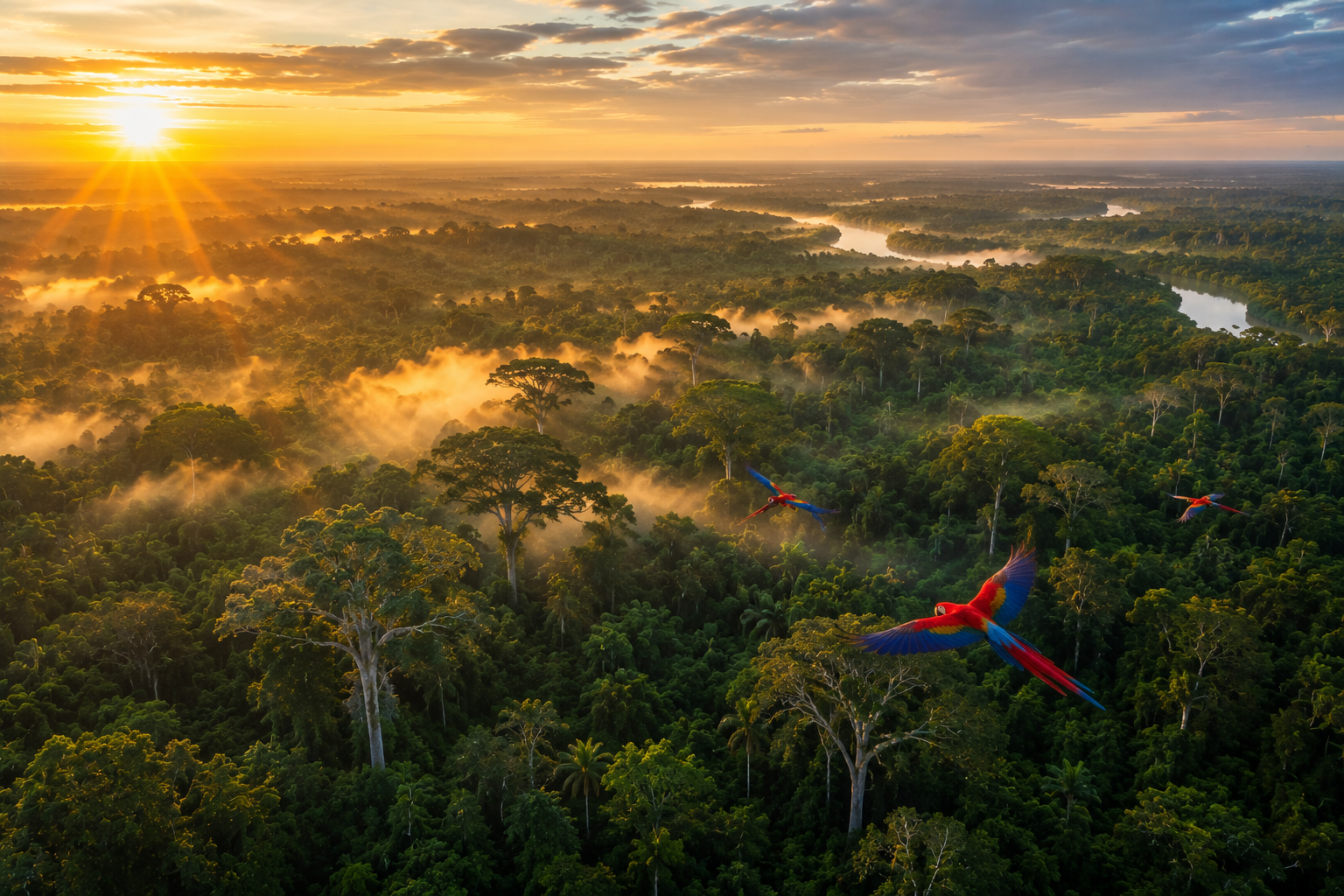
From the ground, the rainforest feels endless.
From above...
It looks like an ocean.
Not an ocean of water.
An ocean of leaves.
Millions upon millions of trees merge into a single emerald blanket that stretches farther than the eye can see.
There are no streets dividing it.
No clear beginning.
No obvious end.
Only waves of green rolling toward the horizon.
This is the largest tropical rainforest on Earth.
A place so immense that weather systems are born within its borders.
Scientists sometimes call the Amazon a "flying river."
It sounds impossible.
Yet every day, billions of trees pull water from the soil and release it into the atmosphere through a process called transpiration.
Together, they create vast rivers of invisible water vapor that drift across South America, helping bring rain to distant forests, farms, and cities.
The rainforest doesn't just respond to the climate.
It helps shape it.
The Amazon is often called "the lungs of the Earth."
It is a beautiful phrase.
But the reality is even more fascinating.
The forest produces enormous amounts of oxygen through photosynthesis.
At the same time, countless plants, animals, fungi, and microorganisms consume much of that oxygen through respiration and decomposition.
Its greatest global importance lies not simply in oxygen production, but in its role as one of Earth's largest carbon stores, its influence on rainfall, and the extraordinary biodiversity it supports.
Nature is rarely as simple as a slogan.
The truth is usually far more remarkable.
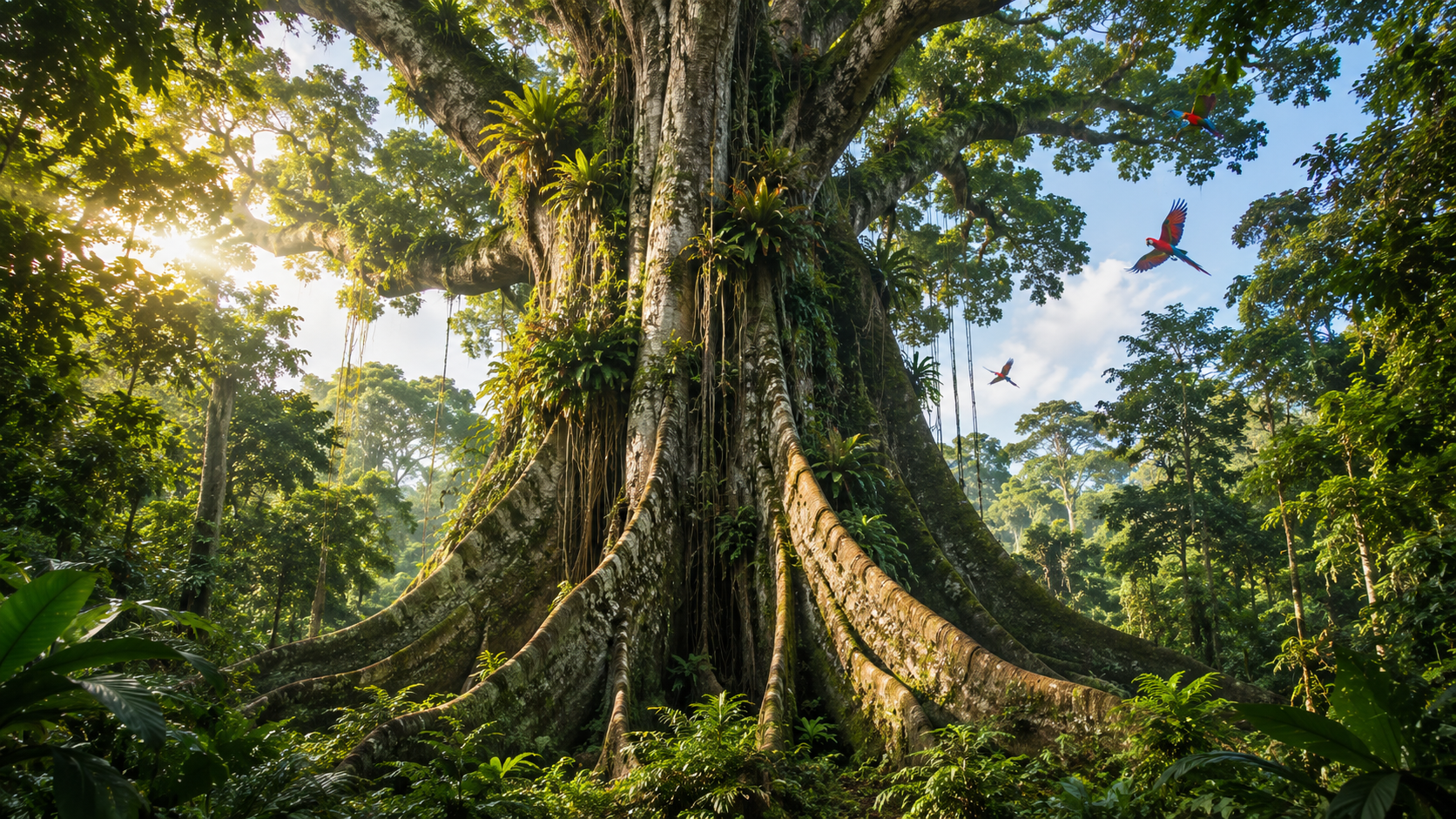
Some of the forest's oldest giants rise more than 70 meters (230 feet) into the sky.
Their trunks are so wide that several people holding hands would struggle to surround them.
These towering trees form the highest layer of the rainforest—the emergent layer.
From here, eagles patrol the skies.
Monkeys leap between distant branches.
The morning sun touches these leaves long before it reaches the forest floor.
Beneath them lies another world.
The dense canopy blocks much of the sunlight.
Only small beams of light manage to slip through the leaves, creating shifting patches of brightness below.
In those brief moments...
Seeds awaken.
Flowers bloom.
Tiny insects emerge.
Even sunlight must compete for space in the Amazon.
The deeper you look...
The more life appears.
A single tree can support hundreds of different species.
Birds build nests high among the branches.
Ants march across the bark in endless lines.
Tree frogs hide inside leaves no larger than your hand.
Colorful orchids cling to the trunk without stealing nutrients from it.
Every branch is occupied.
Every layer has its own community.
The rainforest is not one ecosystem.
It is thousands of ecosystems stacked on top of one another.
Like the floors of a living city.
Then...
A sudden movement catches your eye.
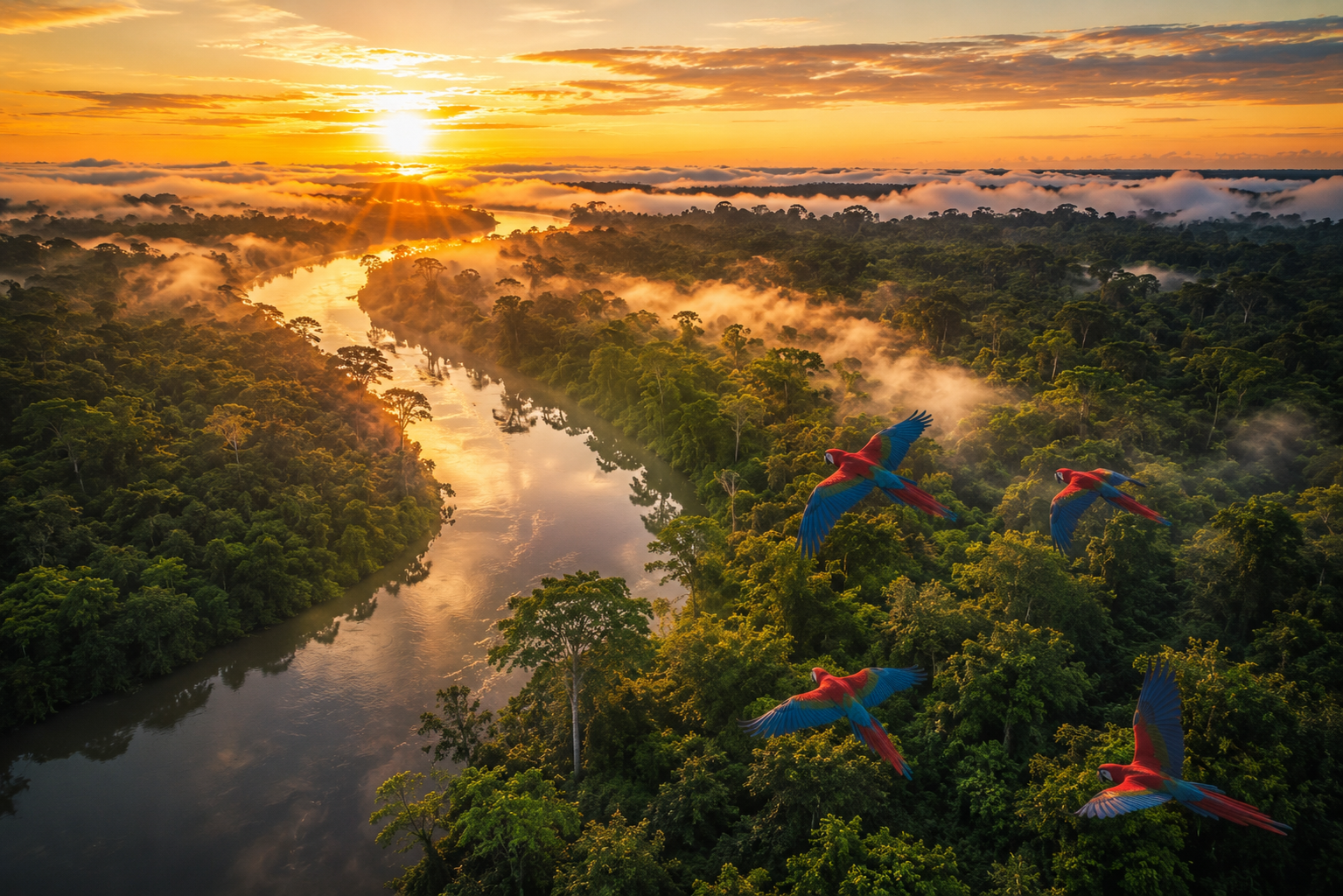
High above the canopy, brilliant flashes of red, blue, and yellow streak across the sky.
The forest has revealed its next chapter.
Its most colorful residents are waiting.
🌍 A Symphony of Wings and Shadows
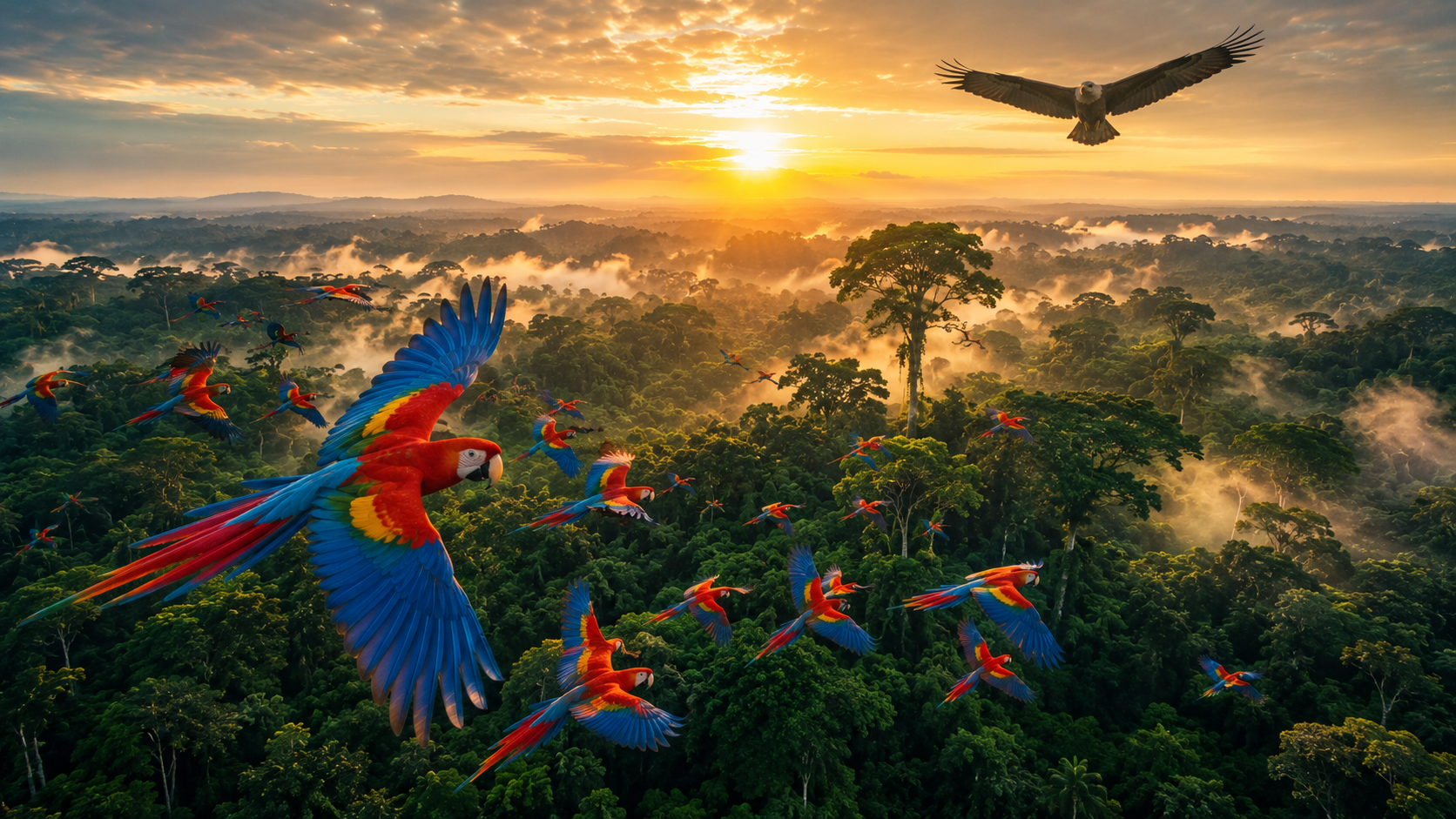
Morning transforms the rainforest.
As the first rays of sunlight reach the canopy...
The forest explodes into sound.
Macaws call across the treetops.
Howler monkeys announce the new day with roars that can travel nearly five kilometers through the dense jungle.
Tiny hummingbirds hover among tropical flowers, beating their wings so rapidly they become almost invisible.
Above them all...
A silent hunter watches.
The harpy eagles.
With powerful talons larger than a grizzly bear's claws, it rules the skies of the Amazon.
From its perch high above the canopy, it waits patiently.
One precise strike is all it needs.
In the Amazon, survival often belongs not to the fastest...
But to the most patient.
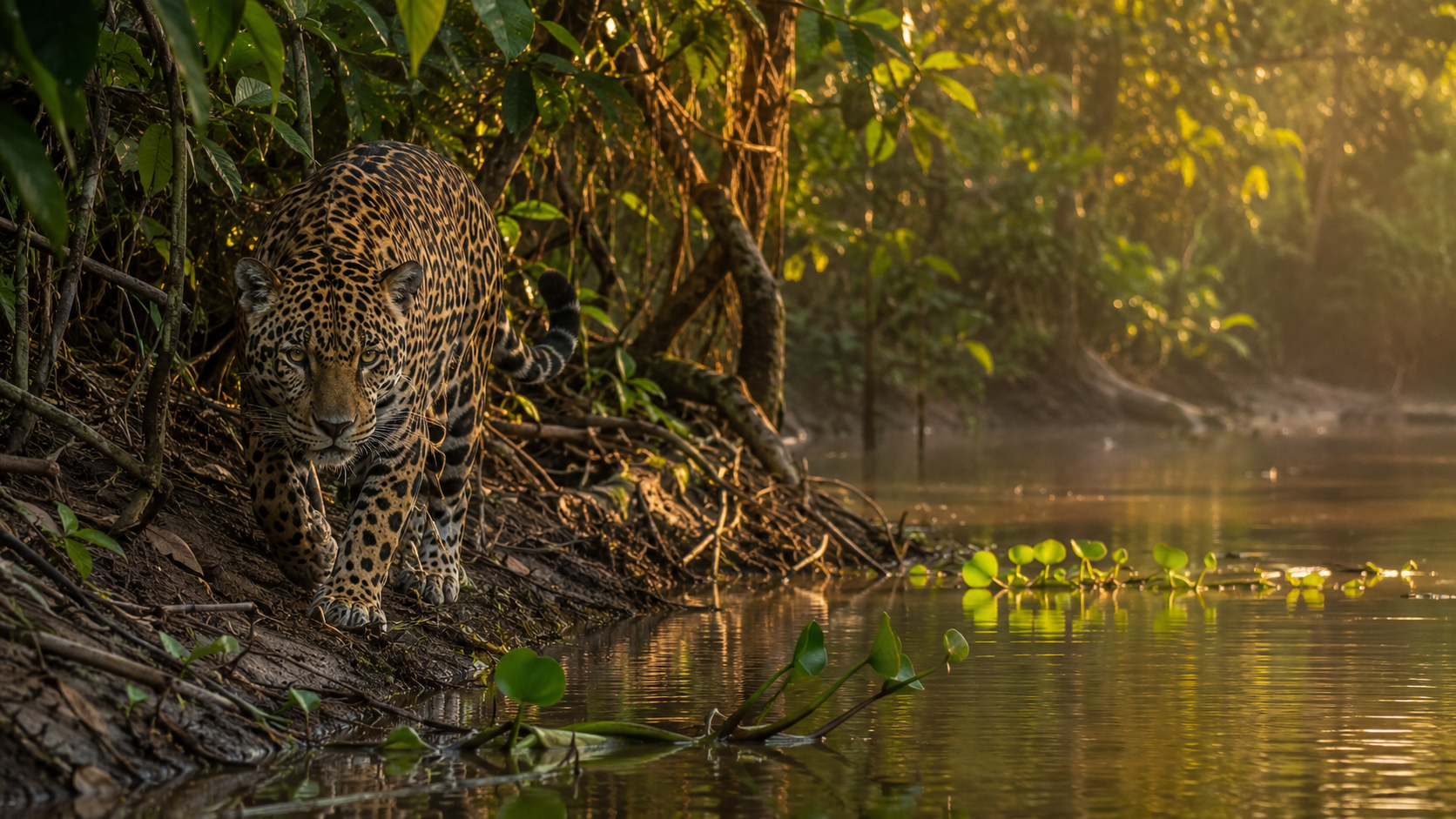
Yet the true ruler of the rainforest rarely announces its presence.
It leaves only footprints.
A ripple in the water.
A broken branch.
Or complete silence.
The jaguar moves through the jungle like a shadow.
Unlike many big cats, it is an excellent swimmer.
It crosses rivers with ease, climbs trees when necessary, and possesses one of the strongest bite forces of any feline.
Instead of suffocating its prey like most large cats, a jaguar can pierce directly through the skull of reptiles and armored animals.
It is a hunter perfectly shaped by the rainforest.
And despite its strength...
Most visitors will never see one.
The Amazon protects its secrets well.
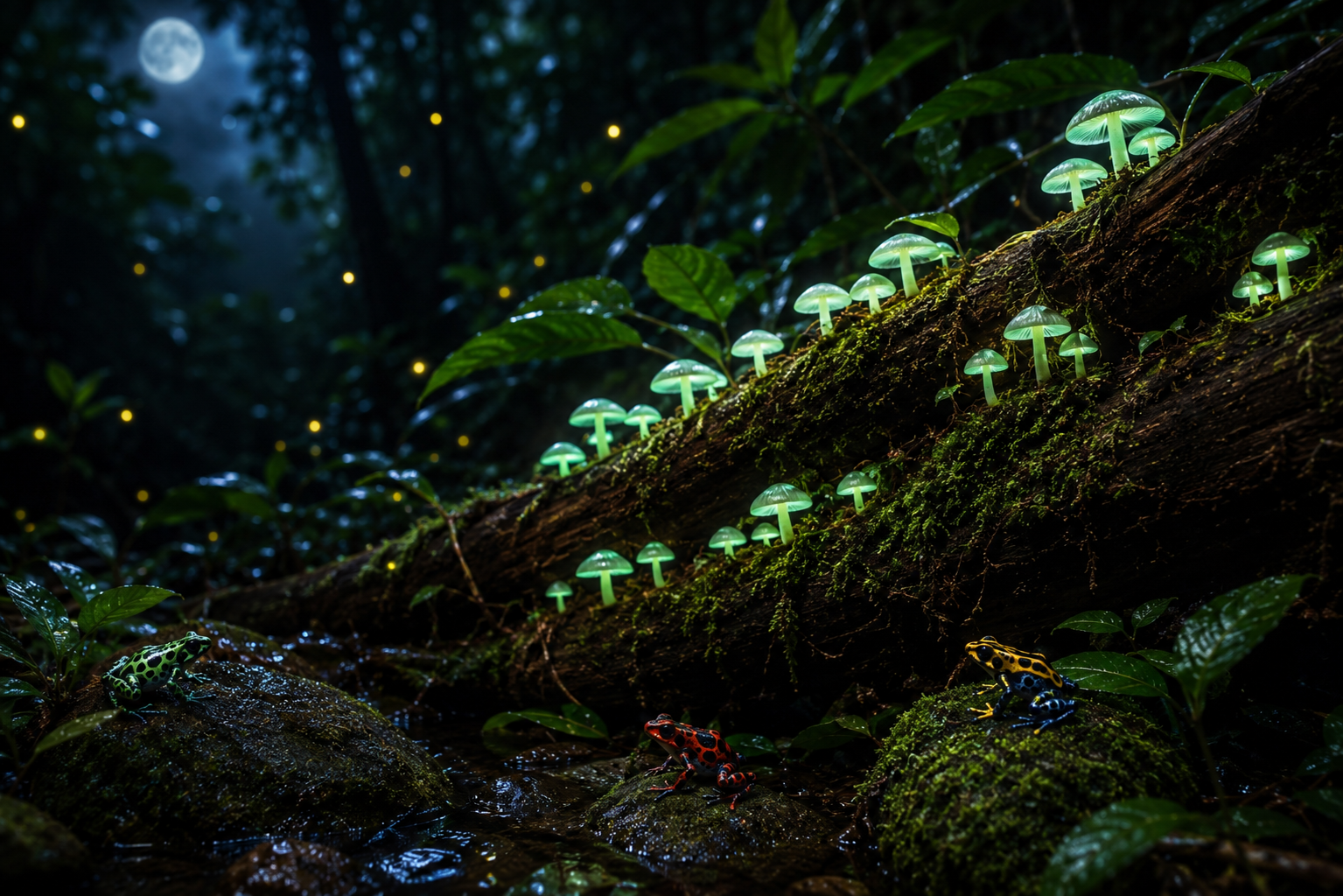
As daylight fades beneath the thick canopy, another world begins to awaken.
Tiny poison dart frogs emerge from damp leaves, their brilliant colors warning predators to stay away.
Leafcutter ants march across the forest floor in endless green rivers, carrying pieces of leaves many times their own size.
Glass frogs cling to branches above quiet streams, their translucent skin revealing the outline of their internal organs.
Every few steps...
Another extraordinary creature appears.
Scientists estimate that millions of species may still live in the Amazon, many of which have never been formally described.
Even today, researchers continue discovering insects, fish, amphibians, and plants previously unknown to science.
In few places on Earth does exploration still feel so alive.
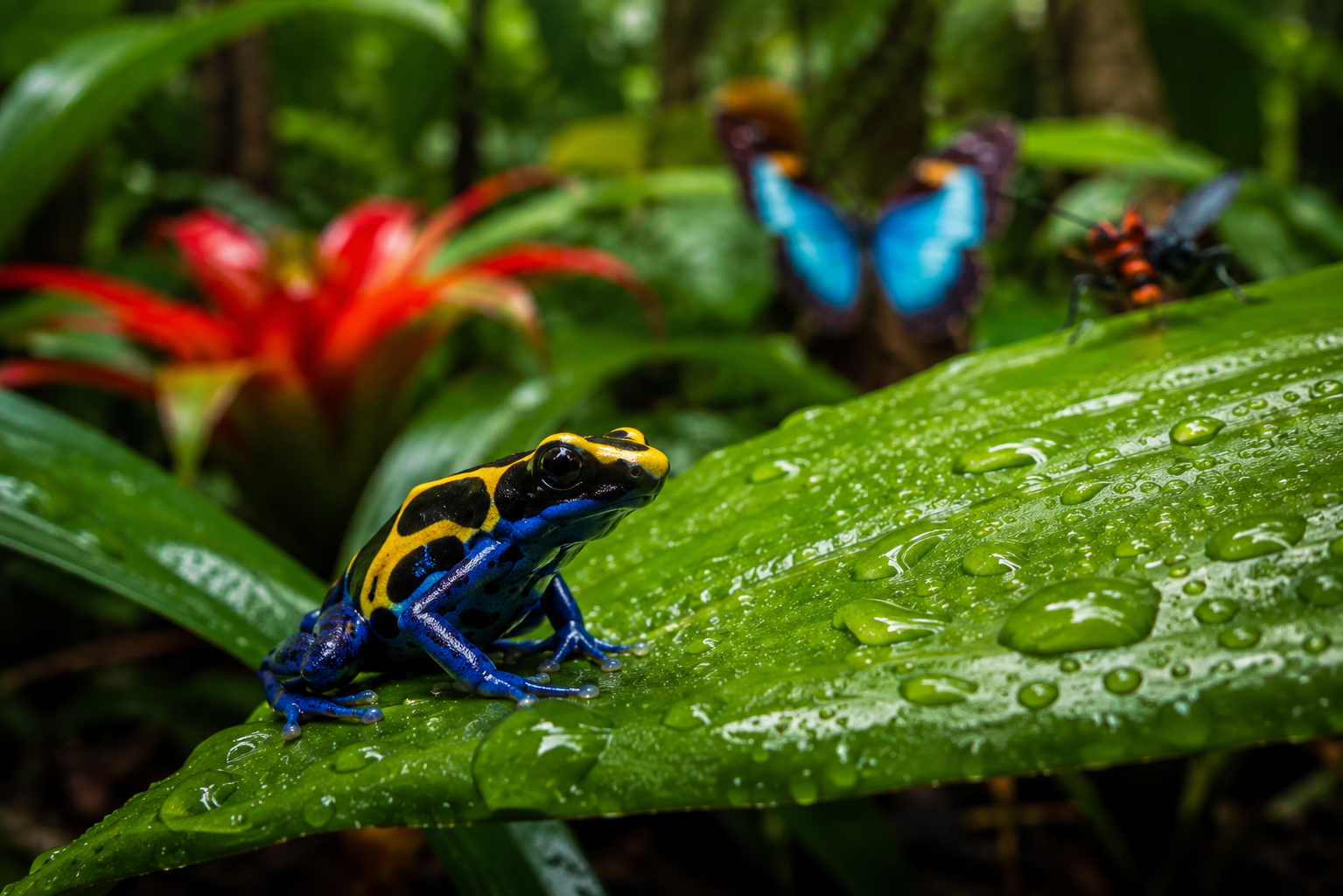
The Amazon is often called the greatest collection of life on Earth.
Standing here...
That description feels almost too small.
This forest is not simply home to countless species.
It is a living network where every bird, every tree, every insect, every fungus, and every river is connected.
Remove one thread...
And countless others begin to change.
The rainforest breathes as one enormous living system.
And beneath its dark rivers...
Another hidden world is waiting.
Not among the trees...
But beneath the surface of the water.
Ahead, the expedition leaves the forest floor behind and enters the mysterious waterways of the Amazon, where pink river dolphins, giant otters, electric eels, piranhas, and ancient fish reveal a completely different side of the rainforest.
🌍 The River That Never Sleeps
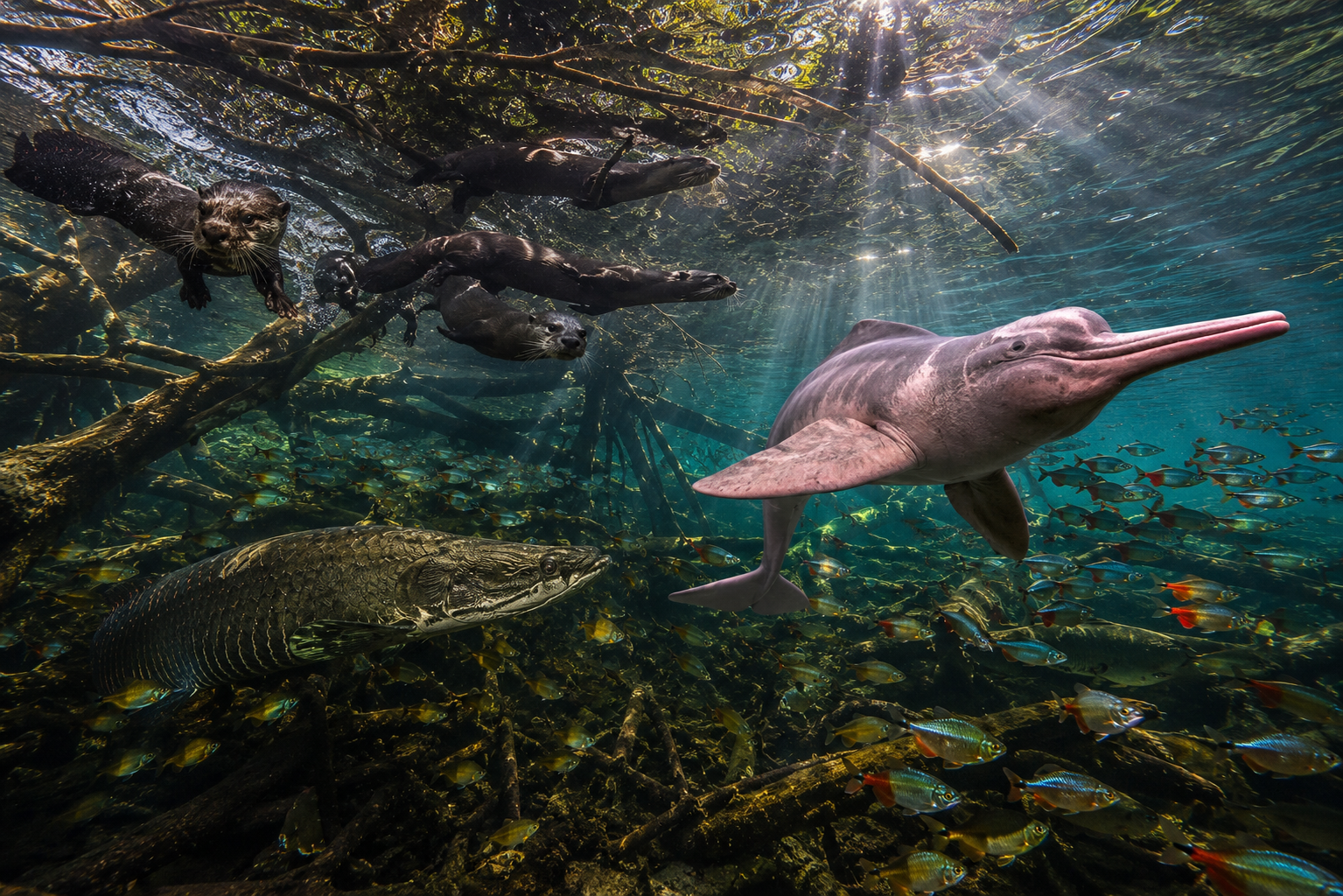
From above...
The Amazon River appears calm.
Its surface reflects the sky like polished glass.
But beneath that quiet mirror...
An entirely different world exists.
A world where visibility can disappear within seconds.
Where predators hunt without being seen.
Where survival depends on senses far beyond eyesight.
The Amazon River is the largest river system on Earth by volume.
Every second, it pours an astonishing amount of freshwater into the Atlantic Ocean—more than any other river on the planet.
Its countless tributaries stretch for tens of thousands of kilometers, forming a watery highway through the heart of the rainforest.
Some channels are wide enough to resemble inland seas.
Others are so narrow that only a small canoe can pass between the trees.
Every bend leads to another hidden world.
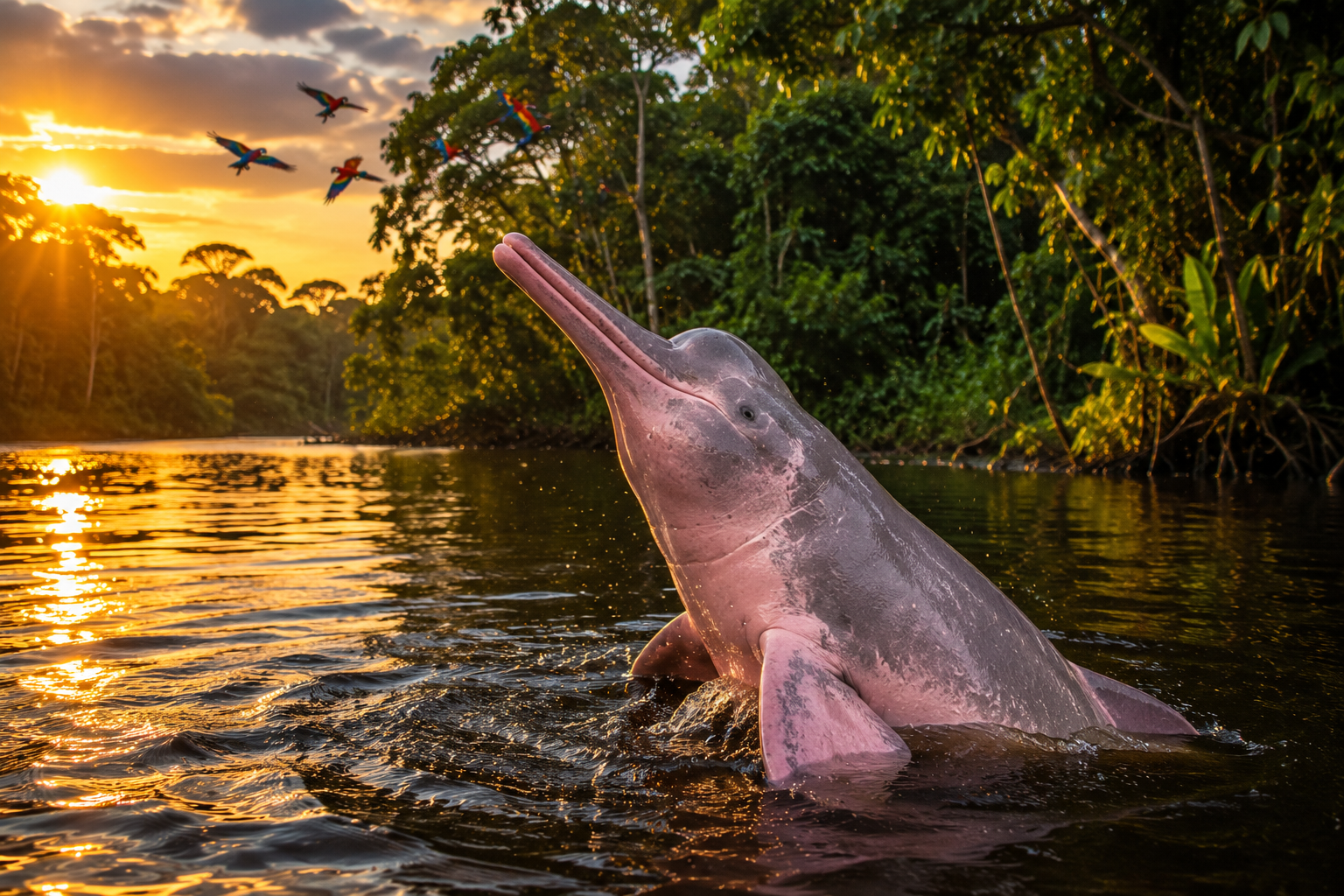
One of the river's most remarkable inhabitants seems almost mythical.
The Amazon River dolphin.
Unlike the dolphins of the open ocean, it has adapted to a world of flooded forests and winding channels.
Its flexible neck allows it to turn its head from side to side—an unusual ability among dolphins.
Its long beak helps it search between submerged branches for fish.
And as it matures...
Its body gradually changes from gray to shades of soft pink.
For centuries, Indigenous communities have woven stories around these mysterious animals, treating them with both admiration and respect.
To scientists, they are living evidence of evolution's extraordinary ability to adapt life to almost any environment.
Nearby...
Another family patrols the waterways.
Not with fear.
But with confidence.
The giant otter.
Growing to nearly 2 meters (6.5 feet) in length, it is the world's largest otter.
Unlike solitary hunters, giant otters live in close family groups.
They hunt together.
Play together.
Protect their young together.
Watch them for a few minutes...
And it becomes impossible not to notice their curiosity.
They investigate almost everything that enters their territory—including curious humans.
In a rainforest full of silent predators, the giant otter brings an unexpected sense of joy.
Yet beneath the same waters...
Other creatures inspire a different emotion.
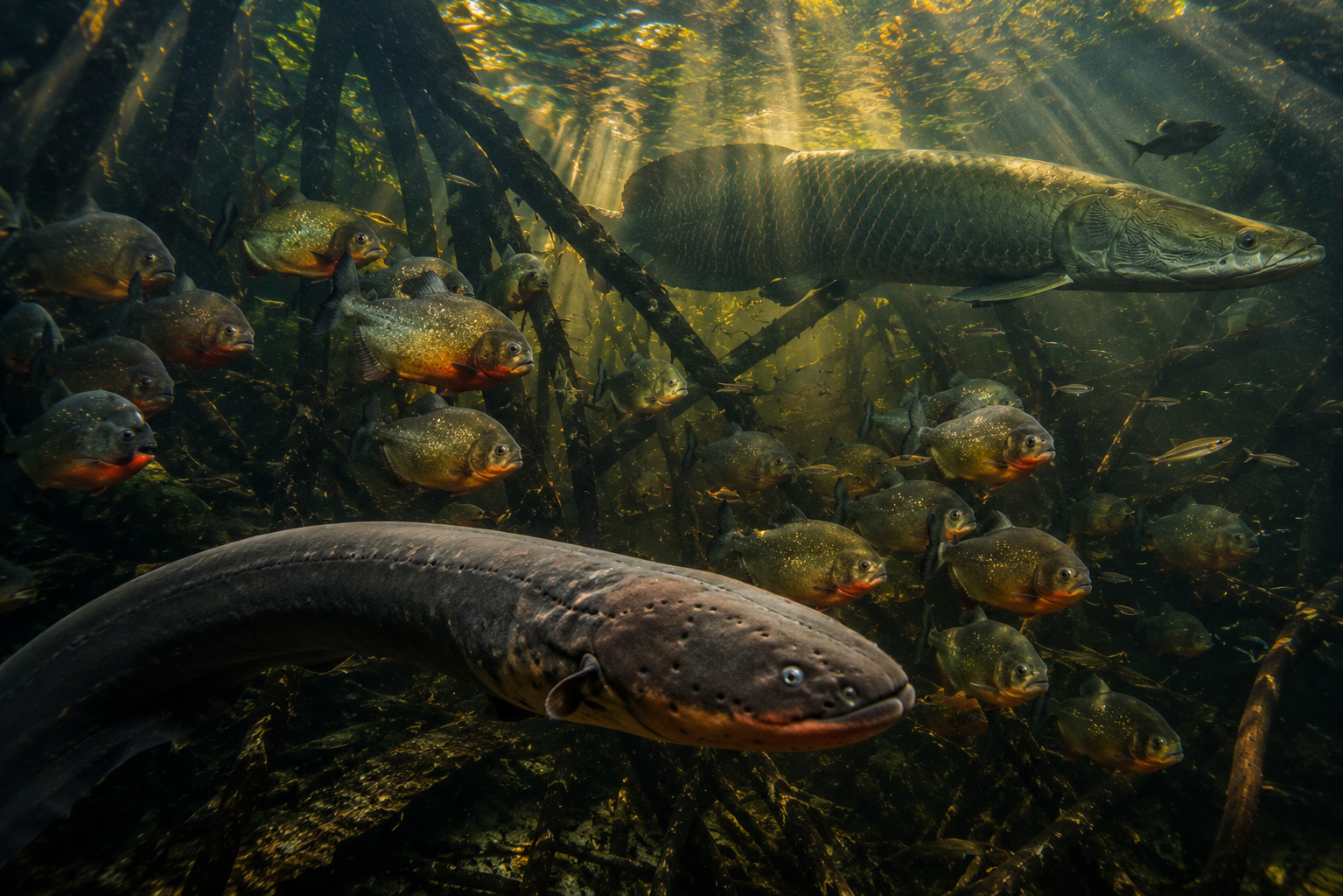
The electric eel.
Despite its name, it is not a true eel but a type of knifefish.
Specialized organs within its body can generate electrical discharges powerful enough to stun prey and defend against threats.
In the murky waters of the Amazon, where vision is often limited, electricity becomes another way of sensing the world.
Then there is the arapaima—one of the largest freshwater fish on Earth.
Some individuals grow longer than three meters (10 feet) and must regularly rise to the surface to breathe air.
These giants have survived in the Amazon for millions of years, long before humans ever explored its rivers.
And yes...
The river is also home to piranhas.
Popular culture has turned them into monsters, but reality is far less dramatic.
Most piranha species are cautious, feeding on fish, insects, fruits, and carrion.
They are an important part of the river's ecosystem—not the relentless predators often portrayed in movies.
Sometimes...
Nature is more interesting than fiction.
As the sun begins to set...
Golden reflections dance across the water.
The rainforest grows quieter.
Birdsong fades.
Mist rises slowly from the river's surface.
In the distance, faint voices echo through the trees.
Not the calls of animals.
But of people.
For thousands of years...
Humans have called this rainforest home.
And their story is just as extraordinary as the forest itself.
The expedition now enters one of the Amazon's oldest chapters—its Indigenous cultures, whose knowledge of the rainforest has been shaped over countless generations.
🌍 The People of the Forest
Long before maps gave this forest a name...
Long before explorers crossed its rivers...
The Amazon already had guardians.
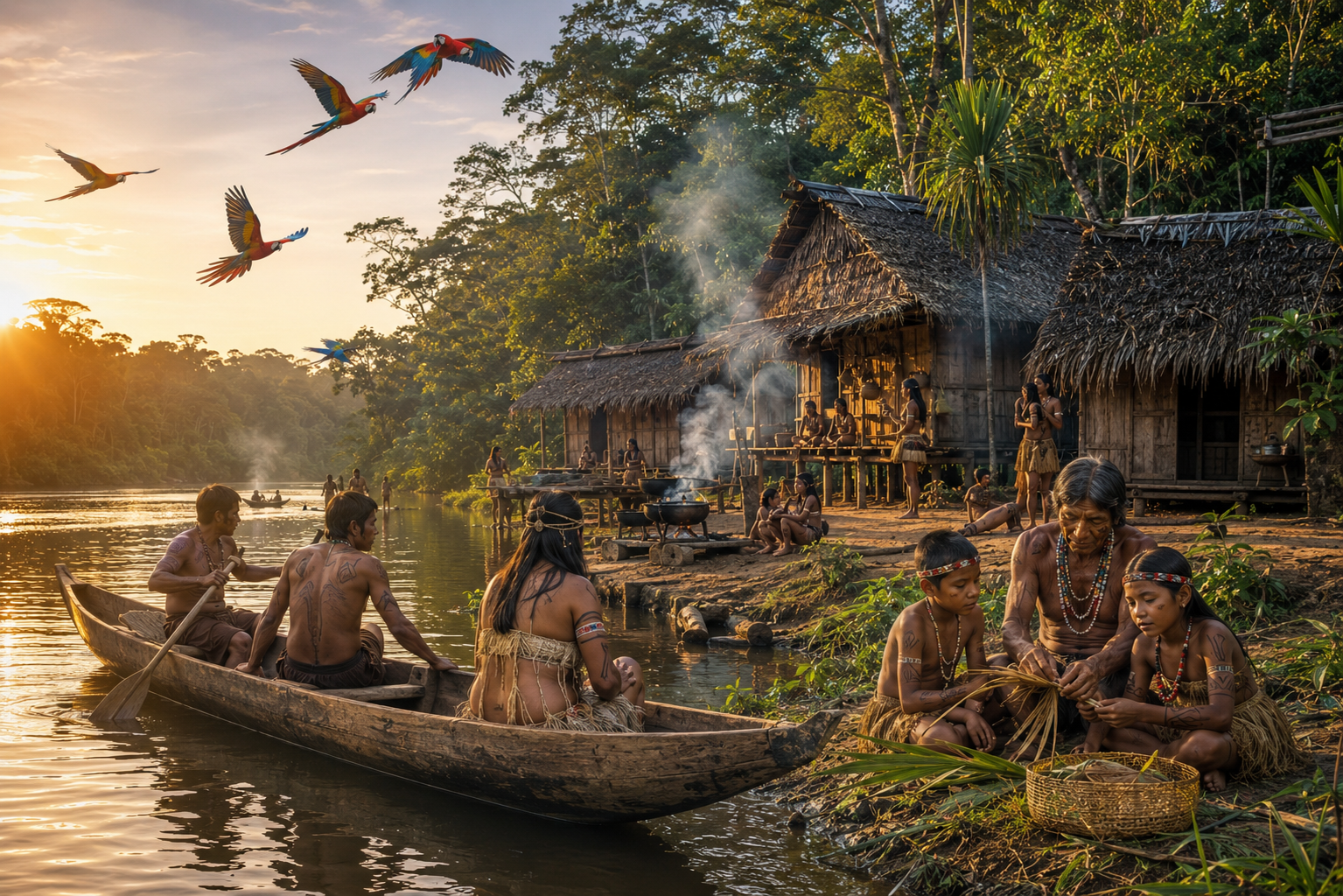
For thousands of years, Indigenous peoples have lived within these forests, learning its rhythms through observation rather than conquest.
To them...
The rainforest is not simply a place to live.
It is home.
A living world where every river, every tree, and every season carries meaning.
Generations have passed down knowledge that cannot be found in textbooks.
Which plants heal.
Which fruits nourish.
Which sounds warn of danger.
And which paths disappear when the rainy season arrives.
Their greatest library has never been built from stone.
It has always been the forest itself.
Life here follows the rhythm of nature.
At sunrise, narrow canoes glide quietly across mist-covered rivers.
Fishing nets are lowered into calm waters.
Children learn by watching, listening, and participating alongside their families.
Every journey through the forest is also a lesson.
Not about controlling nature...
But about understanding it.
In many communities, taking more than is needed has never been considered wisdom.
The rainforest provides generously.
But only when treated with respect.
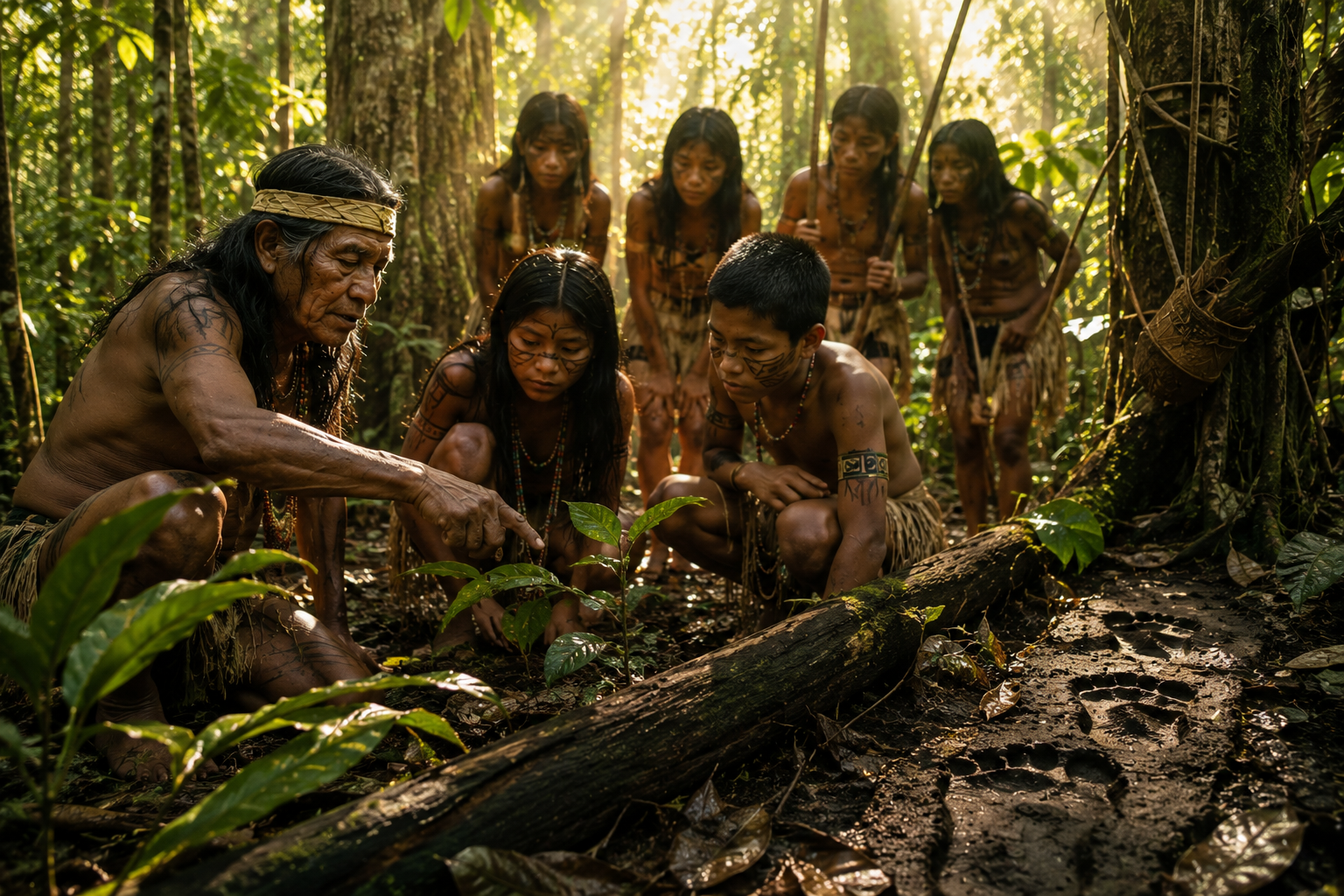
Modern science has increasingly recognized the value of this knowledge.
Researchers studying rainforest ecosystems often work alongside Indigenous communities, whose understanding of local plants, wildlife, and seasonal changes has been refined over countless generations.
Many medicines used around the world today trace their origins to plants found in tropical forests.
Yet scientists believe that thousands of rainforest species remain largely unstudied.
Some may contain compounds that could one day contribute to new medical treatments.
Others may disappear before their secrets are ever discovered.
The Amazon still holds countless unanswered questions.
As evening approaches...
The forest changes once again.
Daytime birds grow quiet.
The air becomes cooler.
Mist rises from the river.
Somewhere in the distance...
A deep roar echoes through the darkness.
Not every creature sleeps when the Sun disappears.
For many...
Night is when the rainforest truly comes alive.
The expedition's final chapter is about to begin.
A world illuminated not by sunlight...
But by moonlight, glowing eyes, and the endless chorus of the jungle after dark.
🌍 When the Forest Never Sleeps
As the last rays of sunlight disappear...
The rainforest does not fall asleep.
It awakens.
The chorus of daytime birds slowly fades into silence.
Almost immediately...
Another orchestra takes its place.
Tree frogs begin calling from hidden pools.
Millions of insects create a constant hum that seems to come from every direction at once.
Somewhere in the darkness...
A branch snaps.
Then another.
You stop walking.
Not because you are afraid.
But because you realize something extraordinary.
You are no longer the observer.
The forest is watching you.
Night changes everything.
Animals that remained hidden throughout the day now emerge beneath the cover of darkness.
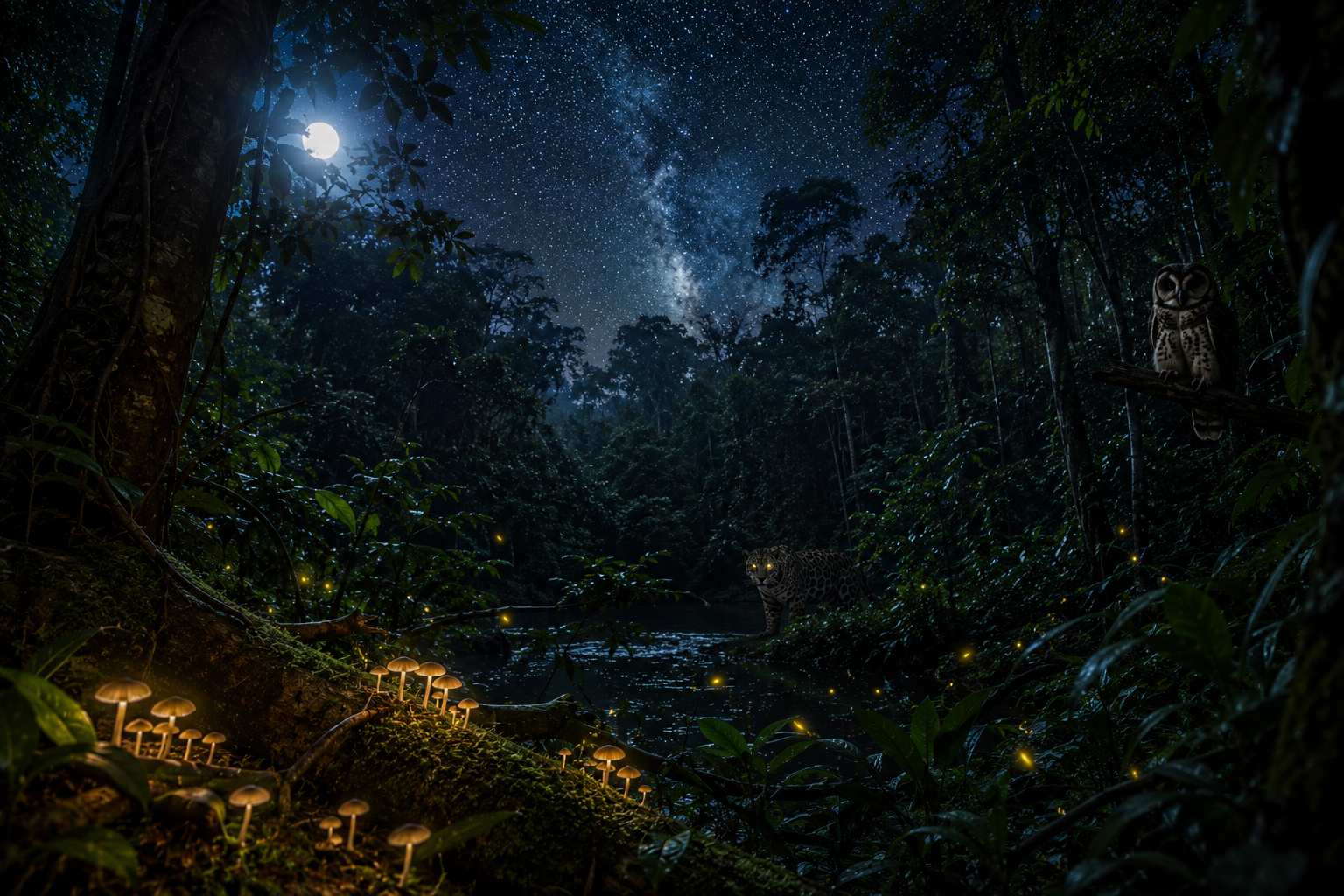
A spectacled owl glides silently between the trees, listening for the faintest movement below.
High above the canopy, fruit bats leave their roosts and travel astonishing distances in search of flowering trees and ripe fruit.
Without them, many rainforest plants would struggle to reproduce.
Even in darkness...
Every creature has a purpose.
Look closely...
And the darkness begins to reveal its own colors.
Tiny fungi glow faintly from fallen logs.
Fireflies drift through the air like floating stars.
The river reflects the Moon as though it were another sky hidden beneath the trees.
In daylight, the Amazon is vibrant.
At night...
It becomes mysterious.
The familiar disappears.
The unknown takes its place.
Every sound seems louder.
Every shadow deeper.
Every step more deliberate.
This is a rainforest that has never truly been silent.
Not for millions of years.
The Amazon is often described as the greatest rainforest on Earth.
But after traveling through its rivers...
Standing beneath its towering trees...
Watching jaguars vanish into the shadows...
Listening to the endless chorus after sunset...
You begin to understand that those words barely capture its true scale.
The Amazon is not simply a collection of trees.
It is a living system.
A place where rivers shape forests...
Forests shape weather...
And life shapes everything else.
Long after our expedition ends...
The rainforest will continue its endless rhythm.
The macaws will greet another sunrise.
The dolphins will return to the river.
The jaguar will walk unseen through the shadows.
And somewhere...
A new species may be waiting to be discovered.
🌍 Before You Leave...
The Amazon does not ask to be understood in a single visit.
It cannot be.
Every river hides another bend.
Every tree shelters another story.
Every sunrise reveals life that no one has ever seen before.
Perhaps that is what makes this place so extraordinary.
It reminds us that, even in an age of satellites and artificial intelligence, parts of our own planet remain wonderfully mysterious.
Some journeys end with answers.
The Amazon leaves you with something even more valuable...
The desire to return.