Introduction — Britain Before the Machines
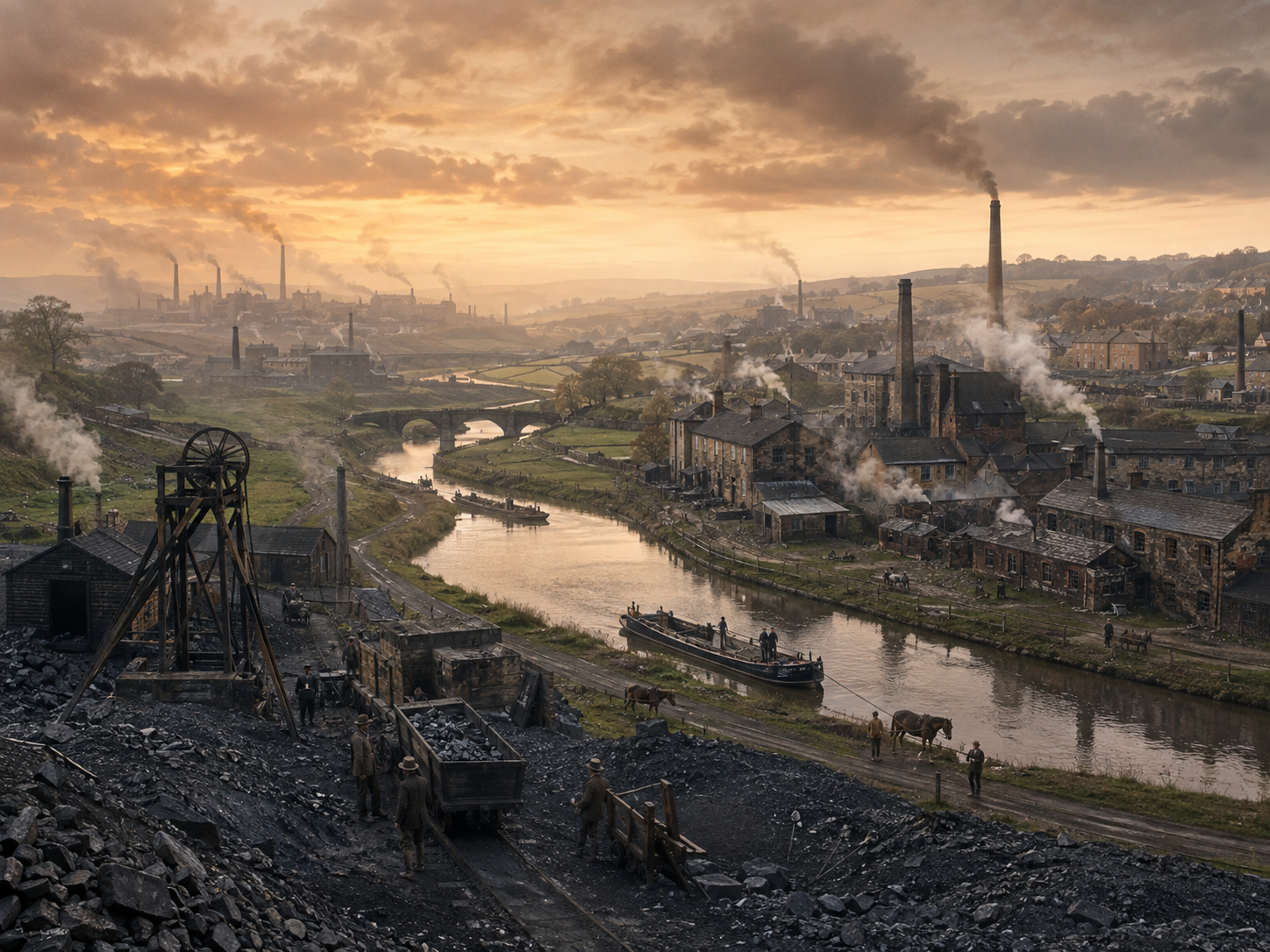
In the early 1700s, Britain did not look like the birthplace of the modern industrial world.
Most people still lived in the countryside. Farming was a major part of the economy, manufacturing was often carried out in small workshops or homes, and there were no great landscapes of factories covering the country. Britain was already commercially active and had important industries such as coal mining, shipbuilding and textiles, but mass factory production was still ahead.
Over the next century, that began to change.
Machines appeared in textile production. Coal became a major source of energy. Steam engines improved. Canals connected industrial areas to ports and cities. Towns grew rapidly around factories and mines.
Britain became the first country to industrialize on a large scale.
But why Britain?
The easy answer is coal.
The slightly less easy answer is coal plus inventors.
Neither is enough.
Historians have pointed to a much larger collection of advantages: relatively high wages, cheap energy, agricultural change, overseas trade, expanding markets, access to capital, useful institutions and a culture of practical experimentation. Robert C. Allen's influential explanation places particular importance on Britain's unusual combination of high labor costs and cheap energy, which made labor-saving machines more attractive.
The most convincing explanation is therefore not that Britain possessed one secret ingredient.
It is that several ingredients arrived together.
And once they began reinforcing one another, Britain's economy started moving in a completely new direction.
Chapter 1 — Britain Had an Unusual Advantage
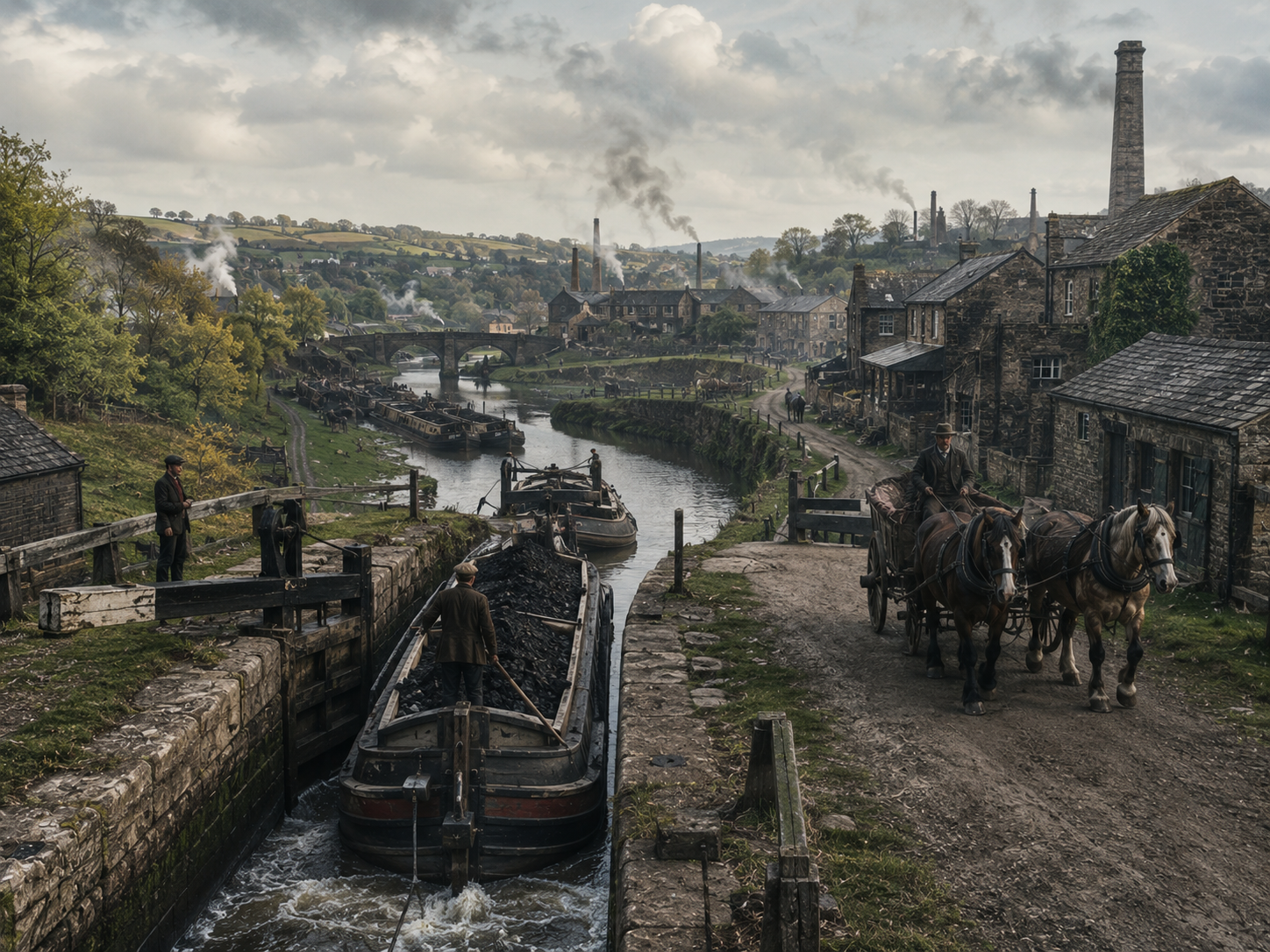
Britain's geography was useful in ways that are easy to overlook.
The country had many navigable rivers, a long coastline and numerous ports. Later, canals connected inland industrial areas with rivers, cities and harbors.
This mattered because early industry needed to move things that were heavy.
Coal was heavy.
So were iron, timber, clay and other raw materials.
Before good roads and railways existed, moving heavy goods overland could be expensive. Water was much cheaper.
Britain gradually built an extensive canal system during the Industrial Revolution. Inland waterways in Great Britain grew from about 1,400 miles in 1760 to around 4,100 miles by 1830. Canals helped inland coalfields and industries such as pottery and metalworking expand.
Britain also had coal deposits close to some areas that would become important industrial centers.
That combination was powerful.
A factory could be supplied with fuel.
A canal could carry that fuel more cheaply than a wagon on a rough road.
Finished goods could then travel to a port or growing city.
But geography alone cannot explain Britain's industrial takeoff.
France had navigable rivers.
The Netherlands had excellent waterways.
Other parts of Europe had ports and natural resources.
Britain's advantage came from how its geography connected with the country's economy.
The landscape made certain forms of industry easier.
And new transport systems made that advantage stronger.
Britain's Geographic Advantage
Chapter 2 — The Strange Importance of High Wages
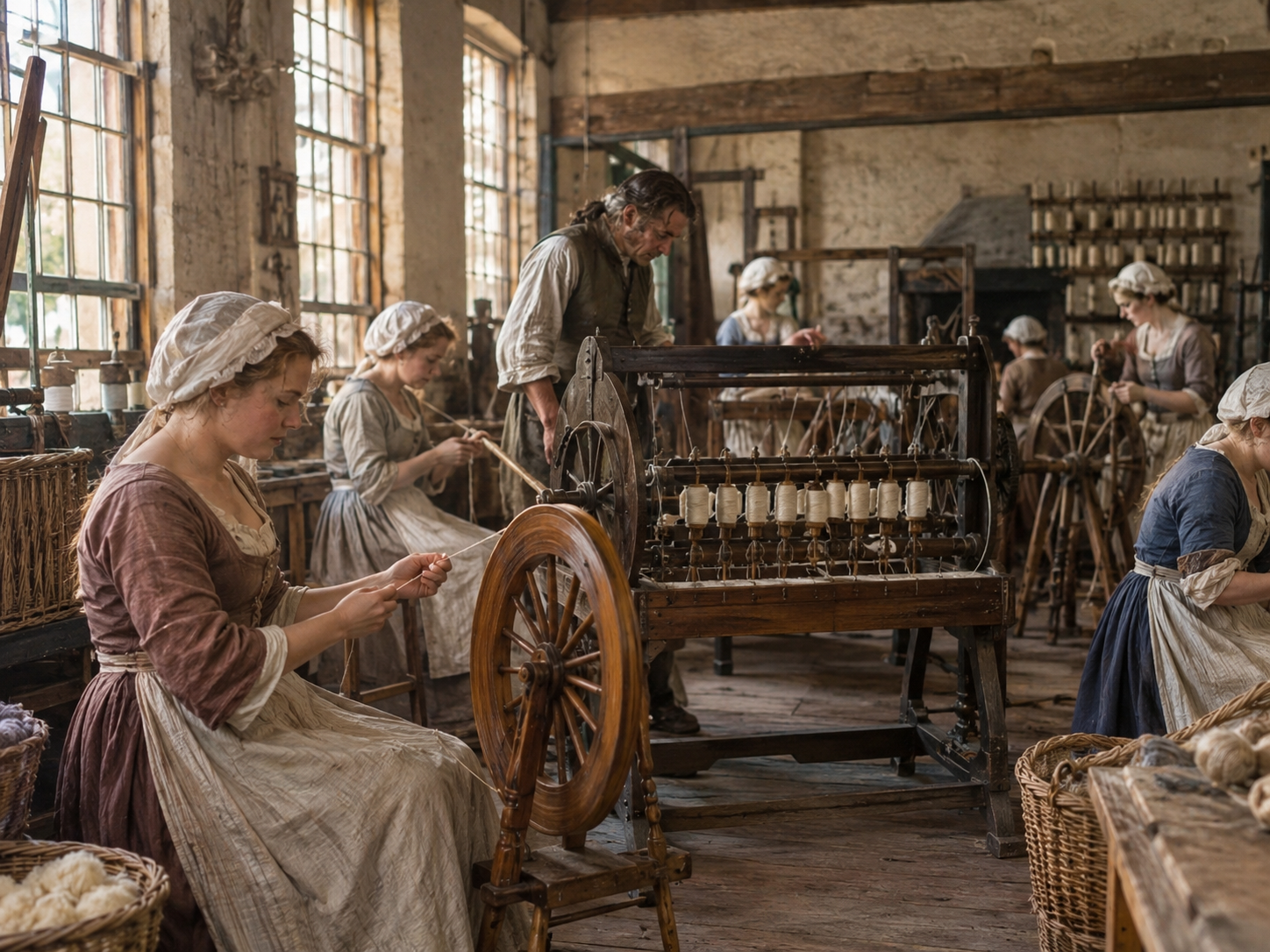
This sounds like one of the strangest explanations for the Industrial Revolution.
Why would high wages help a country invent machines?
Because machines cost money.
Imagine a factory owner in a country where workers are cheap.
A machine that replaces ten workers might be impressive, but if those workers cost very little, the machine may take too long to pay for itself.
Now imagine a country where workers are relatively expensive and energy is cheap.
The calculation changes.
A machine that replaces several workers suddenly becomes much more attractive.
This is the central idea in Robert Allen's high-wage explanation of Britain's industrialization. Allen argues that eighteenth-century Britain had unusually high wages compared with many other countries, while energy—especially coal—was unusually cheap. That combination encouraged firms to invest in machines that replaced labor with capital and energy.
Textile machinery provides a useful example.
Spinning by hand required enormous amounts of labor.
If workers were expensive, finding a machine that could do more spinning with fewer workers made economic sense.
This helps explain why inventions such as spinning machinery became so valuable in Britain.
But the high-wage explanation is not universally accepted as the complete answer.
Historians have debated how high wages actually were across different occupations and regions, and whether they alone can explain Britain's breakthrough.
That debate is important.
It tells us that industrialization was not caused by a single number on a wage sheet.
Still, the basic idea is powerful.
When labor becomes expensive and energy is cheap, people have a stronger reason to invent machines that save labor.
Britain had that unusual combination.
And the machines were coming.
Why High Wages Encouraged Machines
Chapter 3 — Coal: The Fuel That Changed the Equation
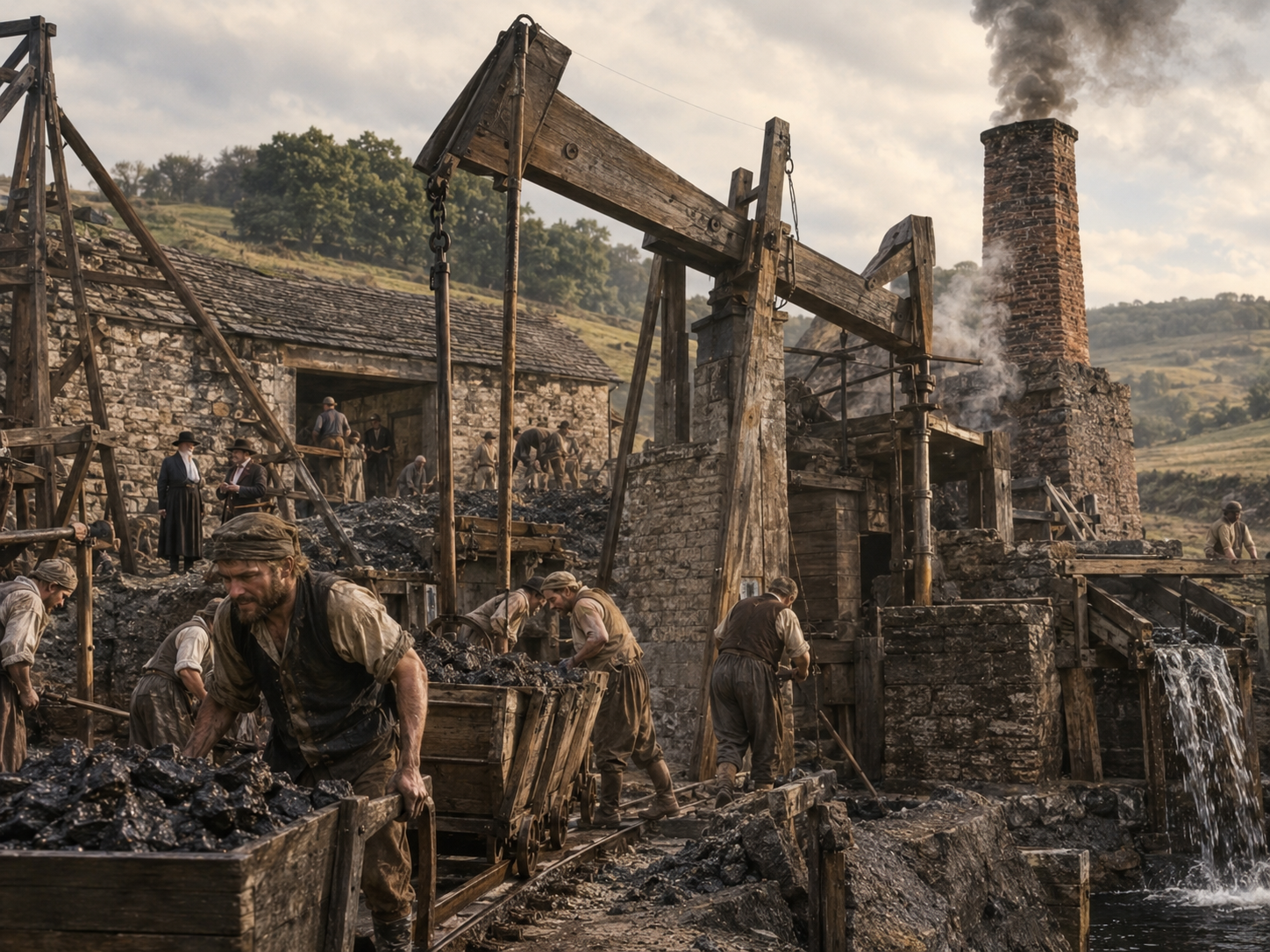
Britain did not simply have coal.
It had a growing reason to use it.
For centuries, wood and charcoal were important fuels. But Britain's expanding economy needed more energy, and coal could provide enormous quantities of heat.
Coal was especially important because it could be used in industries that needed intense heat, including metal production.
Mining itself created another problem.
As British mines became deeper, groundwater became harder to remove.
This created demand for machines that could pump water out of mines.
One early answer was the Newcomen steam engine, developed in the early 18th century.
It was not a fast or elegant machine.
It consumed large amounts of coal.
But it solved an important problem.
Then engineers improved the technology.
James Watt's improvements to the steam engine, developed in the 1760s and later commercialized with Matthew Boulton, greatly improved its efficiency.
Steam power could gradually move beyond mines.
It could drive machinery.
It could eventually power mills.
And later it would transform transportation.
This created a powerful feedback loop.
Coal provided cheap energy.
Cheap energy made machinery more attractive.
Machinery increased production.
Growing industry created greater demand for coal.
The coal industry expanded again.
Historian Robert Allen argues that Britain's cheap-energy economy was a major part of what made its industrial technologies profitable.
Coal therefore was not simply a natural resource sitting underground.
It became the energy source around which a new economy could grow.
Coal Creates a Feedback Loop
Chapter 4 — Agriculture Changed More Than Farms

Industrialization did not begin inside the factory.
Some of its foundations were being built in the countryside.
During the 18th century, British agriculture became more productive in many areas. Farmers adopted new crops, improved livestock breeding and experimented with different ways of organizing land.
These changes helped Britain support a growing population.
But agriculture also changed the movement of people and labor.
As farming became more commercial and land was reorganized, some rural workers gained opportunities while others lost access to older communal arrangements.
The effects of the Enclosure Movement were complex and different from place to place. It would be wrong to describe enclosure simply as a machine for pushing everyone into factories.
The broader change was that agriculture was becoming more productive and more closely connected to markets.
At the same time, Britain's population grew.
More people meant more workers.
It also meant more consumers.
A growing population needed clothes, tools, furniture, food and household goods.
Cities expanded.
People increasingly moved toward places where industrial work was available.
This created another feedback loop:
Better agriculture → more food → population growth → more workers and consumers → larger towns → larger markets → more production.
Agriculture did not single-handedly cause industrialization.
But without changes in food production, population and labor, industrial growth would have faced much greater limits.
Agriculture and Industrialization
Chapter 5 — Trade, Empire and Growing Markets
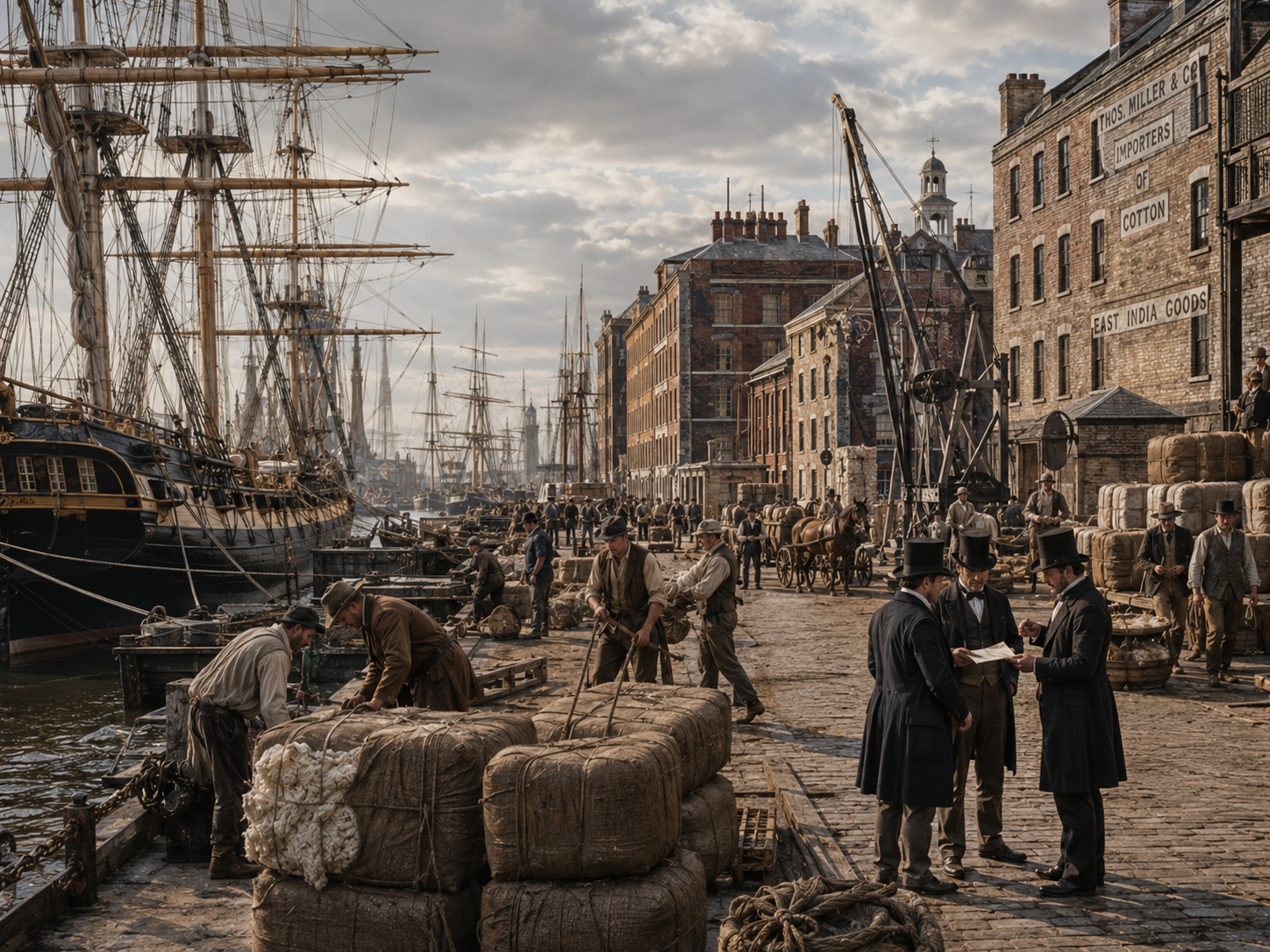
Britain's Industrial Revolution did not happen inside Britain alone.
British merchants were part of a rapidly expanding global trading system.
Ships carried goods across the Atlantic and beyond.
British consumers bought products from abroad.
British manufacturers increasingly sold goods overseas.
This mattered because industry needs customers.
A factory capable of producing large quantities of cloth needs somewhere to sell that cloth.
Britain's growing commercial networks provided those markets.
Empire also mattered.
The British economy was deeply connected to colonial trade and to the Atlantic economy. London, Bristol and Liverpool became major centers of commerce, banking, insurance and shipping. UK Parliament's historical material notes that banking, insurance and industries supplying Atlantic trade all expanded alongside commerce connected to slave-produced goods.
And there is no honest way to tell this story without mentioning slavery.
British merchants, manufacturers, shipowners, financiers and consumers participated in an Atlantic economy that depended heavily on enslaved labor and colonial production.
Raw cotton used by Britain's growing textile industry increasingly came from plantations worked by enslaved people, especially in the Americas.
But historians disagree about exactly how much slavery-derived wealth directly financed British industrialization.
So two statements should not be confused.
It is too simple to say:
“Slavery paid for the entire Industrial Revolution.”
It is also too simple to say:
“Slavery had nothing to do with British industrialization.”
The stronger conclusion is that British industrialization developed within a global commercial system shaped by slavery, colonialism, trade and imperial power. These systems created markets, supplied raw materials and generated commercial activity, even though their precise financial contribution to industrial investment remains debated.
That global connection became one of Britain's greatest economic advantages.
And eventually, British factories would produce goods on a scale the world had rarely seen.
Industry and the Global Economy
Chapter 6 — Why Inventors Could Turn Ideas Into Businesses
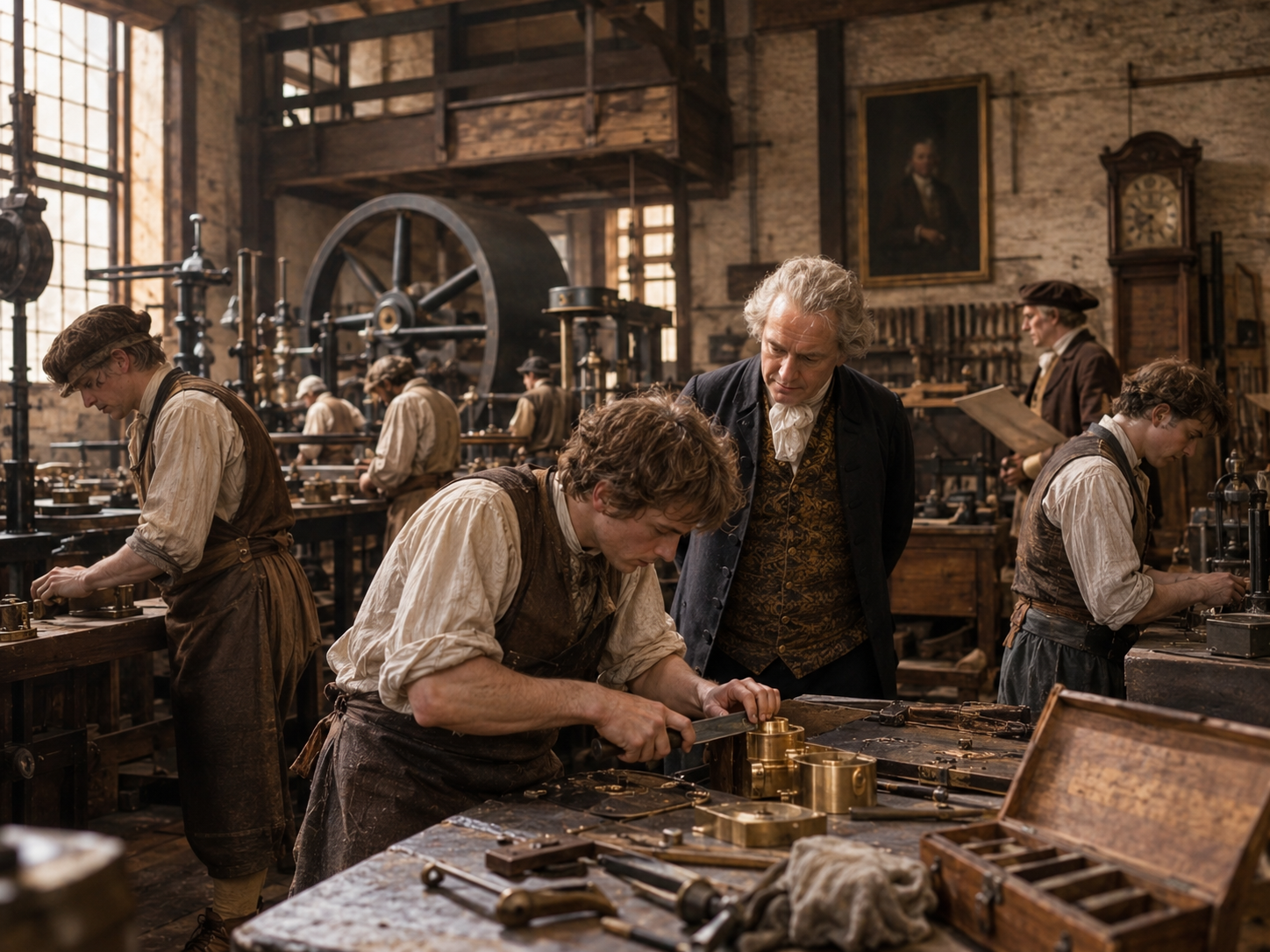
Having an invention is not enough.
Someone has to build it.
Someone has to pay for it.
Someone has to find customers.
Britain had a growing commercial system that could help make this happen.
Inventors could seek patents to protect particular inventions. Entrepreneurs could raise money. Banks and other financial institutions provided credit. Manufacturers could work with engineers and skilled craftsmen to turn ideas into machines.
Parliament also created laws affecting contracts, companies, insurance and patents as Britain's industrial economy developed.
But this should not be misunderstood as a perfectly designed system created specifically to produce the Industrial Revolution.
Much of it developed gradually.
The important thing was that inventors were working in a society with markets, workshops, investors and customers.
Take Richard Arkwright.
His water frame helped transform cotton spinning, and his business model brought machinery, capital and organized factory production together.
Or consider James Watt.
His steam-engine improvements became much more powerful economically when he partnered with industrial entrepreneur Matthew Boulton.
This partnership is a useful lesson.
Watt had technical knowledge.
Boulton had business experience, manufacturing capacity and access to capital.
Together, they could turn an improved machine into a commercial product.
That is how inventions change an economy.
Not when an inventor draws something on paper.
When the idea becomes repeatable, affordable and profitable.
Britain had a growing ecosystem in which that could happen.
From Invention to Industry
Chapter 7 — Steam Engines Were Not the Beginning
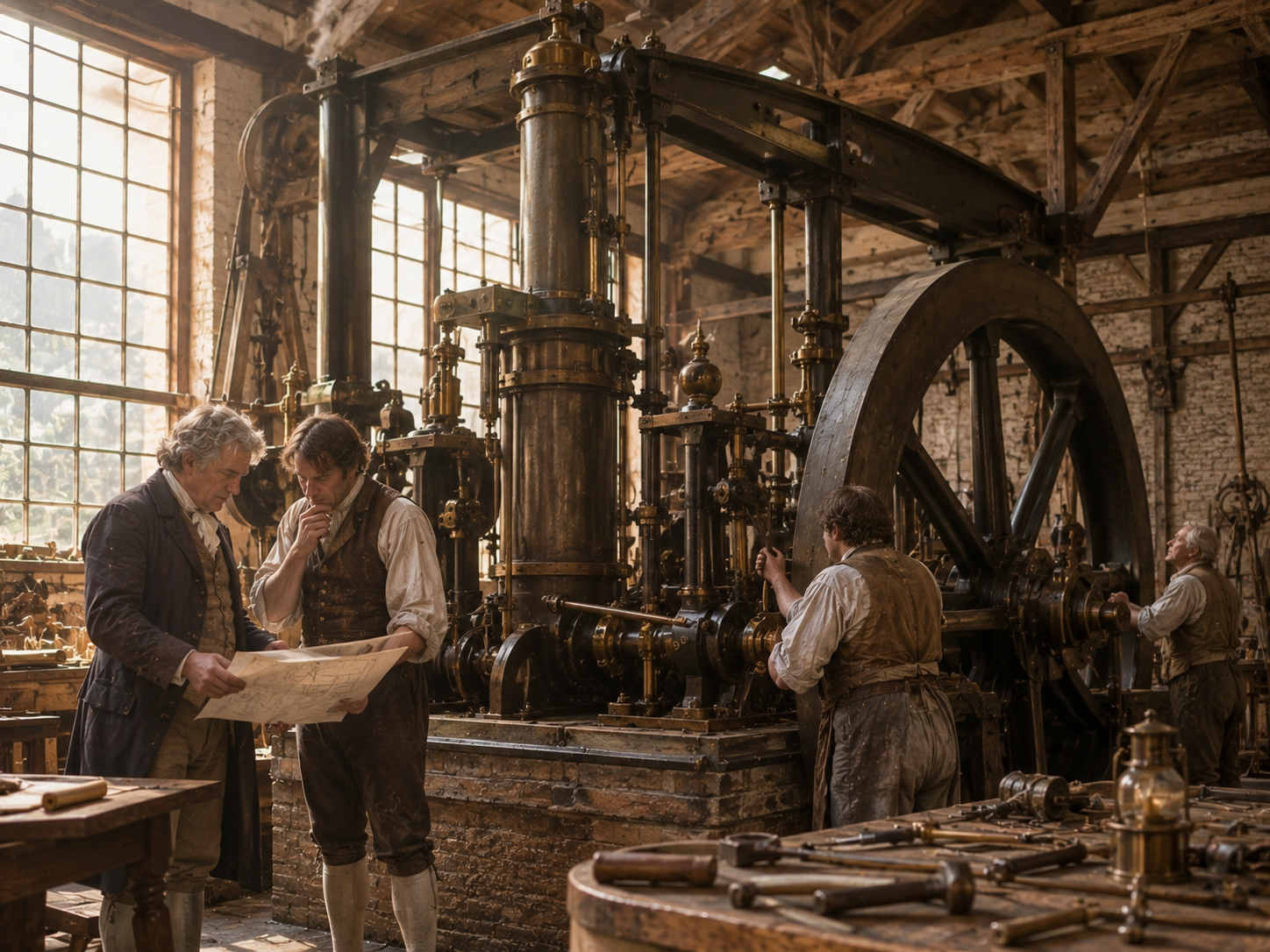
It is tempting to tell the Industrial Revolution as a story that begins with the steam engine.
The real story starts earlier.
Britain already had growing textile production, coal mining, ironworking and commercial activity.
The first major steam engines were created largely to solve a practical problem:
How do you pump water out of deep mines?
Thomas Newcomen's atmospheric engine, developed around 1712, could pump water from mines.
It was useful, but inefficient.
Then James Watt made major improvements to the design in the 1760s. His separate condenser greatly reduced wasted energy, and further improvements made steam power increasingly useful outside mine pumping.
This opened new possibilities.
Factories no longer had to depend entirely on flowing water for mechanical power.
Steam engines could be installed where fuel and transport made them practical.
Textile factories expanded.
Iron production grew.
And eventually steam power transformed transportation through locomotives and steamships.
But the order matters.
Steam did not start the Industrial Revolution.
It became one of the technologies that helped the revolution grow faster.
That is another example of the larger pattern.
A technology becomes powerful when other parts of the economy are ready for it.
Coal mines created demand for engines.
Engineering industries improved them.
Factories created new uses.
Canals and later railways moved fuel and goods.
The technologies fed into one another.
From Mine Pump to Industrial Power
Chapter 8 — Why Not China, France or the Netherlands?
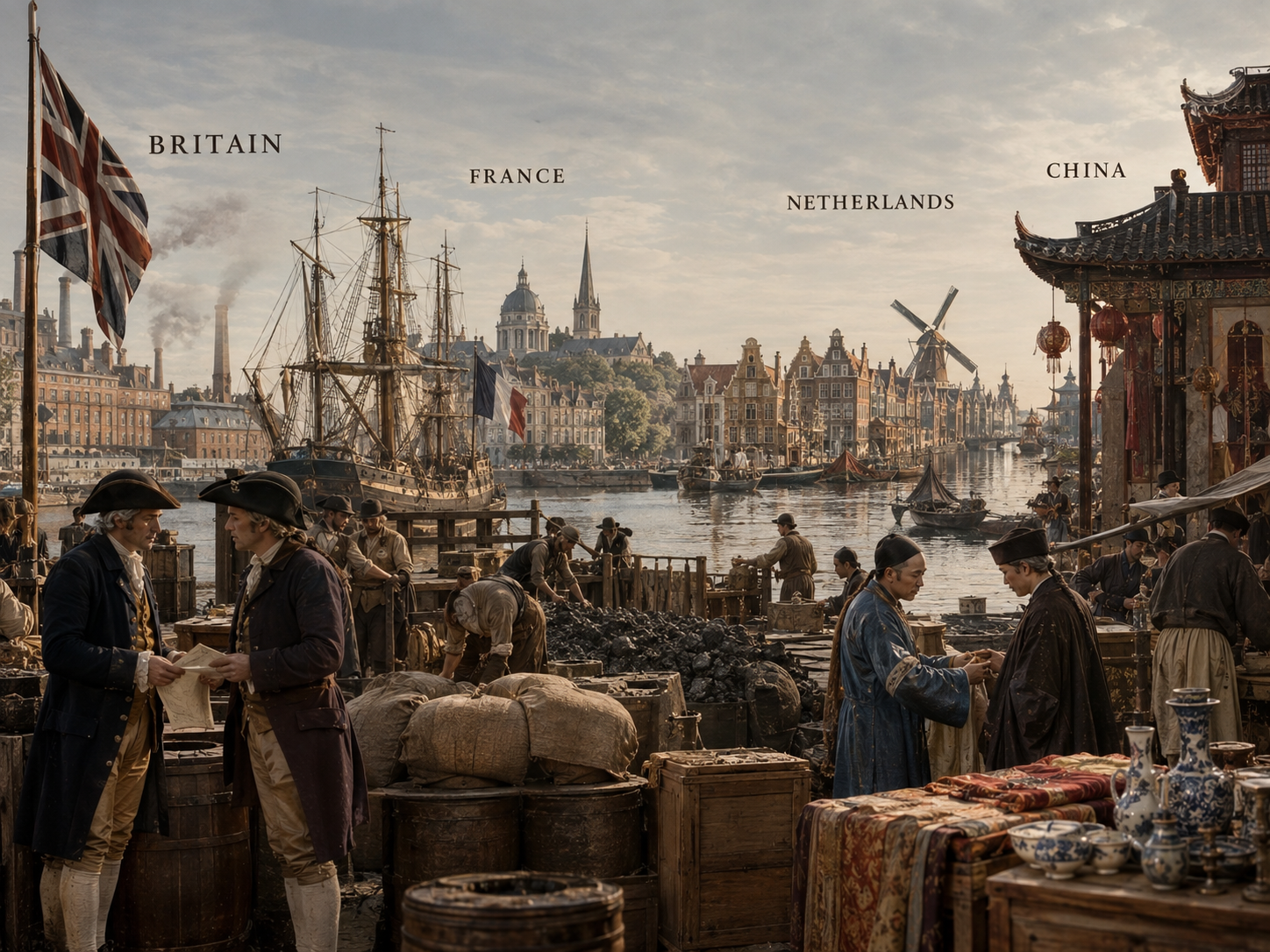
This is where the simple story breaks down.
If coal, trade, skilled people and good institutions were enough, other countries should have industrialized at exactly the same time.
They did not.
China had large markets, advanced technologies, commercial cities and sophisticated manufacturing traditions.
The Netherlands had excellent transport, finance, trade and a highly commercial economy.
France had a large population, skilled craftsmen, substantial resources and an important scientific tradition.
So why Britain?
There is no single answer accepted by every historian.
One influential argument emphasizes Britain's unusual combination of high wages and cheap energy. That made labor-saving technologies particularly attractive.
Another line of research places more weight on global trade and empire, arguing that Britain's commercial expansion created markets and encouraged innovation. Allen himself links Britain's wage and price structure to its success in international trade.
Other historians question how decisive British wages were and emphasize institutions, skills, culture, resources, markets or the particular development of Britain's industrial sectors.
The comparisons are useful because they show what was special about Britain.
The Netherlands had strong trade and finance but lacked Britain's enormous coal advantage.
China had enormous markets and sophisticated technologies, but its economic conditions and energy geography were different.
France had many ingredients for industrialization, but its industrial transition followed a different path and timing.
Britain's advantage was therefore not that it was simply “more advanced.”
It was that several conditions became unusually favorable at the same time.
And once British businesses began developing successful technologies, those technologies themselves changed the country's advantages.
That made the lead increasingly difficult for other countries to close.
Why Britain First?
Chapter 9 — When the Pieces Finally Connected
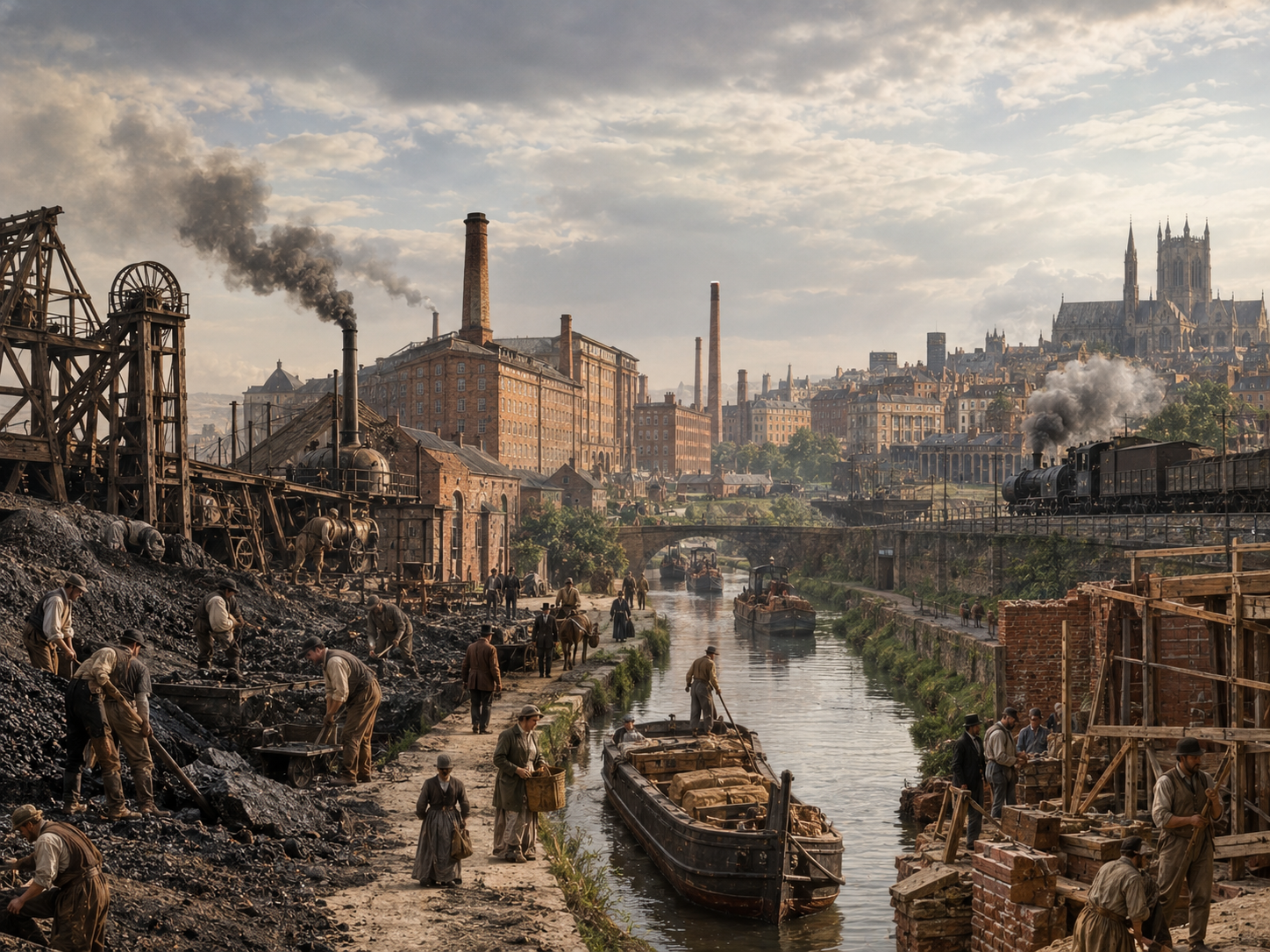
There was no single morning when Britain woke up and became industrial.
The transformation took decades.
Different changes arrived at different times.
But eventually, they began to reinforce one another.
Britain had relatively expensive labor.
That encouraged employers to search for machines that could save labor.
Coal offered unusually cheap energy.
That made energy-hungry machinery more attractive.
Agricultural changes helped support population growth and a larger workforce.
Growing towns created workers and consumers.
Trade connected Britain to overseas markets and raw materials.
Banks, investors, entrepreneurs and legal institutions helped turn inventions into businesses.
Canals made it cheaper to move coal and other heavy goods.
Steam engines made factories less dependent on rivers.
And successful factories created still more demand for coal, machines, transport and skilled workers.
The important word is connection.
None of these factors needed to be perfect on its own.
What mattered was that they could strengthen one another.
A cheap-energy economy made machinery more attractive.
Machinery increased production.
More production increased demand for coal.
Growing markets made investment more profitable.
Investment supported better machines.
Better machines made British products more competitive.
The cycle continued.
This is why the Industrial Revolution is better understood as a system of changes than as the story of one invention.
Britain did not industrialize simply because it had coal.
It did not industrialize simply because James Watt improved the steam engine.
It did not industrialize simply because wages were high.
And it did not industrialize simply because Britain had an empire.
The remarkable thing was that these conditions came together.
Britain happened to be standing at the intersection of energy, labor, technology, markets, finance, geography and global trade.
Once the pieces connected, the consequences reached far beyond Britain.
Factories spread.
Railways crossed continents.
Steamships crossed oceans.
Industrial production reshaped cities and societies.
And the world began moving toward the modern economic system we recognize today.
The Industrial Revolution did not start because Britain had one unbeatable advantage.
It started because Britain had several advantages that suddenly began working together.
The Pieces Finally Connected
Final takeaway
The Industrial Revolution was not one invention appearing out of nowhere.
It was a chain reaction.
High wages encouraged labor-saving technology.
Coal provided cheap energy.
Agricultural change supported population growth.
Trade created markets and supplied raw materials.
Finance and institutions helped inventions become businesses.
Canals and steam made movement cheaper.
Britain's unusual advantage was that these changes reinforced one another.
That is why the better question is not simply “Why did Britain have the Industrial Revolution?”
It is:
“Why did so many favorable conditions come together in Britain at the same time?”
And that question has a much more interesting answer.
FAQ Frequently Asked Question
1. Why did the Industrial Revolution start in Britain?
There was no single cause. Britain had a useful combination of relatively high wages, cheap coal, improving agriculture, growing trade, expanding markets, transport networks, finance and a strong environment for practical invention. Historians continue to debate which factors mattered most.
2. Was coal the main reason Britain industrialized first?
Coal was extremely important because it provided relatively cheap energy for steam engines, metal production and other industries. But coal alone does not explain Britain's lead. It became especially powerful when combined with expensive labor and growing demand for machinery.
3. How did high wages help cause the Industrial Revolution?
When workers were relatively expensive, businesses had more reason to invest in machines that could reduce the amount of labor needed. Economist Robert C. Allen's influential theory argues that Britain's unusual combination of high wages and cheap energy helped make labor-saving technology profitable.
4. Did James Watt invent the steam engine?
No. Steam engines existed before Watt. Thomas Newcomen developed an early practical atmospheric steam engine in the early 18th century, mainly for pumping water from mines. Watt later made important improvements that greatly increased efficiency and helped expand the uses of steam power.
5. Did the Industrial Revolution begin with steam engines?
Not exactly. Industrialization was already developing in areas such as textiles, coal mining and iron production before improved steam engines became widely useful. Steam power later became one of the most important technologies driving further industrial growth.
6. How did agriculture help the Industrial Revolution?
Improved agricultural productivity helped Britain support a growing population. Population growth increased both the supply of workers and the number of consumers buying manufactured goods. Changes in rural employment and land use also helped connect agriculture more closely with Britain's growing market economy.
7. Did Britain's empire and slavery help the Industrial Revolution?
Britain's industrialization developed within a global trading system shaped by empire, colonialism and slavery. Overseas trade provided markets and raw materials, including cotton produced by enslaved labor. However, historians disagree about how much slavery-derived wealth directly financed industrial investment, so it is too simple to say slavery alone “funded” the Industrial Revolution.
8. Why didn't the Industrial Revolution start in China or France?
Both China and France had important technologies, skilled workers, large markets and commercial economies. The difference was the particular combination of conditions Britain had at the right time. High wages and cheap energy are one influential explanation, but historians also debate the roles of trade, institutions, resources, markets and innovation.
9. Did the Industrial Revolution make Britain rich immediately?
No. Industrial production and national economic output grew, but the benefits were not shared equally. Many workers lived in difficult conditions, especially during the early decades of factory industrialization. Economic growth and improved living standards did not arrive at the same speed.
10. Was the Industrial Revolution caused by one invention?
No. There were many important inventions, including new spinning machines, improved iron-making methods and better steam engines. Their importance came from how they worked together with cheap energy, markets, investment, transportation and a growing industrial workforce.
11. Why were canals important to Britain's Industrial Revolution?
Canals made it much cheaper to transport heavy materials such as coal. Britain's canal network expanded rapidly during the 18th and early 19th centuries, linking inland industrial areas with cities, rivers and ports. Lower transport costs helped industries grow beyond the immediate areas around mines and rivers.
12. What made Britain's Industrial Revolution different?
The most important difference was not one British invention or resource. It was the combination of several advantages. High wages encouraged labor-saving machines, coal supplied cheap energy, trade created markets, agriculture supported population growth, and entrepreneurs and investors helped turn inventions into large-scale businesses.