Skip to Content
AtlasNova
  • 0
  • 0
  • Contact Us
  • Home
  • Wildlife
  • Space
  • Places
  • History and Culture
  • About Us
AtlasNova
  • 0
  • 0
    • Home
    • Wildlife
    • Space
    • Places
    • History and Culture
    • About Us
  • Contact Us

Why Did Medieval Towns Lock Their Gates at Night? What Happened After Dark

Why did medieval towns close their gates at night? Discover how gates controlled security, movement, trade, tolls and life after the curfew bell.
  • All Blogs
  • History and Culture
  • Why Did Medieval Towns Lock Their Gates at Night? What Happened After Dark
  • 28 August 2026 by
    Arpit Kaintura
    | No comments yet

    Introduction

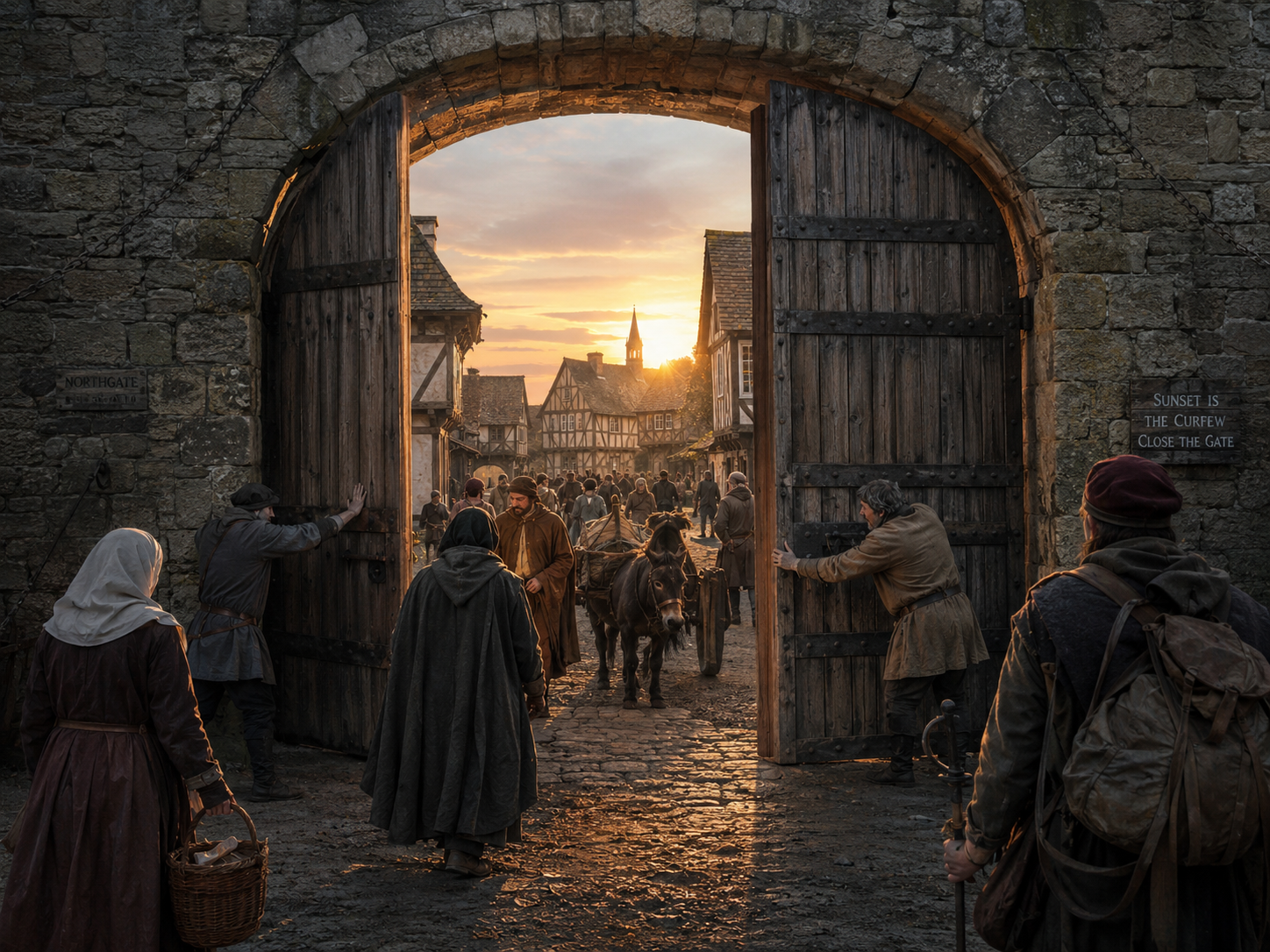
    A medieval town gate closes at sunset as townspeople hurry inside and late travelers remain outside.

    ย Imagine arriving at a medieval town just as the sun is disappearing.

    You can see the gate ahead.

    You are close enough to hear people inside, perhaps carts moving over the street and voices fading into the evening.

    Then the bell rings.

    The gate begins to close.

    You hurry forward, but the heavy doors are already moving.

    A few minutes later, they are shut.

    You are outside.

    For someone living in a modern city, the idea seems extraordinary. A town could effectively control who entered and left simply by closing its gates at night.

    But medieval town gates were much more than defensive doors.

    They were control points.

    During the day, people, animals, carts, merchants and travelers could pass through them. At night, the same narrow entrance could be closed and watched. Depending on the town and period, gates could help regulate movement, collect tolls, restrict access and improve security.

    And the closing time was not necessarily the same everywhere.

    Some towns used bells or other signals to announce curfew or the closing of gates. Others followed local customs, regulations or watch arrangements. There was no single medieval timetable followed by every town.

    What is fascinating is what happened once the gates were shut.

    The town did not simply go to sleep.

    Watchmen remained on duty. People already inside continued their evening. Fires had to be managed. Streets became quieter and darker. And travelers who arrived too late had to wait.

    For a few hours, the town became a very different kind of place.


    Chapter 1 โ€” The Five Minutes Too Late

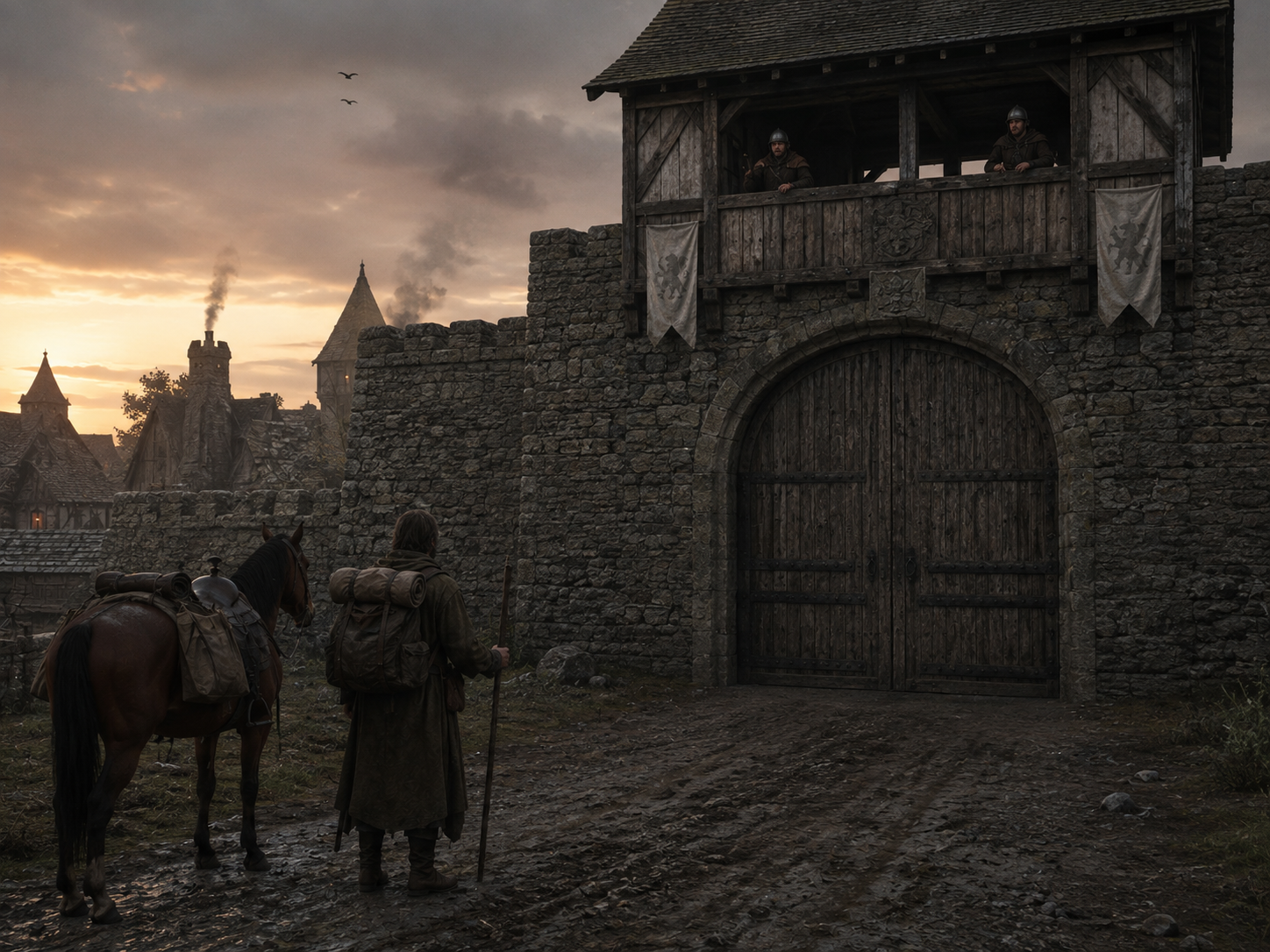
    A late medieval traveler stands outside a closed town gate while watchmen observe from the gatehouse.

    ย The most frustrating moment came when you could see the town but could no longer enter it.

    A traveler arriving after the gate had closed could not simply knock and expect someone to open it.

    Opening a town gate was a serious decision.

    The gate was part of the town's security system, and controlling access after dark reduced the number of unknown people moving through the streets.

    But this did not mean every medieval town automatically trapped everyone outside at exactly sunset.

    That is one of the first myths worth removing.

    Medieval towns were different from one another. Their gates, regulations, watch systems and curfews depended on local circumstances and changed over time.

    Some towns had bells associated with curfew or the closing of gates. In other places, regulations specified when gates should be shut or who was responsible for guarding them.

    The important principle was not sunset = gates always close everywhere.

    It was:

    Night changed the rules of movement.

    Once darkness made it harder to identify people and detect threats, controlling entry became more valuable.

    If you were already inside, you had an advantage.

    If you were outside, you might have to find somewhere else to spend the night.

    That could mean an inn outside the walls, a nearby settlement, or simply waiting until the gates opened again.

    The town's gate had turned an ordinary journey into a deadline.


    What Happened If You Arrived Too Late?

    Medieval Urban Logistics

    What Happened If You Arrived Too Late?

    ๐Ÿšถ
    Approaching Traveler
    Rushing before dusk
    ๐Ÿฐ Town Gatehouse
    The Security & Tax Boundary
    ๐Ÿ›ก๏ธ
    City Watchmen
    Enforcing the curfew
    The Sunset Timeline
    01
    Traveler Approaches
    Merchants, pilgrims, and locals race against the fading daylight to reach the perimeter wall.
    02
    Gate Still Open
    Guards check incoming traffic, collect entry tariffs, and monitor goods entering the market.
    03
    Closing Signal / Curfew Bell
    Bells ring or horns sound from church towers and gatehouses warning that lockdown is imminent.
    04
    Gate Closes & Locks
    Heavy wooden doors swing shut, iron portcullises drop, and key deadbolts are secured for the night.
    Status
    Already Inside
    Continue freely into the town to find an inn, trade at evening taverns, or return home safe within the guarded walls.
    Status
    Still Outside
    Trapped in the extramural suburbs. Must wait until morning reopening or seek accommodation at risky roadside inns outside the wall.
    ๐Ÿ“œ Historical Context Note
    Closing times and procedures varied significantly between towns, regions, and centuries. While sunset was a common benchmark, some major trading centers kept smaller postern gates open longer for fees, while others locked down strictly based on local bell schedules rather than exact solar position.
    ๐Ÿ’ก Key Takeaway
    A closed gate turned arrival time into a major practical problem. Missing the deadline meant risking exposure to nighttime crime, weather, and extra expenses outside the protection of city laws.

    Chapter 2 โ€” The Gate Was More Than a Door

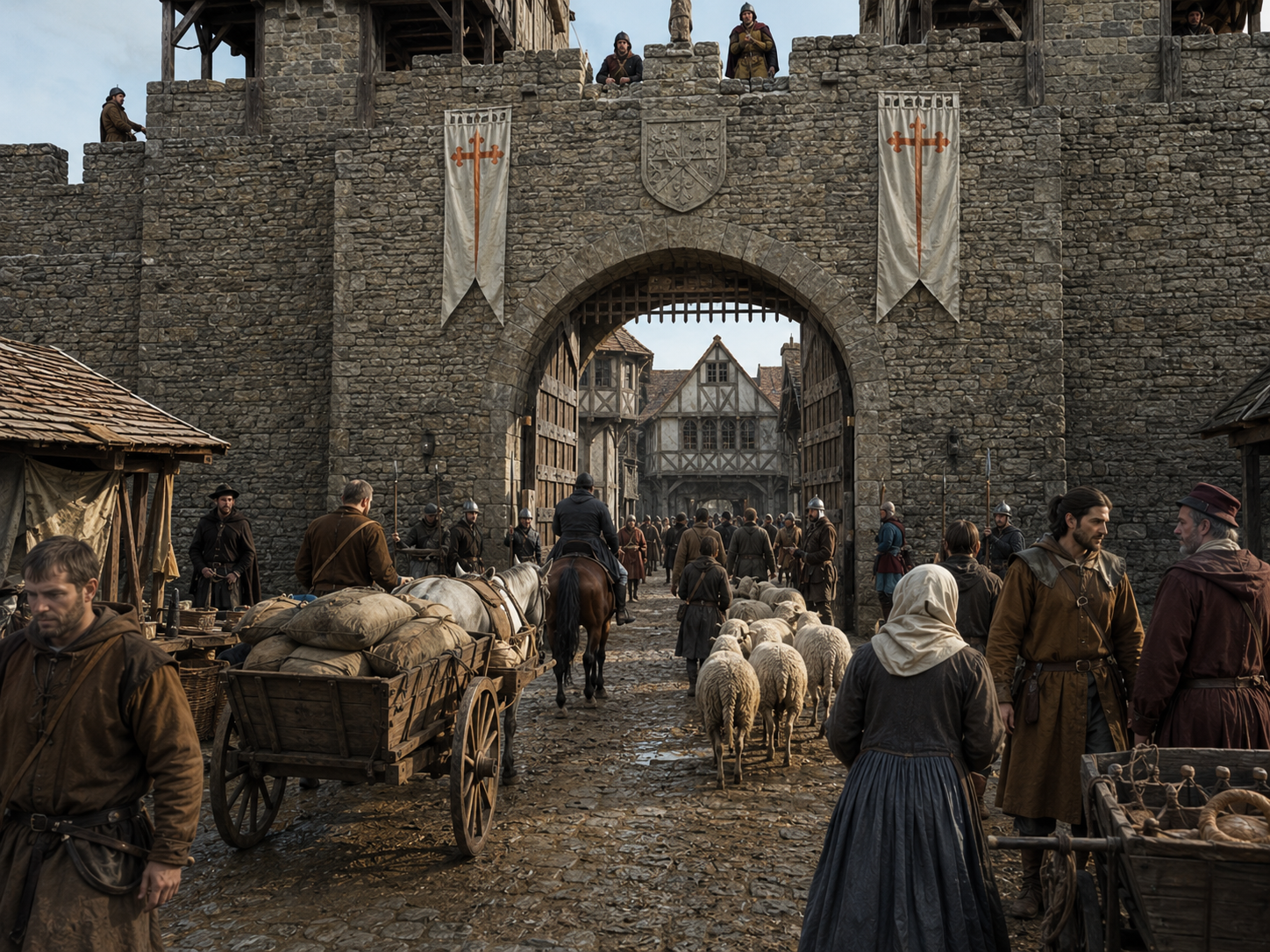
    Merchants, travelers and townspeople pass through a medieval town gate while officials monitor movement.

    ย It is easy to imagine a medieval town gate as a giant door whose only job was to stop an army.

    That was certainly important.

    But most of the time, a town was not under attack.

    The gate still mattered.

    It was one of the few places where almost everyone entering or leaving the town had to pass.

    That made it an excellent place to control movement.

    Merchants bringing goods could be inspected.

    Travelers could be questioned.

    Animals and carts could be monitored.

    Tolls could be collected.

    And people who were not supposed to enter could potentially be turned away.

    Medieval gates therefore sat at the intersection of defense, administration and commerce.

    Historical research on English medieval towns shows that gates could be used for purposes beyond military defense, including controlling access and regulating movement. The exact arrangements varied considerably from town to town.

    This explains why a gate could remain important during peacetime.

    The town did not need to be expecting an invading army for the gate to be useful.

    It was a checkpoint.

    And at night, that checkpoint became much more powerful.

    Instead of deciding individually who should pass through a dark street, authorities could simply restrict access through the main entrance.

    A single set of doors could change the movement of an entire town.


    Four Jobs of a Medieval Town Gate

    Medieval Urban Infrastructure

    Four Jobs of a Medieval Town Gate

    Town Gatehouse
    Civic Control Point
    ๐Ÿ›ก๏ธ
    DEFENSE
    Controlled access during danger. Provided heavy fortified barriers, portcullises, and towers to protect citizens from raids and sieges.
    ๐Ÿšถ
    MOVEMENT
    Regulated who entered and left. Managed the flow of travelers, merchants, and locals while enforcing nightly curfews.
    ๐Ÿช™
    TOLLS
    Provided a location where charges could be collected where applicable. Allowed city officials to levy taxes and duties on incoming market goods.
    ๐Ÿ“œ
    ADMINISTRATION
    Created a controlled point for inspection and regulation. Served to monitor health risks during plagues and inspect merchants' licenses.
    ๐Ÿ“œ Historical Clarification
    Not every gate performed all four functions in exactly the same way. Local regulations, city sizes, regional laws, and specific historical customs varied across medieval Europe.
    ๐Ÿ’ก Final Takeaway
    A medieval town gate was both a defensive structure and a practical control point, serving as the primary intersection between internal urban life and the outside world.

    Chapter 3 โ€” The Curfew Bell Changed the Evening

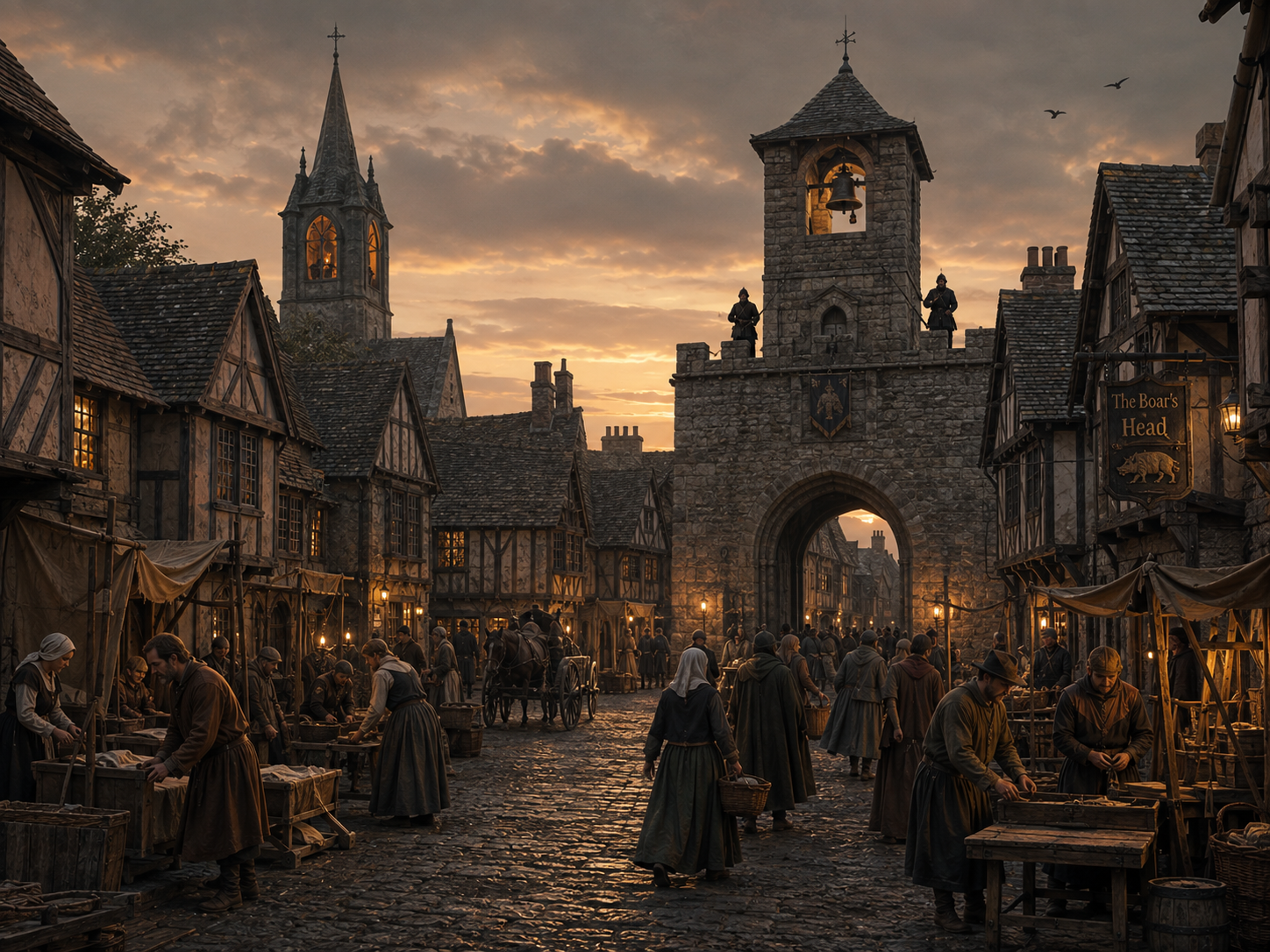
    A medieval town transitions into evening as a bell rings and townspeople finish their day's activities.

    ย The sound of a bell could change the atmosphere of an entire town.

    During the day, streets might be crowded with workers, merchants, animals and travelers.

    After dark, movement became more restricted.

    In many medieval communities, bells were used to communicate important times and instructions. A curfew bell could signal that it was time for certain activities to stop or that people should observe nighttime restrictions.

    But curfew did not necessarily mean โ€œeveryone must be inside their house immediately.โ€

    The word itself comes from the Old French couvre-feu, meaning โ€œcover fire.โ€ The original idea was closely associated with covering or extinguishing domestic fires at a particular time.

    Over time, curfew regulations could become connected with broader nighttime controls.

    That distinction matters.

    The medieval evening was not necessarily a complete shutdown.

    People still needed to work, travel locally and perform essential duties. Inns remained open. Watchmen continued their work. Certain people could have legitimate reasons to be outside.

    The rules were local.

    The bell was therefore not simply saying:

    โ€œGo to bed.โ€

    It could mark a transition from ordinary daytime activity to a more controlled nighttime environment.

    For travelers, that transition could be particularly important.

    If you were still approaching the town when the signal came, you might already have missed your opportunity.


    From Daytime to Curfew

    Medieval Evening Logistics

    How Curfew Changed the Medieval Evening

    ๐Ÿ”ฅ
    Etymological Origin
    The word curfew originates from the Old French couvre-feu, meaning literally "cover fire." It began as a practical safety signal instructing householders to extinguish or cover open hearth fires to prevent devastating urban blazes.
    ๐Ÿ””
    Curfew Bell
    โ˜€๏ธ Day
    Markets open, workshops active, open travel and normal urban movement.
    ๐ŸŒ… Late Afternoon
    Trade winds down; workers begin finishing daily activities.
    ๐Ÿ”” Evening Bell
    Nighttime signal rings, marking a formal change in city routine.
    ๐ŸŒ™ Night
    Gates close, watchmen take post, and public movement is restricted.
    โ˜€๏ธ 1. Day
    Markets, workshops, travel, and normal movement throughout the town.
    ๐ŸŒ… 2. Late Afternoon
    People begin finishing activities as daylight starts to fade.
    ๐Ÿ”” 3. Evening Bell
    A local curfew or nighttime signal marks a decisive change in routine.
    ๐ŸŒ™ 4. Night
    Gates close, watch arrangements become active, and movement becomes restricted.
    ๐Ÿ”ฅ Original Meaning (Fire Safety)
    Initially designed to prevent wood-and-thatch cities from burning down. Citizens covered domestic hearth fires with metal lids before sleeping.
    ๐Ÿ›ก๏ธ Later Expansion (Civic Control)
    Evolved into public order measures: closing taverns, restricting armed night travel, and signaling city watchmen to begin security patrols.
    ๐Ÿ“œ Historical Clarification
    Curfew rules varied widely across regions and eras. "Curfew" did not necessarily mean that every person had to remain strictly indoors immediately; exceptions existed for night watchmen, doctors, officials, and travelers with permission.
    ๐Ÿ’ก Final Takeaway
    The evening bell marked a fundamental shift in how the town managed nighttime lifeโ€”transitioning the community from open economic activity to regulated safety and security.

    Chapter 4 โ€” Who Guarded the Gate After Dark?

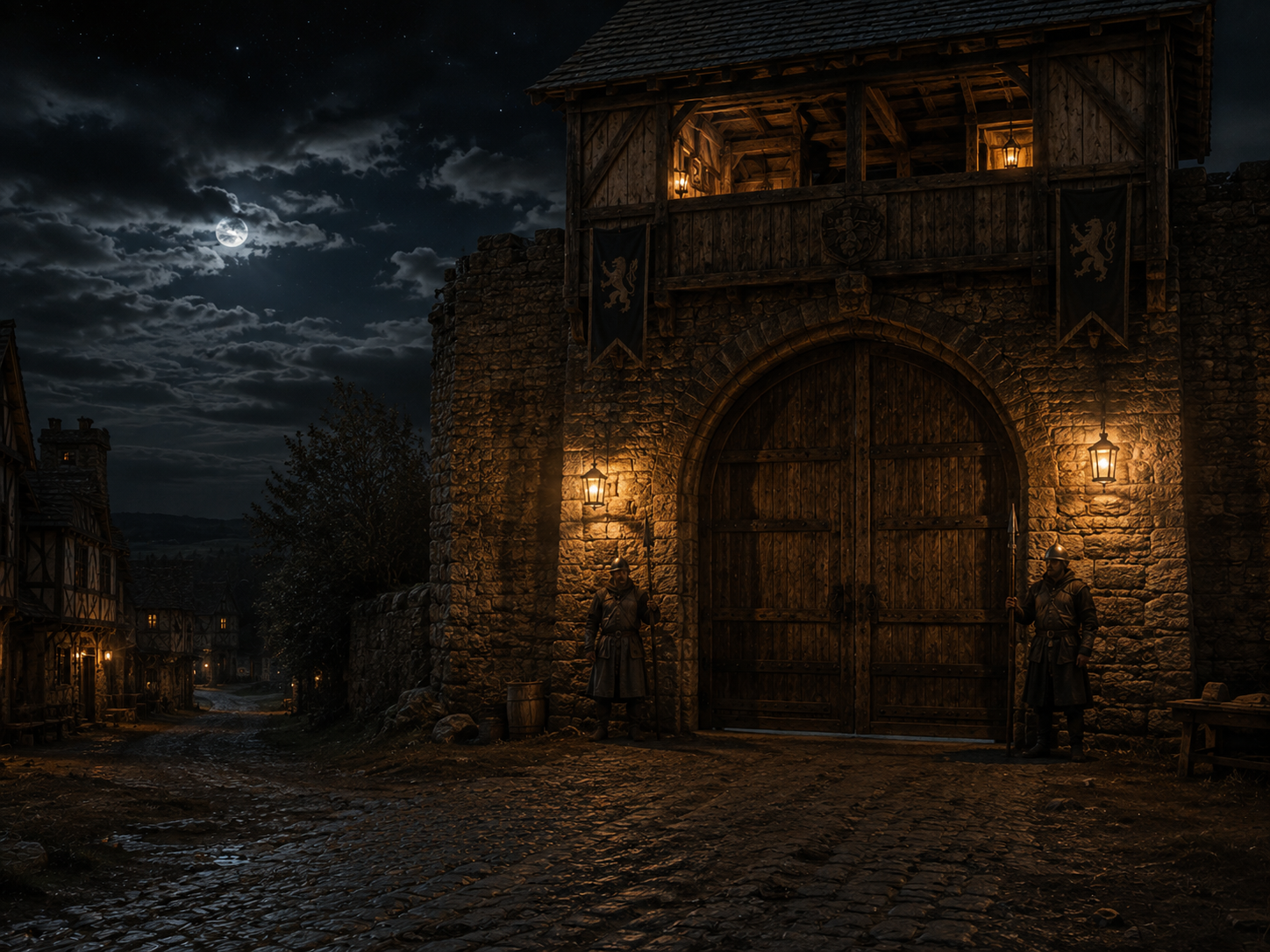
    Two medieval watchmen guard a closed town gate at night under lantern light.

    ย Closing the gate was only half the job.

    Someone had to stay there.

    Medieval towns employed or organized watchmen to monitor gates, walls and streets. The exact arrangement differed between communities. Some watches were organized by officials, while in other places townspeople had obligations to participate in maintaining the town's defenses.

    The gatehouse was therefore not abandoned once the doors closed.

    It became a controlled entrance.

    Watchmen could monitor the area outside, observe anyone approaching and respond to suspicious activity.

    They also had to deal with practical problems.

    What if someone inside needed to leave?

    What if an important traveler arrived?

    What if a fire broke out?

    What if there was a genuine emergency?

    A locked gate was not an absolute wall between the town and the outside world. There could be procedures for exceptional circumstances.

    That is another reason not to imagine medieval curfew as a simple rule applied identically to everyone.

    The town had to remain functional.

    But the default position had changed.

    During the day, people could approach the gate and pass through.

    At night, the burden shifted to anyone who wanted access.

    The gatekeeper or watch had to decide whether there was a reason to open it.

    For ordinary travelers, that could mean waiting until morning.


    Life at the Gate After Dark

    Nighttime Guard Operations

    Life at the Gate After Dark

    ๐Ÿ›ก๏ธ Watchmen On Duty
    ๐Ÿ‘๏ธ
    WATCH
    Observe the gate and surrounding roads. Maintain constant vigilance over approaching silhouettes and lanterns.
    ๐Ÿ”‘
    CONTROL
    Decide whether access should be allowed. Verify credentials, official permits, or identity before opening postern doors.
    ๐Ÿ›ก๏ธ
    SECURITY
    Monitor unusual activity. Prevent illegal wall crossings, contain night disturbances, and deter criminal threats.
    ๐Ÿšจ
    EMERGENCY
    Respond according to local procedures when necessary. Sound alarm bells or alert civic authorities during fires or attacks.
    Nighttime Access Decision Pathway
    ๐Ÿšถ Person Approaches Gate
    โž”
    ๐Ÿ” Watch Identifies Situation
    Normal Traveler?
    โž” May have to wait outside until morning reopening.
    Exceptional Reason?
    โž” Local procedures (messengers, doctors, officials) may allow access.
    โš ๏ธ Historical Caution
    Exact night rules differed significantly between medieval towns and historical periods. Some cities strictly banned all entry, while others allowed passage through small side doors ("posterns") for a hefty night fee.
    ๐Ÿ’ก Final Takeaway
    Closing the gate did not end the gatekeeper's workโ€”it made the gate more controlled, shifting duties from broad daytime traffic management to vigilant nighttime security.

    Chapter 5 โ€” What Happened Inside the Town?

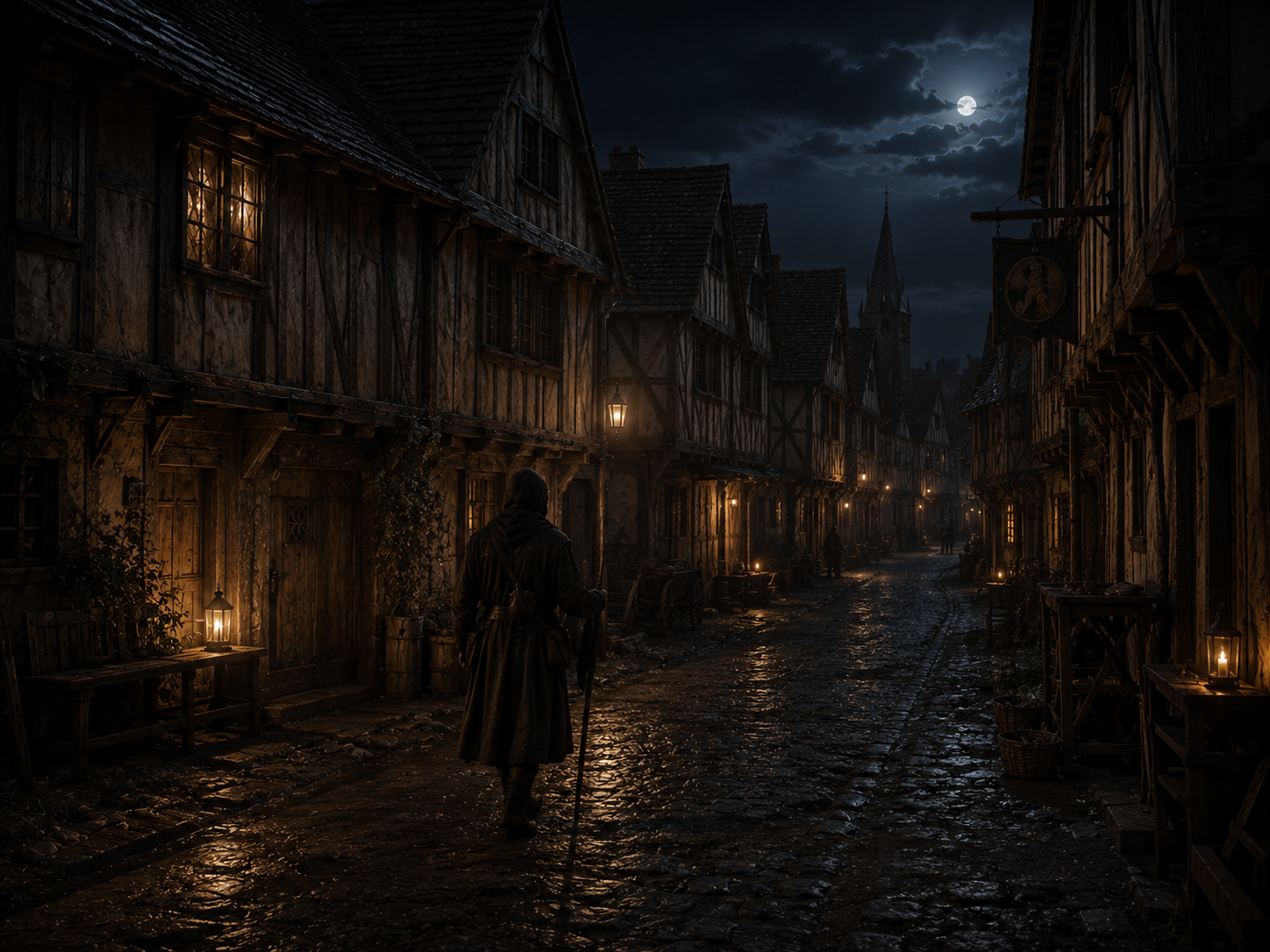
    A quiet medieval town street is illuminated by small lanterns while a watchman patrols after the gates have closed.

    ย The gates closed, but life did not stop.

    Inside the walls, people were still awake.

    An innkeeper might be serving guests.

    A baker might be preparing food.

    A household might be cooking.

    Workers could still be finishing tasks.

    And watchmen were still moving through the town.

    But the character of the streets changed.

    Without the steady flow of daytime traffic, streets could become quieter. Lighting was limited compared with modern cities, with candles, lamps and fires providing localized pools of light rather than illuminating entire streets.

    That darkness mattered.

    It made it harder to identify strangers.

    It also made accidental fires particularly dangerous.

    This helps explain why nighttime regulation was about more than keeping enemies out.

    A town filled with wooden buildings, open flames and narrow streets had reasons to take nighttime behavior seriously.

    But again, the reality was not universal.

    Medieval towns were not identical, and neither were their rules.

    Some were larger and wealthier. Some had stronger municipal governments. Some had major commercial traffic continuing after dark.

    The important change was that night reduced visibility and increased the value of control.

    The gate was closed.

    The watch continued.

    And the streets belonged mostly to the people who were already inside.


    A Medieval Town After Dark

    Medieval Urban Geography

    A Medieval Town After Dark

    Town Cross-Section After Dark
    ๐Ÿ›ก๏ธ Gatehouse Perimeter
    ๐Ÿฐ
    GATE
    Closed and guarded. The primary line of defense becomes a locked boundary regulating night entry.
    ๐Ÿ›ฃ๏ธ Cobblestone Alley
    ๐ŸŒ™
    STREETS
    Quieter and less heavily traveled. Commerce pauses as public thoroughfares empty out after curfew signals.
    ๐Ÿ 
    ๐Ÿบ
    ๐Ÿ”ฅ
    HOMES & INNS
    People continue ordinary nighttime activities indoors, shifting life around domestic hearths, dining, and indoor rest.
    ๐Ÿšถโ€โ™‚๏ธ ๐Ÿ•ฏ๏ธ
    ๐Ÿ—ก๏ธ
    WATCH
    Guards and local watch systems remain active, conducting rounds to protect properties and respond to hazards.
    Nighttime Lighting Comparison
    ๐Ÿ’ก Modern City
    Continuous artificial illumination from electric streetlights, neon signs, and commercial buildings creates widespread visibility across entire districts.
    ๐Ÿ•ฏ๏ธ Medieval Town
    Localized light from candles, oil lamps, and hearth fires. Small pools of warm light illuminated individual rooms and doorways against surrounding dark streets.
    ๐ŸŒ‘ Less Visibility
    +
    ๐Ÿšถโ€โ™‚๏ธ Fewer People Moving
    +
    ๐Ÿ”’ Controlled Entrances
    โž”
    ๐Ÿ›ก๏ธ Greater Importance of Nighttime Watch
    ๐Ÿ“œ Important Historical Note
    Medieval towns varied greatly in size, governance, and infrastructure, so nighttime life was not identical everywhere. Coastal trading ports, university towns, and rural agricultural settlements each maintained their own unique evening customs.
    ๐Ÿ’ก Final Takeaway
    Closing the gates changed the rhythm of the town rather than stopping life altogetherโ€”shifting human activity from bustling public commerce to controlled, indoor private routines.

    Chapter 6 โ€” Gates Also Controlled Trade and Money

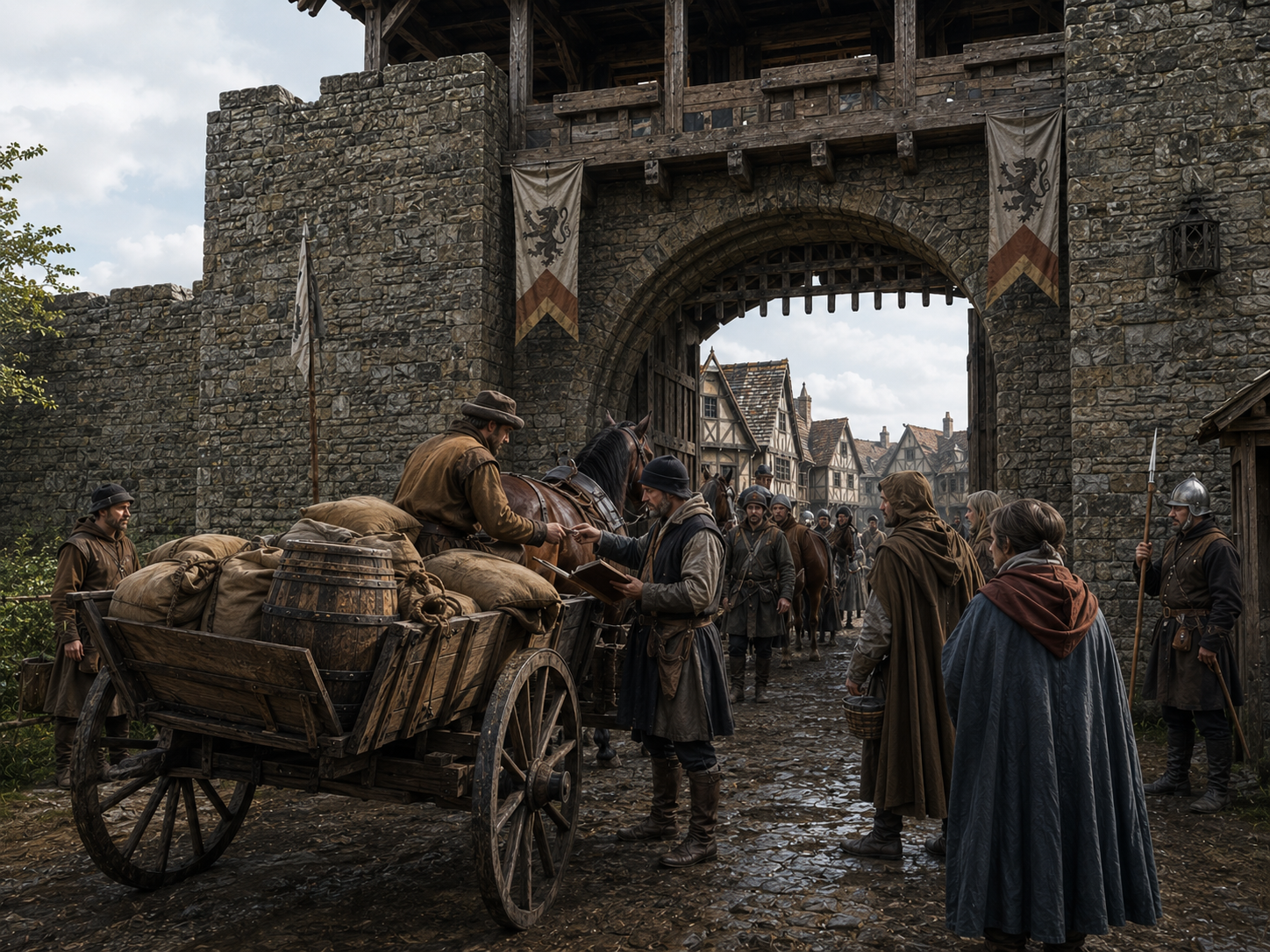
    A medieval toll collector examines a merchant cart as it passes through a fortified town gate.

    ย There was another reason town gates mattered.

    Money.

    Medieval towns could use gates as places where tolls and other charges were collected.

    A merchant arriving with goods might have to pay a toll before entering, depending on the town and its privileges.

    This made the gate an administrative bottleneck.

    Every cart passed through the same controlled entrance.

    The authorities did not need to search every street looking for incoming traders.

    They could regulate movement at the point where the road entered the town.

    That made the gate valuable even when no military threat existed.

    It was a physical expression of municipal authority.

    The same structure could help defend the town, control traffic and generate revenue.

    This also helps explain why gates could remain important during peacetime.

    A town gate was not simply waiting for an army.

    Every ordinary day, it was involved in the movement of people and goods.

    At night, closing it temporarily simplified that system.

    No ordinary stream of travelers.

    No routine commercial traffic.

    No uncontrolled movement through the main entrance.

    For a few hours, the town could effectively reduce the number of variables it had to monitor.


    The Gate as a Medieval Checkpoint

    Medieval Trade Infrastructure

    The Gate as a Medieval Checkpoint

    Checkpoint Flow & Actors
    ๐Ÿ›’
    Merchant Cart
    โž”
    ๐Ÿ’ฐ
    Toll Collector
    โž”
    ๐Ÿฐ
    Town Gatehouse
    1
    ARRIVAL
    Merchant approaches the gate with goods for trade.
    2
    INSPECTION
    Goods and circumstances may be checked by officials.
    3
    TOLL
    A local toll may be collected where applicable.
    4
    ENTRY
    Merchant enters the town to access local markets.
    ๐ŸŒ™
    Nighttime Restriction: Gate Closed
    Routine movement stops or becomes restricted. Trade and general entry pause until daylight, securing the town against unexpected nocturnal traffic.
    ๐Ÿ“œ Historical Caution
    Tolls and gate procedures varied according to local privileges, laws, and period. Exemptions often existed for local citizens, church authorities, or specific royal charters.
    ๐Ÿ’ก Final Takeaway
    The gate gave authorities a practical place to regulate movement and commerceโ€”serving simultaneously as a revenue collection point, quality control station, and defense barrier.

    Chapter 7 โ€” Why the Gates Eventually Stopped Closing
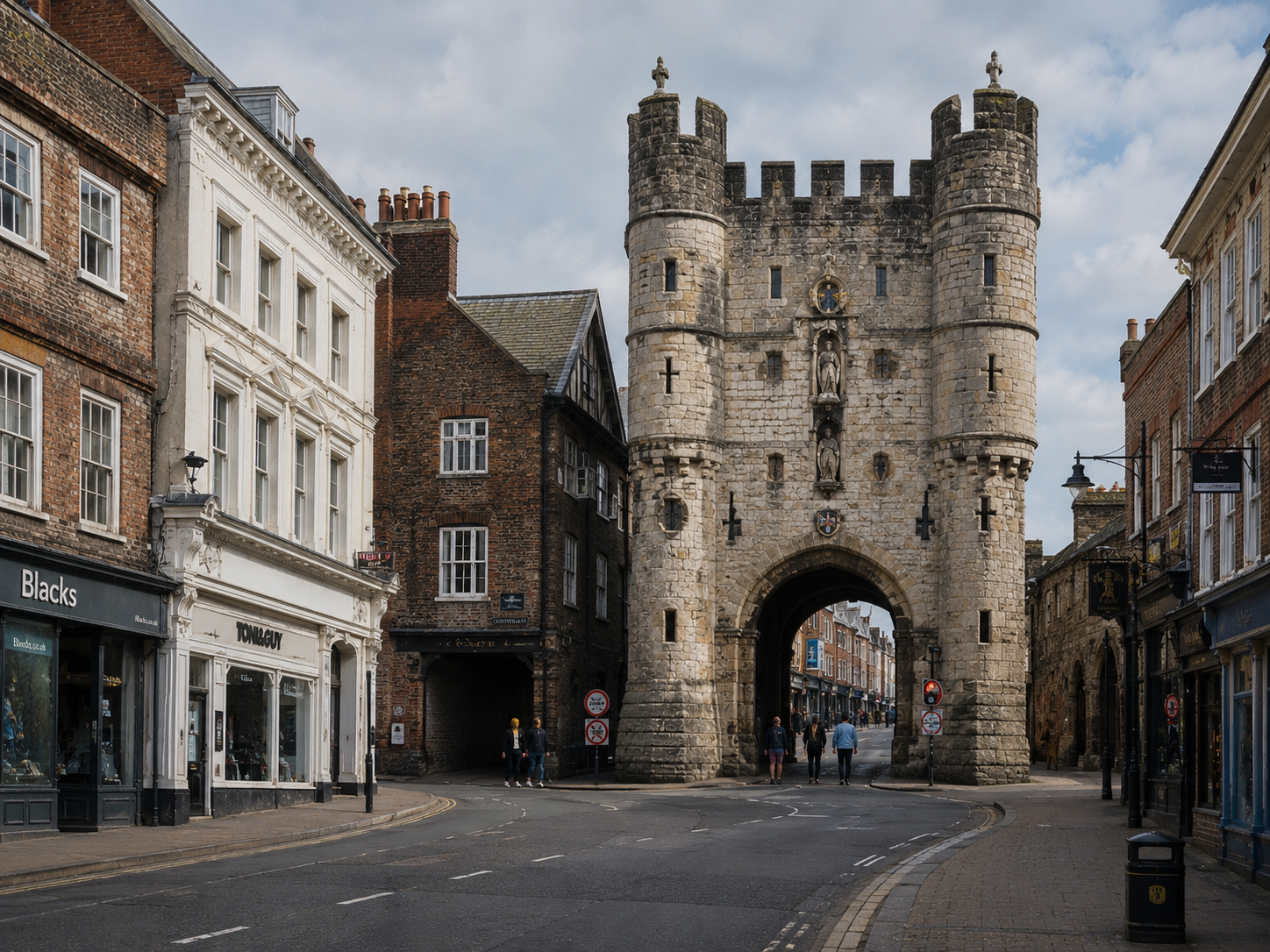
    A surviving medieval gatehouse stands beside later urban buildings, showing the transition from fortified town to expanding city.

    ย The habit of locking town gates at night did not disappear everywhere at the same time.

    In some places, gates remained important for centuries.

    But towns changed.

    As cities grew, walls and gates could become obstacles rather than necessities.

    Road traffic increased.

    Trade expanded.

    Urban areas spread beyond their medieval boundaries.

    New military technologies also changed the value of traditional walls and gatehouses. Artillery made many older fortifications less effective, while larger cities increasingly developed outside their medieval defenses.

    Eventually, a gate that once controlled the entire entrance to a town could become an inconvenient bottleneck.

    London provides a dramatic example.

    The medieval city's gates and walls gradually lost their defensive importance, and many were eventually demolished. The Great Fire of 1666 brought major rebuilding, but it did not single-handedly end the use of town gates across Britain.

    The larger change was gradual.

    The medieval walled town was evolving into a different kind of city.

    When movement became more important than restriction, a locked gate became less useful.

    And once the walls themselves no longer served their old purpose, there was little reason to preserve a daily routine built around closing them.

    The strange thing is that the system had once seemed completely normal.

    Every evening, the gates closed.

    Every morning, they opened again.

    For centuries, that simple rhythm shaped the lives of people who lived insideโ€”and everyone who arrived just a few minutes too late.


    From Locked Gates to Open Cities

    Urban Evolution & History

    From Locked Gates to Open Cities

    Architectural & Functional Transformation
    ๐Ÿฐ
    Walled Medieval Town
    Enclosed defense, restrictive gates, night curfews
    โž”
    ๐Ÿ™๏ธ
    Open Early-Modern City
    Unbounded growth, continuous traffic, removed barriers
    Military
    1. Medieval Walled Town
    Gates control entry, regulate trade, and provide primary defense against external threats.
    Commercial
    2. Growing Commerce
    Increasing populations of merchants and goods need to move rapidly through towns without bottleneck delays.
    Military
    3. Changing Warfare
    Traditional stone walls and gatehouses become ineffective against modern gunpowder and siege artillery.
    Urban
    4. Urban Expansion
    Suburbs sprout outside perimeter walls; cities physically expand beyond older defensive boundaries.
    Urban
    5. Gate Removal / Reduced Importance
    Old masonry entrances turn into traffic obstacles or lose their original security purpose entirely.
    ๐Ÿ“Œ
    Key Principle: The decline of town walls and gatehouses was a gradual historical process that varied significantly from city to city across Europe.
    ๐Ÿ” Historical Clarification
    The Great Fire of London (1666) was crucial to London's internal rebuilding, but the decline of medieval gates was a much broader, continent-wide process driven by economic growth and evolving military tactics over centuries.
    ๐Ÿ’ก Final Takeaway
    As cities evolved, economic demands and urban expansion gradually weakened the ancient necessity of securing a single controlled entrance every night.

    FAQ Frequently Asked Questions


    1. Why did medieval towns close their gates at night?

    Closing the gates could improve security and give authorities greater control over who entered and left after dark. Gates could also have wider administrative and commercial functions.

    2. Did every medieval town close its gates at sunset?

    No. Medieval towns had different rules and schedules. Some used bells or local regulations to mark nighttime restrictions, but there was no single timetable followed everywhere.

    3. What happened if you arrived after the medieval town gates closed?

    Depending on the town and circumstances, a traveler might have to wait until the gates reopened or find somewhere to stay outside the walls. Exceptional situations could be treated differently.

    4. Did medieval towns have curfews?

    Some medieval communities had curfew regulations or nighttime signals, but the meaning and enforcement varied. Curfew did not necessarily mean that everyone had to remain indoors immediately after a bell.

    5. What did the medieval curfew bell mean?

    The word โ€œcurfewโ€ comes from the Old French couvre-feu, meaning โ€œcover fire.โ€ Early curfew practices were associated with covering or extinguishing fires, although the term later became associated with broader nighttime restrictions.

    6. Who guarded medieval town gates at night?

    Watchmen or other people assigned to the town's watch guarded gates and other defensive positions. The exact organization varied between towns and periods.

    7. Were medieval town gates only used for defense?

    No. Gates could also regulate movement, provide locations for toll collection and help authorities control who entered the town. Their importance continued even during peacetime.

    8. Did merchants have to pay to enter medieval towns?

    In some towns, merchants and travelers could be subject to tolls or other charges. The rules depended on local laws, privileges and the period.

    9. Were medieval towns completely quiet after the gates closed?

    No. People continued to live and work inside the walls. Inns, households, watchmen and other activities continued after dark, although movement could be more restricted and streets were much less illuminated than modern cities.

    10. When did medieval towns stop locking their gates at night?

    There was no single date. The practice declined gradually as towns expanded, trade increased, military technology changed and medieval walls and gates became less useful or more inconvenient.


    in History and Culture
    Arpit Kaintura 28 August 2026
    Share this post

    Share

    Tags
    Our blogs
    • Our blog
    • Wildlife
    • Space
    • Places
    • History and Culture
    Archive
    Sign in to leave a comment
    Why Did Medieval Houses Have Overhanging Upper Floors? The Story of Jettying
    Why did medieval houses overhang narrow streets? Discover how jettying created extra floor space, shaped crowded towns and eventually fell out of fashion.
    Helpful Links
    • Home
    • About us
    • Privacy Policy
    • Contact us
    About us

    Welcome to Atlasnova, my personal website where I share interesting discoveries about space exploration, the solar system, world wildlife. My goal is to make space and wildlife easy to explore and fun to learn for curious minds everywhere. 

    Connect with us
    • Contact us
    • arpitkaintura2025@gmail.com

    Copyright ยฉ Atlasnova
    Powered by Odoo - The #1 Open Source eCommerce