Skip to Content
AtlasNova
  • 0
  • 0
  • Contact Us
  • Home
  • Wildlife
  • Space
  • Places
  • History and Culture
  • About Us
AtlasNova
  • 0
  • 0
    • Home
    • Wildlife
    • Space
    • Places
    • History and Culture
    • About Us
  • Contact Us

The Printing Press: The Invention That Rewired the World

How Gutenberg transformed printing in Europe, turning books from rare handmade objects into a powerful engine of knowledge, religion and change.
  • All Blogs
  • History and Culture
  • The Printing Press: The Invention That Rewired the World
  • 23 August 2026 by
    Arpit Kaintura
    | No comments yet

    Introduction — Before Every Book Was Printed
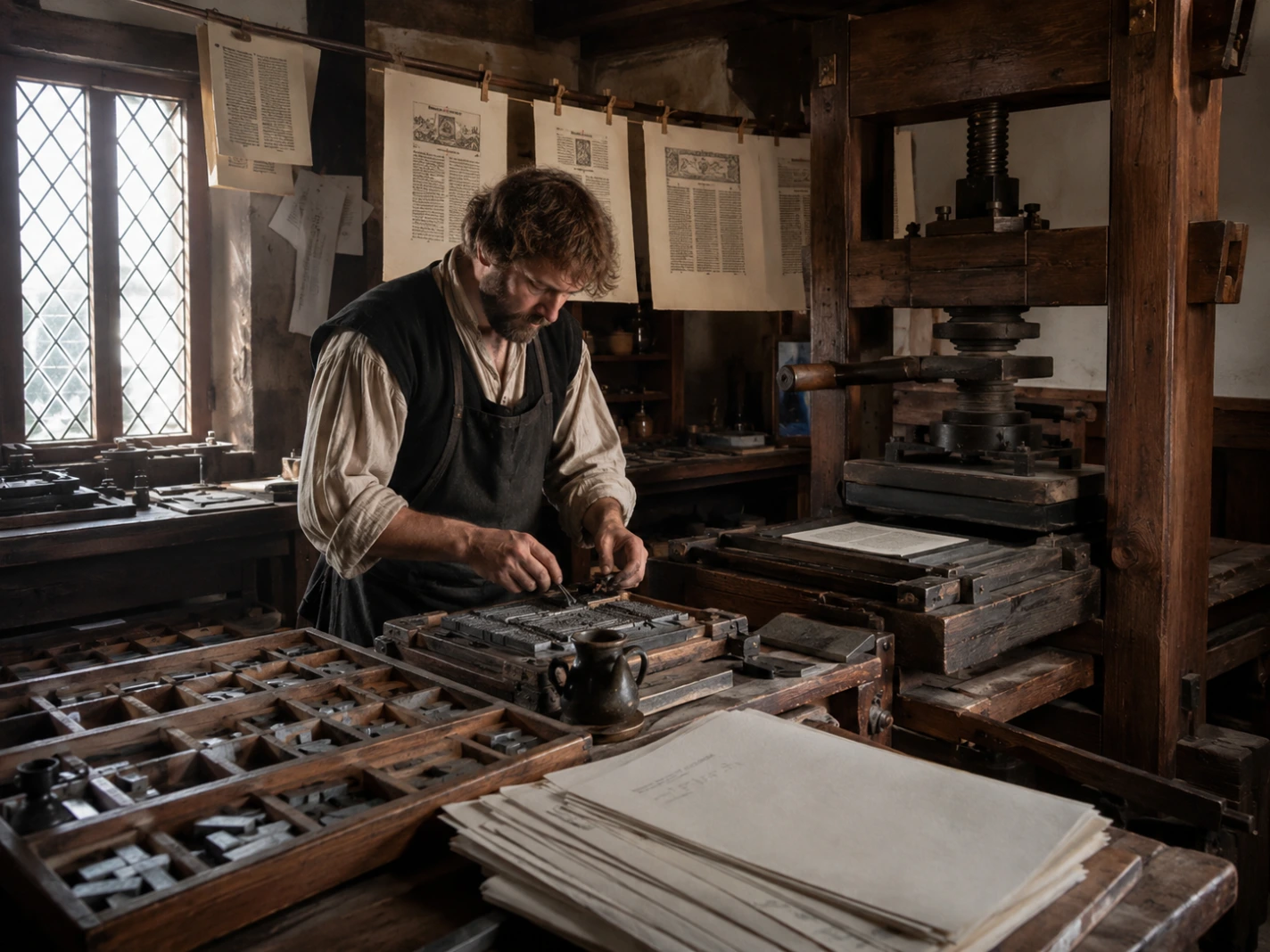
    A historically accurate reconstruction of a 15th-century European printing workshop.

     For centuries, making a book was a slow job.

    There was no printer's machine waiting in a workshop. No keyboard. No way to produce hundreds of identical pages in an afternoon.

    A text had to be copied by hand.

    A scribe sat for hours, copying one page after another. Large manuscripts could take months or even years to complete, depending on their size and decoration. That made books expensive and relatively rare.

    Then, in 15th-century Europe, something changed.

    A German craftsman named Johannes Gutenberg developed a new way to print with reusable metal letters. By bringing together movable type, suitable ink and a mechanical press, he created a system that could reproduce the same page again and again.

    The change was enormous.

    But there is an important part of the story that is often missed.

    Gutenberg did not invent printing.

    People in East Asia had been printing for centuries. China had movable type by the 11th century, and Korea was using movable metal type long before Gutenberg. The Korean Jikji, printed in 1377, is the oldest surviving book known to have been printed with movable metal type.

    Gutenberg's importance was different.

    He found a combination of technologies that worked extremely well with the alphabet used in Western Europe. His press helped make large-scale book production practical, and the effects spread rapidly across the continent.

    Within a few generations, printed pages were everywhere.

    Religious arguments could travel farther.

    Scientific ideas could be copied accurately.

    Political messages could reach ordinary readers.

    And information no longer had to move only at the speed of a person's handwriting.

    The world had entered a new age.


    Chapter 1 — Before Gutenberg

    A reconstruction of a Chinese woodblock printing workshop during the Song dynasty.

     The story of printing begins long before Gutenberg.

    In China, printers were already using woodblocks centuries before the European printing revolution. A page of text could be carved into a wooden block, inked and pressed onto paper.

    It worked well.

    But every page required its own carved block.

    Movable type offered a different idea.

    Instead of carving an entire page, a printer could create individual characters and arrange them into words and lines. When the page was finished, the pieces could be taken apart and used again.

    In the 11th century, during China's Song dynasty, a man named Bi Sheng developed movable type made from baked clay. The system was clever, but Chinese writing presented a major practical challenge: there were thousands of commonly used characters. For many books, traditional woodblock printing could be simpler and cheaper because an entire page could be carved once and then reproduced many times.

    Korea also developed movable type.

    By the 13th century, Korean printers were producing works with movable metal type. The surviving Jikji, printed in July 1377, is the oldest known surviving book printed using movable metal type.

    Craftsmen arranging movable metal type in a historical Korean printing workshop.

     So why did Gutenberg's system make such a dramatic difference in Europe?

    Part of the answer lies in the writing system.

    European languages used relatively small alphabets. A printer needed a manageable collection of letters that could be reused again and again.

    Gutenberg also solved several problems at the same time.

    He developed uniform metal type that could be reproduced in large quantities. He used an oil-based ink suited to the new process. And he used a mechanical press that could apply strong, even pressure to the paper.

    None of these ideas existed completely in isolation.

    The breakthrough was putting them together into one efficient system.

    That distinction matters.

    Great inventions are not always about discovering something that nobody has ever imagined before.

    Sometimes they come from taking several existing ideas and making them work together.

    That was Gutenberg's great achievement.

    And Europe was about to discover what happened when written information could suddenly be reproduced at scale.


    Printing Before Gutenberg

    Printing Did Not Begin With Gutenberg
    MUSEUM EDITORIAL SERIES • GLOBAL PRINTING HISTORY

    Printing Did Not Begin With Gutenberg

    Tracing the Evolution of Print Technology Across East Asia and Europe

    Chronology of Innovation TIMELINE

    Chinese Woodblock Printing

    c. 7th–8th Century CE

    Techniques developed during the Tang Dynasty enabled text and images to be carved onto whole wooden blocks. The Diamond Sutra (868 CE) remains the world’s earliest dated, complete printed book.

    Bi Sheng’s Movable Type

    11th Century (c. 1040 CE)

    Artisan Bi Sheng invented the world’s first movable type using baked clay (earthenware) set in an iron frame with resin and wax, establishing the core concept of re-usable individual character types.

    Korean Movable Metal Type

    12th–13th Century

    Goryeo dynasty artisans advanced the technology by casting individual types in bronze, creating a far more durable substrate capable of handling high-volume printing demands.

    Printing of the Jikji

    1377 CE

    Printed at Heungdeoksa Temple in Cheongju, Korea, this Buddhist anthology represents a critical milestone in global typography—predating European movable press developments by nearly eight decades.

    Gutenberg’s European Press

    c. 1450 CE

    Johannes Gutenberg developed an oil-based ink, a modified screw press, and an adjustable hand mold for casting lead alloy type, sparking an industrial printing revolution across Europe.

    HISTORICAL MILESTONE

    The Significance of the Jikji (1377)

    Jikji is the world’s oldest surviving book printed with movable metal type. Inscribed in UNESCO’s Memory of the World Register, it definitively documents that movable metal type technology was fully operational and institutionalized in Korea 78 years before Gutenberg printed his 42-Line Bible in Mainz.

    Technological Comparison METHODOLOGY

    Woodblock Printing (Xylography)

    • Substrate & Process Entire page of text carved inversely onto a single piece of hardwood block.
    • Advantages Ideal for non-alphabetic scripts with complex or vast character sets; blocks could be stored for future reprints.
    • Limitations Carving was labor-intensive; wooden blocks degraded over time through wear and warping.

    Movable Type Typography

    • Substrate & Process Individual reusable types composed in a frame, inked, printed, and disassembled after use.
    • Advantages Unprecedented speed in typesetting new texts; damaged individual letters could be swapped easily.
    • Limitations Required complex metallurgy and casting techniques; less economical for scripts with thousands of distinct glyphs without standardization.
    ATLASNOVA EDITORIAL BOARD • HISTORICAL REVISIONISM & DOCUMENTATION

    Chapter 2 — Gutenberg's Breakthrough

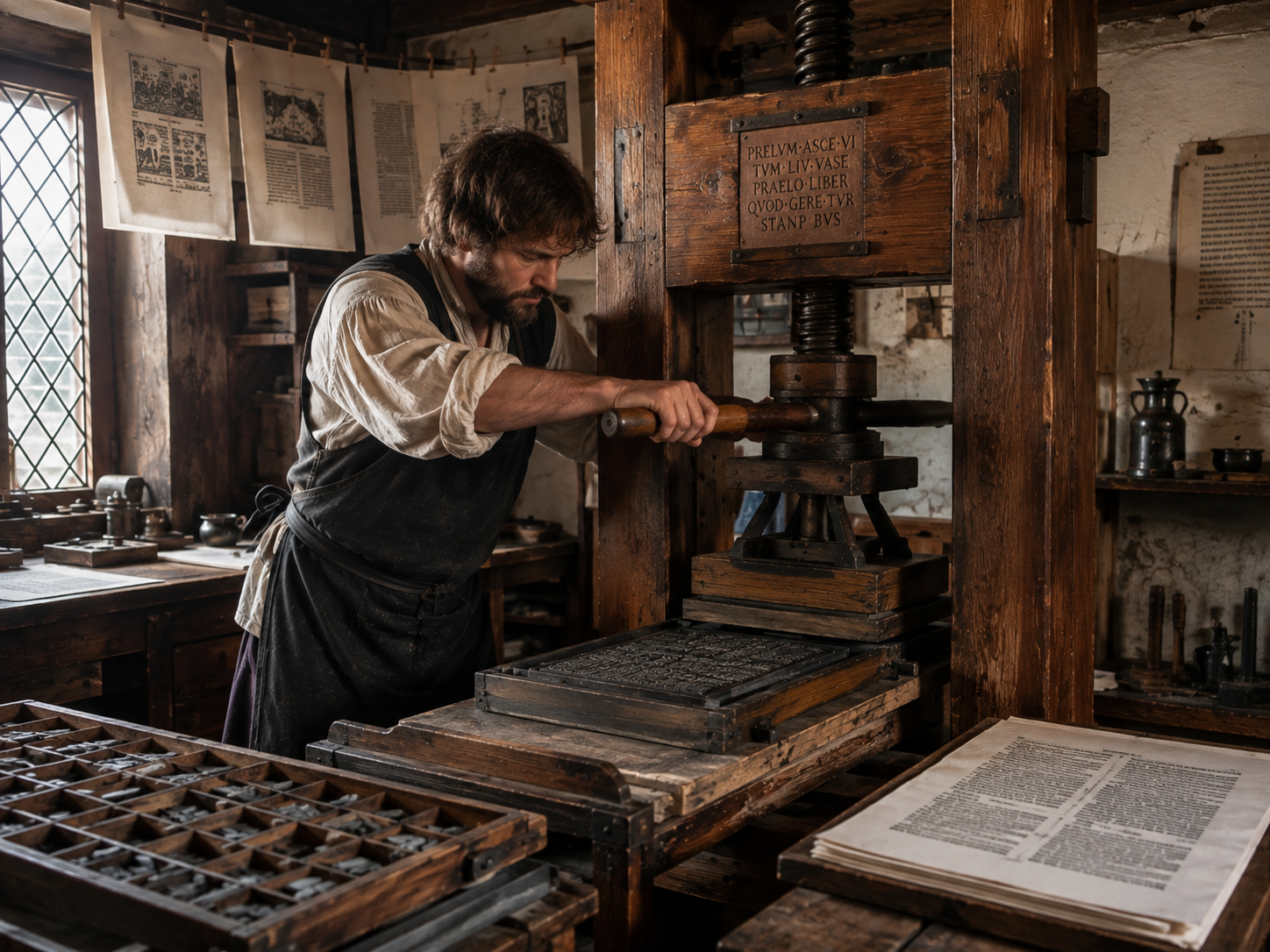
    A 15th-century printer operating a wooden screw press with movable metal type.

     Johannes Gutenberg was probably born around 1400 in Mainz, a city in the German lands of the Holy Roman Empire.

    Very little is known about his early life.

    What historians do know is that he worked with metal and had experience that would have been useful for creating type. He later experimented with printing technology in Strasbourg before returning to Mainz. By the mid-1450s, his printing system was producing books that looked remarkably consistent from page to page.

    The basic idea was surprisingly simple.

    First, individual letters were made from metal.

    These pieces of type could be arranged into lines.

    The arranged type was locked into a frame.

    Ink was applied to the raised letters.

    A sheet of paper was placed over them.

    Then the press pushed the paper firmly against the type.

    When the sheet was lifted away, the letters had left their image behind.

    The important part was that the type could then be rearranged.

    The same letters could print another page.

    Then another.

    And another.

    That was the key advantage.

    A scribe copying a page had to reproduce every letter again.

    A printer only had to arrange the letters once and then use the same set of type repeatedly.

    Gutenberg's press did not make every part of book production automatic. Printing still required skilled workers, paper, ink, typesetting and later processes such as rubrication and illumination.
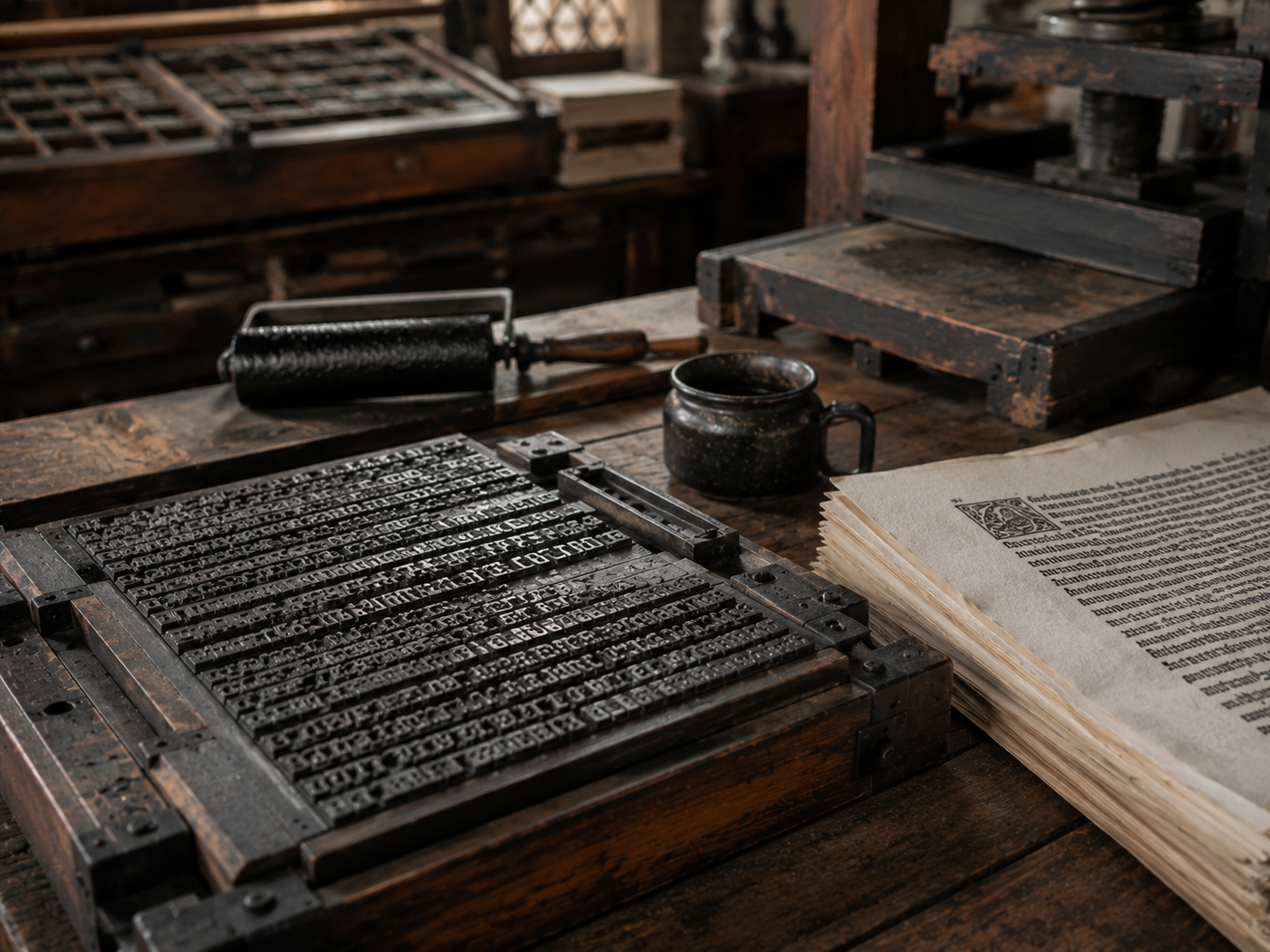
    Movable metal type arranged for printing beside freshly printed pages in a Gutenberg-era workshop

     But it changed the balance between labor and output.

    One careful arrangement of type could produce many nearly identical copies.

    Gutenberg's most famous achievement was the Gutenberg Bible, printed in Mainz around 1454–1455.

    It was not the first printed book in world history, nor even the first printed book in Europe.

    But it was the first great book produced in Western Europe with movable metal type, and it demonstrated just how advanced the new printing system had become. About 180 copies were probably produced.

    The Bible was beautiful.

    Its pages used a sophisticated Gothic typeface.

    Some copies were printed on paper, while others were printed on expensive vellum.

    The printed pages were also decorated by hand.

    In other words, Gutenberg's workshop had not eliminated the older world of bookmaking.

    It had combined it with a new machine.

    And that combination was about to spread.


    How Gutenberg's Press Worked

    How a Gutenberg-Style Press Worked
    TECHNICAL MECHANICS & TYPOGRAPHY

    How a Gutenberg-Style Press Worked

    A Step-by-Step Breakdown of the 15th-Century Mechanical Printing Process

    The Printing Operation 5-STEP PROCESS

    WOODEN SCREW PRESS LEVER PLATEN BED & TYPE INDIVIDUAL METAL TYPE R MIRRORED LETTERFACE LEAD ALLOY SHANK LEATHER INK BALLS Used to dab oil ink
    1

    Type Arrangement (Composing)

    Individual metal pieces of reversed type (cast from a durable lead-tin-antimony alloy) are sorted from cases and arranged by hand, letter by letter, into lines of text inside a compositor’s stick.

    2

    Locking the Forme

    Completed lines of text are transferred to a flat bed and tightly locked into a heavy iron chase (frame) using wooden wedges called quoins. This rigid assembly is known as the forme.

    3

    Inking the Type

    Inkmakers use padded leather ink balls to evenly dab a thick, viscous oil-based ink (made of linseed oil and soot) across the raised metal faces of the locked type.

    4

    Paper Placement

    A damp sheet of rag paper is carefully positioned on a tympan frame and folded down over the inked metal type to ensure precise registration without smudging.

    5

    Pressing & Page Production

    The bed is rolled under the platen. The pressman pulls a wooden lever to turn a heavy wooden screw, driving the platen downward with uniform pressure to transfer the ink onto the page.

    Efficiency through Reusability: The Modular Type Cycle

    Unlike carved woodblocks which were locked to a single page forever, movable metal type was redistributed back into storage cases immediately after printing, allowing a modest set of character sorts to produce infinite book variations.

    1. PRINT PAGE A Type set in Forme A 2. DISASSEMBLE & SORT Cleaned & returned to case 3. RECOMPOSE PAGE B Same type, new configuration
    ATLASNOVA TECHNICAL SERIES • HISTORICAL PRINTING MECHANICS

    Chapter 3 — The Information Explosion

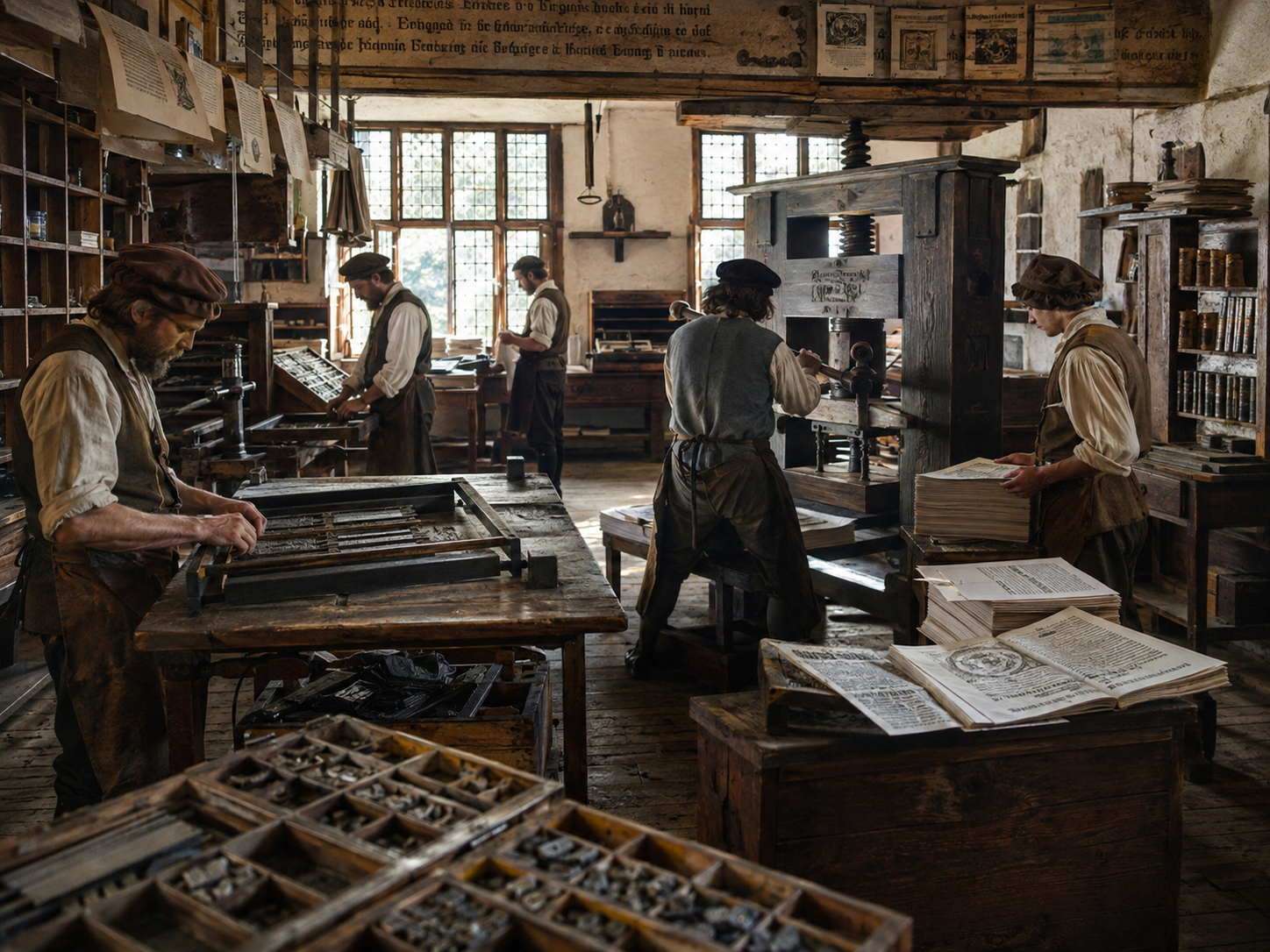
    Workers producing and stacking printed pages in a busy early European print shop.

     The first great change was speed.

    The second was scale.

    Before printing, making another copy of a book meant copying the whole book again.

    After printing, one carefully prepared set of type could produce hundreds of copies.

    Printers soon appeared in cities across Europe.

    By the end of the 15th century, thousands of different editions had been produced. Historians estimate that around 15–20 million printed copies were produced in Europe by about 1500, although exact estimates vary.

    That is an extraordinary change from the world of handwritten books.

    But there is another important point.

    Printing did not suddenly make everyone literate.

    Most Europeans could still not read.

    Education remained unequal.

    Books could still be expensive.

    And many early printed books were written in Latin.

    So the change was gradual.

    What printing did was make reading material more available.

    It also changed what could be printed.

    Printers produced books, but they also produced much smaller works: calendars, religious texts, advertisements, notices, political messages, poems, songs, images and short pamphlets.

    These were cheaper and easier to circulate than large books.

    A person did not need to own a library to encounter print.

    A printed sheet could appear in a marketplace.

    A small religious booklet could be passed from one person to another.

    A news report could be copied and sold in different towns.
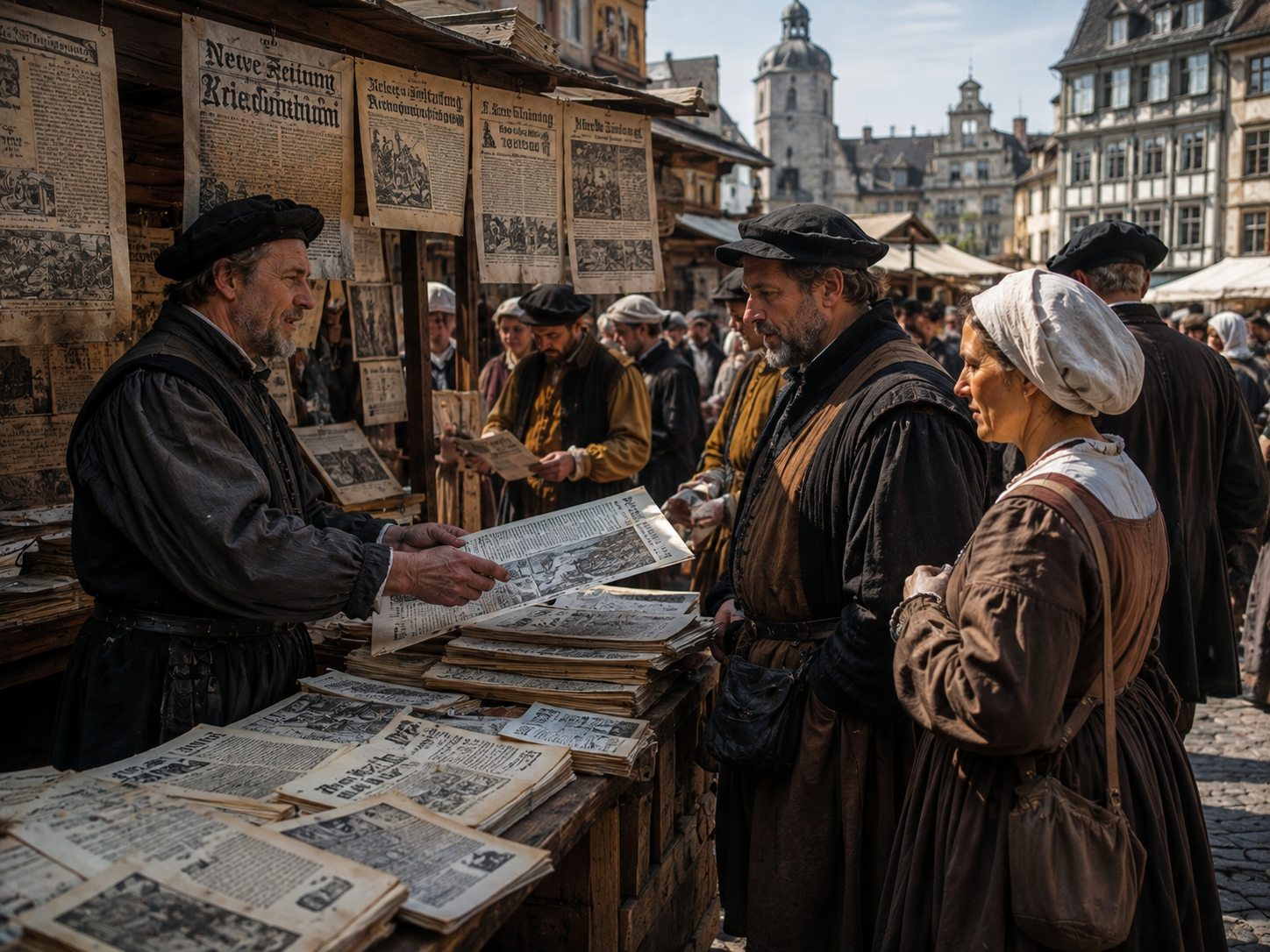
    Printed pamphlets and broadsheets being sold in an early modern European marketplace.

     This created something new: information could travel through society without every copy having to be rewritten by hand.

    The effect on languages was important too.

    Printers could reach readers in vernacular languages, the languages people actually spoke.

    That helped written versions of those languages become more standardized.

    Over time, print helped create larger reading communities.

    It also made it easier for the same text to appear in many places at almost the same time.

    This changed the relationship between an author and an audience.

    A writer no longer needed a patron to distribute a single manuscript.

    A printer could produce hundreds of copies.

    Those copies could be sold far beyond the writer's own city.

    Information had begun to behave differently.

    It was becoming reproducible.

    And once information can be reproduced cheaply, it can spread very quickly.


    From Manuscript to Mass Print

    Before and After the Printing Press
    HISTORICAL COMPARISON & PRINT REVOLUTION

    Before and After the Printing Press

    The Transformation of Knowledge Production and Dissemination in Early Modern Europe

    Comparative Analysis MEDIA SHIFT

    BEFORE (PRE-1450)

    Hand-Copied Manuscript

    Production Method

    Manual transcription by scribes using quill, ink, and parchment (animal skins) or early rag paper.

    Copying Speed

    Painstakingly slow; producing a single complete Bible or major codex required 2 to 3 years of labor.

    Identical Copies

    Zero. Every copy contained unique scribal errors, line variations, abbreviations, and localized alterations.

    Cost

    Extremely high; equivalent to the price of a small estate or years of a skilled artisan's wages per volume.

    Distribution

    Restricted to elite monastic scriptoria, royal archives, wealth-holding nobles, and premier universities.

    Text Reproduction Ability

    Highly vulnerable to cumulative text corruption over successive generations of hand-copying.

    AFTER (POST-1450)

    Printed Book

    Production Method

    Mechanical composition using movable lead-alloy type, oil-based ink, and hand-operated screw press.

    Copying Speed

    Rapid industrial output; a single press operation could produce hundreds of printed sheets per day.

    Identical Copies

    Hundreds to thousands of uniform copies produced in a single edition run from the same set type.

    Cost

    Dramatically reduced; book prices plummeted by approximately 80% within decades of press adoption.

    Distribution

    Widespread international trade routes catering to merchants, students, local clergy, and urban readers.

    Text Reproduction Ability

    High standardization; enabled uniform pagination, cross-referencing, errata sheets, and reliable scientific data.

    Rapid Growth of European Printing (1450–1500)

    The half-century following Gutenberg's invention saw the explosive spread of printing technology across European trade hubs, transforming Europe's information ecosystem (the Incunabula Period).

    1450 Gutenberg Press Mainz workshop operational 1465 Spread to Italy Subiaco press established 1476 Press in England Caxton sets up at Westminster 1500 250+ Print Centers Pan-European network ESTIMATED VOLUME 15–20 Million Copies
    HISTORICAL ESTIMATE NOTE

    Estimated Range: Roughly 15–20 million printed copies in Europe by 1500. Based on bibliographical studies of surviving incunabula (books printed prior to 1501), historians estimate that over 250 European printing centers produced approximately 28,000 to 35,000 distinct editions, yielding an aggregate total of 15 to 20 million individual volumes.

    ATLASNOVA HISTORICAL COMPARISON SERIES • PRINT REVOLUTION ANALYSIS

    Chapter 4 — Ideas That Spread Because of Print
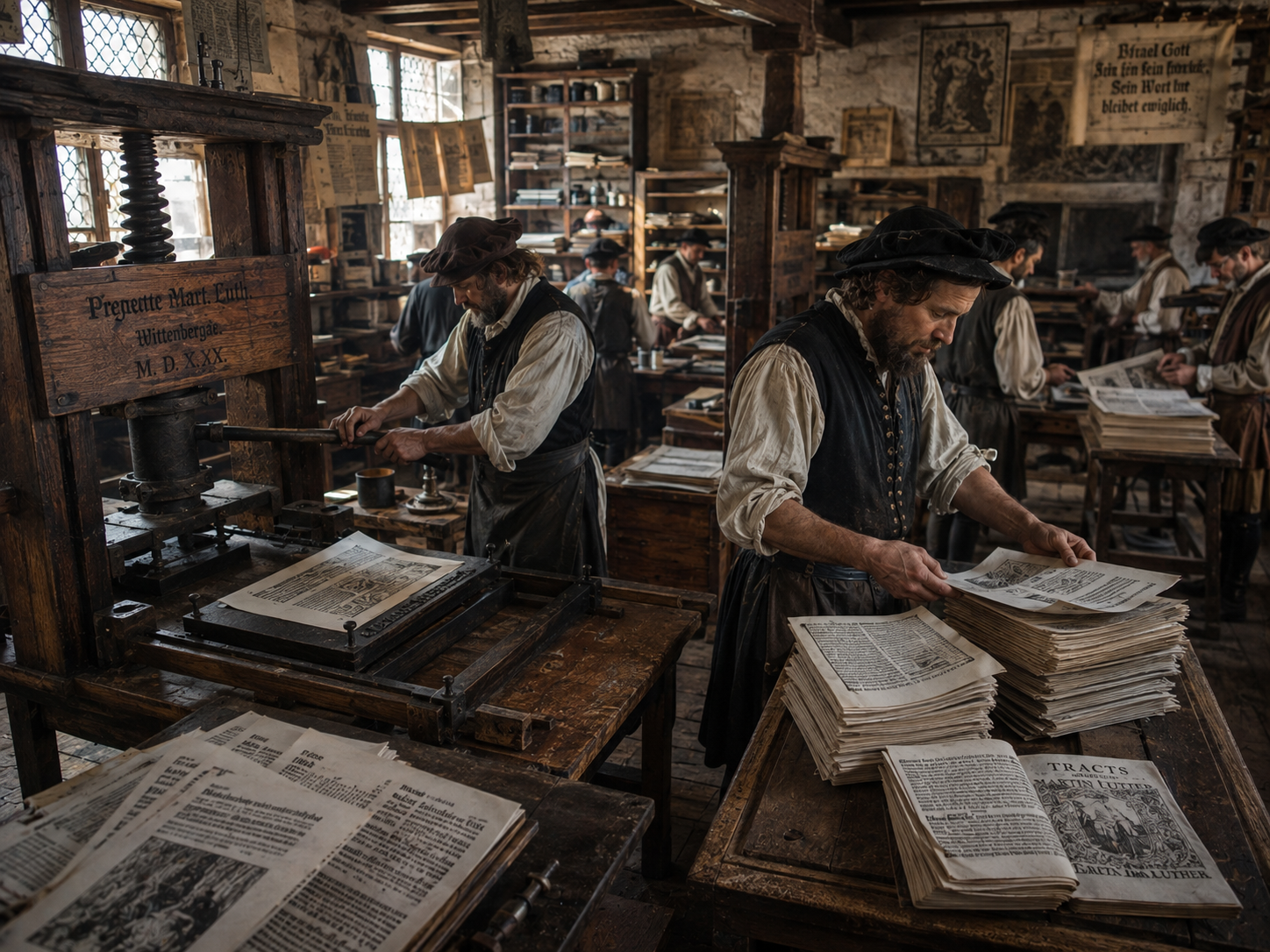
    A 16th-century European printing workshop producing religious pamphlets during the Reformation.
     The printing press did not invent new ideas.

    It made it much easier for ideas to travel.

    One of the clearest examples came in the 16th century.

    In 1517, Martin Luther challenged the Catholic Church's practice of selling indulgences.

    His famous Ninety-Five Theses were written in Latin and were originally intended for an academic discussion. The famous story that Luther personally nailed them to the church door at Wittenberg is still widely told, but the more important historical point is what happened afterward: the text was printed and circulated rapidly. Within months, multiple editions appeared, including in different cities.

    Then Luther's other writings began pouring from printing presses.

    Between 1517 and 1520, his works were printed in enormous numbers for the period. One scholarly estimate places the sales of his thirty publications during those years at more than 300,000 copies.

    That changed the Reformation.

    A theological argument that might once have remained within universities or church circles could now reach merchants, craftsmen, students and other literate readers.

    And the communication went both ways.

    Luther's opponents could print their own responses.

    The result was a massive public argument.

    The printing press had become part of the religious conflict itself.

    Religion was not the only field changed by print.

    Scientists benefited too.

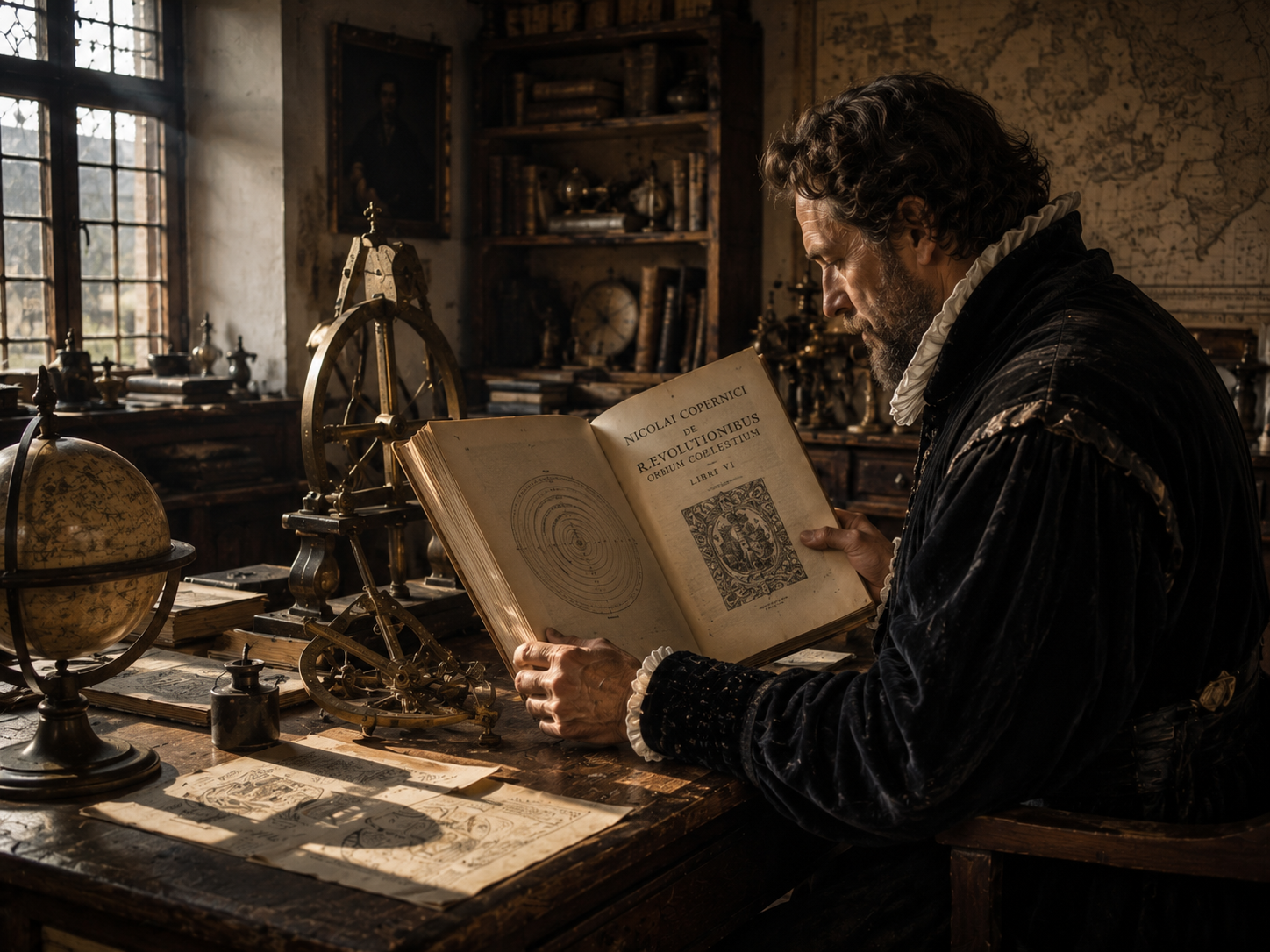
    An early modern scholar studying a printed scientific book beside astronomical instruments.

     Nicolaus Copernicus published De revolutionibus in 1543, presenting his mathematical model in which Earth moved around the Sun.

    More than half a century later, Galileo Galilei used printed books and pamphlets to defend and explain astronomical observations that challenged established ideas about the cosmos.

    Printing did not create the Scientific Revolution by itself.

    Science still depended on observation, mathematics, instruments, correspondence and debate.

    But print gave researchers something extremely useful:

    a way to share the same information with many readers and preserve the exact same text.

    That mattered.

    If one scientist made an observation, another could read about it hundreds of kilometres away.

    If an argument was wrong, someone else could challenge it.

    If a useful method worked, it could be copied.

    The printed page became part of a growing network of knowledge.

    Religious books also changed.

    Bibles and religious writings increasingly appeared in vernacular languages.

    People who could read no longer had to depend entirely on Latin texts.

    This did not mean everyone suddenly became able to read the Bible.

    Most people still could not read.

    But the balance of religious knowledge was shifting.

    And that was one of the most powerful things about print.

    It could carry not only information, but authority.

    Whoever controlled the printed page could influence what people read, discussed and believed.


    How Print Accelerated Ideas

    How Print Helped Ideas Travel
    EDITORIAL HISTORICAL ANALYSIS

    How Print Helped Ideas Travel

    The Mechanics of Mass Communication and Intellectual Transmission in Early Modern Europe

    The Information Dissemination Cycle

    Before movable type, ideas moved sequentially from author to single reader. Print converted linear communication into a exponential feedback loop across Europe.

    1. AUTHOR Writes Manuscript Latin or Vernacular 2. PRINTER Composes & Presses Movable Type Matrix 3. MULTIPLE COPIES Mass Edition Run 500 to 1,500 units EXPONENTIAL SCALE 4. BOOKSELLERS & READERS Trade Fairs & Shops 5. DEBATE & RESPONSE Refutations & Counter-Pamphlets INTELLECTUAL FEEDBACK LOOP

    Case Studies in Knowledge Velocity HISTORICAL IMPACT

    RELIGIOUS REFORMATION

    Martin Luther & The Reformation

    In 1517, Luther's Ninety-five Theses were translated from Latin into German, printed as cheap broadsides and pamphlets, and distributed across Europe in weeks. Print transformed a localized academic dispute into a continent-wide movement.

    Key Dissemination Vehicle Short-form vernacular pamphlets (Flugschriften) designed for rapid reading and public recitation.
    SCIENTIFIC REVOLUTION

    Copernicus & Heliocentricity

    Published on his deathbed in 1543, Nicolaus Copernicus's De revolutionibus orbium coelestium provided complex mathematical models of a sun-centered universe. Print allowed scholars across Europe to independently verify calculations.

    Key Dissemination Vehicle Standardized astronomical tables and mathematical diagrams, protecting data from manual copy errors.
    CULTURAL DEMOCRATIZATION

    Vernacular Religious Texts

    Printing Bibles, prayer books, and devotional guides in common regional languages—rather than Latin—bypassed clerical intermediaries, encouraging lay literacy and personal interpretation of religious texts.

    Key Dissemination Vehicle Mass-market vernacular Bibles (e.g., Luther Bible, Tyndale Bible) standardized national languages.
    DOCUMENTED EXAMPLE: REFORMATION PRINT VELOCITY
    SCHOLARLY ESTIMATE
    Hundreds of Thousands of Copies (1517–1520)

    Between 1517 and 1520, Martin Luther's 30-plus short publications were printed and reprinted across Germany, Basel, and Paris in hundreds of thousands of individual copies. Modern print historians and Reformation scholars (such as Andrew Pettegree) emphasize that this represented an unprecedented surge in media history—marking the first historical instance of true mass-media mobilization.

    ATLASNOVA HISTORICAL ANALYSIS • INTELLECTUAL HISTORY SERIES

    Chapter 5 — Resistance and Consequences
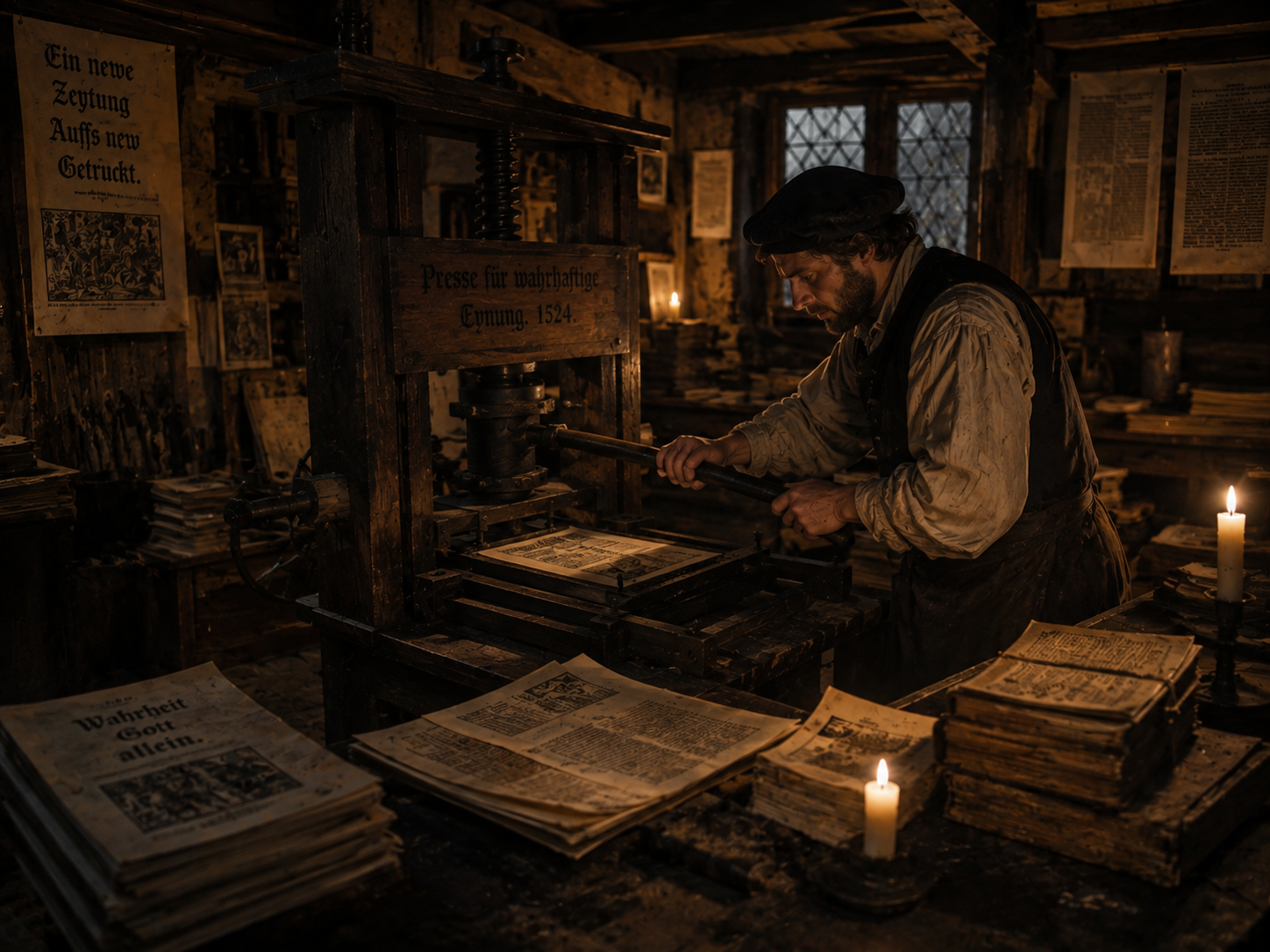
    A historical reconstruction of a printer producing controversial pamphlets under the threat of censorship.

     The printing press was powerful.

    That did not mean everyone loved it.

    Some people feared it.

    Scribes and manuscript producers faced a new technology that could produce many copies of a text far faster than handwriting.

    Religious and political authorities also realized something important:

    If printing could spread useful information, it could spread dangerous information too.

    A ruler could not easily control every printed sheet once presses had multiplied across Europe.

    A religious authority could condemn a book, but printers in another city might produce it anyway.

    Censorship therefore became part of the history of printing almost from the beginning.

    One of the earliest recorded European censorship cases took place in Cologne in 1478, only a few decades after Gutenberg's Bible. The following year, papal legislation authorized the University of Cologne to exercise control over aspects of the new printing industry.

    Over the following centuries, governments and religious institutions developed licensing systems, printing restrictions and book bans.

    But censorship had a problem.

    Printing was already too powerful to control completely.

    If one printer refused to publish something, another might accept the job.

    If a book was banned in one territory, it could potentially be printed somewhere else.

    The same technology that gave authorities a new way to spread official messages also gave their opponents a way to challenge them.
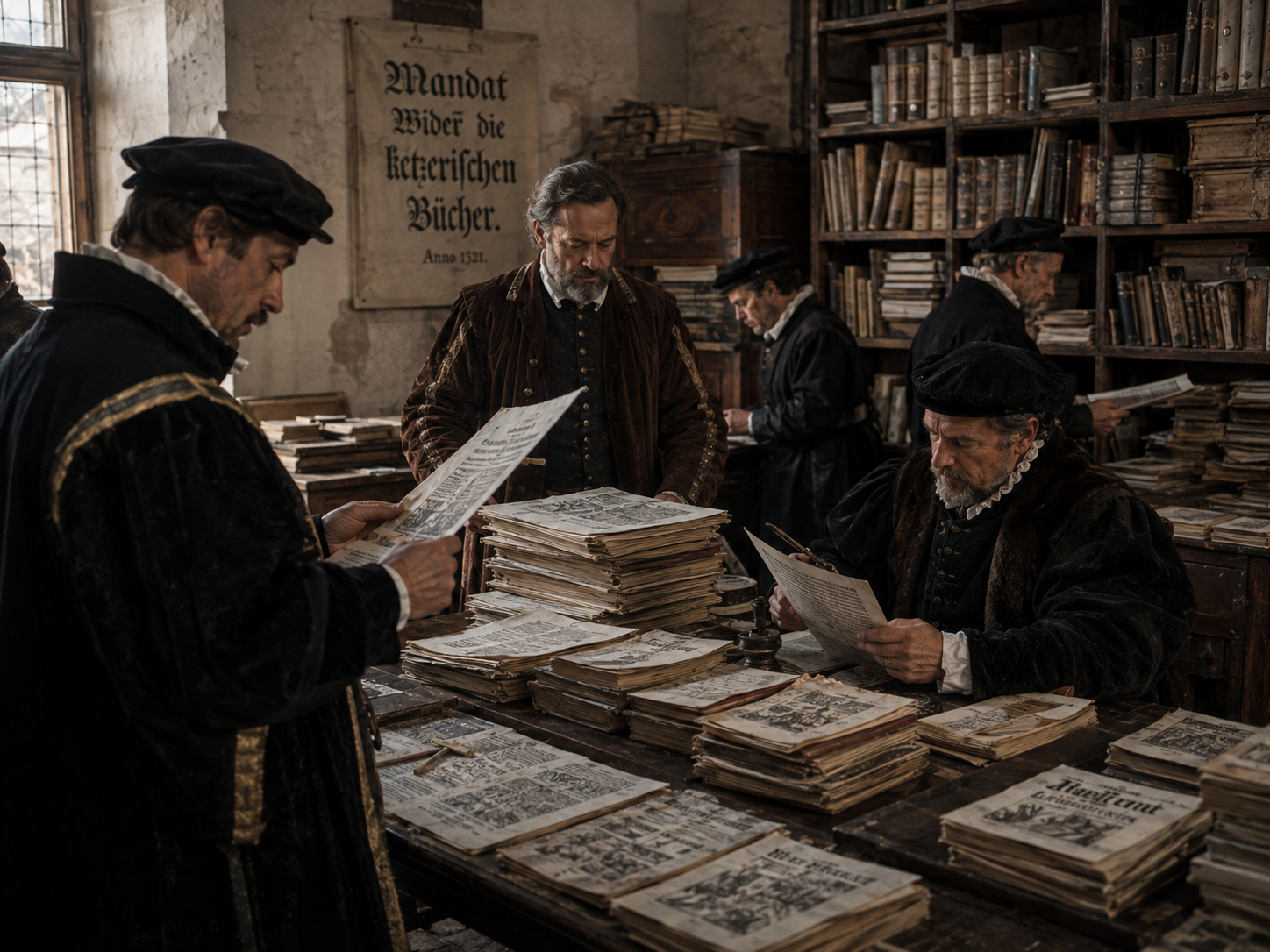
    Early modern authorities examining printed books as part of historical press censorship.

     And then there was misinformation.

    Printed material did not automatically become truthful simply because it came from a press.

    Rumors could be printed.

    False accusations could be printed.

    Exaggerated stories could be printed.

    Political propaganda could be printed.

    During religious and political conflicts, pamphlets were often designed to persuade rather than inform.

    This was one of the strange consequences of the new technology.

    The printing press did not create a world where people suddenly had perfect access to truth.

    It created a world where more people had access to more competing claims.

    That was both liberating and dangerous.

    A printed pamphlet could give a previously ignored person a public voice.

    But another pamphlet could attack that person.

    One book could preserve a scientific discovery.

    Another could spread a false story.

    The printing press did not decide which information was correct.

    People still had to do that.

    In this sense, the information problems of the modern world are older than the internet.

    The technology changed.

    The human challenge remained surprisingly familiar.


    The Double Edge of Print

    The Double Edge of the Printing Press
    EDITORIAL HISTORICAL ANALYSIS

    The Double Edge of the Printing Press

    Examining the Dual Impact of Mass Information Dissemination in Early Modern Europe
    “The press spread information faster—but it did not guarantee truth.”

    What Print Enabled

    Literacy & Education

    The rapid drop in book prices made reading materials accessible beyond elite monasteries and nobility, spurring lay literacy rates and expanding formal schooling across Europe.

    Scientific Exchange

    Standardized mathematical diagrams, anatomical charts, and astronomical tables enabled scholars across distant regions to verify calculations and build upon shared findings.

    Religious Debate

    Vernacular translations of sacred texts and theological treatises encouraged personal interpretation, open academic inquiry, and broader public discussion on reform.

    Wider Access to Books

    Democratized access to classical philosophy, practical manuals, law, and literature, transitioning society from scarce manuscript repositories to abundant public collections.

    What Print Also Enabled

    Censorship Battles

    Triggered institutional crackdowns, including the creation of banned book indexes (e.g., Index Librorum Prohibitorum), licensing regimes, and the public burning of illicit presses.

    Propaganda & Conflict

    States and religious factions weaponized cheap woodcut broadsides and aggressive pamphlets to demonize rivals, accelerating sectarian hatreds during the Wars of Religion.

    Unchecked Rumors & Panics

    Sensationalized broadsheets spread untested medical nostrums, apocalyptic fears, and exaggerated tales of atrocities faster than local authorities could verify or correct them.

    Misinformation & Manipulation

    Counterfeit publications, false attributions, and partisan tracts exploited the print medium's authoritative appearance to mislead audiences for political and commercial gain.

    HISTORICAL SYNTHESIS

    Like later communications breakthroughs, the introduction of movable type did not filter the quality of the content it amplified. By lowering the barrier to entry for public discourse, the press simultaneously laid the groundwork for the Scientific Revolution and accelerated ideological polarization across Europe.

    ATLASNOVA EDITORIAL ANALYSIS • MEDIA HISTORY SERIES

    Chapter 6 — Legacy Into the Digital Age
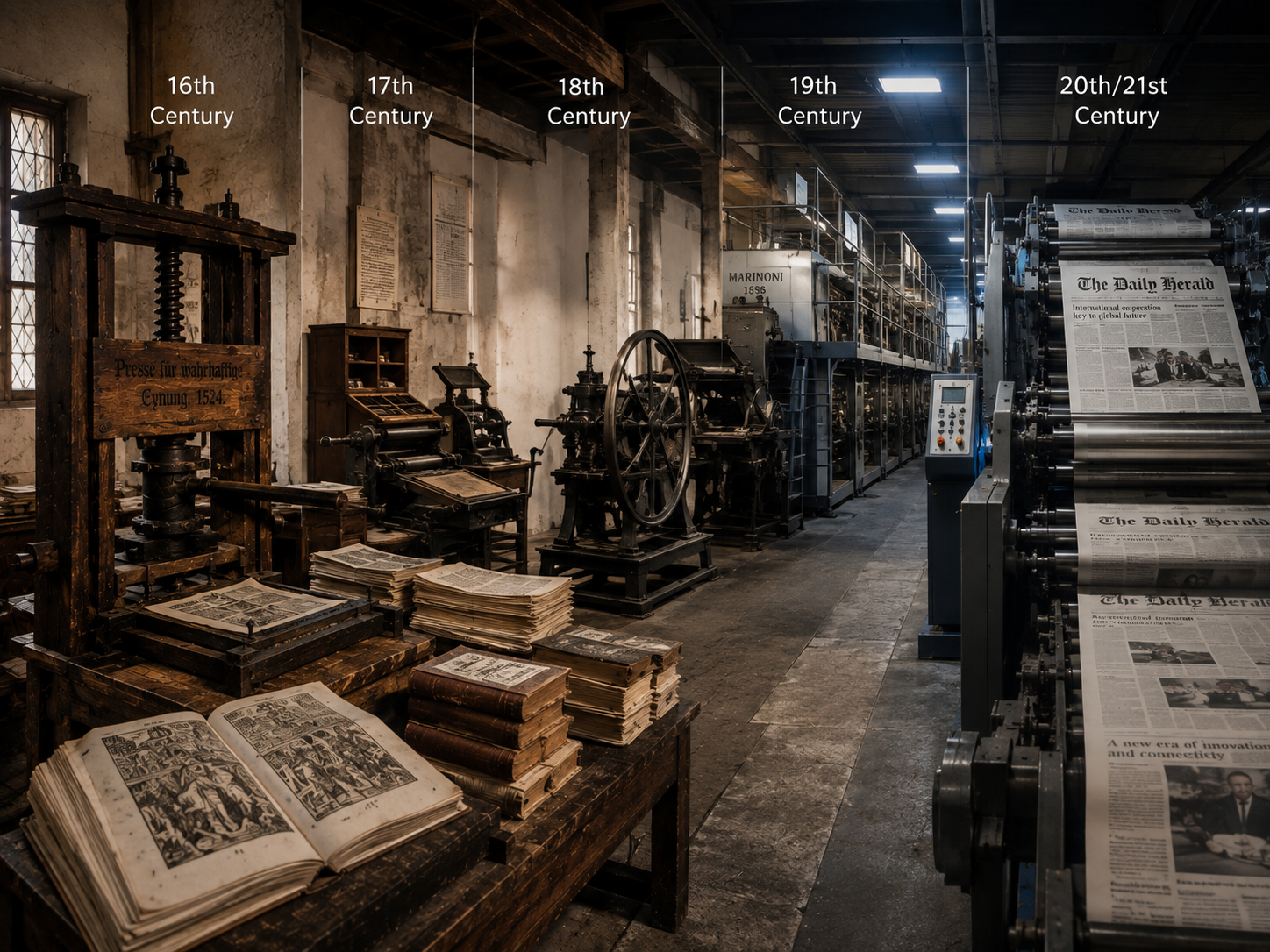
    A visual transition from the historic printing press to later forms of mass print.

     It is easy to look at Gutenberg's press and think of it as an old machine from another world.

    But its basic idea feels surprisingly modern.

    Take information.

    Make copies.

    Distribute those copies widely.

    Let people read them, respond to them, criticize them and create new material from them.

    That pattern continued for centuries.

    Printing helped newspapers grow.

    It helped governments publish laws and notices.

    It helped schools distribute textbooks.

    It allowed novels, maps, scientific papers, political pamphlets and newspapers to reach audiences far beyond the communities where they were written.

    The world became increasingly connected by printed information.

    And then, much later, another information revolution arrived.

    The internet removed the physical page almost entirely.

    Today, a writer can publish an article from a laptop and make it available to readers around the world within seconds.

    That sounds completely different from Gutenberg's workshop.

    But the underlying idea is surprisingly similar.

    Both technologies reduce the cost and difficulty of copying information.

    The biggest difference is speed and scale.

    A 15th-century printer needed paper, ink, metal type, workers and a physical press.

    A modern website needs a computer, software and an internet connection.

    A printed book might take weeks to reach another city.

    A digital article can cross the world almost instantly.

    Yet the problems created by information abundance have also remained familiar.

    More information does not automatically mean better information.

    The printing press made propaganda easier.

    The internet can do the same.
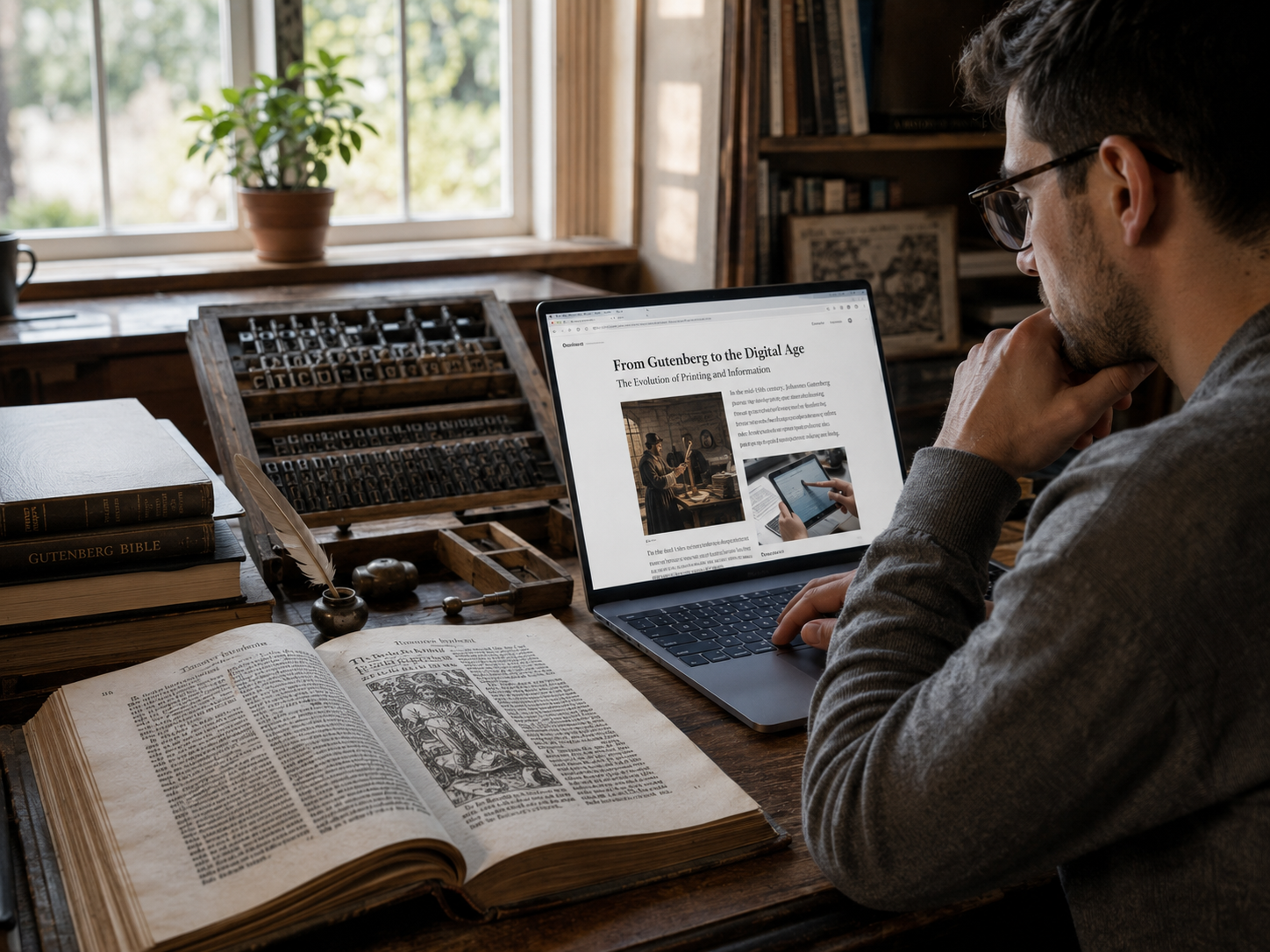
    A modern laptop and digital article placed beside an old printed book and historic printing type.

     The printing press helped ordinary people encounter ideas outside traditional institutions.

    The internet has expanded that possibility enormously.

    Both technologies changed who could speak.

    And both changed who could be heard.

    That is why Gutenberg's importance is bigger than the machine itself.

    His press helped create a new environment for human knowledge.

    People could preserve more ideas.

    Compare more sources.

    Challenge established authorities.

    Teach larger audiences.

    Publish arguments.

    And build on the work of people they had never met.

    The modern internet did not replace that system so much as accelerate it.

    Five hundred years ago, a new idea might take months to cross Europe.

    Today, it can cross the planet before its author closes the browser.

    The technology is different.

    The human impulse is not.

    We still want to write.

    We still want to share.

    We still want to persuade.

    And we still need to decide what deserves to be believed.

    That is the real legacy of the printing press.

    It did not simply make books faster.

    It changed the speed, scale and power of human communication.

    And once that happened, the world could never quite return to the way it was before.


    From Gutenberg to the Internet

    From Gutenberg to the Internet
    COMMUNICATION HISTORY SYNTHESIS

    From Gutenberg to the Internet

    Tracing the Evolution of Information Velocity, Scale, and Economics Across Five Epochs
    THE MACRO EVOLUTION OF MEDIA

    Slow Copying ➔ Mass Printing ➔ Instant Digital Distribution

    The Five Communications Epochs HISTORICAL TIMELINE

    PRE-1450

    Manuscript Culture

    Hand-transcribed scribal codices on parchment or rag paper.

    Production Cost

    Extremely High
    Months of manual labor

    Transfer Speed

    Painfully Slow
    Speed of foot or horse

    Audience Reach

    Elites Only
    Monasteries & Royalty

    1450 – 1750

    Gutenberg Printing

    Movable metal type and hand-operated mechanical presses.

    Production Cost

    Moderate–Low
    80% drop per volume

    Transfer Speed

    Rapid Production
    Weeks/months for edition

    Audience Reach

    Regional Mass
    Urban literate public

    1800 – 1900s

    Mass Publishing

    Steam-powered cylinder presses, linotype, and telegraphy.

    Production Cost

    Low Unit Cost
    Penny press economics

    Transfer Speed

    Daily Cycles
    Overnight news printing

    Audience Reach

    National Public
    Millions of readers daily

    1920s – 1980s

    Broadcast Era

    Over-the-air electromagnetic audio and video transmission.

    Production Cost

    High Infrastructure
    Zero per-listener cost

    Transfer Speed

    Real-Time
    Instantaneous broadcast

    Audience Reach

    Continental Mass
    Simultaneous audience

    1990s – PRESENT

    Digital Publishing

    Global packet-switched networks, web platforms, and devices.

    Production Cost

    Near-Zero Marginal
    Democratized creation

    Transfer Speed

    Instantaneous
    Sub-second global push

    Audience Reach

    Global & Interactive
    Billions of peer nodes

    HISTORICAL PERSPECTIVE: PRINT PRESS VS. DIGITAL NETWORK

    While the Internet is not identical to the printing press, it represents another fundamental expansion in the speed, scale, and democratization of communication. Where Gutenberg’s press centralized production in specialized workshops to mass-produce static texts, the Internet decentralizes both creation and distribution—allowing any connected individual to instantly publish dynamic, interactive media worldwide. Both revolutions drastically lowered information costs while challenging incumbent institutions to adapt to unprecedented information abundance.

    ATLASNOVA EDITORIAL ANALYSIS • COMMUNICATIONS HISTORY FINALE

    FAQ Frequently Asked Question

    1. Did Gutenberg really invent printing?

    No. Printing existed in Asia centuries before Gutenberg. China developed woodblock printing and movable type, while Korea used movable metal type before the 15th century. Gutenberg's achievement was creating a highly effective movable-type printing system for Western Europe.

    2. What was the first printed book?

    There is no single answer because printing existed in different forms and places long before Gutenberg. The Jikji, printed in Korea in 1377, is the oldest surviving book printed with movable metal type. Gutenberg's Bible, completed around 1455, was the first great book printed with movable metal type in Western Europe.

    3. How did Gutenberg's printing press work?

    Small reusable metal letters were arranged into lines, locked into a frame and covered with ink. Paper was placed on top, and a press applied strong, even pressure. After printing, the letters could be rearranged and used again.

    4. Why was Gutenberg's Bible important?

    The Gutenberg Bible demonstrated how advanced European movable-type printing had become. It was printed in Mainz around 1454–1455, and approximately 180 copies were probably produced. It is considered the first great book printed in Western Europe using movable metal type.

    5. How did the printing press help the Reformation?

    It allowed religious arguments to be copied and distributed much faster than handwritten manuscripts. Martin Luther's writings became especially successful in print, with hundreds of thousands of copies of his publications circulating during the early years of the Reformation.

    6. Did the printing press make everyone literate?

    No. Literacy increased gradually over centuries and depended on education, wealth, language and access to books. The printing press helped by making reading material more available and less dependent on hand-copying, but it did not create mass literacy overnight.

    7. Why did some governments and religious authorities oppose printing?

    Because printed material could spread ideas that challenged existing political or religious authority. Authorities responded with licensing systems, bans and censorship. Some of the earliest European examples of formal press censorship appeared within a few decades of Gutenberg's breakthrough.

    8. Did the printing press spread false information?

    Yes. Printing could spread accurate knowledge, but it could also spread rumors, propaganda, exaggerated stories and false claims. The technology made information easier to reproduce; it did not guarantee that the information was true.

    9. How many books were printed by 1500?

    Historians estimate that roughly 15–20 million individual printed copies were produced in Europe by around 1500, although estimates differ. This refers to copies produced, not 15–20 million different titles.

    10. Is the internet similar to the printing press?

    In an important sense, yes. Both technologies dramatically reduced the difficulty of copying and distributing information. The internet is much faster and has a far greater global reach, but it continues the broader transformation in communication that mass printing began in Europe during the 15th century.


    in History and Culture
    # Gutenberg Bible Jikji Johannes Gutenberg Martin Luther Printing Press Reformation movable type printing history
    Arpit Kaintura 23 August 2026
    Share this post

    Share

    Tags
    Gutenberg Bible Jikji Johannes Gutenberg Martin Luther Printing Press Reformation movable type printing history
    Our blogs
    • Our blog
    • Wildlife
    • Space
    • Places
    • History and Culture
    Archive
    Sign in to leave a comment
    Genghis Khan: The Man Behind the World's Largest Empire
    How an abandoned boy from the Mongolian steppe became the founder of the largest contiguous empire in history
    Helpful Links
    • Home
    • About us
    • Privacy Policy
    • Contact us
    About us

    Welcome to Atlasnova, my personal website where I share interesting discoveries about space exploration, the solar system, world wildlife. My goal is to make space and wildlife easy to explore and fun to learn for curious minds everywhere. 

    Connect with us
    • Contact us
    • arpitkaintura2025@gmail.com

    Copyright © Atlasnova
    Powered by Odoo - The #1 Open Source eCommerce