Introduction
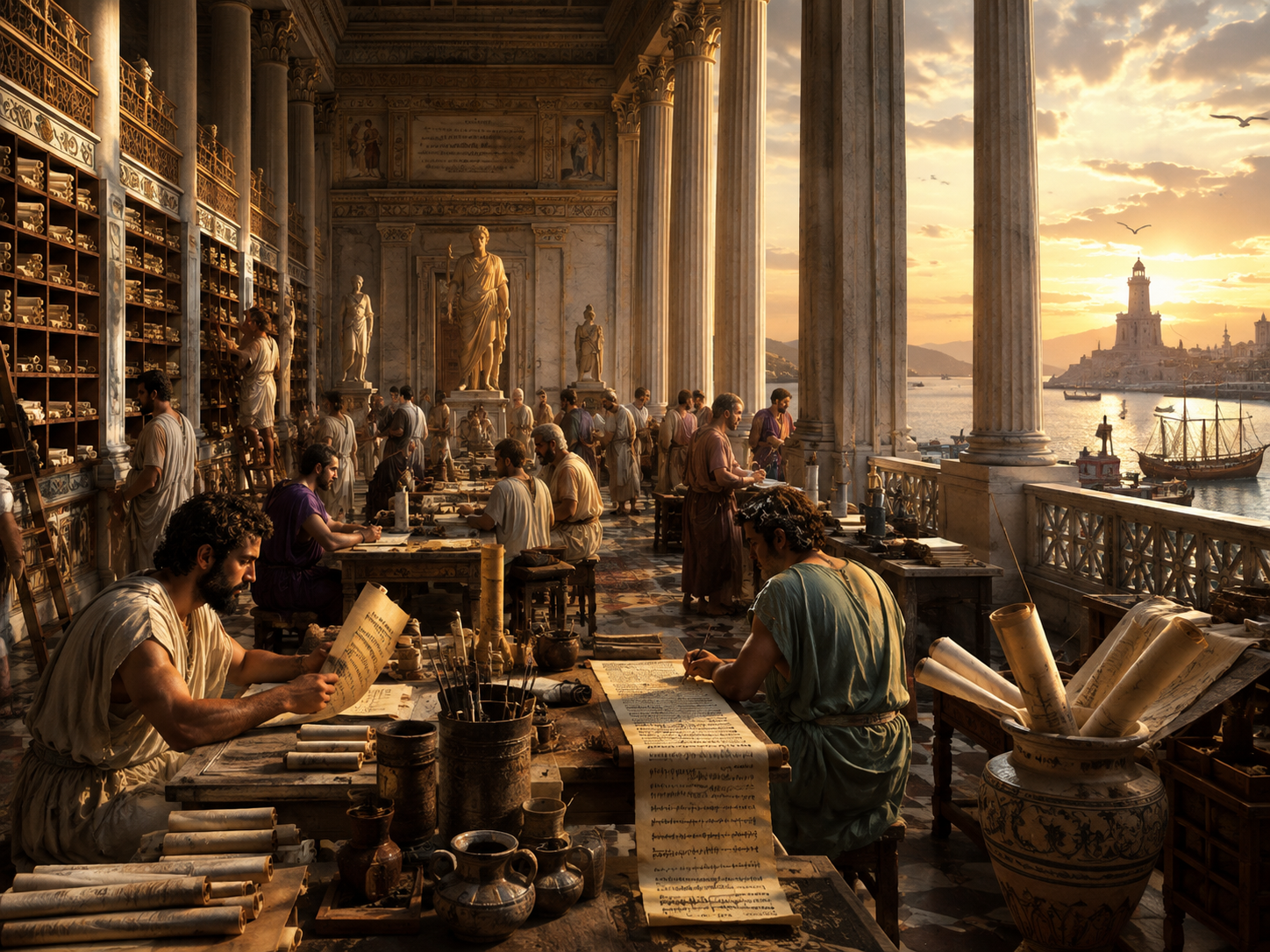
The Library of Alexandria is often remembered in one image.
A huge building.
Thousands of scrolls.
And then, one terrible fire.
The books burn.
The knowledge disappears.
And that is the end.
It is a powerful story.
It is also probably not what happened.
The real history is slower, messier and, in some ways, more interesting.
The famous library grew in Alexandria under the Ptolemaic rulers in the 3rd century BCE. It became part of a much larger centre of learning that attracted scholars, writers and scientists from across the Mediterranean world.
Its end was not one simple moment.
There were fires.
There were wars.
There were changes in royal support.
There was political and religious conflict.
And there were long periods when the institutions that had supported the library were no longer as strong as they once were.
So the better question is not:
“Who burned the Library of Alexandria?”
It is:
“How did one of the ancient world's greatest centres of learning slowly disappear?”
Chapter 1 — A King Wanted More Than a Palace
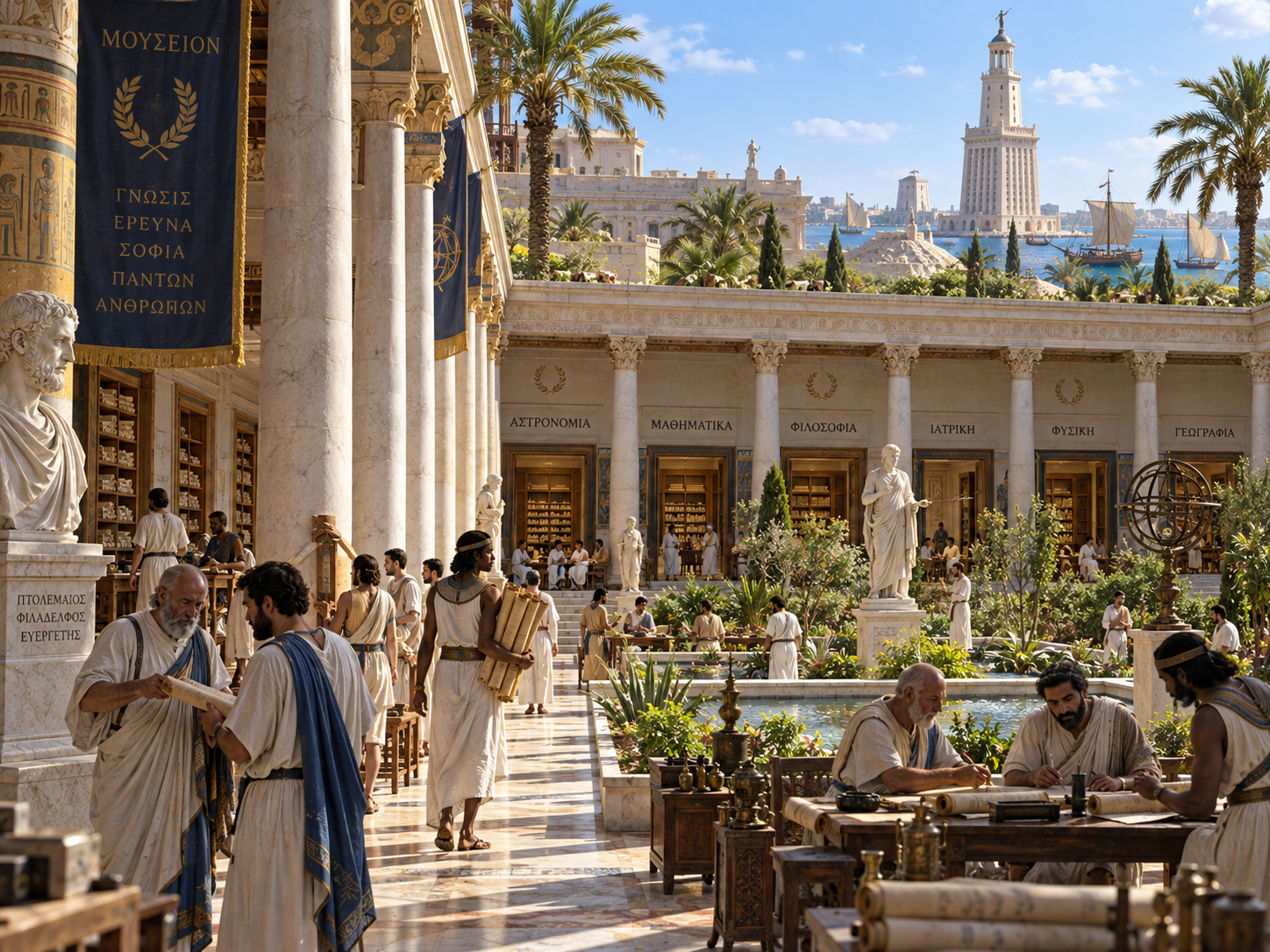
Alexandria was a young city.
Alexander the Great founded it in 331 BCE, but after his death the city became the centre of a new kingdom ruled by the Ptolemaic dynasty.
The Ptolemies wanted Alexandria to be more than a rich port.
They wanted it to matter.
So they built temples.
Palaces.
Public buildings.
And something that could give the city a different kind of power:
a place where knowledge could be gathered.
The library was probably begun under Ptolemy I and developed further under his son, Ptolemy II. The exact details of its foundation are not completely clear, but the early Ptolemies clearly gave the project strong royal support.
This was not just about putting scrolls on shelves.
The library belonged to a larger scholarly institution called the Mouseion, or Museum.
The name can sound familiar now, but the ancient Mouseion was not a modern museum full of paintings.
It was a centre for study.
Scholars could live and work there under royal support. They researched, wrote, taught, edited old texts and worked on problems in science, mathematics, medicine and literature.
The idea was bold.
Instead of waiting for knowledge to arrive in Alexandria by chance, the rulers could go looking for it.
They could invite scholars.
They could acquire books.
They could copy texts.
They could support people whose job was simply to study.
Alexandria was being built into a city where knowledge itself was treated as a resource.
And that decision would change the ancient world.
How Alexandria Built a Centre of Learning
Chapter 2 — They Were Not Collecting Books Just to Fill Shelves
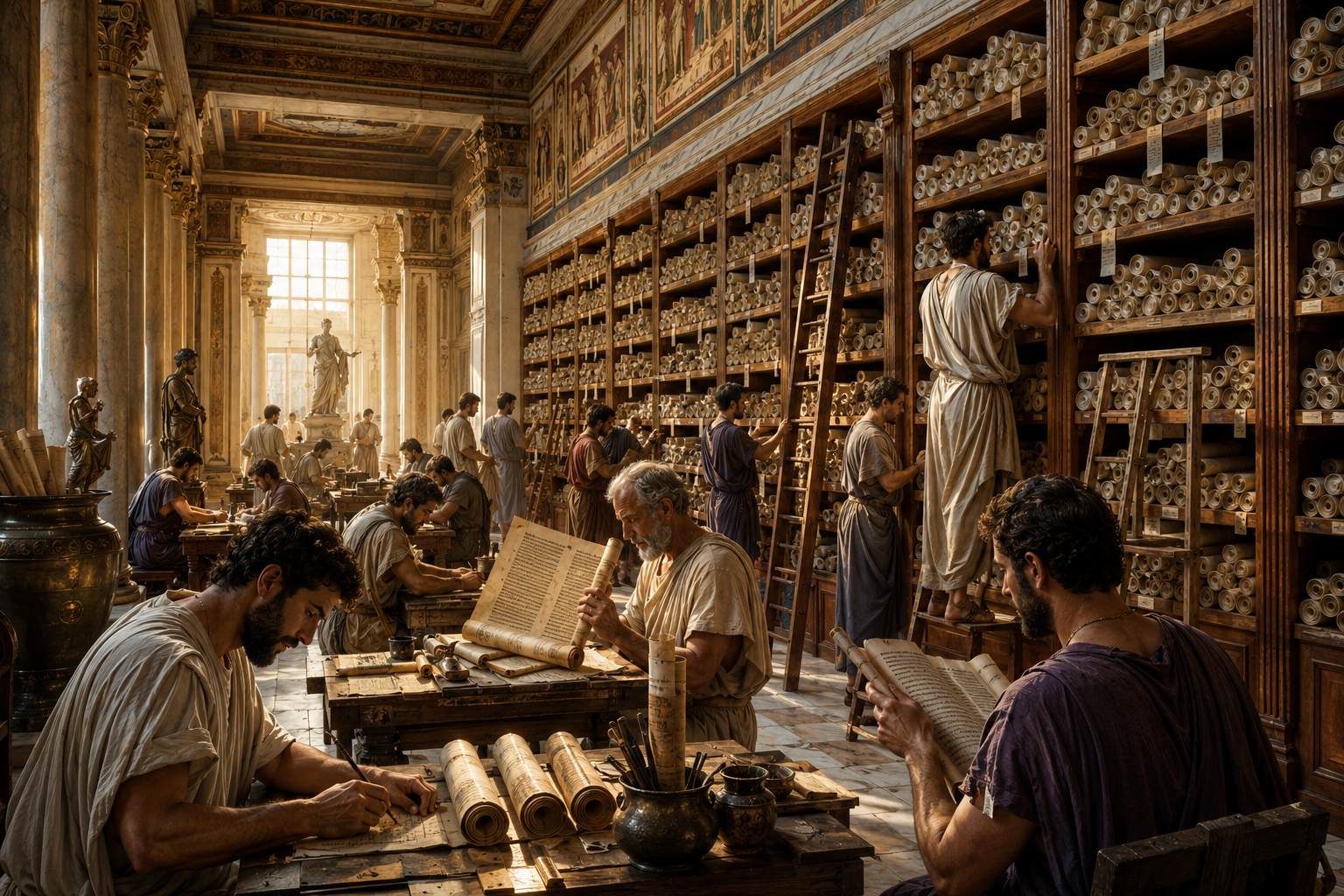
Imagine arriving in Alexandria with a rare scroll.
Someone in the royal court wants it.
Not because the scroll looks beautiful.
Because the words inside it might be useful.
The early Ptolemies wanted to build an enormous collection, and ancient and later accounts describe determined efforts to acquire texts from across the Mediterranean world. Books were bought, copied and sought out by agents working for the library.
One famous story says that when ships arrived at Alexandria, officials could take books found on board, have copies made and return the copies while keeping the originals.
Whether every detail of that story is true is harder to establish.
But the larger point is clear.
The rulers were serious about collecting texts.
They wanted works of literature.
History.
Medicine.
Philosophy.
Astronomy.
Mathematics.
And works written in cultures outside the Greek world were also translated into Greek. The Septuagint, the Greek translation of Jewish scripture, became one important example of this wider collecting and translation culture.
The goal was not simply to own many scrolls.
The scholars also needed to know what they had.
That meant organising the collection.
One of the most important figures here was Callimachus, who created the Pinakes, a massive bibliographic catalogue of Greek literature. It helped scholars find works and understand what the library contained.
That may sound ordinary now.
It was not.
Imagine having thousands of scrolls and no search box.
You need a system.
You need names.
Subjects.
Authors.
Categories.
You need someone who remembers where things are.
Alexandria was beginning to create something very familiar.
Not just a library.
A way of organising human knowledge.
How Do You Organize Thousands of Scrolls?
Chapter 3 — The Famous Library Was Not the Whole Story
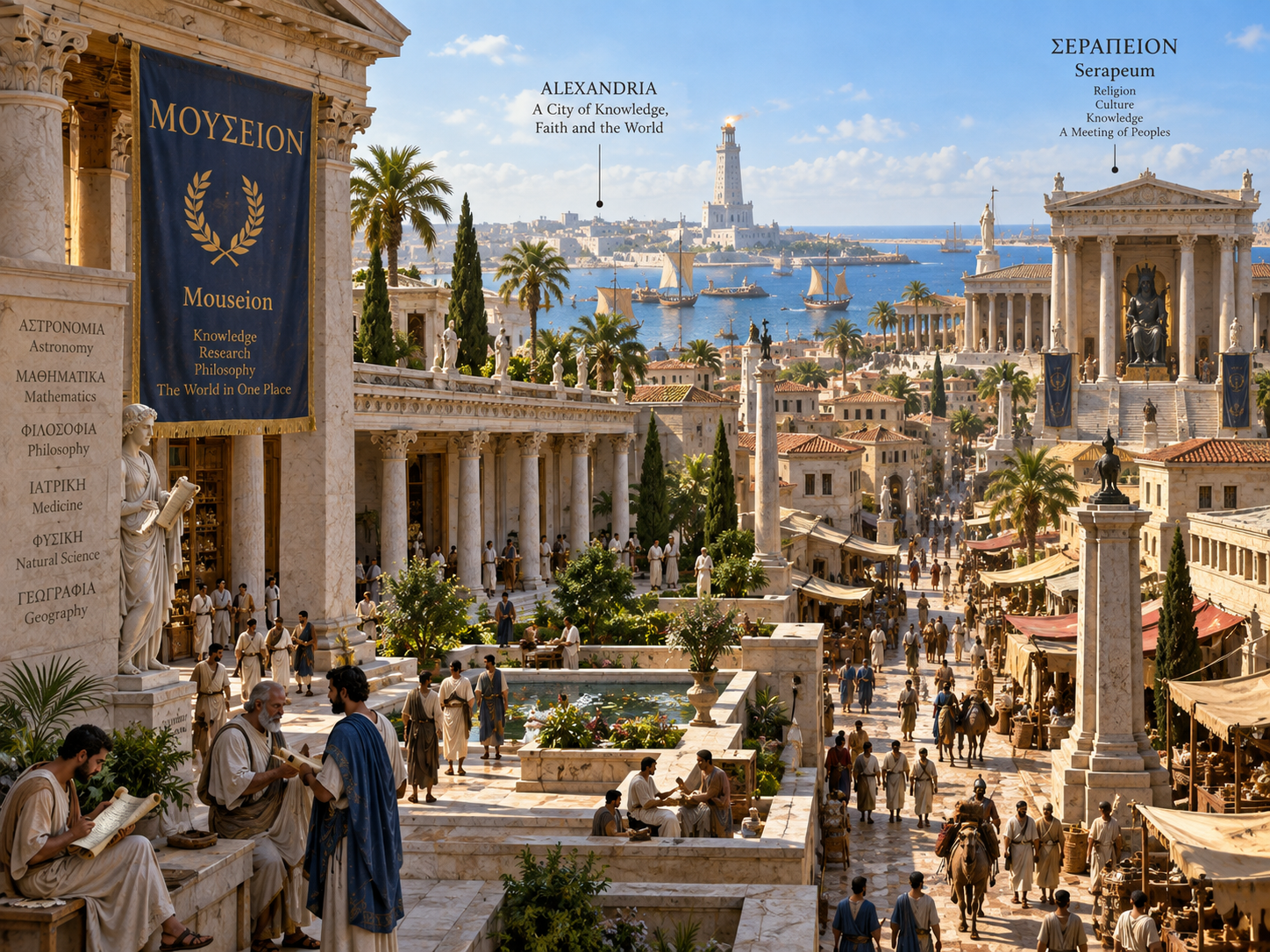
There is a common picture of the Library of Alexandria.
One enormous building.
One enormous collection.
Everything inside.
History was probably more complicated.
Alexandria had more than one important library collection. A major collection was associated with the Mouseion in the royal quarter, while another collection became associated with the Serapeum, the great temple of Serapis.
This matters because later stories often talk about “the library” as though there was one room holding every surviving book.
There was not.
The ancient evidence is incomplete, and scholars still debate how the collections were organised, where exactly they were housed, and how they changed over time.
The Serapeum collection is especially important.
By late antiquity, it appears to have been connected with the earlier Alexandrian library tradition. Some scholars argue that it became an important successor to the original collection, while the exact scale and contents of its library remain debated.
That means the history of Alexandria's books is not a straight line.
A collection could move.
A new collection could grow.
An old institution could lose importance while another survived.
Books could be copied.
Books could disappear.
And sometimes we simply do not know what happened.
This is one reason the story is harder than the famous fire.
There was never just one switch.
Library open.
Library gone.
There were several institutions, several collections and several centuries of change.
Alexandria Had More Than One Collection
Chapter 4 — Then the Money and Attention Began to Change
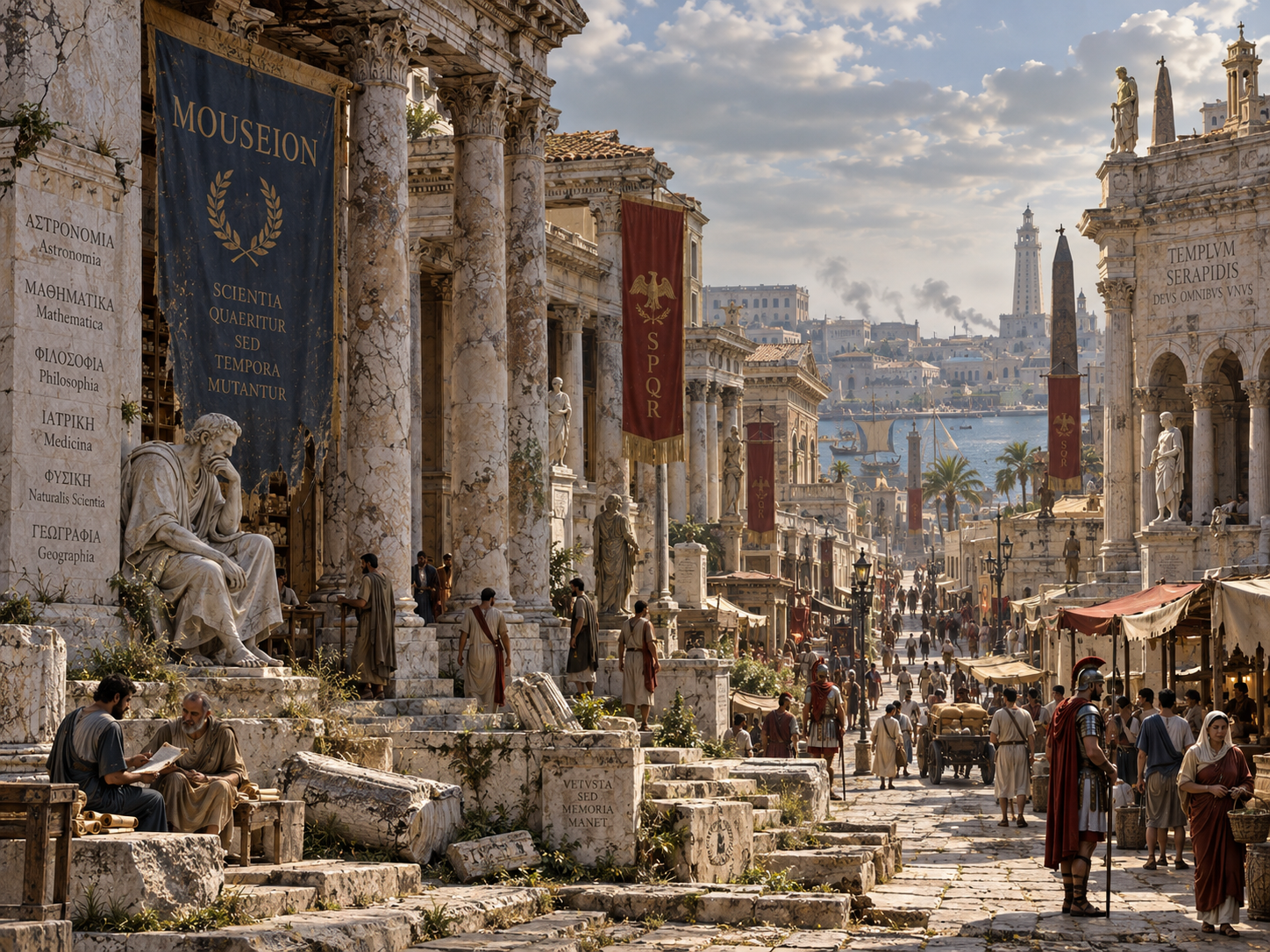
The Library of Alexandria did not remain equally powerful forever.
That part is easy to forget.
The early Ptolemaic rulers gave the library strong royal support. Scholars were invited, collections expanded and the city built a reputation as a centre of learning.
But royal support did not remain unchanged.
Political struggles within the Ptolemaic dynasty damaged the intellectual life of Alexandria. In the 2nd century BCE, Ptolemy VIII expelled many foreign intellectuals from the city, including the librarian Aristarchus of Samothrace. The library still existed, but its position within the royal system was changing.
That matters because institutions built by rulers depend on rulers.
A library needs people to care for it.
Someone has to pay scribes.
Someone has to maintain buildings.
Someone has to appoint scholars.
Someone has to keep acquiring books.
If that support becomes weaker, a library can slowly become less important without anyone setting fire to it.
This is one of the most important parts of the Alexandria story.
Knowledge can disappear quietly.
A collection does not have to burn.
It can simply stop growing.
Fewer scholars can arrive.
Fewer copies can be made.
Buildings can receive less attention.
The institution can lose prestige.
And eventually, people may no longer think of it as the heart of the intellectual world.
Alexandria itself also went through wars, political upheaval and later destruction. The city changed, and so did the institutions inside it.
The library's disappearance was therefore tied to a bigger question:
What happens when the world around a great institution changes?
How a Great Institution Can Decline Without a Fire
Chapter 5 — Then Came Caesar's Fire
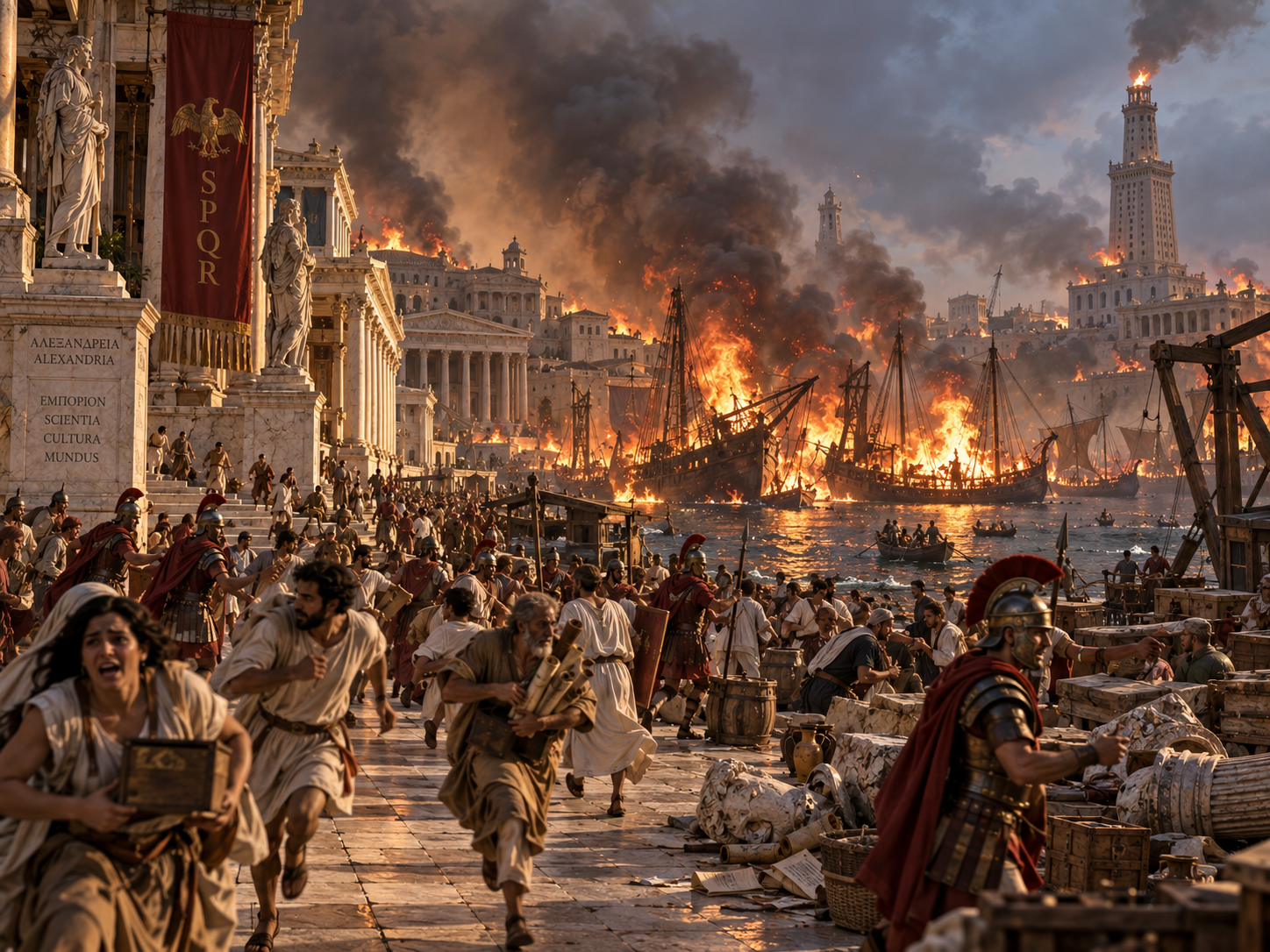
Now we reach the event most people already know.
In 48 BCE, Julius Caesar became trapped in Alexandria during the Roman civil war.
Fighting broke out around the harbour.
Caesar ordered ships in the harbour to be burned as part of the fighting.
The fire spread.
Buildings in the area were damaged.
Ancient writers later connected the blaze with the destruction of books. Plutarch says the fire reached the great library, while other ancient accounts describe books being burned without clearly identifying the main library itself.
So did Caesar burn the Library of Alexandria?
At least some books connected with Alexandria were destroyed in the fire.
But the popular version goes too far when it says Caesar burned the entire library in one night.
The ancient evidence does not agree on how much was lost.
And there is a much bigger problem.
Later evidence shows that the scholarly institution associated with the library continued to exist after Caesar's fire.
That means the famous picture of the whole library disappearing in 48 BCE cannot be taken as simple fact.
Something was lost.
Probably a lot.
But not necessarily everything.
The fire was a disaster.
It was not necessarily the end.
And that difference matters.
Because if the library survived Caesar, we have to ask a harder question:
What happened to it afterward?
What Did Caesar's Fire Actually Destroy?
Chapter 6 — The Serapeum Was Destroyed Centuries Later
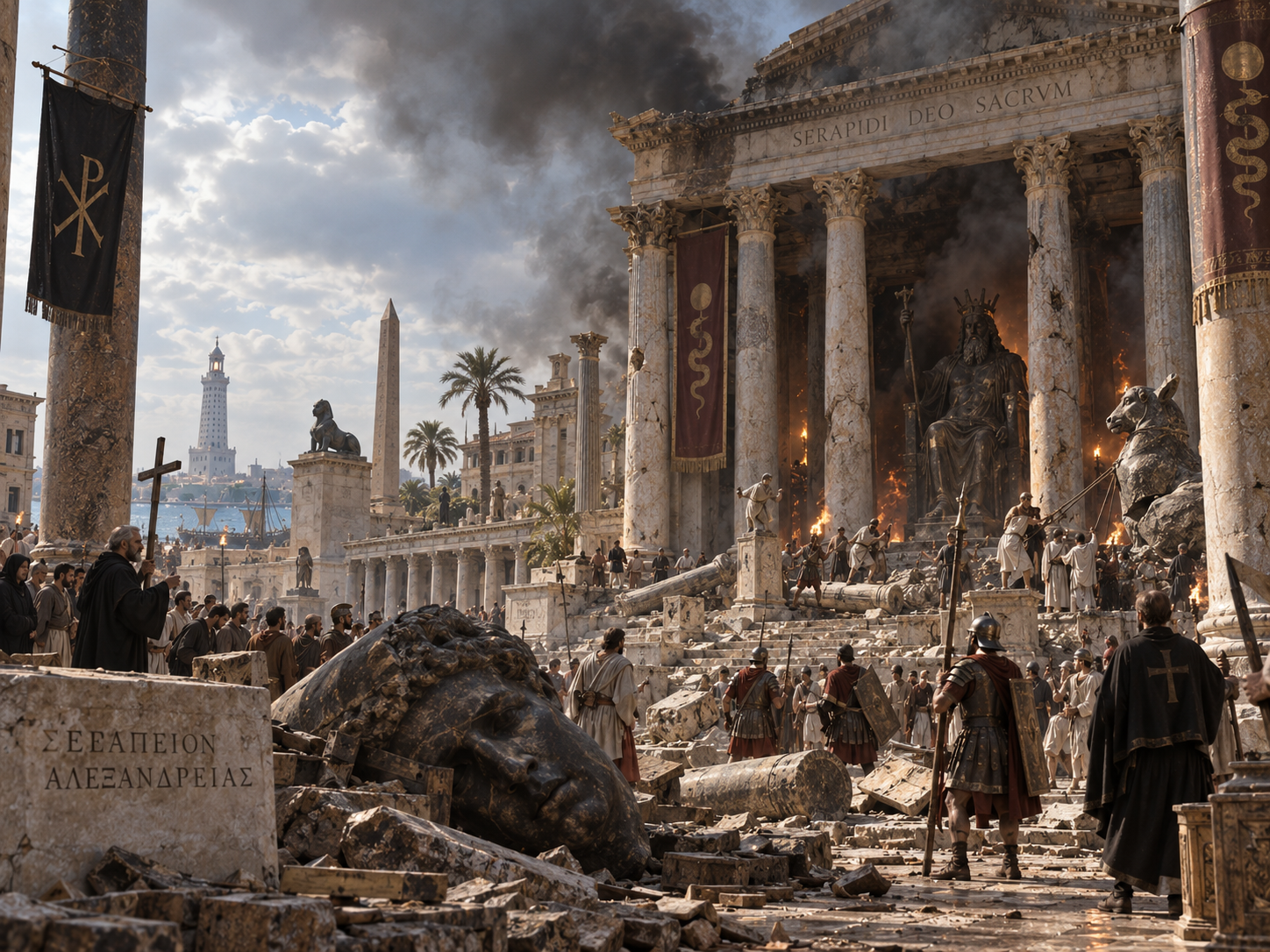
If Caesar's fire had ended the story, Alexandria would be much easier to explain.
But it did not.
Centuries later, another library-related tragedy occurred at the Serapeum.
In 391 CE, the Serapeum was destroyed during violent religious conflict in Alexandria. The destruction of the temple itself is well documented. The more difficult question is what happened to the books that may still have been stored there.
This is where historians have to slow down.
The Serapeum definitely existed.
Its destruction definitely happened.
There was also a book collection associated with it.
But the exact size and fate of that collection are debated.
Some scholars argue that the Serapeum library was an important successor to the earlier Ptolemaic collection and that books were destroyed in the 391 violence. Others are more cautious because the evidence is fragmentary and comes from sources written at different times.
So it is safer to say:
The Serapeum was destroyed in 391.
And:
A library associated with it may have been destroyed or dispersed at the same time.
That is much more careful than saying:
“Christians burned the Great Library in 391.”
The original Ptolemaic library was already centuries old by then.
Alexandria had changed.
The Roman world had changed.
The religious world had changed.
And whatever remained of Alexandria's great scholarly tradition was living in a very different city.
The Serapeum and the Lost Collection
Chapter 7 — The Most Famous Fire Probably Never Happened
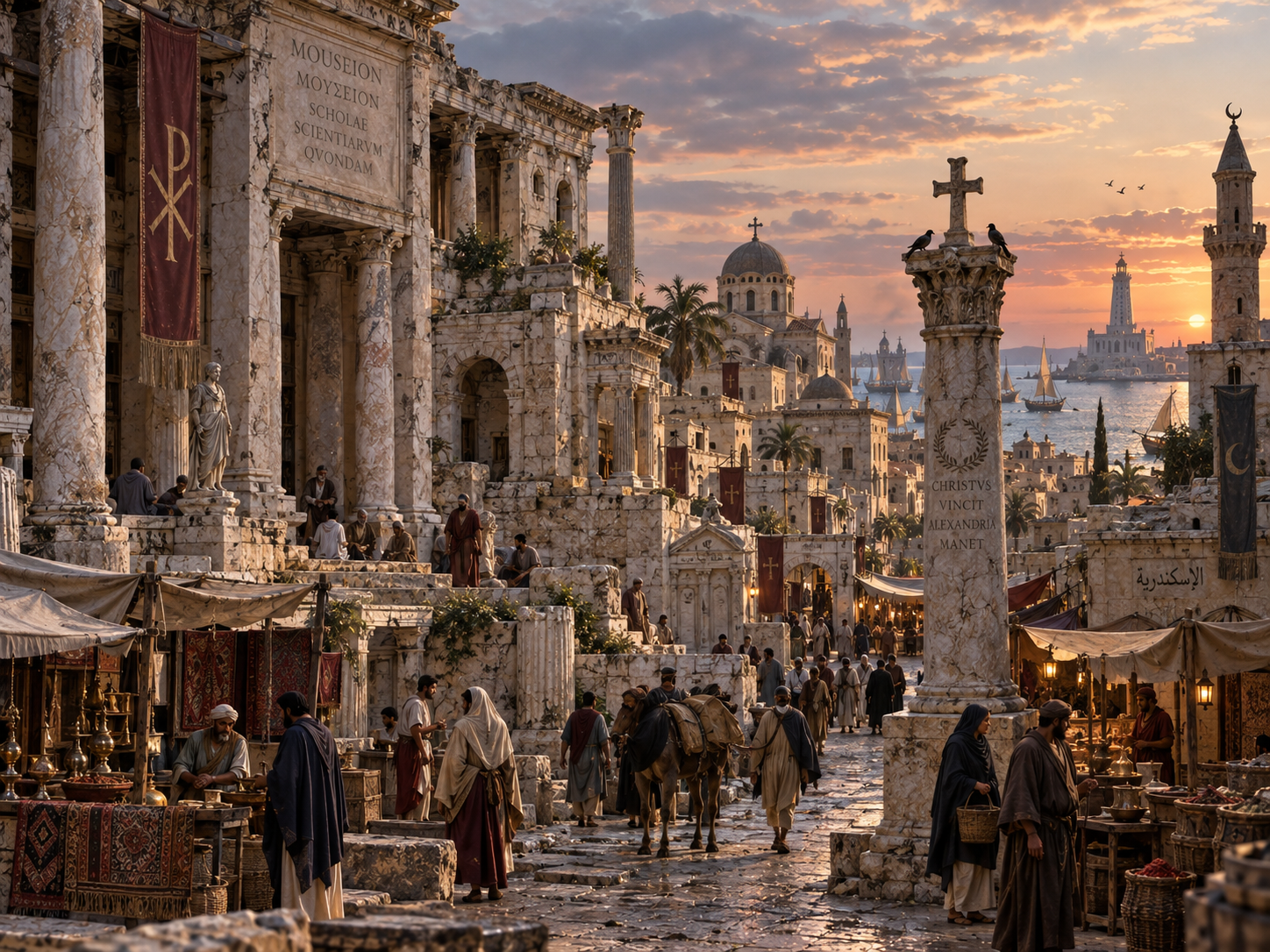
There is one final story.
By the time Alexandria was conquered by Arab forces in the 7th century, the Library of Alexandria had supposedly survived everything.
Then, according to the famous legend, Caliph Umar ordered the remaining books to be burned.
The books were supposedly used to heat the city's bathhouses.
For centuries, this became the ending of the story.
But the evidence does not support it.
The story appears in much later sources, centuries after the Arab conquest of Alexandria in the 7th century. Earlier writers who would have had strong reasons to mention such a dramatic event do not provide a contemporary account of it. Modern historians therefore reject the story as a later legend.
There is an even simpler problem.
By the time Alexandria was conquered, there is no good evidence that the great Ptolemaic library still existed as a huge intact collection waiting to be burned.
The institution had already gone through centuries of political change, violence, declining patronage and uncertain survival.
So the story of the Arabs burning the entire library is almost certainly not the final chapter.
But why did the story survive?
Because it gives history something people love.
A beginning.
A golden age.
A villain.
A fire.
And an ending.
The real story is harder.
There is no single villain who can carry all the blame.
No single night explains everything.
And that may be why the legend became more famous than the truth.
The Story We Were Told vs. the Evidence
What Was Actually Lost?
There is one final question.
How much knowledge disappeared?
We do not know.
That is the uncomfortable part.
We do not know exactly how many scrolls were in Alexandria at its height. Ancient numbers vary widely, and modern historians are cautious about treating the largest figures as reliable.
We also cannot make a list of everything that was destroyed.
For every lost work, we would need to know that it existed in the first place.
Some ancient texts survived because other copies existed elsewhere.
Others survived only in quotations.
Some disappeared completely.
And sometimes, we do not even know that a missing work once existed.
That makes the Library of Alexandria impossible to measure neatly.
It was not simply a warehouse containing “all human knowledge.”
It was a collection of texts, connected to a network of scholars, copyists and teachers.
Its greatest loss was therefore not only paper and ink.
It was the loss of a place where people spent generations collecting, checking, copying, translating and organizing knowledge.
And that is why the real story is more powerful than the famous fire.
The Library of Alexandria probably did not vanish in one dramatic moment.
It faded through centuries of change.
Fire took some books.
War took buildings.
Political change weakened patronage.
Institutions disappeared.
Collections were moved, damaged or lost.
And eventually, the great scholarly world that had made Alexandria famous was gone.
The tragedy is not that one night erased everything.
The tragedy is that something extraordinary was allowed to disappear piece by piece.
And by the time people began telling the story as one great fire, the real history was already much harder to recover.
Frequently Asked Questions
1. Who built the Library of Alexandria?
The library developed under the early Ptolemaic rulers of Egypt. Ptolemy I is often associated with its foundation, while Ptolemy II played a major role in establishing and expanding it. The exact founding process is not completely certain.
2. Why was the Library of Alexandria created?
The Ptolemies wanted Alexandria to become a major centre of learning and culture. The library and the Mouseion helped attract scholars, collect texts and support research and teaching.
3. How many books were in the Library of Alexandria?
No reliable exact number is known. Ancient sources give very different figures, and modern historians are cautious about the largest estimates. It is safer to say that the collection was enormous rather than give one precise number.
4. Did Julius Caesar burn the Library of Alexandria?
Caesar's forces started a fire in Alexandria in 48 BCE, and books were destroyed in the resulting blaze. Ancient sources disagree over how much of the library was lost. Evidence also indicates that Alexandrian scholarly institutions survived afterward, so it is too simple to say Caesar burned the entire library.
5. Did Christians destroy the Library of Alexandria?
In 391 CE, the Serapeum was destroyed during religious conflict in Alexandria. A library collection was associated with the Serapeum, but scholars still debate exactly how large it was and how many books were destroyed at that time.
6. Did Muslims burn the Library of Alexandria?
The famous story that Arab conquerors ordered the library's books burned is considered a later legend. It appears centuries after the conquest of Alexandria and is not supported by contemporary evidence.
7. Did the Library of Alexandria disappear in one fire?
Probably not. The evidence points to several damaging events, changes in political support and a long decline rather than one single fire destroying everything at once.
8. What was the Mouseion?
The Mouseion was a larger scholarly institution associated with Alexandria's library tradition. Scholars lived and worked there under royal support and studied subjects including literature, science and philosophy.
9. What happened to the books that were lost?
We usually cannot know exactly. Some works survived because copies existed elsewhere. Others survive only in quotations or references. Many texts may simply have disappeared without leaving enough evidence for us to identify them.
10. Why is the Library of Alexandria still important?
Because it represents one of the ancient world's most ambitious attempts to gather, organize and study written knowledge in one intellectual centre. Its story also shows that knowledge can be lost gradually through war, political change, neglect and the disappearance of institutions—not only through fire.