Introduction: The Library That Became a Legend
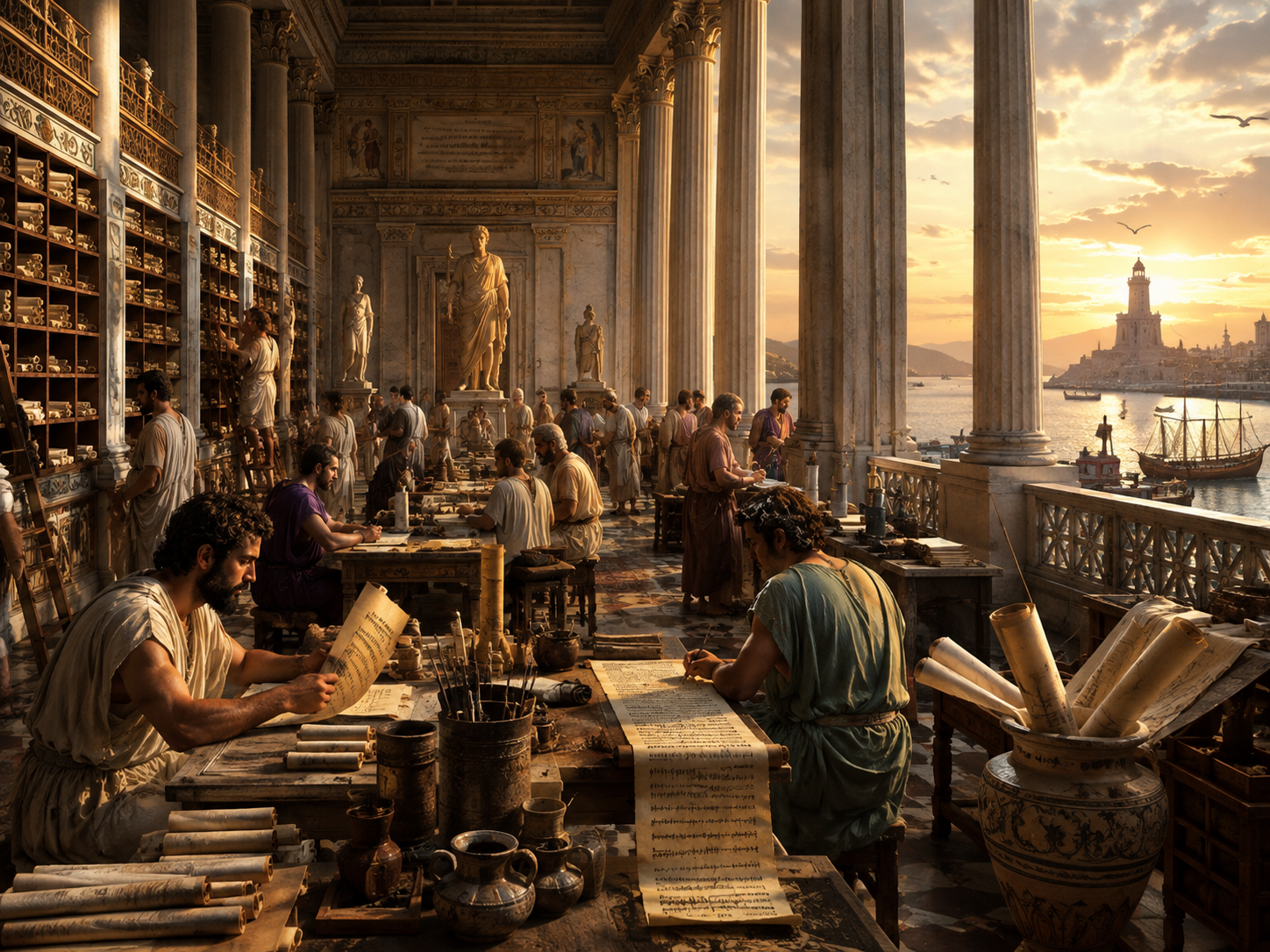
More than two thousand years ago, on the Mediterranean coast of Egypt, a city became one of the greatest intellectual centers the ancient world had ever seen.
Its name was Alexandria.
Founded by Alexander the Great in 331 BCE, the city quickly grew into a major center of trade, politics, scholarship, and culture. But its greatest ambition was not simply to become wealthy or powerful.
It wanted to become the place where the world's knowledge came together.
At the heart of that ambition stood the Library of Alexandria, closely connected to the Mouseion, or Museum—a research and scholarly institution created under the Ptolemaic dynasty.
For centuries, scholars traveled to Alexandria to study mathematics, astronomy, medicine, literature, geography, and philosophy. Thousands of scrolls were collected, copied, translated, catalogued, and studied by people whose discoveries would influence science for generations.
And then, somehow, much of it disappeared.
The popular story is simple: a massive fire destroyed the Library of Alexandria, taking the accumulated knowledge of the ancient world with it.
The real story is far more complicated.
There was probably no single moment when the entire library burned down. Instead, the institution appears to have declined over centuries, affected by political instability, changing priorities, conflict, loss of funding, and the gradual disappearance of its scholarly community. Several destructive events may have damaged collections at different points, but historians cannot confidently identify one fire as the definitive end of the Library.
That uncertainty makes Alexandria even more fascinating.
Because we are not simply asking how a building disappeared.
We are asking how an entire culture of knowledge can fade away—and what humanity loses when the people responsible for preserving knowledge are gone.
The Library of Alexandria has therefore become more than an ancient institution.
It has become a symbol.
A symbol of curiosity.
A symbol of civilization at its intellectual height.
And perhaps most importantly, a warning about how fragile human knowledge can be.
Chapter 1: The Dream of a Universal Library
A City Built for Knowledge
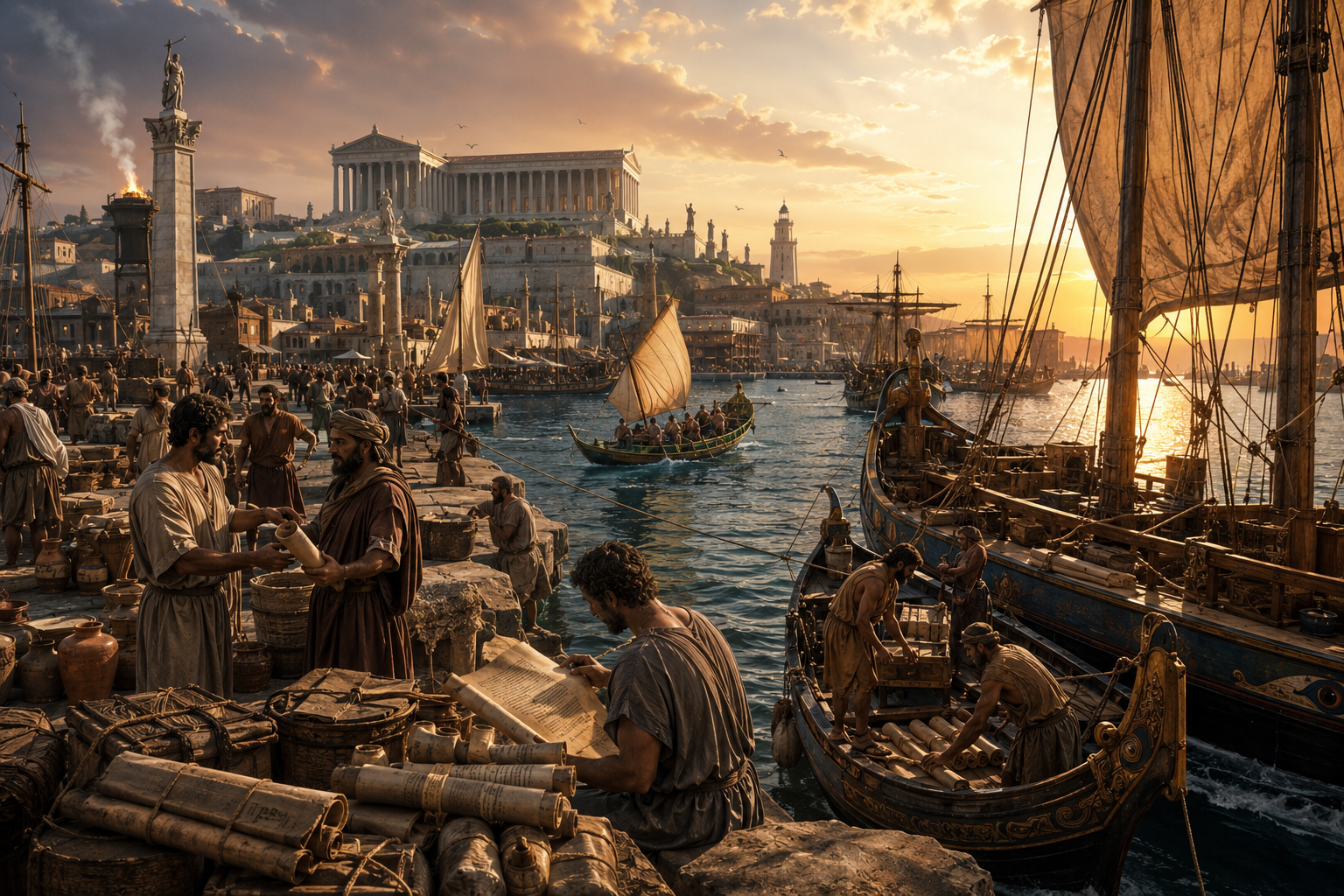
Alexandria was founded in 331 BCE by Alexander the Great during his campaign across Egypt.
After Alexander's death, his empire fractured among his generals. Egypt eventually came under the control of Ptolemy I Soter, who established the Ptolemaic dynasty.
Under Ptolemy I and his successor Ptolemy II Philadelphus, Alexandria developed into one of the most important intellectual centers of the ancient Mediterranean.
The Ptolemies understood something powerful.
Knowledge was power.
A city that attracted the greatest scholars, poets, mathematicians, physicians, and astronomers could become influential far beyond its political borders.
So Alexandria began building an institution unlike anything the ancient world had seen on such a scale.
The Mouseion.
Despite its name, it was not a museum in the modern sense.
It was closer to a research institute or scholarly community, dedicated to the Muses—the goddesses associated with the arts and intellectual pursuits.
The Library was closely connected to this institution.
Together, they created a place where scholars could live, study, conduct research, write, debate, and preserve texts.
Alexandria was attempting something extraordinarily ambitious:
to gather the world's written knowledge in one place.
Collecting the World's Knowledge
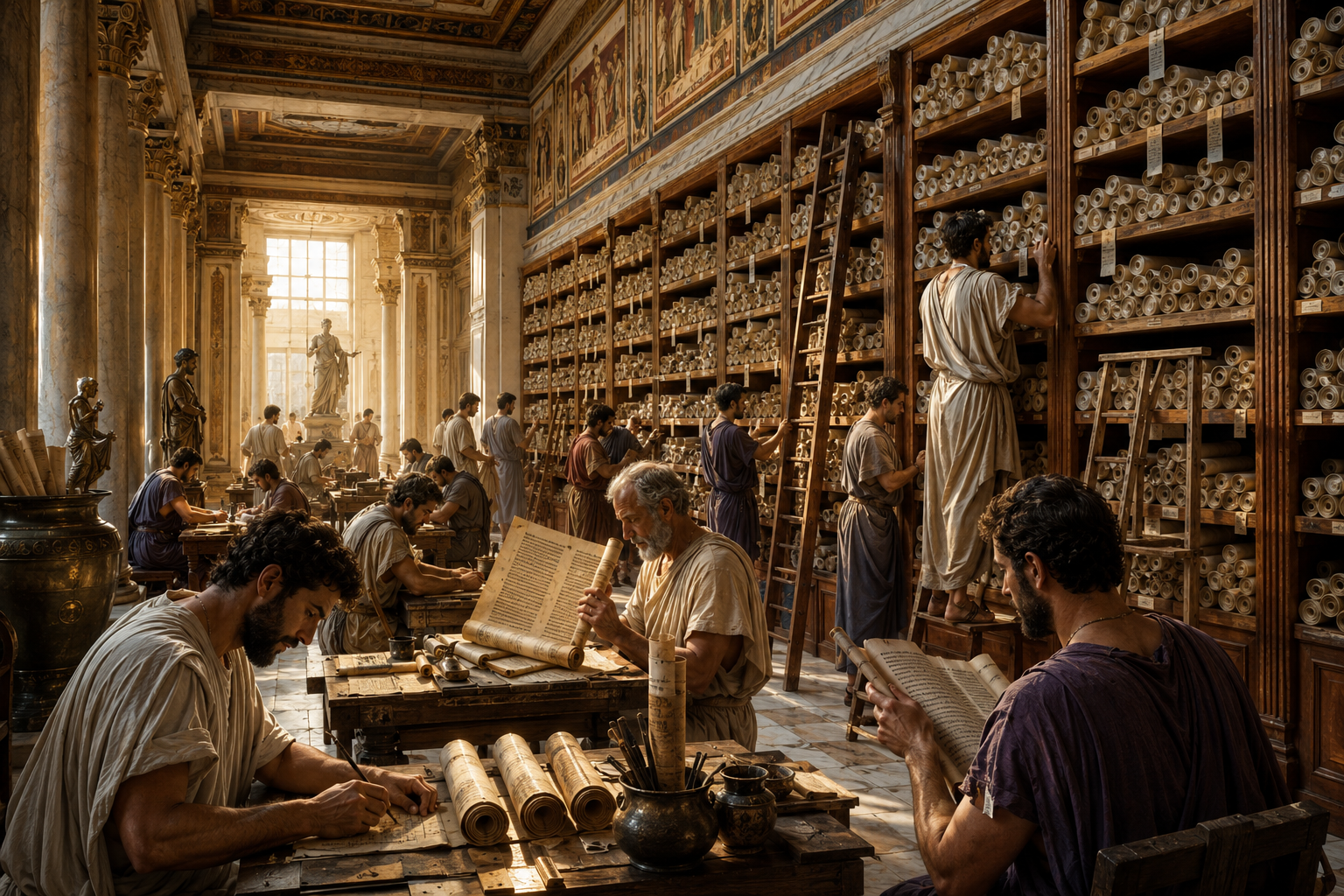
The Ptolemaic rulers were aggressive in their efforts to expand Alexandria's collection.
Ancient sources describe stories of ships arriving at Alexandria and having their books taken for copying. Scribes would reproduce the texts, sometimes returning copies while the originals remained in the royal collection.
Whether every detail of these stories is accurate is uncertain, but they reflect the extraordinary importance the Ptolemies placed on collecting written works.
Texts arrived from different parts of the Greek-speaking world and beyond.
Literature.
Philosophy.
History.
Mathematics.
Medicine.
Astronomy.
Geography.
Religious and cultural works.
Alexandria became a meeting point for knowledge from different traditions.
The goal was not simply to own books.
It was to organize and study them.
How Large Was the Library?
This is where the story becomes uncertain.
Ancient writers provide wildly different numbers for the size of the collection.
Estimates range from tens of thousands of scrolls to hundreds of thousands, with some ancient accounts claiming figures far higher.
But there is an important problem.
A single ancient work could occupy several scrolls.
So saying the library possessed "400,000 books" does not necessarily mean it contained 400,000 individual works in the modern sense.
Furthermore, ancient sources sometimes refer to multiple collections in Alexandria, making it difficult to determine exactly which library a particular number describes.
The safest conclusion is that the Alexandrian collections were enormous by ancient standards, but their exact size remains unknown.
More Than a Library
The most important thing about Alexandria was not the number of scrolls sitting on shelves.
It was what people did with them.
Scholars compared different copies of texts, translated works, corrected errors, studied unfamiliar ideas, and produced new knowledge.
The Library was therefore not simply a storage facility.
It was part of a larger intellectual ecosystem.
The scrolls provided the raw material.
The scholars provided the questions.
And Alexandria provided the environment in which those questions could be pursued.
That distinction is crucial.
If the Library had merely been a giant warehouse of books, its disappearance would have been tragic.
But Alexandria represented something much larger:
an organized attempt to make human knowledge cumulative.
Chapter 1 Summary
The Library of Alexandria was born from an extraordinary ambition—to gather and preserve knowledge on a scale rarely attempted in the ancient world.
Supported by the Ptolemaic rulers and connected to the scholarly Mouseion, Alexandria attracted researchers from across the Mediterranean and became a center for mathematics, astronomy, literature, medicine, geography, and philosophy.
But the true power of Alexandria was never simply the scrolls.
It was the people who came there to read them.
In the next chapter, we will meet some of those remarkable minds and discover what actually happened inside Alexandria's world of scholarship.
Chapter 2: The Minds Behind the Mouseion
Where Knowledge Became Discovery
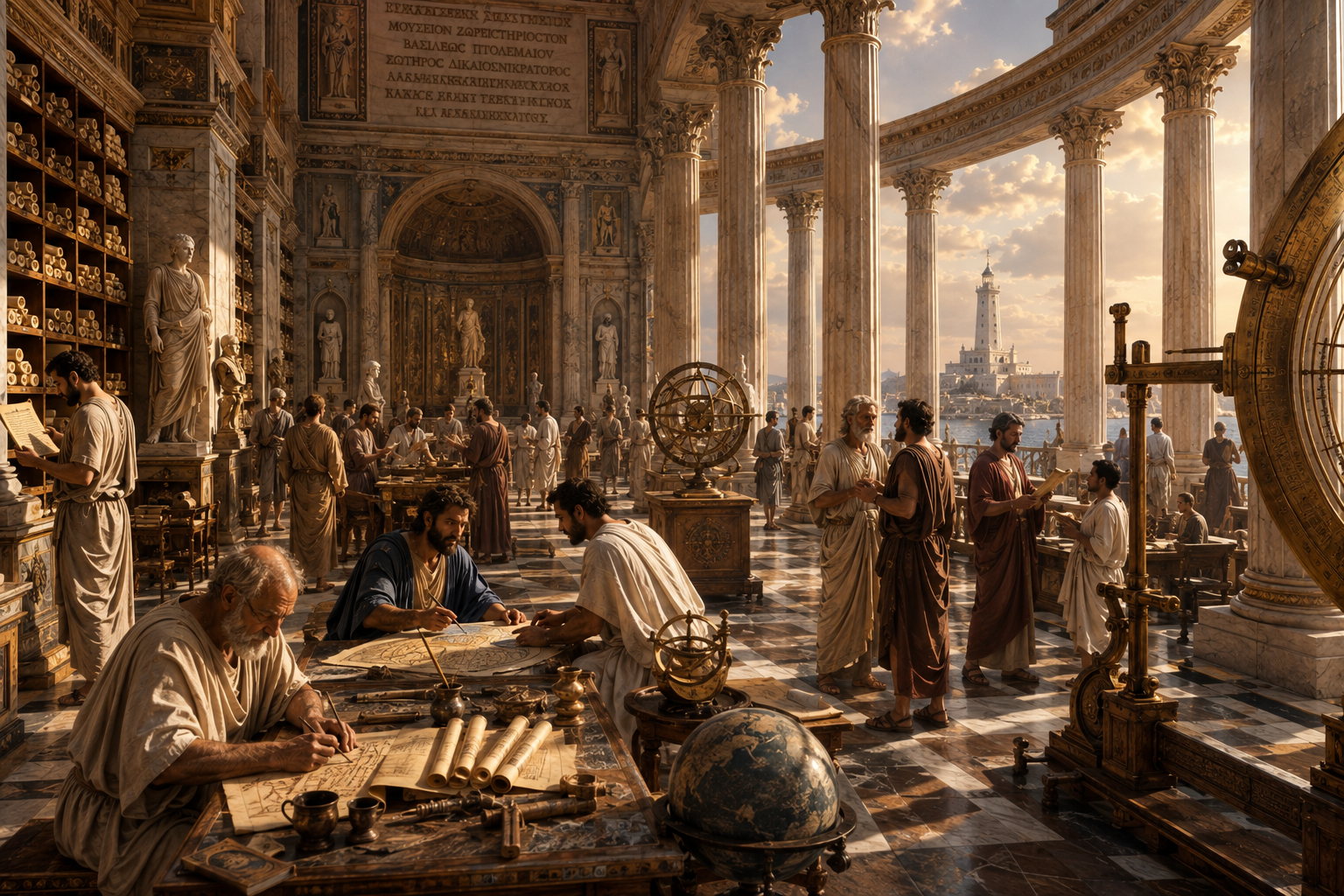
A library can preserve knowledge.
But a collection of scrolls cannot ask questions, test ideas, measure the stars, or challenge an old assumption.
For that, you need people.
And this was where Alexandria became extraordinary.
The Mouseion brought together scholars who were given something remarkably valuable for the ancient world: time to think.
They could study mathematics, astronomy, geography, medicine, literature, and philosophy while having access to a vast collection of written knowledge.
Alexandria was not simply collecting what previous generations knew.
Its scholars were trying to push that knowledge further.
Euclid and the Language of Geometry
Among the scholars associated with Alexandria was Euclid, whose work would become one of the most influential mathematical texts in history.
Around the early 3rd century BCE, Euclid compiled Elements, a systematic treatment of geometry and mathematics built around definitions, axioms, propositions, and proofs.
The significance of Elements was not simply the individual mathematical discoveries inside it.
Euclid presented mathematics as a logical structure.
Start with basic assumptions.
Build propositions from them.
Then prove each result.
This approach became a foundation for mathematical reasoning for centuries.
Long after the Library of Alexandria disappeared, Elements continued to be copied and studied.
The work is a reminder that even when institutions vanish, ideas can survive through transmission.
Eratosthenes Measured the Earth
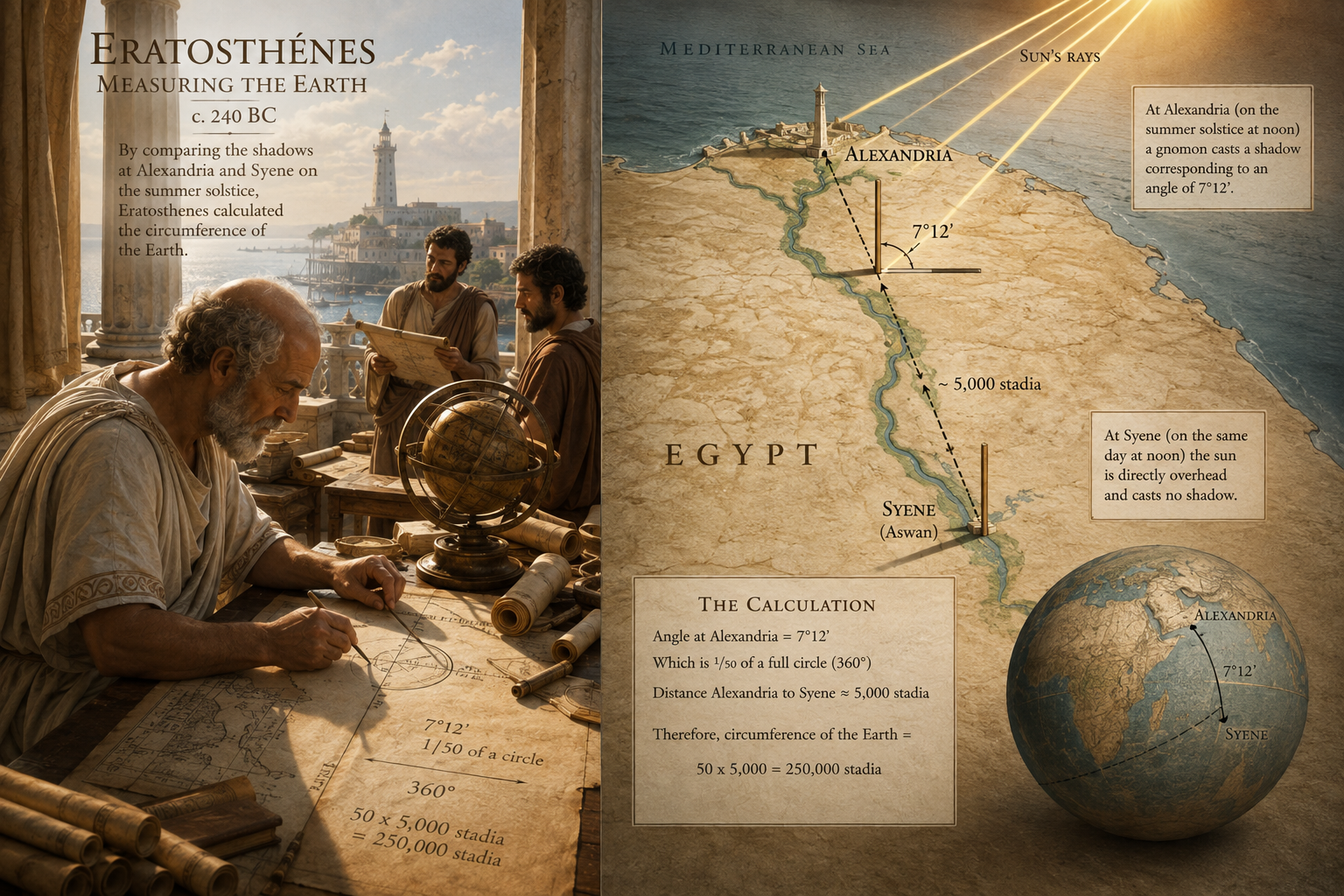
Another extraordinary Alexandrian scholar was Eratosthenes, who became head of the Library according to ancient accounts.
He was interested in geography, mathematics, astronomy, and the shape of the Earth.
His most famous achievement was an astonishing attempt to calculate Earth's circumference.
Eratosthenes noticed that at Syene—modern-day Aswan—the Sun could appear almost directly overhead at noon during the summer solstice.
At approximately the same time in Alexandria, the Sun cast a measurable shadow.
Using the difference in the Sun's angle and the estimated distance between the two locations, he calculated the Earth's circumference.
His result was remarkably close to the modern measurement, although the exact accuracy is debated because ancient units and distances are difficult to reconstruct precisely.
More than two thousand years ago, without satellites or modern instruments, Eratosthenes was using geometry and observation to measure an entire planet.
How Eratosthenes Measured Earth
The Scholars Were Not Working Alone
Alexandria's intellectual community extended far beyond a handful of famous names.
Astronomers studied planetary movements.
Geographers attempted to map the known world.
Physicians investigated the human body.
Linguists and literary scholars compared different versions of ancient texts.
Mathematicians developed new methods for solving difficult problems.
The work could be painstaking.
A scholar might spend years comparing manuscripts that contained slightly different versions of the same poem or historical account.
Another might make astronomical observations night after night.
Someone else could spend months translating a text from one language into another.
There was no modern scientific journal, laboratory network, or digital database.
Knowledge moved slowly.
Yet Alexandria created something surprisingly similar to an early research community: people with specialized knowledge working in proximity to one another and building on earlier work.
The Art of Preserving a Text
One of Alexandria's less glamorous achievements may have been among its most important.
Textual scholarship.
Ancient works were copied by hand, and copying introduced mistakes.
A scribe could accidentally omit a line, repeat a sentence, misunderstand a word, or alter a passage.
Over generations, these small changes could accumulate.
Alexandrian scholars attempted to compare different copies and determine what the original text most likely said.
This was particularly important for Greek literature.
Scholars worked on major authors such as Homer, examining different manuscripts and organizing texts into more reliable versions.
In other words, Alexandria was not simply collecting books.
It was developing methods for editing, organizing, comparing, and preserving knowledge.
That is one reason its intellectual legacy extends far beyond the physical library itself.
A World Before Modern Science
It is tempting to look back at Alexandria and imagine a modern university hidden inside an ancient city.
It wasn't.
Ancient science had serious limitations.
There were no modern laboratories, microscopes, computers, precision clocks, or experimental instruments comparable to those used today.
Some ideas that were widely accepted at the time were eventually proven wrong.
But that does not diminish what happened there.
Alexandrian scholars worked with the tools available to them.
They measured shadows.
Tracked stars.
Mapped coastlines.
Studied anatomy.
Compared manuscripts.
Calculated distances.
And asked questions about how the natural world worked.
Their methods were imperfect, but their curiosity was remarkably modern.
Chapter 2 Summary
The greatness of Alexandria was never contained entirely within its shelves.
It lived in the people who used them.
Euclid transformed mathematical reasoning. Eratosthenes attempted to measure the size of Earth. Astronomers observed the heavens, geographers mapped the known world, physicians investigated the human body, and literary scholars worked to preserve ancient texts.
Together, these scholars turned Alexandria from a repository of knowledge into a place where knowledge could become discovery.
But institutions depend on political stability, money, leadership, and people.
And eventually, Alexandria's remarkable intellectual world began to weaken.
The most famous part of the story is usually described in a single word:
Fire.
The truth is much more complicated.
In the next chapter, we will separate the historical evidence from the legend and examine how the Library of Alexandria may actually have disappeared.
Chapter 3: The Slow Death, Not One Fire
The Greatest Myth About Alexandria
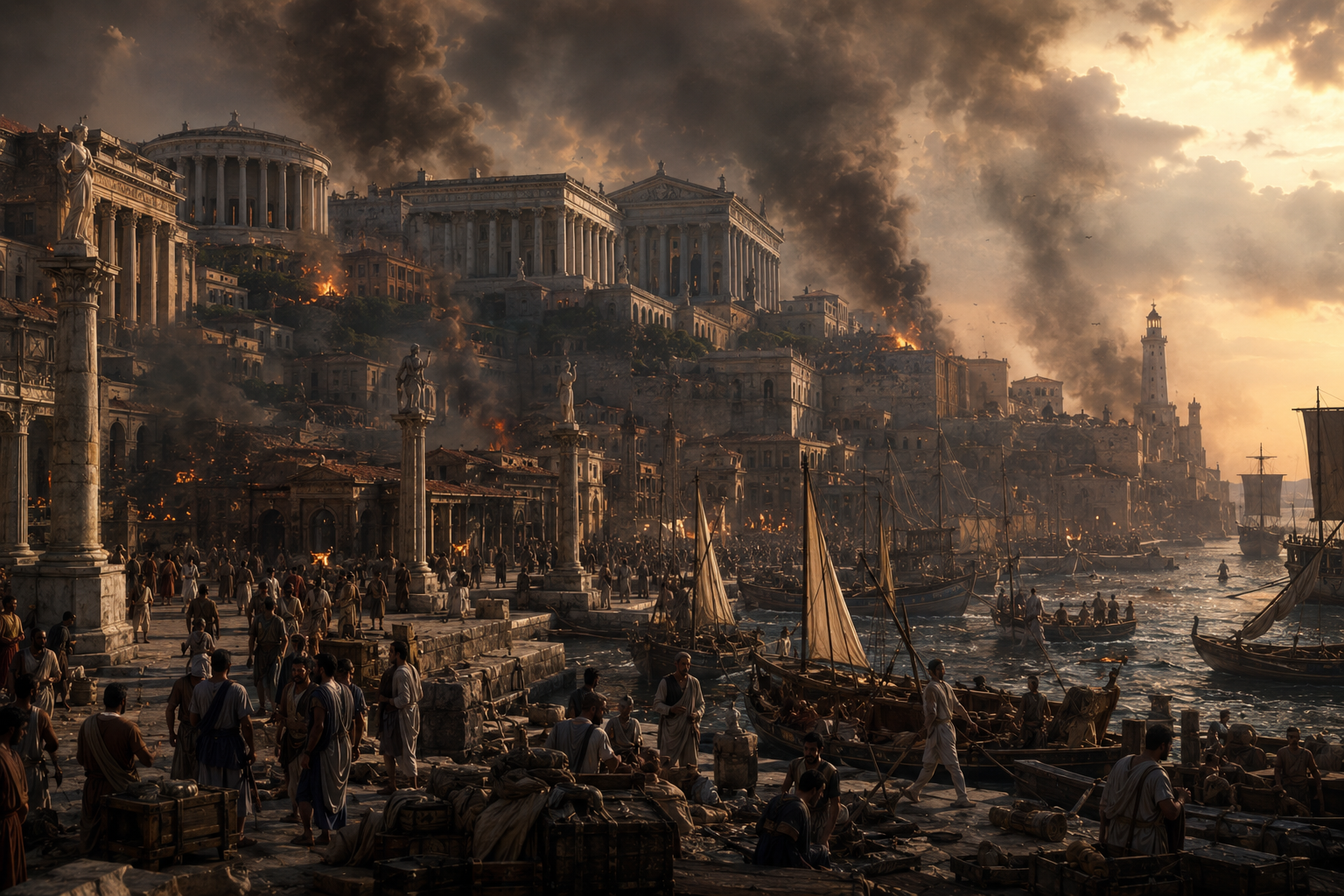
Few stories from the ancient world are repeated as often as this one:
A magnificent library stood in Alexandria, containing the accumulated knowledge of civilization.
Then someone set it on fire.
The flames spread through the building.
Hundreds of thousands of scrolls disappeared in a single catastrophe.
And humanity entered a dark age.
It is a powerful story.
It is also almost certainly too simple.
There is no reliable historical evidence that one enormous fire destroyed the entire Library of Alexandria and all its contents at once.
Instead, the history appears to have been much more complicated—a combination of damage, political upheaval, institutional decline, changing priorities, and the gradual disappearance of Alexandria's scholarly community.
The Library may not have died in one dramatic moment.
It may have faded away.
The Fire During Caesar's War
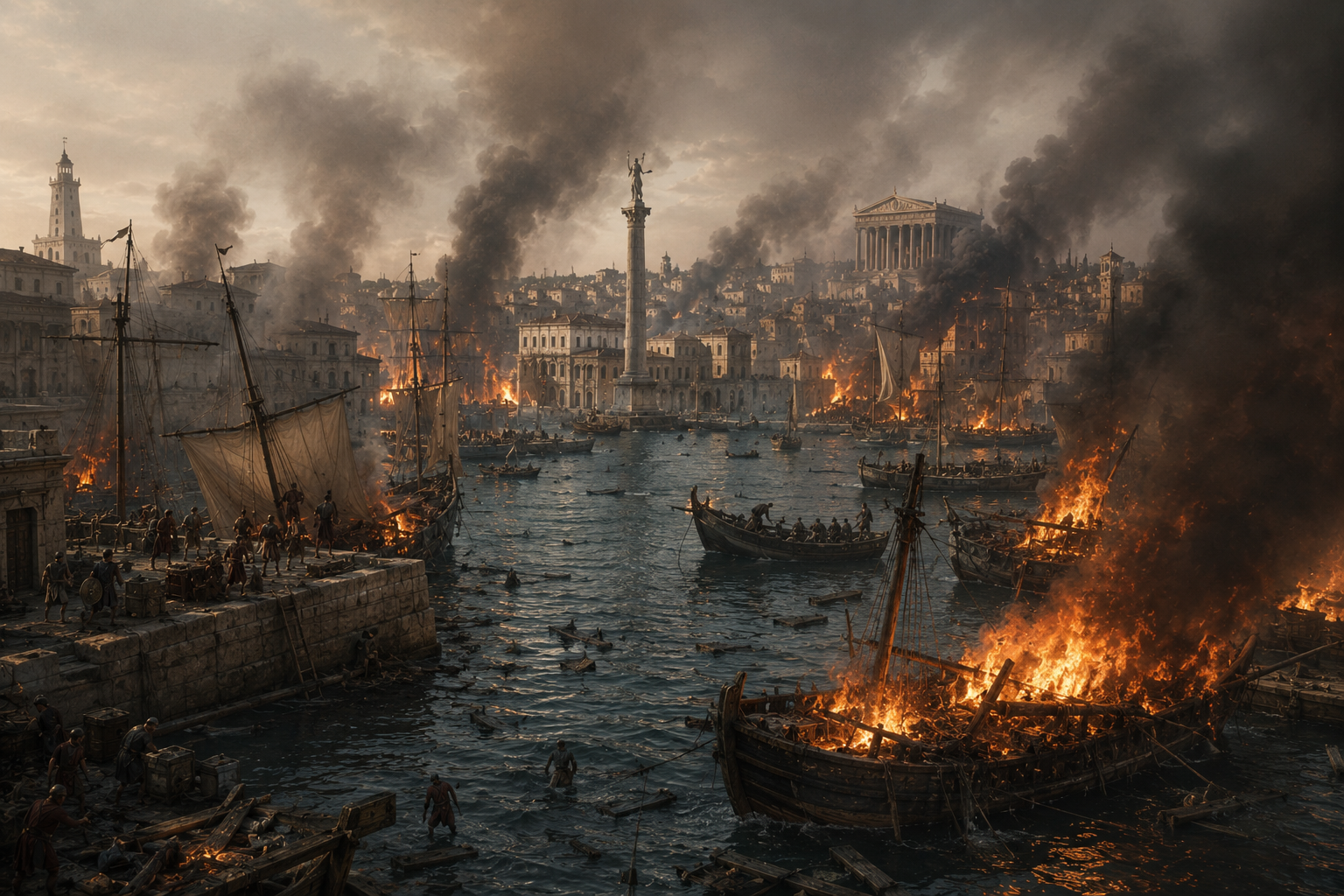
One of the most famous events connected to the Library occurred in 48 BCE, when Julius Caesar became involved in the Alexandrian conflict.
Caesar's forces were attacked by supporters of Ptolemy XIII, and fighting spread around the city's harbor.
Ancient sources describe Caesar ordering fires to be set during the fighting.
The resulting blaze damaged ships and areas near the harbor.
Some ancient accounts later connected this fire with the destruction of books.
But there is an important distinction.
The evidence does not establish that Caesar's fire destroyed the entire Library.
It is possible that scrolls stored near the harbor were lost.
It is also possible that the fire damaged associated collections.
But the scholarly institution appears to have continued afterward.
This is one of the reasons historians are cautious about calling Caesar's fire the destruction of the Library of Alexandria.
Alexandria Continued to Produce Knowledge
This is one of the biggest problems with the single-fire story.
If Caesar's fire had completely destroyed the Library in 48 BCE, why did Alexandria continue to function as a major center of scholarship afterward?
The city remained intellectually important for centuries.
Scholars continued studying mathematics, astronomy, philosophy, medicine, and literature.
The Serapeum, a major religious and cultural complex associated with Alexandria, also possessed a library collection and became important in discussions about the city's surviving books.
The evidence suggests that different collections may have existed in different places.
So the phrase "the Library of Alexandria" can sometimes create a misleading impression of one enormous building containing every scroll.
The ancient reality was probably more complicated.
A Long Period of Decline
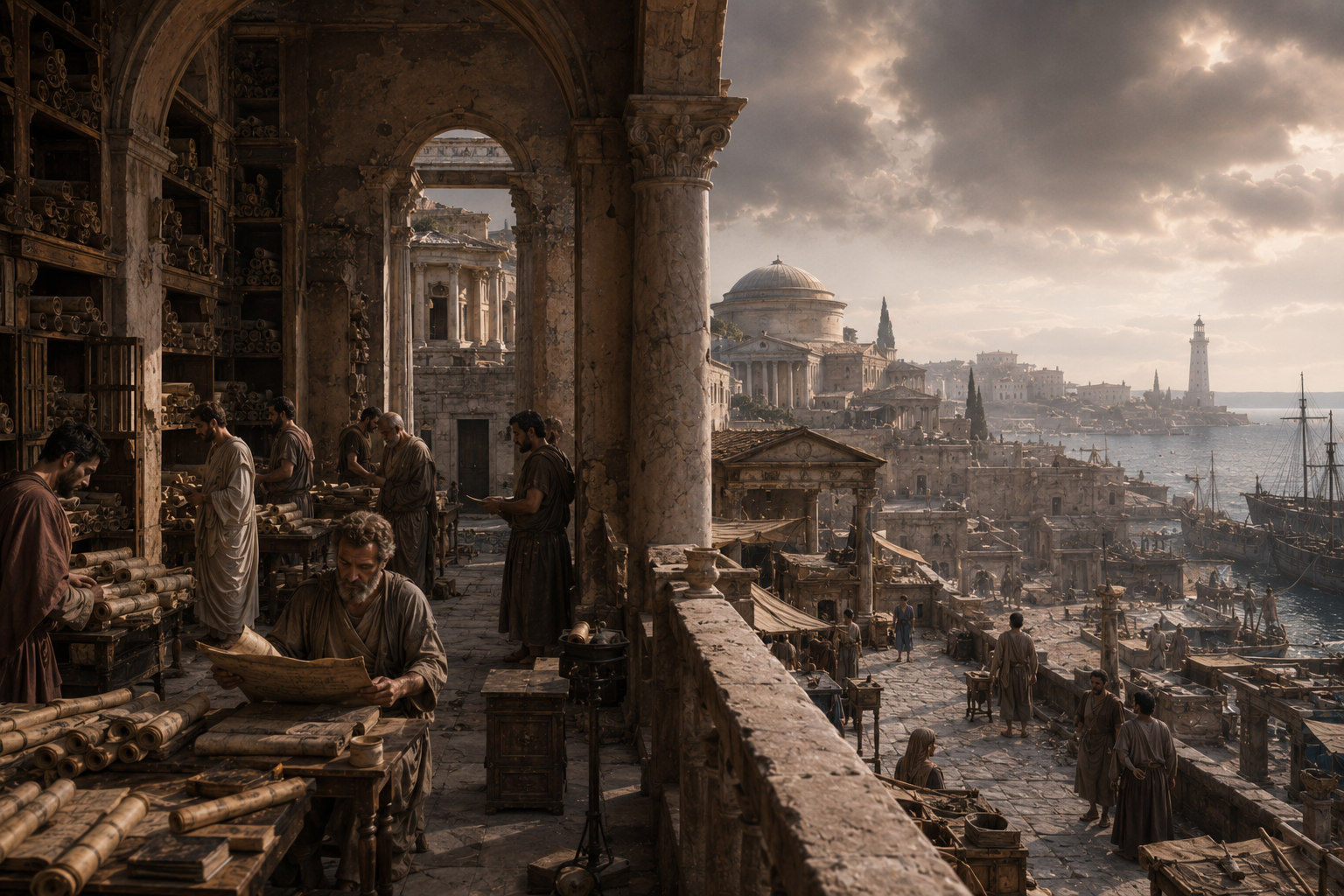
As the centuries passed, the political world around Alexandria changed dramatically.
The Ptolemaic kingdom disappeared.
Egypt became a province of the Roman Empire.
Later, the Roman world itself underwent enormous political and religious transformations.
Institutions that had once received royal support could no longer depend on the same resources.
Scholarly communities changed.
Funding changed.
Political priorities changed.
Religious conflicts affected parts of Alexandria.
And the city itself experienced periods of war and instability.
Knowledge institutions are not independent of the societies that support them.
When the environment that sustains scholars weakens, the institution can weaken with it.
The disappearance of Alexandria's great scholarly tradition may therefore have been a process rather than an event.
The Serapeum and the Religious Conflicts
One important episode occurred in the late 4th century CE.
The Serapeum of Alexandria, a major temple complex associated with the god Serapis, became caught up in religious conflict during a period when Christianity was becoming increasingly dominant within the Roman Empire.
In 391 CE, the Serapeum was destroyed following conflict between Christian authorities and pagan worshippers.
Some later accounts connected this destruction with the loss of books.
However, historians again caution against turning this event into a simple story of Christians destroying the Great Library.
The original Library's exact institutional status by this time is uncertain, and the surviving evidence does not demonstrate that the destruction of the Serapeum destroyed the entire Alexandrian collection.
The broader picture is more complicated.
Political and religious change contributed to the decline of the intellectual environment in which ancient institutions had flourished.
But there was no single documented moment when all Alexandrian knowledge disappeared.
What About the Muslim Conquest?
Another famous story claims that when Arab forces conquered Alexandria in the 7th century, the city's remaining books were ordered to be burned.
According to the story, the books supposedly provided enough fuel to heat the city's bathhouses for months.
It is an extraordinary image.
It is also regarded by modern historians as a much later legend rather than reliable evidence.
The story appears centuries after the conquest and is not supported by the earliest accounts of the event.
There is therefore no solid historical basis for saying that the Muslim conquest destroyed the Library of Alexandria.
This distinction matters.
History becomes distorted when a dramatic story is repeated so many times that repetition begins to look like evidence.
So What Actually Happened?
The most responsible answer is:
We do not know exactly.
There may never have been one final day when someone could point to the Library and say, "Today it disappeared."
Instead, its collections and institutions may have suffered through multiple stages of loss.
Fire may have destroyed some material.
Political instability may have disrupted scholarly activity.
Funding and institutional support may have declined.
Collections may have been scattered.
Scholars may have left.
Other libraries may have preserved copies of some works.
And eventually, the institution itself disappeared from the historical record.
The tragedy is therefore not necessarily that one fire destroyed everything.
The tragedy may be that an institution built to preserve knowledge gradually became unable to continue preserving it.
Chapter 3 Summary
The Library of Alexandria probably did not disappear in one spectacular fire.
Instead, its history appears to have been shaped by a series of disruptions over several centuries. Caesar's fire may have damaged collections, later political and religious changes weakened Alexandria's intellectual institutions, and the scholarly community eventually disappeared.
The famous story of the Muslim conquest destroying the remaining books centuries later is not supported by reliable contemporary evidence.
The real story is less dramatic than a single catastrophe—but perhaps more unsettling.
Knowledge rarely disappears all at once.
It can disappear one institution, one manuscript, one scholar, and one generation at a time.
And that raises the most painful question of all:
If we don't know exactly how Alexandria's knowledge disappeared, what exactly did humanity lose?
Chapter 4: What Was Actually Lost?
The Knowledge We Can No Longer Read
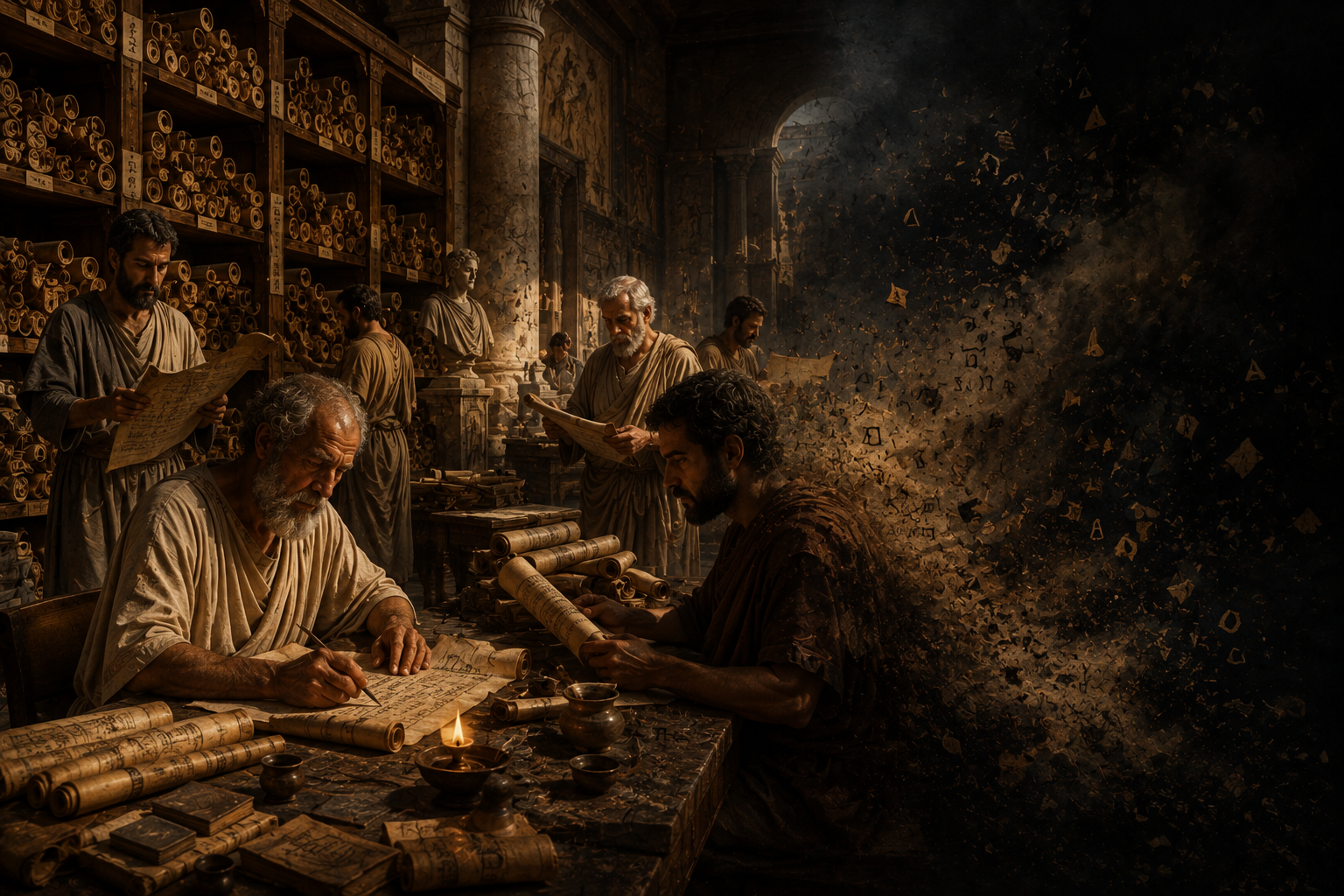
The most haunting part of Alexandria's story is not the image of flames.
It is the silence left behind.
We know that ancient writers produced enormous amounts of literature, history, philosophy, mathematics, science, and poetry. We also know that only a fraction of that intellectual world survives today.
But there is an important distinction.
We cannot simply say:
“Everything that disappeared was destroyed in Alexandria.”
Many ancient works were lost for countless reasons. Some were never copied enough times to survive. Others disappeared when libraries declined, manuscripts deteriorated, wars destroyed cities, or later generations stopped reading particular authors.
Alexandria was part of that much larger story of knowledge loss.
Its disappearance became a symbol of that loss because the institution was specifically designed to preserve and expand human knowledge.
And somewhere among the works that vanished were ideas we may never know existed.
The Works We Know Only Through Fragments
Some lost works are especially frustrating because we know they existed.
Ancient authors sometimes quoted earlier writers whose complete works no longer survive. Other texts are mentioned in catalogs, biographies, letters, or later historical accounts.
We may know an author's name.
We may know the title of a work.
We may even possess a few surviving quotations.
But the complete text is gone.
This creates a strange relationship with the ancient world.
We can sometimes see the outline of an intellectual tradition without being able to read the ideas that once filled it.
Ancient literature suffered enormous losses.
Only a small portion of the plays written in classical Greece survive today. Large bodies of ancient historical writing have also disappeared.
The same is true for scientific and philosophical works.
The surviving record is therefore not necessarily a perfect representation of what ancient people actually knew.
It is what happened to survive.
What Survived Somewhere Else
There is another side to the story.
Not every text disappeared when Alexandria declined.
Ancient knowledge moved between cities, institutions, and civilizations.
Manuscripts were copied.
Translations were produced.
Scholars carried ideas with them.
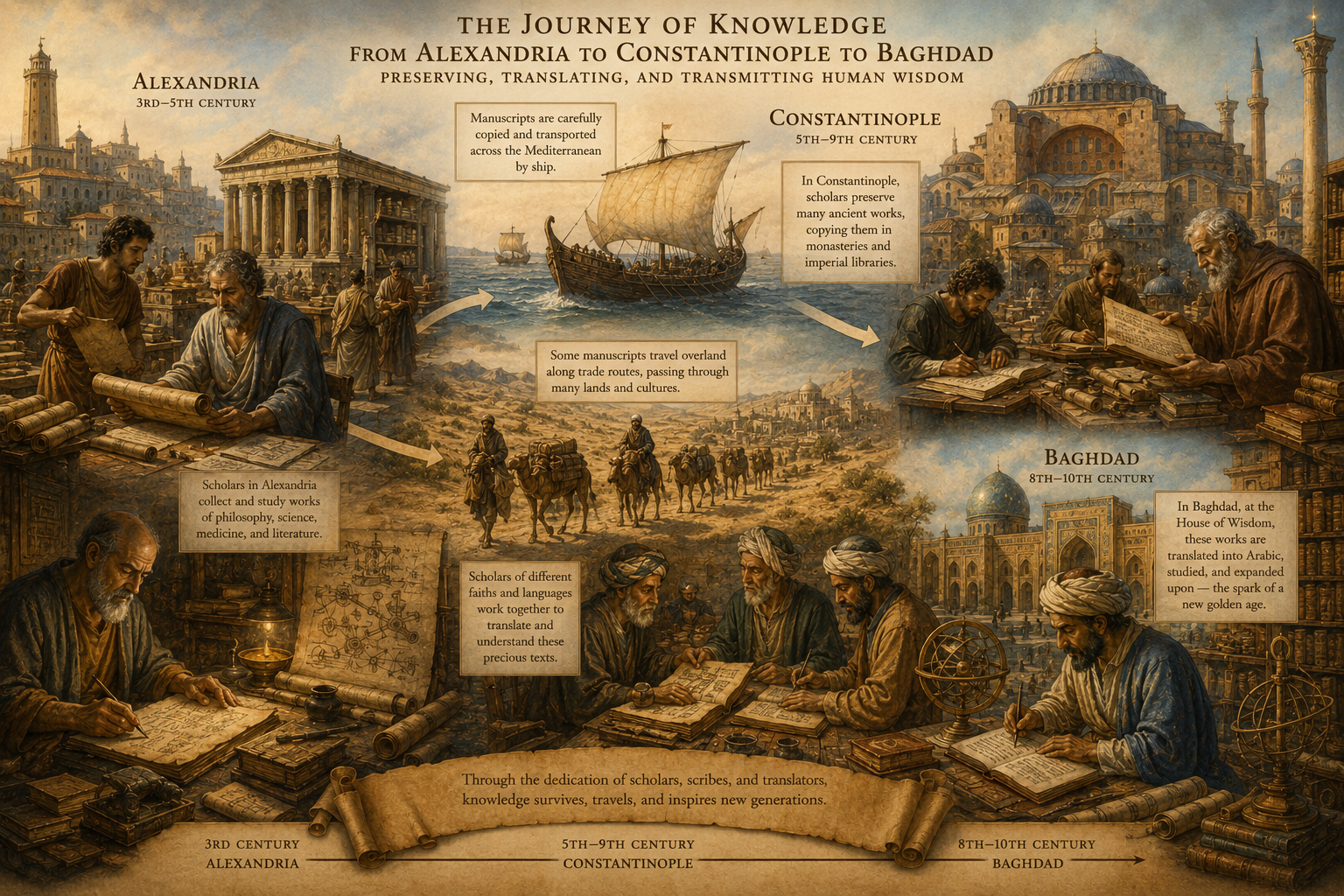
Libraries in places such as Constantinople, monasteries across the medieval world, and later centers of scholarship preserved portions of ancient literature.
Centuries later, scholars working in the Islamic world translated and expanded upon Greek, Persian, Indian, and other intellectual traditions.
The House of Wisdom in Baghdad became an important center of translation and scholarship during the Abbasid period.
This means the history of ancient knowledge is not simply:
Alexandria → destruction → everything lost.
It is closer to:
Alexandria → copying → movement → translation → preservation → rediscovery.
Knowledge survived because people kept making new copies.
What Survived vs. What Was Lost
Why Copies Mattered More Than Buildings
A library building can burn.
A manuscript can survive somewhere else.
This is one of the most important lessons in Alexandria's history.
Ancient texts existed as handwritten copies. If a work had only one surviving copy and that manuscript was destroyed, the work could disappear permanently.
But if dozens of copies existed in different cities, the chances of survival increased dramatically.
The survival of ancient knowledge therefore depended on redundancy.
One copy was fragile.
Many copies spread across different places were much safer.
This principle remains surprisingly relevant today.
Modern humanity stores enormous quantities of information digitally, but digital information also requires preservation, backups, compatible hardware, functioning systems, and organizations willing to maintain it.
The problem has changed.
The fundamental challenge has not.
Knowledge survives only when someone preserves it.
Did Alexandria Lose the World's Knowledge?
Probably not.
This is one of the biggest misconceptions surrounding the Library.
There is no evidence that Alexandria contained literally all human knowledge.
The ancient Mediterranean world had many other centers of learning and collections of texts.
Knowledge also existed outside the Greek-speaking world—in Egypt, Persia, India, China, Mesopotamia, and elsewhere.
The Library was extraordinary, but it was not a single vault containing everything humanity knew.
Its loss was nevertheless significant.
It represented one of the ancient world's most ambitious attempts to gather knowledge systematically.
Losing part of that intellectual ecosystem meant losing works that might otherwise have influenced later generations.
The tragedy is not that humanity lost everything.
It is that we will never know exactly how much was lost.
The Missing Voices of Antiquity
Perhaps the greatest loss is not scientific formulas or famous philosophical arguments.
It is the voices of ordinary people.
Ancient history was largely written by people whose works happened to survive.
Millions of people lived in the ancient world, but only a tiny fraction left written records that remain accessible today.
Women, workers, merchants, soldiers, enslaved people, local communities, and minority cultures often appear only briefly—or not at all—in surviving texts.
Some lost writings may have contained perspectives that could completely change how we understand ancient societies.
That is why the loss of manuscripts is more than the loss of information.
It can be the loss of human experience.
Chapter 4 Summary
The Library of Alexandria did not contain every piece of knowledge in the ancient world, and its disappearance did not erase civilization's entire intellectual heritage.
But countless ancient works were lost across the centuries, while others survived only as fragments, quotations, or references.
Some knowledge escaped destruction because manuscripts were copied elsewhere and translated into other languages. Constantinople, monasteries, Baghdad, and other intellectual centers helped preserve portions of the ancient world's legacy.
The story of Alexandria is therefore not simply about destruction.
It is also about survival.
A manuscript copied in one city could outlive the civilization that created it.
And sometimes, a single surviving copy can be the difference between remembering an idea and losing it forever.
But if Alexandria became a symbol of humanity's lost knowledge, what did it leave behind?
The answer is more powerful than an ancient ruin.
Its greatest legacy is the idea that knowledge itself is something worth protecting.
Chapter 5: What Alexandria Left Behind
The Library That Never Truly Disappeared
The original Library of Alexandria is gone.
Its exact location, final form, and precise moment of disappearance remain uncertain. No complete catalog of its collection has survived, and historians cannot reconstruct a single day when the institution definitively ended.
Yet the idea behind it survived.
The belief that knowledge should be gathered, organized, studied, copied, and passed to future generations did not disappear with the ancient institution.
In fact, that idea became more powerful with time.
Alexandria's greatest legacy may therefore not be the scrolls that were lost.
It may be the idea of preserving knowledge itself.
The Ancient Dream in a Modern World
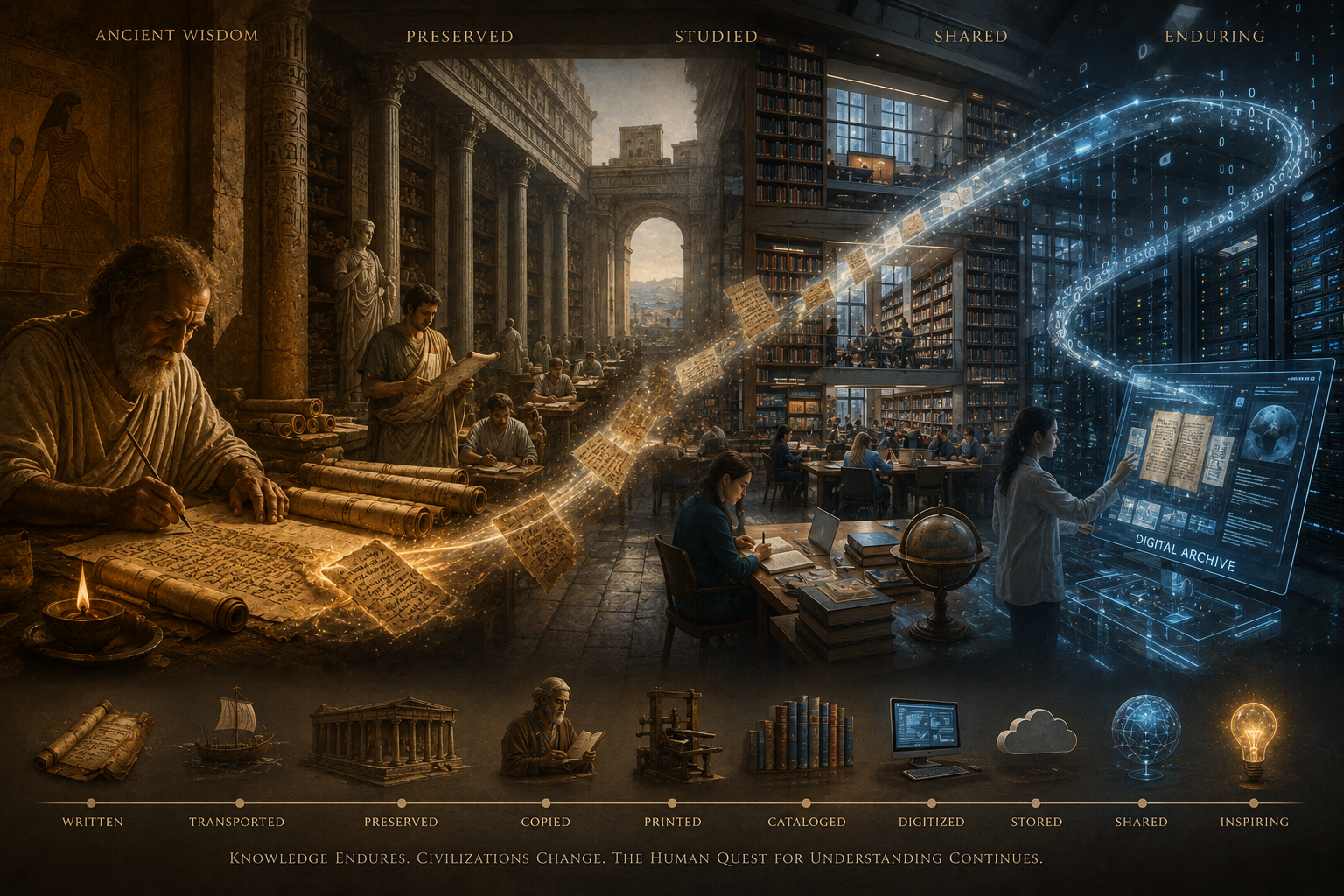
Thousands of years after the Ptolemies attempted to gather the world's knowledge, humanity is still pursuing the same ambition.
Modern libraries hold millions of books.
Universities preserve scientific papers and manuscripts.
Archives protect historical documents.
Museums digitize fragile collections.
And enormous digital databases allow information to be accessed almost instantly from almost anywhere on Earth.
The technology is radically different.
The goal is surprisingly familiar.
Keep knowledge from disappearing.
The story of Alexandria reminds us why that matters.
A civilization can lose political power.
Cities can fall.
Languages can disappear.
But knowledge that has been carefully preserved can cross centuries and reach people who have not even been born yet.
The Bibliotheca Alexandrina
In modern Alexandria, that ancient ambition has been given a new form.
The Bibliotheca Alexandrina opened in 2002, near the site traditionally associated with the ancient library.
It is not the original Library rebuilt.
It is a modern institution inspired by the intellectual legacy of ancient Alexandria.
Its striking architecture was designed to evoke the idea of a rising sun and an institution open toward the world.
Inside are libraries, museums, research centers, exhibition spaces, and facilities dedicated to preserving and sharing knowledge.
The modern institution cannot recover the manuscripts that disappeared two thousand years ago.
But it can continue the principle that made Alexandria remarkable:
knowledge should be collected, protected, and made accessible.
From Papyrus to the Digital Age
The ancient Library depended on scribes.
Modern civilization depends increasingly on servers.
The difference is enormous, but the underlying problem remains.
How do you make knowledge survive?
Ancient scholars copied manuscripts by hand.
Modern archivists create digital copies.
Ancient libraries depended on physical buildings.
Modern archives distribute information across multiple locations.
Ancient texts could disappear when a single manuscript was destroyed.
Today, important information can be duplicated across thousands of systems.
Yet digital preservation has its own vulnerabilities.
Files can become corrupted.
Storage systems can fail.
Websites disappear.
Formats become obsolete.
Organizations stop maintaining archives.
Information can also become difficult to interpret when the software or hardware required to access it no longer exists.
Humanity has become much better at copying information.
We have not completely solved the problem of preserving it forever.
What If Alexandria Had Survived?
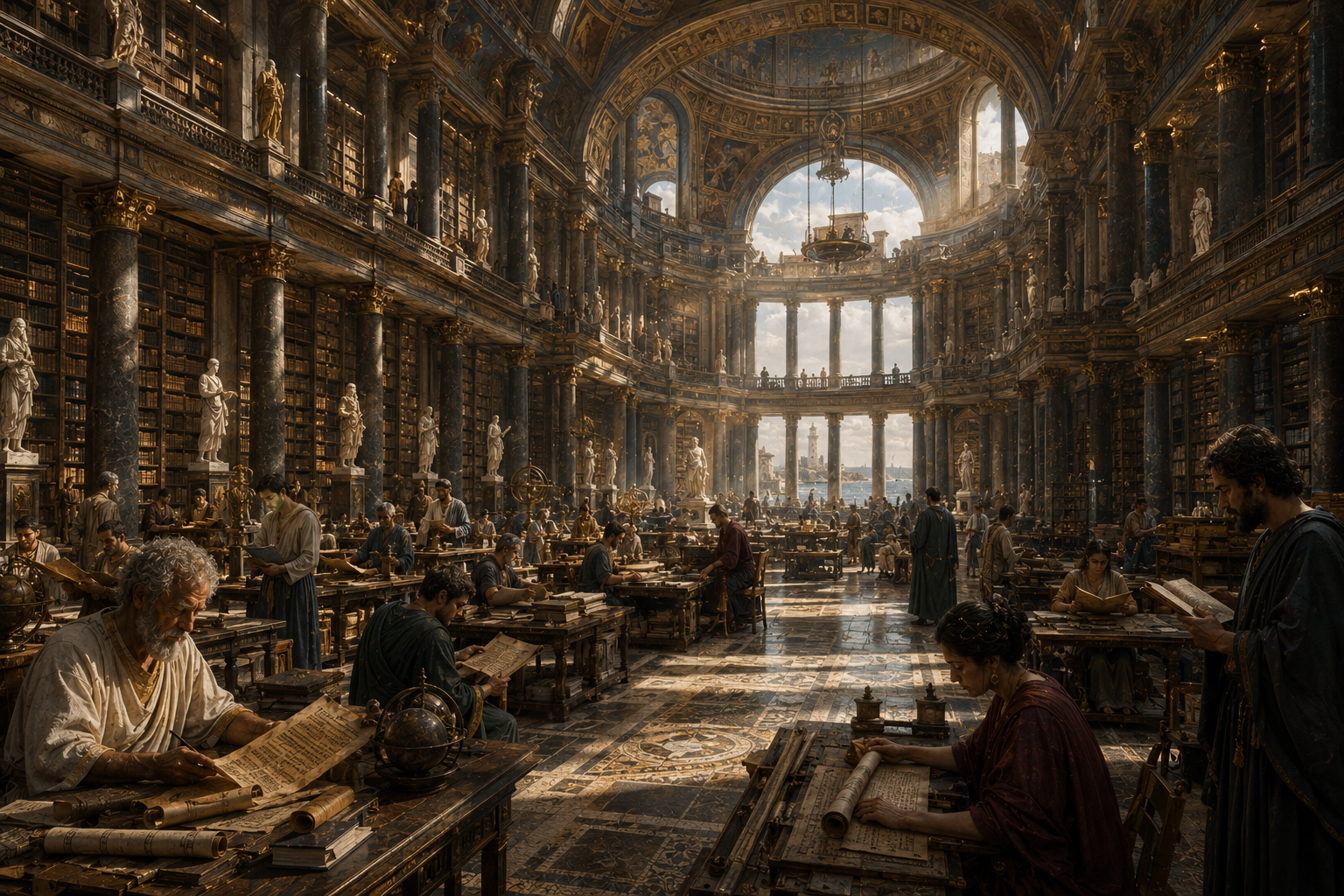
It is tempting to imagine an alternate history.
What if the Library had survived for another thousand years?
Would humanity have reached modern science centuries earlier?
Would ancient scientists have discovered technologies we developed much later?
Would lost Greek literature have changed our understanding of history?
Perhaps.
But there is no way to know.
A surviving library would not automatically have produced modern science. Scientific progress depends on much more than books. It requires institutions, experimentation, technology, communication, economic resources, and societies willing to support research.
Still, a larger surviving collection could have given later generations access to ideas that are now permanently lost.
That possibility is part of what makes Alexandria so haunting.
We can imagine the questions.
We simply cannot read the answers.
From Alexandria to Today
Why Alexandria Still Matters
The Library of Alexandria has become a symbol far beyond Egypt.
It appears whenever people discuss endangered archives, disappearing languages, damaged cultural heritage, lost manuscripts, or the preservation of digital information.
Its story asks a simple question:
What happens when knowledge disappears faster than it can be preserved?
The answer is uncomfortable.
Once the last copy of a work is gone, no amount of technology can bring its exact original contents back.
That is why libraries and archives matter.
They are not simply buildings filled with old material.
They are mechanisms through which one generation communicates with another.
A book written thousands of years ago can still speak today because someone, somewhere, decided it was worth copying.
Conclusion: The Greatest Loss—and the Greatest Lesson
The Library of Alexandria did not vanish in one spectacular moment.
There was no single confirmed fire that erased every book in the ancient world.
Instead, its history appears to have been shaped by centuries of political change, conflict, institutional decline, damaged collections, and the gradual disappearance of the scholarly environment that had made Alexandria extraordinary.
Some knowledge was lost.
Some survived.
Some traveled across civilizations through copying and translation.
And some vanished so completely that we do not even know what we are missing.
That may be the most haunting part of Alexandria's story.
We cannot mourn every lost work because we do not know its name.
We cannot read every vanished idea because we do not know what it contained.
We cannot reconstruct every voice because the manuscripts carrying those voices are gone.
But the Library left something behind.
A lesson.
Knowledge is fragile.
Civilizations can spend centuries creating it and lose parts of it within a generation.
That is why every library, archive, manuscript, database, and preserved memory matters.
The ancient Alexandrians dreamed of gathering the world's knowledge in one place.
Humanity still carries that dream.
The shelves have changed.
The scrolls have become books, servers, and digital archives.
But the purpose remains the same:
to make sure that what humanity learns today can still be remembered tomorrow.
And perhaps that is the true legacy of the Library of Alexandria.
Not the books we know were lost.
But the knowledge we now understand must never be allowed to disappear so easily again.
Frequently Asked Questions About the Library of Alexandria
1. What was the Library of Alexandria?
The Library of Alexandria was an ancient center of learning in Alexandria, Egypt, established during the Ptolemaic period around the 3rd century BCE. It was closely connected with the Mouseion, a scholarly institution that attracted researchers in literature, mathematics, astronomy, medicine, and other fields.
2. Who built the Library of Alexandria?
The Library developed under the Ptolemaic dynasty, particularly during the reigns of Ptolemy I Soter and Ptolemy II Philadelphus. Ancient sources associate scholars such as Demetrius of Phalerum with the institution's early development.
3. How many scrolls were in the Library of Alexandria?
The exact number is unknown. Ancient sources give widely different estimates, ranging from tens of thousands to hundreds of thousands of scrolls. Because one work could require multiple scrolls, these figures cannot be directly converted into the number of individual books.
4. Did the Library of Alexandria really burn down?
There is no reliable evidence that one fire destroyed the entire Library. Several destructive events occurred in Alexandria over centuries, including the fire during Julius Caesar's Alexandrian War in 48 BCE. The Library's decline appears to have been a gradual process rather than one catastrophic event.
5. Did Julius Caesar destroy the Library of Alexandria?
Caesar's forces set fires during fighting in Alexandria in 48 BCE, and books may have been damaged or destroyed. However, there is no strong evidence that Caesar's fire destroyed the entire Library. Scholarly activity in Alexandria continued afterward.
6. Who destroyed the Library of Alexandria?
There is no historically confirmed individual or event responsible for destroying the entire Library. Its decline likely involved multiple factors, including political instability, changing institutions, conflict, and the loss of scholarly support over several centuries.
7. Did the Muslims destroy the Library of Alexandria?
The popular story that the Library was destroyed by Arab conquerors after the Muslim conquest of Alexandria in the 7th century is considered a later legend and is not supported by reliable contemporary evidence. Historians do not accept it as an established explanation for the Library's destruction.
8. What famous scholars worked in Alexandria?
Alexandria became associated with remarkable scholars including Euclid, Eratosthenes, and other mathematicians, astronomers, physicians, geographers, and literary scholars. Eratosthenes famously used geometry and observations of shadows to estimate Earth's circumference.
9. What knowledge was lost from the Library of Alexandria?
Many ancient works have been lost, including portions of literature, history, philosophy, mathematics, and science. However, it is impossible to determine exactly which works were lost specifically because of the Library's decline. Many ancient texts disappeared for other reasons over the centuries.
10. Does the Library of Alexandria still exist today?
The original ancient institution no longer exists. However, Bibliotheca Alexandrina, opened in 2002, is a modern library and cultural center in Alexandria inspired by the intellectual legacy of the ancient Library. It is not the original building rebuilt.