Introduction
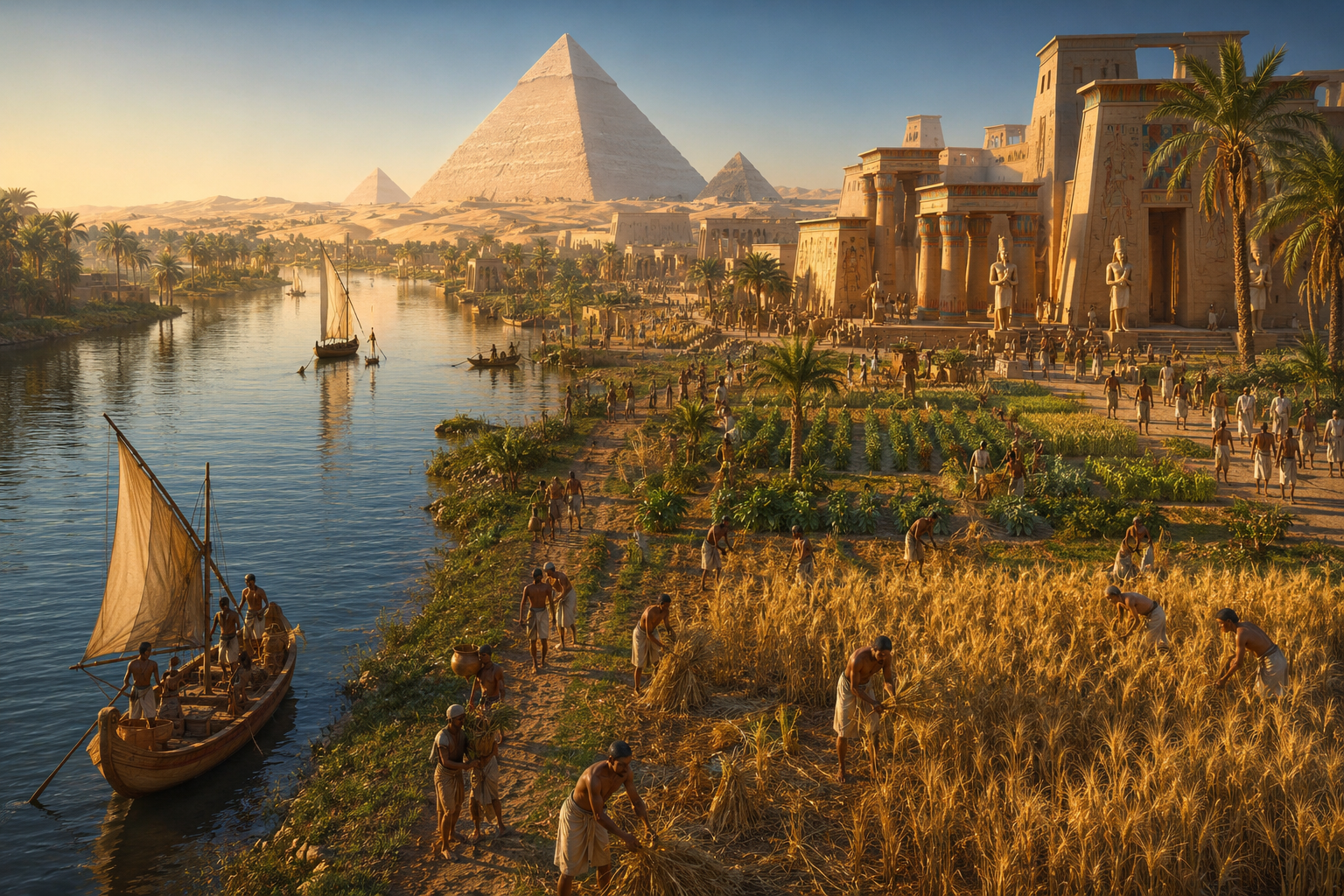
Long before the rise of the Roman Empire, before the Parthenon crowned the hills of Greece, and thousands of years before medieval castles appeared across Europe, a civilization flourished along the banks of a remarkable river in northeastern Africa. Protected by vast deserts and sustained by the life-giving waters of the Nile, Ancient Egypt became one of humanity's earliest and most enduring civilizations. For more than 3,000 years, it stood as a center of political power, scientific innovation, artistic excellence, and architectural achievement.
The story of Ancient Egypt is often told through its monumental pyramids, mysterious mummies, and legendary pharaohs. While these symbols continue to capture the world's imagination, they represent only a small part of a far richer civilization. Behind every colossal monument stood generations of skilled engineers, architects, craftsmen, scribes, farmers, and laborers whose knowledge transformed a narrow river valley into one of history's greatest kingdoms.
Unlike many ancient societies that rose and fell within a few centuries, Egypt endured through changing dynasties, foreign invasions, and periods of prosperity and decline. Its people developed one of the world's earliest writing systems, constructed engineering marvels that still challenge modern understanding, practiced surprisingly advanced medicine, established efficient systems of government, and created religious beliefs that shaped every aspect of daily life. Much of what historians know today comes directly from temples, royal inscriptions, papyrus manuscripts, and archaeological discoveries that have survived for thousands of years beneath Egypt's dry desert climate.
At the heart of this civilization flowed the Nile River, whose predictable annual floods transformed barren desert into fertile farmland. The river not only provided food and transportation but also influenced Egyptian religion, economy, politics, and culture. Without the Nile, Ancient Egypt as we know it would never have existed.
Even today, Egypt continues to reveal new secrets. Modern archaeological excavations, satellite imaging, DNA analysis, and advanced scanning technologies have uncovered forgotten tombs, hidden settlements, and previously unknown details about the lives of pharaohs and ordinary people alike. Each discovery deepens our understanding of a civilization that continues to inspire historians, scientists, engineers, and travelers around the world.
This journey explores how Ancient Egypt was born, how its people lived, what they believed, how they built monuments that have survived for millennia, and why its extraordinary legacy continues to shape our understanding of human civilization. Before the pyramids pierced the desert skyline and before mighty pharaohs ruled from magnificent palaces, everything began with a single river that changed history forever.
Chapter 1 — The Birth of Ancient Egypt
How a River Forged One of Humanity's First Great Civilizations
Where the Story Begins
Every great civilization has a birthplace, and for Ancient Egypt, that birthplace was not a city, a king, or a monument—it was a river.
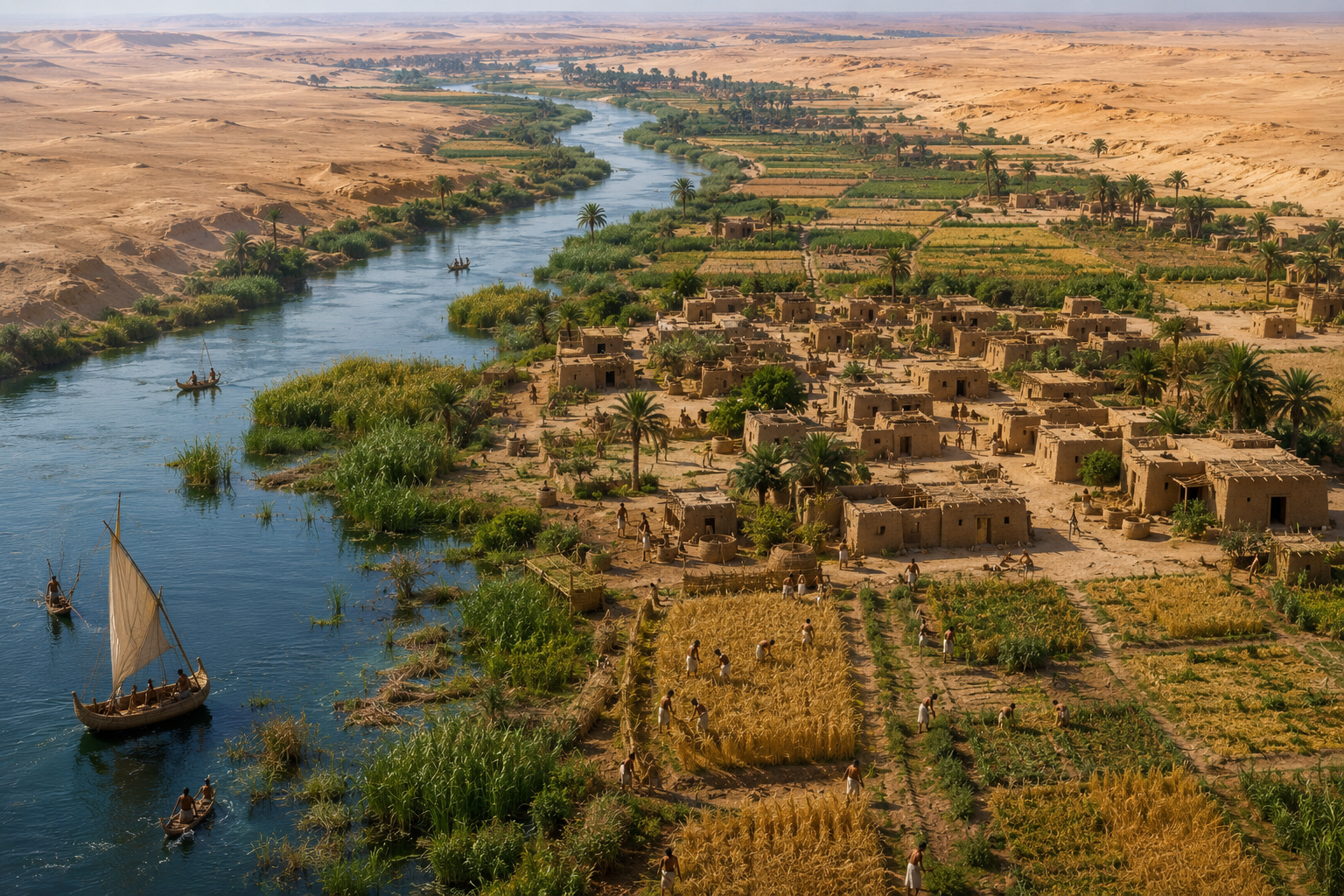
Flowing from the highlands of East Africa to the Mediterranean Sea, the Nile carved a narrow corridor of life through one of the harshest deserts on Earth. Beyond its fertile banks stretched endless expanses of sand and rock where permanent settlement was nearly impossible. Yet beside the river, nature created an environment unlike any other in the ancient world.
Each year, seasonal rains falling hundreds of kilometers upstream caused the Nile to overflow its banks. As the floodwaters gradually retreated, they left behind a thick layer of nutrient-rich black silt that renewed the land. This natural process transformed the valley into exceptionally fertile farmland, allowing crops to flourish year after year without exhausting the soil.
For early farming communities, this dependable cycle brought something rare in the ancient world—predictability. Families could cultivate wheat, barley, flax, vegetables, and fruit with confidence that the river would once again nourish their fields. Reliable harvests produced food surpluses, enabling villages to expand into prosperous communities where craftsmen, traders, priests, and administrators could thrive alongside farmers.
Archaeological evidence suggests that by around 5000 BC, numerous farming settlements had already developed along the Nile Valley. Over the following centuries, these communities became increasingly interconnected through trade, shared religious traditions, and cooperation in managing irrigation and agriculture. Gradually, separate villages evolved into powerful regional kingdoms that competed for influence across the river valley.
The Nile was more than a source of food—it became Egypt's lifeline. Boats carried people, grain, stone, timber, livestock, and ideas between distant settlements. While the river flowed naturally northward, prevailing winds blew from the Mediterranean toward the south, allowing boats to travel efficiently in both directions. Few ancient civilizations enjoyed such an effective natural transportation network.
Geography also protected Egypt. Vast deserts formed formidable barriers to the east and west, limiting large-scale invasions, while the Mediterranean Sea guarded the northern frontier. To the south, rocky rapids known as cataracts restricted easy access into the Nile Valley. These natural defenses gave Egypt a level of security that allowed its civilization to develop with remarkable continuity.
The First United Kingdom
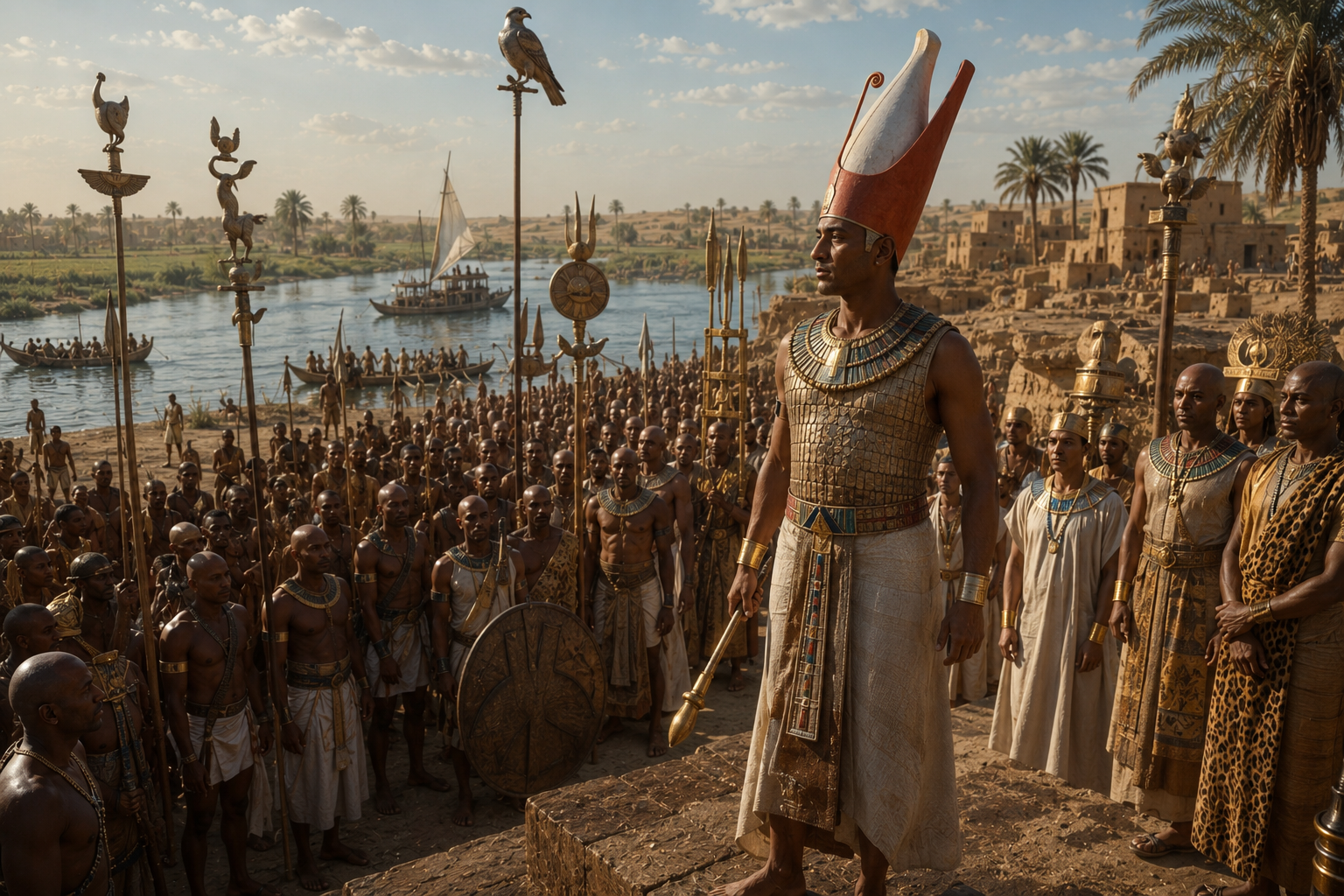
Around 3100 BC, a ruler known today as King Narmer achieved what many regional leaders before him could not—he united the kingdoms of Upper Egypt in the south and Lower Egypt in the north into a single political state. Historians regard this event as the beginning of dynastic Ancient Egypt and one of the earliest examples of a centralized kingdom in human history.
Evidence for this unification comes from one of Egypt's most significant archaeological discoveries: the Narmer Palette, a ceremonial stone carving depicting the king wearing the distinct crowns of both Upper and Lower Egypt. Although historians continue to debate every detail of the unification process, the palette provides strong evidence that Narmer played a central role in bringing the two regions together under one ruler.
Political unity transformed Egypt. A centralized administration could now organize irrigation systems, collect taxes, regulate trade, and coordinate large public projects. Officials recorded harvests, managed food supplies, and supervised the movement of goods along the Nile. This administrative system allowed resources from across the kingdom to be directed toward ambitious construction projects and strengthened Egypt's long-term stability.
The unification also encouraged the growth of a shared cultural identity. Religious beliefs, artistic traditions, royal ceremonies, and systems of writing became increasingly standardized throughout the kingdom. Although local customs remained important, Egyptians gradually came to view themselves as members of a single civilization bound together by the Nile and ruled by a divine king.
Within only a few centuries of unification, Egypt had become one of the most organized societies on Earth. Its political stability, agricultural prosperity, and efficient administration created the conditions that would later produce the pyramids, magnificent temples, and extraordinary achievements that still define Ancient Egypt today.
📦 Historical Fact
The Narmer Palette, discovered in 1898 at Hierakonpolis, is one of the earliest surviving historical records from Ancient Egypt. Many historians consider it the earliest visual representation of the unification of Upper and Lower Egypt, making it one of the most important artifacts in Egyptian archaeology.
Timeline: The Birth of Ancient Egypt
📖 Chapter Summary
Ancient Egypt was not created overnight. It grew gradually from small farming communities that prospered along the fertile Nile before eventually uniting under a single ruler. The river provided food, transportation, and security, while political unification transformed scattered settlements into one of history's first great civilizations. With a stable kingdom now established, Egypt was ready to harness the full power of the Nile—a relationship that would shape every aspect of its economy, culture, and survival for the next three thousand years.
Chapter 2 — The Gift of the Nile
The River That Controlled Time
To modern eyes, an overflowing river may appear destructive. For the ancient Egyptians, the yearly flooding of the Nile was a gift that marked the rhythm of life itself.
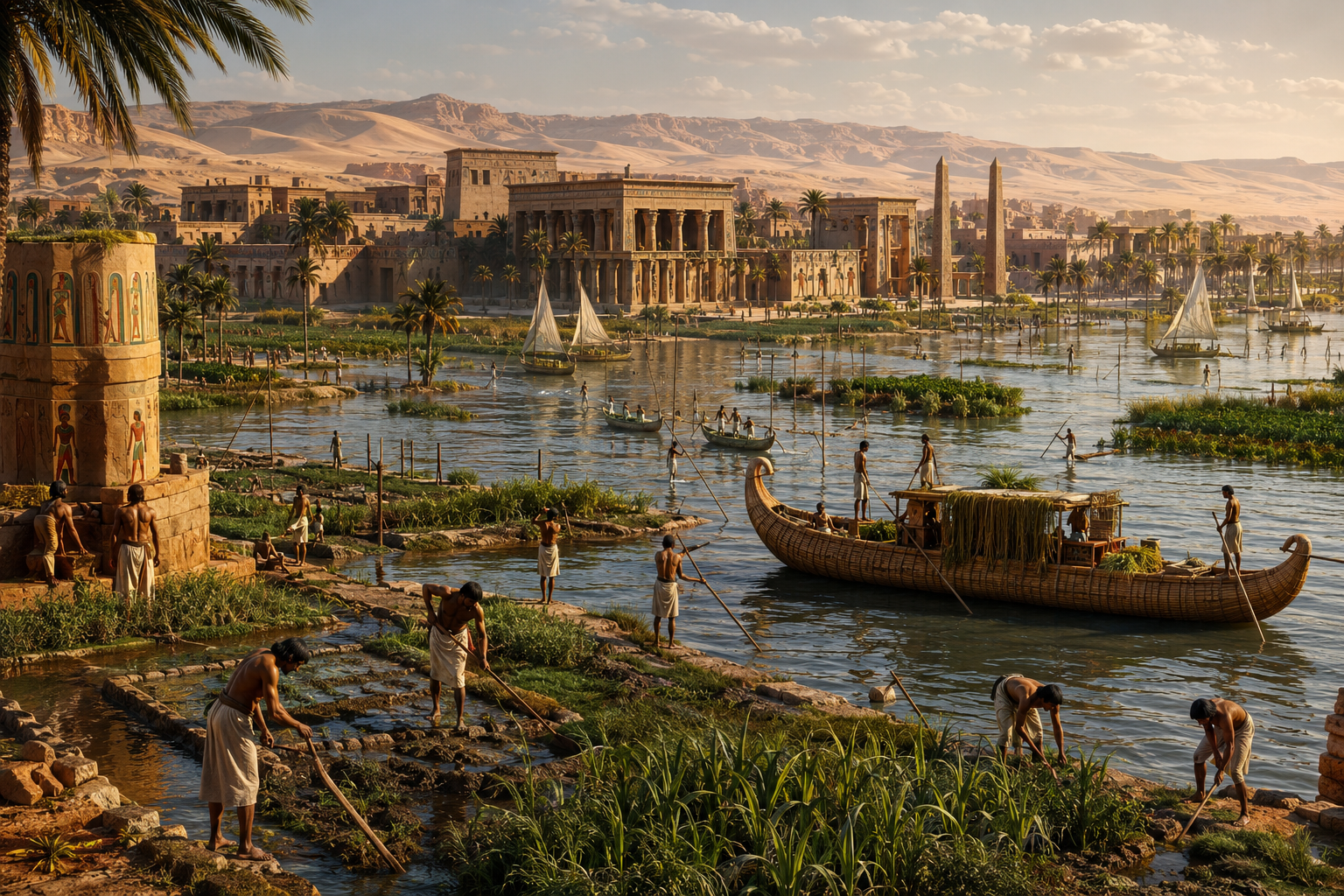
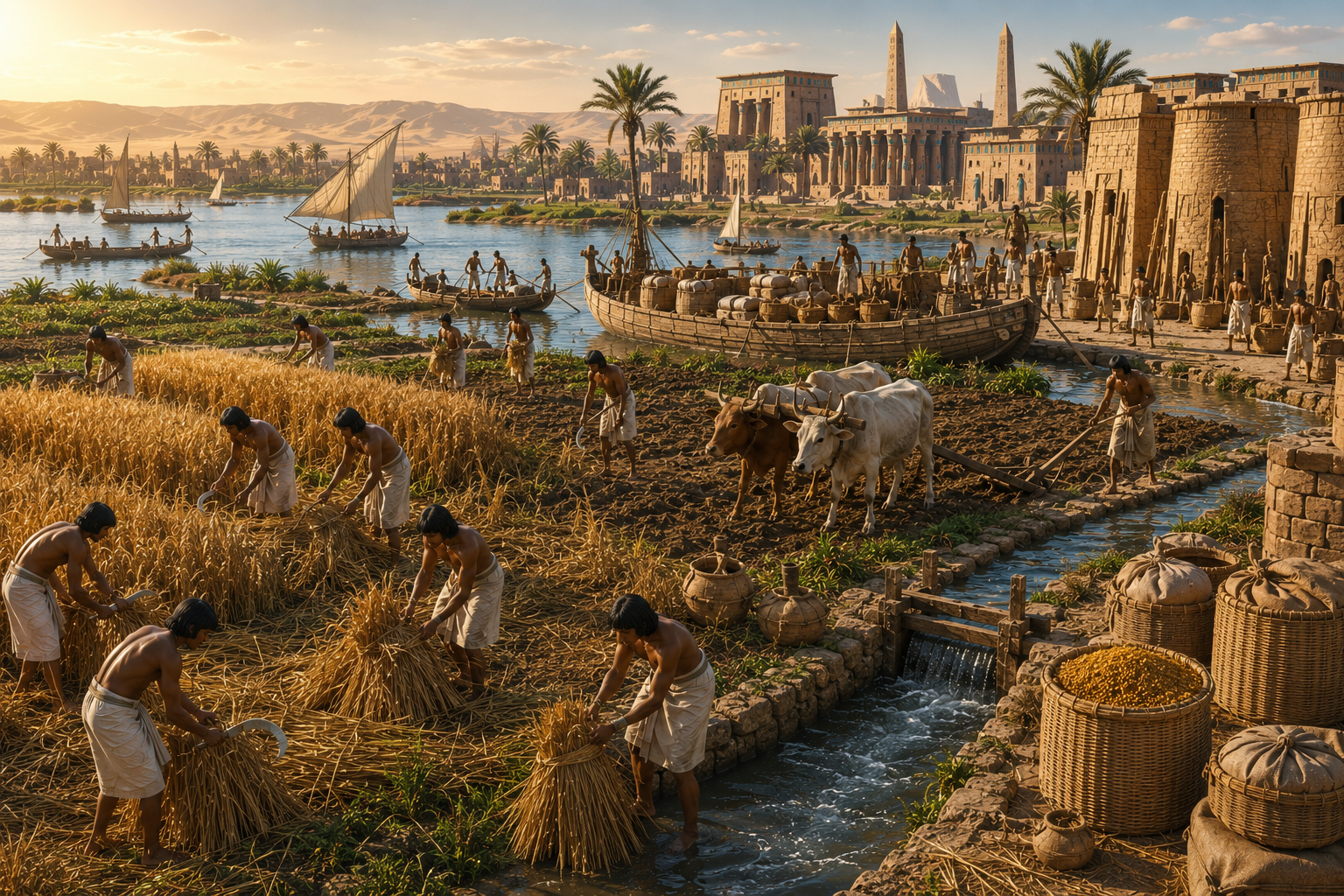
Every year, usually between June and September, the Nile rose as seasonal rains from the Ethiopian Highlands traveled downstream. The floodwaters covered the valley before slowly returning to the river, leaving behind a layer of mineral-rich soil known as silt. This dark earth created some of the most productive agricultural land in the ancient world.
The Egyptians understood this natural cycle and built their entire society around it. Farmers divided the year into three seasons based on the behavior of the Nile:
- Akhet — The flooding season, when fields were covered by water.
- Peret — The growing season, when crops were planted and cultivated.
- Shemu — The harvesting season, when crops were collected.
This agricultural calendar allowed Egyptian farmers to plan their work with remarkable precision. The predictable nature of the Nile meant that food production could be organized on a large scale, supporting not only farmers but also the thousands of people needed to operate a complex kingdom.
The Science Behind Egyptian Agriculture
The Nile's flooding was powerful, but the Egyptians did not simply depend on nature. They developed techniques to manage and distribute water effectively.
Farmers created small channels and basins that helped control floodwaters and spread moisture across fields. Over time, Egyptian communities developed increasingly sophisticated irrigation methods, allowing them to cultivate land beyond the immediate riverbanks.
The ability to produce surplus food changed Egyptian society forever.
When farmers produced more grain than their families needed, the extra supply could support specialists such as:
- Stone workers
- Architects
- Priests
- Soldiers
- Government officials
- Craftsmen
This agricultural wealth became the foundation for Egypt's monumental achievements. The pyramids, temples, and royal tombs were not built by a society struggling for survival; they were built by a civilization with organized resources and a stable food system.
The Nile as Egypt's Highway
The Nile did more than feed Egypt—it connected it.
In a world without roads, rivers were the most efficient transportation systems available. Egyptian boats carried goods and people across hundreds of kilometers, linking southern and northern regions into one economic network.
Stone used for temples and monuments traveled along the river from distant quarries. Grain moved from farming regions to cities. Luxury goods, minerals, and valuable resources entered Egypt through trade routes connected by the Nile.
The river also helped unite the Egyptian people culturally. Communities separated by great distances shared similar religious beliefs, artistic traditions, and political systems because the Nile constantly connected them.
This connection was one reason Egypt remained unified for such a long period. The river was not a boundary separating communities—it was the pathway that brought them together.
📦 Historical Fact
Ancient Egyptians used the Nile's flooding patterns to develop one of the earliest known agricultural calendars. Their three-season system was based entirely on the river's natural cycle and remained central to Egyptian life for thousands of years.
How the Nile Built an Empire
Chapter Summary
The Nile was the foundation of Ancient Egypt's power. Its predictable floods created fertile farmland, supported millions of people, and allowed society to develop beyond simple farming communities. Through careful management of water and agriculture, Egyptians transformed a natural resource into the economic engine of one of history's greatest civilizations.
The river provided Egypt with food and stability—but the people who lived beside it gave that civilization its culture, traditions, and identity.