Introduction
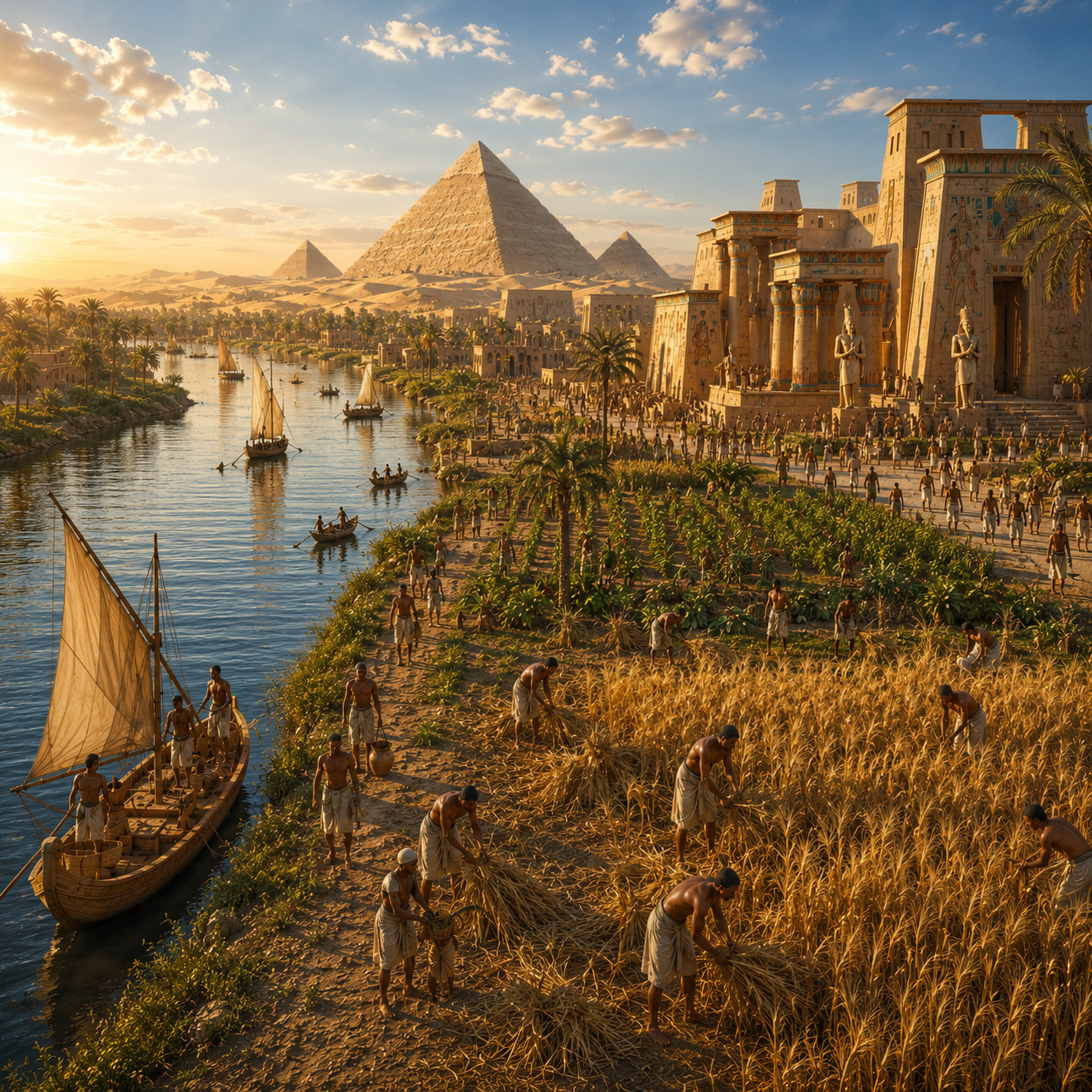
Long before the rise of the Roman Empire, before the Parthenon crowned the hills of Greece, and thousands of years before medieval castles appeared across Europe, a civilization flourished along the banks of a remarkable river in northeastern Africa. Protected by vast deserts and sustained by the life-giving waters of the Nile, Ancient Egypt became one of humanity's earliest and most enduring civilizations. For more than 3,000 years, it stood as a center of political power, scientific innovation, artistic excellence, and architectural achievement.
The story of Ancient Egypt is often told through its monumental pyramids, mysterious mummies, and legendary pharaohs. While these symbols continue to capture the world's imagination, they represent only a small part of a far richer civilization. Behind every colossal monument stood generations of skilled engineers, architects, craftsmen, scribes, farmers, and laborers whose knowledge transformed a narrow river valley into one of history's greatest kingdoms.
Unlike many ancient societies that rose and fell within a few centuries, Egypt endured through changing dynasties, foreign invasions, and periods of prosperity and decline. Its people developed one of the world's earliest writing systems, constructed engineering marvels that still challenge modern understanding, practiced surprisingly advanced medicine, established efficient systems of government, and created religious beliefs that shaped every aspect of daily life. Much of what historians know today comes directly from temples, royal inscriptions, papyrus manuscripts, and archaeological discoveries that have survived for thousands of years beneath Egypt's dry desert climate.
At the heart of this civilization flowed the Nile River, whose predictable annual floods transformed barren desert into fertile farmland. The river not only provided food and transportation but also influenced Egyptian religion, economy, politics, and culture. Without the Nile, Ancient Egypt as we know it would never have existed.
Even today, Egypt continues to reveal new secrets. Modern archaeological excavations, satellite imaging, DNA analysis, and advanced scanning technologies have uncovered forgotten tombs, hidden settlements, and previously unknown details about the lives of pharaohs and ordinary people alike. Each discovery deepens our understanding of a civilization that continues to inspire historians, scientists, engineers, and travelers around the world.
This journey explores how Ancient Egypt was born, how its people lived, what they believed, how they built monuments that have survived for millennia, and why its extraordinary legacy continues to shape our understanding of human civilization. Before the pyramids pierced the desert skyline and before mighty pharaohs ruled from magnificent palaces, everything began with a single river that changed history forever.
Chapter 1 — The Birth of Ancient Egypt
How a River Forged One of Humanity's First Great Civilizations
Where the Story Begins
Every great civilization has a birthplace, and for Ancient Egypt, that birthplace was not a city, a king, or a monument—it was a river.
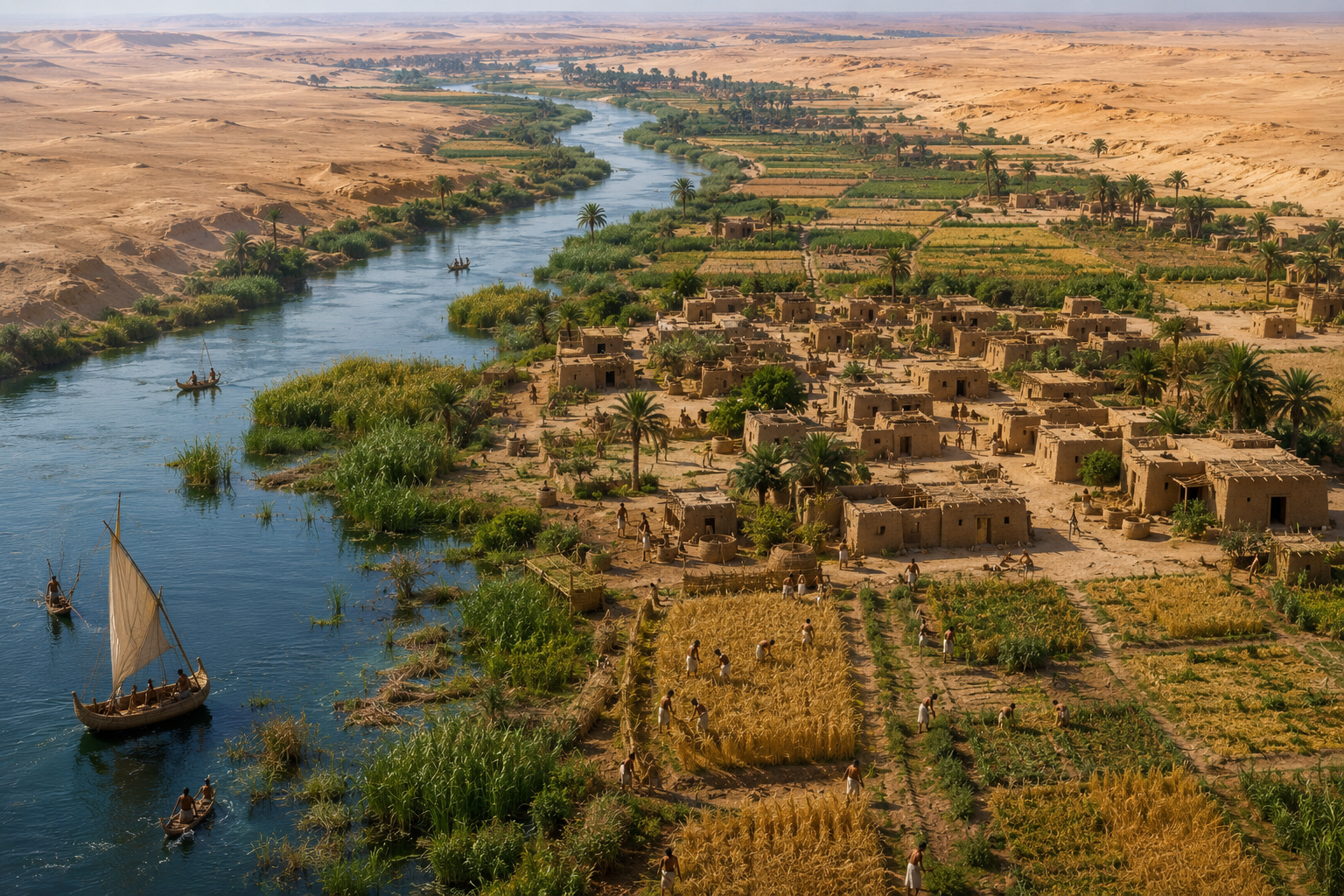
Flowing from the highlands of East Africa to the Mediterranean Sea, the Nile carved a narrow corridor of life through one of the harshest deserts on Earth. Beyond its fertile banks stretched endless expanses of sand and rock where permanent settlement was nearly impossible. Yet beside the river, nature created an environment unlike any other in the ancient world.
Each year, seasonal rains falling hundreds of kilometers upstream caused the Nile to overflow its banks. As the floodwaters gradually retreated, they left behind a thick layer of nutrient-rich black silt that renewed the land. This natural process transformed the valley into exceptionally fertile farmland, allowing crops to flourish year after year without exhausting the soil.
For early farming communities, this dependable cycle brought something rare in the ancient world—predictability. Families could cultivate wheat, barley, flax, vegetables, and fruit with confidence that the river would once again nourish their fields. Reliable harvests produced food surpluses, enabling villages to expand into prosperous communities where craftsmen, traders, priests, and administrators could thrive alongside farmers.
Archaeological evidence suggests that by around 5000 BC, numerous farming settlements had already developed along the Nile Valley. Over the following centuries, these communities became increasingly interconnected through trade, shared religious traditions, and cooperation in managing irrigation and agriculture. Gradually, separate villages evolved into powerful regional kingdoms that competed for influence across the river valley.
The Nile was more than a source of food—it became Egypt's lifeline. Boats carried people, grain, stone, timber, livestock, and ideas between distant settlements. While the river flowed naturally northward, prevailing winds blew from the Mediterranean toward the south, allowing boats to travel efficiently in both directions. Few ancient civilizations enjoyed such an effective natural transportation network.
Geography also protected Egypt. Vast deserts formed formidable barriers to the east and west, limiting large-scale invasions, while the Mediterranean Sea guarded the northern frontier. To the south, rocky rapids known as cataracts restricted easy access into the Nile Valley. These natural defenses gave Egypt a level of security that allowed its civilization to develop with remarkable continuity.
The First United Kingdom
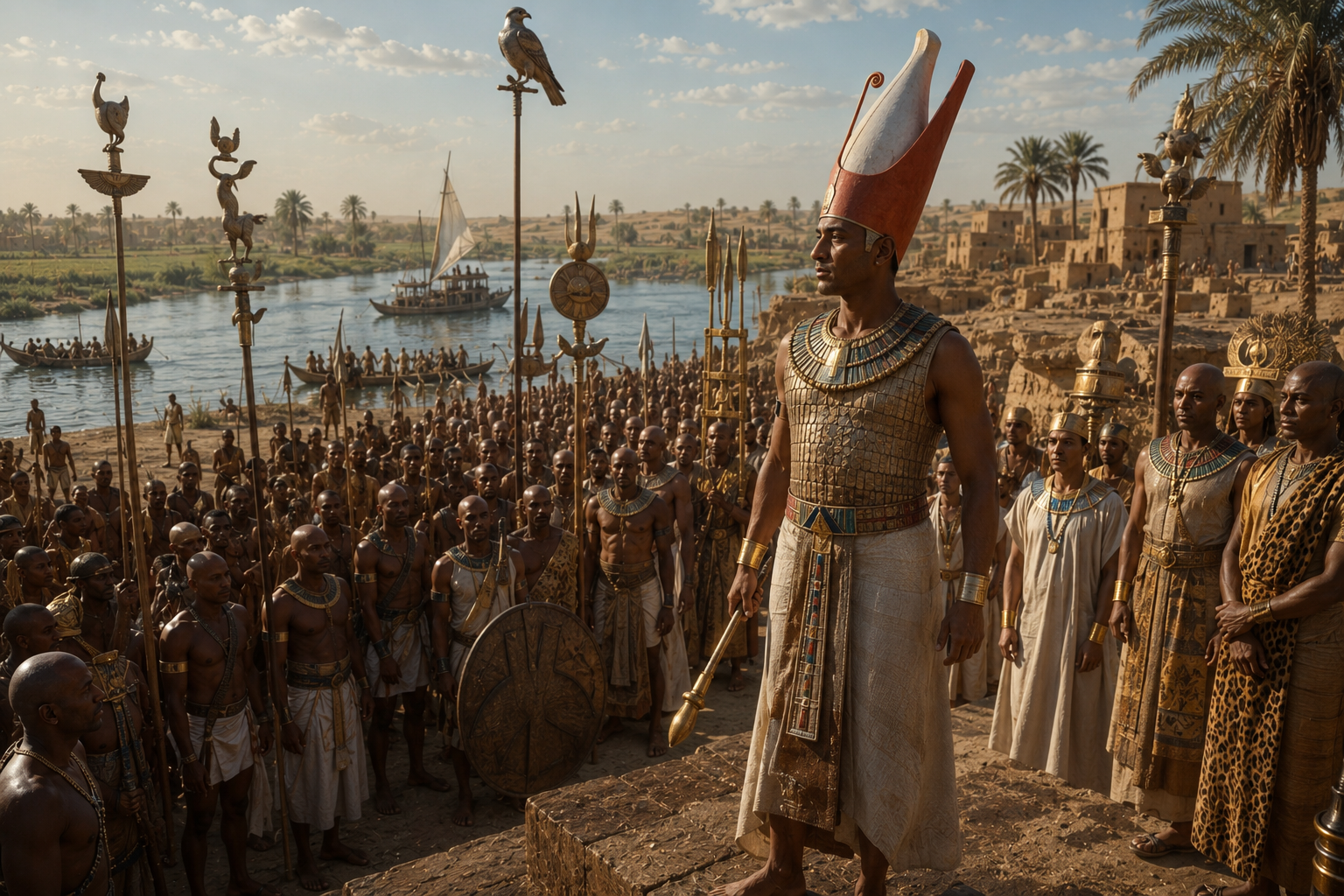
Around 3100 BC, a ruler known today as King Narmer achieved what many regional leaders before him could not—he united the kingdoms of Upper Egypt in the south and Lower Egypt in the north into a single political state. Historians regard this event as the beginning of dynastic Ancient Egypt and one of the earliest examples of a centralized kingdom in human history.
Evidence for this unification comes from one of Egypt's most significant archaeological discoveries: the Narmer Palette, a ceremonial stone carving depicting the king wearing the distinct crowns of both Upper and Lower Egypt. Although historians continue to debate every detail of the unification process, the palette provides strong evidence that Narmer played a central role in bringing the two regions together under one ruler.
Political unity transformed Egypt. A centralized administration could now organize irrigation systems, collect taxes, regulate trade, and coordinate large public projects. Officials recorded harvests, managed food supplies, and supervised the movement of goods along the Nile. This administrative system allowed resources from across the kingdom to be directed toward ambitious construction projects and strengthened Egypt's long-term stability.
The unification also encouraged the growth of a shared cultural identity. Religious beliefs, artistic traditions, royal ceremonies, and systems of writing became increasingly standardized throughout the kingdom. Although local customs remained important, Egyptians gradually came to view themselves as members of a single civilization bound together by the Nile and ruled by a divine king.
Within only a few centuries of unification, Egypt had become one of the most organized societies on Earth. Its political stability, agricultural prosperity, and efficient administration created the conditions that would later produce the pyramids, magnificent temples, and extraordinary achievements that still define Ancient Egypt today.
📦 Historical Fact
The Narmer Palette, discovered in 1898 at Hierakonpolis, is one of the earliest surviving historical records from Ancient Egypt. Many historians consider it the earliest visual representation of the unification of Upper and Lower Egypt, making it one of the most important artifacts in Egyptian archaeology.
Timeline: The Birth of Ancient Egypt
📖 Chapter Summary
Ancient Egypt was not created overnight. It grew gradually from small farming communities that prospered along the fertile Nile before eventually uniting under a single ruler. The river provided food, transportation, and security, while political unification transformed scattered settlements into one of history's first great civilizations. With a stable kingdom now established, Egypt was ready to harness the full power of the Nile—a relationship that would shape every aspect of its economy, culture, and survival for the next three thousand years.
Chapter 2 — The Gift of the Nile
The River That Controlled Time
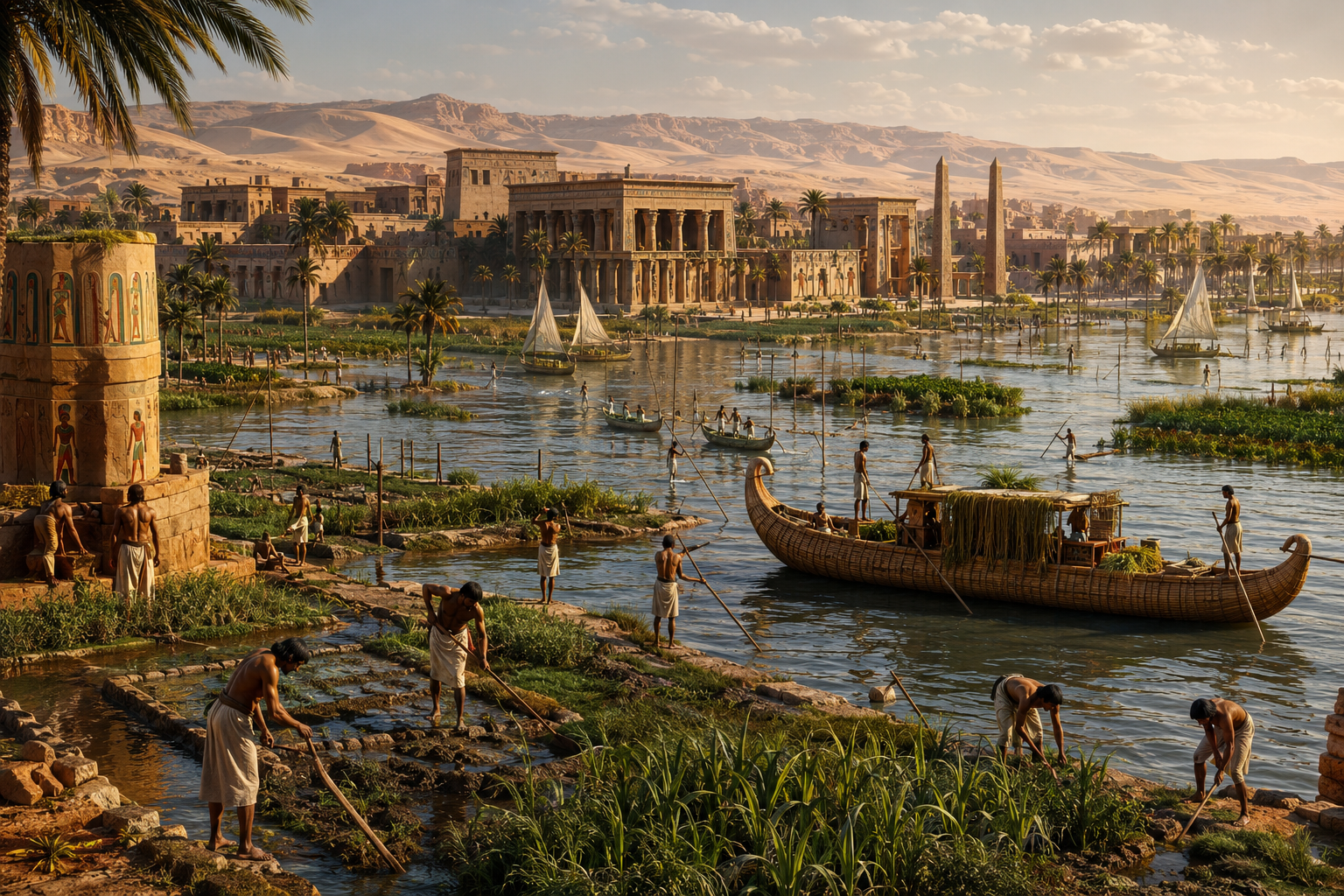
To modern eyes, an overflowing river may appear destructive. For the ancient Egyptians, the yearly flooding of the Nile was a gift that marked the rhythm of life itself.
Every year, usually between June and September, the Nile rose as seasonal rains from the Ethiopian Highlands traveled downstream. The floodwaters covered the valley before slowly returning to the river, leaving behind a layer of mineral-rich soil known as silt. This dark earth created some of the most productive agricultural land in the ancient world.
The Egyptians understood this natural cycle and built their entire society around it. Farmers divided the year into three seasons based on the behavior of the Nile:
- Akhet — The flooding season, when fields were covered by water.
- Peret — The growing season, when crops were planted and cultivated.
- Shemu — The harvesting season, when crops were collected.
This agricultural calendar allowed Egyptian farmers to plan their work with remarkable precision. The predictable nature of the Nile meant that food production could be organized on a large scale, supporting not only farmers but also the thousands of people needed to operate a complex kingdom.
The Science Behind Egyptian Agriculture
The Nile's flooding was powerful, but the Egyptians did not simply depend on nature. They developed techniques to manage and distribute water effectively.
Farmers created small channels and basins that helped control floodwaters and spread moisture across fields. Over time, Egyptian communities developed increasingly sophisticated irrigation methods, allowing them to cultivate land beyond the immediate riverbanks.
The ability to produce surplus food changed Egyptian society forever.
When farmers produced more grain than their families needed, the extra supply could support specialists such as:
- Stone workers
- Architects
- Priests
- Soldiers
- Government officials
- Craftsmen
This agricultural wealth became the foundation for Egypt's monumental achievements. The pyramids, temples, and royal tombs were not built by a society struggling for survival; they were built by a civilization with organized resources and a stable food system.
The Nile as Egypt's Highway
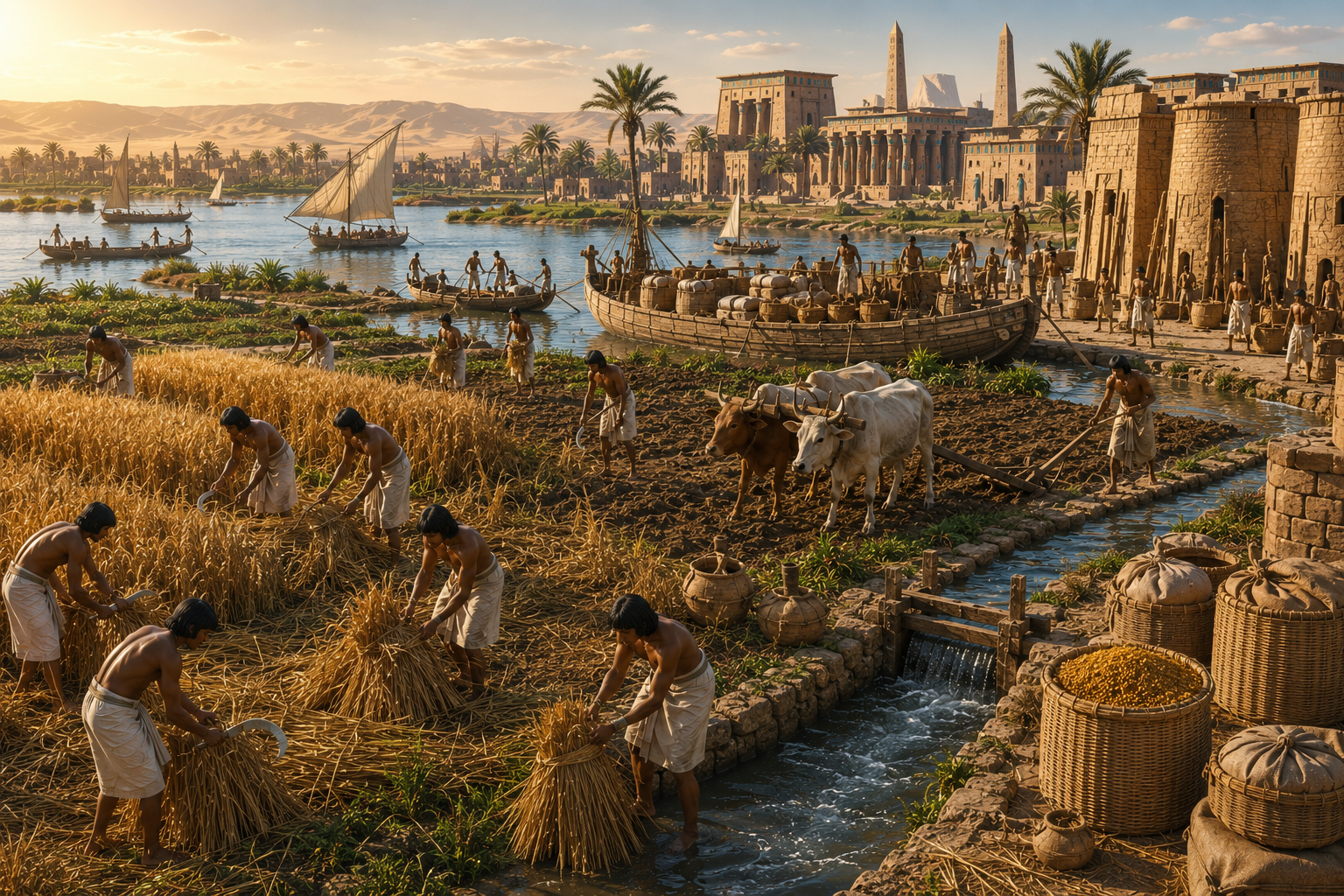
The Nile did more than feed Egypt—it connected it.
In a world without roads, rivers were the most efficient transportation systems available. Egyptian boats carried goods and people across hundreds of kilometers, linking southern and northern regions into one economic network.
Stone used for temples and monuments traveled along the river from distant quarries. Grain moved from farming regions to cities. Luxury goods, minerals, and valuable resources entered Egypt through trade routes connected by the Nile.
The river also helped unite the Egyptian people culturally. Communities separated by great distances shared similar religious beliefs, artistic traditions, and political systems because the Nile constantly connected them.
This connection was one reason Egypt remained unified for such a long period. The river was not a boundary separating communities—it was the pathway that brought them together.
📦 Historical Fact
Ancient Egyptians used the Nile's flooding patterns to develop one of the earliest known agricultural calendars. Their three-season system was based entirely on the river's natural cycle and remained central to Egyptian life for thousands of years.
How the Nile Built an Empire
Chapter Summary
The Nile was the foundation of Ancient Egypt's power. Its predictable floods created fertile farmland, supported millions of people, and allowed society to develop beyond simple farming communities. Through careful management of water and agriculture, Egyptians transformed a natural resource into the economic engine of one of history's greatest civilizations.
The river provided Egypt with food and stability—but the people who lived beside it gave that civilization its culture, traditions, and identity.
Chapter 3 — Life Along the Nile
The People Who Built a Civilization
A Civilization Beyond Pharaohs
When most people think of Ancient Egypt, they imagine towering pyramids, magnificent temples, and powerful pharaohs. Yet these remarkable achievements were made possible by millions of ordinary people whose daily work sustained one of history's greatest civilizations.
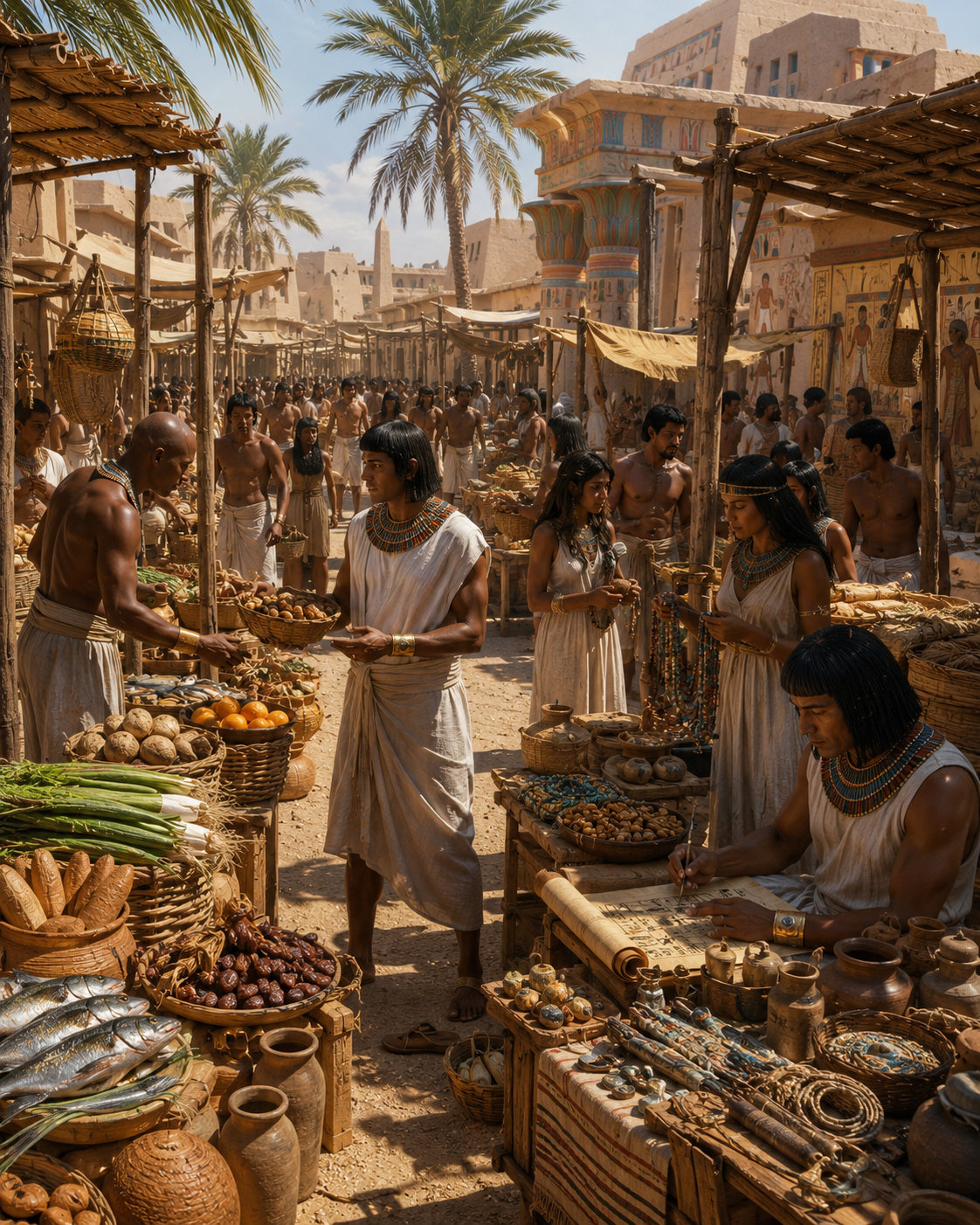
Most Egyptians lived in farming villages scattered along the fertile banks of the Nile. Their homes were built from sun-dried mudbricks, a practical material that helped keep interiors cool despite Egypt's intense heat. Although simple in appearance, these houses often contained several rooms, storage spaces, ovens for baking bread, and flat rooftops where families could work or sleep during warm nights.
Life followed the rhythm of the Nile. During the flooding season, when fields lay underwater, many farmers worked on state projects such as canals, temples, or royal monuments. Once the floodwaters receded, they returned to their fields to plant wheat, barley, vegetables, and flax. This seasonal cycle shaped both their livelihood and their calendar.
Egyptian marketplaces served as the heart of local communities. Farmers exchanged grain and vegetables, fishermen sold fresh catches from the Nile, potters displayed finely crafted vessels, and textile makers traded linen woven from flax. Merchants also brought valuable goods from distant regions, including cedar wood from Lebanon, incense from Punt, gold from Nubia, and copper from the Sinai Peninsula. These trade networks enriched Egypt and connected it to the wider ancient world.
While many people worked the land, others pursued specialized professions. Skilled craftsmen carved statues, jewelers fashioned ornaments from gold and precious stones, physicians treated illnesses, and scribes managed the kingdom's records. Every occupation contributed to the stability and prosperity of Egyptian society.
Knowledge Was Power
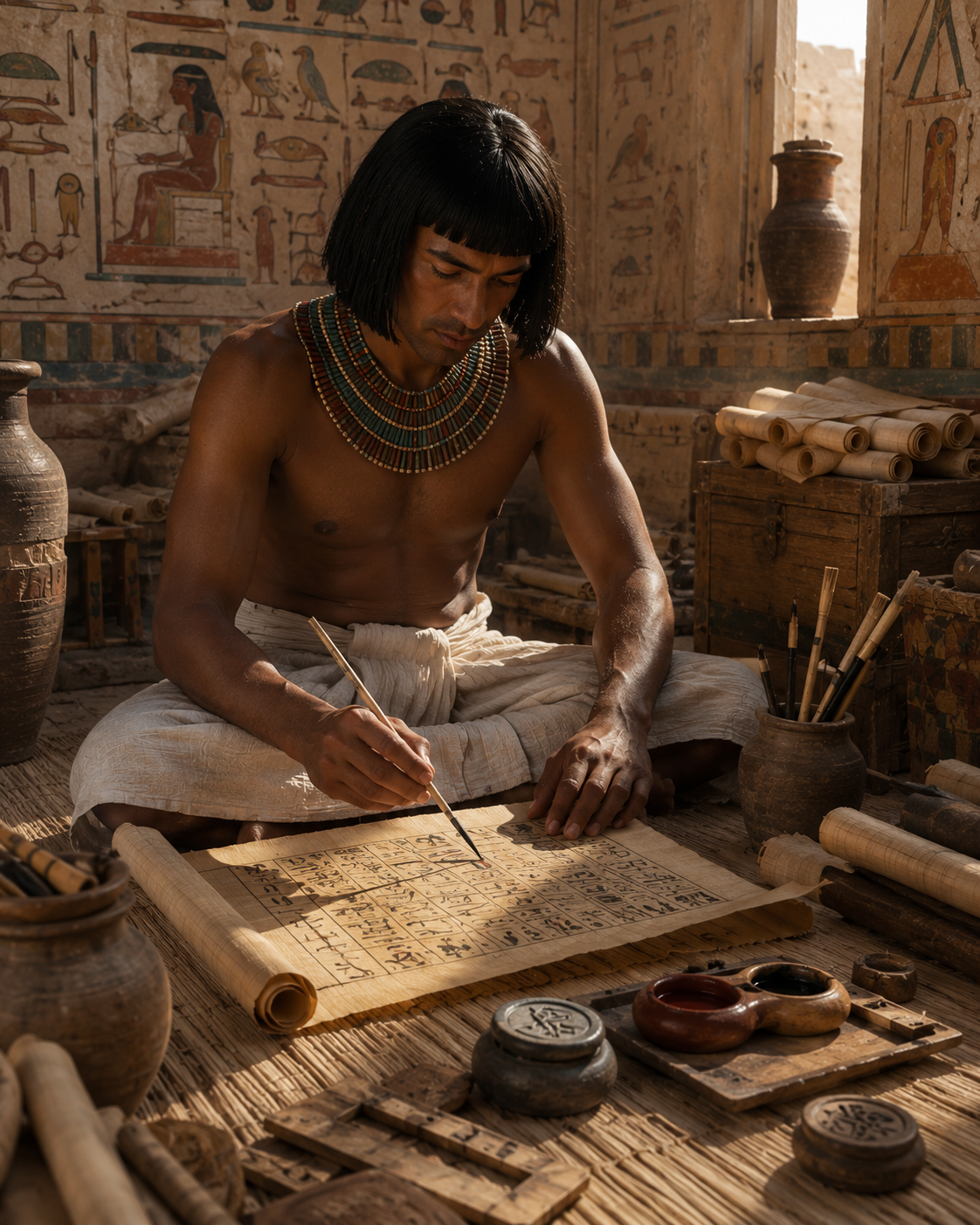
Among all professions in Ancient Egypt, few were as respected as that of the scribe. At a time when most people could not read or write, scribes possessed a rare and valuable skill that made them essential to the kingdom's administration.
They recorded harvests, collected taxes, documented trade agreements, copied religious texts, and preserved royal decrees. Without their careful records, Egypt's vast bureaucracy could not have functioned efficiently. Their work ensured that grain reached storage facilities, construction projects received supplies, and government officials maintained order across the kingdom.
Learning to become a scribe required years of education. Students practiced writing hundreds of hieroglyphic symbols and later mastered the faster cursive script known as Hieratic, which was commonly used for everyday administration. Because literacy opened doors to prestigious careers, many families considered it one of the greatest opportunities for social advancement.
Education, craftsmanship, trade, farming, and administration worked together like the parts of a finely balanced machine. While pharaohs often received the glory, it was the dedication and expertise of ordinary Egyptians that allowed their civilization to flourish for more than three thousand years.
📦 Historical Fact
Only a small percentage of Ancient Egyptians could read and write. Because literacy was uncommon, scribes were among the most respected professionals in society and often served directly within the royal administration.
Social Structure of Ancient Egypt
Chapter Summary
Ancient Egypt was sustained not only by powerful rulers but also by the skill and dedication of ordinary people. Farmers produced food, merchants expanded trade, craftsmen created works of lasting beauty, and scribes managed the kingdom's administration. Together, they built a stable and prosperous society capable of undertaking some of the most ambitious construction projects in human history.
Chapter 4 — Pharaohs, Temples & Pyramids
The Vision, Power, and Engineering That Shaped Ancient Egypt
The Age of Monument Builders
By the beginning of the Old Kingdom (c. 2686–2181 BC), Ancient Egypt had become one of the world's most organized civilizations. Stable government, abundant harvests, and a highly efficient administration enabled its rulers to undertake projects unlike anything previously attempted in human history.
At the center of Egyptian society stood the pharaoh. More than a political leader, the pharaoh was regarded as the protector of Egypt and the intermediary between the gods and humanity. Egyptians believed that maintaining Ma'at—the principle of order, balance, justice, and harmony—was the ruler's sacred duty. Every major decision, from constructing temples to organizing irrigation systems, was viewed as part of preserving this divine order.
The immense monuments commissioned by the pharaohs were therefore more than displays of wealth or power. Temples honored the gods believed to sustain the kingdom, while pyramids served as royal tombs designed to protect the king's body and ensure his journey into the afterlife. These structures reflected both religious belief and the remarkable organizational abilities of the Egyptian state.
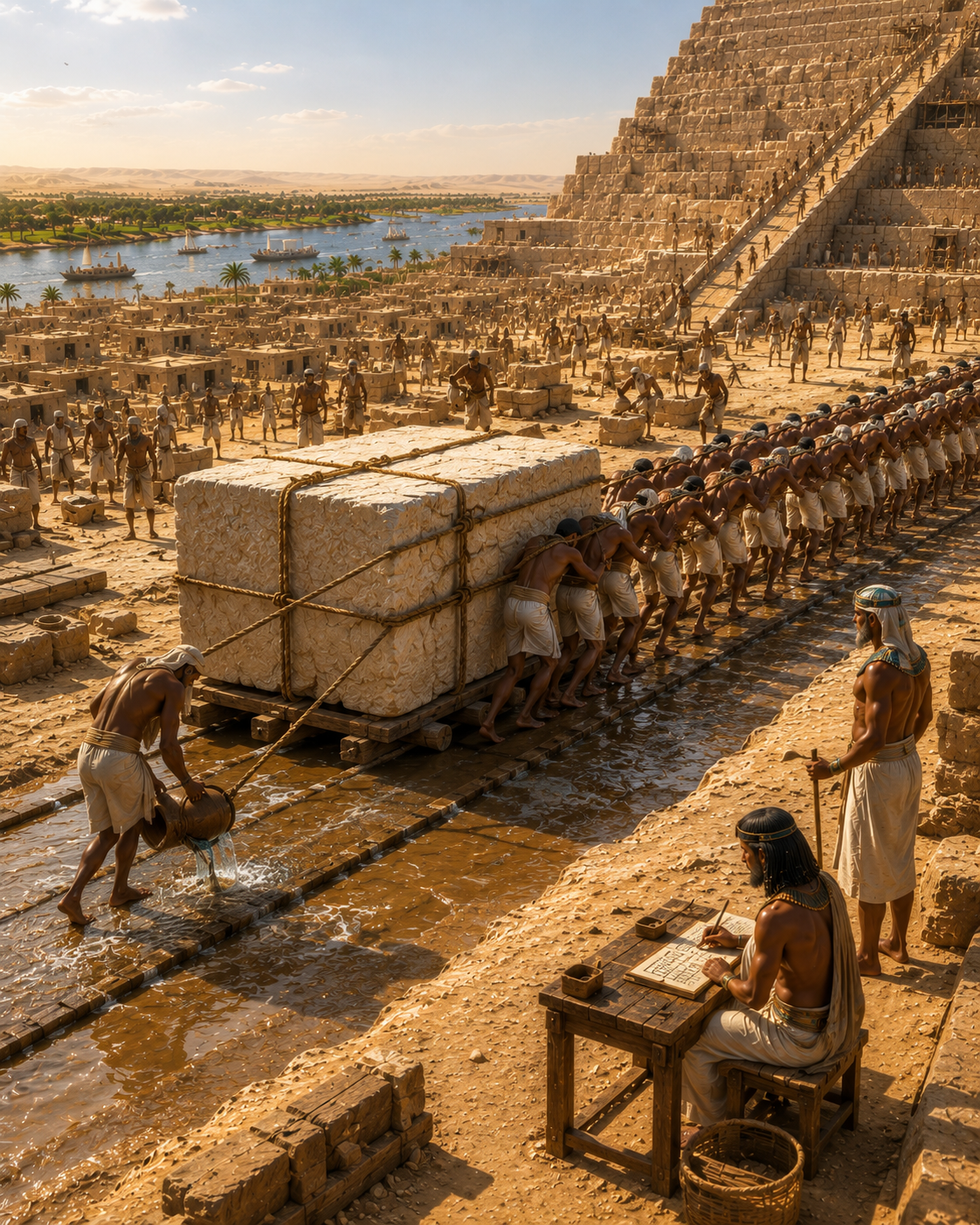
Among these monuments, none became more iconic than the Great Pyramid of Giza, built for Pharaoh Khufu during the Fourth Dynasty. Originally standing about 146.6 meters (481 feet) tall, it remained the tallest human-made structure in the world for nearly 3,800 years. Constructed from millions of limestone and granite blocks, the pyramid demonstrates extraordinary planning, surveying, and engineering that continue to impress modern researchers.
Contrary to a long-standing popular myth, archaeological discoveries at workers' settlements near Giza indicate that the pyramids were built primarily by skilled, organized laborers supported by the Egyptian state rather than by vast armies of enslaved people. Workers received food, medical care, and housing while participating in one of the most ambitious construction projects in history.
More Than Stone Monuments
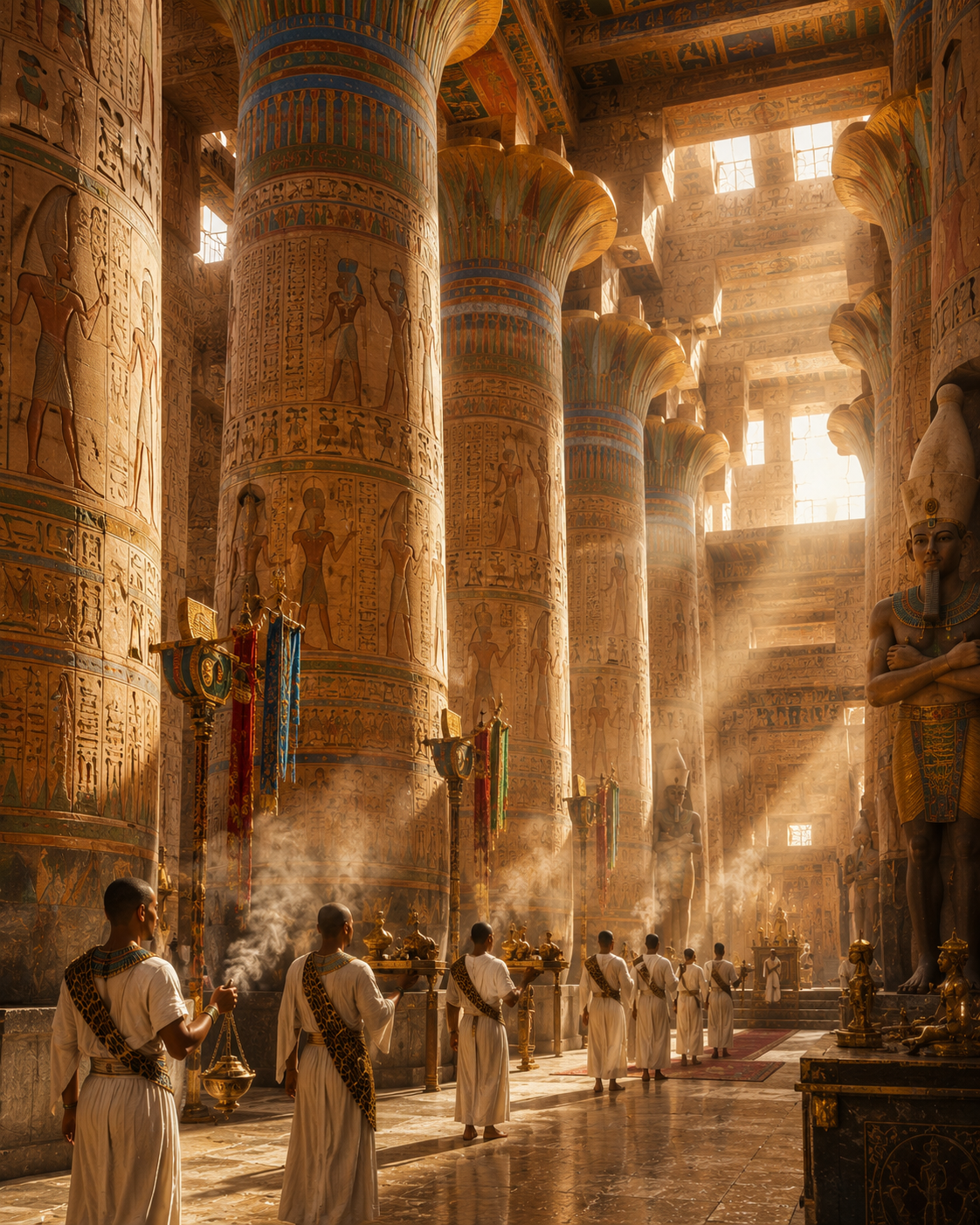
Although pyramids often receive the greatest attention, temples formed the spiritual heart of Ancient Egypt. They were not places for ordinary public worship in the modern sense but sacred spaces where priests performed daily rituals believed to maintain harmony between the gods and the kingdom.
Temple complexes such as Karnak, Luxor, and Abu Simbel expanded over centuries as successive pharaohs added new halls, gateways, obelisks, and statues. Their walls recorded military victories, religious ceremonies, royal achievements, and historical events through detailed hieroglyphic inscriptions that continue to provide valuable evidence for historians.
Building these monuments demanded exceptional expertise. Surveyors measured foundations with remarkable accuracy, architects planned massive structures capable of enduring for millennia, quarry workers extracted stone from distant sites, and skilled artisans carved intricate reliefs that remain visible thousands of years later. Every stage required careful coordination across an empire that stretched hundreds of kilometers along the Nile.
These achievements remind us that Ancient Egypt's greatest strength was not simply the ambition of its rulers but the collective knowledge of engineers, architects, craftsmen, and administrators who transformed vision into reality.
📦 Historical Fact
The Great Pyramid of Giza is the only surviving monument of the Seven Wonders of the Ancient World. Despite thousands of years of earthquakes, erosion, and human activity, it still stands on the Giza Plateau today.
How the Great Pyramid Was Built
Chapter Summary
Ancient Egypt's pyramids and temples were far more than monumental buildings—they embodied the civilization's religious beliefs, engineering expertise, and administrative strength. Guided by powerful pharaohs and constructed through the coordinated efforts of thousands of skilled workers, these enduring monuments became symbols of a civilization that combined faith, organization, and innovation on an unprecedented scale.
Chapter 5 — Religion, Legacy & Modern Discoveries
The Beliefs That Shaped Egypt and the Discoveries That Still Fascinate the World
A Civilization Guided by Faith
Religion was not a separate part of Ancient Egyptian life—it shaped nearly every aspect of it. From the rising of the sun to the flooding of the Nile, Egyptians believed that the universe functioned through a sacred balance known as Ma'at, representing truth, justice, order, and harmony. Preserving this balance was considered essential for the survival of both the kingdom and the cosmos.
The Egyptians worshipped a vast pantheon of deities, each associated with different forces of nature and aspects of human life. Ra, the sun god, symbolized creation and rebirth; Osiris ruled the afterlife; Isis represented motherhood and protection; and Horus, the falcon god, embodied kingship. Rather than competing religions, these beliefs formed an interconnected system that evolved over thousands of years.
One of the most distinctive features of Egyptian religion was its emphasis on the afterlife. Egyptians believed that death marked the beginning of another journey rather than the end of existence. Tombs were therefore designed as eternal homes, filled with food, furniture, jewelry, clothing, and everyday objects that the deceased might require in the next world.
To prepare for eternity, bodies were preserved through mummification, a process refined over centuries. Priests carefully removed internal organs, dehydrated the body with natron, wrapped it in layers of linen, and placed it within elaborately decorated coffins. This preservation was intended to protect the body so that the ka (life force) and ba (personality or spiritual aspect) could be reunited in the afterlife according to Egyptian belief.
The Boy King Who Changed Archaeology
Although Tutankhamun ruled Egypt for only about nine years during the 18th Dynasty, he became the world's most famous pharaoh for a reason unrelated to military conquest or monumental building.
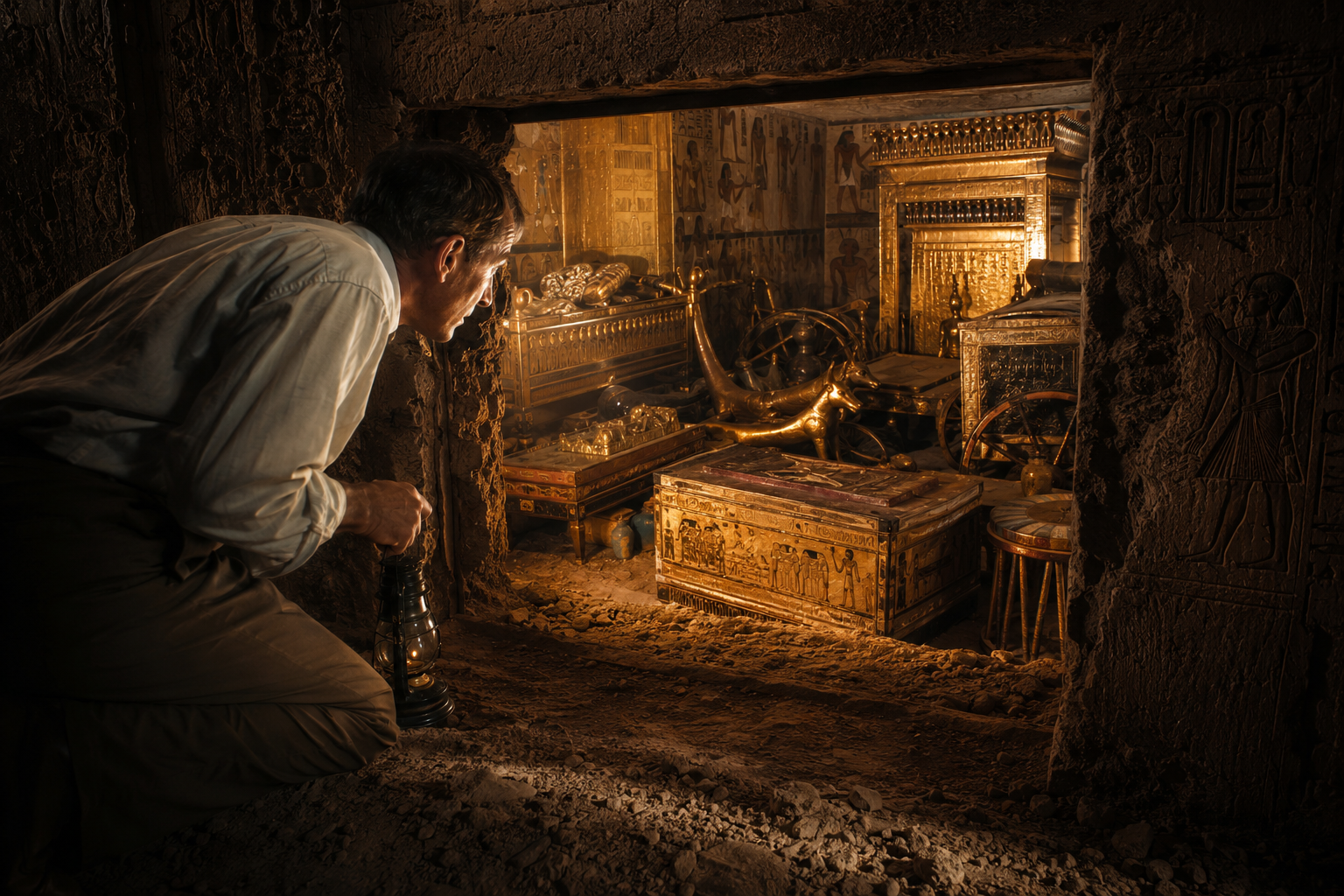
In 1922, Howard Carter discovered Tutankhamun's nearly intact tomb in the Valley of the Kings. Unlike many royal tombs that had been looted in antiquity, this burial chamber remained remarkably well preserved. More than 5,000 artifacts were recovered, including ceremonial weapons, jewelry, furniture, chariots, clothing, and the iconic golden funerary mask that has become one of the defining symbols of Ancient Egypt.
The discovery revolutionized Egyptology. For the first time, archaeologists could study an almost complete royal burial, providing unprecedented insights into royal craftsmanship, religious beliefs, daily life, and funerary practices during the New Kingdom. Modern technologies—including CT scanning, DNA analysis, and high-resolution imaging—continue to reveal new information about Tutankhamun's health, ancestry, and burial.
The sensational discovery also fueled popular myths, including the so-called "Curse of the Pharaoh." Despite widespread media attention, historians and scientists have found no credible evidence supporting the existence of a supernatural curse associated with the tomb.
Egypt's Legacy Lives On
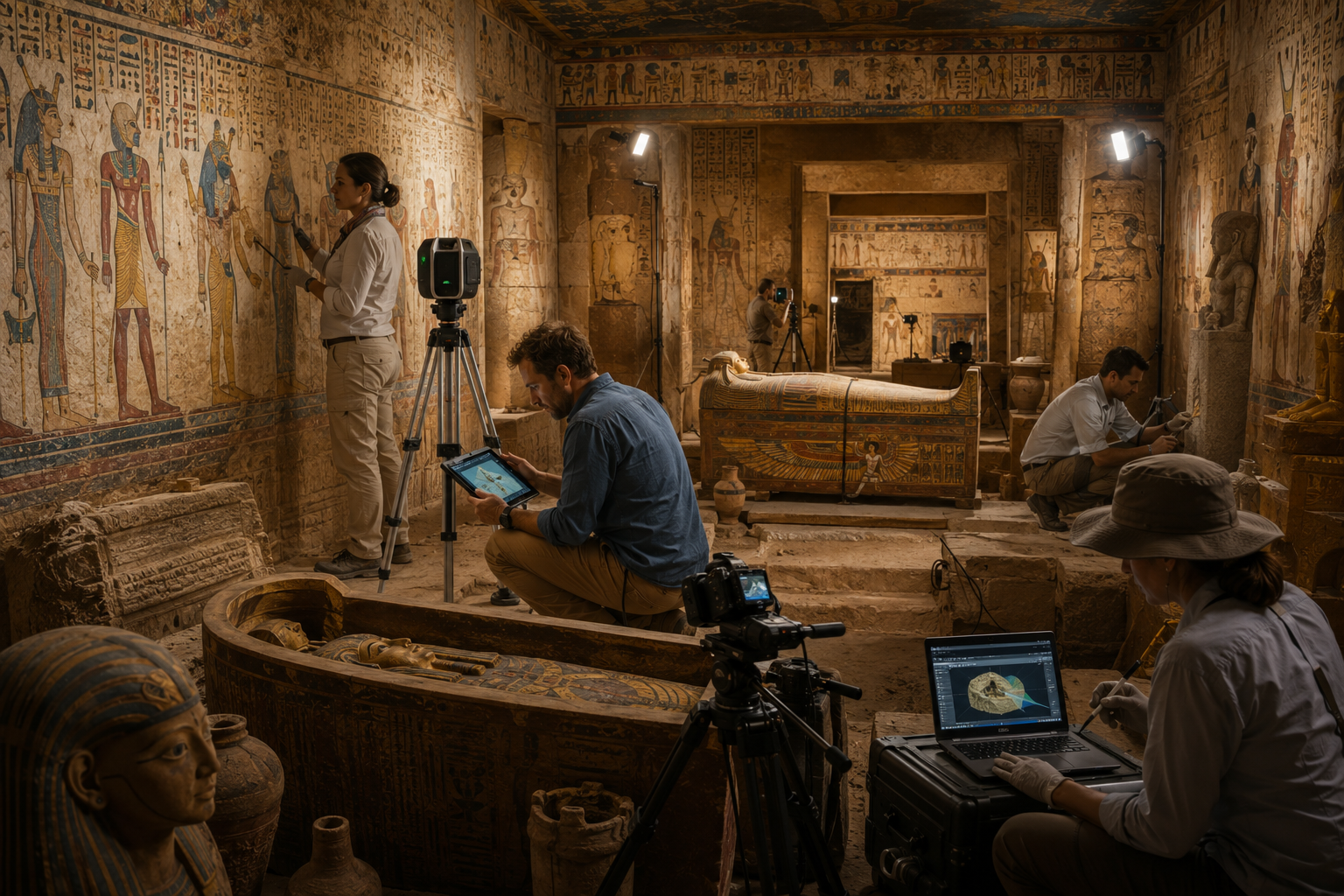
More than three thousand years after the last native pharaohs ruled the Nile Valley, Ancient Egypt continues to influence the modern world.
Its monuments inspire architects and engineers. Hieroglyphic inscriptions provide historians with invaluable records of ancient politics, religion, and daily life. Advances in archaeology, satellite imaging, ground-penetrating radar, and DNA research continue to reveal forgotten tombs, settlements, and royal family connections, demonstrating that Egypt still has many secrets waiting beneath its sands.
Ancient Egypt also transformed our understanding of civilization itself. It showed that stable government, organized agriculture, written administration, scientific observation, and cultural identity could sustain a society for millennia. Few civilizations have left such a complete archaeological record, allowing modern researchers to reconstruct not only the lives of kings but also those of farmers, craftsmen, merchants, priests, and children.
The story of Ancient Egypt is therefore not simply the story of pyramids or pharaohs. It is the story of human ingenuity, resilience, and the enduring desire to build something that outlives generations.
📦 Historical Fact
More than a century after Tutankhamun's tomb was discovered, archaeologists continue to uncover new tombs, settlements, workshops, and inscriptions across Egypt, proving that one of the world's best-studied civilizations still holds many unanswered questions.
Myth vs. Fact: Ancient Egypt
Chapter Summary
Ancient Egypt's greatest legacy is not simply its monuments but its enduring influence on human civilization. Through its religion, writing, engineering, administration, and extraordinary archaeological record, Egypt continues to shape our understanding of the ancient world. Every new discovery reminds us that, even after thousands of years, this remarkable civilization still has stories left to tell.
Frequently Asked Questions (FAQ) About Ancient Egypt
1. What was Ancient Egypt?
Ancient Egypt was one of the world's earliest and longest-lasting civilizations, developing along the Nile River in northeastern Africa around 3100 BC. It lasted for more than 3,000 years, producing remarkable achievements in architecture, engineering, writing, medicine, mathematics, and government.
2. Why was the Nile River so important to Ancient Egypt?
The Nile was the foundation of Egyptian civilization. Its annual floods deposited fertile black silt, making agriculture possible in an otherwise arid region. It also served as Egypt's main transportation route, connected cities through trade, and influenced religion, economy, and daily life.
3. Who united Ancient Egypt?
Most historians credit King Narmer (often identified with Menes) with uniting Upper and Lower Egypt around 3100 BC, creating one of the world's first centralized kingdoms.
4. Why did Ancient Egyptians build pyramids?
Pyramids were built primarily as royal tombs for pharaohs. Egyptians believed that preserving the king's body and providing a secure resting place would help ensure a successful journey into the afterlife.
5. Who built the Great Pyramid of Giza?
The Great Pyramid was built during the reign of Pharaoh Khufu around 2570 BC. Archaeological evidence indicates it was constructed by organized teams of skilled workers, engineers, craftsmen, and seasonal laborers rather than by enslaved people.
6. How were the pyramids built?
Although researchers continue to debate every detail, the most widely accepted explanation is that limestone blocks were quarried, transported by boat along the Nile, hauled on wooden sledges, and carefully positioned using earthen ramps, surveying techniques, and coordinated labor.
7. Did slaves build the pyramids?
No convincing archaeological evidence supports this popular myth. Excavations at workers' villages near Giza indicate that many pyramid builders were paid workers who received food, housing, and medical care while participating in state-organized construction projects.
8. What language did Ancient Egyptians speak and write?
Ancient Egyptians spoke the Egyptian language and wrote using hieroglyphs, one of the world's earliest writing systems. For everyday administration, scribes often used a faster cursive script called Hieratic.
9. Why were mummies created?
Mummification was part of Egyptian religious belief. Egyptians believed that preserving the body was necessary for the soul's journey into the afterlife. The process became increasingly sophisticated over thousands of years.
10. Who was Tutankhamun?
Tutankhamun, often called the Boy King, ruled during the 18th Dynasty. Although his reign was relatively short, he became the world's most famous pharaoh after his nearly intact tomb was discovered in 1922, providing archaeologists with thousands of exceptionally preserved artifacts.
11. What religion did Ancient Egyptians follow?
Ancient Egyptians practiced a polytheistic religion, worshipping many gods and goddesses such as Ra, Osiris, Isis, Horus, and Anubis. Religion influenced government, architecture, art, law, and everyday life.
12. What was Ma'at?
Ma'at represented truth, justice, harmony, balance, and cosmic order. Egyptians believed that maintaining Ma'at was essential for the prosperity of both the kingdom and the universe, making it one of the central principles of Egyptian civilization.
13. Why is Ancient Egypt still important today?
Ancient Egypt continues to influence archaeology, architecture, engineering, art, and historical research. Its monuments, written records, and archaeological discoveries provide one of the most complete pictures of any ancient civilization, helping historians understand how complex societies developed.
14. Are archaeologists still making discoveries in Egypt?
Yes. Modern technologies such as ground-penetrating radar, 3D laser scanning, satellite imagery, and DNA analysis continue to reveal new tombs, settlements, workshops, inscriptions, and information about ancient Egyptian society. Despite more than two centuries of research, Egypt still holds many undiscovered secrets beneath its sands.
15. What is the greatest legacy of Ancient Egypt?
Ancient Egypt's greatest legacy lies in its lasting contributions to architecture, engineering, writing, administration, science, religion, and culture. Its monuments remain among humanity's greatest achievements, while its history continues to inspire researchers and millions of visitors from around the world.